AIEEE 2005 — 1 May Offline (Previous Year Paper)
JEE Main · 2005 · with answers and explanations
- questions
- 219
- Total marks
- 657
- Duration
- 270 minutes
- Negative marking
- −1
Subjects: Physics · Chemistry · Mathematics
Question 1
Physics · 3 marks · −1A projectile can have the same range R for two angles of projection. If and be the times of flights in the two cases, then the product of the two time of flights is proportional to
- A.
- B.
- C.1/R
- D.R
Correct answer: D
Explanation: .
Question 2
Physics · 3 marks · −1An annular ring with inner and outer radii and is rolling without slipping with a uniform angular speed. The ratio of the forces experienced by the two particles situated on the inner and outer parts of the ring, is
- A.
- B.
- C.1
- D.
Correct answer: D
Explanation: .
Question 3
Physics · 3 marks · −1A smooth block is released at rest on a incline and then slides a distance d. The time taken to slide is n times as much to slide on rough incline than on a smooth incline. The coefficient of friction is
- A.
- B.
- C.
- D.
Correct answer: A
Explanation: .
Question 4
Physics · 3 marks · −1The upper half of an inclined plane with inclination is perfectly smooth while the lower half is rough. A body starting from rest at the top will again come to rest at the bottom if the coefficient of friction for the lower half is given by
- A.
- B.
- C.
- D.
Correct answer: C
Explanation: .
Question 5
Physics · 3 marks · −1A bullet fired into a fixed target loses half of its velocity after penetrating 3 cm. How much further it will penetrate before coming to rest assuming that it faces constant resistance to motion?
- A.3.0 cm
- B.2.0 cm
- C.1.5 cm
- D.1.0 cm
Correct answer: D
Explanation: KE lost in 3 cm is ; remaining needs 1 cm.
Question 6
Physics · 3 marks · −1Out of the following pair, which one does NOT have identical dimensions is
- A.angular momentum and Planck's constant
- B.impulse and momentum
- C.moment of inertia and moment of a force
- D.work and torque
Correct answer: C
Explanation: vs .
Question 7
Physics · 3 marks · −1The relation between time t and distance x is where a and b are constants. The acceleration is
- A.
- B.
- C.
- D.
Correct answer: C
Explanation: ; differentiate: .
Question 8
Physics · 3 marks · −1A particle is moving eastwards with a velocity of 5 m/s in 10 seconds the velocity changes to 5 m/s northwards. The average acceleration in this time is
- A. m/s towards north-east
- B. m/s towards north.
- C.zero
- D. m/s towards north-west
Correct answer: D
Explanation: .
Question 9
Physics · 3 marks · −1A parachutist after bailing out falls 50 m without friction. When parachute opens, it decelerates at 2 m/s. He reaches the ground with a speed of 3 m/s. At what height, did he bail out?
- A.91 m
- B.182 m
- C.293 m
- D.111 m
Correct answer: C
Explanation: at 50 m; ; total ≈ 293 m (g = 10).
Question 10
Physics · 3 marks · −1A block is kept on a frictionless inclined surface with angle of inclination . The incline is given an acceleration a to keep the block stationary. Then a is equal to

- A.
- B.
- C.g
- D.
Correct answer: D
Explanation: .
Question 11
Physics · 3 marks · −1A spherical ball of mass 20 kg is stationary at the top of a hill of height 100 m. It rolls down a smooth surface to the ground, then climbs up another hill of height 30 m and finally rolls down to a horizontal base at a height of 20 m above the ground. The velocity attained by the ball is
- A.40 m/s
- B.20 m/s
- C.10 m/s
- D. m/s
Correct answer: A
Explanation: Smooth surface: m/s.
Question 12
Physics · 3 marks · −1A body A of mass M while falling vertically downwards under gravity breaks into two parts; a body B of mass 1/3 M and a body C of mass 2/3 M. The centre of mass of bodies B and C taken together shifts compared to that of body A towards
- A.depends on height of breaking
- B.does not shift
- C.body C
- D.body B
Correct answer: B
Explanation: Internal forces do not move the CM.
Question 13
Physics · 3 marks · −1The moment of inertia of a uniform semicircular disc of mass M and radius r about a line perpendicular to the plane of the disc through the centre is
- A.
- B.
- C.
- D.
Correct answer: D
Explanation: Half of a disc of mass 2M.
Question 14
Physics · 3 marks · −1A particle of mass 0.3 kg is subjected to a force F = -kx with k = 15 N/m. What will be its initial acceleration if it is released from a point 20 cm away from the origin?
- A.3 m/s
- B.15 m/s
- C.5 m/s
- D.10 m/s
Correct answer: D
Explanation: .
Question 15
Physics · 3 marks · −1The block of mass M moving on the frictionless horizontal surface collides with a spring of spring constant K and compresses it by length L. The maximum momentum of the block after collision is
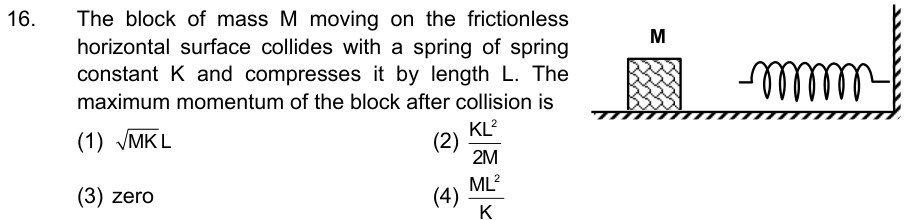
- A.
- B.
- C.zero
- D.
Correct answer: A
Explanation: .
Question 16
Physics · 3 marks · −1A mass 'm' moves with a velocity v and collides inelastically with another identical mass. After collision the mass moves with velocity in a direction perpendicular to the initial direction of motion. Find the speed of the mass after collision
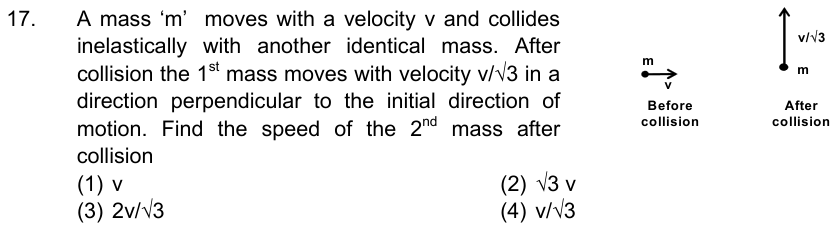
- A.v
- B.
- C.
- D.
Correct answer: C
Explanation: Momentum components: .
Question 17
Physics · 3 marks · −1A 20 cm long capillary tube is dipped in water. The water rises up to 8 cm. If the entire arrangement is put in a freely falling elevator the length of water column in the capillary tube will be
- A.8 cm
- B.10 cm
- C.4 cm
- D.20 cm
Correct answer: D
Explanation: Effective g = 0: water fills the tube.
Question 18
Physics · 3 marks · −1If S is stress and Y is Young's modulus of material of a wire, the energy stored in the wire per unit volume is
- A.
- B.
- C.
- D.
Correct answer: B
Explanation: stress × strain.
Question 19
Physics · 3 marks · −1Average density of the earth
- A.does not depend on g
- B.is a complex function of g
- C.is directly proportional to g
- D.is inversely proportional to g
Correct answer: C
Explanation: .
Question 20
Physics · 3 marks · −1A body of mass m is accelerated uniformly from rest to a speed v in a time T. The instantaneous power delivered to the body as a function time is given by
- A.
- B.
- C.
- D.
Correct answer: A
Explanation: .
Question 21
Physics · 3 marks · −1Consider a car moving on a straight road with a speed of 100 m/s. The distance at which car can be stopped is []
- A.800 m
- B.1000 m
- C.100 m
- D.400 m
Correct answer: B
Explanation: with g = 10.
Question 22
Physics · 3 marks · −1A 'T' shaped object with dimensions shown in the figure, is lying on a smooth floor. A force F is applied at the point P parallel to AB, such that the object has only the translational motion without rotation. Find the location of P with respect to C
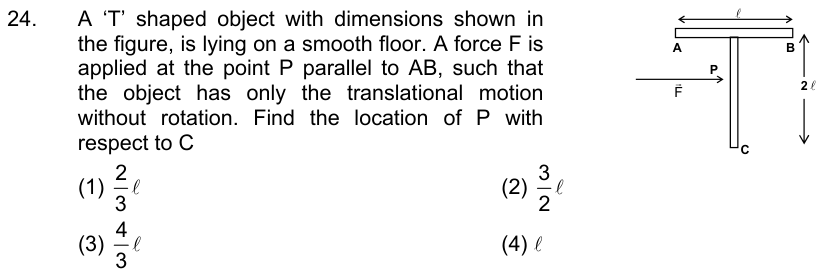
- A.
- B.
- C.
- D.
Correct answer: C
Explanation: P must be the CM: from C.
Question 23
Physics · 3 marks · −1The change in the value of g at a height 'h' above the surface of the earth is the same as at a depth 'd' below the surface of earth. When both 'd' and 'h' are much smaller than the radius of earth, then which one of the following is correct?
- A.
- B.
- C.d = 2h
- D.d = h
Correct answer: C
Explanation: .
Question 24
Physics · 3 marks · −1A particle of mass 10 g is kept on the surface of a uniform sphere of mass 100 kg and radius 10 cm. Find the work to be done against the gravitational force between them to take the particle far away from the sphere (you may take Nm/kg)
- A. J
- B. J
- C. J
- D. J
Correct answer: D
Explanation: .
Question 25
Physics · 3 marks · −1A gaseous mixture consists of 16 g of helium and 16 g of oxygen. The ratio of the mixture is
- A.1.59
- B.1.62
- C.1.4
- D.1.54
Correct answer: B
Explanation: 4 mol He, 0.5 mol : , .
Question 26
Physics · 3 marks · −1The intensity of gamma radiation from a given source is I. On passing through 36 mm of lead, it is reduced to . The thickness of lead which will reduce the intensity to will be
- A.6 mm
- B.9 mm
- C.18 mm
- D.12 mm
Correct answer: D
Explanation: Three halvings in 36 mm.
Question 27
Physics · 3 marks · −1The electrical conductivity of a semiconductor increases when electromagnetic radiation of wavelength shorter than 2480 nm is incident on it. The band gap in (eV) for the semiconductor is
- A.1.1 eV
- B.2.5 eV
- C.0.5 eV
- D.0.7 eV
Correct answer: C
Explanation: .
Question 28
Physics · 3 marks · −1A photocell is illuminated by a small bright source placed 1 m away. When the same source of light is placed m away, the number of electrons emitted by photo cathode would
- A.decrease by a factor of 4
- B.increase by a factor of 4
- C.decrease by a factor of 2
- D.increase by a factor of 2
Correct answer: B
Explanation: .
Question 29
Physics · 3 marks · −1Starting with a sample of pure Cu, 7/8 of it decays into Zn in 15 minutes. The corresponding half-life is
- A.10 minutes
- B.15 minutes
- C.5 minutes
- D. minutes
Correct answer: C
Explanation: Three half-lives.
Question 30
Physics · 3 marks · −1If radius of nucleus is estimated to be 3.6 Fermi then the radius nucleus be nearly
- A.6 fermi
- B.8 fermi
- C.4 fermi
- D.5 fermi
Correct answer: A
Explanation: .
Question 31
Physics · 3 marks · −1The temperature-entropy diagram of a reversible engine cycle is given in the figure. Its efficiency is
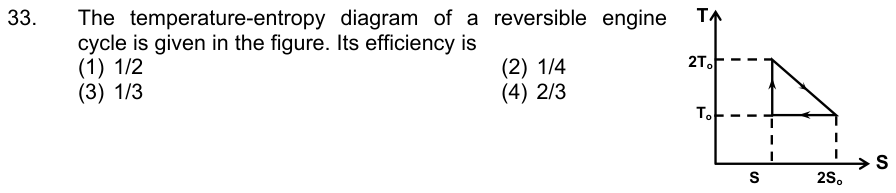
- A.1/2
- B.1/4
- C.1/3
- D.2/3
Correct answer: C
Explanation: Work = triangle area ; heat in .
Question 32
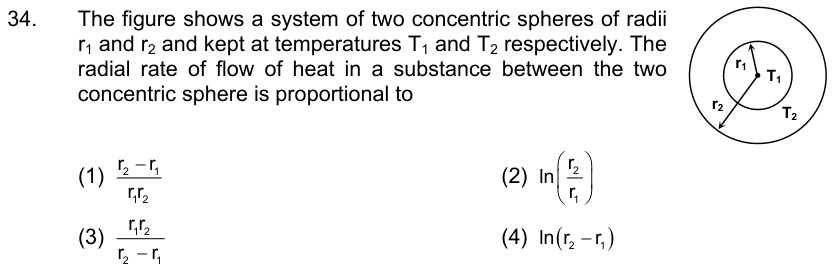
Physics · 3 marks · −1The figure shows a system of two concentric spheres of radii and and kept at temperatures and respectively. The radial rate of flow of heat in a substance between the two concentric sphere is proportional to
- A.
- B.
- C.
- D.
Correct answer: C
Explanation: .
Question 33
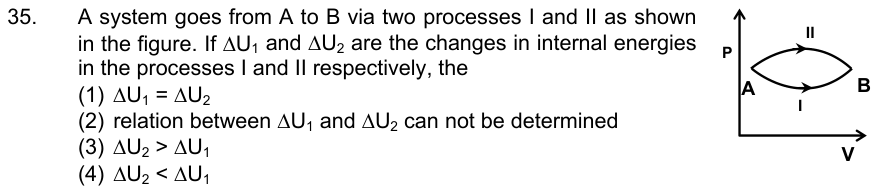
Physics · 3 marks · −1A system goes from A to B via two processes I and II as shown in the figure. If and are the changes in internal energies in the processes I and II respectively, the
- A.
- B.relation between and can not be determined
- C.
- D.
Correct answer: A
Explanation: U is a state function.
Question 34
Physics · 3 marks · −1The function represents
- A.a periodic, but not simple harmonic motion with a period
- B.a periodic, but not simple harmonic motion with a period
- C.a simple harmonic motion with a period
- D.a simple harmonic motion with a period
Correct answer: D
Explanation: : SHM about with period .
Question 35
Physics · 3 marks · −1A Young's double slit experiment uses a monochromatic source. The shape of the interference fringes formed on a screen is
- A.hyperbola
- B.circle
- C.straight line
- D.parabola
Correct answer: C
Explanation: Fringes near the centre are straight lines (strictly hyperbolic).
Question 36
Physics · 3 marks · −1Two simple harmonic motions are represented by the equation and . The phase difference of the velocity of particle 1 w.r.t. the velocity of the particle 2 is
- A.
- B.
- C.
- D.
Correct answer: A
Explanation: Velocities vary as and ; at t = 0 the phase difference is .
Question 37
Physics · 3 marks · −1A fish looking up through the water sees the outside world contained in a circular horizon. If the refractive index of water is 4/3 and the fish is 12 cm below the surface, the radius of this circle in cm is
- A.
- B.
- C.
- D.
Correct answer: B
Explanation: .
Question 38
Physics · 3 marks · −1Two point white dots are 1 mm apart on a black paper. They are viewed by eye of pupil diameter 3 mm. Approximately, what is the maximum distance at which these dots can be resolved by the eye? [Take wavelength of light = 500 nm]
- A.5 m
- B.1m
- C.6 m
- D.3m
Correct answer: A
Explanation: .
Question 39
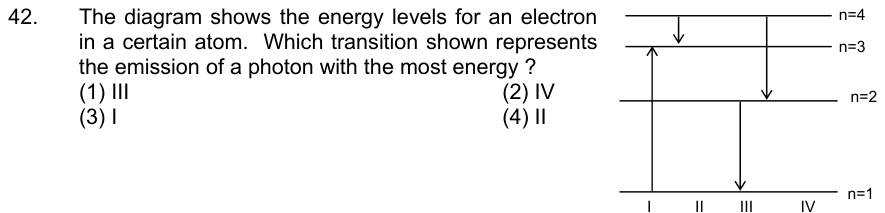
Physics · 3 marks · −1The diagram shows the energy levels for an electron in a certain atom. Which transition shown represents the emission of a photon with the most energy ?
- A.III
- B.IV
- C.I
- D.II
Correct answer: A
Explanation: III is the emission n = 2 to n = 1 (largest downward gap); I is an absorption.
Question 40
Physics · 3 marks · −1If the kinetic energy of a free electron doubles. Its deBroglie wavelength changes by the factor
- A.
- B.2
- C.
- D.
Correct answer: C
Explanation: .
Question 41
Physics · 3 marks · −1In a common base amplifier, the phase difference between the input signal voltage and output voltage is
- A.
- B.
- C.0
- D.
Correct answer: C
Explanation: CB amplifier is non-inverting.
Question 42
Physics · 3 marks · −1In a full wave rectifier circuit operating from 50 Hz mains frequency, the fundamental frequency in the ripple would be
- A.50 Hz
- B.25 Hz
- C.100 Hz
- D.70.7 Hz
Correct answer: C
Explanation: Twice the mains frequency.
Question 43
Physics · 3 marks · −1A nuclear transformation is denoted by X(n, ) . Which of the following is the nucleus of element X ?
- A.
- B.
- C.
- D.
Correct answer: B
Explanation: .
Question 44
Physics · 3 marks · −1A moving coil galvanometer has 150 equal divisions. Its current sensitivity is 10 divisions per milliampere and voltage sensitivity is 2 divisions per millivolt. In order that each division reads 1 volt, the resistance in ohms needed to be connected in series with the coil will be
- A.
- B.
- C.99995
- D.9995
Correct answer: D
Explanation: mA, ; .
Question 45
Physics · 3 marks · −1Two voltameters one of copper and another of silver, are joined in parallel. When a total charge q flows through the voltameters, equal amount of metals are deposited. If the electrochemical equivalents of copper and silver are and respectively the charge which flows through the silver voltameter is
- A.
- B.
- C.
- D.
Correct answer: B
Explanation: , .
Question 46
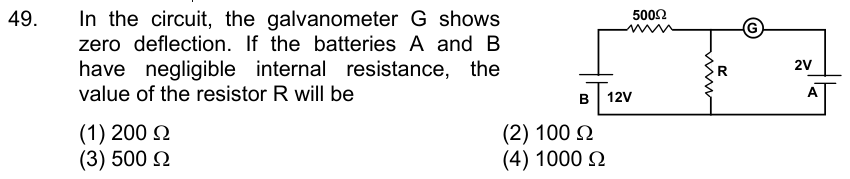
Physics · 3 marks · −1In the circuit, the galvanometer G shows zero deflection. If the batteries A and B have negligible internal resistance, the value of the resistor R will be
- A.
- B.
- C.
- D.
Correct answer: B
Explanation: Voltage across R equals 2 V: .
Question 47
Physics · 3 marks · −1Two sources of equal emf are connected to an external resistance R. The internal resistance of the two sources are and (). If the potential difference across the source having internal resistance is zero, then
- A.
- B.
- C.
- D.
Correct answer: B
Explanation: , .
Question 48
Physics · 3 marks · −1A fully charged capacitor has a capacitance 'C' it is discharged through a small coil of resistance wire embedded in a thermally insulated block of specific heat capacity 's' and mass 'm'. If the temperature of the block is raised by ''. The potential difference V across the capacitance is
- A.
- B.
- C.
- D.
Correct answer: D
Explanation: .
Question 49
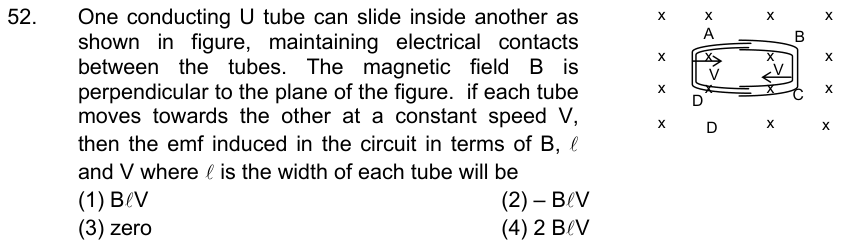
Physics · 3 marks · −1One conducting U tube can slide inside another as shown in figure, maintaining electrical contacts between the tubes. The magnetic field B is perpendicular to the plane of the figure. if each tube moves towards the other at a constant speed V, then the emf induced in the circuit in terms of B, and V where is the width of each tube will be
- A.
- B.
- C.zero
- D.
Correct answer: D
Explanation: Relative speed 2V.
Question 50
Physics · 3 marks · −1A heater coil is cut into two equal parts and only one part is now used in the heater. The heat generated will now be
- A.doubled
- B.four times
- C.one fourth
- D.halved
Correct answer: A
Explanation: with .
Question 51
Physics · 3 marks · −1Two thin, long parallel wires separated by a distance 'd' carry a current of 'i' A in the same direction. They will
- A.attract each other with a force of
- B.repel each other with a force of
- C.attract each other with a force of
- D.repel each other with a force of
Correct answer: A
Explanation: Force per unit length.
Question 52
Physics · 3 marks · −1When an unpolarized light of intensity is incident on a polarizing sheet, the intensity of the light which does not get transmitted is
- A.
- B.
- C.zero
- D.
Correct answer: A
Explanation: Half is transmitted.
Question 53
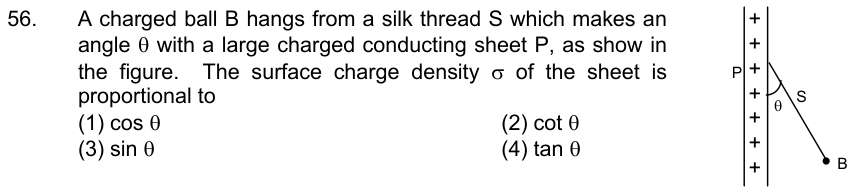
Physics · 3 marks · −1A charged ball B hangs from a silk thread S which makes an angle with a large charged conducting sheet P, as show in the figure. The surface charge density of the sheet is proportional to
- A.
- B.
- C.
- D.
Correct answer: D
Explanation: with .
Question 54
Physics · 3 marks · −1Two point charges + 8q and - 2q are located at x = 0 and x = L respectively. The location of a point on the x axis at which the net electric field due to these two point charges is zero is
- A.2L
- B.L/4
- C.8L
- D.4L
Correct answer: A
Explanation: .
Question 55
Physics · 3 marks · −1Two thin wires rings each having a radius R are placed at a distance d apart with their axes coinciding. The charges on the two rings are +q and -q. The potential difference between the centres of the two rings is
- A.
- B.
- C.zero
- D.
Correct answer: B
Explanation: .
Question 56
Physics · 3 marks · −1A parallel plate capacitor is made by stacking n equally spaced plates connected alternatively. If the capacitance between any two adjacent plates is C then the resultant capacitance is
- A.(n - 1)C
- B.(n + 1)C
- C.C
- D.nC
Correct answer: A
Explanation: capacitors in parallel.
Question 57
Physics · 3 marks · −1When two tuning forks (fork 1 and fork 2) are sounded simultaneously, 4 beats per second are heard. Now, some tape is attached on the prong of the fork 2. When the tuning forks are sounded again, 6 beats per seconds are heard. If the frequency of fork 1 is 200 Hz, then what was the original frequency of fork 2?
- A.200 Hz
- B.202 Hz
- C.196 Hz
- D.204 Hz
Correct answer: C
Explanation: Loading lowers and beats increase, so .
Question 58
Physics · 3 marks · −1If a simple harmonic motion is represented by , its time period is
- A.
- B.
- C.
- D.
Correct answer: B
Explanation: .
Question 59
Physics · 3 marks · −1The bob of a simple pendulum is a spherical hollow ball filled with water. A plugged hole near the bottom of the oscillation bob gets suddenly unplugged. During observation, till water is coming out, the time period of oscillation would
- A.first increase and then decrease to the original value.
- B.first decreased then increase to the original value.
- C.remain unchanged.
- D.increase towards a saturation value.
Correct answer: A
Explanation: CM first lowers then returns.
Question 60
Physics · 3 marks · −1An observer moves towards a stationary source of sound, with a velocity one fifth of the velocity of sound. What is the percentage increase in the apparent frequency?
- A.zero.
- B.0.5%
- C.5%
- D.20%
Correct answer: D
Explanation: .
Question 61
Physics · 3 marks · −1Two concentric coils each of radius equal to cm are placed at right angles to each other. 3 Ampere and 4 ampere are the currents flowing in each coil respectively. The magnetic induction in Weber/m at the centre of the coils will be ( Wb/A-m)
- A.
- B.
- C.
- D.
Correct answer: C
Explanation: .
Question 62
Physics · 3 marks · −1A coil of inductance 300 mH and resistance is connected to a source of voltage 2V. The current reaches half of its steady state value in
- A.0.05 s
- B.0.1 s
- C.0.15 s
- D.0.3 s
Correct answer: B
Explanation: .
Question 63
Physics · 3 marks · −1The self inductance of the motor of an electric fan is 10 H. In order to impart maximum power at 50 Hz, it should be connected to a capacitance of
- A.4F
- B.8F
- C.1F
- D.2F
Correct answer: C
Explanation: Resonance .
Question 64
Physics · 3 marks · −1An energy source will supply a constant current into the load of its internal resistance is
- A.equal to the resistance of the load.
- B.very large as compared to the load resistance.
- C.zero.
- D.non-zero but less than the resistance of the load.
Correct answer: B
Explanation: independent of load.
Question 65
Physics · 3 marks · −1A circuit has a resistance of and an impedance of . The power factor of the circuit will be
- A.0.8
- B.0.4
- C.1.25
- D.0.125
Correct answer: A
Explanation: .
Question 66
Physics · 3 marks · −1The phase difference between the alternating current and emf is . Which of the following cannot be the constituent of the circuit?
- A.C alone
- B.R, L
- C.L, C
- D.L alone
Correct answer: B
Explanation: R-L gives phase below .
Question 67
Physics · 3 marks · −1A uniform electric field and a uniform magnetic field are acting along the same direction in a certain region. If an electron is projected along the direction of the fields with a certain velocity then
- A.its velocity will decrease.
- B.its velocity will increase.
- C.it will turn towards right of direction of motion.
- D.it will turn towards left of direction of motion.
Correct answer: A
Explanation: No magnetic force; E decelerates the electron.
Question 68
Physics · 3 marks · −1A charged particle of mass m and charge q travels on a circular path of radius r that is perpendicular to a magnetic field B. The time taken by the particle to complete one revolution is
- A.
- B.
- C.
- D.
Correct answer: D
Explanation: Cyclotron period.
Question 69
Physics · 3 marks · −1In a potentiometer experiment the balancing with a cell is at length 240 cm. On shunting the cell with a resistance of the balancing length becomes 120 cm. The internal resistance of the cell is
- A.
- B.
- C.
- D.
Correct answer: D
Explanation: .
Question 70
Physics · 3 marks · −1The resistance of hot tungsten filament is about 10 times the cold resistance. What will be the resistance of 100 W and 200 V lamp when not in use?
- A.
- B.
- C.
- D.
Correct answer: A
Explanation: Hot 400 ohm.
Question 71
Physics · 3 marks · −1A magnetic needle is kept in a non-uniform magnetic field. It experiences
- A.a torque but not a force
- B.neither a force nor a torque
- C.a force and a torque.
- D.a force but not a torque.
Correct answer: C
Explanation: Dipole in non-uniform field.
Question 72
Chemistry · 3 marks · −1Which of the following oxides is amphoteric in character?
- A.CaO
- B.
- C.
- D.
Correct answer: D
Explanation: is amphoteric.
Question 73
Chemistry · 3 marks · −1Which one of the following species is diamagnetic in nature?
- A.
- B.
- C.
- D.
Correct answer: B
Explanation: All electrons paired.
Question 74
Chemistry · 3 marks · −1If is the degree of dissociation of , the vant Hoff's factor (i) used for calculating the molecular mass is
- A.
- B.
- C.
- D.
Correct answer: C
Explanation: Three ions.
Question 75
Chemistry · 3 marks · −1The oxidation state of Cr in is
- A.+3
- B.+2
- C.+1
- D.0
Correct answer: A
Explanation: .
Question 76
Chemistry · 3 marks · −1Hydrogen bomb is based on the principle of
- A.Nuclear fission
- B.Natural radioactivity
- C.Nuclear fusion
- D.Artificial radioactivity
Correct answer: C
Explanation: Fusion.
Question 77
Chemistry · 3 marks · −1An ionic compound has a unit cell consisting of A ions at the corners of a cube and B ions on the centres of the faces of the cube. The empirical formula for this compound would be
- A.AB
- B.
- C.
- D.
Correct answer: C
Explanation: A: 1, B: 3.
Question 78
Chemistry · 3 marks · −1For a spontaneous reaction the , equilibrium constant (K) and will be respectively
- A.-ve, >1, +ve
- B.+ve, >1, -ve
- C.-ve, <1, -ve
- D.-ve, >1, -ve
Correct answer: A
Explanation: Standard relations.
Question 79
Chemistry · 3 marks · −1Which of the following is a polyamide?
- A.Teflon
- B.Nylon-66
- C.Terylene
- D.Bakelite
Correct answer: B
Explanation: Nylon-6,6.
Question 80
Chemistry · 3 marks · −1Which one of the following types of drugs reduces fever?
- A.Analgesic
- B.Antipyretic
- C.Antibiotic
- D.Tranquiliser
Correct answer: B
Explanation: Antipyretics.
Question 81
Chemistry · 3 marks · −1Due to the presence of an unpaired electron, free radicals are:
- A.Chemically reactive
- B.Chemically inactive
- C.Anions
- D.Cations
Correct answer: A
Explanation: Radicals are reactive.
Question 82
Chemistry · 3 marks · −1Lattice energy of an ionic compounds depends upon
- A.Charge on the ion only
- B.Size of the ion only
- C.Packing of ions only
- D.Charge on the ion and size of the ion
Correct answer: D
Explanation: Coulombic.
Question 83
Chemistry · 3 marks · −1The highest electrical conductivity of the following aqueous solutions is of
- A.0.1 M acetic acid
- B.0.1 M chloroacetic acid
- C.0.1 M fluoroacetic acid
- D.0.1 M difluoroacetic acid
Correct answer: D
Explanation: Strongest acid ionises most.
Question 84
Chemistry · 3 marks · −1Aluminium oxide may be electrolysed at C to furnish aluminium metal (Atomic mass = 27 amu; 1 Faraday = 96,500 Coulombs). The cathode reaction is . To prepare 5.12 kg of aluminium metal by this method would require
- A. C of electricity
- B. C of electricity
- C. C of electricity
- D. C of electricity
Correct answer: A
Explanation: .
Question 85
Chemistry · 3 marks · −1Consider an endothermic reaction, with the activation energies and for the backward and forward reactions, respectively. In general
- A.
- B.
- C.
- D.There is no definite relation between and
Correct answer: A
Explanation: .
Question 86
Chemistry · 3 marks · −1Consider the reaction: carried out at constant temperature and pressure. If and are the enthalpy and internal energy changes for the reaction, which of the following expressions is true?
- A.
- B.
- C.
- D.
Correct answer: C
Explanation: .
Question 87
Chemistry · 3 marks · −1Which one of the following statements is NOT true about the effect of an increase in temperature on the distribution of molecular speeds in a gas?
- A.The most probable speed increases
- B.The fraction of the molecules with the most probable speed increases
- C.The distribution becomes broader
- D.The area under the distribution curve remains the same as under the lower temperature
Correct answer: B
Explanation: The peak lowers.
Question 88
Chemistry · 3 marks · −1The volume of a colloidal particle, as compared to the volume of a solute particle in a true solution , could be
- A.
- B.
- C.
- D.
Correct answer: D
Explanation: Colloids ~10-1000 times larger in size... volume ratio ~.
Question 89
Chemistry · 3 marks · −1The solubility product of a salt having general formula , in water is: . The concentration of ions in the aqueous solution of the salt is
- A. M
- B. M
- C. M
- D. M
Correct answer: B
Explanation: .
Question 90
Chemistry · 3 marks · −1Benzene and toluene form nearly ideal solutions. At C, the vapour pressure of benzene is 75 torr and that of toluene is 22 torr. The partial vapour pressure of benzene at C for a solution containing 78 g of benzene and 46 g of toluene in torr is
- A.50
- B.25
- C.37.5
- D.53.5
Correct answer: A
Explanation: .
Question 91
Chemistry · 3 marks · −1The exothermic formation of is represented by the equation: ; kJ. Which of the following will increase the quantity of in an equilibrium mixture of , and ?
- A.Increasing the temperature
- B.Removing
- C.Increasing the volume of the container
- D.Adding
Correct answer: D
Explanation: Le Chatelier.
Question 92
Chemistry · 3 marks · −1Two solutions of a substance (non electrolyte) are mixed in the following manner. 480 ml of 1.5 M first solution + 520 mL of 1.2 M second solution. What is the molarity of the final mixture?
- A.1.20 M
- B.1.50 M
- C.1.344 M
- D.2.70 M
Correct answer: C
Explanation: .
Question 93
Chemistry · 3 marks · −1For the reaction , ( at C) (R = 0.0831 kJ/(mol.K)). When and are compared at C, it is found that
- A. is greater than
- B. is less than
- C.
- D.Whether is greater than, less than or equal to depends upon the total gas pressure
Correct answer: A
Explanation: , RT > 1.
Question 94
Chemistry · 3 marks · −1Hydrogen ion concentration in mol/L in a solution of pH = 5.4 will be
- A.
- B.
- C.
- D.
Correct answer: D
Explanation: .
Question 95
Chemistry · 3 marks · −1A reaction involving two different reactants can never be
- A.Unimolecular reaction
- B.First order reaction
- C.second order reaction
- D.Bimolecular reaction
Correct answer: A
Explanation: Molecularity at least 2.
Question 96
Chemistry · 3 marks · −1If we consider that , in place of , mass of carbon atom is taken to be the relative atomic mass unit, the mass of one mole of a substance will
- A.Decrease twice
- B.Increase two fold
- C.Remain unchanged
- D.Be a function of the molecular mass of the substance
Correct answer: C
Explanation: Mass of a mole (fixed number of particles in grams) is unchanged.
Question 97
Chemistry · 3 marks · −1In a multi - electron atom, which of the following orbitals described by the three quantum numbers will have the same energy in the absence of magnetic and electric fields? (a) n = 1, l = 0, m = 0 (b) n = 2, l = 0, m = 0 (c) n = 2, l = 1, m = 1 (d) n = 3, l = 2, m = 1 (e) n = 3, l = 2, m = 0
- A.(a) and (b)
- B.(b) and (c)
- C.(c) and (d)
- D.(d) and (e)
Correct answer: D
Explanation: Same n and l.
Question 98
Chemistry · 3 marks · −1During the process of electrolytic refining of copper, some metals present as impurity settle as 'anode mud' These are
- A.Sn and Ag
- B.Pb and Zn
- C.Ag and Au
- D.Fe and Ni
Correct answer: C
Explanation: Noble metals.
Question 99
Chemistry · 3 marks · −1Using the molar conductances at infinite dilution in at C (S cm mol): KCl 149.9, 145.0, HCl 426.2, NaOAc 91.0, NaCl 126.5, calculate .
- A.517.2
- B.552.7
- C.390.7
- D.217.5
Correct answer: C
Explanation: .
Question 100
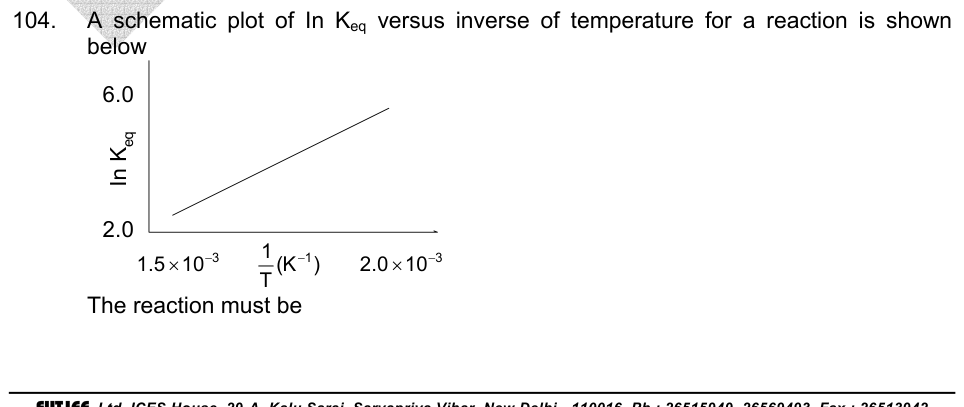
Chemistry · 3 marks · −1A schematic plot of versus inverse of temperature for a reaction is shown below. The reaction must be
- A.exothermic
- B.endothermic
- C.one with negligible enthalpy change
- D.highly spontaneous at ordinary temperature
Correct answer: A
Explanation: Positive slope of vs means .
Question 101
Chemistry · 3 marks · −1The disperse phase in colloidal iron (III) hydroxide and colloidal gold is positively and negatively charged, respectively, which of the following statements is NOT correct?
- A.magnesium chloride solution coagulates, the gold sol more readily than the iron (III) hydroxide sol.
- B.sodium sulphate solution causes coagulation in both sols
- C.mixing the sols has no effect
- D.coagulation in both sols can be brought about by electrophoresis
Correct answer: C
Explanation: Oppositely charged sols coagulate each other.
Question 102
Chemistry · 3 marks · −1Based on lattice energy and other considerations which one of the following alkali metal chlorides is expected to have the highest melting point.
- A.LiCl
- B.NaCl
- C.KCl
- D.RbCl
Correct answer: B
Explanation: LiCl is covalent; NaCl highest among ionic.
Question 103
Chemistry · 3 marks · −1Heating mixture of and will give
- A.Cu +
- B.Cu +
- C.CuO + CuS
- D.
Correct answer: A
Explanation: Self-reduction.
Question 104
Chemistry · 3 marks · −1The molecular shapes of , and are
- A.the same with 2, 0 and 1 lone pairs of electrons on the central atom, respectively
- B.the same with 1, 1 and 1 lone pair of electrons on the central atoms, respectively
- C.different with 0, 1 and 2 lone pair of electrons on the central atoms, respectively
- D.different with 1, 0 and 2 lone pairs of electron on the central atoms respectively
Correct answer: D
Explanation: See-saw, tetrahedral, square planar.
Question 105
Chemistry · 3 marks · −1The number and type of bonds between two carbon atoms in calcium carbide are
- A.One sigma, one pi
- B.One sigma, two pi
- C.Two sigma, one pi
- D.Two sigma, two pi
Correct answer: B
Explanation: in acetylide.
Question 106
Chemistry · 3 marks · −1The oxidation state of chromium in the final product formed by the reaction between KI and acidified potassium dichromate solution is
- A.+4
- B.+6
- C.+2
- D.+3
Correct answer: D
Explanation: .
Question 107
Chemistry · 3 marks · −1The number of hydrogen atom(s) attached to phosphorus atom in hypophosphorous acid is
- A.zero
- B.two
- C.one
- D.three
Correct answer: B
Explanation: has two P-H.
Question 108
Chemistry · 3 marks · −1What is the conjugate base of ?
- A.
- B.
- C.
- D.
Correct answer: D
Explanation: Remove .
Question 109
Chemistry · 3 marks · −1The correct order of the thermal stability of hydrogen halides (H - X) is
- A.HI > HBr > HCl > HF
- B.HF > HCl > HBr > HI
- C.HCl < HF > HBr < HI
- D.HI > HCl < HF > HBr
Correct answer: B
Explanation: Bond strength.
Question 110
Chemistry · 3 marks · −1Heating an aqueous solution of aluminium chloride to dryness will give
- A.
- B.
- C.
- D.
Correct answer: C
Explanation: Hydrolysis.
Question 111
Chemistry · 3 marks · −1Calomel () on reaction with ammonium hydroxide gives
- A.
- B.
- C.
- D.HgO
Correct answer: A
Explanation: Gives .
Question 112
Chemistry · 3 marks · −1In which of the following arrangements the order is NOT according to the property indicated against it?
- A. : Increasing ionic size
- B.B < C < N < O : Increasing first ionization enthalpy
- C.I < Br < F < Cl : Increasing electron gain enthalpy (with negative sign)
- D.Li < Na < K < Rb : Increasing metallic radius
Correct answer: B
Explanation: O < N in IE.
Question 113
Chemistry · 3 marks · −1In silicon dioxide
- A.Each silicon atom is surrounded by four oxygen atoms and each oxygen atom is bonded to two silicon atoms
- B.Each silicon atom is surrounded by two oxygen atoms and each oxygen atom is bonded to two silicon atoms
- C.Silicon atoms is bonded to two oxygen atoms
- D.there are double bonds between silicon and oxygen atoms
Correct answer: A
Explanation: 3D network.
Question 114
Chemistry · 3 marks · −1Of the following sets which one does NOT contain isoelectronic species?
- A., ,
- B., ,
- C., ,
- D., ,
Correct answer: C
Explanation: has 42 electrons vs 32.
Question 115
Chemistry · 3 marks · −1The lanthanide contraction is responsible for the fact that
- A.Zr and Y have about the same radius
- B.Zr and Nb have similar oxidation state
- C.Zr and Hf have about the same radius
- D.Zr and Zn have the same oxidation state
Correct answer: C
Explanation: Standard.
Question 116
Chemistry · 3 marks · −1The IUPAC name of the coordination compound is
- A.Potassium hexacyanoferrate (II)
- B.Potassium hexacyanoferrate (III)
- C.Potassium hexacyanoiron (II)
- D.tripotassium hexcyanoiron (II)
Correct answer: B
Explanation: Fe(III).
Question 117
Chemistry · 3 marks · −1Which of the following compounds shows optical isomerism?
- A.
- B.
- C.
- D.
Correct answer: C
Explanation: Tris-chelate.
Question 118
Chemistry · 3 marks · −1Which one of the following cyano complexes would exhibit the lowest value of paramagnetic behaviour? (At. No. Cr = 24, Mn = 25, Fe = 26, Co = 27)
- A.
- B.
- C.
- D.
Correct answer: D
Explanation: low spin: zero.
Question 119
Chemistry · 3 marks · −12 methylbutane on reacting with bromine in the presence of sunlight gives mainly
- A.1-bromo-2-methylbutane
- B.2-bromo-2-methylbutane
- C.2-bromo-3-methylbutane
- D.1-bromo-3-methylbutane
Correct answer: B
Explanation: Tertiary radical (bromination is selective).
Question 120
Chemistry · 3 marks · −1The photon of hard gamma radiation knocks a proton out of nucleus to form
- A.the isotope of parent nucleus
- B.the isobar of parent nucleus
- C.the nuclide
- D.the isobar of
Correct answer: C
Explanation: Lose one proton.
Question 121
Chemistry · 3 marks · −1The best reagent to convert pent-3-en-2-ol into pent-3-en-2-one is
- A.Acidic permanganate
- B.Acidic dichromate
- C.Chromic anhydride in glacial acetic acid
- D.Pyridinium chloro-chromate
Correct answer: C
Explanation: A mild chromium(VI) oxidant oxidises the secondary alcohol without attacking the C=C; keyed as chromic anhydride in acetic acid.
Question 122
Chemistry · 3 marks · −1Tertiary alkyl halides are practically inert to substitution by mechanism because of
- A.insolubility
- B.instability
- C.inductive effect
- D.steric hindrance
Correct answer: D
Explanation: Steric.
Question 123
Chemistry · 3 marks · −1In both DNA and RNA, heterocyclic base and phosphate ester linkages are at-
- A. and respectively of the sugar molecule
- B. and respectively of the sugar molecule
- C. and respectively of the sugar molecule
- D. and respectively of the sugar molecule
Correct answer: C
Explanation: Base at C1', phosphate at C5'.
Question 124
Chemistry · 3 marks · −1Reaction of one molecule of HBr with one molecule of 1,3-butadiene at C gives predominantly
- A.3-bromobutene under kinetically controlled conditions
- B.1-bromo-2-butene under thermodynamically controlled conditions
- C.3-bromobutene under thermodynamically controlled conditions
- D.1-bromo-2-butene under kinetically controlled conditions
Correct answer: B
Explanation: 1,4-adduct at higher temperature.
Question 125
Chemistry · 3 marks · −1Among the following acids which has the lowest value?
- A.
- B.HCOOH
- C.
- D.
Correct answer: B
Explanation: No +I group.
Question 126
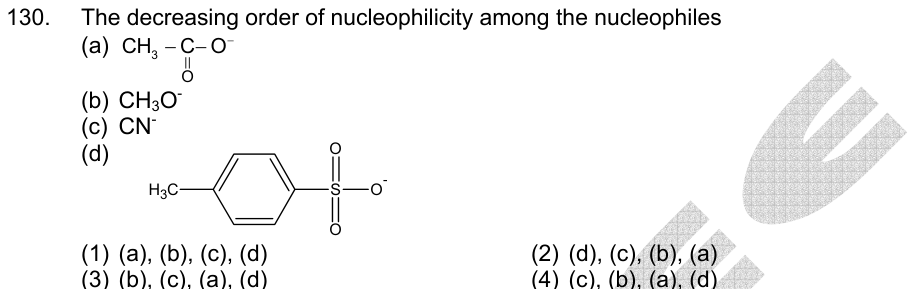
Chemistry · 3 marks · −1The decreasing order of nucleophilicity among the nucleophiles (a) (b) (c) (d) p-toluenesulphonate ()
- A.(a), (b), (c), (d)
- B.(d), (c), (b), (a)
- C.(b), (c), (a), (d)
- D.(c), (b), (a), (d)
Correct answer: D
Explanation: .
Question 127
Chemistry · 3 marks · −1Which one of the following methods is neither meant for the synthesis nor for separation of amines?
- A.Hinsberg method
- B.Hofmann method
- C.Wurtz reaction
- D.Curtius reaction
Correct answer: C
Explanation: Wurtz makes alkanes.
Question 128
Chemistry · 3 marks · −1Which of the following is fully fluorinated polymer?
- A.Neoprene
- B.Teflon
- C.Thiokol
- D.PVC
Correct answer: B
Explanation: PTFE.
Question 129
Chemistry · 3 marks · −1Of the five isomeric hexanes, the isomer which can give two monochlorinated compounds is
- A.n-hexane
- B.2, 3-dimethylbutane
- C.2,2-dimethylbutane
- D.2-methylpentane
Correct answer: B
Explanation: Two H environments.
Question 130
Chemistry · 3 marks · −1Alkyl halides react with dialkyl copper reagents to give
- A.alkenes
- B.alkyl copper halides
- C.alkanes
- D.alkenyl halides
Correct answer: C
Explanation: Corey-House.
Question 131
Chemistry · 3 marks · −1Amongst the following the most basic compound is
- A.benzylamine
- B.aniline
- C.acetanilide
- D.p-nitroaniline
Correct answer: A
Explanation: not conjugated with ring.
Question 132
Chemistry · 3 marks · −1Which types of isomerism is shown by 2,3-dichlorobutane?
- A.Diastereo
- B.Optical
- C.Geometric
- D.Structural
Correct answer: B
Explanation: Two stereocentres (enantiomers + meso).
Question 133
Chemistry · 3 marks · −1The reaction is fastest when X is
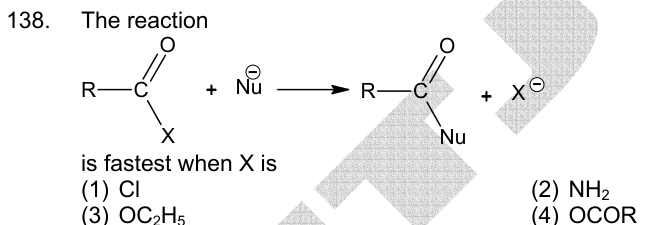
- A.Cl
- B.
- C.
- D.OCOR
Correct answer: A
Explanation: Best leaving group.
Question 134
Chemistry · 3 marks · −1Elimination of bromine from 2-bromobutane results in the formation of-
- A.equimolar mixture of 1 and 2-butene
- B.predominantly 2-butene
- C.predominantly 1-butene
- D.predominantly 2-butyne
Correct answer: B
Explanation: Saytzeff.
Question 135
Chemistry · 3 marks · −1Equimolar solutions in the same solvent have
- A.Same boiling point but different freezing point
- B.Same freezing point but different boiling point
- C.Same boiling and same freezing points
- D.Different boiling and different freezing points
Correct answer: C
Explanation: Colligative (non-electrolytes).
Question 136
Chemistry · 3 marks · −1Which of the following statements in relation to the hydrogen atom is correct?
- A.3s orbital is lower in energy than 3p orbital
- B.3p orbital is lower in energy than 3d orbital
- C.3s and 3p orbitals are of lower energy than 3d orbital
- D.3s, 3p and 3d orbitals all have the same energy
Correct answer: D
Explanation: H energy depends only on n.
Question 137
Chemistry · 3 marks · −1The structure of diborane () contains
- A.four 2c-2e bonds and two 3c-2e bonds
- B.two 2c-2e bonds and four 3c-2e bonds
- C.two 2c-2e bonds and two 3c-3e bonds
- D.four 2c-2e bonds and four 3c-2e bonds
Correct answer: A
Explanation: Terminal and bridging bonds.
Question 138
Chemistry · 3 marks · −1The value of the 'spin only' magnetic moment for one of the following configurations is 2.84 BM. The correct one is
- A. (in strong ligand field)
- B. (in weak ligand field)
- C. (in weak as well as in strong fields)
- D. (in strong ligand field)
Correct answer: A
Explanation: Two unpaired.
Question 139
Chemistry · 3 marks · −1Which of the following factors may be regarded as the main cause of lanthanide contraction?
- A.Poor shielding of one of 4f electron by another in the subshell
- B.Effective shielding of one of 4f electrons by another in the subshell
- C.Poorer shielding of 5d electrons by 4f electrons
- D.Greater shielding of 5d electrons by 4f electrons
Correct answer: A
Explanation: Poor 4f-4f shielding.
Question 140
Chemistry · 3 marks · −1Reaction of cyclohexanone with dimethylamine in the presence of catalytic amount of an acid forms a compound if water during the reaction is continuously removed. The compound formed is generally known as
- A.a Schiff's base
- B.an enamine
- C.an imine
- D.an amine
Correct answer: B
Explanation: Secondary amine gives an enamine.
Question 141
Chemistry · 3 marks · −1p-cresol reacts with chloroform in alkaline medium to give the compound A which adds hydrogen cyanide to form, the compound B. The latter on acidic hydrolysis gives chiral carboxylic acid. The structure of the carboxylic acid is
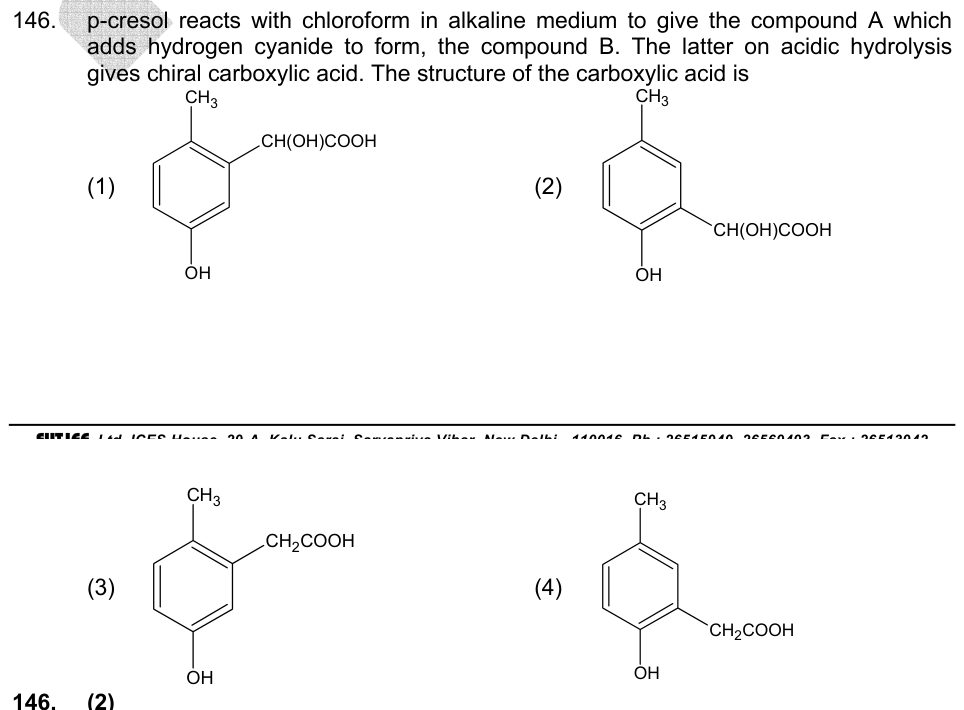
- A.ring with CH3, OH para to it, and CH(OH)COOH ortho to CH3
- B.ring with CH3, OH para to it, and CH(OH)COOH ortho to OH
- C.ring with CH3, OH, and CH2COOH ortho to CH3
- D.ring with CH3, OH, and CH2COOH ortho to OH
Correct answer: B
Explanation: Reimer-Tiemann puts CHO ortho to OH; cyanohydrin then hydrolysis gives the mandelic acid derivative.
Question 142
Chemistry · 3 marks · −1An organic compound having molecular mass 60 is found to contain C = 20%, H = 6.67% and N = 46.67% while rest is oxygen. On heating it gives alongwith a solid residue. The solid residue give violet colour with alkaline copper sulphate solution. The compound is
- A.
- B.
- C.
- D.
Correct answer: C
Explanation: Urea; biuret test.
Question 143
Chemistry · 3 marks · −1can be taken as the time taken for the concentration of a reactant to drop to of its initial value. If the rate constant for a first order reaction is K, the can be written as
- A.0.10/K
- B.0.29/K
- C.0.69/K
- D.0.75/K
Correct answer: B
Explanation: .
Question 144
Chemistry · 3 marks · −1An amount of solid is placed in a flask already containing ammonia gas at a certain temperature and 0.50 atm. Pressure. Ammonium hydrogen sulphide decomposes to yield and gases in the flask. When the decomposition reaction reaches equilibrium, the total pressure in the flask rises to 0.84 atm. The equilibrium constant for decomposition at this temperature is
- A.0.30
- B.0.18
- C.0.17
- D.0.11
Correct answer: D
Explanation: x = 0.17; .
Question 145
Mathematics · 3 marks · −1If , then the inverse of A is
- A.A + I
- B.A
- C.A - I
- D.I - A
Correct answer: D
Explanation: .
Question 146
Mathematics · 3 marks · −1If the cube roots of unity are 1, , then the roots of the equation , are
- A.
- B.-1, -1, -1
- C.
- D.
Correct answer: C
Explanation: .
Question 147
Mathematics · 3 marks · −1Let R = {(3, 3), (6, 6), (9, 9), (12, 12), (6, 12), (3, 9), (3, 12), (3, 6)} be a relation on the set A = {3, 6, 9, 12}. The relation is
- A.reflexive and transitive only
- B.reflexive only
- C.an equivalence relation
- D.reflexive and symmetric only
Correct answer: A
Explanation: Not symmetric.
Question 148
Mathematics · 3 marks · −1Area of the greatest rectangle that can be inscribed in the ellipse is
- A.2ab
- B.ab
- C.
- D.
Correct answer: A
Explanation: .
Question 149
Mathematics · 3 marks · −1The differential equation representing the family of curves , where c > 0, is a parameter, is of order and degree as follows:
- A.order 1, degree 2
- B.order 1, degree 1
- C.order 1, degree 3
- D.order 2, degree 2
Correct answer: C
Explanation: .
Question 150
Mathematics · 3 marks · −1equals
- A.
- B.
- C.
- D.
Correct answer: D
Explanation: .
Question 151
Mathematics · 3 marks · −1ABC is a triangle. Forces , , acting along IA, IB and IC respectively are in equilibrium, where I is the incentre of . Then P : Q : R is
- A.sinA : sinB : sinC
- B.
- C.
- D.cosA : cosB : cosC
Correct answer: C
Explanation: Lami's theorem.
Question 152
Mathematics · 3 marks · −1If in a frequently distribution, the mean and median are 21 and 22 respectively, then its mode is approximately
- A.22.0
- B.20.5
- C.25.5
- D.24.0
Correct answer: D
Explanation: Mode = 3 median - 2 mean.
Question 153
Mathematics · 3 marks · −1Let P be the point (1, 0) and Q a point on the locus . The locus of mid point of PQ is
- A.
- B.
- C.
- D.
Correct answer: A
Explanation: Midpoint substitution.
Question 154
Mathematics · 3 marks · −1If C is the mid point of AB and P is any point outside AB, then
- A.
- B.
- C.
- D.
Correct answer: A
Explanation: Midpoint formula.
Question 155
Mathematics · 3 marks · −1If the coefficients of rth, (r+1)th and (r + 2)th terms in the binomial expansion of are in A.P., then m and r satisfy the equation
- A.
- B.
- C.
- D.
Correct answer: C
Explanation: .
Question 156
Mathematics · 3 marks · −1In a triangle PQR, . If and are the roots of , then
- A.a = b + c
- B.c = a + b
- C.b = c
- D.b = a + c
Correct answer: B
Explanation: .
Question 157
Mathematics · 3 marks · −1The system of equations , , has no solution, if is
- A.-2
- B.either -2 or 1
- C.not -2
- D.1
Correct answer: A
Explanation: ; gives infinitely many.
Question 158
Mathematics · 3 marks · −1The value of for which the sum of the squares of the roots of the equation assume the least value is
- A.1
- B.0
- C.3
- D.2
Correct answer: A
Explanation: .
Question 159
Mathematics · 3 marks · −1If roots of the equation be two consecutive integers, then equals
- A.-2
- B.3
- C.2
- D.1
Correct answer: D
Explanation: Difference of roots is 1.
Question 160
Mathematics · 3 marks · −1If the letters of word SACHIN are arranged in all possible ways and these words are written out as in dictionary, then the word SACHIN appears at serial number
- A.601
- B.600
- C.603
- D.602
Correct answer: A
Explanation: 5 × 5! words before S, SACHIN is first S-word.
Question 161
Mathematics · 3 marks · −1The value of is
- A.
- B.
- C.
- D.
Correct answer: D
Explanation: Pascal's rule repeatedly.
Question 162
Mathematics · 3 marks · −1If and , then which one of the following holds for all , by the principle of mathematical induction
- A.
- B.
- C.
- D.
Correct answer: A
Explanation: .
Question 163
Mathematics · 3 marks · −1If the coefficient of in equals the coefficient of in , then a and b satisfy the relation
- A.a - b = 1
- B.a + b = 1
- C.
- D.ab = 1
Correct answer: D
Explanation: .
Question 164
Mathematics · 3 marks · −1Let , be a function defined by , then f is both one-one and onto when B is the interval
- A.
- B.
- C.
- D.
Correct answer: D
Explanation: .
Question 165
Mathematics · 3 marks · −1If and are two non-zero complex numbers such that then is equal to
- A.
- B.
- C.0
- D.
Correct answer: C
Explanation: Same direction.
Question 166
Mathematics · 3 marks · −1If and , then z lies on
- A.an ellipse
- B.a circle
- C.a straight line
- D.a parabola.
Correct answer: C
Explanation: Perpendicular bisector.
Question 167
Mathematics · 3 marks · −1If and then f(x) is a polynomial of degree
- A.1
- B.0
- C.3
- D.2
Correct answer: D
Explanation: .
Question 168
Mathematics · 3 marks · −1The normal to the curve , at any point '' is such that
- A.it passes through the origin
- B.it makes angle with the x-axis
- C.it passes through
- D.it is at a constant distance from the origin
Correct answer: D
Explanation: Normal .
Question 169
Mathematics · 3 marks · −1A function is matched below against an interval where it is supposed to be increasing. Which of the following pairs is incorrectly matched?
- A. :
- B. :
- C. :
- D. :
Correct answer: C
Explanation: increases for .
Question 170
Mathematics · 3 marks · −1Let and be the distinct roots of , then is equal to
- A.
- B.0
- C.
- D.
Correct answer: A
Explanation: .
Question 171
Mathematics · 3 marks · −1Suppose f(x) is differentiable x = 1 and , then f'(1) equals
- A.3
- B.4
- C.5
- D.6
Correct answer: C
Explanation: f(1) = 0.
Question 172
Mathematics · 3 marks · −1Let f be differentiable for all x. If f(1) = -2 and for , then
- A.
- B.f(6) < 8
- C.f(6) < 5
- D.f(6) = 5
Correct answer: A
Explanation: MVT.
Question 173
Mathematics · 3 marks · −1If f is a real-valued differentiable function satisfying , and f(0) = 0, then f(1) equals
- A.-1
- B.0
- C.2
- D.1
Correct answer: B
Explanation: f' = 0.
Question 174
Mathematics · 3 marks · −1If x is so small that and higher powers of x may be neglected, then may be approximated as
- A.
- B.
- C.
- D.
Correct answer: C
Explanation: Numerator .
Question 175
Mathematics · 3 marks · −1If , , where a, b, c are in A.P. and |a| < 1, |b| < 1, |c| < 1, then x, y, z are in
- A.G.P.
- B.A.P.
- C.Arithmetic - Geometric Progression
- D.H.P.
Correct answer: D
Explanation: etc.
Question 176
Mathematics · 3 marks · −1In a triangle ABC, let . If r is the inradius and R is the circumradius of the triangle ABC, then 2(r + R) equals
- A.b + c
- B.a + b
- C.a + b + c
- D.c + a
Correct answer: B
Explanation: , .
Question 177
Mathematics · 3 marks · −1If , then is equal to
- A.
- B.4
- C.
- D.
Correct answer: C
Explanation: Standard manipulation.
Question 178
Mathematics · 3 marks · −1If in a triangle ABC, the altitudes from the vertices A, B, C on opposite sides are in H.P., then sin A, sin B, sin C are in
- A.G.P.
- B.A.P.
- C.Arithmetic - Geometric Progression
- D.H.P.
Correct answer: B
Explanation: .
Question 179
Mathematics · 3 marks · −1If , , and then
- A.
- B.
- C.
- D.
Correct answer: B
Explanation: on (0, 1).
Question 180
Mathematics · 3 marks · −1The area enclosed between the curve and the coordinate axes is
- A.1
- B.2
- C.3
- D.4
Correct answer: A
Explanation: .
Question 181
Mathematics · 3 marks · −1The parabolas and divide the square region bounded by the lines x = 4, y = 4 and the coordinate axes. If , , are respectively the areas of these parts numbered from top to bottom; then is
- A.1 : 2 : 1
- B.1 : 2 : 3
- C.2 : 1 : 2
- D.1 : 1 : 1
Correct answer: D
Explanation: Each .
Question 182
Mathematics · 3 marks · −1If , then the solution of the equation is
- A.
- B.
- C.
- D.
Correct answer: C
Explanation: Homogeneous: .
Question 183
Mathematics · 3 marks · −1The line parallel to the x-axis and passing through the intersection of the lines and , where is
- A.below the x-axis at a distance of from it
- B.below the x-axis at a distance of from it
- C.above the x-axis at a distance of from it
- D.above the x-axis at a distance of from it
Correct answer: A
Explanation: .
Question 184
Mathematics · 3 marks · −1A spherical iron ball 10 cm in radius is coated with a layer of ice of uniform thickness than melts at a rate of 50 cm/min. When the thickness of ice is 5 cm, then the rate at which the thickness of ice decreases, is
- A. cm/min
- B. cm/min
- C. cm/min
- D. cm/min
Correct answer: B
Explanation: .
Question 185
Mathematics · 3 marks · −1is equal to
- A.
- B.
- C.
- D.
Correct answer: D
Explanation: .
Question 186
Mathematics · 3 marks · −1Let be a differentiable function having f(2) = 6, . Then equals
- A.24
- B.36
- C.12
- D.18
Correct answer: D
Explanation: L'Hospital: .
Question 187
Mathematics · 3 marks · −1Let f(x) be a non-negative continuous function such that the area bounded by the curve y = f(x), x-axis and the ordinates and is . Then is
- A.
- B.
- C.
- D.
Correct answer: D
Explanation: Differentiate w.r.t. .
Question 188
Mathematics · 3 marks · −1The locus of a point P (, ) moving under the condition that the line is a tangent to the hyperbola is
- A.an ellipse
- B.a circle
- C.a parabola
- D.a hyperbola
Correct answer: D
Explanation: .
Question 189
Mathematics · 3 marks · −1If the angle between the line and the plane is such that the value of is
- A.
- B.
- C.
- D.
Correct answer: A
Explanation: .
Question 190
Mathematics · 3 marks · −1The angle between the lines 2x = 3y = -z and 6x = -y = -4z is
- A.
- B.
- C.
- D.
Correct answer: B
Explanation: Directions (3,2,-6), (2,-12,-3): dot 0.
Question 191
Mathematics · 3 marks · −1If the plane passes through the midpoint of the line joining the centres of the spheres and , then a equals
- A.-1
- B.1
- C.-2
- D.2
Correct answer: C
Explanation: Midpoint (1, 1, 1).
Question 192
Mathematics · 3 marks · −1The distance between the line and the plane is
- A.
- B.
- C.
- D.
Correct answer: B
Explanation: Line parallel to plane; point distance.
Question 193
Mathematics · 3 marks · −1For any vector , the value of is equal to
- A.
- B.
- C.
- D.
Correct answer: C
Explanation: Sum .
Question 194
Mathematics · 3 marks · −1If non-zero numbers a, b, c are in H.P., then the straight line always passes through a fixed point. That point is
- A.(-1, 2)
- B.(-1, -2)
- C.(1, -2)
- D.
Correct answer: C
Explanation: .
Question 195
Mathematics · 3 marks · −1If a vertex of a triangle is (1, 1) and the mid-points of two sides through this vertex are (-1, 2) and (3, 2), then the centroid of the triangle is
- A.
- B.
- C.
- D.
Correct answer: C
Explanation: Vertices (-3, 3), (5, 3).
Question 196
Mathematics · 3 marks · −1If the circles and intersect in two distinct points P and Q then the line 5x + by - a = 0 passes through P and Q for
- A.exactly one value of a
- B.no value of a
- C.infinitely many values of a
- D.exactly two values of a
Correct answer: B
Explanation: Leads to .
Question 197
Mathematics · 3 marks · −1A circle touches the x-axis and also touches the circle with centre at (0, 3) and radius 2. The locus of the centre of the circle is
- A.an ellipse
- B.a circle
- C.a hyperbola
- D.a parabola
Correct answer: D
Explanation: .
Question 198
Mathematics · 3 marks · −1If a circle passes through the point (a, b) and cuts the circle orthogonally, then the equation of the locus of its centre is
- A.
- B.
- C.
- D.
Correct answer: D
Explanation: Orthogonality gives .
Question 199
Mathematics · 3 marks · −1An ellipse has OB as semi minor axis, F and F' its focii and the angle FBF' is a right angle. Then the eccentricity of the ellipse is
- A.
- B.
- C.
- D.
Correct answer: A
Explanation: b = ae.
Question 200
Mathematics · 3 marks · −1Let a, b and c be distinct non-negative numbers. If the vectors , and lie in a plane, then c is
- A.the Geometric Mean of a and b
- B.the Arithmetic Mean of a and b
- C.equal to zero
- D.the Harmonic Mean of a and b
Correct answer: A
Explanation: .
Question 201
Mathematics · 3 marks · −1If , , are non-coplanar vectors and is a real number then for
- A.exactly one value of
- B.no value of
- C.exactly three values of
- D.exactly two values of
Correct answer: B
Explanation: .
Question 202
Mathematics · 3 marks · −1Let , and . Then depends on
- A.only y
- B.only x
- C.both x and y
- D.neither x nor y
Correct answer: D
Explanation: Triple product = 1.
Question 203
Mathematics · 3 marks · −1Three houses are available in a locality. Three persons apply for the houses. Each applies for one house without consulting others. The probability that all the three apply for the same house is
- A.
- B.
- C.
- D.
Correct answer: B
Explanation: .
Question 204
Mathematics · 3 marks · −1A random variable X has Poisson distribution with mean 2. Then P(X > 1.5) equals
- A.
- B.0
- C.
- D.
Correct answer: C
Explanation: .
Question 205
Mathematics · 3 marks · −1Let A and B be two events such that , and , where stands for complement of event A. Then events A and B are
- A.equally likely and mutually exclusive
- B.equally likely but not independent
- C.independent but not equally likely
- D.mutually exclusive and independent
Correct answer: C
Explanation: P(B) = 1/3.
Question 206
Mathematics · 3 marks · −1A lizard, at an initial distance of 21 cm behind an insect, moves from rest with an acceleration of 2 cm/s and pursues the insect which is crawling uniformly along a straight line at a speed of 20 cm/s. Then the lizard will catch the insect after
- A.20 s
- B.1 s
- C.21 s
- D.24 s
Correct answer: C
Explanation: .
Question 207
Mathematics · 3 marks · −1Two points A and B move from rest along a straight line with constant acceleration f and f' respectively. If A takes m sec. more than B and describes 'n' units more than B in acquiring the same speed then
- A.
- B.
- C.
- D.
Correct answer: D
Explanation: Eliminate the common speed.
Question 208
Mathematics · 3 marks · −1A and B are two like parallel forces. A couple of moment H lies in the plane of A and B and is contained with them. The resultant of A and B after combining is displaced through a distance
- A.
- B.
- C.
- D.
Correct answer: B
Explanation: .
Question 209
Mathematics · 3 marks · −1The resultant R of two forces acting on a particle is at right angles to one of them and its magnitude is one third of the other force. The ratio of larger force to smaller one is
- A.2 : 1
- B.3 :
- C.3 : 2
- D.3 :
Correct answer: D
Explanation: With the resultant perpendicular to the smaller force F': , ratio .
Question 210
Mathematics · 3 marks · −1The sum of the series ad inf. is
- A.
- B.
- C.
- D.
Correct answer: D
Explanation: .
Question 211
Mathematics · 3 marks · −1The value of , a > 0, is
- A.
- B.
- C.
- D.
Correct answer: B
Explanation: .
Question 212
Mathematics · 3 marks · −1The plane x + 2y - z = 4 cuts the sphere in a circle of radius
- A.3
- B.1
- C.2
- D.
Correct answer: B
Explanation: .
Question 213
Mathematics · 3 marks · −1If the pair of lines lie along diameters of a circle and divide the circle into four sectors such that the area of one of the sectors is thrice the area of another sector then
- A.
- B.
- C.
- D.
Correct answer: D
Explanation: Angle between the lines.
Question 214
Mathematics · 3 marks · −1Let be n observations such that and . Then a possible value of n among the following is
- A.15
- B.18
- C.9
- D.12
Correct answer: B
Explanation: .
Question 215
Mathematics · 3 marks · −1A particle is projected from a point O with velocity u at an angle of with the horizontal. When it is moving in a direction at right angles to its direction at O, its velocity then is given by
- A.
- B.
- C.
- D.
Correct answer: D
Explanation: Horizontal component conserved: .
Question 216
Mathematics · 3 marks · −1If both the roots of the quadratic equation are less than 5, then k lies in the interval
- A.(5, 6]
- B.
- C.
- D.[4, 5]
Correct answer: C
Explanation: Real roots need ; and vertex < 5 give .
Question 217
Mathematics · 3 marks · −1If are in G.P., then the determinant is equal to
- A.1
- B.0
- C.4
- D.2
Correct answer: B
Explanation: Logs in A.P.: columns dependent.
Question 218
Mathematics · 3 marks · −1A real valued function f(x) satisfies the functional equation where a is a given constant and f(0) = 1, f(2a - x) is equal to
- A.-f(x)
- B.f(x)
- C.f(a) + f(a - x)
- D.f(-x)
Correct answer: A
Explanation: f(a) = 0 from x = y = 0.
Question 219
Mathematics · 3 marks · −1If the equation , , , has a positive root , then the equation has a positive root, which is
- A.greater than
- B.smaller than
- C.greater than or equal to
- D.equal to
Correct answer: B
Explanation: Rolle on .