AIEEE 2006 — 30 Apr Offline (Previous Year Paper)
JEE Main · 2006 · with answers and explanations
- questions
- 145
- Total marks
- 580
- Duration
- 180 minutes
- Negative marking
- −1
Subjects: Mathematics · Physics · Chemistry
Question 1
Mathematics · 4 marks · −1ABC is a triangle, right angled at A. The resultant of the forces acting along , with magnitudes and respectively is the force along , where D is the foot of the perpendicular from A onto BC. The magnitude of the resultant is
- A.
- B.
- C.
- D.
Correct answer: D
Explanation: .
Question 2
Mathematics · 4 marks · −1Suppose a population A has 100 observations 101, 102, ..., 200, and another population B has 100 observations 151, 152, ..., 250. If and represent the variances of the two populations, respectively, then is
- A.1
- B.9/4
- C.4/9
- D.2/3
Correct answer: A
Explanation: Shifted data have equal variance.
Question 3
Mathematics · 4 marks · −1If the roots of the quadratic equation are and , respectively then the value of is
- A.2
- B.3
- C.0
- D.1
Correct answer: B
Explanation: .
Question 4
Mathematics · 4 marks · −1The value of the integral, is
- A.1/2
- B.3/2
- C.2
- D.1
Correct answer: B
Explanation: King's rule: .
Question 5
Mathematics · 4 marks · −1The number of values of x in the interval satisfying the equation is
- A.4
- B.6
- C.1
- D.2
Correct answer: A
Explanation: : four solutions in .
Question 6
Mathematics · 4 marks · −1If , where , and are any three vectors such that , , then and are
- A.inclined at an angle of between them
- B.inclined at an angle of between them
- C.perpendicular
- D.parallel
Correct answer: D
Explanation: Expanding gives .
Question 7
Mathematics · 4 marks · −1Let W denote the words in the English dictionary. Define the relation R by : | the words x and y have at least one letter in common. Then R is
- A.not reflexive, symmetric and transitive
- B.reflexive, symmetric and not transitive
- C.reflexive, symmetric and transitive
- D.reflexive, not symmetric and transitive
Correct answer: B
Explanation: Not transitive (DELHI, DWARKA, PARK).
Question 8
Mathematics · 4 marks · −1If A and B are square matrices of size such that , then which of the following will be always true ?
- A.A = B
- B.AB = BA
- C.either of A or B is a zero matrix
- D.either of A or B is an identity matrix
Correct answer: B
Explanation: Expand.
Question 9
Mathematics · 4 marks · −1The value of is
- A.i
- B.1
- C.-1
- D.-i
Correct answer: D
Explanation: , .
Question 10
Mathematics · 4 marks · −1All the values of m for which both roots of the equations are greater than -2 but less than 4, lie in the interval
- A.-2 < m < 0
- B.m > 3
- C.-1 < m < 3
- D.1 < m < 4
Correct answer: C
Explanation: Roots .
Question 11
Mathematics · 4 marks · −1A particle has two velocities of equal magnitude inclined to each other at an angle . If one of them is halved, the angle between the other and the original resultant velocity is bisected by the new resultant. Then is
- A.
- B.
- C.
- D.
Correct answer: B
Explanation: gives , .
Question 12
Mathematics · 4 marks · −1At a telephone enquiry system the number of phone cells regarding relevant enquiry follow Poisson distribution with an average of 5 phone calls during 10-minute time intervals. The probability that there is at the most one phone call during a 10-minute time period is
- A.
- B.
- C.
- D.
Correct answer: D
Explanation: .
Question 13
Mathematics · 4 marks · −1A body falling from rest under gravity passes a certain point P. It was at a distance of 400 m from P, 4s prior to passing through P. If g = 10 m/s, then the height above the point P from where the body began to fall is
- A.720 m
- B.900 m
- C.320 m
- D.680 m
Correct answer: A
Explanation: s; height m.
Question 14
Mathematics · 4 marks · −1is equal to
- A.
- B.
- C.
- D.
Correct answer: D
Explanation: .
Question 15
Mathematics · 4 marks · −1A straight line through the point A(3, 4) is such that its intercept between the axes is bisected at A. Its equation is
- A.x + y = 7
- B.3x - 4y + 7 = 0
- C.4x + 3y = 24
- D.3x + 4y = 25
Correct answer: C
Explanation: Intercepts 6 and 8.
Question 16
Mathematics · 4 marks · −1The two lines x = ay + b, z = cy + d; and x = a'y + b', z = c'y + d' are perpendicular to each other if
- A.aa' + cc' = -1
- B.aa' + cc' = 1
- C.
- D.
Correct answer: A
Explanation: Directions (a, 1, c) and (a', 1, c').
Question 17
Mathematics · 4 marks · −1The locus of the vertices of the family of parabolas is
- A.
- B.
- C.
- D.
Correct answer: A
Explanation: Vertex .
Question 18
Mathematics · 4 marks · −1The values of a, for which the points A, B, C with position vectors , and respectively are the vertices of a right-angled triangle with are
- A.2 and 1
- B.-2 and -1
- C.-2 and 1
- D.2 and -1
Correct answer: A
Explanation: .
Question 19
Mathematics · 4 marks · −1is equal to
- A.
- B.
- C.
- D.
Correct answer: C
Explanation: With : odd part vanishes, .
Question 20
Mathematics · 4 marks · −1If x is real, the maximum value of is
- A.1/4
- B.41
- C.1
- D.17/7
Correct answer: B
Explanation: Minimum of is .
Question 21
Mathematics · 4 marks · −1In an ellipse, the distance between its foci is 6 and minor axis is 8. Then its eccentricity is
- A.
- B.
- C.
- D.
Correct answer: A
Explanation: ae = 3, b = 4, a = 5.
Question 22
Mathematics · 4 marks · −1Let and , . Then
- A.there cannot exist any B such that AB = BA
- B.there exist more than one but finite number of B's such that AB = BA
- C.there exists exactly one B such that AB = BA
- D.there exist infinitely many B's such that AB = BA
Correct answer: D
Explanation: AB = BA iff a = b.
Question 23
Mathematics · 4 marks · −1The function has a local minimum at
- A.x = 2
- B.x = -2
- C.x = 0
- D.x = 1
Correct answer: A
Explanation: , at x = 2.
Question 24
Mathematics · 4 marks · −1Angle between the tangents to the curve at the points (2, 0) and (3, 0) is
- A.
- B. (duplicate as printed)
- C.
- D.
Correct answer: B
Explanation: Slopes -1 and 1: perpendicular.
Question 25
Mathematics · 4 marks · −1Let be terms of an A.P. If , , then equals
- A.
- B.
- C.
- D.
Correct answer: D
Explanation: .
Question 26
Mathematics · 4 marks · −1The set of points where is differentiable is
- A.
- B.
- C.
- D.
Correct answer: C
Explanation: One-sided derivatives at 0 are both 1.
Question 27
Mathematics · 4 marks · −1A triangular park is enclosed on two sides by a fence and on the third side by a straight river bank. The two sides having fence are of same length x. The maximum area enclosed by the park is
- A.
- B.
- C.
- D.
Correct answer: C
Explanation: .
Question 28
Mathematics · 4 marks · −1At an election, a voter may vote for any number of candidates, not greater than the number to be elected. There are 10 candidates and 4 are of be elected. If a voter votes for at least one candidate, then the number of ways in which he can vote is
- A.5040
- B.6210
- C.385
- D.1110
Correct answer: C
Explanation: .
Question 29
Mathematics · 4 marks · −1If the expansion in powers of x of the function is , then is
- A.
- B.
- C.
- D.
Correct answer: D
Explanation: .
Question 30
Mathematics · 4 marks · −1For natural numbers m, n if , and , then (m, n) is
- A.(20, 45)
- B.(35, 20)
- C.(45, 35)
- D.(35, 45)
Correct answer: D
Explanation: , .
Question 31
Mathematics · 4 marks · −1The value of , a > 1, where [x] denotes the greatest integer not exceeding x is
- A.
- B.
- C.
- D.
Correct answer: B
Explanation: Split over unit intervals and telescope.
Question 32
Mathematics · 4 marks · −1If the lines and are two diameters of a circle of area square units, the equation of the circle is
- A.
- B.
- C.
- D.
Correct answer: D
Explanation: Centre (1, -1), r = 7.
Question 33
Mathematics · 4 marks · −1The differential equation whose solution is , where A and B are arbitrary constants is of
- A.second order and second degree
- B.first order and second degree
- C.first order and first degree
- D.second order and first degree
Correct answer: D
Explanation: .
Question 34
Mathematics · 4 marks · −1Let C be the circle with centre (0, 0) and radius 3 units. The equation of the locus of the mid points of the chords of the circle C that subtend an angle of at its centre is
- A.
- B.
- C.
- D.
Correct answer: D
Explanation: Distance .
Question 35
Mathematics · 4 marks · −1If falls inside the angle made by the lines , x > 0 and y = 3x, x > 0, then a belongs to
- A.
- B.
- C.
- D.
Correct answer: C
Explanation: and .
Question 36
Mathematics · 4 marks · −1If , where z is a complex number, then the value of is
- A.18
- B.54
- C.6
- D.12
Correct answer: D
Explanation: Terms 1, 1, 4, 1, 1, 4.
Question 37
Mathematics · 4 marks · −1If and , then is
- A.
- B.
- C.
- D.
Correct answer: C
Explanation: , x obtuse: , .
Question 38
Mathematics · 4 marks · −1If are in H.P., then the expression is equal to
- A.
- B.
- C.
- D.
Correct answer: D
Explanation: Telescoping with the common difference of reciprocals.
Question 39
Mathematics · 4 marks · −1If , then is
- A.
- B.
- C.xy
- D.
Correct answer: A
Explanation: Logarithmic differentiation.
Question 40
Physics · 4 marks · −1A particle located at x = 0 at time t = 0, starts moving along the positive x-direction with a velocity 'v' that varies as . The displacement of the particle varies with time as
- A.
- B.
- C.t
- D.
Correct answer: B
Explanation: .
Question 41
Physics · 4 marks · −1A mass of M kg is suspended by a weightless string. The horizontal force that is required to displace it until the string makes an angle of with the initial vertical direction is
- A.
- B.
- C.
- D.
Correct answer: A
Explanation: Work-energy with constant horizontal F: .
Question 42
Physics · 4 marks · −1A bomb of mass 16 kg at rest explodes into two pieces of masses of 4 kg and 12 kg. The velocity of the 12 kg mass is 4 ms. The kinetic energy of the other mass is
- A.96 J
- B.144 J
- C.288 J
- D.192 J
Correct answer: C
Explanation: v = 12 m/s.
Question 43
Physics · 4 marks · −1A particle of mass 100 g is thrown vertically upwards with a speed of 5 m/s. The work done by the force of gravity during the time the particle goes up is
- A.0.5 J
- B.-0.5 J
- C.-1.25 J
- D.1.25 J
Correct answer: C
Explanation: .
Question 44
Physics · 4 marks · −1A whistle producing sound waves of frequencies 9500 Hz and above is approaching a stationary person with speed v ms. The velocity of sound in air is 300 ms. If the person can hear frequencies upto a maximum of 10,000 Hz, the maximum value of v upto which he can hear the whistle is
- A.30 ms
- B. ms
- C. ms
- D.15 ms
Correct answer: D
Explanation: .
Question 45
Physics · 4 marks · −1A electric dipole is placed at an angle of to a non-uniform electric field. The dipole will experience
- A.a torque only
- B.a translational force only in the direction of the field
- C.a translational force only in a direction normal to the direction of the field
- D.a torque as well as a translational force
Correct answer: D
Explanation: Non-uniform field gives a net force as well.
Question 46
Physics · 4 marks · −1The Kirchhoff's first law () and second law (), where the symbols have their usual meanings, are respectively based on
- A.conservation of charge, conservation of energy
- B.conservation of charge, conservation of momentum
- C.conservation of energy, conservation of charge
- D.conservation of momentum, conservation of charge
Correct answer: A
Explanation: Standard.
Question 47
Physics · 4 marks · −1In a region, steady and uniform electric and magnetic fields are present. These two fields are parallel to each other. A charged particle is released from rest in this region. The path of the particle will be a
- A.circle
- B.helix
- C.straight line
- D.ellipse
Correct answer: C
Explanation: Velocity stays parallel to B.
Question 48
Physics · 4 marks · −1Needles , and are made of a ferromagnetic, a paramagnetic and a diamagnetic substance respectively. A magnet when brought close to them will
- A.attract all three of them
- B.attract and strongly but repel
- C.attract strongly, weakly and repel weakly
- D.attract strongly, but repel and weakly
Correct answer: C
Explanation: Standard behaviour.
Question 49
Physics · 4 marks · −1Which of the following units denotes the dimensions , where Q denotes the electric charge?
- A.Weber (Wb)
- B.Wb/m
- C.Henry (H)
- D.H/m
Correct answer: C
Explanation: has .
Question 50
Physics · 4 marks · −1A player caught a cricket ball of mass 150 g moving at a rate of 20 m/s. If the catching process is completed in 0.1 s, the force of the blow exerted by the ball on the hand of the player is equal to
- A.300 N
- B.150 N
- C.3 N
- D.30 N
Correct answer: D
Explanation: .
Question 51
Physics · 4 marks · −1Consider a two particle system with particles having masses and . If the first particle is pushed towards the centre of mass through a distance d, by what distance should the second particle be moved, so as to keep the centre of mass at the same position?
- A.d
- B.
- C.
- D.
Correct answer: D
Explanation: .
Question 52
Physics · 4 marks · −1Starting from the origin, a body oscillates simple harmonically with a period of 2 s. After what time will its kinetic energy be 75% of the total energy?
- A. s
- B. s
- C. s
- D. s
Correct answer: B
Explanation: , .
Question 53
Physics · 4 marks · −1The maximum velocity of a particle, executing simple harmonic motion with an amplitude 7 mm, is 4.4 m/s. The period of oscillation is
- A.100 s
- B.0.01 s
- C.10 s
- D.0.1 s
Correct answer: B
Explanation: .
Question 54
Physics · 4 marks · −1A string is stretched between fixed points separated by 75 cm. It is observed to have resonant frequencies of 420 Hz and 315 Hz. There are no other resonant frequencies between these two. Then, the lowest resonant frequency for this string is
- A.10.5 Hz
- B.105 Hz
- C.1.05 Hz
- D.1050 Hz
Correct answer: B
Explanation: Successive harmonics differ by the fundamental.
Question 55
Physics · 4 marks · −1Assuming the sun to be a spherical body of radius R at a temperature of T K, evaluate the total radiant power, incident on Earth, at a distance r from the Sun. (where is the radius of the Earth and is Stefan's constant)
- A.
- B.
- C.
- D.
Correct answer: C
Explanation: .
Question 56
Physics · 4 marks · −1The refractive index of glass is 1.520 for red light and 1.525 for blue light. Let and be angles of minimum deviation for red and blue light respectively in a prism of this glass. Then
- A.
- B.
- C.
- D. can be less than or greater than depending upon the angle of prism
Correct answer: B
Explanation: Larger index, larger deviation.
Question 57
Physics · 4 marks · −1In a Wheatstone's bridge, there resistances P, Q and R connected in the three arms and the fourth arm is formed by two resistances and connected in parallel. The condition for bridge to be balanced will be
- A.
- B.
- C.
- D.
Correct answer: C
Explanation: Fourth arm .
Question 58
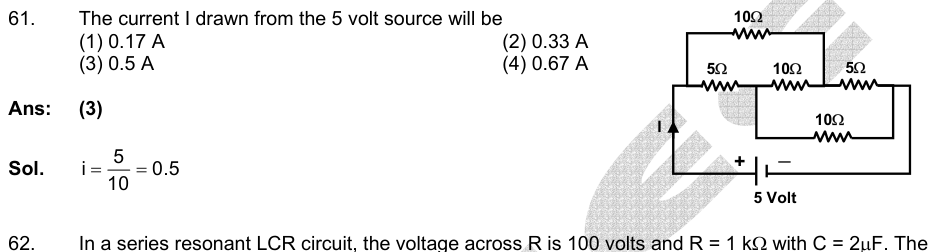
Physics · 4 marks · −1The current I drawn from the 5 volt source will be
- A.0.17 A
- B.0.33 A
- C.0.5 A
- D.0.67 A
Correct answer: C
Explanation: The network is a balanced Wheatstone bridge; equivalent resistance .
Question 59
Physics · 4 marks · −1In a series resonant LCR circuit, the voltage across R is 100 volts and R = 1 k with C = 2F. The resonant frequency is 200 rad/s. At resonance the voltage across L is
- A. V
- B. V
- C.40 V
- D.250 V
Correct answer: D
Explanation: A; V.
Question 60
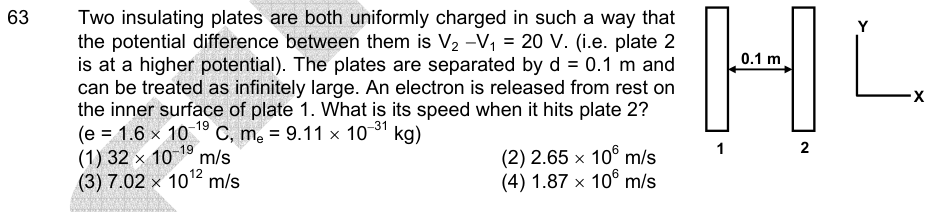
Physics · 4 marks · −1Two insulating plates are both uniformly charged in such a way that the potential difference between them is V. (i.e. plate 2 is at a higher potential). The plates are separated by d = 0.1 m and can be treated as infinitely large. An electron is released from rest on the inner surface of plate 1. What is its speed when it hits plate 2? ( C, kg)
- A. m/s
- B. m/s
- C. m/s
- D. m/s
Correct answer: B
Explanation: .
Question 61
Physics · 4 marks · −1The resistance of a bulb filament is at a temperature of C. If its temperature coefficient of resistance be 0.005 per C, its resistance will become at a temperature of
- A.C
- B.C
- C.C
- D.C
Correct answer: B
Explanation: taking as reference.
Question 62
Physics · 4 marks · −1In an AC generator, a coil with N turns, all of the same area A and total resistance R, rotates with frequency in a magnetic field B. The maximum value of emf generated in the coil is
- A.N.A.B.
- B.N.A.B.R.
- C.N.A.B
- D.N.A.B.R
Correct answer: A
Explanation: .
Question 63
Physics · 4 marks · −1The flux linked with a coil at any instant 't' is given by . The induced emf at t = 3 s is
- A.190 V
- B.-190 V
- C.-10 V
- D.10 V
Correct answer: C
Explanation: at t = 3.
Question 64
Physics · 4 marks · −1A thermocouple is made from two metals, Antimony and Bismuth. If one junction of the couple is kept hot and the other is kept cold then, an electric current will
- A.flow from Antimony to Bismuth at the cold junction
- B.flow from Antimony to Bismuth at the hot junction
- C.flow from Bismuth to Antimony at the cold junction
- D.not flow through the thermocouple
Correct answer: A
Explanation: Seebeck: Sb to Bi at the cold junction.
Question 65
Physics · 4 marks · −1The time by a photoelectron to come out after the photon strikes is approximately
- A. s
- B. s
- C. s
- D. s
Correct answer: C
Explanation: Photoemission is practically instantaneous (~ s).
Question 66
Physics · 4 marks · −1An alpha nucleus of energy bombards a heavy nuclear target of charge Ze. Then the distance of closest approach for the alpha nucleus will be proportional to
- A.
- B.
- C.
- D.
Correct answer: C
Explanation: .
Question 67
Physics · 4 marks · −1The threshold frequency for a metallic surface corresponds to an energy of 6.2 eV, and the stopping potential for a radiation incident on this surface 5 V. The incident radiation lies in
- A.X-ray region
- B.ultra-violet region
- C.infra-red region
- D.visible region
Correct answer: B
Explanation: Photon 11.2 eV, nm.
Question 68
Physics · 4 marks · −1The energy spectrum of -particles [number N(E) as a function of -energy E] emitted from a radioactive source is
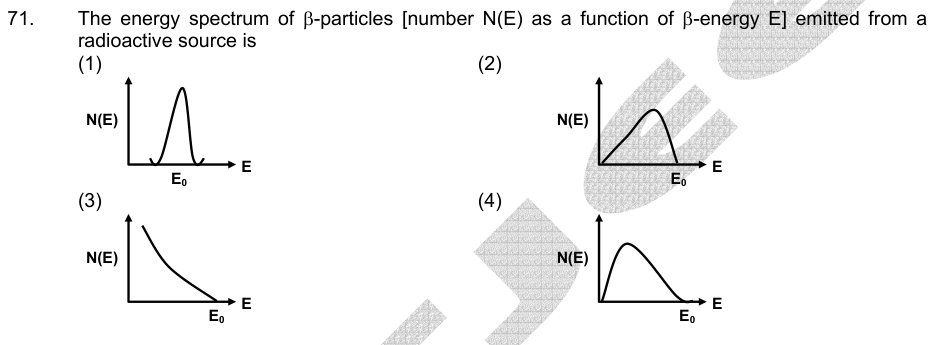
- A.Graph (1)
- B.Graph (2)
- C.Graph (3)
- D.Graph (4)
Correct answer: D
Explanation: Continuous spectrum from 0 to skewed to low energies.
Question 69
Physics · 4 marks · −1When nuclei are bombarded by protons, and the resultant nuclei are , the emitted particles will be
- A.neutrons
- B.alpha particles
- C.beta particles
- D.gamma photons
Correct answer: D
Explanation: .
Question 70
Physics · 4 marks · −1A solid which is transparent to visible light and whose conductivity increases with temperature is formed by
- A.Metallic binding
- B.Ionic binding
- C.Covalent binding
- D.Van der Waals binding
Correct answer: C
Explanation: A covalent semiconductor/insulator with a wide gap.
Question 71
Physics · 4 marks · −1If the ratio of the concentration of electrons to that of holes in a semiconductor is and the ratio of currents is , then what is the ratio of their drift velocities?
- A.
- B.
- C.
- D.
Correct answer: D
Explanation: .
Question 72
Physics · 4 marks · −1In a common base mode of a transistor, the collector current is 5.488 mA for an emitter current of 5.60 mA. The value of the base current amplification factor () will be
- A.48
- B.49
- C.50
- D.51
Correct answer: B
Explanation: .
Question 73
Physics · 4 marks · −1The potential energy of a 1 kg particle free to move along the x-axis is given by J. The total mechanical energy of the particle 2 J. Then, the maximum speed (in m/s) is
- A.2
- B.
- C.
- D.
Correct answer: B
Explanation: at ; .
Question 74
Physics · 4 marks · −1A force of acts on O, the origin of the coordinate system. The torque about the point (1, -1) is
- A.
- B.
- C.
- D.
Correct answer: C
Explanation: ; .
Question 75
Physics · 4 marks · −1A thin circular ring of mass m and radius R is rotating about its axis with a constant angular velocity . Two objects each of mass M are attached gently to the opposite ends of a diameter of the ring. The ring now rotates with an angular velocity =
- A.
- B.
- C.
- D.
Correct answer: A
Explanation: Angular momentum conservation.
Question 76
Physics · 4 marks · −1If the terminal speed of a sphere of gold (density = 19.5 kg/m) is 0.2 m/s in a viscous liquid (density = 1.5 kg/m), find the terminal speed of a sphere of silver (density = 10.5 kg/m) of the same size in the same liquid.
- A.0.2 m/s
- B.0.4 m/s
- C.0.133 m/s
- D.0.1 m/s
Correct answer: D
Explanation: : .
Question 77
Physics · 4 marks · −1The work of 146 kJ is performed in order to compress one kilo mole of gas adiabatically and in this process the temperature of the gas increases by C. The gas is (R = 8.3 J mol K)
- A.monoatomic
- B.diatomic
- C.triatomic
- D.a mixture of monoatomic and diatomic
Correct answer: B
Explanation: .
Question 78
Physics · 4 marks · −1The rms value of the electric field of the light coming from the Sun is 720 N/C. The average total energy density of the electromagnetic wave is
- A. J/m
- B. J/m
- C. J/m
- D. J/m
Correct answer: B
Explanation: .
Question 79
Physics · 4 marks · −1A coin is placed on a horizontal platform which undergoes vertical simple harmonic motion of angular frequency . The amplitude of oscillation is gradually increased. The coin will leave contact with the platform for the first time
- A.at the highest position of the platform
- B.at the mean position of the platform
- C.for an amplitude of
- D.for an amplitude of
Correct answer: C
Explanation: Contact lost when (at the top).
Question 80
Physics · 4 marks · −1An electric bulb is rated 220 volt - 100 watt. The power consumed by it when operated on 110 volt will be
- A.50 watt
- B.75 watt
- C.40 watt
- D.25 watt
Correct answer: D
Explanation: .
Question 81
Physics · 4 marks · −1The anode voltage of a photocell is kept fixed. The wavelength of the light falling on the cathode is gradually changed. The plate current I of the photocell varies as follows :
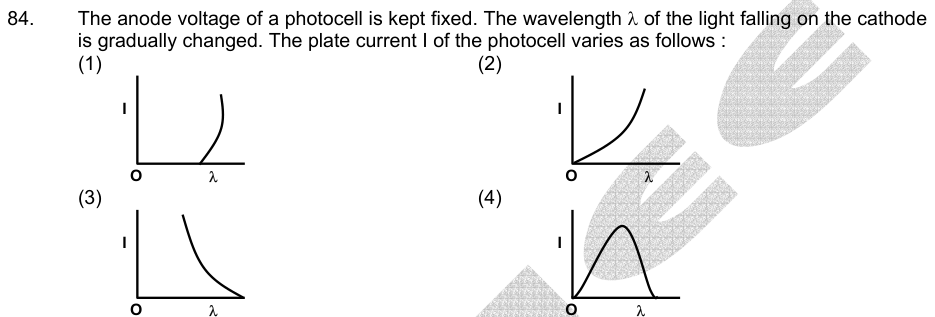
- A.Graph (1)
- B.Graph (2)
- C.Graph (3)
- D.Graph (4)
Correct answer: C
Explanation: Current falls as increases, reaching zero at threshold.
Question 82
Physics · 4 marks · −1If the binding energy per nucleon in and nuclei are 5.60 MeV and 7.06 MeV respectively, then in the reaction energy of proton must be
- A.39.2 MeV
- B.28.24 MeV
- C.17.28 MeV
- D.1.46 MeV
Correct answer: C
Explanation: Q = 8(7.06) - 7(5.60) = 17.28 MeV (energy released).
Question 83
Physics · 4 marks · −1If the lattice constant of this semiconductor is decreased, then which of the following is correct?
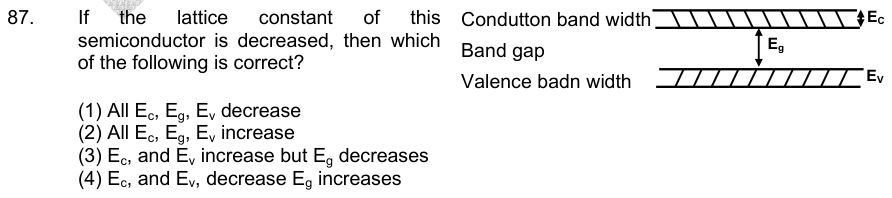
- A.All , , decrease
- B.All , , increase
- C., and increase but decreases
- D., and decrease increases
Correct answer: D
Explanation: Closer atoms broaden the bands and widen the gap (keyed).
Question 84
Physics · 4 marks · −1In the following, which one of the diodes is reverse biased?
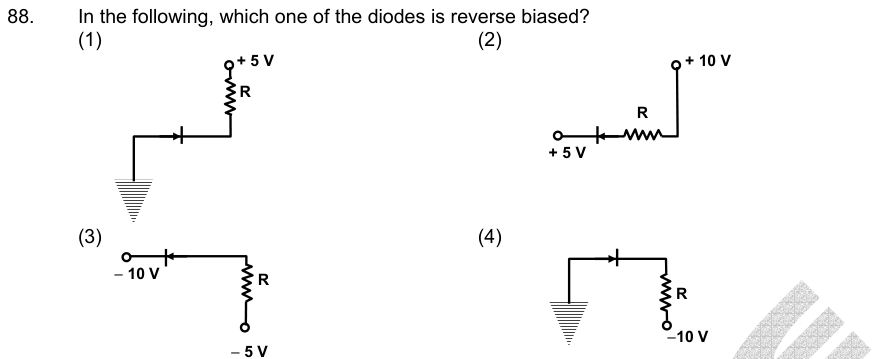
- A.Diagram (1)
- B.Diagram (2)
- C.Diagram (3)
- D.Diagram (4)
Correct answer: A
Explanation: In (1) the cathode side is at +5 V through R while the anode is grounded.
Question 85
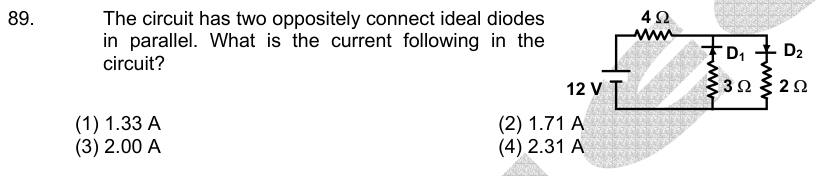
Physics · 4 marks · −1The circuit has two oppositely connected ideal diodes in parallel. What is the current following in the circuit?
- A.1.33 A
- B.1.71 A
- C.2.00 A
- D.2.31 A
Correct answer: C
Explanation: blocks; current through 4 + 2 ohm: 2 A.
Question 86
Physics · 4 marks · −1A long solenoid has 200 turns per cm and carries a current i. The magnetic field at its centre is Weber/m. Another long solenoid has 100 turns per cm and it carries a current i/3. The value of the magnetic field at its centre is
- A. Weber/m
- B. Weber/m
- C. Weber/m
- D. Weber/m
Correct answer: B
Explanation: : factor .
Question 87
Physics · 4 marks · −1Four point masses, each of value m, are placed at the corners of a square ABCD of side . The moment of inertia through A and parallel to BD is
- A.
- B.
- C.
- D.
Correct answer: D
Explanation: B, D at , C at : .
Question 88
Physics · 4 marks · −1A wire elongates by mm when a load W is hanged from it. If the wire goes over a pulley and two weights W each are hung at the two ends, the elongation of the wire will be (in mm)
- A.
- B.
- C.
- D.zero
Correct answer: B
Explanation: Tension is W in both cases.
Question 89
Physics · 4 marks · −1Two rigid boxes containing different ideal gases are placed on a table. Box A contains one mole of nitrogen at temperature , while Box B contains one mole of helium at temperature . The boxes are then put into thermal contact with each other and heat flows between them until the gases reach a common final temperature. (Ignore the heat capacity of boxes). Then, the final temperature of the gases, , in terms of is
- A.
- B.
- C.
- D.
Correct answer: D
Explanation: .
Question 90
Physics · 4 marks · −1Two spherical conductors A and B of radii 1 mm and 2 mm are separated by a distance of 5 cm and are uniformly charged. If the spheres are connected by a conducting wire then in equilibrium condition, the ratio of the magnitude of the electric fields at the surface of spheres A and B is
- A.1 : 4
- B.4 : 1
- C.1 : 2
- D.2 : 1
Correct answer: D
Explanation: Equal potentials: .
Question 91
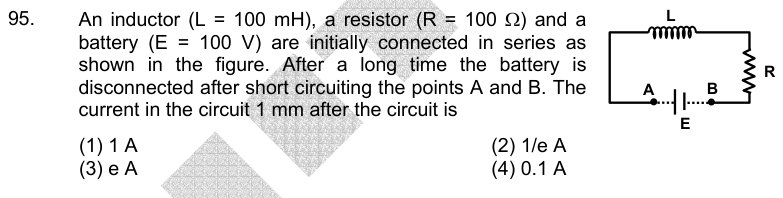
Physics · 4 marks · −1An inductor (L = 100 mH), a resistor (R = 100 ) and a battery (E = 100 V) are initially connected in series as shown in the figure. After a long time the battery is disconnected after short circuiting the points A and B. The current in the circuit 1 ms after the circuit is
- A.1 A
- B.1/e A
- C.e A
- D.0.1 A
Correct answer: B
Explanation: A.
Question 92
Chemistry · 4 marks · −1HBr reacts with under anhydrous conditions at room temperature to give
- A. and
- B. and
- C.
- D.
Correct answer: D
Explanation: Markovnikov addition via the oxocarbenium ion.
Question 93
Chemistry · 4 marks · −1The IUPAC name of the compound shown below is (a cyclohexene ring with Cl on the alkene carbon C1 and Br on C3)
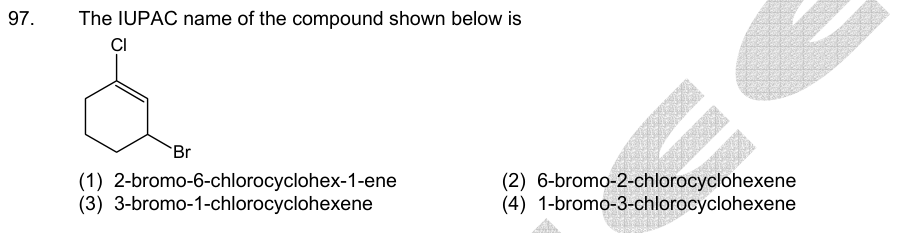
- A.2-bromo-6-chlorocyclohex-1-ene
- B.6-bromo-2-chlorocyclohexene
- C.3-bromo-1-chlorocyclohexene
- D.1-bromo-3-chlorocyclohexene
Correct answer: C
Explanation: Number the double bond first, then lowest locants.
Question 94
Chemistry · 4 marks · −1The increasing order of the rate of HCN addition to compounds A - D is (A) HCHO (B) (C) (D) PhCOPh
- A.A < B < C < D
- B.D < B < C < A
- C.D < C < B < A
- D.C < D < B < A
Correct answer: C
Explanation: Steric and electronic hindrance.
Question 95
Chemistry · 4 marks · −1How many moles of magnesium phosphate, will contain 0.25 mole of oxygen atoms?
- A.0.02
- B.
- C.
- D.
Correct answer: B
Explanation: 8 O per formula.
Question 96
Chemistry · 4 marks · −1According to Bohr's theory, the angular momentum of an electron in orbit is
- A.
- B.
- C.
- D.
Correct answer: D
Explanation: .
Question 97
Chemistry · 4 marks · −1Which of the following molecules/ions does not contain unpaired electrons?
- A.
- B.
- C.
- D.
Correct answer: A
Explanation: Peroxide ion is diamagnetic.
Question 98
Chemistry · 4 marks · −1Total volume of atoms present in a face-centre cubic unit cell of a metal is (r is atomic radius)
- A.
- B.
- C.
- D.
Correct answer: D
Explanation: 4 atoms.
Question 99
Chemistry · 4 marks · −1A reaction was found to be second order with respect to the concentration of carbon monoxide. If the concentration of carbon monoxide is doubled, with everything else kept the same, the rate of reaction will
- A.remain unchanged
- B.triple
- C.increase by a factor of 4
- D.double
Correct answer: C
Explanation: .
Question 100
Chemistry · 4 marks · −1Which of the following chemical reactions depicts the oxidizing behaviour of ?
- A.
- B.
- C.
- D.
Correct answer: A
Explanation: S reduced from +6 to +4.
Question 101
Chemistry · 4 marks · −1The IUPAC name for the complex is
- A.nitrito-N-pentaamminecobalt (III) chloride
- B.nitrito-N-pentaamminecobalt (II) chloride
- C.pentaammine nitrito-N-cobalt (II) chloride
- D.pentaammine nitrito-N-cobalt (III) chloride
Correct answer: D
Explanation: Alphabetical ligand order; Co(III).
Question 102
Chemistry · 4 marks · −1The term anomers of glucose refers to
- A.isomers of glucose that differ in configurations at carbons one and four (C-1 and C-4)
- B.a mixture of (D)-glucose and (L)-glucose
- C.enantiomers of glucose
- D.isomers of glucose that differ in configuration at carbon one (C-1)
Correct answer: D
Explanation: Anomers differ at C-1.
Question 103
Chemistry · 4 marks · −1In the transformation of to , if one emission is an -particle, what should be the other emission(s)?
- A.Two
- B.Two and one
- C.One and one
- D.One and one
Correct answer: A
Explanation: Restore Z by two .
Question 104
Chemistry · 4 marks · −1Phenyl magnesium bromide reacts with methanol to give
- A.a mixture of anisole and Mg(OH)Br
- B.a mixture of benzene and Mg(OMe)Br
- C.a mixture of toluene and Mg(OH)Br
- D.a mixture of phenol and Mg(Me)Br
Correct answer: B
Explanation: Acid-base: .
Question 105
Chemistry · 4 marks · −1. The decreasing order of the rate of the above reaction with nucleophiles () A to D is [ = (A) , (B) , (C) , (D) ]
- A.D > C > A > B
- B.D > C > B > A
- C.A > B > C > D
- D.B > D > C > A
Correct answer: A
Explanation: Nucleophilicity follows basicity here.
Question 106
Chemistry · 4 marks · −1The pyrimidine bases present in DNA are
- A.cytosine and adenine
- B.cytosine and guanine
- C.cytosine and thymine
- D.cytosine and uracil
Correct answer: C
Explanation: Pyrimidines in DNA: C and T.
Question 107
Chemistry · 4 marks · −1Among the following the one that gives positive iodoform test upon reaction with and NaOH is
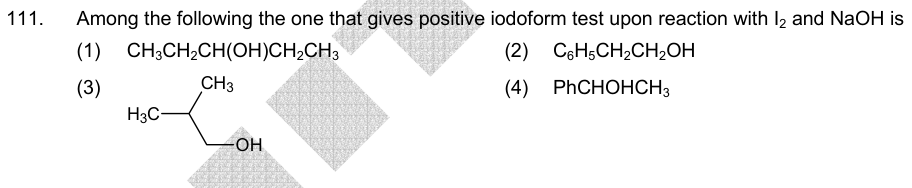
- A.
- B.
- C.2-methylpropan-1-ol ()
- D.
Correct answer: D
Explanation: Contains .
Question 108
Chemistry · 4 marks · −1The increasing order of stability of the following free radicals is
- A.
- B.
- C.
- D.
Correct answer: A
Explanation: Resonance > hyperconjugation.
Question 109
Chemistry · 4 marks · −1Uncertainty in the position of an electron (mass = kg) moving with a velocity 300 ms, accurate upto 0.001%, will be ( Js)
- A. m
- B. m
- C. m
- D. m
Correct answer: C
Explanation: with .
Question 110
Chemistry · 4 marks · −1Phosphorus pentachloride dissociates as follows, in a closed reaction vessel, . If total pressure at equilibrium of the reaction mixture is P and degree of dissociation of is x, the partial pressure of will be
- A.
- B.
- C.
- D.
Correct answer: A
Explanation: Total moles .
Question 111
Chemistry · 4 marks · −1The standard enthalpy of formation () at 298 K for methane, (g), is -74.8 kJ mol. The additional information required to determine the average energy for C - H bond formation would be
- A.the dissociation energy of and enthalpy of sublimation of carbon
- B.latent heat of vapourization of methane
- C.the first four ionization energies of carbon and electron gain enthalpy of hydrogen
- D.the dissociation energy of hydrogen molecule,
Correct answer: A
Explanation: Born-Haber style cycle needs atomisation enthalpies.
Question 112
Chemistry · 4 marks · −1Among the following mixtures, dipole-dipole as the major interaction, is present in
- A.benzene and ethanol
- B.acetonitrile and acetone
- C.KCl and water
- D.benzene and carbon tetrachloride
Correct answer: B
Explanation: Both polar aprotic molecules.
Question 113
Chemistry · 4 marks · −1Fluorobenzene () can be synthesized in the laboratory
- A.by heating phenol with HF and KF
- B.from aniline by diazotisation followed by heating the diazonium salt with
- C.by direct fluorination of benzene with gas
- D.by reacting bromobenzene with NaF solution
Correct answer: B
Explanation: Balz-Schiemann reaction.
Question 114
Chemistry · 4 marks · −1A metal, M forms chlorides in its +2 and +4 oxidation states. Which of the following statements about these chlorides is correct?
- A. is more volatile than
- B. is more soluble in anhydrous ethanol than
- C. is more ionic than
- D. is more easily hydrolysed than
Correct answer: C
Explanation: Lower oxidation state is more ionic (Fajans).
Question 115
Chemistry · 4 marks · −1Which of the following statements is true?
- A. is a stronger acid than
- B.In aqueous medium HF is a stronger acid than HCl
- C. is a weaker acid than
- D. is a stronger acid than
Correct answer: D
Explanation: More oxygen, stronger oxoacid.
Question 116
Chemistry · 4 marks · −1The molar conductivities and at infinite dilution in water at C are 91.0 and 426.2 S cm/mol respectively. To calculate , the additional value required is
- A.
- B.
- C.
- D.
Correct answer: D
Explanation: Kohlrausch's law.
Question 117
Chemistry · 4 marks · −1Which one of the following sets of ions represents a collection of isoelectronic species?
- A., , ,
- B., , ,
- C., , ,
- D., , ,
Correct answer: A
Explanation: All 18 electrons.
Question 118
Chemistry · 4 marks · −1The correct order of increasing acid strength of the compounds (a) (b) (c) (d) is
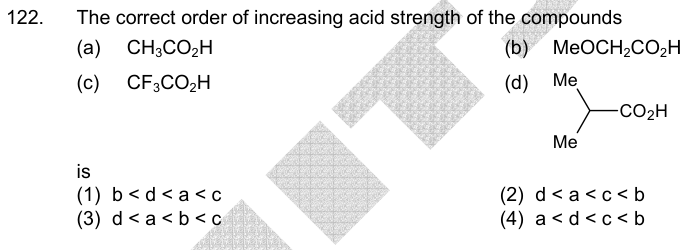
- A.b < d < a < c
- B.d < a < c < b
- C.d < a < b < c
- D.a < d < c < b
Correct answer: C
Explanation: +I lowers, -I raises acidity.
Question 119
Chemistry · 4 marks · −1In which of the following molecules/ions are all the bonds not equal?
- A.
- B.
- C.
- D.
Correct answer: A
Explanation: See-saw has axial and equatorial bonds.
Question 120
Chemistry · 4 marks · −1What products are expected from the disproportionation reaction of hypochlorous acid?
- A. and
- B. and
- C.HCl and
- D.HCl and
Correct answer: D
Explanation: .
Question 121
Chemistry · 4 marks · −1Nickel (Z = 28) combines with a uninegative monodentate ligand to form a paramagnetic complex . The number of unpaired electron(s) in the nickel and geometry of this complex ion are, respectively
- A.one, tetrahedral
- B.two, tetrahedral
- C.one, square planar
- D.two, square planar
Correct answer: B
Explanation: , .
Question 122
Chemistry · 4 marks · −1In , the Fe - C bond possesses
- A.-character only
- B.both and characters
- C.ionic character
- D.-character only
Correct answer: B
Explanation: Synergic bonding.
Question 123
Chemistry · 4 marks · −1The increasing order of the first ionization enthalpies of the elements B, P, S and F (lowest first) is
- A.F < S < P < B
- B.P < S < B < F
- C.B < P < S < F
- D.B < S < P < F
Correct answer: D
Explanation: P > S (half-filled p).
Question 124
Chemistry · 4 marks · −1An ideal gas is allowed to expand both reversibly and irreversibly in an isolated system. If is the initial temperature and is the final temperature, which of the following statements is correct?
- A.
- B. for reversible process but for irreversible process
- C.
- D. for both reversible and irreversible processes
Correct answer: A
Explanation: Adiabatic reversible expansion does more work, cooling more.
Question 125
Chemistry · 4 marks · −1In Langmuir's model of adsorption of a gas on a solid surface
- A.the rate of dissociation of adsorbed molecules from the surface does not depend on the surface covered
- B.the adsorption at a single site on the surface may involve multiple molecules at the same time
- C.the mass of gas striking a given area of surface is proportional to the pressure of the gas
- D.the mass of gas striking a given area of surface is independent of the pressure of the gas
Correct answer: C
Explanation: Kinetic theory: collision rate proportional to pressure.
Question 126
Chemistry · 4 marks · −1Rate of a reaction can be expressed by Arrhenius equation as: . In this equation, E represents
- A.the energy above which all the colliding molecules will react
- B.the energy below which colliding molecules will not react
- C.the total energy of the reacting molecules at a temperature, T
- D.the fraction of molecules with energy greater than the activation energy of the reaction
Correct answer: B
Explanation: Activation energy threshold.
Question 127
Chemistry · 4 marks · −1The structure of the major product formed in the following reaction: 3-iodobenzyl chloride ?
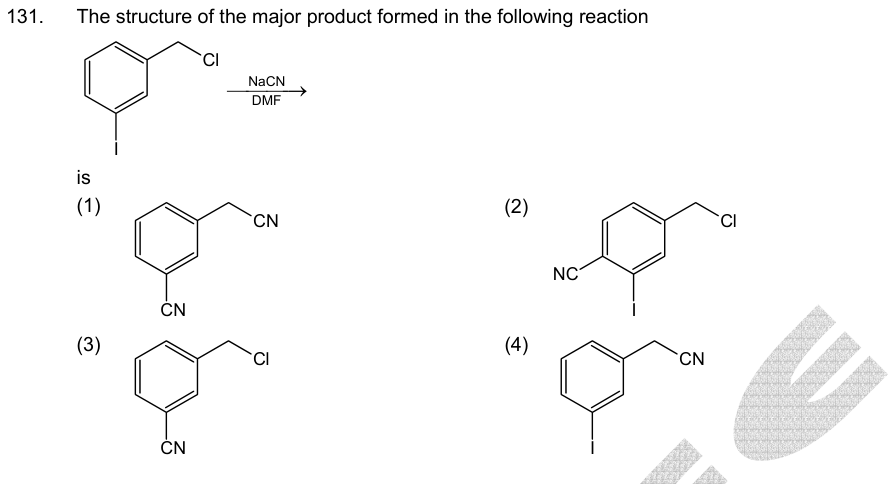
- A.3-cyanobenzyl cyanide (both I and Cl replaced by CN)
- B.benzyl chloride with CN para to CH2Cl and I retained
- C.3-cyanobenzyl chloride (aryl I replaced)
- D.3-iodophenylacetonitrile (only the benzylic Cl replaced)
Correct answer: D
Explanation: at the benzylic C; the aryl iodide is inert.
Question 128
Chemistry · 4 marks · −1Reaction of trans-2-phenyl-1-bromocyclopentane on reaction with alcoholic KOH produces
- A.4-phenylcyclopentene
- B.2-phenylcyclopentene
- C.1-phenylcyclopentene
- D.3-phenylcyclopentene
Correct answer: D
Explanation: Anti-periplanar H is only available away from the phenyl carbon.
Question 129
Chemistry · 4 marks · −1Increasing order of stability among the three main conformations (i.e. Eclipse, Anti, Gauche) of 2-fluoroethanol is
- A.Eclipse, Gauche, Anti
- B.Gauche, Eclipse, Anti
- C.Eclipse, Anti, Gauche
- D.Anti, Gauche, Eclipse
Correct answer: C
Explanation: Gauche stabilised by intramolecular H-bonding/gauche effect.
Question 130
Chemistry · 4 marks · −1The structure of the compound that gives a tribromo derivative on treatment with bromine water is
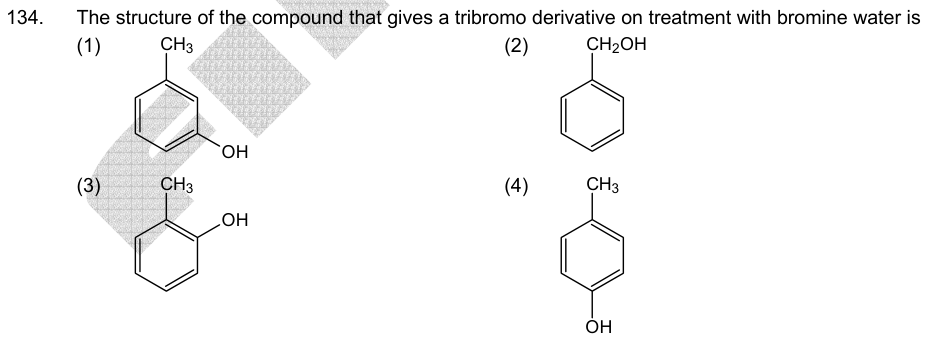
- A.m-cresol (3-methylphenol)
- B.benzyl alcohol
- C.o-cresol (2-methylphenol)
- D.p-cresol (4-methylphenol)
Correct answer: A
Explanation: m-Cresol has three free o/p positions to OH.
Question 131
Chemistry · 4 marks · −1The decreasing values of bond angles from (106) to (101) down group-15 of the periodic table is due to
- A.increasing bp-bp repulsion
- B.increasing p-orbital character in
- C.decreasing lp-bp repulsion
- D.decreasing electronegativity
Correct answer: D
Explanation: Decreasing electronegativity of the central atom.
Question 132
Chemistry · 4 marks · −1The alkene formed as a major product in the elimination reaction on heating (2-methylcyclohexyl)ethylmethyl-n-butylammonium hydroxide () is
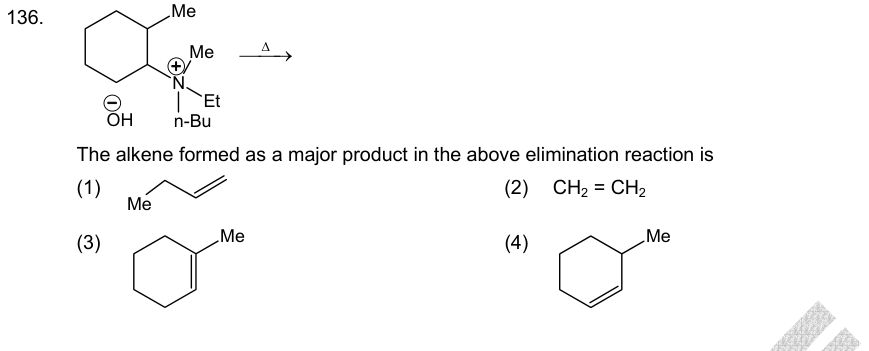
- A.1-butene
- B.
- C.1-methylcyclohexene
- D.3-methylcyclohexene
Correct answer: B
Explanation: Hofmann elimination favours the least substituted alkene: ethene from the N-ethyl group.
Question 133
Chemistry · 4 marks · −1The 'spin-only' magnetic moment [in units of Bohr magneton, ()] of in aqueous solution would be (Atomic number of Ni = 28)
- A.2.84
- B.4.90
- C.0
- D.1.73
Correct answer: A
Explanation: Two unpaired: .
Question 134
Chemistry · 4 marks · −1The equilibrium constant for the reaction is . The value of for the reaction will be
- A.416
- B.
- C.
- D.
Correct answer: A
Explanation: .
Question 135
Chemistry · 4 marks · −1Following statements regarding the periodic trends of chemical reactivity of the alkali metals and the halogens are given. Which of these statements gives the correct picture?
- A.The reactivity decreases in the alkali metals but increases in the halogens with increase in atomic number down the group
- B.In both the alkali metals and the halogens the chemical reactivity decreases with increase in atomic number down the group
- C.Chemical reactivity increases with increase in atomic number down the group in both the alkali metals and halogens
- D.In alkali metals the reactivity increases but in the halogens it decreases with increase in atomic number down the group
Correct answer: D
Explanation: Standard trends.
Question 136
Chemistry · 4 marks · −1Given the data at C, ; V; ; V. What is the value of log for AgI?
- A.-8.12
- B.+8.612
- C.-37.83
- D.-16.13
Correct answer: D
Explanation: V; .
Question 137
Chemistry · 4 marks · −1The following mechanism has been proposed for the reaction of NO with to form NOBr: ; . If the second step is the rate determining step, the order of the reaction with respect to NO(g) is
- A.1
- B.0
- C.3
- D.2
Correct answer: D
Explanation: Rate .
Question 138
Chemistry · 4 marks · −1Lanthanoid contraction is caused due to
- A.the appreciable shielding on outer electrons by 4f electrons from the nuclear charge
- B.the appreciable shielding on outer electrons by 5d electrons from the nuclear charge
- C.the same effective nuclear charge from Ce to Lu
- D.the imperfect shielding on outer electrons by 4f electrons from the nuclear charge
Correct answer: D
Explanation: Poor 4f shielding.
Question 139
Chemistry · 4 marks · −1Resistance of a conductivity cell filled with a solution of an electrolyte of concentration 0.1 M is 100 . The conductivity of this solution is 1.29 S m. Resistance of the same cell when filled with 0.2 M of the same solution is 520 . The molar conductivity of 0.02 M solution of the electrolyte will be
- A. S m mol
- B. S m mol
- C. S m mol
- D. S m mol
Correct answer: D
Explanation: Cell constant 129 m; for the 0.2 M solution , .
Question 140
Chemistry · 4 marks · −1The ionic mobility of alkali metal ions in aqueous solution is maximum for
- A.
- B.
- C.
- D.
Correct answer: B
Explanation: Least hydrated ion moves fastest.
Question 141
Chemistry · 4 marks · −1Density of a 2.05 M solution of acetic acid in water is 1.02 g/mL. The molality of the solution is
- A.1.14 mol kg
- B.3.28 mol kg
- C.2.28 mol kg
- D.0.44 mol kg
Correct answer: C
Explanation: Solvent g.
Question 142
Chemistry · 4 marks · −1The enthalpy changes for the following processes are listed below: , 242.3 kJ mol; , 151.0 kJ mol; ICl(g) = I(g) + Cl(g), 211.3 kJ mol; , 62.76 kJ mol. Given that the standard states for iodine and chlorine are (s) and (g), the standard enthalpy of formation for ICl(g) is
- A.-14.6 kJ mol
- B.-16.8 kJ mol
- C.+16.8 kJ mol
- D.+244.8 kJ mol
Correct answer: C
Explanation: .
Question 143
Chemistry · 4 marks · −1How many EDTA (ethylenediaminetetraacetic acid) molecules are required to make an octahedral complex with a ion?
- A.Six
- B.Three
- C.One
- D.Two
Correct answer: C
Explanation: EDTA is hexadentate.
Question 144
Chemistry · 4 marks · −1In the Reimer-Tiemann reaction, phenol + + NaOH sodium salicylaldehyde phenoxide. The electrophile involved in the above reaction is
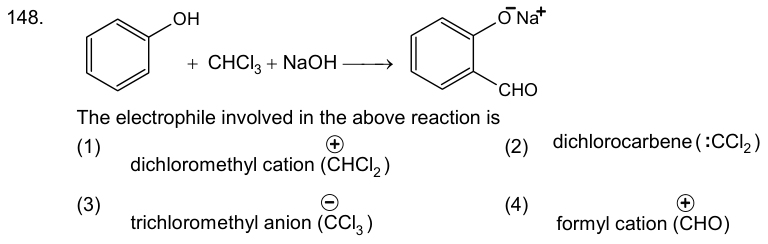
- A.dichloromethyl cation ()
- B.dichlorocarbene ()
- C.trichloromethyl anion ()
- D.formyl cation ()
Correct answer: B
Explanation: Dichlorocarbene.
Question 145
Chemistry · 4 marks · −118 g of glucose () is added to 178.2 g of water. The vapour pressure of water for this aqueous solution at C is
- A.759.00 Torr
- B.7.60 Torr
- C.76.00 Torr
- D.752.40 Torr
Correct answer: D
Explanation: .