AIEEE 2007 — 29 Apr Offline Set O (Previous Year Paper)
JEE Main · 2007 · with answers and explanations
- questions
- 116
- Total marks
- 348
- Duration
- 180 minutes
- Negative marking
- −1
Subjects: Mathematics · Physics · Chemistry
Question 1
Mathematics · 3 marks · −1In a geometric progression consisting of positive terms, each term equals the sum of the next two terms. Then the common ratio of this progression equals
- A.
- B.
- C.
- D.
Correct answer: D
Explanation: , positive root.
Question 2
Mathematics · 3 marks · −1If then a value of x is
- A.1
- B.3
- C.4
- D.5
Correct answer: B
Explanation: .
Question 3
Mathematics · 3 marks · −1In the binomial expansion of , , the sum of and terms is zero, then equals
- A.
- B.
- C.
- D.
Correct answer: D
Explanation: .
Question 4
Mathematics · 3 marks · −1The set S = {1, 2, 3, ..., 12} is to be partitioned into three sets A, B, C of equal size. Thus, , . The number of ways to partition S is
- A.
- B.
- C.
- D.
Correct answer: C
Explanation: Labelled sets A, B, C: .
Question 5
Mathematics · 3 marks · −1The largest interval lying in for which the function is defined, is
- A.
- B.
- C.
- D.
Correct answer: D
Explanation: and .
Question 6
Mathematics · 3 marks · −1A body weighing 13 kg is suspended by two strings 5 m and 12 m long, their other ends being fastened to the extremities of a rod 13 m long. If the rod be so held that the body hangs immediately below the middle point. The tensions in the strings are
- A.12 kg and 13 kg
- B.5 kg and 5 kg
- C.5 kg and 12 kg
- D.5 kg and 13 kg
Correct answer: C
Explanation: The strings meet at a right angle (5-12-13 triangle). Resolving along each string: the tension in each string equals the weight component along it, kg and kg.
Question 7
Mathematics · 3 marks · −1A pair of fair dice is thrown independently three times. The probability of getting a score of exactly 9 twice is
- A.1/729
- B.8/9
- C.8/729
- D.8/243
Correct answer: D
Explanation: .
Question 8
Mathematics · 3 marks · −1Consider a family of circles which are passing through the point (-1, 1) and are tangent to x-axis. If (h, k) are the co-ordinates of the centre of the circles, then the set of values of k is given by the interval
- A.
- B.
- C.
- D.
Correct answer: B
Explanation: real in h: .
Question 9
Mathematics · 3 marks · −1Let L be the line of intersection of the planes and . If L makes an angle with the positive x-axis, then equals
- A.
- B.
- C.1
- D.
Correct answer: A
Explanation: Direction .
Question 10
Mathematics · 3 marks · −1The differential equation of all circles passing through the origin and having their centres on the x-axis is
- A.
- B.
- C.
- D.
Correct answer: C
Explanation: Eliminate g from .
Question 11
Mathematics · 3 marks · −1If p and q are positive real numbers such that , then the maximum value of (p + q) is
- A.2
- B.1/2
- C.
- D.
Correct answer: D
Explanation: .
Question 12
Mathematics · 3 marks · −1A tower stands at the centre of a circular park. A and B are two points on the boundary of the park such that AB (= a) subtends an angle of at the foot of the tower, and the angle of elevation of the top of the tower from A or B is . The height of the tower is
- A.
- B.
- C.
- D.
Correct answer: C
Explanation: Radius = a; .
Question 13
Mathematics · 3 marks · −1The sum of the series is
- A.
- B.
- C.0
- D.
Correct answer: B
Explanation: By symmetry of the alternating sum .
Question 14
Mathematics · 3 marks · −1If , then the maximum value of is
- A.4
- B.10
- C.6
- D.0
Correct answer: C
Explanation: .
Question 15
Mathematics · 3 marks · −1The resultant of two forces P N and 3 N is a force of 7 N. If the direction of 3 N force were reversed, the resultant would be N. The value of P is
- A.5 N
- B.6 N
- C.3 N
- D.4 N
Correct answer: A
Explanation: Adding and : .
Question 16
Mathematics · 3 marks · −1If for , then D is
- A.divisible by neither x nor y
- B.divisible by both x and y
- C.divisible by x but not y
- D.divisible by y but not x
Correct answer: B
Explanation: .
Question 17
Mathematics · 3 marks · −1For the hyperbola , which of the following remains constant when varies?
- A.eccentricity
- B.directrix
- C.abscissae of vertices
- D.abscissae of foci
Correct answer: D
Explanation: , foci at .
Question 18
Mathematics · 3 marks · −1If a line makes an angle of with the positive directions of each of x-axis and y-axis, then the angle that the line makes with the positive direction of the z-axis is
- A.
- B.
- C.
- D.
Correct answer: D
Explanation: .
Question 19
Mathematics · 3 marks · −1A value of C for which the conclusion of Mean Value Theorem holds for the function on the interval [1, 3] is
- A.
- B.
- C.
- D.
Correct answer: A
Explanation: .
Question 20
Mathematics · 3 marks · −1The function is an increasing function in
- A.
- B.
- C.
- D.
Correct answer: B
Explanation: on .
Question 21
Mathematics · 3 marks · −1Let . If , then equals
- A.
- B.1
- C.1/5
- D.5
Correct answer: C
Explanation: , .
Question 22
Mathematics · 3 marks · −1The sum of the series upto infinity is
- A.
- B.
- C.
- D.
Correct answer: B
Explanation: .
Question 23
Mathematics · 3 marks · −1If and are unit vectors and is the acute angle between them, then is a unit vector for
- A.exactly two values of
- B.more than two values of
- C.no value of
- D.exactly one value of
Correct answer: D
Explanation: .
Question 24
Mathematics · 3 marks · −1A particle just clears a wall of height b at distance a and strikes the ground at a distance c from the point of projection. The angle of projection is
- A.
- B.
- C.
- D.
Correct answer: C
Explanation: .
Question 25
Mathematics · 3 marks · −1The average marks of boys in a class is 52 and that of girls is 42. The average marks of boys and girls combined is 50. The percentage of boys in the class is
- A.40
- B.20
- C.80
- D.60
Correct answer: C
Explanation: .
Question 26
Mathematics · 3 marks · −1The equation of a tangent to the parabola is . The point on this line from which the other tangent to the parabola is perpendicular to the given tangent is
- A.(-1, 1)
- B.(0, 2)
- C.(2, 4)
- D.(-2, 0)
Correct answer: D
Explanation: Perpendicular tangents meet on the directrix x = -2.
Question 27
Mathematics · 3 marks · −1If (2, 3, 5) is one end of a diameter of the sphere , then the coordinates of the other end of the diameter are
- A.(4, 9, -3)
- B.(4, -3, 3)
- C.(4, 3, 5)
- D.(4, 3, -3)
Correct answer: A
Explanation: Centre (3, 6, 1).
Question 28
Mathematics · 3 marks · −1Let , and . If the vector lies in the plane of and , then x equals
- A.0
- B.1
- C.-4
- D.-2
Correct answer: D
Explanation: Scalar triple product zero: .
Question 29
Mathematics · 3 marks · −1Let A(h, k), B(1, 1) and C(2, 1) be the vertices of a right angled triangle with AC as its hypotenuse. If the area of the triangle is 1, then the set of values which 'k' can take is given by
- A.{1, 3}
- B.{0, 2}
- C.{-1, 3}
- D.{-3, -2}
Correct answer: C
Explanation: .
Question 30
Mathematics · 3 marks · −1Let P = (-1, 0), Q = (0, 0) and R = be three points. The equation of the bisector of the angle PQR is
- A.
- B.
- C.
- D.
Correct answer: A
Explanation: QR at , QP at : bisector at , .
Question 31
Mathematics · 3 marks · −1If one of the lines of is a bisector of the angle between the lines xy = 0, then m is
- A.-1/2
- B.-2
- C.1
- D.2
Correct answer: C
Explanation: Substituting gives ; option 1 lists .
Question 32
Mathematics · 3 marks · −1Let , where . Then F(e) equals
- A.
- B.0
- C.1
- D.2
Correct answer: A
Explanation: .
Question 33
Mathematics · 3 marks · −1Let be a function defined by . Then which of the following is true?
- A. for all
- B.f(x) is not differentiable at x = 1
- C.f(x) is differentiable everywhere
- D.f(x) is not differentiable at x = 0
Correct answer: C
Explanation: everywhere.
Question 34
Mathematics · 3 marks · −1The function given by can be made continuous at x = 0 by defining f(0) as
- A.2
- B.-1
- C.0
- D.1
Correct answer: D
Explanation: Limit is 1.
Question 35
Mathematics · 3 marks · −1equals
- A.
- B.
- C.
- D.
Correct answer: A
Explanation: .
Question 36
Mathematics · 3 marks · −1The area enclosed between the curves and is
- A.2/3
- B.1
- C.1/6
- D.1/3
Correct answer: C
Explanation: .
Question 37
Mathematics · 3 marks · −1If the difference between the roots of the equation is less than , then the set of possible values of a is
- A.(-3, 3)
- B.
- C.
- D.
Correct answer: A
Explanation: (with real roots, ; the intended answer is (-3, 3)).
Question 38
Physics · 3 marks · −1The displacement of an object attached to a spring and executing simple harmonic motion is given by metres. The time at which the maximum speed first occurs is
- A.0.5 s
- B.0.75 s
- C.0.125 s
- D.0.25 s
Correct answer: A
Explanation: , max at s.
Question 39
Physics · 3 marks · −1In an a.c. circuit the voltage applied is . The resulting current in the circuit is . The power consumption in the circuit is given by
- A.
- B.P = zero
- C.
- D.
Correct answer: B
Explanation: .
Question 40
Physics · 3 marks · −1An electric charge C is placed at the origin (0, 0) of X-Y co-ordinate system. Two points A and B are situated at and (2, 0) respectively. The potential difference between the points A and B will be
- A.9 volt
- B.zero
- C.2 volt
- D.4.5 volt
Correct answer: B
Explanation: Both at distance 2.
Question 41
Physics · 3 marks · −1A battery is used to charge a parallel plate capacitor till the potential difference between the plates becomes equal to the electromotive force of the battery. The ratio of the energy stored in the capacitor and the work done by the battery will be
- A.1
- B.2
- C.
- D.
Correct answer: D
Explanation: .
Question 42
Physics · 3 marks · −1An ideal coil of 10H is connected in series with a resistance of and a battery of 5V. 2 second after the connection is made the current flowing in amperes in the circuit is
- A.(1 - e)
- B.e
- C.
- D.
Correct answer: D
Explanation: s, A.
Question 43
Physics · 3 marks · −1A long straight wire of radius 'a' caries a steady current i. The current is uniformly distributed across its cross section. The ratio of the magnetic field at and 2a is
- A.
- B.4
- C.1
- D.
Correct answer: C
Explanation: Both equal .
Question 44
Physics · 3 marks · −1A current I flows along the length of an infinitely long, straight, thin walled pipe. Then
- A.the magnetic field is zero only on the axis of the pipe
- B.the magnetic field is different at different points inside the pipe
- C.the magnetic field at any point inside the pipe is zero
- D.the magnetic field at all points inside the pipe is the same, but not zero
Correct answer: C
Explanation: Ampere's law: no enclosed current.
Question 45
Physics · 3 marks · −1If is the mass of an oxygen isotope , and are the masses of a proton and a neutron respectively, the nuclear binding energy of the isotope is
- A.
- B.
- C.
- D.
Correct answer: B
Explanation: The binding energy is ; option 2 is its negative (the intended answer).
Question 46
Physics · 3 marks · −1In gamma ray emission from a nucleus
- A.both the neutron number and the proton number change
- B.there is no change in the proton number and the neutron number.
- C.only the neutron number changes
- D.only the proton number changes
Correct answer: B
Explanation: Gamma emission is de-excitation only.
Question 47
Physics · 3 marks · −1If in a p-n junction diode, a square input signal of 10V is applied as shown. Then the output signal across will be
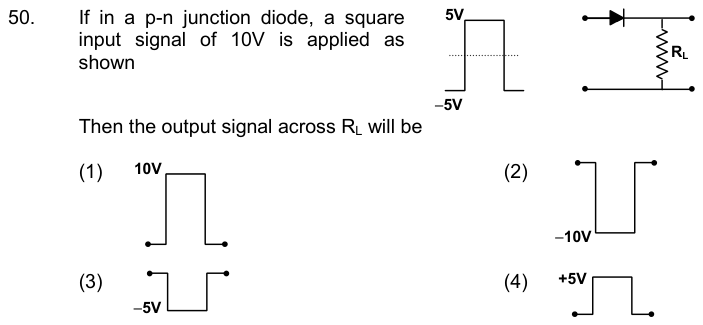
- A.Waveform (1): square pulse 0 to 10 V
- B.Waveform (2): negative pulse to -10 V
- C.Waveform (3): negative pulse to -5 V
- D.Waveform (4): positive pulse +5 V only
Correct answer: D
Explanation: The forward-biased half (+5 V) passes, the -5 V half is blocked.
Question 48
Physics · 3 marks · −1Photon of frequency has a momentum associated with it. If c is the velocity of light, the momentum is
- A.
- B.
- C.
- D.
Correct answer: D
Explanation: .
Question 49
Physics · 3 marks · −1The velocity of a particle is . If its position is x = 0 at t = 0, then its displacement after unit time (t = 1) is
- A.
- B.
- C.
- D.
Correct answer: B
Explanation: Integrate.
Question 50
Physics · 3 marks · −1For the given uniform square lamina ABCD, whose centre is O,

- A.
- B.
- C.
- D.
Correct answer: C
Explanation: By the perpendicular axis theorem and symmetry, all in-plane axes through O have equal moments.
Question 51
Physics · 3 marks · −1A point mass oscillates along the x-axis according to the law . If the acceleration of the particle is written as
- A.,
- B.,
- C.,
- D.,
Correct answer: D
Explanation: .
Question 52
Physics · 3 marks · −1Charges are placed on the vertices of a square as shown. Let be the electric field and V the potential at the centre. If the charges on A and B are interchanged with those on D and C respectively, then
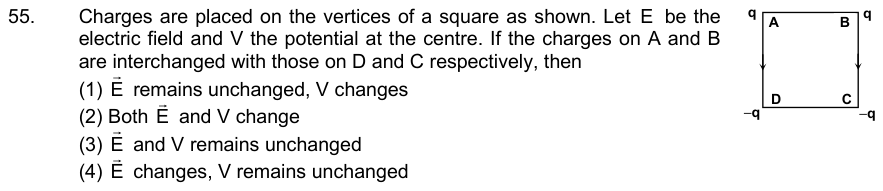
- A. remains unchanged, V changes
- B.Both and V change
- C. and V remains unchanged
- D. changes, V remains unchanged
Correct answer: D
Explanation: Swapping reverses the field direction; the potential (sum of q/r) stays zero.
Question 53
Physics · 3 marks · −1The half-life period of a radio-active element X is same as the mean life time of another radio-active element Y. Initially they have the same number of atoms. Then
- A.X will decay faster than Y
- B.Y will decay faster than X
- C.X and Y have same decay rate initially
- D.X and Y decay at same rate always
Correct answer: B
Explanation: .
Question 54
Physics · 3 marks · −1A Carnot engine, having an efficiency of as heat engine, is used as a refrigerator. If the work done on the system is 10 J, the amount of energy absorbed from the reservoir at lower temperature is
- A.99 J
- B.90 J
- C.1 J
- D.100 J
Correct answer: B
Explanation: COP .
Question 55
Physics · 3 marks · −1Carbon, silicon and germanium have four valence electrons each. At room temperature which one of the following statements is most appropriate?
- A.The number of free conduction electrons is significant in C but small in Si and Ge.
- B.The number of free conduction electrons is negligible small in all the three.
- C.The number of free electrons for conduction is significant in all the three.
- D.The number of free electrons for conduction is significant only in Si and Ge but small in C.
Correct answer: D
Explanation: Diamond has a large band gap.
Question 56
Physics · 3 marks · −1A charged particle with charge q enters a region of constant, uniform and mutually orthogonal fields and with a velocity perpendicular to both and , and comes out without any change in magnitude or direction of . Then
- A.
- B.
- C.
- D.
Correct answer: A
Explanation: .
Question 57
Physics · 3 marks · −1The potential at a point x (measured in m) due to some charges situated on the x-axis is given by Volts. The electric field E at x = 4 m is given by
- A.5/3 Volt/m and in the -ve x direction
- B.5/3 Volt/m and in the +ve x direction
- C.10/9 Volt/m and in the -ve x direction
- D.10/9 Volt/m and in the +ve x direction
Correct answer: D
Explanation: .
Question 58
Physics · 3 marks · −1Which of the following transitions in hydrogen atoms emit photons of highest frequency?
- A.n = 2 to n = 6
- B.n = 6 to n = 2
- C.n = 2 to n = 1
- D.n = 1 to n = 2
Correct answer: C
Explanation: Largest emitted energy gap.
Question 59
Physics · 3 marks · −1A block of mass 'm' is connected to another block of mass 'M' by a spring (massless) of spring constant 'k'. The blocks are kept on a smooth horizontal plane. Initially the blocks are at rest and the spring is unstretched. Then a constant force 'F' starts acting on the block of mass 'M' to pull it. Find the force on the block of mass 'm'
- A.
- B.
- C.
- D.
Correct answer: C
Explanation: Intended: when both move with common acceleration, .
Question 60
Physics · 3 marks · −1Two lenses of power -15 D and +5 D are in contact with each other. The focal length of the combination is
- A.-20 cm
- B.-10 cm
- C.+20 cm
- D.+10 cm
Correct answer: B
Explanation: P = -10 D.
Question 61
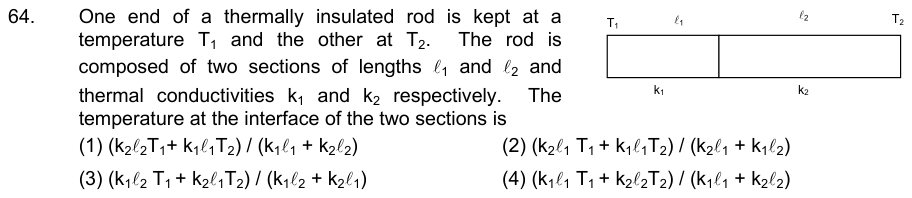
Physics · 3 marks · −1One end of a thermally insulated rod is kept at a temperature and the other at . The rod is composed of two sections of lengths and and thermal conductivities and respectively. The temperature at the interface of the two sections is
- A.
- B.
- C.
- D.
Correct answer: C
Explanation: Equal heat currents: .
Question 62
Physics · 3 marks · −1A sound absorber attenuates the sound level by 20 dB. The intensity decreases by a factor of
- A.1000
- B.10000
- C.10
- D.100
Correct answer: D
Explanation: 20 dB = factor 100.
Question 63
Physics · 3 marks · −1If and denote the specific heats of nitrogen per unit mass at constant pressure and constant volume respectively, then
- A.
- B.
- C.
- D.
Correct answer: A
Explanation: Per unit mass: .
Question 64
Physics · 3 marks · −1A charged particle moves through a magnetic field perpendicular to its direction. Then
- A.the momentum changes but the kinetic energy is constant
- B.both momentum and kinetic energy of the particle are not constant
- C.both, momentum and kinetic energy of the particle are constant
- D.kinetic energy changes but the momentum is constant
Correct answer: A
Explanation: Magnetic force does no work.
Question 65
Physics · 3 marks · −1Two identical conducting wires AOB and COD are placed at right angles to each other. The wire AOB carries an electric current and COD carries a current . The magnetic field on a point lying at a distance 'd' from O, in a direction perpendicular to the plane of the wires AOB and COD, will be given by
- A.
- B.
- C.
- D.
Correct answer: B
Explanation: Perpendicular fields add in quadrature.
Question 66
Physics · 3 marks · −1The resistance of a wire is 5 ohm at C and 6 ohm at C. The resistance of the wire at C will be
- A.2 ohm
- B.1 ohm
- C.4 ohm
- D.3 ohm
Correct answer: C
Explanation: Linear: 1 ohm per C.
Question 67
Physics · 3 marks · −1A parallel plate condenser with a dielectric of dielectric constant K between the plates has a capacity C and is charged to a potential V volts. The dielectric slab is slowly removed from between the plates and then reinserted. The net work done by the system in this process is
- A.
- B.
- C.
- D.zero
Correct answer: D
Explanation: The system returns to its initial state.
Question 68
Physics · 3 marks · −1If and are the accelerations due to gravity on the surfaces of the earth and the moon respectively and if Millikan's oil drop experiment could be performed on the two surfaces, one will find the ratio to be
- A.1
- B.0
- C.
- D.
Correct answer: A
Explanation: Electronic charge is universal.
Question 69
Physics · 3 marks · −1A circular disc of radius R is removed from a bigger circular disc of radius 2R such that the circumferences of the discs coincide. The centre of mass of the new disc is from the centre of the bigger disc. The value of is
- A.1/3
- B.1/2
- C.1/6
- D.1/4
Correct answer: A
Explanation: Interpreting the distance as : .
Question 70
Physics · 3 marks · −1A round uniform body of radius R, mass M and moment of inertia 'I', rolls down (without slipping) an inclined plane making an angle with the horizontal. Then its acceleration is
- A.
- B.
- C.
- D.
Correct answer: A
Explanation: Standard rolling result.
Question 71
Physics · 3 marks · −1Angular momentum of the particle rotating with a central force is constant due to
- A.Constant Force
- B.Constant linear momentum.
- C.Zero Torque
- D.Constant Torque
Correct answer: C
Explanation: Central force exerts no torque.
Question 72
Physics · 3 marks · −1A 2 kg block slides on a horizontal floor with a speed of 4 m/s. It strikes a uncompressed spring, and compresses it till the block is motionless. The kinetic friction force is 15 N and spring constant is 10,000 N/m. The spring compresses by
- A.5.5 cm
- B.2.5 cm
- C.11.0 cm
- D.8.5 cm
Correct answer: A
Explanation: m.
Question 73
Physics · 3 marks · −1A particle is projected at to the horizontal with a kinetic energy K. The kinetic energy at the highest point is
- A.K
- B.Zero
- C.K/2
- D.K/4
Correct answer: D
Explanation: .
Question 74
Physics · 3 marks · −1In a Young's double slit experiment the intensity at a point where the path difference is ( being the wavelength of the light used) is I. If denotes the maximum intensity, is equal to
- A.
- B.
- C.1/2
- D.3/4
Correct answer: D
Explanation: , .
Question 75
Physics · 3 marks · −1Two springs, of force constants and , are connected to a mass m as shown. The frequency of oscillation of the mass is f. If both and are made four times their original values, the frequency of oscillation becomes

- A.f/2
- B.f/4
- C.4f
- D.2f
Correct answer: D
Explanation: Parallel combination: .
Question 76
Physics · 3 marks · −1When a system is taken from state i to state f along the path iaf, it is found that Q = 50 cal and W = 20 cal. Along the path ibf Q = 36 cal. W along the path ibf is

- A.6 cal
- B.16 cal
- C.66 cal
- D.14 cal
Correct answer: A
Explanation: cal; .
Question 77
Physics · 3 marks · −1A particle of mass m executes simple harmonic motion with amplitude 'a' and frequency ''. The average kinetic energy during its motion from the position of equilibrium to the end is
- A.
- B.
- C.
- D.
Correct answer: A
Explanation: Time average .
Question 78
Chemistry · 3 marks · −1The energies of activation for forward and reverse reactions for are 180 kJ mol and 200 kJ mol respectively. The presence of catalyst lowers the activation energy of both (forward and reverse) reactions by 100 kJ mol. The enthalpy change of the reaction in the presence of catalyst will be (in kJ mol)
- A.300
- B.120
- C.280
- D.20
Correct answer: D
Explanation: kJ/mol, unchanged by the catalyst; the magnitude 20 is offered.
Question 79
Chemistry · 3 marks · −1The cell, ( V), was allowed to be completely discharged at 298 K. The relative concentration of to is
- A.antilog (24.08)
- B.37.3
- C.
- D.
Correct answer: C
Explanation: .
Question 80
Chemistry · 3 marks · −1The pKa of a weak acid (HA) is 4.5. The pOH of an aqueous buffered solution of HA in which 50% of the acid is ionized is
- A.4.5
- B.2.5
- C.9.5
- D.7.0
Correct answer: C
Explanation: pH = pKa = 4.5.
Question 81
Chemistry · 3 marks · −1Consider the reaction, Products. When concentration of B alone was doubled, the half-life did not change. When the concentration of A alone was doubled, the rate increased by two times. The unit of rate constant for this reaction is
- A.L mol s
- B.no unit
- C.mol L s
- D.s
Correct answer: A
Explanation: First order in each: overall second order.
Question 82
Chemistry · 3 marks · −1Identify the incorrect statement among the following
- A.d-Block elements show irregular and erratic chemical properties among themselves
- B.La and Lu have partially filled d orbitals and no other partially filled orbitals
- C.The chemistry of various lanthanoids is very similar
- D.4f and 5f orbitals are equally shielded
Correct answer: D
Explanation: 4f is more shielded than 5f.
Question 83
Chemistry · 3 marks · −1Which one of the following has a square planar geometry?
- A.
- B.
- C.
- D.
Correct answer: D
Explanation: 5d complexes are square planar.
Question 84
Chemistry · 3 marks · −1Which of the following molecules is expected to rotate the plane of plane polarized light?
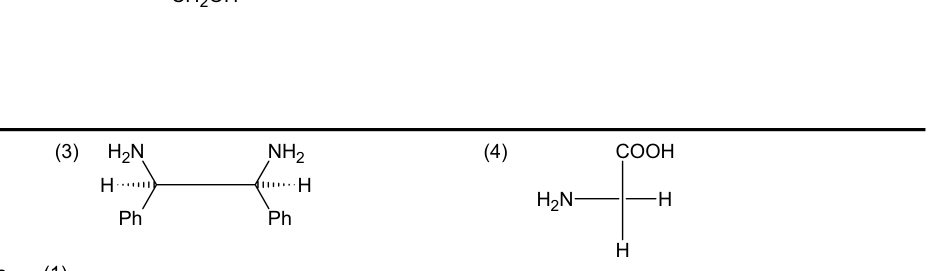
- A.D-glyceraldehyde (Fischer projection: CHO, H-C-OH, CH2OH)
- B.3-pentanethiol ()
- C.meso-1,2-diphenylethane-1,2-diamine
- D.Glycine ()
Correct answer: A
Explanation: Only glyceraldehyde is chiral.
Question 85
Chemistry · 3 marks · −1The secondary structure of a protein refers to
- A.-helical backbone
- B.hydrophobic interactions
- C.sequence of -amino acids
- D.fixed configuration of the polypeptide backbone
Correct answer: A
Explanation: H-bonded helices/sheets.
Question 86
Chemistry · 3 marks · −1Which of the following reactions will yield 2, 2-dibromopropane?
- A.
- B.
- C.
- D.
Correct answer: A
Explanation: Markovnikov addition twice to propyne.
Question 87
Chemistry · 3 marks · −1In the chemical reaction, , the compound (A) and (B) are respectively
- A. and 3KCl
- B. and 3KCl
- C. and
- D. and 3KCl
Correct answer: D
Explanation: Carbylamine reaction.
Question 88
Chemistry · 3 marks · −1The reaction of toluene with in presence of gives predominantly
- A.benzoyl chloride
- B.benzyl chloride
- C.o-and p-chlorotoluene
- D.m-chlorotoluene
Correct answer: C
Explanation: Ring chlorination, o/p directed.
Question 89
Chemistry · 3 marks · −1Presence of a nitro group in a benzene ring
- A.activates the ring towards electrophilic substitution
- B.renders the ring basic
- C.deactivates the ring towards nucleophilic substitution
- D.deactivates the ring towards electrophilic substitution
Correct answer: D
Explanation: -M/-I withdrawal.
Question 90
Chemistry · 3 marks · −1In which of the following ionization processes, the bond order has increased and the magnetic behaviour has changed?
- A.
- B.
- C.
- D.
Correct answer: B
Explanation: NO loses an antibonding electron and becomes diamagnetic.
Question 91
Chemistry · 3 marks · −1The actinoids exhibits more number of oxidation states in general than the lanthanoids. This is because
- A.the 5f orbitals are more buried than the 4f orbitals
- B.there is a similarity between 4f and 5f orbitals in their angular part of the wave function
- C.the actinoids are more reactive than the lanthanoids
- D.the 5f orbitals extend further from the nucleus than the 4f orbitals
Correct answer: D
Explanation: 5f are less buried.
Question 92
Chemistry · 3 marks · −1Equal masses of methane and oxygen are mixed in an empty container at C. The fraction of the total pressure exerted by oxygen is
- A.
- B.
- C.
- D.
Correct answer: C
Explanation: Mole fraction .
Question 93
Chemistry · 3 marks · −1A 5.25 % solution of a substance is isotonic with a 1.5% solution of urea (molar mass = 60 g mol) in the same solvent. If the densities of both the solutions are assumed to be equal to 1.0 g cm, molar mass of the substance will be
- A.90.0 g mol
- B.115.0 g mol
- C.105.0 g mol
- D.210.0 g mol
Correct answer: D
Explanation: .
Question 94
Chemistry · 3 marks · −1Assuming that water vapour is an ideal gas, the internal energy () when 1 mol of water is vapourised at 1 bar pressure and C, (Given: Molar enthalpy of vapourization of water at 1 bar and 373 K = 41 kJ mol and R = 8.3 J molK) will be
- A.4.100 kJ mol
- B.3.7904 kJ mol
- C.37.904 kJ mol
- D.41.00 kJ mol
Correct answer: C
Explanation: .
Question 95
Chemistry · 3 marks · −1In a saturated solution of the sparingly soluble strong electrolyte (Molecular mass = 283) the equilibrium which sets in is . If the solubility product constant of at a given temperature is , what is the mass of contained in 100 ml of its saturated solution?
- A. g
- B. g
- C. g
- D. g
Correct answer: B
Explanation: M; mol in 100 mL.
Question 96
Chemistry · 3 marks · −1A radioactive element gets spilled over the floor of a room. Its half-life period is 30 days. If the initial activity is ten times the permissible value, after how many days will it be safe to enter the room?
- A.1000 days
- B.300 days
- C.10 days
- D.100 days
Correct answer: D
Explanation: days.
Question 97
Chemistry · 3 marks · −1Which one of the following conformation of cyclohexane is chiral?
- A.Twist boat
- B.Rigid
- C.Chair
- D.Boat
Correct answer: A
Explanation: Twist-boat has no mirror plane.
Question 98
Chemistry · 3 marks · −1Which of the following is the correct order of decreasing reactivity? (X = a halogen)
- A.
- B.
- C.
- D.
Correct answer: B
Explanation: Steric hindrance.
Question 99
Chemistry · 3 marks · −1In the following sequence of reactions, the compound 'D' is
- A.butanal
- B.n-butyl alcohol
- C.n-propyl alcohol
- D.propanal
Correct answer: C
Explanation: .
Question 100
Chemistry · 3 marks · −1Which of the following sets of quantum numbers represents the highest energy of an atom?
- A.n = 3, l = 2, m = 1, s = +1/2
- B.n = 3, l = 2, m = 1, s = +1/2
- C.n = 4, l = 0, m = 0, s = +1/2
- D.n = 3, l = 0, m = 0, s = +1/2
Correct answer: B
Explanation: 3d (n + l = 5) is higher than 4s (4 + 0).
Question 101
Chemistry · 3 marks · −1Which of the following hydrogen bonds is the strongest?
- A.O-H.......N
- B.F-H.......F
- C.O-H.......O
- D.O-H.......F
Correct answer: B
Explanation: F is the most electronegative.
Question 102
Chemistry · 3 marks · −1In the reaction, ,
- A.6 L HCl(aq) is consumed for every 3L (g) produced
- B.33.6 L (g) is produced regardless of temperature and pressure for every mole Al that reacts
- C.67.2 L (g) at STP is produced for every mole Al that reacts
- D.11.2 L (g) at STP is produced for every mole HCl(aq) consumed
Correct answer: D
Explanation: 0.5 mol per mol HCl.
Question 103
Chemistry · 3 marks · −1Regular use of which of the following fertilizer increases the acidity of soil?
- A.Potassium nitrate
- B.Urea
- C.Superphosphate of lime
- D.Ammonium sulphate
Correct answer: D
Explanation: hydrolysis.
Question 104
Chemistry · 3 marks · −1Identify the correct statement regarding a spontaneous process
- A.For a spontaneous process in an isolated system, the change in entropy is positive
- B.Endothermic processes are never spontaneous
- C.Exothermic processes are always spontaneous
- D.Lowering of energy in the reaction process is the only criterion for spontaneity
Correct answer: A
Explanation: Second law.
Question 105
Chemistry · 3 marks · −1Which of the following nuclear reactions will generate an isotope?
- A.neutron particle emission
- B.positron emission
- C.-particle emission
- D.-particle emission
Correct answer: A
Explanation: Z unchanged.
Question 106
Chemistry · 3 marks · −1The equivalent conductances of two strong electrolytes at infinite dilution in (where ions move freely through a solution) at C are given below: S cm/equiv, S cm/equiv. What additional information/quantity one needs to calculate of an aqueous solution of acetic acid?
- A. of NaCl
- B. of
- C.The limiting equivalent conductance of ()
- D. of chloroacetic acid ()
Correct answer: A
Explanation: Kohlrausch: .
Question 107
Chemistry · 3 marks · −1Which one of the following is the strongest base in aqueous solution?
- A.Trimethylamine
- B.Aniline
- C.Dimethylamine
- D.Methylamine
Correct answer: C
Explanation: In water: 2° > 1° > 3° for methylamines.
Question 108
Chemistry · 3 marks · −1The compound formed as a result of oxidation of ethyl benzene by is
- A.benzophenone
- B.acetophenone
- C.benzoic acid
- D.benzyl alcohol
Correct answer: C
Explanation: Side-chain oxidation.
Question 109
Chemistry · 3 marks · −1The IUPAC name of the compound shown (skeletal: a seven-carbon chain with two methyls on C4 and an ethyl on C3) is

- A.1, 1-diethyl-2,2-dimethylpentane
- B.4, 4-dimethyl-5, 5-diethylpentane
- C.5, 5-diethyl-4, 4-diemthylpentane
- D.3-ethyl-4, 4-dimethylheptane
Correct answer: D
Explanation: Longest chain seven carbons.
Question 110
Chemistry · 3 marks · −1Which of the following species exhibits the diamagnetic behaviour?
- A.
- B.
- C.
- D.NO
Correct answer: A
Explanation: 18 electrons, all paired.
Question 111
Chemistry · 3 marks · −1The stability of dihalides of Si, Ge, Sn and Pb increases steadily in the sequence
- A.
- B.
- C.
- D.
Correct answer: C
Explanation: Inert pair effect.
Question 112
Chemistry · 3 marks · −1The charge/size ratio of a cation determines its polarizing power. Which one of the following sequences represents the increasing order of the polarizing power of the cationic species, , , , ?
- A.
- B.
- C.
- D.
Correct answer: C
Explanation: Increasing charge/size.
Question 113
Chemistry · 3 marks · −1The density (in g mL) of a 3.60 M sulphuric acid solution that is 29% (Molar mass = 98 g mol) by mass will be
- A.1.64
- B.1.88
- C.1.22
- D.1.45
Correct answer: C
Explanation: .
Question 114
Chemistry · 3 marks · −1The first and second dissociation constants of an acid are and respectively. The overall dissociation constant of the acid will be
- A.
- B.
- C.
- D.
Correct answer: C
Explanation: .
Question 115
Chemistry · 3 marks · −1A mixture of ethyl alcohol and propyl alcohol has a vapour pressure of 290 mm at 300 K. The vapour pressure of propyl alcohol is 200 mm. If the mole fraction of ethyl alcohol is 0.6, its vapour pressure (in mm) at the same temperature will be
- A.350
- B.300
- C.700
- D.360
Correct answer: A
Explanation: .
Question 116
Chemistry · 3 marks · −1In conversion of lime-stone to lime, the values of and are +179.1 kJ mol and 160.2 J/K respectively at 298 K and 1 bar. Assuming that do not change with temperature, temperature above which conversion of limestone to lime will be spontaneous is
- A.1008 K
- B.1200 K
- C.845 K
- D.1118 K
Correct answer: D
Explanation: .