AIEEE 2008 — 27 Apr Offline Set C-5 (Previous Year Paper)
JEE Main · 2008 · with answers and explanations
- questions
- 98
- Total marks
- 294
- Duration
- 180 minutes
- Negative marking
- −1
Subjects: Mathematics · Chemistry · Physics
Question 1
Mathematics · 3 marks · −1AB is a vertical pole with B at the ground level and A at the top. A man finds that the angle of elevation of the point A from a certain point C on the ground is . He moves away from the pole along the line BC to a point D such that CD = 7 m. From D the angle of elevation of the point A is . Then the height of the pole is
- A. m
- B. m
- C. m
- D.
Correct answer: B
Explanation: ; m.
Question 2
Mathematics · 3 marks · −1It is given that the events A and B are such that , and . Then P(B) is
- A.
- B.
- C.
- D.
Correct answer: B
Explanation: .
Question 3
Mathematics · 3 marks · −1A die is thrown. Let A be the event that the number obtained is greater than 3. Let B be the event that the number obtained is less than 5. Then is
- A.
- B.0
- C.1
- D.
Correct answer: C
Explanation: is the whole sample space.
Question 4
Mathematics · 3 marks · −1A focus of an ellipse is at the origin. The directrix is the line x = 4 and the eccentricity is 1/2. Then the length of the semi-major axis is
- A.
- B.
- C.
- D.
Correct answer: A
Explanation: Focus-directrix distance .
Question 5
Mathematics · 3 marks · −1A parabola has the origin as its focus and the line x = 2 as the directrix. Then the vertex of the parabola is at
- A.(0, 2)
- B.(1, 0)
- C.(0, 1)
- D.(2, 0)
Correct answer: B
Explanation: Midpoint of focus and directrix foot.
Question 6
Mathematics · 3 marks · −1The point diametrically opposite to the point P(1, 0) on the circle is
- A.(3, -4)
- B.(-3, 4)
- C.(-3, -4)
- D.(3, 4)
Correct answer: C
Explanation: Centre (-1, -2) is the midpoint.
Question 7
Mathematics · 3 marks · −1Let be a function defined as , where . Show that f is invertible and its inverse is
- A.
- B.
- C.
- D.
Correct answer: D
Explanation: Solve .
Question 8
Mathematics · 3 marks · −1The conjugate of a complex number is . Then the complex number is
- A.
- B.
- C.
- D.
Correct answer: C
Explanation: Replace i by -i: .
Question 9
Mathematics · 3 marks · −1Let R be the real line. Consider the following subsets of the plane . , . Which one of the following is true?
- A.neither S nor T is an equivalence relation on R
- B.both S and T are equivalence relations on R
- C.S is an equivalence relation on R but T is not
- D.T is an equivalence relation on R but S is not
Correct answer: D
Explanation: T is reflexive, symmetric, transitive; S is not reflexive.
Question 10
Mathematics · 3 marks · −1The perpendicular bisector of the line segment joining P(1, 4) and Q(k, 3) has y-intercept -4. Then a possible value of k is
- A.1
- B.2
- C.-2
- D.-4
Correct answer: D
Explanation: Bisector at x = 0 gives .
Question 11
Mathematics · 3 marks · −1The solution of the differential equation satisfying the condition y(1) = 1 is
- A.
- B.
- C.
- D.
Correct answer: D
Explanation: : .
Question 12
Mathematics · 3 marks · −1The mean of the numbers a, b, 8, 5, 10 is 6 and the variance is 6.80. Then which one of the following gives possible values of a and b?
- A.a = 0, b = 7
- B.a = 5, b = 2
- C.a = 1, b = 6
- D.a = 3, b = 4
Correct answer: D
Explanation: , : {3, 4}.
Question 13
Mathematics · 3 marks · −1The vector lies in the plane of the vectors and and bisects the angle between and . Then which one of the following gives possible values of and ?
- A.
- B.
- C.
- D.
Correct answer: D
Explanation: .
Question 14
Mathematics · 3 marks · −1The non-zero vectors , and are related by and . Then the angle between and is
- A.0
- B.
- C.
- D.
Correct answer: D
Explanation: and are antiparallel.
Question 15
Mathematics · 3 marks · −1The line passing through the points (5, 1, a) and (3, b, 1) crosses the yz-plane at the point . Then
- A.a = 2, b = 8
- B.a = 4, b = 6
- C.a = 6, b = 4
- D.a = 8, b = 2
Correct answer: C
Explanation: at x = 0 gives b = 4, a = 6.
Question 16
Mathematics · 3 marks · −1If the straight lines and intersect at a point, then the integer k is equal to
- A.-5
- B.5
- C.2
- D.-2
Correct answer: A
Explanation: Coplanarity: (integer).
Question 17
Mathematics · 3 marks · −1Statement-1: For every natural number , . Statement-2: For every natural number , .
- A.Statement-1 is false, Statement-2 is true
- B.Statement-1 is true, Statement-2 is true; Statement-2 is a correct explanation for Statement-1
- C.Statement-1 is true, Statement-2 is true; Statement-2 is not a correct explanation for Statement-1
- D.Statement-1 is true, Statement-2 is false
Correct answer: C
Explanation: Both are provable (induction / AM-GM), but Statement-2 is not what makes Statement-1 true.
Question 18
Mathematics · 3 marks · −1Let A be a matrix with real entries. Let I be the identity matrix. Denote by tr(A), the sum of diagonal entries of A. Assume that . Statement-1: If and , then det A = -1. Statement-2: If and , then .
- A.Statement-1 is false, Statement-2 is true
- B.Statement-1 is true, Statement-2 is true; Statement-2 is a correct explanation for Statement-1
- C.Statement-1 is true, Statement-2 is true; Statement-2 is not a correct explanation for Statement-1
- D.Statement-1 is true, Statement-2 is false
Correct answer: D
Explanation: Such A has , so and .
Question 19
Mathematics · 3 marks · −1Statement-1: . Statement-2: .
- A.Statement-1 is false, Statement-2 is true
- B.Statement-1 is true, Statement-2 is true; Statement-2 is a correct explanation for Statement-1
- C.Statement-1 is true, Statement-2 is true; Statement-2 is not a correct explanation for Statement-1
- D.Statement-1 is true, Statement-2 is false
Correct answer: B
Explanation: Put x = 1 in Statement-2: .
Question 20
Mathematics · 3 marks · −1Let p be the statement 'x is an irrational number', q be the statement 'y is a transcendental number', and r be the statement 'x is a rational number iff y is a transcendental number'. Statement-1: r is equivalent to either q or p. Statement-2: r is equivalent to .
- A.Statement-1 is false, Statement-2 is true
- B.Statement-1 is true, Statement-2 is true; Statement-2 is a correct explanation for Statement-1
- C.Statement-1 is true, Statement-2 is true; Statement-2 is not a correct explanation for Statement-1
- D.Statement-1 is true, Statement-2 is false
Correct answer: D
Explanation: , i.e. exactly one of p, q (Statement-1 true); (false).
Question 21
Mathematics · 3 marks · −1In a shop there are five types of ice-creams available. A child buys six ice-creams. Statement-1: The number of different ways the child can buy the six ice-creams is . Statement-2: The number of different ways the child can buy the six ice-creams is equal to the number of different ways of arranging 6 A's and 4 B's in a row.
- A.Statement-1 is false, Statement-2 is true
- B.Statement-1 is true, Statement-2 is true; Statement-2 is a correct explanation for Statement-1
- C.Statement-1 is true, Statement-2 is true; Statement-2 is not a correct explanation for Statement-1
- D.Statement-1 is true, Statement-2 is false
Correct answer: A
Explanation: Count ; Statement-2 (stars and bars) is true.
Question 22
Mathematics · 3 marks · −1The first two terms of a geometric progression add up to 12. The sum of the third and the fourth terms is 48. If the terms of the geometric progression are alternately positive and negative, then the first term is
- A.-4
- B.-12
- C.12
- D.4
Correct answer: B
Explanation: , , .
Question 23
Mathematics · 3 marks · −1Suppose the cubic has three distinct real roots where p > 0 and q > 0. Then which one of the following holds?
- A.The cubic has minima at and maxima at
- B.The cubic has minima at and maxima at
- C.The cubic has minima at both and
- D.The cubic has maxima at both and
Correct answer: A
Explanation: .
Question 24
Mathematics · 3 marks · −1How many real solutions does the equation have?
- A.7
- B.1
- C.3
- D.5
Correct answer: B
Explanation: Strictly increasing polynomial of odd degree.
Question 25
Mathematics · 3 marks · −1The statement is equivalent to
- A.
- B.
- C.
- D.
Correct answer: B
Explanation: Both are tautologies.
Question 26
Mathematics · 3 marks · −1The value of is
- A.
- B.
- C.
- D.
Correct answer: A
Explanation: .
Question 27
Mathematics · 3 marks · −1The differential equation of the family of circles with fixed radius 5 units and centre on the line y = 2 is
- A.
- B.
- C.
- D.
Correct answer: C
Explanation: Eliminate h: .
Question 28
Mathematics · 3 marks · −1Let and . Then which one of the following is true?
- A. and
- B. and
- C. and
- D. and
Correct answer: B
Explanation: , .
Question 29
Mathematics · 3 marks · −1The area of the plane region bounded by the curves and is equal to
- A.
- B.
- C.
- D.
Correct answer: D
Explanation: .
Question 30
Mathematics · 3 marks · −1The value of is
- A.
- B.
- C.
- D.
Correct answer: C
Explanation: Write .
Question 31
Mathematics · 3 marks · −1How many different words can be formed by jumbling the letters in the word MISSISSIPPI in which no two S are adjacent?
- A.
- B.
- C.
- D.
Correct answer: D
Explanation: Arrange MIIIIPP: ; choose 4 of 8 gaps for S.
Question 32
Mathematics · 3 marks · −1Let a, b, c be any real numbers. Suppose that there are real numbers x, y, z not all zero such that , and . Then is equal to
- A.2
- B.-1
- C.0
- D.1
Correct answer: D
Explanation: Determinant zero gives .
Question 33
Mathematics · 3 marks · −1Let A be a square matrix all of whose entries are integers. Then which one of the following is true?
- A.If det A = , then exists but all its entries are not necessarily integers
- B.If det A , then exists and all its entries are non-integers
- C.If det A = , then exists and all its entries are integers
- D.If det A = , then need not exist
Correct answer: C
Explanation: has integer entries.
Question 34
Mathematics · 3 marks · −1The quadratic equations and have one root in common. The other roots of the first and second equations are integers in the ratio 4 : 3. Then the common root is
- A.1
- B.4
- C.3
- D.2
Correct answer: D
Explanation: Roots and : , , roots 2 and 4; integer condition gives .
Question 35
Chemistry · 3 marks · −1The organic chloro compound, which shows complete stereochemical inversion during a reaction, is
- A.
- B.
- C.
- D.
Correct answer: D
Explanation: Least hindered substrate.
Question 36
Chemistry · 3 marks · −1Toluene is nitrated and the resulting product is reduced with tin and hydrochloric acid. The product so obtained is diazotised and then heated with cuprous bromide. The reaction mixture so formed contains
- A.mixture of o- and p-bromotoluenes
- B.mixture of o- and p-dibromobenzenes
- C.mixture of o- and p-bromoanilines
- D.mixture of o- and m-bromotoluenes
Correct answer: A
Explanation: o/p-nitrotoluene, then toluidines, then Sandmeyer bromination.
Question 37
Chemistry · 3 marks · −1The coordination number and the oxidation state of the element 'E' in the complex (where (en) is ethylene diamine) are, respectively,
- A.6 and 2
- B.4 and 2
- C.4 and 3
- D.6 and 3
Correct answer: D
Explanation: Three bidentate ligands; charge balance gives +3.
Question 38
Chemistry · 3 marks · −1Identify the wrong statements in the following:
- A.Chlorofluorocarbons are responsible for ozone layer depletion
- B.Greenhouse effect is responsible for global warming
- C.Ozone layer does not permit infrared radiation from the sun to reach the earth
- D.Acid rains is mostly because of oxides of nitrogen and sulphur
Correct answer: C
Explanation: Ozone absorbs UV, not IR.
Question 39
Chemistry · 3 marks · −1Phenol, when it first reacts with concentrated sulphuric acid and then with concentrated nitric acid, gives
- A.2,4,6-trinitrobenzene
- B.o-nitrophenol
- C.p-nitrophenol
- D.nitrobenzene
Correct answer: B
Explanation: Sulphonation blocks the para position; nitration goes ortho (the SO3H is later lost).
Question 40
Chemistry · 3 marks · −1In the following sequence of reactions, the alkene affords the compound 'B': . The compound B is
- A.
- B.
- C.
- D.
Correct answer: D
Explanation: Reductive ozonolysis of 2-butene.
Question 41
Chemistry · 3 marks · −1Larger number of oxidation states are exhibited by the actinoids than those by the lanthanoids, the main reason being
- A.4f orbitals more diffused than the 5f orbitals
- B.lesser energy difference between 5f and 6d than between 4f and 5d orbitals
- C.more energy difference between 5f and 6d than between 4f and 5d orbitals
- D.more reactive nature of the actinoids than the lanthanoids
Correct answer: B
Explanation: Comparable 5f/6d energies.
Question 42
Chemistry · 3 marks · −1In which of the following octahedral complexes of Co (at. no. 27), will the magnitude of be the highest?
- A.
- B.
- C.
- D.
Correct answer: A
Explanation: is the strongest-field ligand.
Question 43
Chemistry · 3 marks · −1At C, the vapour pressure of pure liquid 'A' is 520 mm Hg and that of pure liquid 'B' is 1000 mm Hg. If a mixture solution of 'A' and 'B' boils at C and 1 atm pressure, the amount of 'A' in the mixture is (1 atm = 760 mm Hg)
- A.52 mol percent
- B.34 mol percent
- C.48 mol percent
- D.50 mol percent
Correct answer: D
Explanation: .
Question 44
Chemistry · 3 marks · −1For a reaction , rate of disappearance of 'A' is related to the rate of appearance of 'B' by the expression
- A.
- B.
- C.
- D.
Correct answer: B
Explanation: .
Question 45
Chemistry · 3 marks · −1The equilibrium constants and for the reactions and , respectively are in the ratio of 1 : 9. If the degree of dissociation of X and Z be equal then the ratio of total pressure at these equilibria is
- A.1 : 36
- B.1 : 1
- C.1 : 3
- D.1 : 9
Correct answer: A
Explanation: .
Question 46
Chemistry · 3 marks · −1Oxidising power of chlorine in aqueous solution can be determined by the parameters indicated below: . The energy involved in the conversion of to (using the data, kJ mol, kJ mol, kJ mol) will be
- A. kJ mol
- B. kJ mol
- C. kJ mol
- D. kJ mol
Correct answer: B
Explanation: kJ/mol.
Question 47
Chemistry · 3 marks · −1Bakelite is obtained from phenol by reacting with
- A.
- B.
- C.
- D.HCHO
Correct answer: D
Explanation: Phenol-formaldehyde resin.
Question 48
Chemistry · 3 marks · −1For the following three reactions a, b and c, equilibrium constants are given: a. ; b. ; c. ; . Which of the following relations is correct?
- A.
- B.
- C.
- D.
Correct answer: C
Explanation: c = a + b.
Question 49
Chemistry · 3 marks · −1The absolute configuration of tartaric acid drawn as with the C1-OH on a hashed bond and the C2-OH on a wedged bond (see figure) is
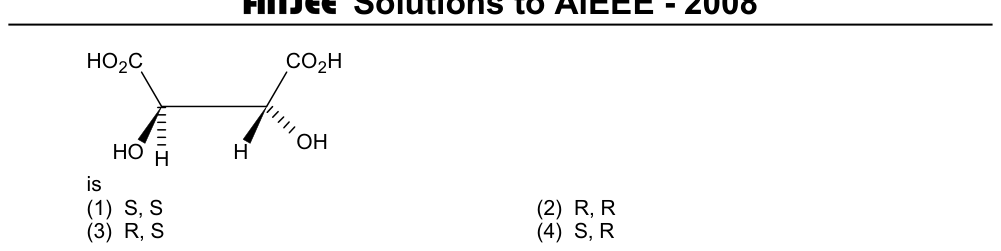
- A.S, S
- B.R, R
- C.R, S
- D.S, R
Correct answer: B
Explanation: Assigning CIP priorities (OH > CO2H > CH(OH) > H) at each centre gives R at both.
Question 50
Chemistry · 3 marks · −1The electrophile, attacks the benzene ring to generate the intermediate -complex. Of the following, which -complex is of lowest energy?
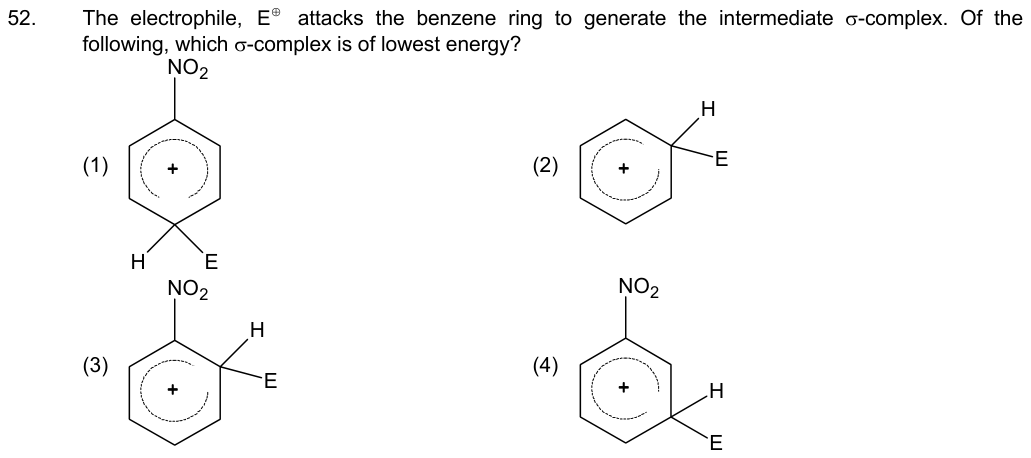
- A.sigma-complex of nitrobenzene with E at the para position
- B.sigma-complex of benzene (no substituent)
- C.sigma-complex of nitrobenzene with E at the ortho position
- D.sigma-complex of nitrobenzene with E at the meta position
Correct answer: B
Explanation: destabilises every arenium ion, so the unsubstituted one is lowest in energy.
Question 51
Chemistry · 3 marks · −1-D-(+)-glucose and -D-(+)-glucose are
- A.conformers
- B.epimers
- C.anomers
- D.enantiomers
Correct answer: C
Explanation: They differ at C1 (anomeric carbon).
Question 52
Chemistry · 3 marks · −1Standard entropy of , and are 60, 40 and 50 JKmol, respectively. For the reaction, , kJ, to be at equilibrium, the temperature will be
- A.1250 K
- B.500 K
- C.750 K
- D.1000 K
Correct answer: C
Explanation: ; .
Question 53
Chemistry · 3 marks · −1Four species are listed below: i. ii. iii. iv. . Which one of the following is the correct sequence of their acid strength?
- A.iv < ii < iii < i
- B.ii < iii < i < iv
- C.i < iii < ii < iv
- D.iii < i < iv < ii
Correct answer: C
Explanation: (superacid) > > > .
Question 54
Chemistry · 3 marks · −1Which one of the following constitutes a group of the isoelectronic species?
- A., , CO, NO
- B., , ,
- C., , ,
- D., , , CO
Correct answer: B
Explanation: All have 14 electrons.
Question 55
Chemistry · 3 marks · −1Which one of the following pairs of species have the same bond order?
- A. and
- B. and
- C. and
- D. and
Correct answer: A
Explanation: Both isoelectronic with , bond order 3.
Question 56
Chemistry · 3 marks · −1The ionization enthalpy of hydrogen atom is J mol. The energy required to excite the electron in the atom from n = 1 to n = 2 is
- A. J mol
- B. J mol
- C. J mol
- D. J mol
Correct answer: D
Explanation: .
Question 57
Chemistry · 3 marks · −1Which one of the following is the correct statement?
- A.Boric acid is a protonic acid
- B.Beryllium exhibits coordination number of six
- C.Chlorides of both beryllium and aluminium have bridged chloride structures in solid phase
- D. is known as 'inorganic benzene'
Correct answer: C
Explanation: chains and dimers are chloride bridged.
Question 58
Chemistry · 3 marks · −1Given V, V. The potential for the cell is
- A.0.26 V
- B.0.399 V
- C.-0.339 V
- D.-0.26 V
Correct answer: A
Explanation: V.
Question 59
Chemistry · 3 marks · −1Amount of oxalic acid present in a solution can be determined by its titration with solution in the presence of . The titration gives unsatisfactory result when carried out in the presence of HCl, because HCl
- A.gets oxidised by oxalic acid to chlorine
- B.furnishes ions in addition to those from oxalic acid
- C.reduces permanganate to
- D.oxidises oxalic acid to carbon dioxide and water
Correct answer: C
Explanation: HCl consumes permanganate.
Question 60
Chemistry · 3 marks · −1The vapour pressure of water at C is 17.5 mm Hg. If 18 g of glucose is added to 178.2 g of water at C, the vapour pressure of the resulting solution will be
- A.17.675 mm Hg
- B.15.750 mm Hg
- C.16.500 mm Hg
- D.17.325 mm Hg
Correct answer: D
Explanation: : .
Question 61
Chemistry · 3 marks · −1Among the following substituted silanes the one which will give rise to cross linked silicone polymer on hydrolysis is
- A.
- B.
- C.
- D.
Correct answer: B
Explanation: Trifunctional cross-links.
Question 62
Chemistry · 3 marks · −1In context with the industrial preparation of hydrogen from water gas , which of the following is the correct statement?
- A.CO and are fractionally separated using differences in their densities
- B.CO is removed by absorption in aqueous solution
- C. is removed through occlusion with Pd
- D.CO is oxidised to with steam in the presence of a catalyst followed by absorption of in alkali
Correct answer: D
Explanation: Water-gas shift then scrubbing.
Question 63
Chemistry · 3 marks · −1In a compound atoms of element Y from ccp lattice and those of element X occupy of tetrahedral voids. The formula of the compound will be
- A.
- B.
- C.
- D.
Correct answer: A
Explanation: Y = 4, X = .
Question 64
Chemistry · 3 marks · −1Gold numbers of protective colloids A, B, C and D are 0.50, 0.01, 0.10 and 0.005, respectively. The correct order of their protective powers is
- A.D < A < C < B
- B.C < B < D < A
- C.A < C < B < D
- D.B < D < A < C
Correct answer: C
Explanation: Protective power is inverse of gold number.
Question 65
Chemistry · 3 marks · −1The hydrocarbon which can react with sodium in liquid ammonia is
- A.
- B.
- C.
- D.
Correct answer: B
Explanation: Terminal alkyne has an acidic H.
Question 66
Chemistry · 3 marks · −1The treatment of with produces
- A.
- B.
- C.
- D.
Correct answer: D
Explanation: Acid-base: the acetylenic H protonates the Grignard.
Question 67
Chemistry · 3 marks · −1The of a weak acid, HA, is 4.80. The of a weak base, BOH, is 4.78. The pH of an aqueous solution of the corresponding salt, BA, will be
- A.9.58
- B.4.79
- C.7.01
- D.9.22
Correct answer: C
Explanation: .
Question 68
Physics · 3 marks · −1Wave property of electrons implies that they will show diffraction effects. Davisson and Germer demonstrated this by diffracting electrons from crystals. The law governing the diffraction from a crystal is obtained by requiring that electron waves reflected from the planes of atoms in a crystal interfere constructively (see in figure). Electrons accelerated by potential V are diffracted from a crystal. If d = 1 Å and i = , V should be about ( Js, kg, C)

- A.2000 V
- B.50 V
- C.500 V
- D.1000 V
Correct answer: B
Explanation: Å Å V.
Question 69
Physics · 3 marks · −1Wave property of electrons implies that they will show diffraction effects. Davisson and Germer demonstrated this by diffracting electrons from crystals. The law governing the diffraction from a crystal is obtained by requiring that electron waves reflected from the planes of atoms in a crystal interfere constructively (see in figure). In an experiment, electrons are made to pass through a narrow slit of width 'd' comparable to their de Broglie wavelength. They are detected on a screen at a distance 'D' from the slit (see figure). Which of the following graph can be expected to represent the number of electrons 'N' detected as a function of the detector position 'y' (y = 0 corresponds to the middle of the slit)?
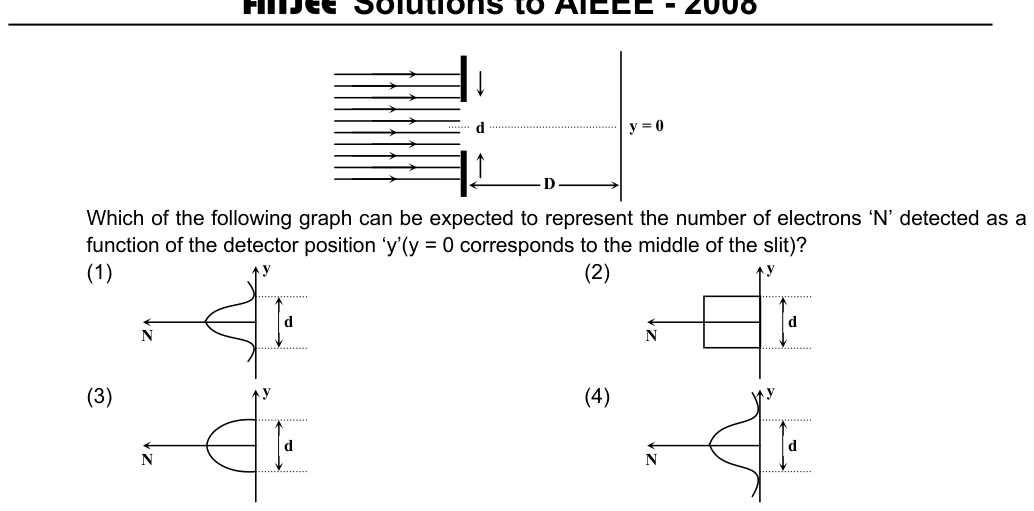
- A.Graph (1)
- B.Graph (2)
- C.Graph (3)
- D.Graph (4)
Correct answer: D
Explanation: Single-slit diffraction: central maximum wider than d with side lobes.
Question 70
Physics · 3 marks · −1A planet in a distant solar system is 10 times more massive than the earth and its radius is 10 times smaller. Given that the escape velocity from the earth is 11 kms, the escape velocity from the surface of the planet would be
- A.1.1 kms
- B.11 kms
- C.110 kms
- D.0.11 kms
Correct answer: C
Explanation: : factor 10.
Question 71
Physics · 3 marks · −1A spherical solid ball of volume V is made of a material of density . It is falling through a liquid of density . Assume that the liquid applies a viscous force on the ball that is proportional to the square of its speed v, i.e., . The terminal speed of the ball is
- A.
- B.
- C.
- D.
Correct answer: A
Explanation: .
Question 72
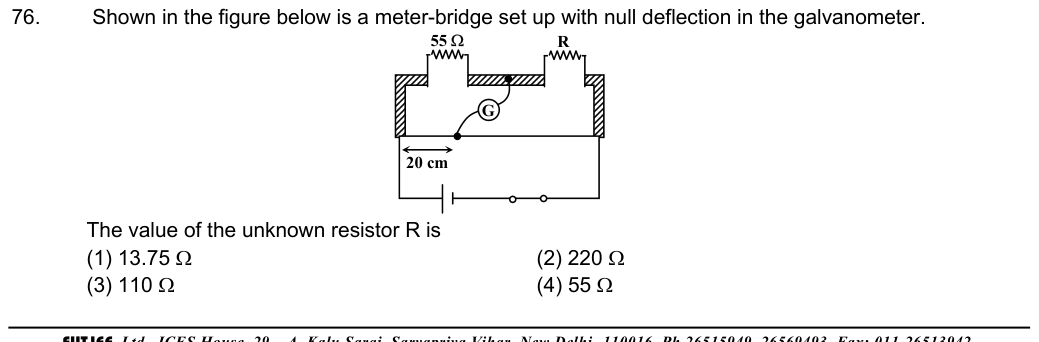
Physics · 3 marks · −1Shown in the figure below is a meter-bridge set up with null deflection in the galvanometer. The value of the unknown resistor R is
- A.
- B.
- C.
- D.
Correct answer: B
Explanation: .
Question 73
Physics · 3 marks · −1A thin rod of length 'L' is lying along the x-axis with its ends at x = 0 and x = L. Its linear density (mass/length) varies with x as , where n can be zero or any positive number. If the position of the centre of mass of the rod is plotted against 'n', which of the following graphs best approximates the dependence of on n?
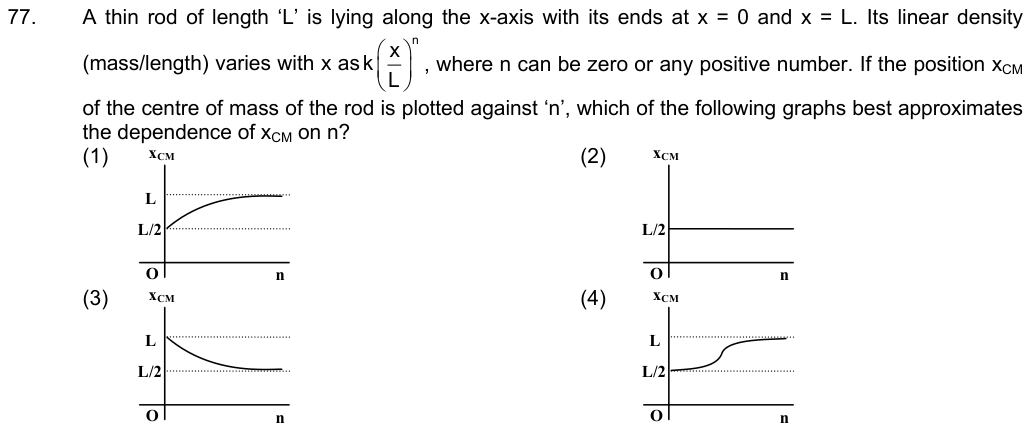
- A.Graph (1)
- B.Graph (2)
- C.Graph (3)
- D.Graph (4)
Correct answer: A
Explanation: : starts at and rises towards L.
Question 74
Physics · 3 marks · −1While measuring the speed of sound by performing a resonance column experiment, a student gets the first resonance condition at a column length of 18 cm during winter. Repeating the same experiment during summer, she measures the column length to be x cm for the second resonance. Then
- A.18 > x
- B.x > 54
- C.54 > x > 36
- D.36 > x > 18
Correct answer: B
Explanation: Second resonance is 3 times the first; higher summer temperature increases the speed, so .
Question 75
Physics · 3 marks · −1The dimension of magnetic field in M, L, T and C (Coulomb) is given as
- A.
- B.
- C.
- D.
Correct answer: C
Explanation: .
Question 76
Physics · 3 marks · −1Consider a uniform square plate of side 'a' and mass 'm'. The moment of inertia of this plate about an axis perpendicular to its plane and passing through one of its corners is
- A.
- B.
- C.
- D.
Correct answer: D
Explanation: .
Question 77
Physics · 3 marks · −1A body of mass m = 3.513 kg is moving along the x-axis with a speed of 5.00 ms. The magnitude of its momentum is recorded as
- A.17.6 kg ms
- B.17.565 kg ms
- C.17.56 kg ms
- D.17.57 kg ms
Correct answer: A
Explanation: Three significant figures.
Question 78
Physics · 3 marks · −1An athlete in the olympic games covers a distance of 100 m in 10 s. His kinetic energy can be estimated to be in the range
- A.200 J - 500 J
- B. J - J
- C.20,000 J - 50,000 J
- D.2,000 J - 5,000 J
Correct answer: D
Explanation: J.
Question 79
Physics · 3 marks · −1A parallel plate capacitor with air between the plates has a capacitance of 9 pF. The separation between its plates is 'd'. The space between the plates is now filled with two dielectrics. One of the dielectrics has dielectric constant and thickness while the other one has dielectric constant and thickness . Capacitance of the capacitor is now
- A.1.8 pF
- B.45 pF
- C.40.5 pF
- D.20.25 pF
Correct answer: C
Explanation: .
Question 80
Physics · 3 marks · −1Statement-1: Energy is released when heavy nuclei undergo fission or light nuclei undergo fusion. Statement-2: For heavy nuclei, binding energy per nucleon increases with increasing Z while for light nuclei it decreases with increasing Z.
- A.Statement-1 is false, Statement-2 is true.
- B.Statement-1 is true, Statement-2 is true; Statement-2 is correct explanation for Statement-1.
- C.Statement-1 is true, Statement-2 is true; Statement-2 is not a correct explanation for Statement-1.
- D.Statement-1 is true, Statement-2 is False.
Correct answer: D
Explanation: Binding energy per nucleon decreases with Z for heavy nuclei and increases for light nuclei, so Statement-2 is false.
Question 81
Physics · 3 marks · −1Statement-1: For a mass M kept at the centre of a cube of side 'a', the flux of gravitational field passing through its sides is . Statement-2: If the direction of a field due to a point source is radial and its dependence on the distance 'r' for the source is given as , its flux through a closed surface depends only on the strength of the source enclosed by the surface and not on the size or shape of the surface
- A.Statement-1 is false, Statement-2 is true.
- B.Statement-1 is true, Statement-2 is true; Statement-2 is correct explanation for Statement-1.
- C.Statement-1 is true, Statement-2 is true; Statement-2 is not a correct explanation for Statement-1.
- D.Statement-1 is true, Statement-2 is False.
Correct answer: B
Explanation: Gauss's law for gravity.
Question 82
Physics · 3 marks · −1A jar filled with two non mixing liquids 1 and 2 having densities and respectively. A solid ball, made of a material of density , is dropped in the jar. It comes to equilibrium in the position shown in the figure. Which of the following is true for , and ?

- A.
- B.
- C.
- D.
Correct answer: D
Explanation: Liquid 1 floats on liquid 2, the ball sits at the interface.
Question 83
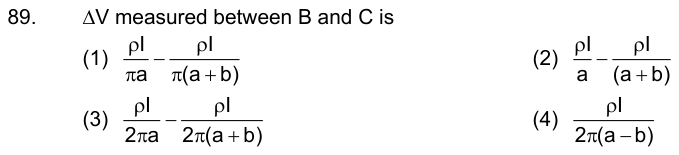
Physics · 3 marks · −1Consider a block of conducting material of resistivity '' shown in the figure. Current 'I' enters at 'A' and leaves from 'D'. We apply superposition principle to find voltage '' developed between 'B' and 'C'. The calculation is done in the following steps: (i) Take current 'I' entering from 'A' and assume it to spread over a hemispherical surface in the block. (ii) Calculate field E(r) at distance 'r' from A by using Ohm's law , where j is the current per unit area at 'r'. (iii) From the 'r' dependence of E(r), obtain the potential V(r) at r. (iv) Repeat (i), (ii) and (iii) for current 'I' leaving 'D' and superpose results for 'A' and 'D'. For current entering at A, the electric field at a distance 'r' from A is
- A.
- B.
- C.
- D.
Correct answer: C
Explanation: over a hemisphere.
Question 84
Physics · 3 marks · −1A student measures the focal length of convex lens by putting an object pin at a distance 'u' from the lens and measuring the distance 'v' of the image pin. The graph between 'u' and 'v' plotted by the student should look like
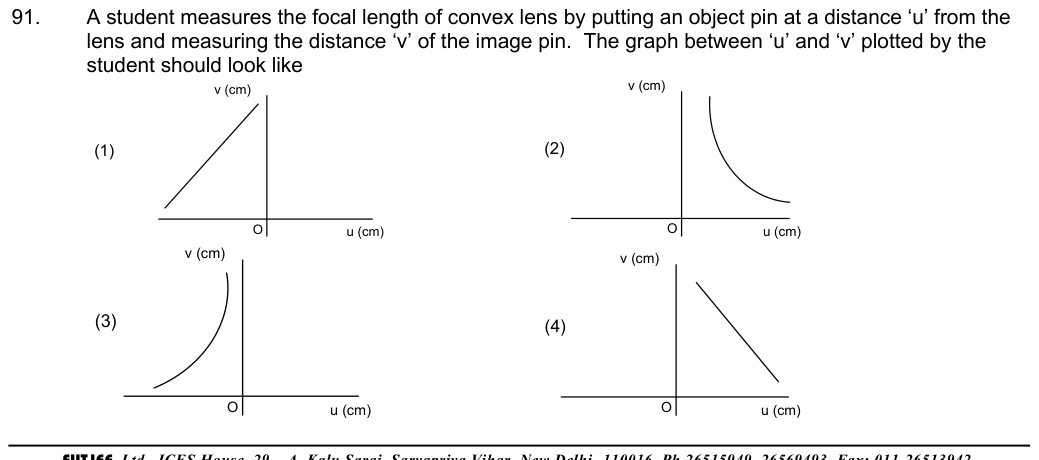
- A.Graph (1)
- B.Graph (2)
- C.Graph (3)
- D.Graph (4)
Correct answer: C
Explanation: with u negative: a rectangular hyperbola in the second quadrant.
Question 85
Physics · 3 marks · −1A block of mass 0.50 kg is moving with a speed of 2.00 m/s on a smooth surface. It strikes another mass of 1.00 kg and then they move together as a single body. The energy loss during the collision is
- A.0.16 J
- B.1.00 J
- C.0.67 J
- D.0.34 J
Correct answer: C
Explanation: ; loss J.
Question 86
Physics · 3 marks · −1A capillary tube (A) is dipped in water. Another identical tube (B) is dipped in a soap water solution. Which of the following shows the relative nature of the liquid columns in the two tubes?
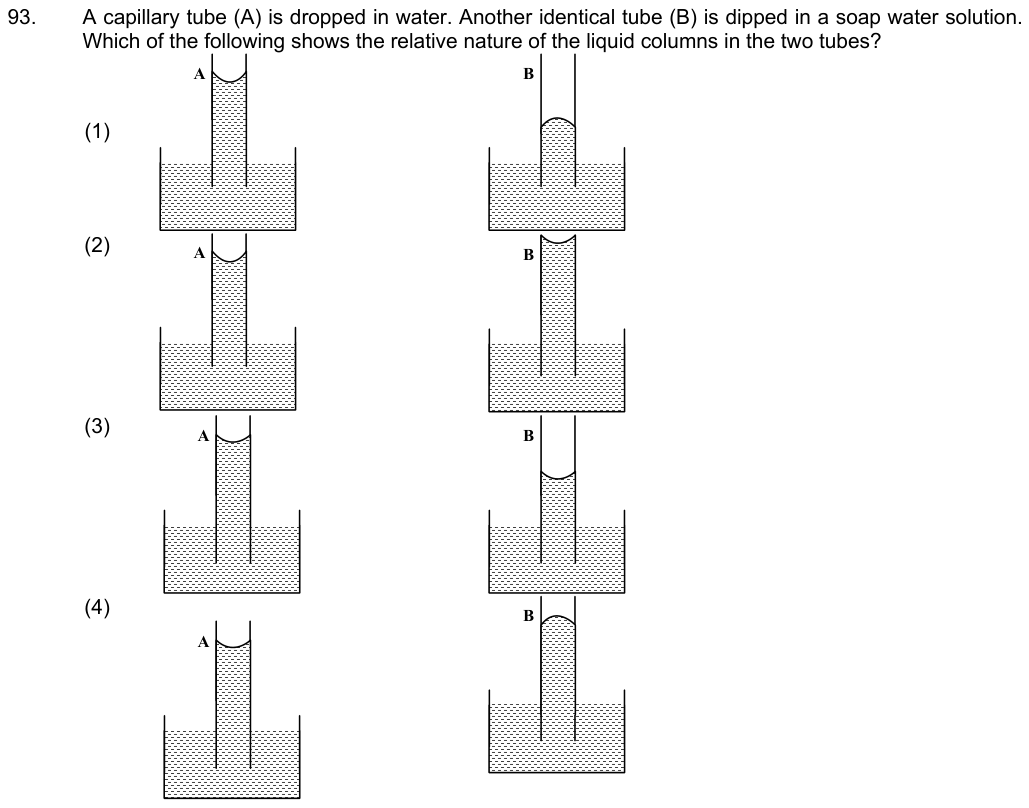
- A.Figure (1)
- B.Figure (2)
- C.Figure (3)
- D.Figure (4)
Correct answer: C
Explanation: Both concave menisci; soap solution (lower surface tension) rises less.
Question 87
Physics · 3 marks · −1Suppose an electron is attracted towards the origin by a force k/r where 'k' is a constant and 'r' is the distance of the electron from the origin. By applying Bohr model to this system, the radius of the orbital of the electron is found to be '' and the kinetic energy of the electron to be ''. Then which of the following is true?
- A.,
- B. independent of n,
- C.,
- D.,
Correct answer: B
Explanation: constant; .
Question 88
Physics · 3 marks · −1A wave travelling along the x-axis is described by the equation . If the wavelength and the time period of the wave are 0.08 m and 2.0 s, respectively, then and in appropriate units are
- A.,
- B.,
- C.,
- D.,
Correct answer: A
Explanation: , .
Question 89
Physics · 3 marks · −1Two coaxial solenoids are made by winding thin insulated wire over a pipe of cross sectional area A = 10 cm and length = 20 cm. If one of the solenoids has 300 turns and the other 400 turns, their mutual inductance is ( Tm A)
- A. H
- B. H
- C. H
- D. H
Correct answer: D
Explanation: .
Question 90
Physics · 3 marks · −1In the circuit below, A and B represent two inputs and C represents the output. The circuit represents

- A.NOR gate
- B.AND gate
- C.NAND gate
- D.OR gate
Correct answer: D
Explanation: Diode OR: output high if either input high.
Question 91
Physics · 3 marks · −1A body is at rest at x = 0. At t = 0, it starts moving in the positive x-direction with a constant acceleration. At the same instant another body passes through x = 0 moving in the positive x-direction with a constant speed. The position of the first body is given by after time 't' and that of the second body by after the same time interval. Which of the following graphs correctly describes as a function of time 't'?
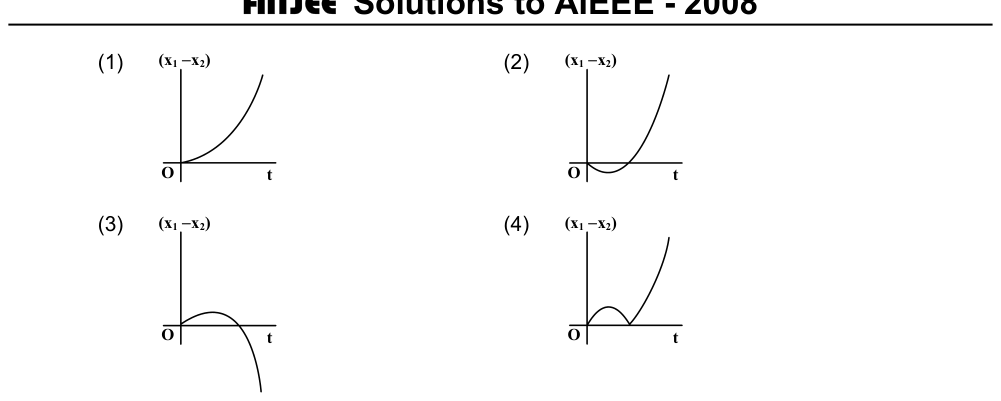
- A.Graph (1)
- B.Graph (2)
- C.Graph (3)
- D.Graph (4)
Correct answer: B
Explanation: : dips below zero then rises (parabola through origin).
Question 92
Physics · 3 marks · −1An experiment is performed to find the refractive index of glass using a travelling microscope. In this experiment distance are measured by
- A.a vernier scale provided on the microscope
- B.a standard laboratory scale
- C.a meter scale provided on the microscope
- D.a screw gauge provided on the microscope
Correct answer: A
Explanation: Travelling microscope readings use its vernier.
Question 93
Physics · 3 marks · −1A thin spherical shell of radius R has charge Q spread uniformly over its surface. Which of the following graphs most closely represents the electric field E(r) produced by the shell in the range , where r is the distance from the centre of the shell?
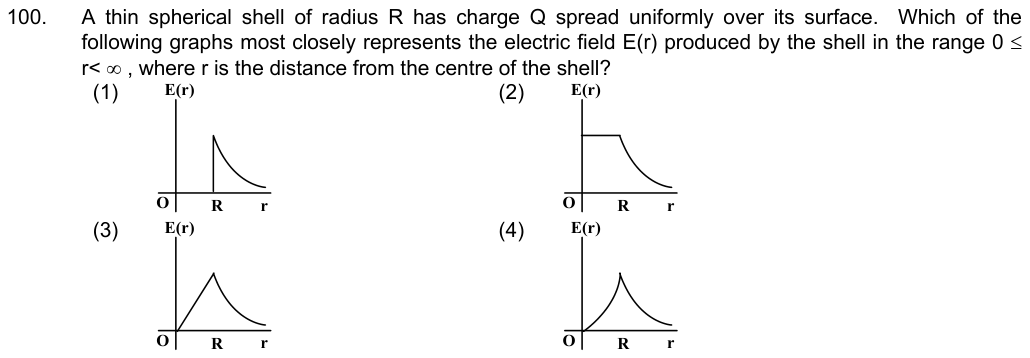
- A.Graph (1)
- B.Graph (2)
- C.Graph (3)
- D.Graph (4)
Correct answer: A
Explanation: Zero inside, jumps at R, then falls as .
Question 94
Physics · 3 marks · −1A 5V battery with internal resistance and a 2V battery with internal resistance are connected to a resistor as shown in the figure. The current in the resistor is
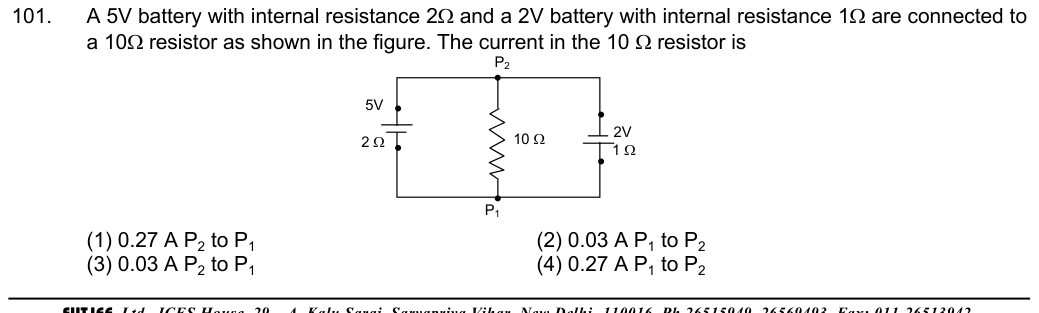
- A.0.27 A to
- B.0.03 A to
- C.0.03 A to
- D.0.27 A to
Correct answer: C
Explanation: Millman: V; A from to .
Question 95
Physics · 3 marks · −1A horizontal overhead power line is at a height of 4m from the ground and carries a current of 100 A from east to west. The magnetic field directly below it on the ground is ( T m A)
- A. T southward
- B. T northward
- C. T southward
- D. northward
Correct answer: C
Explanation: T; right-hand rule gives south.
Question 96
Physics · 3 marks · −1Relative permittivity and permeability of a material are and , respectively. Which of the following values of these quantities are allowed for a diamagnetic material?
- A.,
- B.,
- C.,
- D.,
Correct answer: B
Explanation: Diamagnetic: ; for a material.
Question 97
Physics · 3 marks · −1Two full turns of the circular scale of a screw gauge cover a distance of 1 mm on its main scale. The total number of divisions on the circular scale is 50. Further, it is found that the screw gauge has a zero error of -0.03 mm while measuring the diameter of a thin wire, a student notes the main scale reading of 3 mm and the number of circular scale divisions in line with the main scale as 35. The diameter of the wire is
- A.3.32 mm
- B.3.73 mm
- C.3.67 mm
- D.3.38 mm
Correct answer: D
Explanation: mm.
Question 98
Physics · 3 marks · −1An insulated container of gas has two chambers separated by an insulating partition. One of the chambers has volume and contains ideal gas at pressure and temperature . The other chamber has volume and contains ideal gas at pressure and temperature . If the partition is removed without doing any work on the gas, the final equilibrium temperature of the gas in the container will be
- A.
- B.
- C.
- D.
Correct answer: A
Explanation: Internal energy conserved: with .