AIEEE 2009 — 26 Apr Offline Set A (Previous Year Paper)
JEE Main · 2009 · with answers and explanations
- questions
- 86
- Total marks
- 416
- Duration
- 180 minutes
- Negative marking
- −2
Subjects: Physics · Chemistry · Mathematics
Question 1
Physics · 4 marks · −1Statement-1: For a charged particle moving from point P to point Q, the net work done by an electrostatic field on the particle is independent of the path connecting point P to point Q. Statement-2: The net work done by a conservative force on an object moving along a closed loop is zero
- A.Statement-1 is true, Statement-2 is false
- B.Statement-1 is true, Statement-2 is true; Statement-2 is the correct explanation of Statement-1.
- C.Statement-1 is true, Statement-2 is true; Statement-2 is not the correct explanation of Statement-1.
- D.Statement-1 is false, Statement-2 is true
Correct answer: B
Explanation: Electrostatic force is conservative; path independence is equivalent to zero work round any closed loop.
Question 2
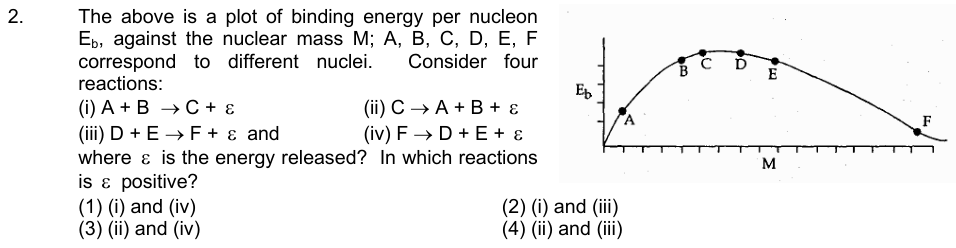
Physics · 4 marks · −1The above is a plot of binding energy per nucleon , against the nuclear mass M; A, B, C, D, E, F correspond to different nuclei. Consider four reactions: (i) (ii) (iii) and (iv) where is the energy released? In which reactions is positive?
- A.(i) and (iv)
- B.(i) and (iii)
- C.(ii) and (iv)
- D.(ii) and (iii)
Correct answer: A
Explanation: Energy is released when products have higher binding energy per nucleon: fusion of light A, B into C, and fission of heavy F into D, E.
Question 3
Physics · 8 marks · −2A p-n junction (D) shown in the figure can act as a rectifier. An alternating current source (V) is connected in the circuit. The current (I) in the resistor (R) can be shown by :
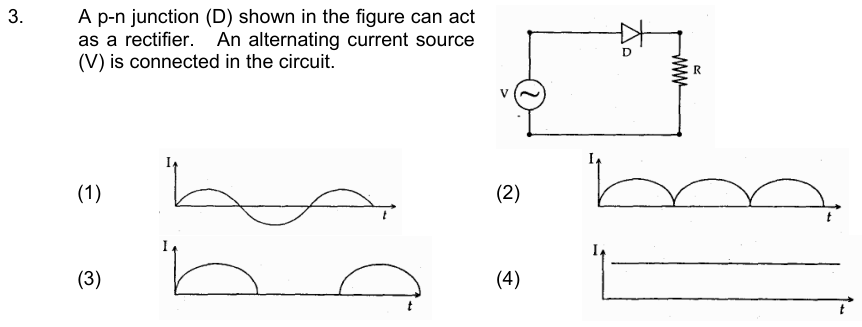
- A.Graph (1): full sinusoid
- B.Graph (2): full-wave rectified humps
- C.Graph (3): half-wave rectified (alternate humps)
- D.Graph (4): constant DC
Correct answer: C
Explanation: A single diode passes only one half-cycle: half-wave rectification.
Question 4
Physics · 8 marks · −2The logic circuit shown below has the input waveforms 'A' and 'B' as shown. Pick out the correct output waveform.
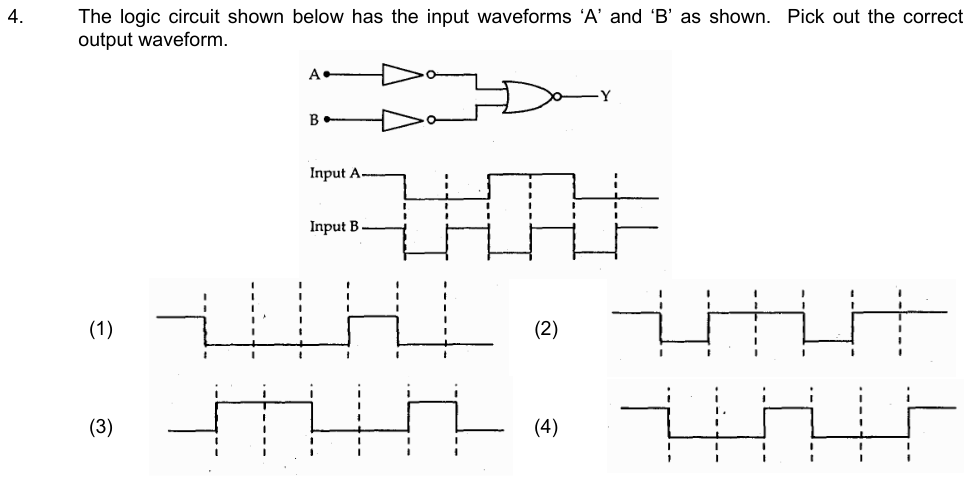
- A.Waveform (1)
- B.Waveform (2)
- C.Waveform (3)
- D.Waveform (4)
Correct answer: A
Explanation: Both inputs are inverted and fed to a NOR: , high only when both A and B are high.
Question 5
Physics · 8 marks · −2If x, v and a denote the displacement, the velocity and the acceleration of a particle executing simple harmonic motion of time period T, then, which of the following does not change with time?
- A.
- B.
- C.
- D.
Correct answer: B
Explanation: , so , constant.
Question 6
Physics · 8 marks · −2In an optics experiment, with the position of the object fixed, a student varies the position of a convex lens and for each position, the screen is adjusted to get a clear image of the object. A graph between the object distance u and the image distance v, from the lens, is plotted using the same scale for the two axes. A straight line passing through the origin and making an angle of with the x-axis meets the experimental curve at P. The coordinates of P will be
- A.(2f, 2f)
- B.
- C.(f, f)
- D.(4f, 4f)
Correct answer: A
Explanation: on the lens equation gives .
Question 7
Physics · 8 marks · −2A thin uniform rod of length and mass m is swinging freely about a horizontal axis passing through its end. Its maximum angular speed is . Its centre of mass rises to a maximum height of
- A.
- B.
- C.
- D.
Correct answer: D
Explanation: .
Question 8
Physics · 8 marks · −2Let be the charge density distribution for a solid sphere of radius R and total charge Q. For a point 'p' inside the sphere at distance from the centre of the sphere, the magnitude of electric field is
- A.0
- B.
- C.
- D.
Correct answer: C
Explanation: Enclosed charge ; .
Question 9
Physics · 4 marks · −1The transition from the state n = 4 to n = 3 in a hydrogen like atom results in ultraviolet radiation. Infrared radiation will be obtained in the transition from
- A.
- B.
- C.
- D.
Correct answer: D
Explanation: Need a smaller energy gap than : only .
Question 10
Physics · 4 marks · −1One kg of a diatomic gas is at a pressure of N/m. The density of the gas is 4 kg/m. What is the energy of the gas due to its thermal motion?
- A. J
- B. J
- C. J
- D. J
Correct answer: B
Explanation: m; J.
Question 11
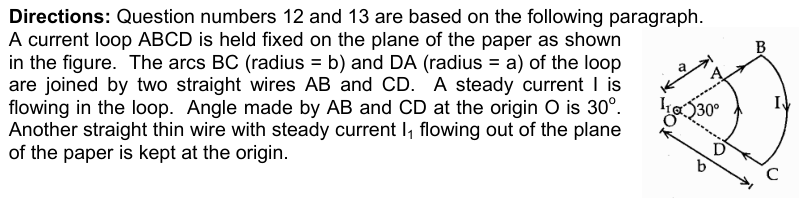
Physics · 4 marks · −1A current loop ABCD is held fixed on the plane of the paper as shown in the figure. The arcs BC (radius = b) and DA (radius = a) of the loop are joined by two straight wires AB and CD. A steady current I is flowing in the loop. Angle made by AB and CD at the origin O is . Another straight thin wire with steady current flowing out of the plane of the paper is kept at the origin. The magnitude of the magnetic field (B) due to loop ABCD at the origin (O) is
- A.zero
- B.
- C.
- D.
Correct answer: B
Explanation: Radial segments give no field at O; arcs give .
Question 12
Physics · 4 marks · −1A current loop ABCD is held fixed on the plane of the paper as shown in the figure. The arcs BC (radius = b) and DA (radius = a) of the loop are joined by two straight wires AB and CD. A steady current I is flowing in the loop. Angle made by AB and CD at the origin O is . Another straight thin wire with steady current flowing out of the plane of the paper is kept at the origin. Due to the presence of the current at the origin
- A.The forces on AB and DC are zero
- B.The forces on AD and BC are zero
- C.The magnitude of the net force on the loop is given by
- D.The magnitude of the net force on the loop is given by
Correct answer: B
Explanation: The field of is tangential, parallel to the arcs AD and BC, so they feel no force; the radial segments do.
Question 13
Physics · 4 marks · −1A mixture of light, consisting of wavelength 590 nm and an unknown wavelength, illuminates Young's double slit and gives rise to two overlapping interference patterns on the screen. The central maximum of both lights coincide. Further, it is observed that the third bright fringe of known light coincides with the bright fringe of the unknown light. From this data, the wavelength of the unknown light is
- A.393.4 nm
- B.885.0 nm
- C.442.5 nm
- D.776.8 nm
Correct answer: C
Explanation: nm.
Question 14
Physics · 4 marks · −1Two points P and Q are maintained at the potentials of 10V and -4V respectively. The work done in moving 100 electrons from P to Q is
- A. J
- B. J
- C. J
- D. J
Correct answer: D
Explanation: J.
Question 15
Physics · 4 marks · −1The surface of a metal is illuminated with the light of 400 nm. The kinetic energy of the ejected photoelectrons was found to be 1.68 eV. The work function of the metal is (hc = 1240 eV nm)
- A.3.09 eV
- B.1.41 eV
- C.151 eV
- D.1.68 eV
Correct answer: B
Explanation: eV.
Question 16
Physics · 4 marks · −1A particle has an initial velocity and an acceleration of . Its speed after 10 s is
- A.10 units
- B. units
- C.7 units
- D.8.5 units
Correct answer: B
Explanation: .
Question 17
Physics · 4 marks · −1A motor cycle starts from rest and accelerates along a straight path at 2 m/s. At the starting point of the motor cycle there is a stationary electric siren. How far has the motor cycle gone when the driver hears the frequency of the siren at 94% of its value when the motor cycle was at rest? (speed of sound = 330 ms)
- A.49 m
- B.98 m
- C.147 m
- D.196 m
Correct answer: B
Explanation: m/s; m.
Question 18
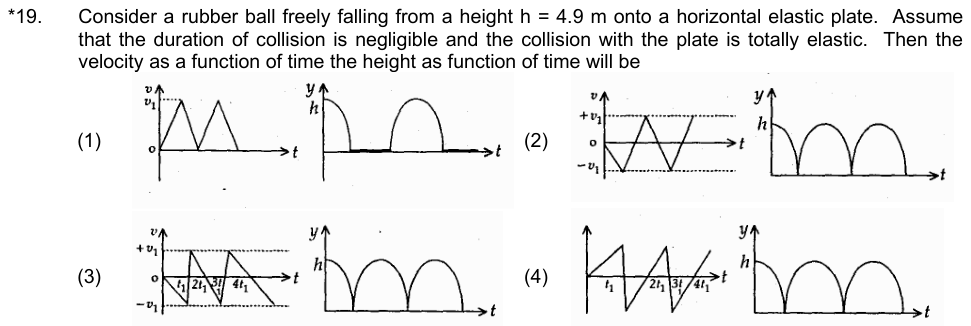
Physics · 4 marks · −1Consider a rubber ball freely falling from a height h = 4.9 m onto a horizontal elastic plate. Assume that the duration of collision is negligible and the collision with the plate is totally elastic. Then the velocity as a function of time and the height as function of time will be
- A.Pair (1)
- B.Pair (2)
- C.Pair (3)
- D.Pair (4)
Correct answer: C
Explanation: v decreases linearly from 0 to , jumps to at impact, and repeats (sawtooth between ); height is a series of parabolic arches.
Question 19
Physics · 4 marks · −1A charge Q is placed at each of the opposite corners of a square. A charge q is placed at each of the other two corners. If the net electrical force on Q is zero, then the Q/q equals
- A.
- B.
- C.1
- D.
Correct answer: A
Explanation: .
Question 20
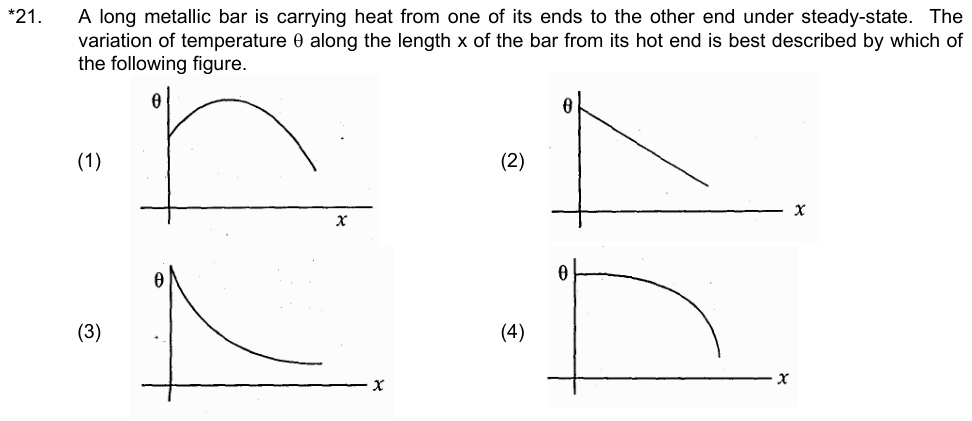
Physics · 4 marks · −1A long metallic bar is carrying heat from one of its ends to the other end under steady-state. The variation of temperature along the length x of the bar from its hot end is best described by which of the following figure.
- A.Graph (1)
- B.Graph (2)
- C.Graph (3)
- D.Graph (4)
Correct answer: B
Explanation: Uniform bar in steady state: decreases linearly with x.
Question 21
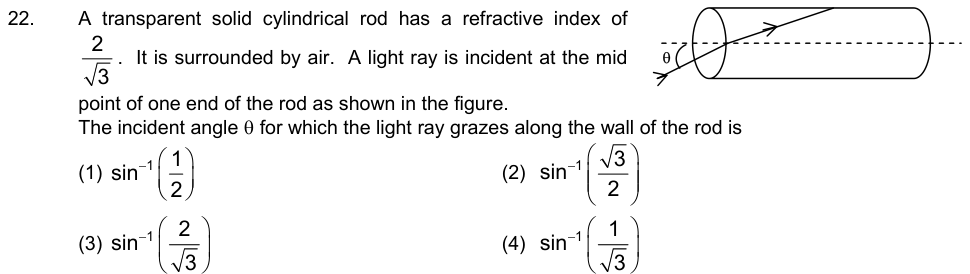
Physics · 4 marks · −1A transparent solid cylindrical rod has a refractive index of . It is surrounded by air. A light ray is incident at the mid point of one end of the rod as shown in the figure. The incident angle for which the light ray grazes along the wall of the rod is
- A.
- B.
- C.
- D.
Correct answer: D
Explanation: Critical angle: ; , ; .
Question 22
Physics · 4 marks · −1Three sound waves of equal amplitudes have frequencies , , . They superpose to give beats. The number of beats produced per second will be
- A.4
- B.3
- C.2
- D.1
Correct answer: C
Explanation: The resultant amplitude has two maxima per second (one full and one secondary), conventionally counted as 2 beats per second (difference between extreme frequencies).
Question 23
Physics · 4 marks · −1The height at which the acceleration due to gravity becomes (where g = the acceleration due to gravity on the surface of the earth) in terms of R, the radius of the earth is
- A.2R
- B.
- C.
- D.
Correct answer: A
Explanation: .
Question 24
Physics · 4 marks · −1Two wires are made of the same material and have the same volume. However wire 1 has cross-sectional area A and wire-2 has cross-sectional area 3A. If the length of wire 1 increases by on applying force F, how much force is needed to stretch wire 2 by the same amount?
- A.F
- B.4F
- C.6F
- D.9F
Correct answer: D
Explanation: ; .
Question 25
Physics · 4 marks · −1In an experiment the angles are required to be measured using an instrument. 29 divisions of the main scale exactly coincide with the 30 divisions of the vernier scale. If the smallest division of the main scale is half-a-degree (= ), then the least count of the instrument is
- A.one minute
- B.half minute
- C.one degree
- D.half degree
Correct answer: A
Explanation: LC .
Question 26
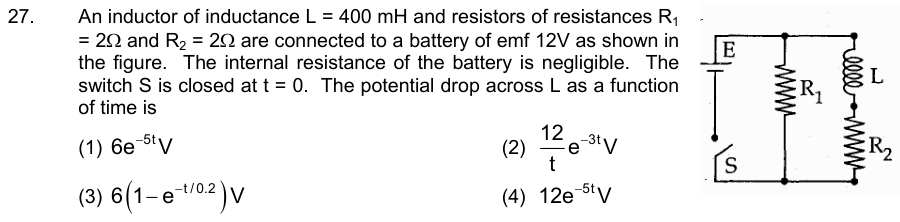
Physics · 4 marks · −1An inductor of inductance L = 400 mH and resistors of resistances and are connected to a battery of emf 12V as shown in the figure. The internal resistance of the battery is negligible. The switch S is closed at t = 0. The potential drop across L as a function of time is
- A. V
- B. V
- C. V
- D. V
Correct answer: D
Explanation: The L- branch sits directly across 12 V: V.
Question 27
Physics · 4 marks · −1Two moles of helium gas are taken over the cycle ABCDA, as shown in the P-T diagram. The net work done on the gas in the cycle ABCDA is

- A.Zero
- B.276 R
- C.1076 R
- D.1904 R
Correct answer: B
Explanation: By gas: (magnitude).
Question 28
Chemistry · 4 marks · −1Knowing that the Chemistry of lanthanoids (Ln) is dominated by its +3 oxidation state, which of the following statements is incorrect ?
- A.Because of the large size of the Ln (III) ions the bonding in its compounds is predominantly ionic in character.
- B.The ionic sizes of Ln (III) decrease in general with increasing atomic number.
- C.Ln (III) compounds are generally colourless.
- D.Ln (III) hydroxides are mainly basic in character.
Correct answer: C
Explanation: Most compounds are coloured (f-f transitions).
Question 29
Chemistry · 4 marks · −1A liquid was mixed with ethanol and a drop of concentrated was added. A compound with a fruity smell was formed. The liquid was :
- A.
- B.HCHO
- C.
- D.
Correct answer: D
Explanation: Esterification gives ethyl acetate.
Question 30
Chemistry · 4 marks · −1Arrange the carbanions, , , , , in order of their decreasing stability :
- A.
- B.
- C.
- D.
Correct answer: C
Explanation: of three Cl (and d-orbital delocalisation) > benzylic resonance > secondary > tertiary (alkyl groups destabilise).
Question 31
Chemistry · 4 marks · −1The alkene that exhibits geometrical isomerism is :
- A.propene
- B.2-methyl propene
- C.2-butene
- D.2- methyl -2- butene
Correct answer: C
Explanation: Each carbon of 2-butene carries H and .
Question 32
Chemistry · 4 marks · −1In which of the following arrangements, the sequence is not strictly according to the property written against it ?
- A. : increasing oxidising power
- B.HF < HCl < HBr < HI : increasing acid strength
- C. : increasing basic strength
- D.B < C < O < N : increasing first ionization enthalpy
Correct answer: C
Explanation: Basic strength decreases from to .
Question 33
Chemistry · 4 marks · −1The major product obtained on interaction of phenol with sodium hydroxide and carbon dioxide is :
- A.benzoic acid
- B.salicylaldehyde
- C.salicylic acid
- D.phthalic acid
Correct answer: C
Explanation: Kolbe-Schmitt reaction.
Question 34
Chemistry · 4 marks · −1Which of the following statements is incorrect regarding physissorptions ?
- A.It occurs because of vander Waal's forces.
- B.More easily liquefiable gases are adsorbed readily.
- C.Under high pressure it results into multi molecular layer on adsorbent surface.
- D.Enthalpy of adsorption () is low and positive.
Correct answer: D
Explanation: Adsorption is exothermic; is negative.
Question 35
Chemistry · 4 marks · −1Which of the following on heating with aqueous KOH, produces acetaldehyde ?
- A.
- B.
- C.
- D.
Correct answer: D
Explanation: Gem-dihalide hydrolyses to the gem-diol, which loses water to .
Question 36
Chemistry · 4 marks · −1In an atom, an electron is moving with a speed of 600m/s with an accuracy of 0.005%. Certainity with which the position of the electron can be located is ( kg ms, mass of electron kg)
- A. m
- B. m
- C. m
- D. m
Correct answer: C
Explanation: m/s; m.
Question 37
Chemistry · 8 marks · −2In a fuel cell methanol is used as fuel and oxygen gas is used as an oxidizer. The reaction is . At 298K standard Gibb's energies of formation for , and are , and kJ mol respectively. If standard enthalpy of combustion of methanol is kJ mol, efficiency of the fuel cell will be
- A.80 %
- B.87%
- C.90%
- D.97%
Correct answer: D
Explanation: ; efficiency .
Question 38
Chemistry · 8 marks · −2Two liquids X and Y form an ideal solution. At 300K, vapour pressure of the solution containing 1 mol of X and 3 mol of Y is 550 mm Hg. At the same temperature, if 1 mol of Y is further added to this solution, vapour pressure of the solution increases by 10 mm Hg. Vapour pressure (in mmHg) of X and Y in their pure states will be, respectively :
- A.200 and 300
- B.300 and 400
- C.400 and 600
- D.500 and 600
Correct answer: C
Explanation: , : , .
Question 39
Chemistry · 8 marks · −2The half life period of a first order chemical reaction is 6.93 minutes. The time required for the completion of 99% of the chemical reaction will be (log 2 = 0.301) :
- A.230.3 minutes
- B.23.03 minutes
- C.46.06 minutes
- D.460.6 minutes
Correct answer: C
Explanation: min; min.
Question 40
Chemistry · 8 marks · −2Given : V, V. The value of standard electrode potential for the change, will be :
- A. V
- B.0.385 V
- C.0.770 V
- D. V
Correct answer: C
Explanation: V.
Question 41
Chemistry · 8 marks · −2On the basis of the following thermochemical data : () ; kJ; ; kJ. The value of enthalpy of formation of ion at C is :
- A. kJ
- B. kJ
- C. kJ
- D. kJ
Correct answer: B
Explanation: Adding: kJ.
Question 42
Chemistry · 8 marks · −2Copper crystallizes in fcc with a unit cell length of 361 pm. What is the radius of copper atom ?
- A.108 pm
- B.127 pm
- C.157 pm
- D.181 pm
Correct answer: B
Explanation: pm.
Question 43
Chemistry · 4 marks · −1Which of the following has an optical isomer ?
- A.
- B.
- C.
- D.
Correct answer: D
Explanation: cis- is chiral.
Question 44
Chemistry · 4 marks · −1Solid is gradually dissolved in a M solution. At what concentration of will a precipitate begin to form ? ( for ).
- A. M
- B. M
- C. M
- D. M
Correct answer: B
Explanation: .
Question 45
Chemistry · 4 marks · −1Which one of the following reactions of Xenon compounds is not feasible ?
- A.
- B.
- C.
- D.
Correct answer: A
Explanation: The reverse (hydrolysis of ) is what occurs; is not fluorinated by HF.
Question 46
Chemistry · 4 marks · −1Using MO theory predict which of the following species has the shortest bond length ?
- A.
- B.
- C.
- D.
Correct answer: A
Explanation: Bond orders 3, 2.5, 1.5, 1.
Question 47
Chemistry · 4 marks · −1In context with the transition elements, which of the following statements is incorrect ?
- A.In addition to the normal oxidation states, the zero oxidation state is also shown by these elements in complexes.
- B.In the highest oxidation states, the transition metal show basic character and form cationic complexes.
- C.In the highest oxidation states of the first five transition elements (Sc to Mn), all the 4s and 3d electrons are used for bonding.
- D.Once the configuration is exceeded, the tendency to involve all the 3d electrons in bonding decreases.
Correct answer: B
Explanation: Highest oxidation states are acidic (e.g. , ).
Question 48
Chemistry · 4 marks · −1Calculate the wavelength (in nanometer) associated with a proton moving at ms (Mass of proton = kg and Js) :
- A.0.032 nm
- B.0.40 nm
- C.2.5 nm
- D.14.0 nm
Correct answer: B
Explanation: nm.
Question 49
Chemistry · 4 marks · −1A binary liquid solution is prepared by mixing n-heptane and ethanol. Which one of the following statements is correct regarding the behaviour of the solution ?
- A.The solution formed is an ideal solution
- B.The solution is non-ideal, showing +ve deviation from Raoult's law.
- C.The solution is non-ideal, showing -ve deviation from Raoult's law.
- D.n-heptane shows +ve deviation while ethanol shows -ve deviation from Raoult's law.
Correct answer: B
Explanation: Heptane breaks ethanol's H-bonds: weaker mixed interactions, positive deviation.
Question 50
Chemistry · 4 marks · −1The number of stereoisomers possible for a compound of the molecular formula is :
- A.3
- B.2
- C.4
- D.6
Correct answer: C
Explanation: One C=C (cis/trans) and one stereocentre: 4.
Question 51
Chemistry · 4 marks · −1The IUPAC name of neopentane is
- A.2-methylbutane
- B.2, 2-dimethylpropane
- C.2-methylpropane
- D.2,2-dimethylbutane
Correct answer: B
Explanation: .
Question 52
Chemistry · 4 marks · −1The set representing the correct order of ionic radius is :
- A.
- B.
- C.
- D.
Correct answer: B
Explanation: 102, 76, 72, 31 pm.
Question 53
Chemistry · 4 marks · −1The two functional groups present in a typical carbohydrate are :
- A.-OH and -COOH
- B.-CHO and -COOH
- C.>C=O and -OH
- D.-OH and -CHO
Correct answer: C
Explanation: Polyhydroxy aldehydes or ketones: carbonyl and hydroxyl.
Question 54
Chemistry · 4 marks · −1The bond dissociation energy of B - F in is 646 kJ mol whereas that of C-F in is 515 kJ mol. The correct reason for higher B-F bond dissociation energy as compared to that of C-F is :
- A.smaller size of B-atom as compared to that of C- atom
- B.stronger bond between B and F in as compared to that between C and F in
- C.significant interaction between B and F in whereas there is no possibility of such interaction between C and F in .
- D.lower degree of interaction between B and F in than that between C and F in .
Correct answer: C
Explanation: Back-donation from F into the vacant B 2p orbital gives partial double-bond character.
Question 55
Chemistry · 4 marks · −1In Cannizzaro reaction given below the slowest step is :
- A.the attack of at the carboxyl group
- B.the transfer of hydride to the carbonyl group
- C.the abstraction of proton from the carboxylic group
- D.the deprotonation of
Correct answer: B
Explanation: Hydride transfer is rate-determining.
Question 56
Chemistry · 4 marks · −1Which of the following pairs represents linkage isomers ?
- A. and
- B. and
- C. and
- D. and
Correct answer: B
Explanation: Thiocyanate binds through N or S.
Question 57
Chemistry · 4 marks · −1Buna-N synthetic rubber is a copolymer of :
- A. and
- B. and
- C. and
- D. and
Correct answer: C
Explanation: Acrylonitrile and 1,3-butadiene.
Question 58
Mathematics · 4 marks · −1Let a, b, c be such that . If , then the value of 'n' is
- A.zero
- B.any even integer
- C.any odd integer
- D.any integer
Correct answer: C
Explanation: The second determinant equals times the first (after transposing and row swaps), so the sum vanishes only when n is odd.
Question 59
Mathematics · 4 marks · −1If the mean deviation of number 1, 1 + d, 1 + 2d, ....., 1 + 100d from their mean is 255, then the d is equal to
- A.10.0
- B.20.0
- C.10.1
- D.20.2
Correct answer: C
Explanation: Mean ; MD .
Question 60
Mathematics · 4 marks · −1If the roots of the equation be imaginary, then for all real values of x, the expression is
- A.greater than 4ab
- B.less than 4ab
- C.greater than -4ab
- D.less than -4ab
Correct answer: C
Explanation: Minimum value and , so the expression exceeds .
Question 61
Mathematics · 4 marks · −1Let A and B denote the statements A: , B: . If , then
- A.A is true and B is false
- B.A is false and B is true
- C.both A and B are true
- D.both A and B are false
Correct answer: C
Explanation: The condition is .
Question 62
Mathematics · 4 marks · −1The lines and are perpendicular to a common line for
- A.no value of p
- B.exactly one value of p
- C.exactly two values of p
- D.more than two values of p
Correct answer: B
Explanation: They must be parallel: .
Question 63
Mathematics · 4 marks · −1If A, B and C are three sets such that and , then
- A.A = B
- B.A = C
- C.B = C
- D.
Correct answer: C
Explanation: Standard set identity: B = C.
Question 64
Mathematics · 4 marks · −1If are non-coplanar vectors and p, q are real numbers, then the equality holds for
- A.exactly one value of (p, q)
- B.exactly two values of (p, q)
- C.more than two but not all values of (p, q)
- D.all values of (p, q)
Correct answer: A
Explanation: and only at .
Question 65
Mathematics · 4 marks · −1Let the line lie in the plane . Then equals
- A.(6, -17)
- B.(-6, 7)
- C.(5, -15)
- D.(-5, 15)
Correct answer: B
Explanation: ; point : .
Question 66
Mathematics · 4 marks · −1From 6 different novels and 3 different dictionaries, 4 novels and 1 dictionary are to be selected and arranged in a row on the shelf so that the dictionary is always in the middle. Then the number of such arrangements is
- A.less than 500
- B.at least 500 but less than 750
- C.at least 750 but less than 1000
- D.at least 1000
Correct answer: D
Explanation: .
Question 67
Mathematics · 4 marks · −1, denotes the greatest integer function, is equal to
- A.
- B.1
- C.
- D.
Correct answer: D
Explanation: a.e., so .
Question 68
Mathematics · 4 marks · −1For real x, let , then
- A.f is one-one but not onto R
- B.f is onto R but not one-one
- C.f is one-one and onto R
- D.f is neither one-one nor onto R
Correct answer: C
Explanation: Strictly increasing odd-degree polynomial.
Question 69
Mathematics · 4 marks · −1In a binomial distribution , if the probability of at least one success is greater than or equal to , then n is greater than
- A.
- B.
- C.
- D.
Correct answer: A
Explanation: .
Question 70
Mathematics · 4 marks · −1The projections of a vector on the three coordinate axis are 6, -3, 2 respectively. The direction cosines of the vector are
- A.6, -3, 2
- B.
- C.
- D.
Correct answer: C
Explanation: Magnitude 7.
Question 71
Mathematics · 4 marks · −1If , then the maximum value of |Z| is equal to
- A.
- B.
- C.2
- D.
Correct answer: B
Explanation: .
Question 72
Mathematics · 4 marks · −1Three distinct points A, B and C are given in the 2-dimensional coordinate plane such that the ratio of the distance of any one of them from the point (1, 0) to the distance from the point (-1, 0) is equal to . Then the circumcentre of the triangle ABC is at the point
- A.(0, 0)
- B.
- C.
- D.
Correct answer: B
Explanation: Apollonius circle , centre .
Question 73
Mathematics · 4 marks · −1The remainder left out when is divided by 9 is
- A.0
- B.2
- C.7
- D.8
Correct answer: B
Explanation: , : .
Question 74
Mathematics · 4 marks · −1The ellipse is inscribed in a rectangle aligned with the coordinate axes, which in turn in inscribed in another ellipse that passes through the point (4, 0). Then the equation of the ellipse is
- A.
- B.
- C.
- D.
Correct answer: B
Explanation: Rectangle corner (2, 1) on : .
Question 75
Mathematics · 4 marks · −1The sum to the infinity of the series is
- A.2
- B.3
- C.4
- D.6
Correct answer: B
Explanation: Arithmetico-geometric series: .
Question 76
Mathematics · 4 marks · −1The differential equation which represents the family of curves , where and are arbitrary constants is
- A.
- B.
- C.
- D.
Correct answer: D
Explanation: , .
Question 77
Mathematics · 4 marks · −1One ticket is selected at random from 50 tickets numbered 00, 01, 02, ...., 49. Then the probability that the sum of the digits on the selected ticket is 8, given that the product of these digits is zero, equals
- A.
- B.
- C.
- D.
Correct answer: A
Explanation: Product zero: 14 tickets; among them only 08 has digit sum 8.
Question 78
Mathematics · 4 marks · −1Let y be an implicit function of x defined by . Then y'(1) equals
- A.
- B.1
- C.log 2
- D.
Correct answer: A
Explanation: At x = 1, ; differentiating gives .
Question 79
Mathematics · 8 marks · −2The area of the region bounded by the parabola , the tangent to the parabola at the point (2, 3) and the x-axis is
- A.3
- B.6
- C.9
- D.12
Correct answer: C
Explanation: Tangent ; area .
Question 80
Mathematics · 8 marks · −2Given such that x = 0 is the only real root of P'(x) = 0. If P(-1) < P(1), then in the interval [-1, 1]
- A.P(-1) is the minimum and P(1) is the maximum of P
- B.P(-1) is not minimum but P(1) is the maximum of P
- C.P(-1) is the minimum and P(1) is not the maximum of P
- D.neither P(-1) is the minimum nor P(1) is the maximum of P
Correct answer: B
Explanation: , P decreases on [-1, 0] and increases on [0, 1]; the minimum is P(0), the maximum P(1).
Question 81
Mathematics · 8 marks · −2The shortest distance between the line and the curve is
- A.
- B.
- C.
- D.
Correct answer: A
Explanation: Tangent slope 1 at ; distance .
Question 82
Mathematics · 8 marks · −2Let , . Statement-1 : The set . Statement-2 : f is a bijection.
- A.Statement-1 is true, Statement-2 is true; Statement-2 is a correct explanation for Statement-1
- B.Statement-1 is true, Statement-2 is true; Statement-2 is not a correct explanation for Statement-1
- C.Statement-1 is true, Statement-2 is false
- D.Statement-1 is false, Statement-2 is true
Correct answer: C
Explanation: gives ; f is not onto R (co-domain unspecified), so Statement-2 is false.
Question 83
Mathematics · 8 marks · −2Let and . Statement-1 : gof is differentiable at x = 0 and its derivative is continuous at that point. Statement-2 : gof is twice differentiable at x = 0.
- A.Statement-1 is true, Statement-2 is true; Statement-2 is a correct explanation for Statement-1
- B.Statement-1 is true, Statement-2 is true; Statement-2 is not a correct explanation for Statement-1
- C.Statement-1 is true, Statement-2 is false
- D.Statement-1 is false, Statement-2 is true
Correct answer: C
Explanation: is continuous, but the second derivative jumps from -2 to 2.
Question 84
Mathematics · 8 marks · −2Statement-1 : The variance of first n even natural numbers is . Statement-2 : The sum of first n natural numbers is and the sum of squares of first n natural numbers is .
- A.Statement-1 is true, Statement-2 is true; Statement-2 is a correct explanation for Statement-1
- B.Statement-1 is true, Statement-2 is true; Statement-2 is not a correct explanation for Statement-1
- C.Statement-1 is true, Statement-2 is false
- D.Statement-1 is false, Statement-2 is true
Correct answer: D
Explanation: The variance is , so Statement-1 is false.
Question 85
Mathematics · 4 marks · −1Statement-1 : is equivalent to . Statement-2 : is a tautology.
- A.Statement-1 is true, Statement-2 is true; Statement-2 is a correct explanation for Statement-1
- B.Statement-1 is true, Statement-2 is true; Statement-2 is not a correct explanation for Statement-1
- C.Statement-1 is true, Statement-2 is false
- D.Statement-1 is false, Statement-2 is true
Correct answer: C
Explanation: Truth table: equivalent to , not a tautology.
Question 86
Mathematics · 4 marks · −1Let A be a 2 x 2 matrix. Statement-1 : adj(adj A) = A. Statement-2 : |adj A| = |A|
- A.Statement-1 is true, Statement-2 is true; Statement-2 is a correct explanation for Statement-1
- B.Statement-1 is true, Statement-2 is true; Statement-2 is not a correct explanation for Statement-1
- C.Statement-1 is true, Statement-2 is false
- D.Statement-1 is false, Statement-2 is true
Correct answer: B
Explanation: For n = 2: and ; both true but independent.