AIEEE 2010 — 25 Apr Offline Set D (Previous Year Paper)
JEE Main · 2010 · with answers and explanations
- questions
- 89
- Total marks
- 424
- Duration
- 180 minutes
- Negative marking
- −2
Subjects: Chemistry · Physics · Mathematics
Question 1
Chemistry · 8 marks · −2The standard enthalpy of formation of is kJ mol. If the enthalpy of formation of from its atoms is kJ mol and that of is kJ mol, the average bond enthalpy of N-H bond in is
- A. kJ mol
- B. kJ mol
- C. kJ mol
- D. kJ mol
Correct answer: B
Explanation: kJ/mol.
Question 2
Chemistry · 8 marks · −2The time for half life period of a certain reaction products is 1 hour. When the initial concentration of the reactant 'A', is 2.0 mol L, how much time does it take for its concentration to come from 0.50 to 0.25 mol L if it is a zero order reaction ?
- A.4 h
- B.0.5 h
- C.0.25 h
- D.1 h
Correct answer: C
Explanation: M/h; h.
Question 3
Chemistry · 8 marks · −2A solution containing 2.675 g of (molar mass = 267.5 g mol) is passed through a cation exchanger. The chloride ions obtained in solution were treated with excess of to give 4.78 g of AgCl (molar mass = 143.5 g mol). The formula of the complex is (At. Mass of Ag = 108 u)
- A.
- B.
- C.
- D.
Correct answer: A
Explanation: 0.01 mol complex gives mol AgCl: 3 ionisable .
Question 4
Chemistry · 4 marks · −1Consider the reaction : . The rate equation for this reaction is rate = . Which of these mechanisms is/are consistent with this rate equation ? (A) (slow); (fast). (B) (fast equilibrium); (slow)
- A.B only
- B.Both A and B
- C.Neither A nor B
- D.A only
Correct answer: D
Explanation: A's slow step gives ; B gives .
Question 5
Chemistry · 4 marks · −1If dm of water is introduced into a 1.0 dm flask to 300 K, how many moles of water are in the vapour phase when equilibrium is established ? (Given : Vapour pressure of at 300 K is 3170 Pa ; J K mol)
- A. mol
- B. mol
- C. mol
- D. mol
Correct answer: D
Explanation: mol.
Question 6
Chemistry · 4 marks · −1One mole of a symmetrical alkene on ozonolysis gives two moles of an aldehyde having a molecular mass of 44 u. The alkene is
- A.propene
- B.1-butene
- C.2-butene
- D.ethene
Correct answer: C
Explanation: 2-butene gives 2 (44 u).
Question 7
Chemistry · 4 marks · −1If sodium sulphate is considered to be completely dissociated into cations and anions in aqueous solution, the change in freezing point of water , when 0.01 mol of sodium sulphate is dissolved in 1 kg of water, is ( = 1.86 K kg mol)
- A.0.0372 K
- B.0.0558 K
- C.0.0744 K
- D.0.0186 K
Correct answer: B
Explanation: : K.
Question 8
Chemistry · 4 marks · −1From amongst the following alcohols the one that would react fastest with conc. HCl and anhydrous , is
- A.2-Butanol
- B.2-Methylpropan-2-ol
- C.2-Methylpropanol
- D.1-Butanol
Correct answer: B
Explanation: The tertiary alcohol reacts fastest (Lucas test).
Question 9
Chemistry · 4 marks · −1In the chemical reactions, aniline A B, the compounds 'A' and 'B' respectively are
- A.nitrobenzene and fluorobenzene
- B.phenol and benzene
- C.benzene diazonium chloride and fluorobenzene
- D.nitrobenzene and chlorobenzene
Correct answer: C
Explanation: Diazotisation then Balz-Schiemann.
Question 10
Chemistry · 8 marks · −229.5 mg of an organic compound containing nitrogen was digested according to Kjeldahl's method and the evolved ammonia was absorbed in 20 mL of 0.1 M HCl solution. The excess of the acid required 15 mL of 0.1 M NaOH solution for complete neutralization. The percentage of nitrogen in the compound is
- A.59.0
- B.47.4
- C.23.7
- D.29.5
Correct answer: C
Explanation: mmol, N mg; .
Question 11
Chemistry · 8 marks · −2The energy required to break one mole of Cl-Cl bonds in is 242 kJ mol. The longest wavelength of light capable of breaking a single Cl - Cl bond is ( ms and mol)
- A.594 nm
- B.640 nm
- C.700 nm
- D.494 nm
Correct answer: D
Explanation: nm.
Question 12
Chemistry · 8 marks · −2Ionisation energy of is J atom. The energy of the first stationary state (n = 1) of is
- A. J atom
- B. J atom
- C. J atom
- D. J atom
Correct answer: B
Explanation: : J.
Question 13
Chemistry · 4 marks · −1Consider the following bromides : (A) 1-bromobutane (), (B) 3-bromobut-1-ene (), (C) 2-bromobutane (). The correct order of reactivity is
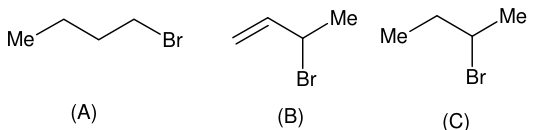
- A.B > C > A
- B.B > A > C
- C.C > B > A
- D.A > B > C
Correct answer: A
Explanation: Carbocation stability: allylic secondary > secondary > primary.
Question 14
Chemistry · 4 marks · −1Which one of the following has an optical isomer ? (en = ethylenediamine)
- A.
- B.
- C.
- D.
Correct answer: B
Explanation: is chiral (tris-chelate).
Question 15
Chemistry · 4 marks · −1On mixing, heptane and octane form an ideal solution. At 373 K, the vapour pressures of the two liquid components (heptane and octane) are 105 kPa and 45 kPa respectively. Vapour pressure of the solution obtained by mixing 25.0g of heptane and 35 g of octane will be (molar mass of heptane = 100 g mol and of octane = 114 g mol).
- A.72.0 kPa
- B.36.1 kPa
- C.96.2 kPa
- D.144.5 kPa
Correct answer: A
Explanation: ; kPa.
Question 16
Chemistry · 4 marks · −1The main product of the following reaction is ?
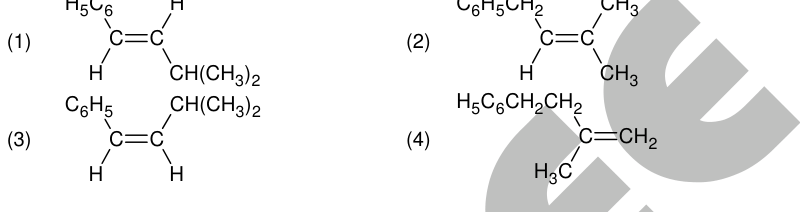
- A.trans-
- B.
- C.cis-
- D.
Correct answer: A
Explanation: E1 dehydration gives the alkene conjugated with the ring; the trans isomer is favoured.
Question 17
Chemistry · 4 marks · −1Three reactions involving are given below : (i) (ii) (iii) . In which of the above does act as an acid ?
- A.(ii) only
- B.(i) and (ii)
- C.(iii) only
- D.(i) only
Correct answer: A
Explanation: Only in (ii) does donate a proton.
Question 18
Chemistry · 4 marks · −1In aqueous solution the ionization constants for carbonic acid are and . Select the correct statement for a saturated 0.034 M solution of the carbonic acid.
- A.The concentration of is 0.034 M.
- B.The concentration of is greater than that of .
- C.The concentration of and are approximately equal.
- D.The concentration of is double that of .
Correct answer: C
Explanation: : first ionisation dominates, .
Question 19
Chemistry · 4 marks · −1The edge length of a face centered cubic cell of an ionic substance is 508 pm. If the radius of the cation is 110 pm, the radius of the anion is
- A.288 pm
- B.398 pm
- C.618 pm
- D.144 pm
Correct answer: D
Explanation: pm.
Question 20
Chemistry · 4 marks · −1The correct order of increasing basicity of the given conjugate bases () is
- A.
- B.
- C.
- D.
Correct answer: D
Explanation: Conjugate acid strength: .
Question 21
Chemistry · 4 marks · −1The correct sequence which shows decreasing order of the ionic radii of the elements is
- A.
- B.
- C.
- D.
Correct answer: D
Explanation: Isoelectronic: radius falls as nuclear charge rises.
Question 22
Chemistry · 4 marks · −1Solubility product of silver bromide is . The quantity of potassium bromide (molar mass taken as 120 g mol) to be added to 1 litre of 0.05 M solution of silver nitrate to start the precipitation of AgBr is
- A. g
- B. g
- C. g
- D. g
Correct answer: B
Explanation: M; mass g.
Question 23
Chemistry · 4 marks · −1The Gibbs energy for the decomposition of at C is as follows : , kJ mol. The potential difference needed for electrolytic reduction of at C is at least
- A.4.5 V
- B.3.0 V
- C.2.5 V
- D.5.0 V
Correct answer: C
Explanation: : V.
Question 24
Chemistry · 4 marks · −1At C, the solubility product of is . At which pH, will ions start precipitating in the form of from a solution of 0.001 M ions ?
- A.9
- B.10
- C.11
- D.8
Correct answer: B
Explanation: : pH 10.
Question 25
Chemistry · 4 marks · −1Percentage of free space in cubic close packed structure and in body centred packed structure are respectively
- A.30% and 26%
- B.26% and 32%
- C.32% and 48%
- D.48% and 26%
Correct answer: B
Explanation: Packing fractions 0.74 and 0.68.
Question 26
Chemistry · 4 marks · −1Out of the following, the alkene that exhibits optical isomerism is
- A.3-methyl-2-pentene
- B.4-methyl-1-pentene
- C.3-methyl-1-pentene
- D.2-methyl-2-pentene
Correct answer: C
Explanation: C3 of 3-methyl-1-pentene carries H, , and vinyl.
Question 27
Chemistry · 4 marks · −1Biuret test is not given by
- A.carbohydrates
- B.polypeptides
- C.urea
- D.proteins
Correct answer: A
Explanation: Biuret test needs peptide/amide linkages, absent in carbohydrates.
Question 28
Chemistry · 4 marks · −1The correct order of values with negative sign for the four successive elements Cr, Mn, Fe and Co is
- A.Mn > Cr > Fe > Co
- B.Cr > Fe > Mn > Co
- C.Fe > Mn > Cr > Co
- D.Cr > Mn > Fe > Co
Correct answer: A
Explanation: : Mn , Cr , Fe , Co V.
Question 29
Chemistry · 4 marks · −1The polymer containing strong intermolecular forces e.g. hydrogen bonding, is
- A.teflon
- B.nylon 6,6
- C.polystyrene
- D.natural rubber
Correct answer: B
Explanation: Polyamide N-H...O=C hydrogen bonds.
Question 30
Chemistry · 4 marks · −1For a particular reversible reaction at temperature T, and were found to be both +ve. If is the temperature at equilibrium, the reaction would be spontaneous when
- A.
- B.
- C. is 5 times T
- D.
Correct answer: B
Explanation: when .
Question 31
Physics · 8 marks · −2A rectangular loop has a sliding connector PQ of length and resistance R and it is moving with a speed v as shown. The set-up is placed in a uniform magnetic field going into the plane of the paper. The three currents , and I are
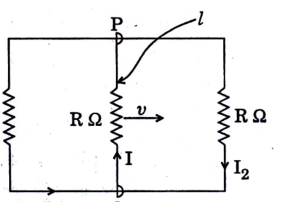
- A.,
- B.,
- C.
- D.,
Correct answer: B
Explanation: PQ is an emf with internal resistance R feeding two parallel R's: , split equally.
Question 32
Physics · 8 marks · −2Let C be the capacitance of a capacitor discharging through a resistor R. Suppose is the time taken for the energy stored in the capacitor to reduce to half its initial value and is the time taken for the charge to reduce to one-fourth its initial value. Then the ratio will be
- A.1
- B.
- C.
- D.2
Correct answer: C
Explanation: , .
Question 33
Physics · 4 marks · −1Statement-1 : Two particles moving in the same direction do not lose all their energy in a completely inelastic collision. Statement-2 : Principle of conservation of momentum holds true for all kinds of collisions.
- A.Statement-1 is true, Statement-2 is true; Statement-2 is the correct explanation of Statement-1.
- B.Statement-1 is true, Statement-2 is true; Statement-2 is not the correct explanation of Statement-1.
- C.Statement-1 is false, Statement-2 is true.
- D.Statement-1 is true, Statement-2 is false.
Correct answer: A
Explanation: Momentum is non-zero and conserved, so the combined body keeps some KE.
Question 34
Physics · 4 marks · −1Statement-1 : When ultraviolet light is incident on a photocell, its stopping potential is and the maximum kinetic energy of the photoelectrons is . When the ultraviolet light is replaced by X-rays, both and increase. Statement-2 : Photoelectrons are emitted with speeds ranging from zero to a maximum value because of the range of frequencies present in the incident light.
- A.Statement-1 is true, Statement-2 is true; Statement-2 is the correct explanation of Statement-1.
- B.Statement-1 is true, Statement-2 is true; Statement-2 is not the correct explanation of Statement-1.
- C.Statement-1 is false, Statement-2 is true.
- D.Statement-1 is true, Statement-2 is false.
Correct answer: D
Explanation: Higher frequency raises and ; the spread of speeds is due to energy losses inside the metal, not a range of frequencies.
Question 35
Physics · 4 marks · −1A ball is made of a material of density where with and representing the densities of oil and water, respectively. The oil and water are immiscible. If the above ball is in equilibrium in a mixture of this oil and water, which of the following pictures represents its equilibrium position ?
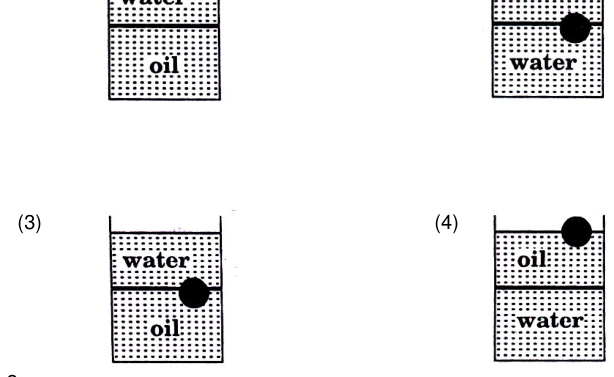
- A.Picture (1)
- B.Picture (2)
- C.Picture (3)
- D.Picture (4)
Correct answer: B
Explanation: Oil floats on water; the ball sinks through oil but floats on water, so it rests at the interface with oil on top.
Question 36
Physics · 4 marks · −1A particle is moving with velocity , where K is a constant. The general equation for its path is
- A. constant
- B. constant
- C. = constant
- D. constant
Correct answer: D
Explanation: .
Question 37
Physics · 4 marks · −1Two long parallel wires are at a distance 2d apart. They carry steady equal current flowing out of the plane of the paper as shown. The variation of the magnetic field along the line XX' is given by
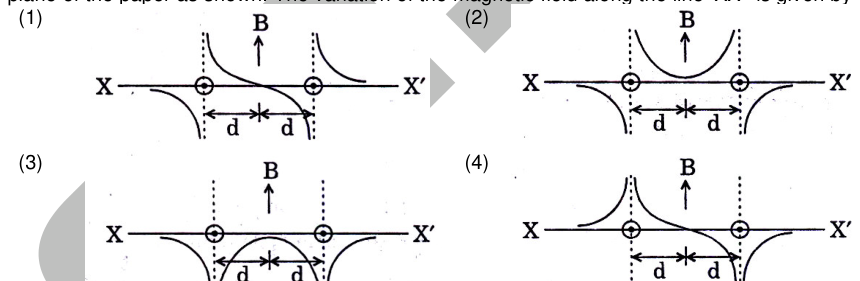
- A.Graph (1)
- B.Graph (2)
- C.Graph (3)
- D.Graph (4)
Correct answer: A
Explanation: Fields cancel at the midpoint and reverse sign across it; outside the wires they add, diverging near each wire.
Question 38
Physics · 4 marks · −1In the circuit shown below, the key K is closed at t = 0. The current through the battery is
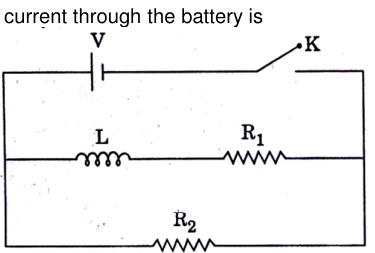
- A. at t = 0 and at
- B. at t = 0 and at
- C. at t = 0 and at
- D. at t = 0 and at
Correct answer: B
Explanation: At t = 0 the inductor branch carries no current; at steady state it is a wire, R1 and R2 in parallel.
Question 39
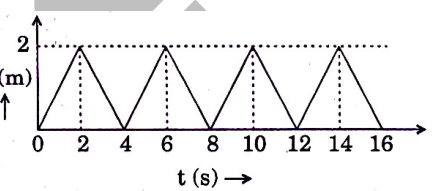
Physics · 4 marks · −1The figure shows the position - time (x - t) graph of one-dimensional motion of a body of mass 0.4 kg. The magnitude of each impulse is
- A.0.4 Ns
- B.0.8 Ns
- C.1.6 Ns
- D.0.2 Ns
Correct answer: B
Explanation: Velocity switches between and m/s: N s.
Question 40
Physics · 4 marks · −1A nucleus of mass is at rest and decays into two daughter nuclei of equal mass each. Speed of light is c. The binding energy per nucleon for the parent nucleus is and that for the daughter nuclei is . Then
- A.
- B.
- C.
- D.
Correct answer: C
Explanation: Energy is released, so the daughters are more tightly bound.
Question 41
Physics · 4 marks · −1A nucleus of mass is at rest and decays into two daughter nuclei of equal mass each. Speed of light is c. The speed of daughter nuclei is
- A.
- B.
- C.
- D.
Correct answer: B
Explanation: .
Question 42
Physics · 4 marks · −1A radioactive nucleus (initial mass number A and atomic number Z) emits 3 -particles and 2 positrons. The ratio of number of neutrons to that of protons in the final nucleus will be
- A.
- B.
- C.
- D.
Correct answer: B
Explanation: Protons: ; neutrons: .
Question 43
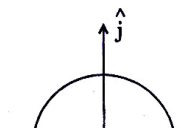
Physics · 4 marks · −1A thin semi-circular ring of radius r has a positive charge q distributed uniformly over it. The net field at the centre O is
- A.
- B.
- C.
- D.
Correct answer: C
Explanation: , directed away from the ring ().
Question 44
Physics · 4 marks · −1The combination of gates shown below yields
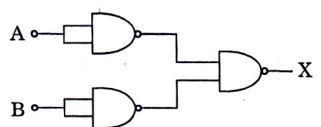
- A.OR gate
- B.NOT gate
- C.XOR gate
- D.NAND gate
Correct answer: A
Explanation: Each input passes through a NOT (NAND with tied inputs), then a NAND: .
Question 45
Physics · 4 marks · −1A diatomic ideal gas is used in a Car engine as the working substance. If during the adiabatic expansion part of the cycle, volume of the gas increases from V to 32V the efficiency of the engine is
- A.0.5
- B.0.75
- C.0.99
- D.0.25
Correct answer: B
Explanation: ; .
Question 46
Physics · 4 marks · −1If a source of power 4 kW produces photons/second, the radiation belong to a part of the spectrum called
- A.X-rays
- B.ultraviolet rays
- C.microwaves
- D.-rays
Correct answer: A
Explanation: Photon energy J, Hz: X-rays.
Question 47
Physics · 4 marks · −1The respective number of significant figures for the numbers 23.023, 0.0003 and are
- A.5, 1, 2
- B.5, 1, 5
- C.5, 5, 2
- D.4, 4, 2
Correct answer: A
Explanation: 5, 1, 2.
Question 48
Physics · 4 marks · −1In a series LCR circuit R = 200 and the voltage and the frequency of the main supply is 220 V and 50 Hz respectively. On taking out the capacitance from the circuit the current lags behind the voltage by . On taking out the inductor from the circuit the current leads the voltage by . The power dissipated in the LCR circuit is
- A.305 W
- B.210 W
- C.Zero W
- D.242 W
Correct answer: D
Explanation: : resonance, W.
Question 49
Physics · 4 marks · −1Let there be a spherically symmetric charge distribution with charge density varying as upto r = R, and for r > R, where r is the distance from the origin. The electric field at a distance r (r < R) from the origin is given by
- A.
- B.
- C.
- D.
Correct answer: B
Explanation: ; .
Question 50
Physics · 8 marks · −2The potential energy function for the force between two atoms in a diatomic molecule is approximately given by , where a and b are constants and x is the distance between the atoms. If the dissociation energy of the molecule is , D is
- A.
- B.
- C.
- D.
Correct answer: C
Explanation: Equilibrium , .
Question 51
Physics · 8 marks · −2Two conductors have the same resistance at C but their temperature coefficients of resistance are and . The respective temperature coefficients of their series and parallel combinations are nearly
- A.,
- B.,
- C.,
- D.,
Correct answer: D
Explanation: For equal both combinations give to first order.
Question 52
Physics · 8 marks · −2A point P moves in counter-clockwise direction on a circular path as shown in the figure. The movement of 'P' is such that it sweeps out a length , where s is in metres and t is in seconds. The radius of the path is 20 m. The acceleration of 'P' when t = 2 s is nearly
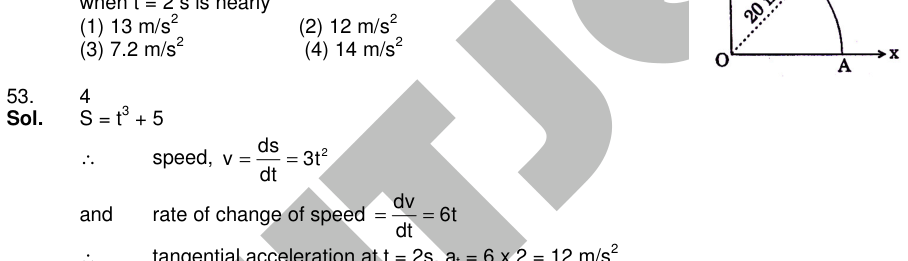
- A.13 m/s
- B.12 m/s
- C.7.2 m/s
- D.14 m/s
Correct answer: D
Explanation: , , ; m/s.
Question 53
Physics · 4 marks · −1Two fixed frictionless inclined plane making an angle and with the vertical are shown in the figure. Two block A and B are placed on the two planes. What is the relative vertical acceleration of A with respect to B ?
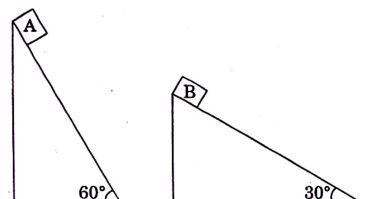
- A.4.9 ms in horizontal direction
- B.9.8 ms in vertical direction
- C.zero
- D.4.9 ms in vertical direction
Correct answer: D
Explanation: Vertical acceleration (θ with horizontal): m/s.
Question 54
Physics · 4 marks · −1For a particle in uniform circular motion the acceleration at a point on the circle of radius R is (here is measured from the x-axis)
- A.
- B.
- C.
- D.
Correct answer: C
Explanation: Centripetal acceleration points to the centre: .
Question 55
Physics · 4 marks · −1An initially parallel cylindrical beam travels in a medium of refractive index , where and are positive constants and I is the intensity of the light beam. The intensity of the beam is decreasing with increasing radius. As the beam enters the medium, it will
- A.diverge
- B.converge
- C.diverge near the axis and converge near the periphery
- D.travel as a cylindrical beam
Correct answer: B
Explanation: Refractive index is largest on the axis (self-focusing), so the beam converges.
Question 56
Physics · 4 marks · −1An initially parallel cylindrical beam travels in a medium of refractive index , where and are positive constants and I is the intensity of the light beam. The intensity of the beam is decreasing with increasing radius. The initial shape of the wave front of the beam is
- A.convex
- B.concave
- C.convex near the axis and concave near the periphery
- D.planar
Correct answer: D
Explanation: A parallel beam has plane wavefronts.
Question 57
Physics · 4 marks · −1An initially parallel cylindrical beam travels in a medium of refractive index , where and are positive constants and I is the intensity of the light beam. The intensity of the beam is decreasing with increasing radius. The speed of light in the medium is
- A.minimum on the axis of the beam
- B.the same everywhere in the beam
- C.directly proportional to the intensity I
- D.maximum on the axis of the beam
Correct answer: A
Explanation: Largest on the axis means lowest speed there.
Question 58
Physics · 4 marks · −1A small particle of mass m is projected at an angle with the x-axis with an initial velocity in the x-y plane as shown in the figure. At a time , the angular momentum of the particle is (where , and are unit vectors along x, y and z-axis respectively)
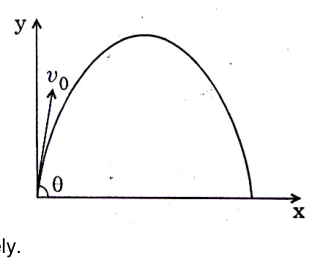
- A.
- B.
- C.
- D.
Correct answer: C
Explanation: about the launch point.
Question 59
Physics · 4 marks · −1The equation of a wave on a string of linear mass density 0.04 kg m is given by . The tension in the string is
- A.4.0 N
- B.12.5 N
- C.0.5 N
- D.6.25 N
Correct answer: D
Explanation: m/s; N.
Question 60
Mathematics · 4 marks · −1Let and let , where , then =
- A.
- B.
- C.
- D.
Correct answer: A
Explanation: .
Question 61
Mathematics · 4 marks · −1Let S be a non-empty subset of R. Consider the following statement: P: There is a rational number such that . Which of the following statements is the negation of the statement P ?
- A.There is no rational number such that
- B.Every rational number satisfies
- C. and is not rational
- D.There is a rational number such that
Correct answer: B
Explanation: Negate the existential: for all rational x in S, .
Question 62
Mathematics · 4 marks · −1Let and . Then vector satisfying and is
- A.
- B.
- C.
- D.
Correct answer: D
Explanation: Check : , .
Question 63
Mathematics · 4 marks · −1The equation of the tangent to the curve , that is parallel to the x-axis, is
- A.
- B.
- C.
- D.
Correct answer: C
Explanation: , .
Question 64
Mathematics · 4 marks · −1Solution of the differential equation , is
- A.
- B.
- C.
- D.
Correct answer: D
Explanation: Bernoulli: with , ; IF : .
Question 65
Mathematics · 4 marks · −1The area bounded by the curves and between the ordinates and is
- A.
- B.
- C.
- D.
Correct answer: D
Explanation: .
Question 66
Mathematics · 4 marks · −1If two tangents drawn from a point P to the parabola are at right angles, then the locus of P is
- A.
- B.
- C.
- D.
Correct answer: B
Explanation: Perpendicular tangents meet on the directrix .
Question 67
Mathematics · 4 marks · −1If the vectors , and are mutually orthogonal, then =
- A.(2, -3)
- B.(-2, 3)
- C.(3, -2)
- D.(-3, 2)
Correct answer: D
Explanation: , : , .
Question 68
Mathematics · 4 marks · −1Consider the following relations: R = {(x, y) | x, y are real numbers and x = wy for some rational number w}; S = {(m/n, p/q) | m, n, p and q are integers such that and qm = pn}. Then
- A.neither R nor S is an equivalence relation
- B.S is an equivalence relation but R is not an equivalence relation
- C.R and S both are equivalence relations
- D.R is an equivalence relation but S is not an equivalence relation
Correct answer: B
Explanation: R is not symmetric ( but not conversely); S is equality of fractions, an equivalence.
Question 69
Mathematics · 8 marks · −2Let be defined by . If f has a local minimum at , then a possible value of k is
- A.0
- B.
- C.
- D.1
Correct answer: C
Explanation: Need , i.e. .
Question 70
Mathematics · 8 marks · −2The number of non-singular matrices, with four entries as 1 and all other entries as 0, is
- A.5
- B.6
- C.at least 7
- D.less than 4
Correct answer: C
Explanation: A permutation matrix plus one extra 1 in any of the 6 zero positions stays non-singular: .
Question 71
Mathematics · 8 marks · −2Four numbers are chosen at random (without replacement) from the set {1, 2, 3, ....., 20}. Statement-1: The probability that the chosen numbers when arranged in some order will form an AP is . Statement-2: If the four chosen numbers form an AP, then the set of all possible values of common difference is .
- A.Statement-1 is true, Statement-2 is true; Statement-2 is not the correct explanation for Statement-1
- B.Statement-1 is true, Statement-2 is false
- C.Statement-1 is false, Statement-2 is true
- D.Statement-1 is true, Statement-2 is true; Statement-2 is the correct explanation for Statement-1
Correct answer: B
Explanation: Number of APs: , ; d can also be 6, so Statement-2 is false.
Question 72
Mathematics · 4 marks · −1Statement-1: The point A(3, 1, 6) is the mirror image of the point B(1, 3, 4) in the plane . Statement-2: The plane bisects the line segment joining A(3, 1, 6) and B(1, 3, 4).
- A.Statement-1 is true, Statement-2 is true; Statement-2 is not the correct explanation for Statement-1
- B.Statement-1 is true, Statement-2 is false
- C.Statement-1 is false, Statement-2 is true
- D.Statement-1 is true, Statement-2 is true; Statement-2 is the correct explanation for Statement-1
Correct answer: A
Explanation: Midpoint (2, 2, 5) lies on the plane and AB is along the normal; bisection alone does not explain the image.
Question 73
Mathematics · 4 marks · −1Let , and . Statement-1: . Statement-2: and .
- A.Statement-1 is true, Statement-2 is true; Statement-2 is not the correct explanation for Statement-1
- B.Statement-1 is true, Statement-2 is false
- C.Statement-1 is false, Statement-2 is true
- D.Statement-1 is true, Statement-2 is true; Statement-2 is the correct explanation for Statement-1
Correct answer: B
Explanation: , (not ), .
Question 74
Mathematics · 4 marks · −1Let A be a matrix with non-zero entries and let , where I is identity matrix. Define Tr(A) = sum of diagonal elements of A and |A| = determinant of matrix A. Statement-1: Tr(A) = 0. Statement-2: |A| = 1.
- A.Statement-1 is true, Statement-2 is true; Statement-2 is not the correct explanation for Statement-1
- B.Statement-1 is true, Statement-2 is false
- C.Statement-1 is false, Statement-2 is true
- D.Statement-1 is true, Statement-2 is true; Statement-2 is the correct explanation for Statement-1
Correct answer: B
Explanation: Off-diagonal equations force ; then .
Question 75
Mathematics · 4 marks · −1Let be a continuous function defined by . Statement-1: , for some . Statement-2: , for all .
- A.Statement-1 is true, Statement-2 is true; Statement-2 is not the correct explanation for Statement-1
- B.Statement-1 is true, Statement-2 is false
- C.Statement-1 is false, Statement-2 is true
- D.Statement-1 is true, Statement-2 is true; Statement-2 is the correct explanation for Statement-1
Correct answer: D
Explanation: Max and f is continuous tending to 0, so by IVT is attained.
Question 76
Mathematics · 4 marks · −1For a regular polygon, let r and R be the radii of the inscribed and the circumscribed circles. A false statement among the following is
- A.There is a regular polygon with
- B.There is a regular polygon with
- C.There is a regular polygon with
- D.There is a regular polygon with
Correct answer: B
Explanation: ; is not for any n.
Question 77
Mathematics · 4 marks · −1If and are the roots of the equation , then =
- A.
- B.1
- C.2
- D.
Correct answer: B
Explanation: ; sum .
Question 78
Mathematics · 4 marks · −1The number of complex numbers z such that equals
- A.1
- B.2
- C.
- D.0
Correct answer: A
Explanation: Only the circumcentre of 1, -1, i: z = 0.
Question 79
Mathematics · 4 marks · −1A line AB in three-dimensional space makes angles and with the positive x-axis and the positive y-axis respectively. If AB makes an acute angle with the positive z-axis, then equals
- A.
- B.
- C.
- D.
Correct answer: B
Explanation: .
Question 80
Mathematics · 4 marks · −1The line L given by passes through the point (13, 32). The line K is parallel to L and has the equation . Then the distance between L and K is
- A.
- B.
- C.
- D.
Correct answer: C
Explanation: , L: ; K: ; distance .
Question 81
Mathematics · 8 marks · −2A person is to count 4500 currency notes. Let denote the number of notes he counts in the minute. If and are in A.P. with common difference , then the time taken by him to count all notes is
- A.34 minutes
- B.125 minutes
- C.135 minutes
- D.24 minutes
Correct answer: A
Explanation: After 10 min, 1500 counted; ; total 34 min.
Question 82
Mathematics · 8 marks · −2Let be a positive increasing function with . Then =
- A.
- B.
- C.3
- D.1
Correct answer: D
Explanation: (sandwich).
Question 83
Mathematics · 8 marks · −2Let p(x) be a function defined on R such that , for all , p(0) = 1 and p(1) = 41. Then equals
- A.21
- B.41
- C.42
- D.
Correct answer: A
Explanation: , so .
Question 84
Mathematics · 4 marks · −1Let be a differentiable function with f(0) = -1 and f'(0) = 1. Let . Then g'(0) =
- A.
- B.0
- C.
- D.4
Correct answer: A
Explanation: .
Question 85
Mathematics · 4 marks · −1There are two urns. Urn A has 3 distinct red balls and urn B has 9 distinct blue balls. From each urn two balls are taken out at random and then transferred to the other. The number of ways in which this can be done is
- A.36
- B.66
- C.108
- D.3
Correct answer: C
Explanation: .
Question 86
Mathematics · 4 marks · −1Consider the system of linear equations: , , . The system has
- A.exactly 3 solutions
- B.a unique solution
- C.no solution
- D.infinite number of solutions
Correct answer: C
Explanation: Eq1 + Eq2 gives LHS of Eq3 but RHS 6 ≠ 1: inconsistent.
Question 87
Mathematics · 4 marks · −1An urn contains nine balls of which three are red, four are blue and two are green. Three balls are drawn at random without replacement from the urn. The probability that the three balls have different colour is
- A.
- B.
- C.
- D.
Correct answer: A
Explanation: .
Question 88
Mathematics · 4 marks · −1For two data sets, each of size 5, the variances are given to be 4 and 5 and the corresponding means are given to be 2 and 4, respectively. The variance of the combined data set is
- A.
- B.6
- C.
- D.
Correct answer: A
Explanation: , ; combined variance .
Question 89
Mathematics · 4 marks · −1The circle intersects the line at two distinct points if
- A.
- B.
- C.
- D.
Correct answer: A
Explanation: Centre (2, 4), r = 5: .