AIEEE 2012 — 29 Apr Offline Set C (Previous Year Paper)
JEE Main · 2012 · with answers and explanations
- questions
- 87
- Total marks
- 348
- Duration
- 180 minutes
- Negative marking
- −1
Subjects: Mathematics · Physics · Chemistry
Question 1
Mathematics · 4 marks · −1The equation has
- A.infinite number of real roots
- B.no real roots
- C.exactly one real root
- D.exactly four real roots
Correct answer: B
Explanation: With : , ; but , so no solution.
Question 2
Mathematics · 4 marks · −1Let and be two unit vectors. If the vectors and are perpendicular to each other, then the angle between and is
- A.
- B.
- C.
- D.
Correct answer: C
Explanation: .
Question 3
Mathematics · 4 marks · −1A spherical balloon is filled with cubic meters of helium gas. If a leak in the balloon causes the gas to escape at the rate of cubic meters per minute, then the rate (in meters per minute) at which the radius of the balloon decreases 49 minutes after the leakage began is
- A.
- B.
- C.
- D.
Correct answer: C
Explanation: After 49 min ; .
Question 4
Mathematics · 4 marks · −1Statement 1: The sum of the series is 8000. Statement 2: for any natural number n.
- A.Statement 1 is false, statement 2 is true
- B.Statement 1 is true, statement 2 is true; statement 2 is a correct explanation for statement 1
- C.Statement 1 is true, statement 2 is true; statement 2 is not a correct explanation for statement 1
- D.Statement 1 is true, statement 2 is false
Correct answer: B
Explanation: The k-th bracket is ; 20 brackets telescope to , so Statement 2 explains Statement 1.
Question 5
Mathematics · 4 marks · −1The negation of the statement 'If I become a teacher, then I will open a school' is
- A.I will become a teacher and I will not open a school
- B.Either I will not become a teacher or I will not open a school
- C.Neither I will become a teacher nor I will open a school
- D.I will not become a teacher or I will open a school
Correct answer: A
Explanation: .
Question 6
Mathematics · 4 marks · −1If the integral , then a is equal to
- A.
- B.
- C.1
- D.2
Correct answer: D
Explanation: , so the integral is .
Question 7
Mathematics · 4 marks · −1Statement 1: An equation of a common tangent to the parabola and the ellipse is . Statement 2: If the line , is a common tangent to the parabola and the ellipse , then m satisfies .
- A.Statement 1 is false, statement 2 is true
- B.Statement 1 is true, statement 2 is true; statement 2 is a correct explanation for statement 1
- C.Statement 1 is true, statement 2 is true; statement 2 is not a correct explanation for statement 1
- D.Statement 1 is true, statement 2 is false
Correct answer: B
Explanation: Tangency to : , ; gives .
Question 8
Mathematics · 4 marks · −1Let . If and are column matrices such that and , then is equal to
- A.
- B.
- C.
- D.
Correct answer: D
Explanation: Forward substitution: , ; sum .
Question 9
Mathematics · 4 marks · −1If n is a positive integer, then is
- A.an irrational number
- B.an odd positive integer
- C.an even positive integer
- D.a rational number other than positive integers
Correct answer: A
Explanation: ; only odd powers of survive, giving an integer multiple of .
Question 10
Mathematics · 4 marks · −1If 100 times the term of an AP with non zero common difference equals the 50 times its term, then the term of this AP is
- A.
- B.150 times its term
- C.150
- D.zero
Correct answer: D
Explanation: .
Question 11
Mathematics · 4 marks · −1In a , if and , then the angle R is equal to
- A.
- B.
- C.
- D.
Correct answer: B
Explanation: Squaring and adding: . If then and , impossible; so and .
Question 12
Mathematics · 4 marks · −1An equation of a plane parallel to the plane and at a unit distance from the origin is
- A.
- B.
- C.
- D.
Correct answer: A
Explanation: .
Question 13
Mathematics · 4 marks · −1If the line passes through the point which divides the line segment joining the points (1, 1) and (2, 4) in the ratio 3 : 2, then k equals
- A.
- B.5
- C.6
- D.
Correct answer: C
Explanation: Point ; .
Question 14
Mathematics · 4 marks · −1Let be n observations, and let be their arithmetic mean and be their variance. Statement 1: Variance of is . Statement 2: Arithmetic mean of is .
- A.Statement 1 is false, statement 2 is true
- B.Statement 1 is true, statement 2 is true; statement 2 is a correct explanation for statement 1
- C.Statement 1 is true, statement 2 is true; statement 2 is not a correct explanation for statement 1
- D.Statement 1 is true, statement 2 is false
Correct answer: D
Explanation: Scaling by 2 multiplies variance by 4 but the mean only by 2.
Question 15
Mathematics · 4 marks · −1The population p(t) at time t of a certain mouse species satisfies the differential equation . If , then the time at which the population becomes zero is
- A.
- B.
- C.
- D.
Correct answer: A
Explanation: ; , .
Question 16
Mathematics · 4 marks · −1Let be such that the function f given by , has extreme values at and . Statement 1: f has local maximum at and at . Statement 2: and .
- A.Statement 1 is false, statement 2 is true
- B.Statement 1 is true, statement 2 is true; statement 2 is a correct explanation for statement 1
- C.Statement 1 is true, statement 2 is true; statement 2 is not a correct explanation for statement 1
- D.Statement 1 is true, statement 2 is false
Correct answer: B
Explanation: give , ; then at both points, so both are maxima.
Question 17
Mathematics · 4 marks · −1The area bounded between the parabolas and , and the straight line is
- A.
- B.
- C.
- D.
Correct answer: C
Explanation: .
Question 18
Mathematics · 4 marks · −1Assuming the balls to be identical except for difference in colours, the number of ways in which one or more balls can be selected from 10 white, 9 green and 7 black balls is
- A.880
- B.629
- C.630
- D.879
Correct answer: D
Explanation: .
Question 19
Mathematics · 4 marks · −1If is a function defined by , where [x] denotes the greatest integer function, then f is
- A.continuous for every real x
- B.discontinuous only at
- C.discontinuous only at non-zero integral values of x
- D.continuous only at
Correct answer: A
Explanation: ; at integers kills the jump of .
Question 20
Mathematics · 4 marks · −1If the lines and intersect, then k is equal to
- A.
- B.
- C.
- D.0
Correct answer: C
Explanation: : , , .
Question 21
Mathematics · 4 marks · −1Three numbers are chosen at random without replacement from {1, 2, 3, ......, 8}. The probability that their minimum is 3, given that their maximum is 6, is
- A.
- B.
- C.
- D.
Correct answer: B
Explanation: Given max 6: choices for the other two; min 3 needs 3 and one of {4,5}: 2. Probability .
Question 22
Mathematics · 4 marks · −1If and is real, then the point represented by the complex number z lies
- A.either on the real axis or on a circle passing through the origin
- B.on a circle with centre at the origin
- C.either on the real axis or on a circle not passing through the origin
- D.on the imaginary axis
Correct answer: A
Explanation: Imaginary part zero gives .
Question 23
Mathematics · 4 marks · −1Let P and Q be matrices with . If and , then determinant of is equal to
- A.
- B.1
- C.0
- D.
Correct answer: C
Explanation: with , so is singular.
Question 24
Mathematics · 4 marks · −1The length of the diameter of the circle which touches the x-axis at the point (1, 0) and passes through the point (2, 3) is
- A.
- B.
- C.
- D.
Correct answer: A
Explanation: Centre : ; diameter .
Question 25
Mathematics · 4 marks · −1Let X = {1, 2, 3, 4, 5}. The number of different ordered pairs (Y, Z) that can be formed such that , and is empty, is
- A.
- B.
- C.
- D.
Correct answer: B
Explanation: Each element is in Y only, Z only, or neither: .
Question 26
Mathematics · 4 marks · −1An ellipse is drawn by taking a diameter of the circle as its semiminor axis and a diameter of the circle as its semi-major axis. If the centre of the ellipse is the origin and its axes are the coordinate axes, then the equation of the ellipse is
- A.
- B.
- C.
- D.
Correct answer: D
Explanation: , : .
Question 27
Mathematics · 4 marks · −1Consider the function , . Statement 1: . Statement 2: f is continuous in [2, 5], differentiable in (2, 5) and .
- A.Statement 1 is false, statement 2 is true
- B.Statement 1 is true, statement 2 is true; statement 2 is a correct explanation for statement 1
- C.Statement 1 is true, statement 2 is true; statement 2 is not a correct explanation for statement 1
- D.Statement 1 is true, statement 2 is false
Correct answer: B
Explanation: f is constant (=3) on [2,5], so ; Rolle's conditions in Statement 2 hold and explain it.
Question 28
Mathematics · 4 marks · −1A line is drawn through the point (1, 2) to meet the coordinate axes at P and Q such that it forms a triangle OPQ, where O is the origin. If the area of the triangle OPQ is least, then the slope of the line PQ is
- A.
- B.
- C.
- D.
Correct answer: C
Explanation: Area with is least at (area 4).
Question 29
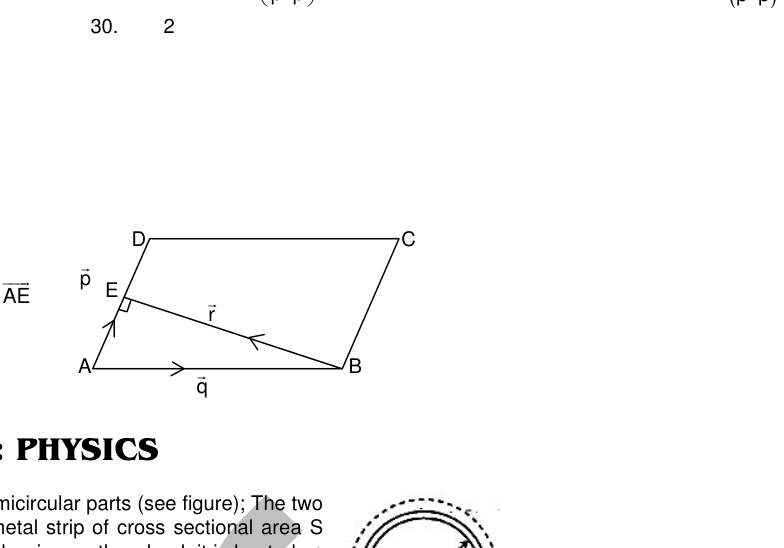
Mathematics · 4 marks · −1Let ABCD be a parallelogram such that , and be an acute angle. If is the vector that coincides with the altitude directed from the vertex B to the side AD, then is given by
- A.
- B.
- C.
- D.
Correct answer: B
Explanation: Foot E on AD: ; .
Question 30
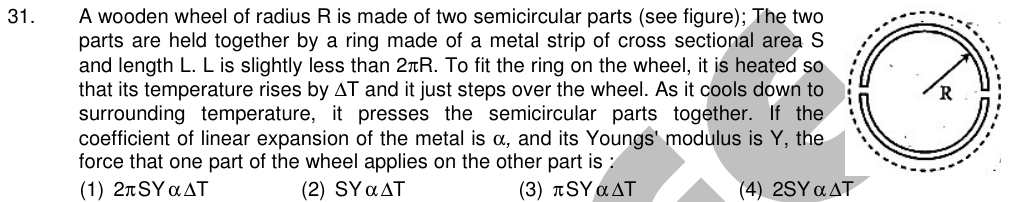
Physics · 4 marks · −1A wooden wheel of radius R is made of two semicircular parts (see figure). The two parts are held together by a ring made of a metal strip of cross sectional area S and length L. L is slightly less than . To fit the ring on the wheel, it is heated so that its temperature rises by and it just steps over the wheel. As it cools down to surrounding temperature, it presses the semicircular parts together. If the coefficient of linear expansion of the metal is , and its Youngs' modulus is Y, the force that one part of the wheel applies on the other part is :
- A.
- B.
- C.
- D.
Correct answer: D
Explanation: Ring tension ; each semicircle is pulled by .
Question 31
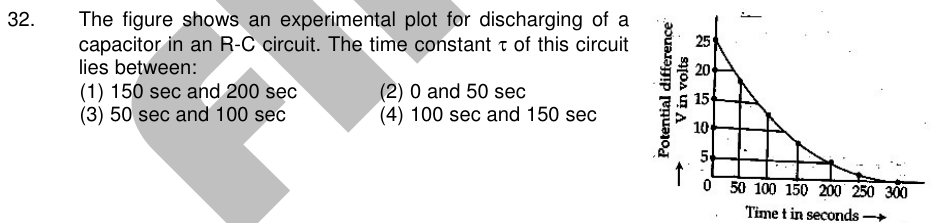
Physics · 4 marks · −1The figure shows an experimental plot for discharging of a capacitor in an R-C circuit. The time constant of this circuit lies between:
- A.150 sec and 200 sec
- B.0 and 50 sec
- C.50 sec and 100 sec
- D.100 sec and 150 sec
Correct answer: D
Explanation: V falls from 25 V to 12.5 V in about 100 s: s.
Question 32
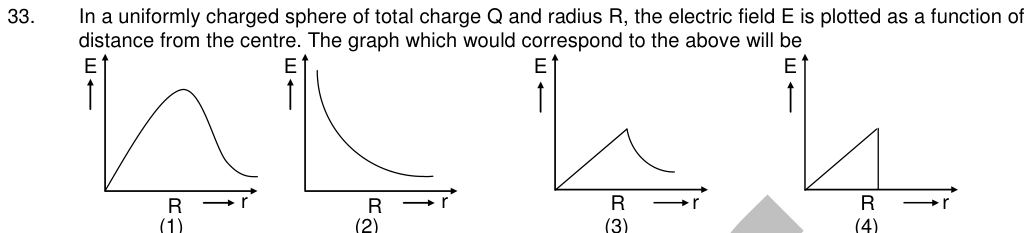
Physics · 4 marks · −1In a uniformly charged sphere of total charge Q and radius R, the electric field E is plotted as a function of distance from the centre. The graph which would correspond to the above will be
- A.Graph (1)
- B.Graph (2)
- C.Graph (3)
- D.Graph (4)
Correct answer: C
Explanation: E rises linearly inside (), peaks at R, then falls as .
Question 33
Physics · 4 marks · −1If a simple pendulum has significant amplitude (up to a factor of 1/e of original) only in the period between s to s, then may be called the average life of the pendulum. When the spherical bob of the pendulum suffers a retardation (due to viscous drag) proportional to its velocity, with 'b' as the constant of proportionality, the average life time of the pendulum is (assuming damping is small) in seconds:
- A.
- B.b
- C.
- D.
Correct answer: D
Explanation: Amplitude decays as ; it reaches at .
Question 34
Physics · 4 marks · −1Hydrogen atom is excited from ground state to another state with principal quantum number equal to 4. Then the number of spectral lines in the emission spectra will be
- A.2
- B.3
- C.5
- D.6
Correct answer: D
Explanation: .
Question 35
Physics · 4 marks · −1A coil is suspended in a uniform magnetic field, with the plane of the coil parallel to the magnetic lines of force. When a current is passed through the coil it starts oscillating; it is very difficult to stop. But if an aluminium plate is placed near to the coil, it stops. This is due to :
- A.development of air current when the plate is placed.
- B.induction of electrical charge on the plate
- C.shielding of magnetic lines of force as aluminium is a paramagnetic material.
- D.electromagnetic induction in the aluminium plate giving rise to electromagnetic damping.
Correct answer: D
Explanation: Eddy currents induced in the plate oppose the motion (electromagnetic damping).
Question 36
Physics · 4 marks · −1The mass of a spaceship is 1000 kg. It is to be launched from the earth's surface out into free space. The value of 'g' and 'R' (radius of earth) are 10 m/s and 6400 km respectively. The required energy for this work will be ;
- A. Joules
- B. Joules
- C. Joules
- D. Joules
Correct answer: D
Explanation: J.
Question 37
Physics · 4 marks · −1Helium gas goes through a cycle ABCDA (consisting of two isochoric and two isobaric lines) as shown in figure. Efficiency of this cycle is nearly: (Assume the gas to be close to ideal gas)

- A.15.4%
- B.9.1%
- C.10.5%
- D.12.5%
Correct answer: A
Explanation: Work ; heat in: A to B , B to C . .
Question 38
Physics · 4 marks · −1In Young's double slit experiment, one of the slit is wider than other, so that the amplitude of the light from one slit is double of that from other slit. If be the maximum intensity, the resultant intensity I when they interfere at phase difference is given by
- A.
- B.
- C.
- D.
Correct answer: D
Explanation: , : .
Question 39
Physics · 4 marks · −1A liquid in a beaker has temperature at time t and is temperature of surroundings, then according to Newton's law of cooling the correct graph between and t is
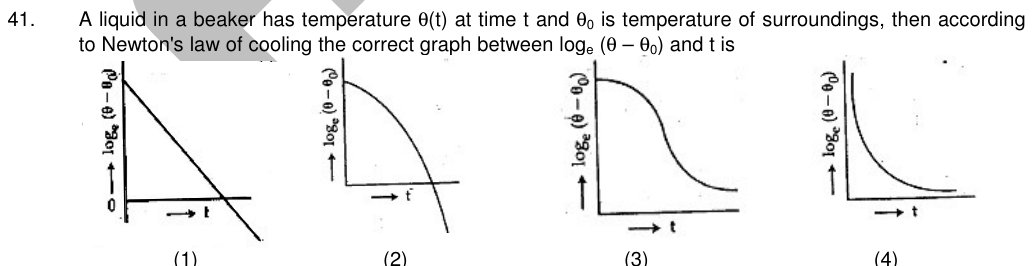
- A.Graph (1)
- B.Graph (2)
- C.Graph (3)
- D.Graph (4)
Correct answer: A
Explanation: : a straight line with negative slope.
Question 40
Physics · 4 marks · −1A particle of mass m is at rest at the origin at time . It is subjected to a force in the x direction. Its speed v(t) is depicted by which of the following curves?
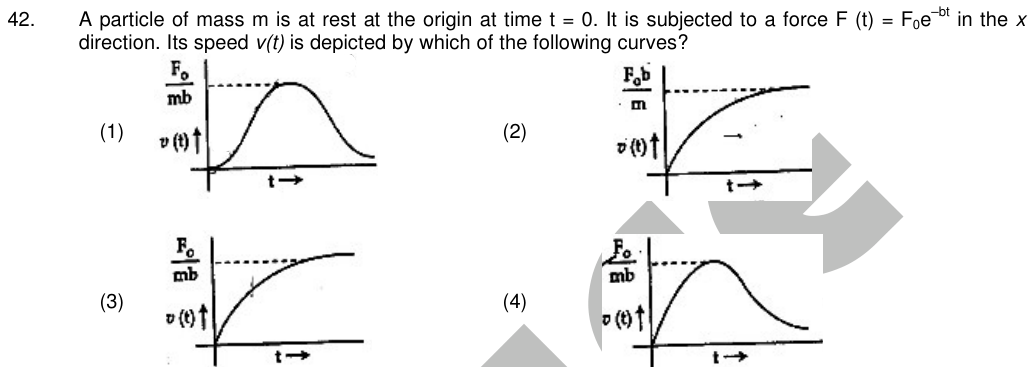
- A.Graph (1)
- B.Graph (2)
- C.Graph (3)
- D.Graph (4)
Correct answer: C
Explanation: , rising from 0 to the asymptote .
Question 41
Physics · 4 marks · −1Two electric bulbs marked 25W - 220V and 100W - 220V are connected in series to a 440V supply. Which of the bulbs will fuse?
- A.both
- B.100 W
- C.25 W
- D.neither
Correct answer: C
Explanation: ; the 25 W bulb gets V > 220 V and fuses.
Question 42
Physics · 4 marks · −1Resistance of a given wire is obtained by measuring the current flowing in it and the voltage difference applied across it. If the percentage errors in the measurement of the current and the voltage difference are 3% each, then error in the value of resistance of the wire is
- A.6%
- B.zero
- C.1%
- D.3%
Correct answer: A
Explanation: .
Question 43
Physics · 4 marks · −1A boy can throw a stone up to a maximum height of 10 m. The maximum horizontal distance that the boy can throw the same stone up to will be
- A. m
- B.10 m
- C. m
- D.20 m
Correct answer: D
Explanation: m.
Question 44
Physics · 4 marks · −1Statement 1: Davisson - Germer experiment established the wave nature of electrons. Statement 2: If electrons have wave nature, they can interfere and show diffraction.
- A.Statement 1 is false, Statement 2 is true
- B.Statement 1 is true, Statement 2 is false
- C.Statement 1 is true, Statement 2 is the correct explanation for statement 1
- D.Statement 1 is true, Statement 2 is true, Statement 2 is not the correct explanation for statement 1.
Correct answer: C
Explanation: The experiment observed electron diffraction from a crystal, which is what establishes wave nature.
Question 45
Physics · 4 marks · −1A thin liquid film formed between a U-shaped wire and a light slider supports a weight of N (see figure). The length of the slider is 30 cm and its weight negligible. The surface tension of the liquid film is

- A.0.0125 Nm
- B.0.1 Nm
- C.0.05 Nm
- D.0.025 Nm
Correct answer: D
Explanation: Two surfaces: N/m.
Question 46
Physics · 4 marks · −1A charge Q is uniformly distributed over the surface of non conducting disc of radius R. The disc rotates about an axis perpendicular to its plane and passing through its centre with an angular velocity . As a result of this rotation a magnetic field of induction B is obtained at the centre of the disc. If we keep both the amount of charge placed on the disc and its angular velocity to be constant and vary the radius of the disc then the variation of the magnetic induction at the centre of the disc will be represented by the figure
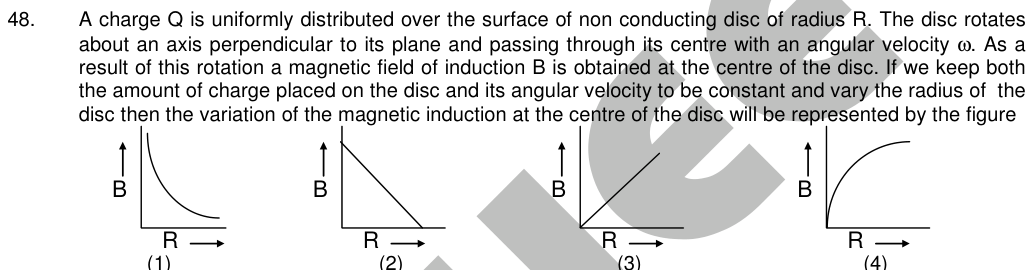
- A.Graph (1)
- B.Graph (2)
- C.Graph (3)
- D.Graph (4)
Correct answer: A
Explanation: : a rectangular hyperbola.
Question 47
Physics · 4 marks · −1Truth table for system of four NAND gates as shown in figure is
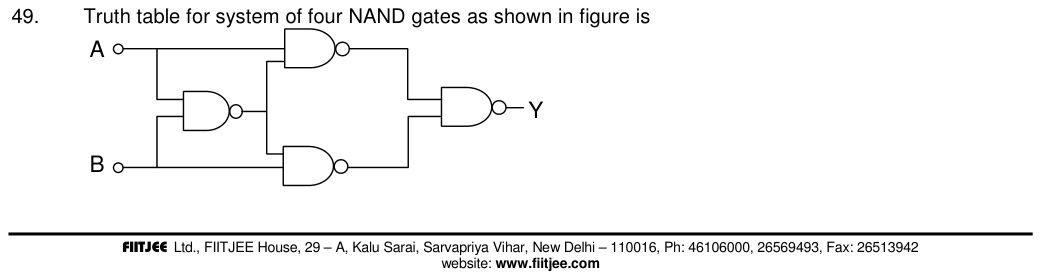
- A.A,B,Y: 00-0, 01-1, 10-1, 11-0
- B.A,B,Y: 00-0, 01-0, 10-1, 11-1
- C.A,B,Y: 00-1, 01-1, 10-0, 11-0
- D.A,B,Y: 00-1, 01-0, 10-0, 11-1
Correct answer: A
Explanation: The standard four-NAND network implements XOR: Y = 1 only when inputs differ.
Question 48
Physics · 4 marks · −1A radar has a power of 1 Kw and is operating at a frequency of 10 GHz. It is located on a mountain top of height 500 m. The maximum distance upto which it can detect object located on the surface of the earth (Radius of earth = m) is
- A.80 km
- B.16 km
- C.40 km
- D.64 km
Correct answer: A
Explanation: km.
Question 49
Physics · 4 marks · −1A Carnot engine, whose efficiency is 40%, takes in heat from a source maintained at a temperature of 500 K. It is desired to have an engine of efficiency 60%. Then, the intake temperature for the same exhaust (sink) temperature must be
- A.efficiency of Carnot engine cannot be made larger than 50%
- B.1200 K
- C.750 K
- D.600 K
Correct answer: C
Explanation: Sink K; K.
Question 50
Physics · 4 marks · −1If two springs and of force constants and , respectively, are stretched by the same force, it is found that more work is done on spring than on spring . Statement 1: If stretched by the same amount, work done on , will be more than that on . Statement 2:
- A.Statement 1 is false, Statement 2 is true
- B.Statement 1 is true, Statement 2 is false
- C.Statement 1 is true, Statement 2 is the correct explanation for statement 1
- D.Statement 1 is true, Statement 2 is true, Statement 2 is not the correct explanation for statement 1.
Correct answer: A
Explanation: Same force: , so . Same extension: , so .
Question 51
Physics · 4 marks · −1Two cars of masses and are moving in circles of radii and , respectively. Their speeds are such that they make complete circles in the same time t. The ratio of their centripetal acceleration is
- A.
- B.
- C.
- D.1 : 1
Correct answer: C
Explanation: Same : .
Question 52
Physics · 4 marks · −1A cylindrical tube, open at both ends, has a fundamental frequency, f, in air. The tube is dipped vertically in water so that half of it is in water. The fundamental frequency of the air-column is now
- A.f
- B.
- C.
- D.2f
Correct answer: A
Explanation: Closed pipe of length : .
Question 53
Physics · 4 marks · −1An object 2.4 m in front of a lens forms a sharp image on a film 12 cm behind the lens. A glass plate 1cm thick, of refractive index 1.50 is interposed between lens and film with its plane faces parallel to film. At what distance (from lens) should object be shifted to be in sharp focus on film?
- A.7.2 m
- B.2.4 m
- C.3.2 m
- D.5.6 m
Correct answer: D
Explanation: . The slab shifts the image by cm, so the lens must image at cm: cm.
Question 54
Physics · 4 marks · −1A diatomic molecule is made of two masses and which are separated by a distance r. If we calculate its rotational energy by applying Bohr's rule of angular momentum quantization, its energy will be given by (n is an integer)
- A.
- B.
- C.
- D.
Correct answer: D
Explanation: with ; (h in the options stands for ).
Question 55
Physics · 4 marks · −1A spectrometer gives the following reading when used to measure the angle of a prism. Main scale reading: 58.5 degree. Vernier scale reading: 09 divisions. Given that 1 division on main scale corresponds to 0.5 degree. Total divisions on the vernier scale is 30 and match with 29 divisions of the main scale. The angle of the prism from the above data
- A.
- B.
- C.
- D.
Correct answer: C
Explanation: LC ; reading .
Question 56
Physics · 4 marks · −1An insulating solid sphere of radius R has a uniformly positive charge density . As a result of this uniform charge distribution there is a finite value of electric potential at the centre of the sphere, at the surface of the sphere and also at a point out side the sphere. The electric potential at infinity is zero. Statement 1: When a charge q is taken from the centre to the surface of the sphere, its potential energy changes by . Statement 2: The electric field at a distance r (r < R) from the centre of the sphere is .
- A.Statement 1 is true, Statement 2 is true, Statement 2 is not the correct explanation for statement 1.
- B.Statement 1 is true, Statement 2 is false
- C.Statement 1 is false, Statement 2 is true
- D.Statement 1 is true, Statement 2 is the correct explanation for statement 1
Correct answer: C
Explanation: Gauss's law gives (true). , so Statement 1 is false.
Question 57
Physics · 4 marks · −1Proton, Deuteron and alpha particle of the same kinetic energy are moving in circular trajectories in a constant magnetic field. The radii of proton, deuteron and alpha particle are respectively , and . Which one of the following relations is correct?
- A.
- B.
- C.
- D.
Correct answer: B
Explanation: : p 1, d , .
Question 58
Chemistry · 4 marks · −1Which among the following will be named as dibromidobis(ethylene diamine)chromium(III) bromide ?
- A.
- B.
- C.
- D.
Correct answer: B
Explanation: Two Br ligands, two en ligands, Cr(III), bromide counter-ion.
Question 59
Chemistry · 4 marks · −1Which method of purification is represented by the following equation :
- A.zone refining
- B.cupellation
- C.Poling
- D.Van Arkel
Correct answer: D
Explanation: Van Arkel (iodide) process.
Question 60
Chemistry · 4 marks · −1Lithium forms body centred cubic structure. The length of the side of its unit cell is 351 pm. Atomic radius of the lithium will be :
- A.75 pm
- B.300 pm
- C.240 pm
- D.152 pm
Correct answer: D
Explanation: pm.
Question 61
Chemistry · 4 marks · −1The molecule having smallest bond angle is :
- A.
- B.
- C.
- D.
Correct answer: C
Explanation: Bond angle falls down the group as the central atom grows: .
Question 62
Chemistry · 4 marks · −1Which of the following compounds can be detected by Molisch's test ?
- A.Nitro compounds
- B.Sugars
- C.Amines
- D.Primary alcohols
Correct answer: B
Explanation: Molisch's test (-naphthol + conc. , violet ring) detects carbohydrates.
Question 63
Chemistry · 4 marks · −1The incorrect expression among the following is :
- A.
- B.In isothermal process
- C.
- D.
Correct answer: C
Explanation: ; the sign in (3) is wrong.
Question 64
Chemistry · 4 marks · −1The density of a solution prepared by dissolving 120 g of urea (mol. Mass = 60 u) in 1000g of water is 1.15 g/mL. The molarity of this solution is :
- A.0.50 M
- B.1.78 M
- C.1.02 M
- D.2.05 M
Correct answer: D
Explanation: Volume mL; M.
Question 65
Chemistry · 4 marks · −1The species which can best serve as an initiator for the cationic polymerization is :
- A.
- B.
- C.
- D.BuLi
Correct answer: C
Explanation: Lewis acids like initiate cationic polymerisation.
Question 66
Chemistry · 4 marks · −1Which of the following on thermal decomposition yields a basic as well as an acidic oxide ?
- A.
- B.
- C.
- D.
Correct answer: C
Explanation: (basic) (acidic).
Question 67
Chemistry · 4 marks · −1The standard reduction potentials for , , and are , and V respectively. The reaction will be spontaneous when :
- A.X = Ni, Y = Fe
- B.X = Ni, Y = Zn
- C.X = Fe, Y = Zn
- D.X = Zn, Y = Ni
Correct answer: D
Explanation: Need : Zn reduces .
Question 68
Chemistry · 4 marks · −1According to Freundlich adsorption isotherm, which of the following is correct ?
- A.
- B.
- C.
- D.All the above are correct for different ranges of pressure
Correct answer: D
Explanation: Low pressure: ; intermediate: ; high: .
Question 69
Chemistry · 4 marks · −1The equilibrium constant for the reaction at temperature T is . The value of for the reaction, at the same temperature is :
- A.0.02
- B.
- C.
- D.50.0
Correct answer: D
Explanation: .
Question 70
Chemistry · 4 marks · −1The compressibility factor for a real gas at high pressure is :
- A.
- B.1
- C.
- D.
Correct answer: C
Explanation: At high pressure the term is negligible: .
Question 71
Chemistry · 4 marks · −1Which one of the following statements is correct ?
- A.All amino acids except lysine are optically active
- B.All amino acids are optically active
- C.All amino acids except glycine are optically active
- D.All amino acids except glutamic acid are optically active
Correct answer: C
Explanation: Glycine () has no stereocentre.
Question 72
Chemistry · 4 marks · −1Aspirin is known as :
- A.Acetyl salicylic acid
- B.Phenyl salicylate
- C.Acetyl salicylate
- D.Methyl salicylic acid
Correct answer: A
Explanation: Aspirin is 2-acetoxybenzoic acid (acetylsalicylic acid).
Question 73
Chemistry · 4 marks · −1Ortho-Nitrophenol is less soluble in water than p- and m- Nitrophenols because :
- A.o-Nitrophenol is more volatile in steam than those of m- and p-isomers
- B.o-Nitrophenol shows Intramolecular H-bonding
- C.o-Nitrophenol shows Intermolecular H-bonding
- D.Melting point of o-Nitrophenol is lower than those of m- and p-isomers.
Correct answer: B
Explanation: Intramolecular H-bonding reduces H-bonding with water.
Question 74
Chemistry · 4 marks · −1How many chiral compounds are possible on monochlorination of 2-methyl butane ?
- A.8
- B.2
- C.4
- D.6
Correct answer: B
Explanation: Products: (achiral), (chiral), (achiral), (chiral): 2 chiral constitutional products.
Question 75
Chemistry · 4 marks · −1Very pure hydrogen (99.9%) can be made by which of the following processes ?
- A.Reaction of methane with steam
- B.Mixing natural hydrocarbons of high molecular weight
- C.Electrolysis of water
- D.Reaction of salt like hydrides with water
Correct answer: C
Explanation: Electrolysis of water gives very pure hydrogen.
Question 76
Chemistry · 4 marks · −1The electrons identified by quantum numbers n and l : (a) n = 4, l = 1 (b) n = 4, l = 0 (c) n = 3, l = 2 (d) n = 3, l = 1. Can be placed in order of increasing energy as :
- A.(c) < (d) < (b) < (a)
- B.(d) < (b) < (c) < (a)
- C.(b) < (d) < (a) < (c)
- D.(a) < (c) < (b) < (d)
Correct answer: B
Explanation: (n + l) rule: 3p (4) < 4s (4) < 3d (5) < 4p (5).
Question 77
Chemistry · 4 marks · −1For a first order reaction, products, the concentration of A changes from 0.1 M to 0.025 M in 40 minutes. The rate of reaction when the concentration of A is 0.01 M is :
- A. M/min
- B. M/min
- C. M/min
- D. M/min
Correct answer: B
Explanation: Two half-lives in 40 min: ; rate M/min.
Question 78
Chemistry · 4 marks · −1Iron exhibits +2 and +3 oxidation states. Which of the following statements about iron is incorrect ?
- A.Ferrous oxide is more basic in nature than the ferric oxide.
- B.Ferrous compounds are relatively more ionic than the corresponding ferric compounds
- C.Ferrous compounds are less volatile than the corresponding ferric compounds.
- D.Ferrous compounds are more easily hydrolysed than the corresponding ferric compounds.
Correct answer: D
Explanation: The more highly charged compounds hydrolyse more readily.
Question 79
Chemistry · 4 marks · −1The pH of a 0.1 molar solution of the acid HQ is 3. The value of the ionization constant, Ka of this acid is :
- A.
- B.
- C.
- D.
Correct answer: C
Explanation: .
Question 80
Chemistry · 4 marks · −1Which branched chain isomer of the hydrocarbon with molecular mass 72u gives only one isomer of mono substituted alkyl halide ?
- A.Tertiary butyl chloride
- B.Neopentane
- C.Isohexane
- D.Neohexane
Correct answer: B
Explanation: ; neopentane has only equivalent hydrogens.
Question 81
Chemistry · 4 marks · −1for water is 1.86K kg mol. If your automobile radiator holds 1.0 kg of water, how many grams of ethylene glycol must you add to get the freezing point of the solution lowered to C ?
- A.72g
- B.93g
- C.39g
- D.27g
Correct answer: B
Explanation: mol/kg; mass g.
Question 82
Chemistry · 4 marks · −1What is DDT among the following :
- A.Greenhouse gas
- B.A fertilizer
- C.Biodegradable pollutant
- D.Non-biodegradable pollutant
Correct answer: D
Explanation: DDT is a persistent, non-biodegradable pesticide.
Question 83
Chemistry · 4 marks · −1The increasing order of the ionic radii of the given isoelectronic species is :
- A.
- B.
- C.
- D.
Correct answer: C
Explanation: For isoelectronic ions radius increases as nuclear charge decreases.
Question 84
Chemistry · 4 marks · −12-Hexyne gives trans-2-Hexene on treatment with :
- A.
- B.
- C.
- D.
Correct answer: B
Explanation: Dissolving-metal reduction gives trans-alkenes.
Question 85
Chemistry · 4 marks · −1Iodoform can be prepared from all except :
- A.Ethyl methyl ketone
- B.Isopropyl alcohol
- C.3-Methyl-2-butanone
- D.Isobutyl alcohol
Correct answer: D
Explanation: Isobutyl alcohol lacks the / unit.
Question 86
Chemistry · 4 marks · −1In which of the following pairs the two species are not isostructural ?
- A. and
- B. and
- C. and
- D. and
Correct answer: C
Explanation: is trigonal bipyramidal; is square pyramidal.
Question 87
Chemistry · 4 marks · −1In the given transformation, which of the following is the most appropriate reagent ? 4-(3-oxobut-1-enyl)cyclohexan-1-ol ()
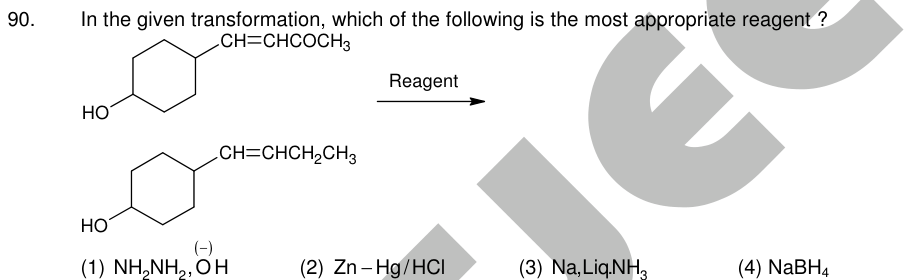
- A.,
- B.Zn-Hg/HCl
- C.Na, Liq.
- D.
Correct answer: A
Explanation: Wolff-Kishner reduces C=O to without touching the OH or the C=C; Clemmensen's acid would affect the alcohol, and the others give alcohols.