JEE Main 2013 — 7 Apr Offline Set Q (Previous Year Paper)
JEE Main · 2013 · with answers and explanations
- questions
- 86
- Total marks
- 344
- Duration
- 180 minutes
- Negative marking
- −1
Subjects: Chemistry · Mathematics · Physics
Question 1
Chemistry · 4 marks · −1An unknown alcohol is treated with the 'Lucas reagent' to determine whether the alcohol is primary, secondary or tertiary. Which alcohol reacts fastest and by what mechanism:
- A.tertiary alcohol by
- B.secondary alcohol by
- C.tertiary alcohol by
- D.secondary alcohol by
Correct answer: A
Explanation: Tertiary alcohols react fastest via the stable tertiary carbocation ().
Question 2
Chemistry · 4 marks · −1The first ionization potential of Na is 5.1 eV. The value of electron gain enthalpy of will be:
- A. eV
- B. eV
- C. eV
- D. eV
Correct answer: A
Explanation: is the reverse of ionisation, releasing 5.1 eV.
Question 3
Chemistry · 4 marks · −1Stability of the species , and increases in the order of:
- A.
- B.
- C.
- D.
Correct answer: A
Explanation: Bond orders: 1, 0.5, 0.5; has an antibonding electron so is less stable than .
Question 4
Chemistry · 4 marks · −1The molarity of a solution obtained by mixing 750 mL of 0.5 (M) HCl with 250 mL of 2(M) HCl will be:
- A.1.00 M
- B.1.75 M
- C.0.975 M
- D.0.875 M
Correct answer: D
Explanation: M.
Question 5
Chemistry · 4 marks · −1Four successive members of the first row transition elements are listed below with atomic numbers. Which one of them is expected to have the highest value?
- A.Mn (Z = 25)
- B.Fe (Z = 26)
- C.Co (Z = 27)
- D.Cr (Z = 24)
Correct answer: C
Explanation: : Co 1.97 V > Mn 1.57 > Fe 0.77 > Cr V.
Question 6
Chemistry · 4 marks · −1A solution of -1-chloro-1-phenylethane in toluene racemises slowly in the presence of a small amount of , due to the formation of :
- A.carbene
- B.carbocation
- C.free radical
- D.carbanion
Correct answer: B
Explanation: abstracts giving a planar benzylic carbocation, which recombines from either face.
Question 7
Chemistry · 4 marks · −1The coagulating power of electrolytes having ions , and for arsenic sulphide sol increases in the order:
- A.
- B.
- C.
- D.
Correct answer: A
Explanation: is a negative sol; by Hardy-Schulze, coagulating power rises with cation charge.
Question 8
Chemistry · 4 marks · −1How many litres of water must be added to 1 litre of an aqueous solution of HCl with a pH of 1 to create an aqueous solution with pH of 2?
- A.0.9 L
- B.2.0 L
- C.9.0 L
- D.0.1 L
Correct answer: C
Explanation: must fall tenfold: total volume 10 L, so add 9 L.
Question 9
Chemistry · 4 marks · −1Experimentally it was found that a metal oxide has formula . Metal M, is present as and in its oxide. Fraction of the metal which exists as would be:
- A.4.08%
- B.6.05%
- C.5.08%
- D.7.01%
Correct answer: A
Explanation: ; fraction .
Question 10
Chemistry · 4 marks · −1A compound with molecular mass 180 is acylated with to get a compound with molecular mass 390. The number of amino groups present per molecule of the former compound is:
- A.5
- B.4
- C.6
- D.2
Correct answer: A
Explanation: Each acetylation adds 42; .
Question 11
Chemistry · 4 marks · −1Given V; V; V; V. Based on the data given above, strongest oxidising agent will be:
- A.
- B.
- C.
- D.
Correct answer: C
Explanation: Highest reduction potential: .
Question 12
Chemistry · 4 marks · −1Arrange the following compounds in order of decreasing acidity: (I) p-chlorophenol, (II) p-cresol (p-methylphenol), (III) p-nitrophenol, (IV) p-methoxyphenol
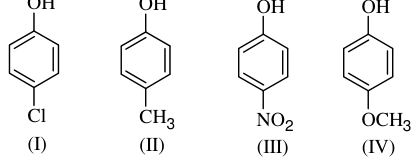
- A.I > II > III > IV
- B.III > I > II > IV
- C.IV > III > I > II
- D.II > IV > I > III
Correct answer: B
Explanation: Electron-withdrawing > Cl increase acidity; and especially (+R) decrease it.
Question 13
Chemistry · 4 marks · −1The rate of a reaction doubles when its temperature changes from 300K to 310K. Activation energy of such a reaction will be: ( JK mol and log 2 = 0.301)
- A.48.6 kJ mol
- B.58.5 kJ mol
- C.60.5 kJ mol
- D.53.6 kJ mol
Correct answer: D
Explanation: kJ/mol.
Question 14
Chemistry · 4 marks · −1Synthesis of each molecule of glucose in photosynthesis involves:
- A.10 molecules of ATP
- B.8 molecules of ATP
- C.6 molecules of ATP
- D.18 molecules of ATP
Correct answer: D
Explanation: The Calvin cycle consumes 18 ATP (and 12 NADPH) per glucose.
Question 15
Chemistry · 4 marks · −1Which of the following complex species is not expected to exhibit optical isomerism?
- A.
- B.
- C.
- D.
Correct answer: B
Explanation: Both fac and mer have mirror planes.
Question 16
Chemistry · 4 marks · −1A piston filled with 0.04 mol of an ideal gas expands reversibly from 50.0 mL to 375 mL at a constant temperature of C. As it does so, it absorbs 208J of heat. The values of q and w for the process will be: ( J/mol K) ()
- A. J, J
- B. J, J
- C. J, J
- D. J, J
Correct answer: D
Explanation: Isothermal: , heat absorbed J, work done on gas J.
Question 17
Chemistry · 4 marks · −1A gaseous hydrocarbon gives upon combustion 0.72 g of water and 3.08 g of . The empirical formula of the hydrocarbon is:
- A.
- B.
- C.
- D.
Correct answer: C
Explanation: C: 0.07 mol, H: 0.08 mol, ratio 7:8.
Question 18
Chemistry · 4 marks · −1The order of stability of the following carbocations: (I) (allyl), (II) (n-propyl), (III) (benzyl) is:
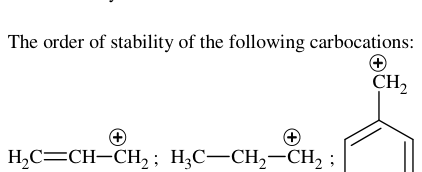
- A.II > III > I
- B.I > II > III
- C.III > I > II
- D.III > II > I
Correct answer: C
Explanation: Benzyl (more delocalisation) > allyl > primary propyl.
Question 19
Chemistry · 4 marks · −1Which of the following represents the correct order of increasing first ionization enthalpy for Ca, Ba, S, Se and Ar?
- A.S < Se < Ca < Ba < Ar
- B.Ba < Ca < Se < S < Ar
- C.Ca < Ba < S < Se < Ar
- D.Ca < S < Ba < Se < Ar
Correct answer: B
Explanation: IE increases up a group and across a period.
Question 20
Chemistry · 4 marks · −1For gaseous state, if most probable speed is denoted by , average speed by and mean square speed by C, then for a large number of molecules the ratios of these speeds are:
- A.
- B.
- C.
- D.
Correct answer: B
Explanation: (C here is the root mean square speed).
Question 21
Chemistry · 4 marks · −1The gas leaked from a storage tank of the Union Carbide plant in Bhopal gas tragedy was:
- A.Methylamine
- B.Ammonia
- C.Phosgene
- D.Methylisocyanate
Correct answer: D
Explanation: Methyl isocyanate, .
Question 22
Chemistry · 4 marks · −1Consider the following reaction: . The values of x, y and z in the reaction are, respectively:
- A.2, 5 and 8
- B.2, 5 and 16
- C.5, 2 and 8
- D.5, 2 and 16
Correct answer: B
Explanation: .
Question 23
Chemistry · 4 marks · −1Which of the following exists as covalent crystals in the solid state?
- A.Silicon
- B.Sulphur
- C.Phosphorous
- D.Iodine
Correct answer: A
Explanation: Silicon is a covalent network solid; , , form molecular solids.
Question 24
Chemistry · 4 marks · −1Compound (A), , gives a white precipitate when warmed with alcoholic . Oxidation of (A) gives an acid (B), . (B) easily forms anhydride on heating. Identify the compound (A).
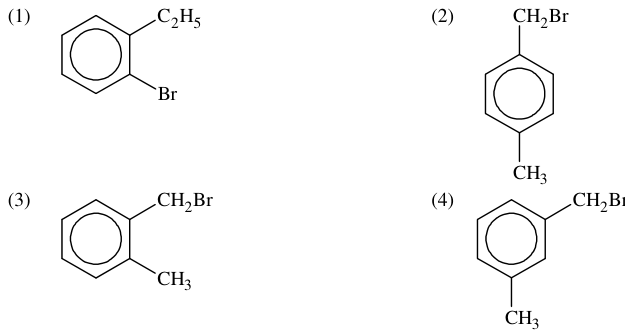
- A.1-bromo-2-ethylbenzene
- B.4-methylbenzyl bromide
- C.2-methylbenzyl bromide
- D.3-methylbenzyl bromide
Correct answer: C
Explanation: Benzylic bromide reacts with ; oxidation gives phthalic acid (ortho), which forms phthalic anhydride, so A is o-methylbenzyl bromide.
Question 25
Chemistry · 4 marks · −1Energy of an electron is given by J . Wavelength of light required to excite an electron in an hydrogen atom from level n = 1 to n = 2 will be ( Js and ms)
- A. m
- B. m
- C. m
- D. m
Correct answer: D
Explanation: ; m.
Question 26
Chemistry · 4 marks · −1An organic compound A upon reacting with gives B. On heating B gives C. C in presence of KOH reacts with to give . A is
- A.
- B.
- C.
- D.
Correct answer: C
Explanation: Propanoic acid gives ammonium salt, then propanamide, whose Hofmann degradation gives ethylamine.
Question 27
Chemistry · 4 marks · −1In which of the following pairs of molecules/ions, both the species are not likely to exist?
- A.,
- B.,
- C.,
- D.,
Correct answer: B
Explanation: Both and have bond order zero.
Question 28
Mathematics · 4 marks · −1The circle passing through and touching the axis of x at also passes through the point
- A.
- B.
- C.
- D.
Correct answer: B
Explanation: through : ; satisfies it.
Question 29
Mathematics · 4 marks · −1ABCD is a trapezium such that AB and CD are parallel and . If , BC = p and CD = q, then AB is equal to
- A.
- B.
- C.
- D.
Correct answer: D
Explanation: Sine rule in with and () gives .
Question 30
Mathematics · 4 marks · −1Given : A circle, and a parabola, . Statement-I : An equation of a common tangent to these curves is . Statement-II : If the line, is their common tangent, then m satisfies .
- A.Statement-I is True; Statement-II is true; Statement-II is not a correct explanation for Statement-I
- B.Statement-I is True; Statement-II is False.
- C.Statement-I is False; Statement-II is True
- D.Statement-I is True; Statement-II is True; Statement-II is a correct explanation for Statement-I
Correct answer: A
Explanation: Tangency to the circle gives , i.e. , so is common (I true). also satisfies (II true) but that equation is not the governing condition.
Question 31
Mathematics · 4 marks · −1A ray of light along gets reflected upon reaching x-axis, the equation of the reflected rays is
- A.
- B.
- C.
- D.
Correct answer: A
Explanation: Incidence point ; reflected slope : .
Question 32
Mathematics · 4 marks · −1All the students of a class performed poorly in Mathematics. The teacher decided to give grace marks of 10 to each of the students. Which of the following statistical measures will not change even after the grace marks were given ?
- A.median
- B.mode
- C.variance
- D.mean
Correct answer: C
Explanation: Variance is independent of a change of origin.
Question 33
Mathematics · 4 marks · −1If x, y, z are in A.P. and , and are also in A.P., then
- A.
- B.
- C.
- D.
Correct answer: D
Explanation: with forces as well, so .
Question 34
Mathematics · 4 marks · −1If , then is equal to
- A.
- B.
- C.
- D.
Correct answer: B
Explanation: With : .
Question 35
Mathematics · 4 marks · −1The equation of the circle passing through the foci of the ellipse , and having centre at is
- A.
- B.
- C.
- D.
Correct answer: D
Explanation: Foci ; : .
Question 36
Mathematics · 4 marks · −1The x-coordinate of the incentre of the triangle that has the coordinates of mid points of its sides as , and is
- A.
- B.
- C.
- D.
Correct answer: A
Explanation: Vertices ; inradius , which is the x-coordinate.
Question 37
Mathematics · 4 marks · −1The intercepts on x-axis made by tangents to the curve, , , which are parallel to the line , are equal to
- A.
- B.
- C.
- D.
Correct answer: D
Explanation: , ; tangents meet the x-axis at .
Question 38
Mathematics · 4 marks · −1The sum of first 20 terms of the sequence 0.7, 0.77, 0.777, ....., is
- A.
- B.
- C.
- D.
Correct answer: B
Explanation: ; .
Question 39
Mathematics · 4 marks · −1Consider : Statement-I : is a fallacy. Statement-II : is a tautology.
- A.Statement-I is True; Statement-II is true; Statement-II is not a correct explanation for Statement-I
- B.Statement-I is True; Statement-II is False.
- C.Statement-I is False; Statement-II is True
- D.Statement-I is True; Statement-II is True; Statement-II is a correct explanation for Statement-I
Correct answer: A
Explanation: Both are verified by truth tables, but II (contrapositive) does not explain I.
Question 40
Mathematics · 4 marks · −1The area (in square units) bounded by the curves , , x-axis, and lying in the first quadrant is
- A.36
- B.18
- C.
- D.9
Correct answer: D
Explanation: Curves meet at ; area .
Question 41
Mathematics · 4 marks · −1The expression can be written as
- A.secA cosecA + 1
- B.tanA + cotA
- C.secA + cosecA
- D.sinA cosA + 1
Correct answer: A
Explanation: Simplifies to .
Question 42
Mathematics · 4 marks · −1The real number k for which the equation, has two distinct real roots in [0, 1]
- A.lies between 2 and 3
- B.lies between and 0
- C.does not exist
- D.lies between 1 and 2
Correct answer: C
Explanation: , so f is strictly increasing and cannot have two roots.
Question 43
Mathematics · 4 marks · −1is equal to
- A.
- B.1
- C.2
- D.
Correct answer: C
Explanation: .
Question 44
Mathematics · 4 marks · −1Let be the number of all possible triangles formed by joining vertices of an n-sided regular polygon. If , then the value of n is
- A.5
- B.10
- C.8
- D.7
Correct answer: A
Explanation: .
Question 45
Mathematics · 4 marks · −1At present, a firm is manufacturing 2000 items. It is estimated that the rate of change of production P w.r.t. additional number of workers x is given by . If the firm employs 25 more workers, then the new level of production of items is
- A.3000
- B.3500
- C.4500
- D.2500
Correct answer: B
Explanation: .
Question 46
Mathematics · 4 marks · −1Statement-I : The value of the integral is equal to . Statement-II : .
- A.Statement-I is True; Statement-II is true; Statement-II is not a correct explanation for Statement-I
- B.Statement-I is True; Statement-II is False.
- C.Statement-I is False; Statement-II is True
- D.Statement-I is True; Statement-II is True; Statement-II is a correct explanation for Statement-I
Correct answer: C
Explanation: Using II, , , so I is false and II true.
Question 47
Mathematics · 4 marks · −1If is the adjoint of a matrix A and , then is equal to
- A.11
- B.5
- C.0
- D.4
Correct answer: A
Explanation: : .
Question 48
Mathematics · 4 marks · −1The number of values of k, for which the system of equations , has no solution, is
- A.1
- B.2
- C.3
- D.infinite
Correct answer: A
Explanation: ; gives infinitely many solutions, none: one value.
Question 49
Mathematics · 4 marks · −1If , then at is equal to
- A.
- B.1
- C.
- D.
Correct answer: D
Explanation: , .
Question 50
Mathematics · 4 marks · −1If the lines and are coplanar, then k can have
- A.exactly one value
- B.exactly two values
- C.exactly three values
- D.any value
Correct answer: B
Explanation: Coplanarity determinant gives : .
Question 51
Mathematics · 4 marks · −1Let A and B be two sets containing 2 elements and 4 elements respectively. The number of subsets of having 3 or more elements is
- A.220
- B.219
- C.211
- D.256
Correct answer: B
Explanation: .
Question 52
Mathematics · 4 marks · −1If the vectors and are the sides of a triangle ABC, then the length of the median through A is
- A.
- B.
- C.
- D.
Correct answer: B
Explanation: , length .
Question 53
Mathematics · 4 marks · −1A multiple choice examination has 5 questions. Each question has three alternative answers of which exactly one is correct. The probability that a student will get 4 or more correct answers just by guessing is
- A.
- B.
- C.
- D.
Correct answer: B
Explanation: .
Question 54
Mathematics · 4 marks · −1If z is a complex number of unit modulus and argument , then equals
- A.
- B.
- C.
- D.
Correct answer: B
Explanation: , so .
Question 55
Mathematics · 4 marks · −1If the equations and , , have a common root, then is
- A.3 : 2 : 1
- B.1 : 3 : 2
- C.3 : 1 : 2
- D.1 : 2 : 3
Correct answer: D
Explanation: The roots of the first are non-real, so both roots are common: .
Question 56
Mathematics · 4 marks · −1Distance between two parallel planes and is
- A.
- B.
- C.
- D.
Correct answer: B
Explanation: .
Question 57
Mathematics · 4 marks · −1The term independent of x in expansion of is
- A.120
- B.210
- C.310
- D.4
Correct answer: B
Explanation: The base simplifies to ; , : .
Question 58
Physics · 4 marks · −1In an LCR circuit as shown below both switches are open initially. Now switch is closed, kept open. (q is charge on the capacitor and is capacitive time constant). Which of the following statement is correct?
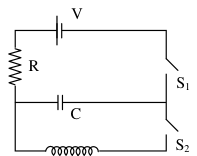
- A.At ,
- B.At ,
- C.At ,
- D.Work done by the battery is half of the energy dissipated in the resistor.
Correct answer: B
Explanation: With closed the RC branch charges: .
Question 59
Physics · 4 marks · −1The supply voltage to a room is 120 V. The resistance of the lead wires is . A 60 W bulb is already switched on. What is the decrease of voltage across the bulb, when a 240 W heater is switched on in parallel to the bulb?
- A.2.9 Volt
- B.13.3 Volt
- C.10.04 Volt
- D.zero volt
Correct answer: C
Explanation: Bulb , heater . Before: V; after (parallel ): V; drop V.
Question 60
Physics · 4 marks · −1A uniform cylinder of length L and mass M having cross-sectional area A is suspended, with its length vertical, from a fixed point by a massless spring, such that it is half submerged in a liquid of density at equilibrium position. The extension of the spring when it is in equilibrium is: (Here k is spring constant)
- A.
- B.
- C.
- D.
Correct answer: B
Explanation: .
Question 61
Physics · 4 marks · −1Two charges, each equal to q, are kept at and on the x-axis. A particle of mass m and charge is placed at the origin. If charge is given a small displacement along the y-axis, the net force acting on the particle is proportional to:
- A.
- B.
- C.
- D.
Correct answer: D
Explanation: (away from origin).
Question 62
Physics · 4 marks · −1A beam of unpolarised light of intensity is passed through a polaroid A and then through another polaroid B which is oriented so that its principal plane makes an angle of relative to that of A. The intensity of the emergent light is:
- A.
- B.
- C.
- D.
Correct answer: B
Explanation: .
Question 63
Physics · 4 marks · −1The anode voltage of a photocell is kept fixed. The wavelength of the light falling on the cathode is gradually changed. The plate current I of the photocell varies as follows:
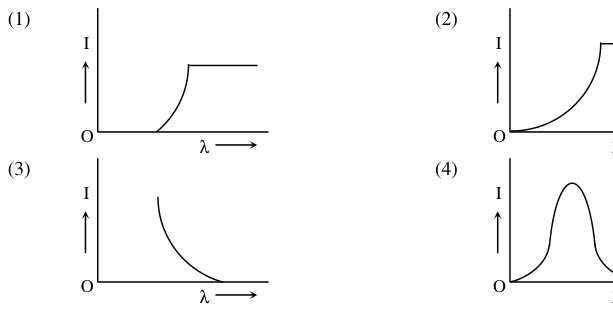
- A.Graph (1)
- B.Graph (2)
- C.Graph (3)
- D.Graph (4)
Correct answer: C
Explanation: As increases, photon energy falls; the current decreases and becomes zero at the threshold wavelength (graph 3).
Question 64
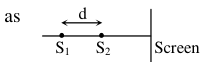
Physics · 4 marks · −1Two coherent point sources and are separated by a small distance 'd' as shown. The fringes obtained on the screen will be:
- A.straight lines
- B.semi-circles
- C.concentric circles
- D.points
Correct answer: C
Explanation: The sources lie on a line perpendicular to the screen, so loci of constant path difference on the screen are circles about the foot of that line.
Question 65
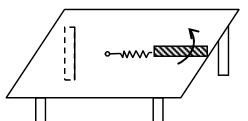
Physics · 4 marks · −1A metallic rod of length is tied to a string of length and made to rotate with angular speed on a horizontal table with one end of the string fixed. If there is a vertical magnetic field B in the region, the e.m.f. induced across the ends of the rod is:
- A.
- B.
- C.
- D.
Correct answer: C
Explanation: .
Question 66
Physics · 4 marks · −1In a hydrogen like atom electron makes transition from an energy level with quantum number n to another with quantum number (n - 1). If , the frequency of radiation emitted is proportional to
- A.
- B.
- C.
- D.
Correct answer: C
Explanation: .
Question 67
Physics · 4 marks · −1Assume that a drop of liquid evaporates by decrease in its surface energy, so that its temperature remains unchanged. What should be the minimum radius of the drop for this to be possible? The surface tension is T, density of liquid is and L is its latent heat of vaporization.
- A.
- B.
- C.
- D.
Correct answer: C
Explanation: .
Question 68
Physics · 4 marks · −1The graph between angle of deviation and angle of incidence (i) for a triangular prism is represented by:
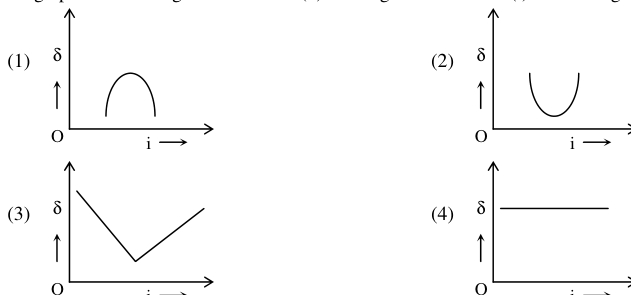
- A.Graph (1)
- B.Graph (2)
- C.Graph (3)
- D.Graph (4)
Correct answer: B
Explanation: first decreases to a minimum then increases smoothly (U-shaped curve).
Question 69
Physics · 4 marks · −1Let denote the dimensional formula of the permittivity of vacuum. If M = mass, L = length, T = time and A = electric current, then:
- A.
- B.
- C.
- D.
Correct answer: A
Explanation: : .
Question 70
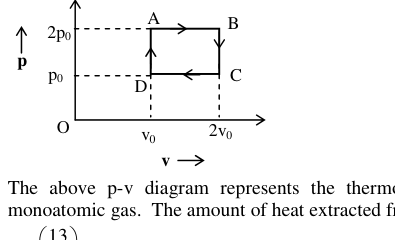
Physics · 4 marks · −1The above p-v diagram represents the thermodynamic cycle of an engine, operating with an ideal monoatomic gas. The amount of heat extracted from the source in a single cycle is
- A.
- B.
- C.
- D.
Correct answer: A
Explanation: Heat is absorbed on D to A (isochoric, ) and A to B (isobaric, ): total .
Question 71
Physics · 4 marks · −1A sonometer wire of length 1.5 m is made of steel. The tension in it produces an elastic strain of 1 %. What is the fundamental frequency of steel if density and elasticity of steel are kg/m and N/m respectively?
- A.178.2 Hz
- B.200.5 Hz
- C.770 Hz
- D.188.5 Hz
Correct answer: A
Explanation: Hz.
Question 72
Physics · 4 marks · −1This question has statement I and statement II. Statement-I: Higher the range, greater is the resistance of ammeter. Statement-II: To increase the range of ammeter, additional shunt needs to be used across it.
- A.Statement-I is true, Statement-II is true, Statement-II is not the correct explanation of Statement-I.
- B.Statement-I is true, statement-II is false.
- C.Statement-I is false, Statement-II is true
- D.Statement-I is true, Statement-II is true, Statement-II is the correct explanation of statement-I.
Correct answer: C
Explanation: Higher range needs a smaller shunt, so the ammeter resistance decreases (I false); an extra shunt in parallel increases the range (II true).
Question 73
Physics · 4 marks · −1What is the minimum energy required to launch a satellite of mass m from the surface of a planet of mass M and radius R in a circular orbit at an altitude of 2R?
- A.
- B.
- C.
- D.
Correct answer: D
Explanation: , : difference .
Question 74
Physics · 4 marks · −1A projectile is given an initial velocity of m/s, where is along the ground and is along the vertical. If m/s, the equation of its trajectory is:
- A.
- B.
- C.
- D.
Correct answer: A
Explanation: , .
Question 75
Physics · 4 marks · −1Two capacitors and are charged to 120 V and 200 V respectively. It is found that by connecting them together the potential on each one can be made zero. Then :
- A.
- B.
- C.
- D.
Correct answer: A
Explanation: Connecting opposite plates, charges cancel: .
Question 76
Physics · 4 marks · −1A hoop of radius r and mass m rotating with an angular velocity is placed on a rough horizontal surface. The initial velocity of the centre of the hoop is zero. What will be the velocity of the centre of the hoop when it ceases to slip?
- A.
- B.
- C.
- D.
Correct answer: B
Explanation: Angular momentum about the contact point: .
Question 77
Physics · 4 marks · −1An ideal gas enclosed in a vertical cylindrical container supports a freely moving piston of mass M. The piston and cylinder have equal cross sectional area A. When the piston is in equilibrium, the volume of the gas is and its pressure is . The piston is slightly displaced from the equilibrium position and released. Assuming that the system is completely isolated from its surrounding, the piston executes a simple harmonic motion with frequency:
- A.
- B.
- C.
- D.
Correct answer: B
Explanation: Adiabatic: , restoring force .
Question 78
Physics · 4 marks · −1A charge Q is uniformly distributed over a long rod AB of length L as shown in the figure. The electric potential at the point O lying at a distance L from the end A is:

- A.
- B.
- C.
- D.
Correct answer: C
Explanation: .
Question 79
Physics · 4 marks · −1A circular loop of radius 0.3 cm lies parallel to a much bigger circular loop of radius 20 cm. The centre of the small loop is on the axis of the bigger loop. The distance between their centres is 15 cm. If a current of 2.0 A flows through the smaller loop, then the flux linked with bigger loop is
- A. weber
- B. weber
- C. weber
- D. weber
Correct answer: D
Explanation: ; Wb.
Question 80
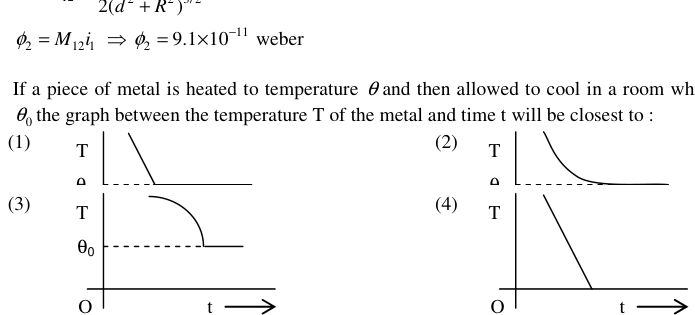
Physics · 4 marks · −1If a piece of metal is heated to temperature and then allowed to cool in a room which is at temperature the graph between the temperature T of the metal and time t will be closest to :
- A.Graph (1)
- B.Graph (2)
- C.Graph (3)
- D.Graph (4)
Correct answer: B
Explanation: Newton's cooling: exponential decay towards (graph 2).
Question 81
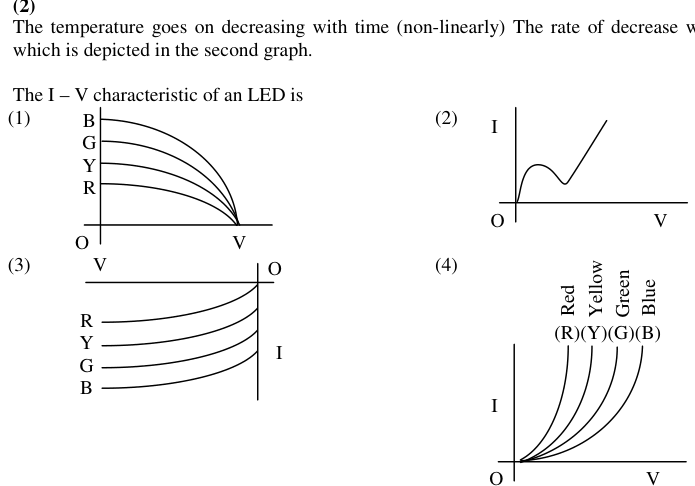
Physics · 4 marks · −1The I - V characteristic of an LED is
- A.Graph (1)
- B.Graph (2)
- C.Graph (3)
- D.Graph (4)
Correct answer: D
Explanation: In forward bias, current rises steeply beyond a threshold that increases from red to blue (graph 4).
Question 82
Physics · 4 marks · −1This question has Statement I and Statement II. Statement-I : A point particle of mass m moving with speed v collides with stationary point particle of mass M. If the maximum energy loss possible is given as then . Statement-II : Maximum energy loss occurs when the particles get stuck together as a result of the collision.
- A.Statement-I is true, Statement-II is true, Statement-II is not a correct explanation of Statement-I.
- B.Statement-I is true, Statement-II is false.
- C.Statement-I is false, Statement-II is true
- D.Statement-I is true, Statement-II is true, Statement-II is a correct explanation of Statement-I.
Correct answer: C
Explanation: Max loss (perfectly inelastic) , so : I false, II true.
Question 83
Physics · 4 marks · −1The amplitude of a damped oscillator decreases to 0.9 times its original magnitude is 5s. In another 10s it will decrease to times its original magnitude, where equals.
- A.0.81
- B.0.729
- C.0.6
- D.0.7
Correct answer: B
Explanation: Every 5 s multiplies by 0.9; after 15 s total: .
Question 84
Physics · 4 marks · −1Diameter of plano-convex lens is 6 cm and thickness at the centre is 3 mm. If speed of light in material of lens is m/s, the focal length of the lens is :
- A.20 cm
- B.30 cm
- C.10 cm
- D.15 cm
Correct answer: B
Explanation: cm; ; cm.
Question 85
Physics · 4 marks · −1The magnetic field in a travelling electromagnetic wave has a peak value of 20 nT. The peak value of electric field strength is :
- A.6 V/m
- B.9 V/m
- C.12 V/m
- D.3 V/m
Correct answer: A
Explanation: V/m.
Question 86
Physics · 4 marks · −1Two short bar magnets of length 1 cm each have magnetic moments 1.20 Am and 1.00 Am respectively. They are placed on a horizontal table parallel to each other with their N poles pointing towards the South. They have a common magnetic equator and are separated by a distance of 20.0 cm. The value of the resultant horizontal magnetic induction at the mid-point O of the line joining their centres is close to (Horizontal component of earth's magnetic induction is Wb/m)
- A. Wb/m
- B. Wb/m
- C. Wb/m
- D. Wb/m
Correct answer: A
Explanation: At O (equatorial, 10 cm from each): T.