JEE Main 2015 — 4 Apr Offline Set B (Previous Year Paper)
JEE Main · 2015 · with answers and explanations
- questions
- 88
- Total marks
- 352
- Duration
- 180 minutes
- Negative marking
- −1
Subjects: Chemistry · Mathematics · Physics
Question 1
Chemistry · 4 marks · −1Which of the following is the energy of a possible excited state of hydrogen?
- A. eV
- B. eV
- C. eV
- D. eV
Correct answer: B
Explanation: eV; gives eV.
Question 2
Chemistry · 4 marks · −1In the following sequence of reactions: Toluene A B C, the product C is:
- A.
- B.
- C.
- D.
Correct answer: C
Explanation: Benzoic acid, then benzoyl chloride, then Rosenmund reduction to benzaldehyde.
Question 3
Chemistry · 4 marks · −1Which compound would give 5-keto-2-methyl hexanal upon ozonolysis?
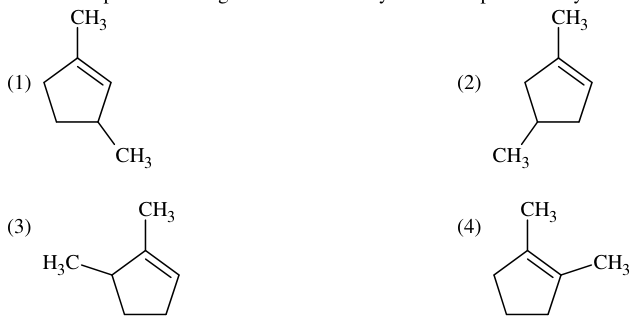
- A.1,3-dimethylcyclopentene (methyl on C1 of the double bond and on the ring carbon next to C2)
- B.1,4-dimethylcyclopentene
- C.1,5-dimethylcyclopentene (methyl on C1 and on the adjacent sp3 carbon)
- D.1,2-dimethylcyclopentene
Correct answer: A
Explanation: Ozonolysis of 1,3-dimethylcyclopentene cleaves C1=C2 giving , i.e. 5-oxo-2-methylhexanal.
Question 4
Chemistry · 4 marks · −1The ionic radii (in Å) of , and are respectively:
- A.1.36, 1.71 and 1.40
- B.1.71, 1.40 and 1.36
- C.1.71, 1.36 and 1.40
- D.1.36, 1.40 and 1.71
Correct answer: B
Explanation: Isoelectronic anions shrink as nuclear charge grows: .
Question 5
Chemistry · 4 marks · −1The color of is due to:
- A.d - d transition
- B.L M charge transfer transition
- C. transition
- D.M L charge transfer transition
Correct answer: B
Explanation: Mn(VII) is ; the intense colour arises from ligand (O) to metal charge transfer.
Question 6
Chemistry · 4 marks · −1Assertion : Nitrogen and Oxygen are the main components in the atmosphere but these do not react to form oxides of nitrogen. Reason : The reaction between nitrogen and oxygen requires high temperature.
- A.Both assertion and reason are correct, but the reason is not the correct explanation for the assertion
- B.The assertion is incorrect, but the reason is correct
- C.Both the assertion and reason are incorrect
- D.Both assertion and reason are correct, and the reason is the correct explanation for the assertion
Correct answer: D
Explanation: is endothermic and needs very high temperature (lightning, engines), which explains the assertion.
Question 7
Chemistry · 4 marks · −1Which of the following compounds is not an antacid?
- A.Cimetidine
- B.Phenelzine
- C.Ranitidine
- D.Aluminium hydroxide
Correct answer: B
Explanation: Phenelzine is an antidepressant (MAO inhibitor); the others are antacids.
Question 8
Chemistry · 4 marks · −1In the context of the Hall-Heroult process for the extraction of Al, which of the following statements is false?
- A. is mixed with which lowers the melting point of the mixture and brings conductivity
- B. is reduced at the cathode to form Al
- C. serves as the electrolyte
- D.CO and are produced in this process
Correct answer: C
Explanation: The electrolyte is alumina dissolved in molten cryolite; cryolite itself is not the species electrolysed.
Question 9
Chemistry · 4 marks · −1Match the catalysts to the correct processes: Catalyst (A) (B) (C) (D) ; Process (i) Wacker process (ii) Ziegler - Natta polymerization (iii) Contact process (iv) Deacon's process
- A.(A) - (ii), (B) - (i), (C) - (iv), (D) - (iii)
- B.(A) - (ii), (B) - (iii), (C) - (iv), (D) - (i)
- C.(A) - (iii), (B) - (i), (C) - (ii), (D) - (iv)
- D.(A) - (iii), (B) - (ii), (C) - (iv), (D) - (i)
Correct answer: A
Explanation: : Ziegler-Natta; : Wacker; : Deacon; : Contact process.
Question 10
Chemistry · 4 marks · −1In the reaction: p-toluidine D E + , the product E is
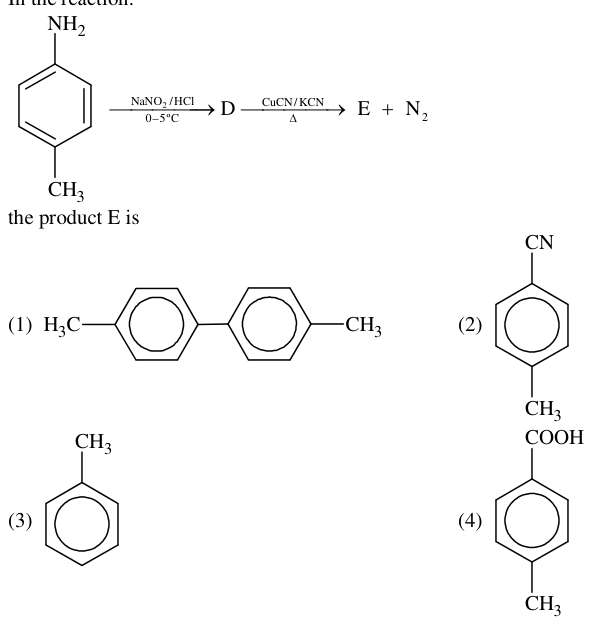
- A.4,4'-dimethylbiphenyl
- B.p-tolunitrile (4-methylbenzonitrile)
- C.Toluene
- D.p-toluic acid (4-methylbenzoic acid)
Correct answer: B
Explanation: Diazotisation then Sandmeyer cyanation gives .
Question 11
Chemistry · 4 marks · −1Which polymer is used in the manufacture of paints and lacquers?
- A.Glyptal
- B.Polypropene
- C.Poly vinyl chloride
- D.Bakelite
Correct answer: A
Explanation: Glyptal (glycerol-phthalic acid polyester) is used in paints and lacquers.
Question 12
Chemistry · 4 marks · −1The number of geometric isomers that can exist for square planar is (py = pyridine):
- A.3
- B.4
- C.6
- D.2
Correct answer: A
Explanation: Square planar has 3 geometric isomers.
Question 13
Chemistry · 4 marks · −1Higher order (>3) reactions are rare due to:
- A.increase in entropy and activation energy as more molecules are involved
- B.shifting of equilibrium towards reactants due to elastic collisions
- C.loss of active species on collision
- D.low probability of simultaneous collision of all the reacting species
Correct answer: D
Explanation: Simultaneous effective collision of more than three species is highly improbable.
Question 14
Chemistry · 4 marks · −1Which among the following is the most reactive?
- A.
- B.
- C.ICl
- D.
Correct answer: C
Explanation: The polar, weaker I-Cl bond makes the interhalogen ICl more reactive than the halogens.
Question 15
Chemistry · 4 marks · −1Two Faraday of electricity is passed through a solution of . The mass of copper deposited at the cathode is: (at. mass of Cu = 63.5 amu)
- A.63.5 g
- B.2 g
- C.127 g
- D.0 g
Correct answer: A
Explanation: : 2 F deposit 1 mol = 63.5 g.
Question 16
Chemistry · 4 marks · −13 g of activated charcoal was added to 50 mL of acetic acid solution (0.06N) in a flask. After an hour it was filtered and the strength of the filtrate was found to be 0.042 N. The amount of acetic acid adsorbed (per gram of charcoal) is:
- A.36 mg
- B.42 mg
- C.54 mg
- D.18 mg
Correct answer: D
Explanation: Adsorbed mmol mg in total, i.e. 18 mg per gram.
Question 17
Chemistry · 4 marks · −1The synthesis of alkyl fluorides is best accomplished by:
- A.Sandmeyer's reaction
- B.Finkelstein reaction
- C.Swarts reaction
- D.Free radical fluorination
Correct answer: C
Explanation: Swarts reaction: alkyl chloride/bromide with , , or .
Question 18
Chemistry · 4 marks · −1The molecular formula of a commercial resin used for exchanging ions in water softening is (Mol. Wt. 206). What would be the maximum uptake of ions by the resin when expressed in mole per gram resin?
- A.
- B.
- C.
- D.
Correct answer: C
Explanation: Two sites exchange one : mol per gram.
Question 19
Chemistry · 4 marks · −1Which of the vitamins given below is water soluble?
- A.Vitamin D
- B.Vitamin E
- C.Vitamin K
- D.Vitamin C
Correct answer: D
Explanation: Vitamins B and C are water soluble; A, D, E, K are fat soluble.
Question 20
Chemistry · 4 marks · −1The intermolecular interaction that is dependent on the inverse cube of distance between the molecule is:
- A.ion-dipole interaction
- B.London force
- C.hydrogen bond
- D.ion-ion interaction
Correct answer: C
Explanation: Interaction energies: ion-ion , ion-dipole , dipole-dipole (fixed) , London . A hydrogen bond is a strong dipole-dipole interaction, hence the dependence.
Question 21
Chemistry · 4 marks · −1The following reaction is performed at 298 K. . The standard free energy of formation of NO(g) is 86.6 kJ/mol at 298 K. What is the standard free energy of formation of (g) at 298 K? ()
- A.
- B.
- C.
- D.
Correct answer: C
Explanation: .
Question 22
Chemistry · 4 marks · −1Which of the following compounds is not colored yellow?
- A.
- B.
- C.
- D.
Correct answer: D
Explanation: Zinc ferrocyanide is white; the other three are yellow precipitates.
Question 23
Chemistry · 4 marks · −1In Carius method of estimation of halogens, 250 mg of an organic compound gave 141 mg of AgBr. The percentage of bromine in the compound is: (at. Mass Ag = 108; Br = 80)
- A.36
- B.48
- C.60
- D.24
Correct answer: D
Explanation: %Br .
Question 24
Chemistry · 4 marks · −1Sodium metal crystallizes in a body centred cubic lattice with a unit cell edge of 4.29 Å. The radius of sodium atom is approximately:
- A.3.22 Å
- B.5.72 Å
- C.0.93 Å
- D.1.86 Å
Correct answer: D
Explanation: bcc: Å.
Question 25
Chemistry · 4 marks · −1Which of the following compounds will exhibit geometrical isomerism?
- A.3-Phenyl-1-butene
- B.2-Phenyl-1-butene
- C.1,1-Diphenyl-1-propane
- D.1-Phenyl-2-butene
Correct answer: D
Explanation: has two different groups on each alkene carbon.
Question 26
Chemistry · 4 marks · −1The vapour pressure of acetone at C is 185 torr. When 1.2 g of a non-volatile substance was dissolved in 100 g of acetone at C, its vapour pressure was 183 torr. The molar mass (g mol) of the substance is:
- A.64
- B.128
- C.488
- D.32
Correct answer: A
Explanation: g/mol.
Question 27
Chemistry · 4 marks · −1From the following statements regarding , choose the incorrect statement:
- A.It decomposes on exposure to light
- B.It has to be stored in plastic or wax lined glass bottles in dark
- C.It has to be kept away from dust
- D.It can act only as an oxidizing agent
Correct answer: D
Explanation: acts as both oxidising and reducing agent.
Question 28
Chemistry · 4 marks · −1Which one of the following alkaline earth metal sulphates has its hydration enthalpy greater than its lattice enthalpy?
- A.
- B.
- C.
- D.
Correct answer: A
Explanation: Small is so strongly hydrated that is water soluble.
Question 29
Chemistry · 4 marks · −1The standard Gibbs energy change at 300 K for the reaction is 2494.2 J. At a given time, the composition of the reaction mixture is , and . The reaction proceeds in the: ( J/K/mol, )
- A.reverse direction because
- B.forward direction because
- C.reverse direction because
- D.forward direction because
Correct answer: A
Explanation: , ; : reverse.
Question 30
Chemistry · 4 marks · −1Which one has the highest boiling point?
- A.Ne
- B.Kr
- C.Xe
- D.He
Correct answer: C
Explanation: Largest, most polarisable noble gas Xe has the strongest dispersion forces.
Question 31
Mathematics · 4 marks · −1The sum of coefficients of integral powers of x in the binomial expansion of is :
- A.
- B.
- C.
- D.
Correct answer: D
Explanation: Even-index terms: .
Question 32
Mathematics · 4 marks · −1Let f(x) be a polynomial of degree four having extreme values at and . If , then f(2) is equal to :
- A.
- B.0
- C.4
- D.
Correct answer: B
Explanation: ; give , ; .
Question 33
Mathematics · 4 marks · −1The mean of the data set comprising of 16 observations is 16. If one of the observation valued 16 is deleted and three new observations valued 3, 4 and 5 are added to the data, then the mean of the resultant data, is :
- A.16.0
- B.15.8
- C.14.0
- D.16.8
Correct answer: C
Explanation: .
Question 34
Mathematics · 4 marks · −1The sum of first 9 terms of the series is :
- A.96
- B.142
- C.192
- D.71
Correct answer: A
Explanation: ; .
Question 35
Mathematics · 4 marks · −1Let O be the vertex and Q be any point on the parabola, . If the point P divides the line segment OQ internally in the ratio 1 : 3, then the locus of P is :
- A.
- B.
- C.
- D.
Correct answer: C
Explanation: , : .
Question 36
Mathematics · 4 marks · −1Let and be the roots of equation . If , for , then the value of is equal to :
- A.
- B.3
- C.
- D.6
Correct answer: B
Explanation: , so the ratio is .
Question 37
Mathematics · 4 marks · −1If 12 identical balls are to be placed in 3 identical boxes, then the probability that one of the boxes contains exactly 3 balls is :
- A.
- B.
- C.
- D.
Correct answer: D
Explanation: Intended reading: balls placed independently, a specified box gets exactly 3: .
Question 38
Mathematics · 4 marks · −1A complex number z is said to be unimodular if . Suppose and are complex numbers such that is unimodular and is not unimodular. Then the point lies on a :
- A.straight line parallel to y-axis.
- B.circle of radius 2.
- C.circle of radius .
- D.straight line parallel to x-axis.
Correct answer: B
Explanation: simplifies to , so .
Question 39
Mathematics · 4 marks · −1The integral equals :
- A.
- B.
- C.
- D.
Correct answer: C
Explanation: ; with it becomes .
Question 40
Mathematics · 4 marks · −1The number of points, having both co-ordinates as integers, that lie in the interior of the triangle with vertices , and , is :
- A.861
- B.820
- C.780
- D.901
Correct answer: C
Explanation: Need , : .
Question 41
Mathematics · 4 marks · −1The distance of the point from the point of intersection of the line and the plane , is :
- A.8
- B.
- C.13
- D.
Correct answer: C
Explanation: , point ; distance .
Question 42
Mathematics · 4 marks · −1The equation of the plane containing the line ; , and parallel to the plane, , is :
- A.
- B.
- C.
- D.
Correct answer: B
Explanation: Plane through a point of the line, e.g. solving gives (family method with ).
Question 43
Mathematics · 4 marks · −1The area (in sq. units) of the region described by is :
- A.
- B.
- C.
- D.
Correct answer: C
Explanation: Curves meet at . Area .
Question 44
Mathematics · 4 marks · −1If m is the A.M. of two distinct real numbers and n and , and are three geometric means between and n, then equals :
- A.
- B.
- C.
- D.
Correct answer: A
Explanation: With : sum .
Question 45
Mathematics · 4 marks · −1Locus of the image of the point in the line , , is a :
- A.straight line parallel to y-axis.
- B.circle of radius .
- C.circle of radius .
- D.straight line parallel to x-axis.
Correct answer: B
Explanation: All lines pass through ; the image stays at distance from .
Question 46
Mathematics · 4 marks · −1The area (in sq. units) of the quadrilateral formed by the tangents at the end points of the latera recta to the ellipse , is :
- A.18
- B.
- C.27
- D.
Correct answer: C
Explanation: End : tangent , intercepts and 3. Area .
Question 47
Mathematics · 4 marks · −1The number of integers greater than 6,000 that can be formed, using the digits 3, 5, 6, 7 and 8, without repetition, is :
- A.192
- B.120
- C.72
- D.216
Correct answer: A
Explanation: 4-digit starting 6/7/8: ; all 5-digit: 120. Total 192.
Question 48
Mathematics · 4 marks · −1Let A and B be two sets containing four and two elements respectively. Then the number of subsets of the set , each having at least three elements is :
- A.256
- B.275
- C.510
- D.219
Correct answer: D
Explanation: : .
Question 49
Mathematics · 4 marks · −1Let , where . Then a value of y is :
- A.
- B.
- C.
- D.
Correct answer: D
Explanation: RHS for , so .
Question 50
Mathematics · 4 marks · −1The integral is equal to :
- A.4
- B.1
- C.6
- D.2
Correct answer: B
Explanation: ; using , , .
Question 51
Mathematics · 4 marks · −1The negation of is equivalent to :
- A.
- B.
- C.
- D.
Correct answer: C
Explanation: .
Question 52
Mathematics · 4 marks · −1If the angles of elevation of the top of a tower from three collinear points A, B and C, on a line leading to the foot of the tower, are , and respectively, then the ratio, AB : BC, is :
- A.
- B.
- C.2 : 3
- D.
Correct answer: D
Explanation: Distances , , : , .
Question 53
Mathematics · 4 marks · −1is equal to :
- A.3
- B.2
- C.
- D.4
Correct answer: B
Explanation: .
Question 54
Mathematics · 4 marks · −1Let , and be three non-zero vectors such that no two of them are collinear and . If is the angle between vectors and , then a value of is :
- A.
- B.
- C.
- D.
Correct answer: D
Explanation: , .
Question 55
Mathematics · 4 marks · −1If is a matrix satisfying the equation , where I is identity matrix, then ordered pair is equal to :
- A.
- B.
- C.
- D.
Correct answer: C
Explanation: Row orthogonality: and give , .
Question 56
Mathematics · 4 marks · −1If the function is differentiable, then the value of is :
- A.
- B.
- C.4
- D.2
Correct answer: D
Explanation: Continuity ; derivatives . So , , .
Question 57
Mathematics · 4 marks · −1The set of all values of for which the system of linear equations , , has a non-trivial solution,
- A.is a singleton.
- B.contains two elements.
- C.contains more than two elements.
- D.is an empty set.
Correct answer: B
Explanation: Determinant gives : .
Question 58
Mathematics · 4 marks · −1The normal to the curve, , at :
- A.meets the curve again in the second quadrant.
- B.meets the curve again in the third quadrant.
- C.meets the curve again in the fourth quadrant.
- D.does not meet the curve again.
Correct answer: C
Explanation: Curve is the pair , . Normal at : , meeting at in the fourth quadrant.
Question 59
Mathematics · 4 marks · −1The number of common tangents to the circles and , is :
- A.2
- B.3
- C.4
- D.1
Correct answer: B
Explanation: Centres , radii 5 and 8; distance 13 : touching externally, 3 common tangents.
Question 60
Mathematics · 4 marks · −1Let y(x) be the solution of the differential equation , . Then y(e) is equal to :
- A.0
- B.2
- C.2e
- D.e
Correct answer: B
Explanation: (using ). At : .
Question 61
Physics · 4 marks · −1As an electron makes a transition from an excited state to the ground state of a hydrogen - like atom/ion:
- A.kinetic energy, potential energy and total energy decrease
- B.kinetic energy decreases, potential energy increases but total energy remains same
- C.kinetic energy and total energy decrease but potential energy increases
- D.its kinetic energy increases but potential energy and total energy decrease
Correct answer: D
Explanation: Moving to lower n: increases while PE and total energy become more negative.
Question 62
Physics · 4 marks · −1The period of oscillation of a simple pendulum is . Measured value of L is 20.0 cm known to 1 mm accuracy and time for 100 oscillations of the pendulum is found to be 90 s using wrist watch of 1 s resolution. The accuracy in the determination of g is:
- A.3%
- B.1%
- C.5%
- D.2%
Correct answer: A
Explanation: .
Question 63
Physics · 4 marks · −1A long cylindrical shell carries positive surface charge in the upper half and negative surface charge in the lower half. The electric field lines around the cylinder will look like figure given in: (figures are schematic and not drawn to scale)
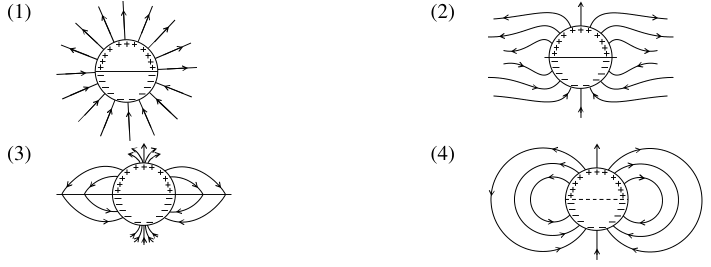
- A.Figure (1)
- B.Figure (2)
- C.Figure (3)
- D.Figure (4)
Correct answer: D
Explanation: Field lines start on the positive upper half and end on the negative lower half, curving around the cylinder like a dipole pattern (figure 4).
Question 64
Physics · 4 marks · −1A signal of 5 kHz frequency is amplitude modulated on a carrier wave of frequency 2 MHz. The frequencies of the resultant signal is/are:
- A.2005 kHz, and 1995 kHz
- B.2005 kHz, 2000 kHz and 1995 kHz
- C.2000 kHz and 1995 kHz
- D.2 MHz only
Correct answer: B
Explanation: AM wave contains the carrier and the two side bands .
Question 65
Physics · 4 marks · −1Consider a spherical shell of radius R at temperature T. The black body radiation inside it can be considered as an ideal gas of photons with internal energy per unit volume and pressure . If the shell now undergoes an adiabatic expansion the relation between T and R is:
- A.
- B.
- C.
- D.
Correct answer: B
Explanation: Adiabatic: with , gives const, so .
Question 66
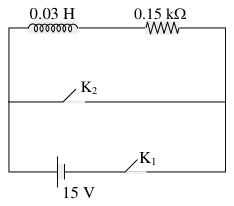
Physics · 4 marks · −1An inductor H and a resistor k are connected in series to a battery of 15V EMF in a circuit shown. The key has been kept closed for a long time. Then at , is opened and key is closed simultaneously. At ms, the current in the circuit will be:
- A.67 mA
- B.6.7 mA
- C.0.67 mA
- D.100 mA
Correct answer: C
Explanation: A; decay mA.
Question 67
Physics · 4 marks · −1A pendulum made of a uniform wire of cross sectional area A has time period T. When an additional mass M is added to its bob, the time period changes to . If the Young's modulus of the material of the wire is Y then is equal to: (g = gravitational acceleration)
- A.
- B.
- C.
- D.
Correct answer: D
Explanation: , so .
Question 68
Physics · 4 marks · −1A red LED emits light at 0.1 watt uniformly around it. The amplitude of the electric field of the light at a distance of 1 m from the diode is:
- A.2.45 V/m
- B.5.48 V/m
- C.7.75 V/m
- D.1.73 V/m
Correct answer: A
Explanation: ; V/m.
Question 69
Physics · 4 marks · −1Two coaxial solenoids of different radii carry current I in the same direction. Let be the magnetic force on the inner solenoid due to the outer one and be the magnetic force on the outer solenoid due to the inner one. Then:
- A. is radially inwards and is radially outwards
- B. is radially inwards and
- C. is radially outwards and
- D.
Correct answer: C
Explanation: The inner solenoid's azimuthal currents sit in the outer solenoid's uniform axial field; on each element points radially outward (parallel currents attract the windings outward). The inner solenoid produces no field outside itself, so .
Question 70
Physics · 4 marks · −1Consider an ideal gas confined in an isolated closed chamber. As the gas undergoes an adiabatic expansion the average time of collision between molecules increases as , where V is the volume of the gas. The value of q is :
- A.
- B.
- C.
- D.
Correct answer: B
Explanation: and : .
Question 71
Physics · 4 marks · −1An LCR circuit is equivalent to a damped pendulum. In an LCR circuit the capacitor is charged to and then connected to the L and R as shown. If a student plots graphs of the square of maximum charge on the capacitor with time (t) for two different values and of L then which of the following represents this graph correctly? (Plots are schematic and not drawn to scale)
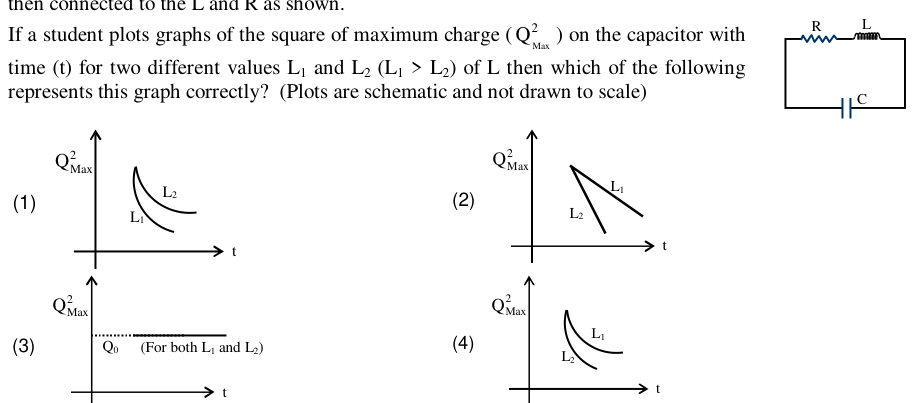
- A.Graph (1)
- B.Graph (2)
- C.Graph (3)
- D.Graph (4)
Correct answer: D
Explanation: : exponential decay, slower for the larger inductance (graph 4).
Question 72
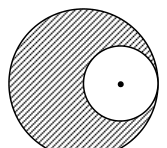
Physics · 4 marks · −1From a solid sphere of mass M and radius R, a spherical portion of radius is removed, as shown in the figure. Taking gravitational potential at , the potential at the centre of the cavity thus formed is (G = gravitational constant)
- A.
- B.
- C.
- D.
Correct answer: A
Explanation: Full sphere at : ; removed sphere (mass ) at its own centre: . Difference .
Question 73
Physics · 4 marks · −1A train is moving on a straight track with speed 20 ms. It is blowing its whistle at the frequency of 1000 Hz. The percentage change in the frequency heard by a person standing near the track as the train passes him is (speed of sound = 320 ms) close to :
- A.12 %
- B.18 %
- C.24 %
- D.6 %
Correct answer: A
Explanation: Approaching: Hz; receding: Hz. Change .
Question 74
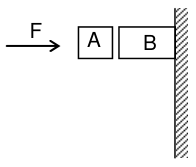
Physics · 4 marks · −1Given in the figure are two blocks A and B of weight 20 N and 100 N respectively. These are being pressed against a wall by a force F as shown. If the coefficient of friction between the blocks is 0.1 and between block B and the wall is 0.15, the frictional force applied by the wall on block B is
- A.80 N
- B.120 N
- C.150 N
- D.100 N
Correct answer: B
Explanation: The system is in equilibrium; the wall's friction must support the total weight N.
Question 75
Physics · 4 marks · −1Distance of the centre of mass of a solid uniform cone from its vertex is . If the radius of its base is R and its height is h then is equal to :
- A.
- B.
- C.
- D.
Correct answer: A
Explanation: Centre of mass of a solid cone lies at from the base, i.e. from the vertex.
Question 76
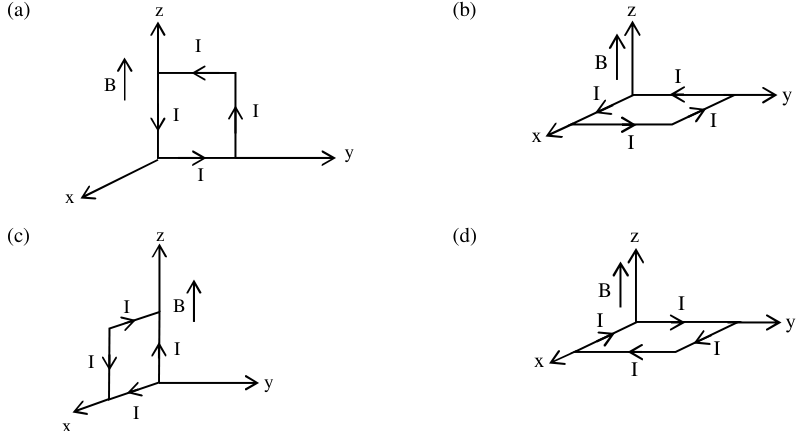
Physics · 4 marks · −1A rectangular loop of sides 10 cm and 5 cm carrying a current I of 12 A is placed in different orientations as shown in the figures below. If there is a uniform magnetic field of 0.3 T in the positive z direction, in which orientations the loop would be in (i) stable equilibrium and (ii) unstable equilibrium?
- A.(a) and (c), respectively
- B.(b) and (d), respectively
- C.(b) and (c), respectively
- D.(a) and (b), respectively
Correct answer: B
Explanation: In (b) the loop lies in the x-y plane with magnetic moment along (parallel to B): stable. In (d) the current sense is reversed, moment along : unstable. In (a) and (c) the moment is perpendicular to B (torque acts).
Question 77
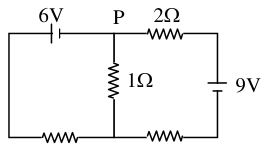
Physics · 4 marks · −1In the circuit shown, the current in the resistor is :
- A.0 A
- B.0.13 A, from Q to P
- C.0.13 A, from P to Q
- D.1.3 A, from P to Q
Correct answer: B
Explanation: Applying Kirchhoff's laws to the two meshes (6 V with 3 ohm on the left, 9 V with 2 ohm and 3 ohm on the right, 1 ohm shared) gives about 0.13 A in the 1 ohm resistor, flowing from Q to P.
Question 78
Physics · 4 marks · −1In the given circuit, charge on the F capacitor changes as C is varied from F to F. as a function of 'C' is given properly by : (figures are drawn schematically and are not to scale)
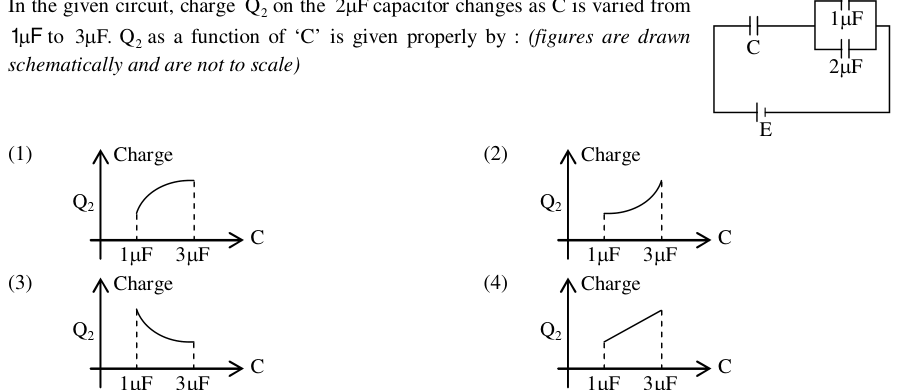
- A.Graph (1): increasing, concave down
- B.Graph (2): increasing, concave up
- C.Graph (3): decreasing
- D.Graph (4): increasing linearly
Correct answer: A
Explanation: C in series with F: , , increasing and concave down.
Question 79
Physics · 4 marks · −1A particle of mass m moving in the x direction with speed 2v is hit by another particle of mass 2m moving in the y direction with speed v. If the collision is perfectly inelastic, the percentage loss in the energy during the collision is close to
- A.50%
- B.56%
- C.62%
- D.44%
Correct answer: B
Explanation: Initial KE ; final velocity with mass 3m: KE . Loss .
Question 80
Physics · 4 marks · −1Monochromatic light is incident on a glass prism of angle A. If the refractive index of the material of the prism is , a ray, incident at an angle , on the face AB would get transmitted through the face AC of the prism provided:
- A.
- B.
- C.
- D.
Correct answer: D
Explanation: Need , i.e. , so .
Question 81
Physics · 4 marks · −1From a solid sphere of mass M and radius R a cube of maximum possible volume is cut. Moment of inertia of cube about an axis passing through its center and perpendicular to one of its faces is :
- A.
- B.
- C.
- D.
Correct answer: B
Explanation: Side , mass ; .
Question 82
Physics · 4 marks · −1Match List - I (Fundamental Experiment) with List - II (its conclusion): (A) Franck-Hertz Experiment, (B) Photo-electric experiment, (C) Davison - Germer Experiment; (i) Particle nature of light, (ii) Discrete energy levels of atom, (iii) Wave nature of electron, (iv) Structure of atom
- A.(A)-(ii), (B)-(iv), (C)-(iii)
- B.(A)-(ii), (B)-(i), (C)-(iii)
- C.(A)-(iv), (B)-(iii), (C)-(ii)
- D.(A)-(i), (B)-(iv), (C)-(iii)
Correct answer: B
Explanation: Franck-Hertz: discrete levels; photoelectric: particle nature of light; Davisson-Germer: electron waves.
Question 83
Physics · 4 marks · −1When 5V potential difference is applied across a wire of length 0.1 m, the drift speed of electrons is ms. If the electron density in the wire is m, the resistivity of the material is close to:
- A.m
- B.m
- C.m
- D.m
Correct answer: C
Explanation: m.
Question 84
Physics · 4 marks · −1For a simple pendulum, a graph is plotted between its kinetic energy (KE) and potential energy (PE) against its displacement d. Which one of the following represents these correctly? (Graphs are schematic and not drawn to scale)
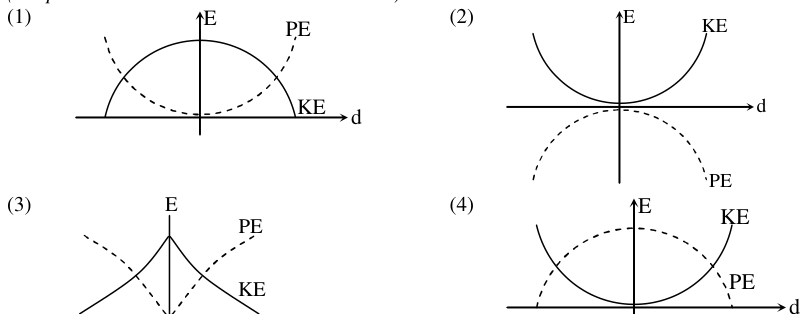
- A.Graph (1)
- B.Graph (2)
- C.Graph (3)
- D.Graph (4)
Correct answer: A
Explanation: KE is an inverted parabola (maximum at d = 0), PE an upright parabola (zero at d = 0), both non-negative.
Question 85
Physics · 4 marks · −1Two stones are thrown up simultaneously from the edge of a cliff 240 m high with initial speed of 10 m/s and 40 m/s respectively. Which of the following graph best represents the time variation of relative position of the second stone with respect to the first ? (Assume stones do not rebound after hitting the ground and neglect air resistance, take m/s) (The figures are schematic and not drawn to scale)
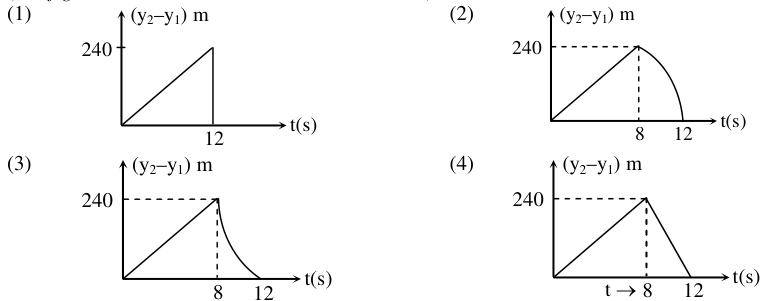
- A.Graph (1)
- B.Graph (2)
- C.Graph (3)
- D.Graph (4)
Correct answer: B
Explanation: Until the first stone lands ( s) (linear, reaching 240 m); afterwards follows a downward parabola reaching 0 at s.
Question 86
Physics · 4 marks · −1Assuming human pupil to have a radius of 0.25 cm and a comfortable viewing distance of 25 cm, the minimum separation between two objects that human eye can resolve at 500 nm wavelength is:
- A.m
- B.m
- C.m
- D.m
Correct answer: A
Explanation: ; m.
Question 87
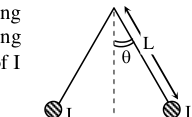
Physics · 4 marks · −1Two long current carrying thin wires, both with current I, are held by insulating threads of length L and are in equilibrium as shown in the figure, with threads making an angle with the vertical. If wires have mass per unit length then the value of I is: (g = gravitational acceleration)
- A.
- B.
- C.
- D.
Correct answer: A
Explanation: Separation ; .
Question 88
Physics · 4 marks · −1On a hot summer night, the refractive index of air is smallest near the ground and increases with height from the ground. When a light beam is directed horizontally, the Huygens' principle leads us to conclude that as it travels, the light beam:
- A.goes horizontally without any deflection
- B.bends downwards
- C.bends upwards
- D.becomes narrower
Correct answer: C
Explanation: The lower part of the wavefront travels faster (smaller n), so the wavefront tilts and the beam bends upward, toward higher refractive index.