JEE Main 2017 — 2 Apr Offline Set D (Previous Year Paper)
JEE Main · 2017 · with answers and explanations
- questions
- 89
- Total marks
- 356
- Duration
- 180 minutes
- Negative marking
- −1
Subjects: Mathematics · Physics · Chemistry
Question 1
Mathematics · 4 marks · −1If S is the set of distinct values of 'b' for which the following system of linear equations , , has no solution, then S is:
- A.an empty set
- B.an infinite set
- C.a finite set containing two or more elements
- D.a singleton
Correct answer: D
Explanation: forces ; then the equations are (twice) and , inconsistent only when . So S .
Question 2
Mathematics · 4 marks · −1The following statement is:
- A.a tautology
- B.equivalent to
- C.equivalent to
- D.a fallacy
Correct answer: A
Explanation: , so the statement is , a tautology.
Question 3
Mathematics · 4 marks · −1If , then the value of is:
- A.
- B.
- C.
- D.
Correct answer: D
Explanation: With : , . , .
Question 4
Mathematics · 4 marks · −1For three events A, B and C, P(Exactly one of A or B occurs) = P(Exactly one of B or C occurs) = P(Exactly one of C or A occurs) = and P(All the three events occur simultaneously) = . Then the probability that at least one of the events occurs, is:
- A.
- B.
- C.
- D.
Correct answer: B
Explanation: Adding etc.: . .
Question 5
Mathematics · 4 marks · −1Let be a complex number such that where . If , then k is equal to:
- A.
- B.
- C.
- D.1
Correct answer: A
Explanation: is a cube root of unity, , . The determinant is , so .
Question 6
Mathematics · 4 marks · −1Let k be an integer such that the triangle with vertices , and has area 28 sq. units. Then the orthocentre of this triangle is at the point:
- A.
- B.
- C.
- D.
Correct answer: D
Explanation: Area condition gives , integer root . Vertices : altitude and altitude through with slope meet at .
Question 7
Mathematics · 4 marks · −1Twenty meters of wire is available for fencing off a flower-bed in the form of a circular sector. Then the maximum area (in sq. m) of the flower-bed, is:
- A.12.5
- B.10
- C.25
- D.30
Correct answer: C
Explanation: , area , maximum 25 at .
Question 8
Mathematics · 4 marks · −1The area (in sq. units) of the region is:
- A.
- B.
- C.
- D.
Correct answer: D
Explanation: Area (trapezium under from 1 to 2) .
Question 9
Mathematics · 4 marks · −1If the image of the point in the plane, measured parallel to the line, is Q, then PQ is equal to:
- A.
- B.
- C.
- D.
Correct answer: B
Explanation: Line through P: meets the plane at , M . , .
Question 10
Mathematics · 4 marks · −1If for , the derivative of is , then equals:
- A.
- B.
- C.
- D.
Correct answer: A
Explanation: The function is ; derivative .
Question 11
Mathematics · 4 marks · −1If and , then is equal to:
- A.
- B.
- C.
- D.
Correct answer: A
Explanation: , so ; at : .
Question 12
Mathematics · 4 marks · −1Let a vertical tower AB have its end A on the level ground. Let C be the mid-point of AB and P be a point on the ground such that . If , then is equal to:
- A.
- B.
- C.
- D.
Correct answer: C
Explanation: With AB , AP : , . .
Question 13
Mathematics · 4 marks · −1If , then is equal to:
- A.
- B.
- C.
- D.
Correct answer: B
Explanation: , , adjoint .
Question 14
Mathematics · 4 marks · −1For any three positive real numbers a, b and c, . Then:
- A.b, c and a are in G.P.
- B.b, c and a are in A.P.
- C.a, b and c are in A.P.
- D.a, b and c are in G.P.
Correct answer: B
Explanation: The relation is , so : , giving .
Question 15
Mathematics · 4 marks · −1The distance of the point from the plane passing through the point , having normal perpendicular to both the lines and , is:
- A.
- B.
- C.
- D.
Correct answer: B
Explanation: Normal ; plane ; distance .
Question 16
Mathematics · 4 marks · −1Let , . If , where C is a constant of integration, then the ordered pair is equal to:
- A.
- B.
- C.
- D.
Correct answer: B
Explanation: , so : , .
Question 17
Mathematics · 4 marks · −1The eccentricity of an ellipse whose centre is at the origin is . If one of its directrices is , then the equation of the normal to it at is:
- A.
- B.
- C.
- D.
Correct answer: B
Explanation: gives , : . Normal at : , i.e. .
Question 18
Mathematics · 4 marks · −1A hyperbola passes through the point and has foci at . Then the tangent to this hyperbola at P also passes through the point:
- A.
- B.
- C.
- D.
Correct answer: B
Explanation: gives (as ): . Tangent at P: , passing through .
Question 19
Mathematics · 4 marks · −1The function defined as , is:
- A.invertible.
- B.injective but not surjective.
- C.surjective but not injective.
- D.neither injective nor surjective.
Correct answer: C
Explanation: Range of is exactly (extremes at ), so onto; , so not one-one.
Question 20
Mathematics · 4 marks · −1equals:
- A.
- B.
- C.
- D.
Correct answer: B
Explanation: Put : expression .
Question 21
Mathematics · 4 marks · −1Let and . Let be a vector such that , and the angle between and be . Then is equal to:
- A.
- B.2
- C.5
- D.
Correct answer: B
Explanation: , so . From : , .
Question 22
Mathematics · 4 marks · −1The normal to the curve at the point where the curve intersects the y-axis passes through the point:
- A.
- B.
- C.
- D.
Correct answer: B
Explanation: At , ; differentiating, so . Normal: , which contains .
Question 23
Mathematics · 4 marks · −1If two different numbers are taken from the set ; then the probability that their sum as well as absolute difference are both multiple of 4, is:
- A.
- B.
- C.
- D.
Correct answer: A
Explanation: Both numbers must be or both : pairs from or : .
Question 24
Mathematics · 4 marks · −1A man X has 7 friends, 4 of them are ladies and 3 are men. His wife Y also has 7 friends, 3 of them are ladies and 4 are men. Assume X and Y have no common friends. Then the total number of ways in which X and Y together can throw a party inviting 3 ladies and 3 men, so that 3 friends of each of X and Y are in this party, is:
- A.485
- B.468
- C.469
- D.484
Correct answer: A
Explanation: Cases (X's ladies, X's men): (3,0),(2,1),(1,2),(0,3): .
Question 25
Mathematics · 4 marks · −1The value of is:
- A.
- B.
- C.
- D.
Correct answer: D
Explanation: and ; the terms cancel, giving .
Question 26
Mathematics · 4 marks · −1A box contains 15 green and 10 yellow balls. If 10 balls are randomly drawn, one-by-one, with replacement, then the variance of the number of green balls drawn is:
- A.
- B.6
- C.4
- D.
Correct answer: A
Explanation: Binomial with , : variance .
Question 27
Mathematics · 4 marks · −1Let . If is such that and , , then is equal to:
- A.330
- B.165
- C.190
- D.255
Correct answer: A
Explanation: Comparing gives , , so . .
Question 28
Mathematics · 4 marks · −1If, for a positive integer n, the quadratic equation, has two consecutive integral solutions, then n is equal to:
- A.12
- B.9
- C.10
- D.11
Correct answer: D
Explanation: The equation is . Roots : discriminant , i.e. , , .
Question 29
Mathematics · 4 marks · −1The integral is equal to:
- A.
- B.2
- C.4
- D.
Correct answer: B
Explanation: ; antiderivative , giving .
Question 30
Physics · 4 marks · −1A radioactive nucleus A with a half life T, decays into a nucleus B. At , there is no nucleus B. At sometime t, the ratio of the number of B to that of A is 0.3. Then, t is given by :
- A.
- B.
- C.
- D.
Correct answer: C
Explanation: , .
Question 31
Physics · 4 marks · −1The following observations were taken for determining surface tension T of water by capillary method: diameter of capillary, m; rise of water, m. Using m/s and the simplified relation N/m, the possible error in surface tension is closest to :
- A.10 %
- B.0.15 %
- C.1.5 %
- D.2.4 %
Correct answer: C
Explanation: (least counts 0.01 in the last digit).
Question 32
Physics · 4 marks · −1An electron beam is accelerated by a potential difference V to hit a metallic target to produce X-rays. It produces continuous as well as characteristic X-rays. If is the smallest possible wavelength of X-ray in the spectrum, the variation of with is correctly represented in:
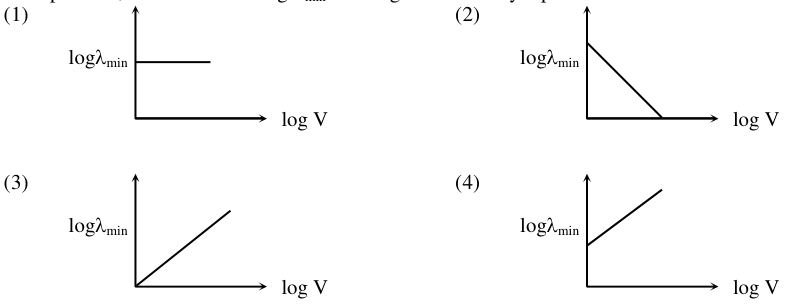
- A.Graph (1): horizontal line
- B.Graph (2): straight line with negative slope
- C.Graph (3): straight line through origin with positive slope
- D.Graph (4): straight line with positive slope and positive intercept
Correct answer: B
Explanation: , so : a straight line of slope .
Question 33
Physics · 4 marks · −1The moment of inertia of a uniform cylinder of length and radius R about its perpendicular bisector is I. What is the ratio such that the moment of inertia is minimum ?
- A.
- B.
- C.
- D.1
Correct answer: B
Explanation: with (fixed mass). , .
Question 34
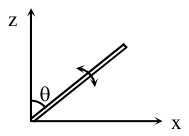
Physics · 4 marks · −1A slender uniform rod of mass M and length is pivoted at one end so that it can rotate in a vertical plane (see figure). There is negligible friction at the pivot. The free end is held vertically above the pivot and then released. The angular acceleration of the rod when it makes an angle with the vertical is:
- A.
- B.
- C.
- D.
Correct answer: B
Explanation: .
Question 35
Physics · 4 marks · −1and are specific heats at constant pressure and constant volume respectively. It is observed that for hydrogen gas and for nitrogen gas. The correct relation between a and b is
- A.
- B.
- C.
- D.
Correct answer: D
Explanation: For specific heats per unit mass, : , , so .
Question 36
Physics · 4 marks · −1A copper ball of mass 100 gm is at a temperature T. It is dropped in a copper calorimeter of mass 100 gm, filled with 170 gm of water at room temperature. Subsequently, the temperature of the system is found to be C. T is given by: (Given : room temperature = C, specific heat of copper = 0.1 cal/gmC)
- A.C
- B.C
- C.C
- D.C
Correct answer: C
Explanation: , C.
Question 37
Physics · 4 marks · −1In amplitude modulation, sinusoidal carrier frequency used is denoted by and the signal frequency is denoted by . The bandwidth of the signal is such that . Which of the following frequencies is not contained in the modulated wave?
- A.
- B.
- C.
- D.
Correct answer: B
Explanation: The AM wave contains and the side bands , not itself.
Question 38
Physics · 4 marks · −1The temperature of an open room of volume 30 m increases from C to C due to the sunshine. The atmospheric pressure in the room remains Pa. If and are the number of molecules in the room before and after heating, then will be :
- A.
- B.
- C.
- D.
Correct answer: A
Explanation: : .
Question 39
Physics · 4 marks · −1In a Young's double slit experiment, slits are separated by 0.5 mm, and the screen is placed 150 cm away. A beam of light consisting of two wavelengths, 650 nm and 520 nm, is used to obtain interference fringes on the screen. The least distance from the common central maximum to the point where the bright fringes due to both the wavelengths coincide is
- A.15.6 mm
- B.1.56 mm
- C.7.8 mm
- D.9.75 mm
Correct answer: C
Explanation: . mm.
Question 40
Physics · 4 marks · −1A particle A of mass m and initial velocity v collides with a particle B of mass which is at rest. The collision is head on, and elastic. The ratio of the de-Broglie wavelengths to after the collision is:
- A.
- B.
- C.
- D.
Correct answer: C
Explanation: Elastic: , . Momenta and ; .
Question 41
Physics · 4 marks · −1A magnetic needle of magnetic moment Am and moment of inertia kg m is performing simple harmonic oscillations in a magnetic field of 0.01 T. Time taken for 10 complete oscillations is:
- A.8.76 s
- B.6.65 s
- C.8.89 s
- D.6.98 s
Correct answer: B
Explanation: s; 10 oscillations 6.65 s.
Question 42
Physics · 4 marks · −1An electric dipole has a fixed dipole moment , which makes angle with respect to x-axis. When subjected to an electric field , it experiences a torque . When subjected to another electric field it experiences a torque . The angle is:
- A.
- B.
- C.
- D.
Correct answer: D
Explanation: , ; equal magnitudes give , .
Question 43
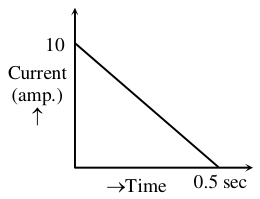
Physics · 4 marks · −1In a coil of resistance , a current is induced by changing the magnetic flux through it as shown in the figure. The magnitude of change in flux through the coil is:
- A.275 Wb
- B.200 Wb
- C.225 Wb
- D.250 Wb
Correct answer: D
Explanation: Wb.
Question 44
Physics · 4 marks · −1A time dependent force acts on a particle of mass 1 kg. If the particle starts from rest, the work done by the force during the first 1 sec. will be:
- A.18 J
- B.4.5 J
- C.22 J
- D.9 J
Correct answer: B
Explanation: Impulse , so m/s; work J.
Question 45
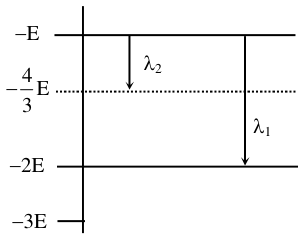
Physics · 4 marks · −1Some energy levels of a molecule are shown in the figure. The ratio of the wavelengths , is given by:
- A.
- B.
- C.
- D.
Correct answer: A
Explanation: : (); : (). .
Question 46
Physics · 4 marks · −1In the given circuit, the current in each resistance is:
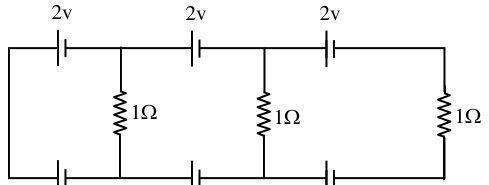
- A.0 A
- B.1 A
- C.0.25 A
- D.0.5 A
Correct answer: A
Explanation: Each resistor connects points whose potential difference is zero (the 2 V cells in the upper and lower rails cancel), so no current flows.
Question 47
Physics · 4 marks · −1A body is thrown vertically upwards. Which one of the following graphs correctly represent the velocity vs time?
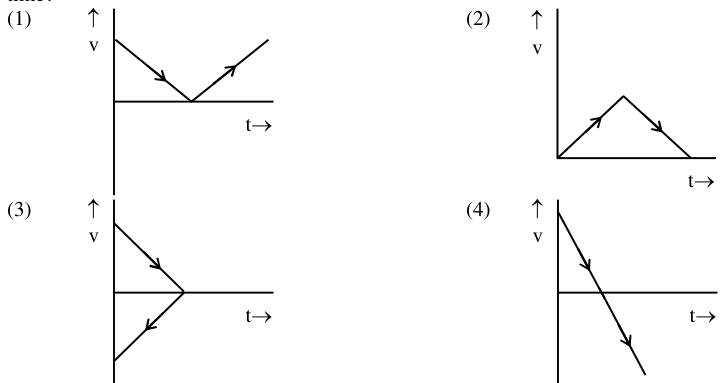
- A.Graph (1)
- B.Graph (2)
- C.Graph (3)
- D.Graph (4)
Correct answer: D
Explanation: : a single straight line with negative slope crossing the time axis.
Question 48
Physics · 4 marks · −1A capacitance of F is required in an electrical circuit across a potential difference of 1.0 kV. A large number of F capacitors are available which can withstand a potential difference of not more than 300 V. The minimum number of capacitors required to achieve this is:
- A.32
- B.2
- C.16
- D.24
Correct answer: A
Explanation: Need at least 4 in series (4 x 300 V > 1 kV); each series row gives F, so 8 parallel rows: 32 capacitors.
Question 49
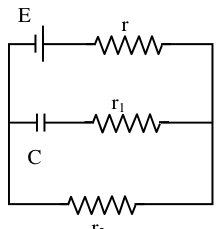
Physics · 4 marks · −1In the given circuit diagram when the current reaches steady state in the circuit, the charge on the capacitor of capacitance C will be:
- A.
- B.
- C.
- D.
Correct answer: D
Explanation: In steady state no current flows through the - branch; current flows through , and the capacitor voltage equals the voltage across .
Question 50
Physics · 4 marks · −1In a common emitter amplifier circuit using an n-p-n transistor, the phase difference between the input and the output voltages will be:
- A.
- B.
- C.
- D.
Correct answer: A
Explanation: CE amplifier output is inverted relative to input: .
Question 51
Physics · 4 marks · −1Which of the following statements is false?
- A.Kirchhoff's second law represents energy conservation.
- B.Wheatstone bridge is the most sensitive when all the four resistances are of the same order of magnitude.
- C.In a balanced wheatstone bridge if the cell and the galvanometer are exchanged, the null point is disturbed.
- D.A rheostat can be used as a potential divider.
Correct answer: C
Explanation: Exchanging cell and galvanometer changes the balance condition to , equivalent to ; balance is not disturbed.
Question 52
Physics · 4 marks · −1A particle is executing simple harmonic motion with a time period T. At time , it is at its position of equilibrium. The kinetic energy - time graph of the particle will look like:
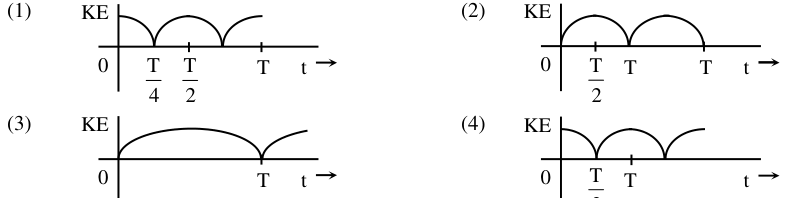
- A.Graph (1)
- B.Graph (2)
- C.Graph (3)
- D.Graph (4)
Correct answer: A
Explanation: : maximum at , zero at , maximum at , period .
Question 53
Physics · 4 marks · −1An observer is moving with half the speed of light towards a stationary microwave source emitting waves at frequency 10 GHz. What is the frequency of the microwave measured by the observer? (speed of light = ms)
- A.15.3 GHz
- B.10.1 GHz
- C.12.1 GHz
- D.17.3 GHz
Correct answer: D
Explanation: Relativistic Doppler: GHz.
Question 54
Physics · 4 marks · −1A man grows into a giant such that his linear dimensions increase by a factor of 9. Assuming that his density remains same, the stress in the leg will change by a factor of:
- A.
- B.9
- C.
- D.81
Correct answer: B
Explanation: Stress : factor 9.
Question 55
Physics · 4 marks · −1When a current of 5 mA is passed through a galvanometer having a coil of resistance , it shows full scale deflection. The value of the resistance to be put in series with the galvanometer to convert it into a voltmeter of range 0 - 10V is:
- A.
- B.
- C.
- D.
Correct answer: B
Explanation: .
Question 56
Physics · 4 marks · −1The variation of acceleration due to gravity g with distance d from centre of the earth is best represented by (R = Earth's radius):

- A.Graph (1)
- B.Graph (2)
- C.Graph (3)
- D.Graph (4)
Correct answer: A
Explanation: inside () and outside: linear rise to a peak at R, then inverse-square fall.
Question 57
Physics · 4 marks · −1An external pressure P is applied on a cube at C so that it is equally compressed from all sides. K is the bulk modulus of the material of the cube and is its coefficient of linear expansion. Suppose we want to bring the cube to its original size by heating. The temperature should be raised by:
- A.
- B.
- C.
- D.
Correct answer: B
Explanation: Compression must equal thermal expansion : .
Question 58
Physics · 4 marks · −1A diverging lens with magnitude of focal length 25 cm is placed at a distance of 15 cm from a converging lens of magnitude of focal length 20 cm. A beam of parallel light falls on the diverging lens. The final image formed is:
- A.real and at a distance of 6 cm from the convergent lens.
- B.real and at a distance of 40 cm from convergent lens.
- C.virtual and at a distance of 40 cm from convergent lens.
- D.real and at a distance of 40 cm from the divergent lens.
Correct answer: B
Explanation: Diverging lens images at 25 cm before it, i.e. 40 cm before the converging lens. cm, real.
Question 59
Physics · 4 marks · −1A body of mass kg is moving in a medium and experiences a frictional force . Its initial speed is ms. If, after 10 s, its energy is , the value of k will be:
- A. kg ms
- B. kg m
- C. kg s
- D. kg m
Correct answer: D
Explanation: . , kg/m.
Question 60
Chemistry · 4 marks · −11 gram of a carbonate on treatment with excess HCl produces 0.01186 mole of . The molar mass of in g mol is:
- A.84.3
- B.118.6
- C.11.86
- D.1186
Correct answer: A
Explanation: Moles of carbonate = moles of : g/mol.
Question 61
Chemistry · 4 marks · −1Given ; kJ mol; ; kJ mol; ; kJ mol. Based on the above thermochemical equations, the value of at 298 K for the reaction will be:
- A. kJ mol
- B. kJ mol
- C. kJ mol
- D. kJ mol
Correct answer: B
Explanation: kJ/mol.
Question 62
Chemistry · 4 marks · −1The freezing point of benzene decreases by C when 0.2 g of acetic acid is added to 20 g of benzene. If acetic acid associates to form a dimer in benzene, percentage association of acetic acid in benzene will be: ( for benzene = 5.12 K kg mol)
- A.80.4 %
- B.74.6 %
- C.94.6 %
- D.64.6 %
Correct answer: C
Explanation: ; for dimerisation , .
Question 63
Chemistry · 4 marks · −1The most abundant elements by mass in the body of a healthy human adult are: Oxygen (61.4%); Carbon (22.9%), Hydrogen (10.0%); and Nitrogen (2.6%). The weight which a 75 kg person would gain if all H atoms are replaced by H atoms is:
- A.37.5 kg
- B.7.5 kg
- C.10 kg
- D.15 kg
Correct answer: B
Explanation: Hydrogen mass kg; replacing by deuterium doubles it, a gain of 7.5 kg.
Question 64
Chemistry · 4 marks · −1is equal to
- A.Isobaric work
- B.Adiabatic work
- C.Isothermal work
- D.Isochoric work
Correct answer: B
Explanation: For an adiabatic process , so .
Question 65
Chemistry · 4 marks · −1The formation of which of the following polymers involves hydrolysis reaction?
- A.Bakelite
- B.Nylon 6, 6
- C.Terylene
- D.Nylon 6
Correct answer: D
Explanation: Nylon 6 is made by heating caprolactam with water: hydrolytic ring opening followed by polymerisation.
Question 66
Chemistry · 4 marks · −1Given V, V, V, V. Among the following, the strongest reducing agent is
- A.
- B.
- C.
- D.Cr
Correct answer: D
Explanation: The species with the lowest reduction potential couple (Cr in , V) is the strongest reducing agent.
Question 67
Chemistry · 4 marks · −1The Tyndall effect is observed only when following conditions are satisfied: (a) The diameter of the dispersed particles is much smaller than the wavelength of the light used. (b) The diameter of the dispersed particle is not much smaller than the wavelength of the light used. (c) The refractive indices of the dispersed phase and dispersion medium are almost similar in magnitude. (d) The refractive indices of the dispersed phase and dispersion medium differ greatly in magnitude.
- A.(b) and (d)
- B.(a) and (c)
- C.(b) and (c)
- D.(a) and (d)
Correct answer: A
Explanation: Scattering needs particles not much smaller than and a large refractive-index difference.
Question 68
Chemistry · 4 marks · −1In the following reactions, ZnO is respectively acting as a/an: (a) (b)
- A.base and base
- B.acid and acid
- C.acid and base
- D.base and acid
Correct answer: C
Explanation: With basic it acts as an acid; with acidic it acts as a base (amphoteric).
Question 69
Chemistry · 4 marks · −1Which of the following compounds will behave as a reducing sugar in an aqueous KOH solution?
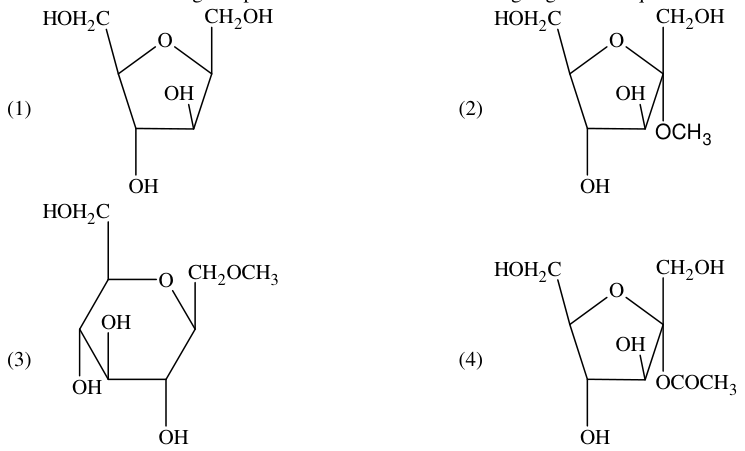
- A.Furanose whose anomeric carbon bears and H (no anomeric OH)
- B.Furanose with anomeric (glycoside)
- C.Pyranose with anomeric group
- D.Furanose with anomeric (ester)
Correct answer: D
Explanation: In aqueous KOH the anomeric acetate ester is hydrolysed, liberating a free hemiacetal which reduces (glycosides and C-glycosides are stable to base).
Question 70
Chemistry · 4 marks · −1The major product obtained in the following reaction is: (+)- (optically active 1-bromo-1,2-diphenylethane) ?
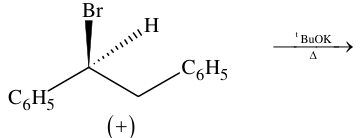
- A.
- B.
- C.
- D.
Correct answer: A
Explanation: Bulky strong base with heat favours E2, giving stilbene.
Question 71
Chemistry · 4 marks · −1Which of the following species is not paramagnetic?
- A.CO
- B.
- C.
- D.NO
Correct answer: A
Explanation: CO (14 electrons) has all electrons paired; and have two unpaired electrons, NO one.
Question 72
Chemistry · 4 marks · −1On treatment of 100 mL of 0.1 M solution of with excess ; ions are precipitated. The complex is:
- A.
- B.
- C.
- D.
Correct answer: D
Explanation: 0.01 mol complex. precipitated ions mol of ions; the precipitate AgCl consists of and ions in equal number, i.e. 0.01 mol AgCl, so one ionisable chloride per formula: .
Question 73
Chemistry · 4 marks · −1of a weak acid (HA) and of a weak base (BOH) are 3.2 and 3.4, respectively. The pH of their salt (AB) solution is:
- A.6.9
- B.7.0
- C.1.0
- D.7.2
Correct answer: A
Explanation: .
Question 74
Chemistry · 4 marks · −1The increasing order of the reactivity of the following halides for the reaction is: (I) (II) (III)
- A.(II) < (I) < (III)
- B.(I) < (III) < (II)
- C.(II) < (III) < (I)
- D.(III) < (II) < (I)
Correct answer: A
Explanation: rate follows carbocation stability: primary < secondary < p-methoxybenzyl.
Question 75
Chemistry · 4 marks · −1Both lithium and magnesium display several similar properties due to the diagonal relationship; however, the one which is incorrect, is:
- A.both form soluble bicarbonates
- B.both form nitrides
- C.nitrates of both Li and Mg yield and on heating
- D.both form basic carbonates
Correct answer: D
Explanation: Mg forms a basic carbonate () but Li forms only the normal carbonate ; the other three statements hold (bicarbonates exist in solution).
Question 76
Chemistry · 4 marks · −1The correct sequence of reagents for the following conversion will be: 4-oxocyclohexane-1-carbaldehyde 4-(2-hydroxypropan-2-yl)-1-methylcyclohexan-1-ol
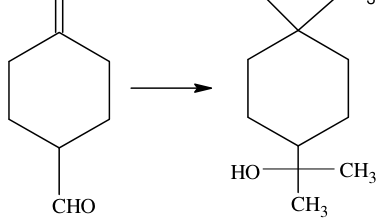
- A., ,
- B., ,
- C., ,
- D., ,
Correct answer: D
Explanation: Tollens' oxidises CHO to COOH; esterify (); excess converts the ketone to a tertiary alcohol and the ester to .
Question 77
Chemistry · 4 marks · −1The products obtained when chlorine gas reacts with cold and dilute aqueous NaOH are:
- A. and
- B. and
- C. and
- D. and
Correct answer: B
Explanation: .
Question 78
Chemistry · 4 marks · −1Which of the following compounds will form significant amount of meta product during mono-nitration reaction?
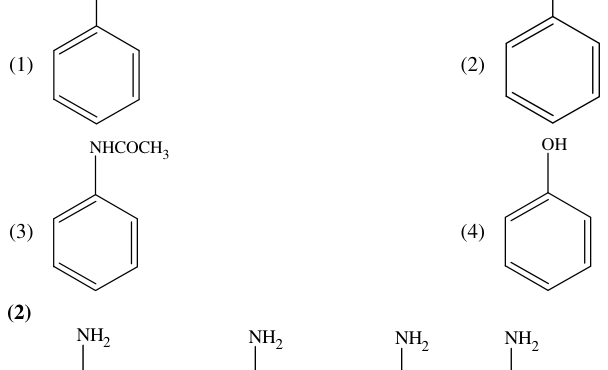
- A.Phenyl acetate ()
- B.Aniline ()
- C.Acetanilide ()
- D.Phenol ()
Correct answer: B
Explanation: In nitrating mixture aniline is protonated to anilinium (, meta-directing), giving about 47% m-nitroaniline.
Question 79
Chemistry · 4 marks · −13-Methyl-pent-2-ene on reaction with HBr in presence of peroxide forms an addition product. The number of possible stereoisomers for the product is :
- A.Zero
- B.Two
- C.Four
- D.Six
Correct answer: C
Explanation: Anti-Markovnikov addition gives with two stereocentres: stereoisomers.
Question 80
Chemistry · 4 marks · −1Two reactions and have identical pre-exponential factors. Activation energy of exceeds that of by 10 kJ mol. If and are rate constants for reactions and respectively at 300 K, then is equal to : ( J mol K)
- A.12
- B.6
- C.4
- D.8
Correct answer: C
Explanation: .
Question 81
Chemistry · 4 marks · −1Which of the following molecules is least resonance stabilized?
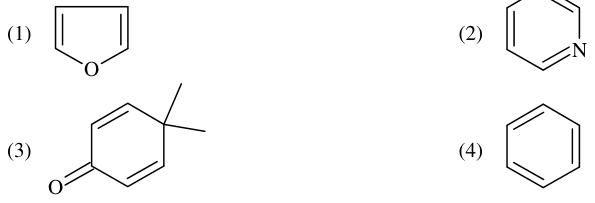
- A.Furan
- B.Pyridine
- C.4,4-Dimethylcyclohexa-2,5-dien-1-one
- D.Benzene
Correct answer: C
Explanation: Furan, pyridine and benzene are aromatic; the cross-conjugated dienone is not.
Question 82
Chemistry · 4 marks · −1The group having isoelectronic species is:
- A.
- B.
- C.
- D.
Correct answer: D
Explanation: all have 10 electrons.
Question 83
Chemistry · 4 marks · −1The radius of the second Bohr orbit for hydrogen atom is: (Planck's Const. Js; mass of electron kg; charge of electron C; permittivity of vacuum kg m A)
- A.4.76 Å
- B.0.529 Å
- C.2.12 Å
- D.1.65 Å
Correct answer: C
Explanation: Å; : 2.12 Å.
Question 84
Chemistry · 4 marks · −1The major product obtained in the following reaction is: a bicyclic γ-lactone fused to a cyclopentene ring that also carries a group ?
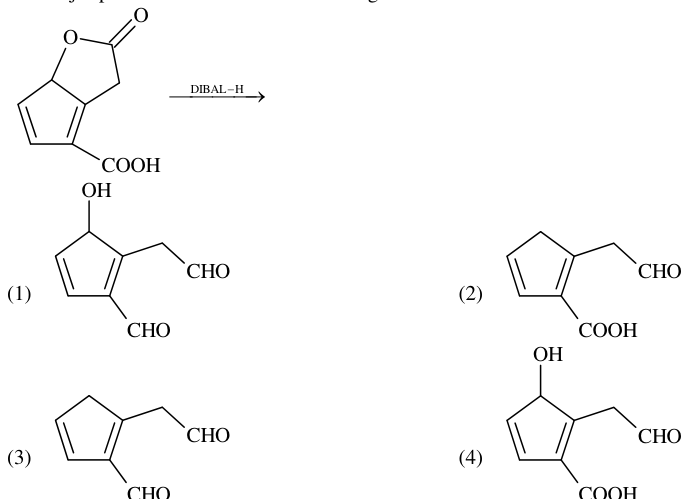
- A.Cyclopentadiene ring bearing OH, and
- B.Cyclopentadiene ring bearing and (no OH)
- C.Cyclopentadiene ring bearing and (no OH)
- D.Cyclopentadiene ring bearing OH, and
Correct answer: D
Explanation: DIBAL-H reduces the lactone to the lactol, which opens to a hydroxy-aldehyde ( and ). Under controlled conditions the carboxylic acid is only deprotonated, not reduced, giving option 4. If DIBAL-H is also assumed to reduce to , option 1 results.
Question 85
Chemistry · 4 marks · −1Which of the following reactions is an example of a redox reaction?
- A.
- B.
- C.
- D.
Correct answer: D
Explanation: Xe goes from +4 to +6 and O from +1 to 0; the others involve no change of oxidation state.
Question 86
Chemistry · 4 marks · −1A metal crystallises in a face centred cubic structure. If the edge length of its unit cell is 'a', the closest approach between two atoms in metallic crystal will be:
- A.
- B.
- C.
- D.
Correct answer: C
Explanation: In fcc, atoms touch along the face diagonal: , closest approach .
Question 87
Chemistry · 4 marks · −1Sodium salt of an organic acid 'X' produces effervescence with conc. . 'X' reacts with the acidified aqueous solution to give a white precipitate which decolourises acidic solution of . 'X' is:
- A.
- B.
- C.
- D.
Correct answer: C
Explanation: Oxalate gives with conc. and white , which is oxidised by acidified .
Question 88
Chemistry · 4 marks · −1A water sample has ppm level concentration of following anions: ; ; . The anion/anions that make/makes the water sample unsuitable for drinking is/are:
- A.both and
- B.only
- C.only
- D.only
Correct answer: B
Explanation: Limits: about 1 ppm, 500 ppm, 50 ppm; only fluoride exceeds.
Question 89
Chemistry · 4 marks · −1Which of the following, upon treatment with tert-BuONa followed by addition of bromine water, fails to decolourize the colour of bromine?
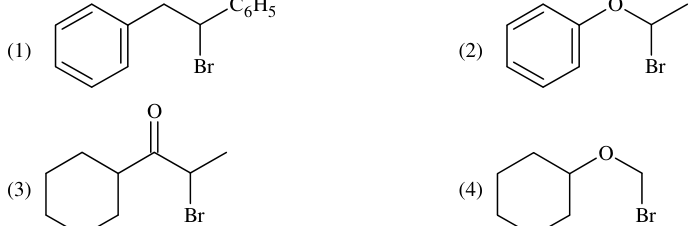
- A.1-bromo-1,2-diphenylethane type:
- B.1-bromoethyl phenyl ether:
- C.2-bromo-1-cyclohexylpropan-1-one:
- D.Bromomethyl cyclohexyl ether:
Correct answer: D
Explanation: The first three have a -hydrogen and give alkenes by elimination (which decolourise bromine water); has no -H on carbon, so no alkene forms.