JEE Main 2018 — 15 Apr Morning (online CBT) (Previous Year Paper)
JEE Main · 2018 · with answers and explanations
- questions
- 90
- Total marks
- 360
- Duration
- 180 minutes
- Negative marking
- −1
Subjects: Physics · Chemistry · Mathematics
Question 1
Physics · 4 marks · −1The relative error in the determination of the surface area of a sphere is . Then the relative error in the determination of its volume is :
- A.
- B.
- C.
- D.
Correct answer: A
Question 2
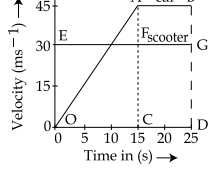
Physics · 4 marks · −1The velocity-time graphs of a car and a scooter are shown in the figure. (i) The difference between the distance travelled by the car and the scooter in 15 s and (ii) the time at which the car will catch up with the scooter are, respectively.
- A.112.5 m and 22.5 s
- B.337.5 m and 25 s
- C.112.5 m and 15 s
- D.225.5 m and 10 s
Correct answer: A
Question 3
Physics · 4 marks · −1A given object takes n times more time to slide down a rough inclined plane as it takes to slide down a perfectly smooth incline. The coefficient of kinetic friction between the object and the incline is :
- A.
- B.
- C.
- D.
Correct answer: B
Question 4
Physics · 4 marks · −1An automobile, travelling at 40 km/h, can be stopped at a distance of 40 m by applying brakes. If the same automobile is travelling at 80 km/h, the minimum stopping distance, in metres, is (assume no skidding) :
- A.75 m
- B.100 m
- C.150 m
- D.160 m
Correct answer: D
Question 5
Physics · 4 marks · −1A particle is oscillating on the X-axis with an amplitude 2 cm about the point cm, with a frequency . A concave mirror of focal length 5 cm is placed at the origin (see figure). Identify the correct statements. (A) The image executes periodic motion. (B) The image executes non-periodic motion. (C) The turning points of the image are asymmetric w.r.t. the image of the point at cm. (D) The distance between the turning points of the oscillation of the image is cm.

- A.(A), (D)
- B.(A), (C), (D)
- C.(B), (D)
- D.(B), (C)
Correct answer: B
Question 6
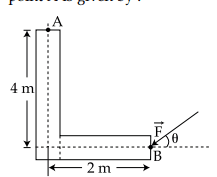
Physics · 4 marks · −1A force of 40 N acts on a point B at the end of an L-shaped object, as shown in the figure. The angle that will produce maximum moment of the force about point A is given by :
- A.
- B.
- C.
- D.
Correct answer: B
Question 7
Physics · 4 marks · −1A body of mass m is moving in a circular orbit of radius R about a planet of mass M. At some instant, it splits into two equal masses. The first mass moves in a circular orbit of radius , and the other mass, in a circular orbit of radius . The difference between the final and initial total energies is :
- A.
- B.
- C.
- D.
Correct answer: D
Question 8
Physics · 4 marks · −1Take the mean distance of the moon and the sun from the earth to be km and km respectively. Their masses are kg and kg respectively. The radius of the earth is 6400 km. Let be the difference in the forces exerted by the moon at the nearest and farthest points on the earth and be the difference in the force exerted by the sun at the nearest and farthest points on the earth. Then, the number closest to is :
- A.2
- B.
- C.0.6
- D.6
Correct answer: A
Question 9
Physics · 4 marks · −1A thin uniform tube is bent into a circle of radius r in the vertical plane. Equal volumes of two immiscible liquids, whose densities are and , fill half the circle. The angle between the radius vector passing through the common interface and the vertical is :
- A.
- B.
- C.
- D.
Correct answer: C
Question 10
Physics · 4 marks · −1A Carnot's engine works as a refrigerator between 250 K and 300 K. It receives 500 cal heat from the reservoir at the lower temperature. The amount of work done in each cycle to operate the refrigerator is :
- A.420 J
- B.772 J
- C.2100 J
- D.2520 J
Correct answer: A
Question 11
Physics · 4 marks · −1One mole of an ideal monoatomic gas is compressed isothermally in a rigid vessel to double its pressure at room temperature, C. The work done on the gas will be :
- A.300 R
- B.300 R ln 6
- C.300 R ln 2
- D.300 R ln 7
Correct answer: C
Question 12
Physics · 4 marks · −1A body of mass M and charge q is connected to a spring of spring constant k. It is oscillating along x-direction about its equilibrium position, taken to be at , with an amplitude A. An electric field E is applied along the x-direction. Which of the following statements is correct ?
- A.The new equilibrium position is at a distance from .
- B.The total energy of the system is .
- C.The total energy of the system is .
- D.The new equilibrium position is at a distance from .
Correct answer: C
Question 13
Physics · 4 marks · −1A tuning fork vibrates with frequency 256 Hz and gives one beat per second with the third normal mode of vibration of an open pipe. What is the length of the pipe ? (Speed of sound in air is 340 m s)
- A.220 cm
- B.190 cm
- C.180 cm
- D.200 cm
Correct answer: D
Question 14
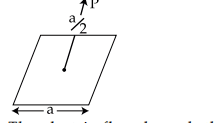
Physics · 4 marks · −1A charge Q is placed at a distance above the centre of the square surface of edge a as shown in the figure. The electric flux through the square surface is :
- A.
- B.
- C.
- D.
Correct answer: D
Question 15
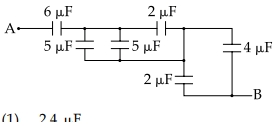
Physics · 4 marks · −1The equivalent capacitance between A and B in the circuit given below, is :
- A.2.4 F
- B.4.9 F
- C.3.6 F
- D.5.4 F
Correct answer: A
Question 16
Physics · 4 marks · −1In the given circuit all resistances are of value R ohm each. The equivalent resistance between A and B is :
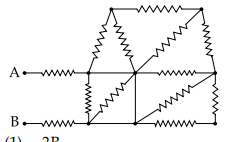
- A.2R
- B.3R
- C.
- D.
Correct answer: A
Question 17
Physics · 4 marks · −1In a meter bridge, as shown in the figure, it is given that resistance Y = 12.5 and that the balance is obtained at a distance 39.5 cm from end A (by Jockey J). After interchanging the resistances X and Y, a new balance point is found at a distance from end A. What are the values of X and ?
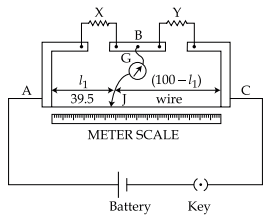
- A.8.16 and 60.5 cm
- B.19.15 and 39.5 cm
- C.8.16 and 39.5 cm
- D.19.15 and 60.5 cm
Correct answer: A
Question 18
Physics · 4 marks · −1A Helmholtz coil has a pair of loops, each with N turns and radius R. They are placed coaxially at distance R and the same current I flows through the loops in the same direction. The magnitude of magnetic field at P, midway between the centres A and C, is given by [Refer to figure given below] :
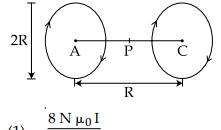
- A.
- B.
- C.
- D.
Correct answer: B
Question 19
Physics · 4 marks · −1The B-H curve for a ferromagnet is shown in the figure. The ferromagnet is placed inside a long solenoid with 1000 turns/cm. The current that should be passed in the solenoid to demagnetise the ferromagnet completely is :
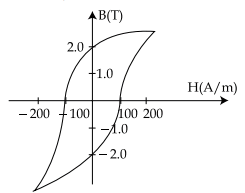
- A.1 mA
- B.2 mA
- C.20 A
- D.40 A
Correct answer: A
Question 20
Physics · 4 marks · −1An ideal capacitor of capacitance 0.2 F is charged to a potential difference of 10 V. The charging battery is then disconnected. The capacitor is then connected to an ideal inductor of self inductance 0.5 mH. The current at a time when the potential difference across the capacitor is 5 V, is :
- A.0.34 A
- B.0.25 A
- C.0.17 A
- D.0.15 A
Correct answer: C
Question 21
Physics · 4 marks · −1A monochromatic beam of light has a frequency Hz and is propagating along the direction . It is polarized along the direction. The acceptable form for the magnetic field is :
- A.
- B.
- C.
- D.
Correct answer: A
Question 22
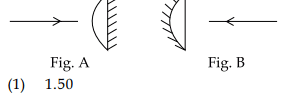
Physics · 4 marks · −1A planoconvex lens becomes an optical system of 28 cm focal length when its plane surface is silvered and illuminated from left to right as shown in Fig-A. If the same lens is instead silvered on the curved surface and illuminated from other side as in Fig. B, it acts like an optical system of focal length 10 cm. The refractive index of the material of lens is :
- A.1.50
- B.1.55
- C.1.75
- D.1.51
Correct answer: B
Question 23
Physics · 4 marks · −1Light of wavelength 550 nm falls normally on a slit of width cm. The angular position of the second minima from the central maximum will be (in radians) :
- A.
- B.
- C.
- D.
Correct answer: C
Question 24
Physics · 4 marks · −1Two electrons are moving with non-relativistic speeds perpendicular to each other. If corresponding de Broglie wavelengths are and , their de Broglie wavelength in the frame of reference attached to their centre of mass is :
- A.
- B.
- C.
- D.
Correct answer: B
Question 25
Physics · 4 marks · −1The energy required to remove the electron from a singly ionized Helium atom is 2.2 times the energy required to remove an electron from Helium atom. The total energy required to ionize the Helium atom completely is :
- A.20 eV
- B.34 eV
- C.79 eV
- D.109 eV
Correct answer: C
Question 26
Physics · 4 marks · −1A solution containing active cobalt having activity of 0.8 Ci and decay constant is injected in an animal's body. If 1 cm of blood is drawn from the animal's body after 10 hrs of injection, the activity found was 300 decays per minute. What is the volume of blood that is flowing in the body ? (1 Ci = decays per second and at t = 10 hrs )
- A.6 liters
- B.7 liters
- C.4 liters
- D.5 liters
Correct answer: D
Question 27
Physics · 4 marks · −1In a common emitter configuration with suitable bias, it is given that is the load resistance and is small signal dynamic resistance (input side). Then, voltage gain, current gain and power gain are given, respectively, by : is current gain, , and are respectively base, collector and emitter currents.
- A., ,
- B., ,
- C., ,
- D., ,
Correct answer: A
Question 28
Physics · 4 marks · −1The number of amplitude modulated broadcast stations that can be accommodated in a 300 kHz band width for the highest modulating frequency 15 kHz will be :
- A.20
- B.15
- C.10
- D.8
Correct answer: C
Question 29
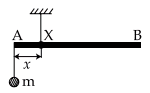
Physics · 4 marks · −1A uniform rod AB is suspended from a point X, at a variable distance x from A, as shown. To make the rod horizontal, a mass m is suspended from its end A. A set of (m, x) values is recorded. The appropriate variables that give a straight line, when plotted, are :
- A.m, x
- B.m,
- C.m,
- D.m,
Correct answer: B
Question 30
Physics · 4 marks · −1In a screw gauge, 5 complete rotations of the screw cause it to move a linear distance of 0.25 cm. There are 100 circular scale divisions. The thickness of a wire measured by this screw gauge gives a reading of 4 main scale divisions and 30 circular scale divisions. Assuming negligible zero error, the thickness of the wire is :
- A.0.4300 cm
- B.0.2150 cm
- C.0.3150 cm
- D.0.0430 cm
Correct answer: B
Question 31
Chemistry · 4 marks · −1A sample of is converted by heat to NaCl with a loss of 0.16 g of oxygen. The residue is dissolved in water and precipitated as AgCl. The mass of AgCl (in g) obtained will be : (Given : Molar mass of AgCl = 143.5 g mol)
- A.0.35
- B.0.41
- C.0.48
- D.0.54
Correct answer: C
Question 32
Chemistry · 4 marks · −1Which of the following arrangements shows the schematic alignment of magnetic moments of antiferromagnetic substance ?
- A.
- B.
- C.
- D.
Correct answer: C
Question 33
Chemistry · 4 marks · −1The minimum volume of water required to dissolve 0.1 g lead(II) chloride to get a saturated solution ( of ; atomic mass of Pb = 207 u) is :
- A.0.36 L
- B.17.98 L
- C.0.18 L
- D.1.798 L
Correct answer: C
Question 34
Chemistry · 4 marks · −1In which of the following reactions, an increase in the volume of the container will favour the formation of products ?
- A.
- B.
- C.
- D.
Correct answer: A
Question 35
Chemistry · 4 marks · −1When an electric current is passed through acidified water, 112 mL of hydrogen gas at N.T.P. was collected at the cathode in 965 seconds. The current passed, in ampere, is :
- A.1.0
- B.0.5
- C.0.1
- D.2.0
Correct answer: A
Question 36
Chemistry · 4 marks · −1decomposes to and and follows first order kinetics. After 50 minutes, the pressure inside the vessel increases from 50 mmHg to 87.5 mmHg. The pressure of the gaseous mixture after 100 minute at constant temperature will be :
- A.175.0 mmHg
- B.116.25 mmHg
- C.136.25 mmHg
- D.106.25 mmHg
Correct answer: D
Question 37
Chemistry · 4 marks · −1For which of the following reactions, is equal to ?
- A.
- B.
- C.
- D.
Correct answer: B
Question 38
Chemistry · 4 marks · −1Which of the following statements about colloids is False ?
- A.Freezing point of colloidal solution is lower than true solution at same concentration of a solute.
- B.Colloidal particles can pass through ordinary filter paper.
- C.When silver nitrate solution is added to potassium iodide solution, a negatively charged colloidal solution is formed.
- D.When excess of electrolyte is added to colloidal solution, colloidal particle will be precipitated.
Correct answer: A
Question 39
Chemistry · 4 marks · −1Ejection of the photoelectron from metal in the photoelectric effect experiment can be stopped by applying 0.5 V when the radiation of 250 nm is used. The work function of the metal is :
- A.4 eV
- B.4.5 eV
- C.5 eV
- D.5.5 eV
Correct answer: B
Question 40
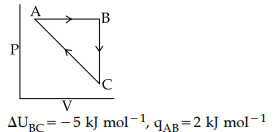
Chemistry · 4 marks · −1An ideal gas undergoes a cyclic process as shown in Figure. kJ mol, kJ mol, kJ mol, kJ mol. Heat absorbed by the system during process CA is :
- A. kJ mol
- B. kJ mol
- C.18 kJ mol
- D. kJ mol
Correct answer: B
Question 41
Chemistry · 4 marks · −1For , , and ; the correct order of increasing ionic radii is :
- A.
- B.
- C.
- D.
Correct answer: C
Question 42
Chemistry · 4 marks · −1In the molecular orbital diagram for the molecular ion, , the number of electrons in the molecular orbital is :
- A.0
- B.1
- C.2
- D.3
Correct answer: B
Question 43
Chemistry · 4 marks · −1Which of the following is a Lewis acid ?
- A.
- B.
- C.NaH
- D.
Correct answer: B
Question 44
Chemistry · 4 marks · −1In graphite and diamond, the percentage of p-characters of the hybrid orbitals in hybridisation are respectively :
- A.33 and 25
- B.33 and 75
- C.50 and 75
- D.67 and 75
Correct answer: D
Question 45
Chemistry · 4 marks · −1A white sodium salt dissolves readily in water to give a solution which is neutral to litmus. When silver nitrate solution is added to the aforementioned solution, a white precipitate is obtained which does not dissolve in dil. nitric acid. The anion is :
- A.
- B.
- C.
- D.
Correct answer: C
Question 46
Chemistry · 4 marks · −1Identify the pair in which the geometry of the species is T-shape and square-pyramidal, respectively :
- A. and
- B. and
- C. and
- D. and
Correct answer: C
Question 47
Chemistry · 4 marks · −1The correct combination is :
- A. — tetrahedral ; — paramagnetic
- B. — paramagnetic ; — tetrahedral
- C. — square-planar ; — paramagnetic
- D. — diamagnetic ; — square-planar
Correct answer: B
Question 48
Chemistry · 4 marks · −1In hydrogen azide (above) the bond orders of bonds (I) and (II) are :
- A.(I) ; (II)
- B.(I) ; (II)
- C.(I) ; (II)
- D.(I) ; (II)
Correct answer: A
Question 49
Chemistry · 4 marks · −1The decreasing order of bond angles in , , and is :
- A.
- B.
- C.
- D.
Correct answer: B
Question 50
Chemistry · 4 marks · −1Xenon hexafluoride on partial hydrolysis produces compounds 'X' and 'Y'. Compounds 'X' and 'Y' and the oxidation state of Xe are respectively :
- A. and
- B. and
- C. and
- D. and
Correct answer: D
Question 51
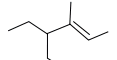
Chemistry · 4 marks · −1The IUPAC name of the following compound is : [bond-line structure: ]
- A.4-methyl-3-ethylhex-4-ene
- B.3-ethyl-4-methylhex-4-ene
- C.4-ethyl-3-methylhex-2-ene
- D.4,4-diethyl-3-methylbut-2-ene
Correct answer: C
Question 52
Chemistry · 4 marks · −1Which of the following is the correct structure of Adenosine ?
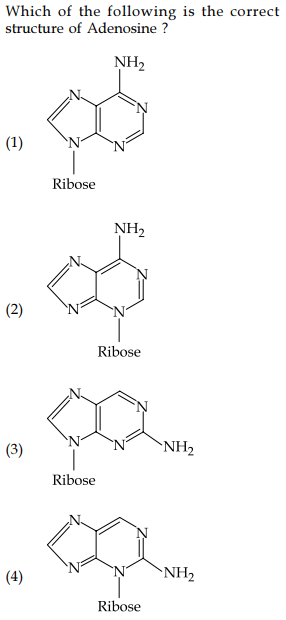
- A.Purine base with at C-6 (adenine), ribose attached at N-9 (the five-membered imidazole-ring nitrogen)
- B.Purine base with at C-6, ribose attached at N-3 (a six-membered-ring nitrogen)
- C.Purine base with at C-2, ribose attached at N-9 (imidazole-ring nitrogen)
- D.Purine base with at C-2, ribose attached at N-3 (a six-membered-ring nitrogen)
Correct answer: A
Question 53
Chemistry · 4 marks · −1The main reduction product of the following compound with in methanol is : [structure: a cyclohexene ring carrying a ketone at C-1 and, on the adjacent carbon C-2, a side chain; the ring C=C is between C-3 and C-4]
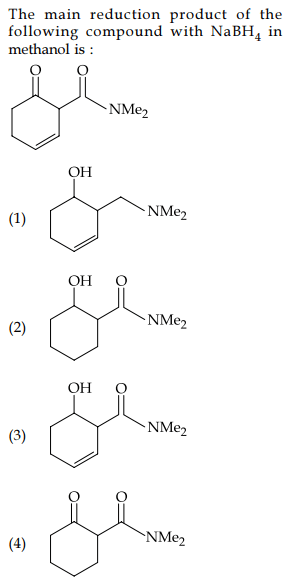
- A.Ring ketone reduced to and the amide carbonyl also reduced (side chain drawn as an amine, type, with no C=O); ring C=C retained
- B.Ring ketone reduced to , amide retained, ring C=C also reduced (saturated cyclohexanol)
- C.Ring ketone reduced to , amide retained, ring C=C retained
- D.Ketone and amide retained, ring C=C reduced (saturated cyclohexanone)
Correct answer: C
Question 54
Chemistry · 4 marks · −1The increasing order of nitration of the following compounds is : (a) aniline (b) chlorobenzene (c) anisole (d) toluene
- A.(b) < (a) < (c) < (d)
- B.(a) < (b) < (c) < (d)
- C.(b) < (a) < (d) < (c)
- D.(a) < (b) < (d) < (c)
Correct answer: D
Question 55
Chemistry · 4 marks · −1The correct match between items of List-I and List-II is : List-I: (A) Coloured impurity (B) Mixture of o-nitrophenol and p-nitrophenol (C) Crude Naphtha (D) Mixture of glycerol and sugars. List-II: (P) Steam distillation (Q) Fractional distillation (R) Charcoal treatment (S) Distillation under reduced pressure
- A.(A)-(R), (B)-(S), (C)-(P), (D)-(Q)
- B.(A)-(R), (B)-(P), (C)-(S), (D)-(Q)
- C.(A)-(R), (B)-(P), (C)-(Q), (D)-(S)
- D.(A)-(P), (B)-(S), (C)-(R), (D)-(Q)
Correct answer: C
Question 56
Chemistry · 4 marks · −1The copolymer formed by addition polymerization of styrene and acrylonitrile in the presence of peroxide is :
- A.
- B.
- C. (phenyl and CN groups on the terminal CH carbons of the repeat unit)
- D.
Correct answer: D
Question 57
Chemistry · 4 marks · −1Which of the following will most readily give the dehydrohalogenation product ?
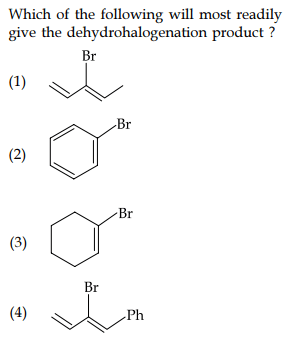
- A. (3-bromopenta-1,3-diene)
- B.Bromobenzene,
- C.1-Bromocyclohexene
- D.
Correct answer: D
Question 58
Chemistry · 4 marks · −1Which of the following will not exist in zwitter ionic form at pH = 7 ?
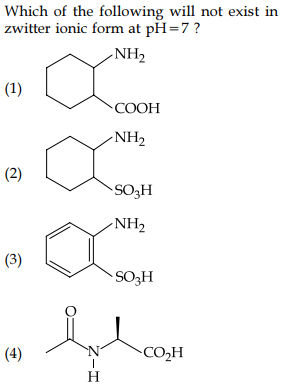
- A.2-Aminocyclohexane-1-carboxylic acid ( and on adjacent ring carbons)
- B.2-Aminocyclohexane-1-sulphonic acid ( and on adjacent ring carbons)
- C.2-Aminobenzenesulphonic acid (orthanilic acid)
- D.N-Acetylalanine,
Correct answer: D
Question 59
Chemistry · 4 marks · −1The major product of the following reaction is : 3-methoxyphenol
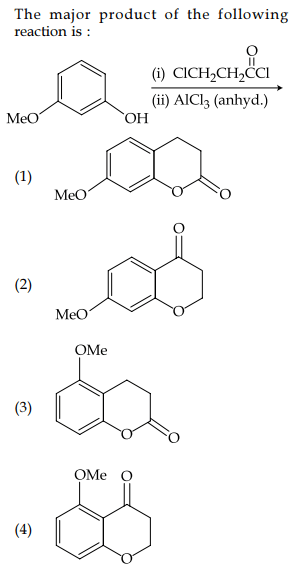
- A.7-Methoxychroman-2-one (7-methoxy-3,4-dihydrocoumarin)
- B.7-Methoxychroman-4-one
- C.5-Methoxychroman-2-one
- D.5-Methoxychroman-4-one
Correct answer: A
Question 60
Chemistry · 4 marks · −1The reagent(s) required for the following conversion are : [3-(ethoxycarbonyl)-5-cyanocyclohexane-1-carboxylic acid, i.e. a cyclohexane bearing , and at alternate carbons] [cyclohexane bearing (from ), (from ) and (from )]
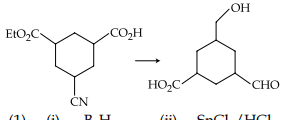
- A.(i) (ii) (iii)
- B.(i) (ii)
- C.(i) (ii) DIBAL-H (iii)
- D.(i) (ii) Raney Ni/ (iii)
Correct answer: A
Question 61
Mathematics · 4 marks · −1Consider the following two binary relations on the set : and . Then :
- A.both and are not symmetric.
- B. is not symmetric but it is transitive.
- C. is symmetric but it is not transitive.
- D.both and are transitive.
Correct answer: C
Question 62
Mathematics · 4 marks · −1If is such that the sum of the cubes of the roots of the equation, is minimum, then the magnitude of the difference of the roots of this equation is :
- A.
- B.
- C.
- D.20
Correct answer: B
Question 63
Mathematics · 4 marks · −1The set of all , for which is a purely imaginary number, for all satisfying and , is :
- A.an empty set
- B.
- C.
- D.equal to
Correct answer: B
Question 64
Mathematics · 4 marks · −1Let A be a matrix such that is a scalar matrix and . Then equals :
- A.
- B.
- C.
- D.
Correct answer: D
Question 65
Mathematics · 4 marks · −1Let S be the set of all real values of k for which the system of linear equations , , has a unique solution. Then S is :
- A.an empty set
- B.equal to
- C.equal to
- D.equal to
Correct answer: D
Question 66
Mathematics · 4 marks · −1n-digit numbers are formed using only three digits 2, 5 and 7. The smallest value of n for which 900 such distinct numbers can be formed, is :
- A.6
- B.7
- C.8
- D.9
Correct answer: B
Question 67
Mathematics · 4 marks · −1If n is the degree of the polynomial, and m is the coefficient of in it, then the ordered pair (n, m) is equal to :
- A.
- B.
- C.
- D.
Correct answer: C
Question 68
Mathematics · 4 marks · −1If and are two A.P.s such that and , then equals :
- A.2560
- B.2650
- C.3200
- D.1600
Correct answer: A
Question 69
Mathematics · 4 marks · −1If b is the first term of an infinite G.P. whose sum is five, then b lies in the interval :
- A.
- B.
- C.
- D.
Correct answer: C
Question 70
Mathematics · 4 marks · −1If , then
- A.does not exist.
- B.exists and is equal to 2.
- C.exists and is equal to 0.
- D.exists and is equal to .
Correct answer: D
Question 71
Mathematics · 4 marks · −1If , then the value of at the point is :
- A.
- B.
- C.4
- D.
Correct answer: A
Question 72
Mathematics · 4 marks · −1Let , is a differentiable function. Then S is a subset of :
- A.
- B.
- C.
- D.
Correct answer: A
Question 73
Mathematics · 4 marks · −1If a right circular cone, having maximum volume, is inscribed in a sphere of radius 3 cm, then the curved surface area (in cm) of this cone is :
- A.
- B.
- C.
- D.
Correct answer: D
Question 74
Mathematics · 4 marks · −1If , , then is equal to : (where C is a constant of integration)
- A.
- B.
- C.
- D.
Correct answer: B
Question 75
Mathematics · 4 marks · −1The area (in sq. units) of the region , is :
- A.
- B.
- C.
- D.
Correct answer: C
Question 76
Mathematics · 4 marks · −1The value of the integral is :
- A.0
- B.
- C.
- D.
Correct answer: C
Question 77
Mathematics · 4 marks · −1Let be the solution of the differential equation , where . If , then is :
- A.
- B.
- C.
- D.
Correct answer: D
Question 78
Mathematics · 4 marks · −1In a triangle ABC, coordinates of A are (1, 2) and the equations of the medians through B and C are respectively, and . Then area of (in sq. units) is :
- A.12
- B.4
- C.5
- D.9
Correct answer: D
Question 79
Mathematics · 4 marks · −1A circle passes through the points (2, 3) and (4, 5). If its centre lies on the line, , then its radius is equal to :
- A.2
- B.
- C.
- D.1
Correct answer: A
Question 80
Mathematics · 4 marks · −1Two parabolas with a common vertex and with axes along x-axis and y-axis, respectively, intersect each other in the first quadrant. If the length of the latus rectum of each parabola is 3, then the equation of the common tangent to the two parabolas is :
- A.
- B.
- C.
- D.
Correct answer: A
Question 81
Mathematics · 4 marks · −1If the tangents drawn to the hyperbola intersect the co-ordinate axes at the distinct points A and B, then the locus of the mid point of AB is :
- A.
- B.
- C.
- D.
Correct answer: B
Question 82
Mathematics · 4 marks · −1If is one of the angles between the normals to the ellipse, at the points and ; ; then is equal to :
- A.
- B.
- C.
- D.
Correct answer: A
Question 83
Mathematics · 4 marks · −1A variable plane passes through a fixed point (3, 2, 1) and meets x, y and z axes at A, B and C respectively. A plane is drawn parallel to yz-plane through A, a second plane is drawn parallel zx-plane through B and a third plane is drawn parallel to xy-plane through C. Then the locus of the point of intersection of these three planes, is :
- A.
- B.
- C.
- D.
Correct answer: D
Question 84
Mathematics · 4 marks · −1An angle between the plane, and the line of intersection of the planes, and , is :
- A.
- B.
- C.
- D.
Correct answer: A
Question 85
Mathematics · 4 marks · −1If , , and are unit vectors such that , then is equal to :
- A.
- B.
- C.
- D.
Correct answer: A
Question 86
Mathematics · 4 marks · −1The mean of a set of 30 observations is 75. If each observation is multiplied by a non-zero number and then each of them is decreased by 25, their mean remains the same. Then is equal to :
- A.
- B.
- C.
- D.
Correct answer: C
Question 87
Mathematics · 4 marks · −1A box 'A' contains 2 white, 3 red and 2 black balls. Another box 'B' contains 4 white, 2 red and 3 black balls. If two balls are drawn at random, without replacement, from a randomly selected box and one ball turns out to be white while the other ball turns out to be red, then the probability that both balls are drawn from box 'B' is :
- A.
- B.
- C.
- D.
Correct answer: B
Question 88
Mathematics · 4 marks · −1If and are the roots of the quadratic equation, , then the value of is :
- A.
- B.10
- C.
- D.25
Correct answer: C
Question 89
Mathematics · 4 marks · −1An aeroplane flying at a constant speed, parallel to the horizontal ground, km above it, is observed at an elevation of from a point on the ground. If, after five seconds, its elevation from the same point, is , then the speed (in km/hr) of the aeroplane, is :
- A.1500
- B.1440
- C.750
- D.720
Correct answer: B
Question 90
Mathematics · 4 marks · −1If is false, then the truth values of p, q and r are, respectively :
- A.F, T, F
- B.T, F, T
- C.T, T, T
- D.F, F, F
Correct answer: B