JEE Main 2019 — 10 Apr Shift 1 (Previous Year Paper)
JEE Main · 2019 · with answers and explanations
- questions
- 88
- Total marks
- 352
- Duration
- 180 minutes
- Negative marking
- −1
Subjects: Physics · Chemistry · Mathematics
Question 1
Physics · 4 marks · −1Given below in the left column are different modes of communication using the kinds of waves given in the right column. A. Optical Fibre Communication — P. Ultrasound B. Radar — Q. Infrared Light C. Sonar — R. Microwaves D. Mobile Phones — S. Radio Waves From the options given below, find the most appropriate match between entries in the left and the right column.
- A.A-Q, B-S, C-R, D-P
- B.A-Q, B-S, C-P, D-R
- C.A-S, B-Q, C-R, D-P
- D.A-R, B-P, C-S, D-Q
Correct answer: B
Question 2
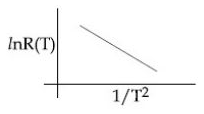
Physics · 4 marks · −1In an experiment, the resistance of a material is plotted as a function of temperature (in some range). As shown in the figure, it is a straight line. One may conclude that:
- A.
- B.
- C.
- D.
Correct answer: C
Question 3
Physics · 4 marks · −1A particle of mass is moving along a trajectory given by The torque, acting on the particle about the origin, at is:
- A.
- B.
- C.
- D.Zero
Correct answer: A
Question 4
Physics · 4 marks · −1A ball is thrown upward with an initial velocity from the surface of the earth. The motion of the ball is affected by a drag force equal to (where is mass of the ball, is its instantaneous velocity and is a constant). Time taken by the ball to rise to its zenith is:
- A.
- B.
- C.
- D.
Correct answer: C
Question 5
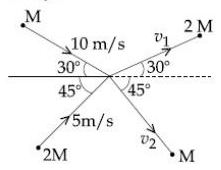
Physics · 4 marks · −1Two particles, of masses and , moving, as shown, with speeds of 10 m/s and 5 m/s, collide elastically at the origin. After the collision, they move along the indicated directions with speeds and , respectively. The values of and are nearly:
- A.6.5 m/s and 3.2 m/s
- B.3.2 m/s and 12.6 m/s
- C.6.5 m/s and 6.3 m/s
- D.3.2 m/s and 6.3 m/s
Correct answer: C
Question 6
Physics · 4 marks · −1Two coaxial discs, having moments of inertia and , are rotating with respective angular velocities and , about their common axis. They are brought in contact with each other and thereafter they rotate with a common angular velocity. If and are the final and initial total energies, then is:
- A.
- B.
- C.
- D.
Correct answer: B
Question 7
Physics · 4 marks · −1A thin disc of mass and radius has mass per unit area where is the distance from its centre. Its moment of inertia about an axis going through its centre of mass and perpendicular to its plane is:
- A.
- B.
- C.
- D.
Correct answer: B
Question 8
Physics · 4 marks · −1The value of acceleration due to gravity at Earth's surface is . The altitude above its surface at which the acceleration due to gravity decreases to , is close to: (Radius of earth m)
- A. m
- B. m
- C. m
- D. m
Correct answer: A
Question 9
Physics · 4 marks · −1The ratio of surface tensions of mercury and water is given to be 7.5 while the ratio of their densities is 13.6. Their contact angles, with glass, are close to 135° and 0°, respectively. It is observed that mercury gets depressed by an amount in a capillary tube of radius , while water rises by the same amount in a capillary tube of radius . The ratio, , is then close to:
- A.2/5
- B.4/5
- C.2/3
- D.3/5
Correct answer: A
Question 10
Physics · 4 marks · −1moles of an ideal gas with constant volume heat capacity undergo an isobaric expansion by certain volume. The ratio of the work done in the process, to the heat supplied is:
- A.
- B.
- C.
- D.
Correct answer: D
Question 11
Physics · 4 marks · −1The displacement of a damped harmonic oscillator is given by . Here is in seconds. The time taken for its amplitude of vibration to drop to half of its initial value is close to:
- A.4 s
- B.27 s
- C.7 s
- D.13 s
Correct answer: C
Question 12
Physics · 4 marks · −1A stationary source emits sound waves of frequency 500 Hz. Two observers moving along a line passing through the source detect sound to be of frequencies 480 Hz and 530 Hz. Their respective speeds are, in , (Given speed of sound m/s)
- A.12, 18
- B.16, 14
- C.8, 18
- D.12, 16
Correct answer: A
Question 13
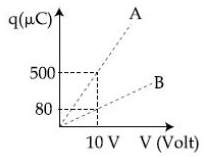
Physics · 4 marks · −1Figure shows charge () versus voltage () graph for series and parallel combination of two given capacitors. The capacitances are:
- A.50 F and 30 F
- B.20 F and 30 F
- C.40 F and 10 F
- D.60 F and 40 F
Correct answer: C
Question 14
Physics · 4 marks · −1A cylinder with fixed capacity of 67.2 lit contains helium gas at STP. The amount of heat needed to raise the temperature of the gas by 20°C is: [Given that ]
- A.700 J
- B.748 J
- C.374 J
- D.350 J
Correct answer: B
Question 15
Physics · 4 marks · −1A uniformly charged ring of radius and total charge is placed in -plane centred at origin. A point charge is moving towards the ring along the -axis and has speed at . The minimum value of such that it crosses the origin is:
- A.
- B.
- C.
- D.
Correct answer: B
Question 16
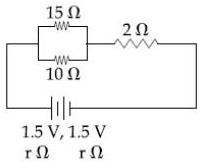
Physics · 4 marks · −1In the given circuit, an ideal voltmeter connected across the 10 resistance reads 2 V. The internal resistance , of each cell is:
- A.1
- B.1.5
- C.0.5
- D.0
Correct answer: C
Question 17
Physics · 4 marks · −1A current of 5 A passes through a copper conductor (resistivity m) of radius of cross-section 5 mm. Find the mobility of the charges if their drift velocity is m/s.
- A.1.5 m/Vs
- B.1.8 m/Vs
- C.1.0 m/Vs
- D.1.3 m/Vs
Correct answer: C
Question 18
Physics · 4 marks · −1A proton, an electron, and a Helium nucleus, have the same energy. They are in circular orbits in a plane due to magnetic field perpendicular to the plane. Let , and be their respective radii, then,
- A.
- B.
- C.
- D.
Correct answer: D
Question 19
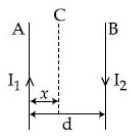
Physics · 4 marks · −1Two wires A & B are carrying currents & as shown in the figure. The separation between them is . A third wire C carrying a current is to be kept parallel to them at a distance from A such that the net force acting on it is zero. The possible values of are:
- A.
- B. and
- C. and
- D. and
Correct answer: A
Question 20
Physics · 4 marks · −1A transformer consisting of 300 turns in the primary and 150 turns in the secondary gives output power of 2.2 kW. If the current in the secondary coil is 10 A, then the input voltage and current in the primary coil are:
- A.440 V and 20 A
- B.220 V and 10 A
- C.440 V and 5 A
- D.220 V and 20 A
Correct answer: C
Question 21
Physics · 4 marks · −1The electric field of a plane electromagnetic wave is given by The corresponding magnetic field is then given by:
- A.
- B.
- C.
- D.
Correct answer: A
Question 22
Physics · 4 marks · −1One plano-convex and one plano-concave lens of same radius of curvature '' but of different materials are joined side by side as shown in the figure. If the refractive index of the material of 1 is and that of 2 is , then the focal length of the combination is:

- A.
- B.
- C.
- D.
Correct answer: A
Question 23
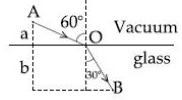
Physics · 4 marks · −1A ray of light AO in vacuum is incident on a glass slab at angle 60° and refracted at angle 30° along OB as shown in the figure. The optical path length of light ray from A to B is:
- A.
- B.
- C.
- D.
Correct answer: C
Question 24
Physics · 4 marks · −1In a photoelectric effect experiment the threshold wavelength of light is 380 nm. If the wavelength of incident light is 260 nm, the maximum kinetic energy of emitted electrons will be: Given
- A.3.0 eV
- B.4.5 eV
- C.15.1 eV
- D.1.5 eV
Correct answer: D
Question 25
Physics · 4 marks · −1Two radioactive materials A and B have decay constants and , respectively. If initially they have the same number of nuclei, then the ratio of the number of nuclei of A to that of B will be after a time:
- A.
- B.
- C.
- D.
Correct answer: D
Question 26
Physics · 4 marks · −1An npn transistor operates as a common emitter amplifier, with a power gain of 60 dB. The input circuit resistance is 100 and the output load resistance is 10 k. The common emitter current gain is:
- A.
- B.60
- C.
- D.
Correct answer: C
Question 27
Physics · 4 marks · −1A message signal of frequency 100 MHz and peak voltage 100 V is used to execute amplitude modulation on a carrier wave of frequency 300 GHz and peak voltage 400 V. The modulation index and difference between the two side band frequencies are:
- A.0.25 ; Hz
- B.4 ; Hz
- C.0.25 ; Hz
- D.4 ; Hz
Correct answer: C
Question 28
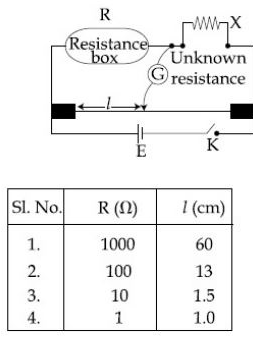
Physics · 4 marks · −1In a meter bridge experiment, the circuit diagram and the corresponding observation table are shown in figure. Sl. No. 1: R = 1000 , = 60 cm Sl. No. 2: R = 100 , = 13 cm Sl. No. 3: R = 10 , = 1.5 cm Sl. No. 4: R = 1 , = 1.0 cm Which of the readings is inconsistent?
- A.1
- B.2
- C.3
- D.4
Correct answer: D
Explanation: With R in the left gap, gives about 667, 669, 657 and 99 for readings 1–4; reading 4 is inconsistent.
Question 29
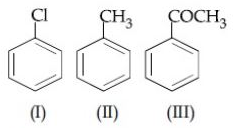
Chemistry · 4 marks · −1The increasing order of the reactivity of the following compounds towards electrophilic aromatic substitution reactions is: (I) chlorobenzene, (II) toluene, (III) acetophenone
- A.II < I < III
- B.I < III < II
- C.III < I < II
- D.III < II < I
Correct answer: C
Question 30
Chemistry · 4 marks · −1Major products of the following reaction are: Benzaldehyde () + HCHO
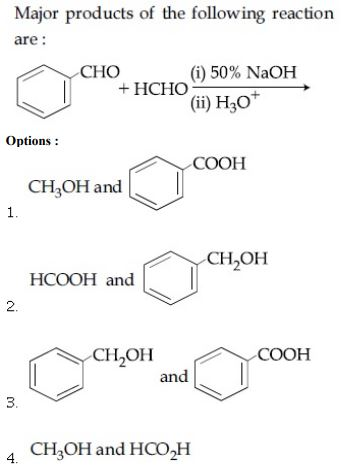
- A. and benzoic acid ()
- B.HCOOH and benzyl alcohol ()
- C.Benzyl alcohol () and benzoic acid ()
- D. and
Correct answer: B
Question 31
Chemistry · 4 marks · −1Amylopectin is composed of:
- A.-D-glucose, and linkages
- B.-D-glucose, and linkages
- C.-D-glucose, and linkages
- D.-D-glucose, and linkages
Correct answer: C
Question 32
Chemistry · 4 marks · −1The principle of column chromatography is:
- A.Differential adsorption of the substances on the solid phase.
- B.Differential absorption of the substances on the solid phase.
- C.Capillary action.
- D.Gravitational force.
Correct answer: A
Question 33
Chemistry · 4 marks · −1Increasing rate of reaction in the following compounds is: (A) 1-iodo-1-phenylethane; (B) 1-iodo-1-(3-methoxyphenyl)ethane; (C) 1-iodo-1-(4-methylphenyl)ethane; (D) 1-iodo-1-(4-methoxyphenyl)ethane
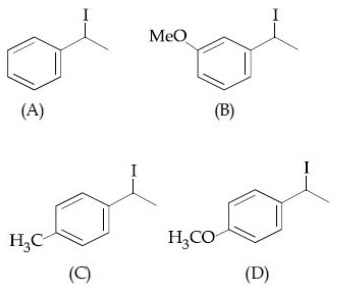
- A.(B) < (A) < (D) < (C)
- B.(B) < (A) < (C) < (D)
- C.(A) < (B) < (C) < (D)
- D.(A) < (B) < (D) < (C)
Correct answer: B
Question 34
Chemistry · 4 marks · −1Ethylamine () can be obtained from N-ethylphthalimide on treatment with:
- A.
- B.
- C.
- D.
Correct answer: D
Question 35
Chemistry · 4 marks · −1The major product of the following reaction is: 3-Methoxyphenyl–CH(CN)–O–CH(CH) (the benzylic carbon carries a CN group and an isopropoxy group; the ring carries OCH meta to it)
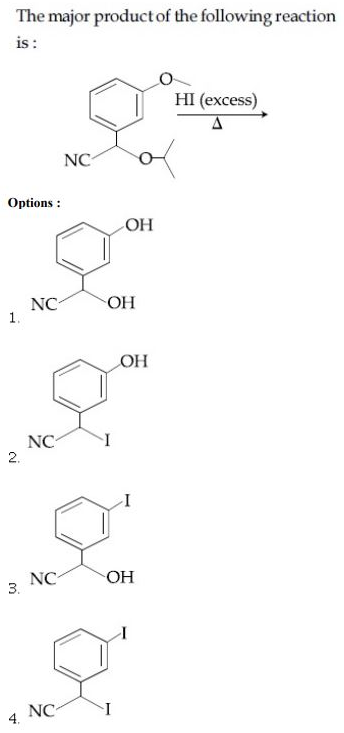
- A.3-Hydroxyphenyl–CH(OH)–CN (ring OH, benzylic OH)
- B.3-Hydroxyphenyl–CH(I)–CN (ring OH, benzylic I)
- C.3-Iodophenyl–CH(OH)–CN (ring I, benzylic OH)
- D.3-Iodophenyl–CH(I)–CN (ring I, benzylic I)
Correct answer: B
Question 36
Chemistry · 4 marks · −1The major product of the following reaction is:
- A.
- B.
- C.
- D.
Correct answer: C
Question 37
Chemistry · 4 marks · −1Which of the following is a condensation polymer?
- A.Buna - S
- B.Nylon 6, 6
- C.Teflon
- D.Neoprene
Correct answer: B
Question 38
Chemistry · 4 marks · −1The major product of the following reaction is:
- A. (O-formyl ester)
- B.
- C.
- D.
Correct answer: B
Question 39
Chemistry · 4 marks · −1The isoelectronic set of ions is:
- A., , and
- B., , and
- C., , and
- D., , and
Correct answer: A
Question 40
Chemistry · 4 marks · −1Match the refining methods (Column I) with metals (Column II). Column I (Refining methods): (I) Liquation (II) Zone Refining (III) Mond Process (IV) Van Arkel Method Column II (Metals): (a) Zr (b) Ni (c) Sn (d) Ga
- A.(I)-(c); (II)-(a); (III)-(b); (IV)-(d)
- B.(I)-(c); (II)-(d); (III)-(b); (IV)-(a)
- C.(I)-(b); (II)-(c); (III)-(d); (IV)-(a)
- D.(I)-(b); (II)-(d); (III)-(a); (IV)-(c)
Correct answer: B
Question 41
Chemistry · 4 marks · −1The synonym for water gas when used in the production of methanol is:
- A.fuel gas
- B.natural gas
- C.laughing gas
- D.syn gas
Correct answer: D
Question 42
Chemistry · 4 marks · −1The alloy used in the construction of aircrafts is:
- A.Mg - Al
- B.Mg - Sn
- C.Mg - Zn
- D.Mg - Mn
Correct answer: A
Question 43
Chemistry · 4 marks · −1The oxoacid of sulphur that does not contain bond between sulphur atoms is:
- A.
- B.
- C.
- D.
Correct answer: D
Question 44
Chemistry · 4 marks · −1The correct order of catenation is:
- A.Si > Sn > C > Ge
- B.Ge > Sn > Si > C
- C.C > Si > Ge Sn
- D.C > Sn > Si Ge
Correct answer: C
Question 45
Chemistry · 4 marks · −1Consider the hydrated ions of , , , and . The correct order of their spin-only magnetic moments is:
- A.
- B.
- C.
- D.
Correct answer: A
Question 46
Chemistry · 4 marks · −1Three complexes, (I), (II) and (III) absorb light in the visible region. The correct order of the wavelength of light absorbed by them is:
- A.(II) > (I) > (III)
- B.(I) > (II) > (III)
- C.(III) > (I) > (II)
- D.(III) > (II) > (I)
Correct answer: B
Question 47
Chemistry · 4 marks · −1The species that can have a trans-isomer is: (en = ethane-1, 2-diamine, ox = oxalate)
- A.
- B.
- C.
- D.
Correct answer: D
Question 48
Chemistry · 4 marks · −1The regions of the atmosphere, where clouds form and where we live, respectively, are:
- A.Troposphere and Troposphere
- B.Troposphere and Stratosphere
- C.Stratosphere and Troposphere
- D.Stratosphere and Stratosphere
Correct answer: A
Question 49
Chemistry · 4 marks · −1At 300 K and 1 atmospheric pressure, 10 mL of a hydrocarbon required 55 mL of for complete combustion, and 40 mL of is formed. The formula of the hydrocarbon is:
- A.
- B.
- C.
- D.
Correct answer: A
Question 50
Chemistry · 4 marks · −1Consider the following table: Gas A: kPa dm mol, dm mol Gas B: , Gas C: , Gas D: , and are van der Waals constants. The correct statement about the gases is:
- A.Gas C will occupy lesser volume than gas A; gas B will be more compressible than gas D
- B.Gas C will occupy more volume than gas A; gas B will be lesser compressible than gas D
- C.Gas C will occupy more volume than gas A; gas B will be more compressible than gas D
- D.Gas C will occupy lesser volume than gas A; gas B will be lesser compressible than gas D
Correct answer: C
Question 51
Chemistry · 4 marks · −1The graph between and (radial distance) is shown below. This represents:
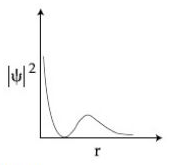
- A.1s orbital
- B.2s orbital
- C.3s orbital
- D.2p orbital
Correct answer: B
Question 52
Chemistry · 4 marks · −1During the change of to , the incoming electron goes to the orbital:
- A.
- B.
- C.
- D.
Correct answer: B
Question 53
Chemistry · 4 marks · −1A process will be spontaneous at all temperatures if:
- A. and
- B. and
- C. and
- D. and
Correct answer: C
Question 54
Chemistry · 4 marks · −1At room temperature, a dilute solution of urea is prepared by dissolving 0.60 g of urea in 360 g of water. If the vapour pressure of pure water at this temperature is 35 mmHg, lowering of vapour pressure will be: (molar mass of urea )
- A.0.027 mmHg
- B.0.031 mmHg
- C.0.017 mmHg
- D.0.028 mmHg
Correct answer: C
Question 55
Chemistry · 4 marks · −1Consider the following statements (a) The pH of a mixture containing 400 mL of 0.1 M and 400 mL of 0.1 M NaOH will be approximately 1.3. (b) Ionic product of water is temperature dependent. (c) A monobasic acid with has a pH = 5. The degree of dissociation of this acid is 50%. (d) The Le Chatelier's principle is not applicable to common-ion effect. The correct statements are:
- A.(a), (b) and (c)
- B.(a), (b) and (d)
- C.(a) and (b)
- D.(b) and (c)
Correct answer: A
Question 56
Chemistry · 4 marks · −1Consider the statements S1 and S2: S1: Conductivity always increases with decrease in the concentration of electrolyte. S2: Molar conductivity always increases with decrease in the concentration of electrolyte. The correct option among the following is:
- A.Both S1 and S2 are correct
- B.Both S1 and S2 are wrong
- C.S1 is wrong and S2 is correct
- D.S1 is correct and S2 is wrong
Correct answer: C
Question 57
Chemistry · 4 marks · −1A bacterial infection in an internal wound grows as , where the time is in hours. A dose of antibiotic, taken orally, needs 1 hour to reach the wound. Once it reaches there, the bacterial population goes down as . What will be the plot of vs. after 1 hour?
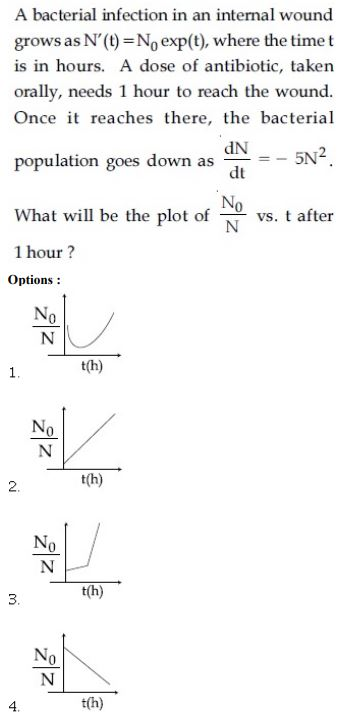
- A.Graph 1: first decreases then rises (a U-shaped curve) with
- B.Graph 2: increases linearly with (straight line with positive slope)
- C.Graph 3: rises slowly and then abruptly steeply (two line segments)
- D.Graph 4: decreases linearly with (straight line with negative slope)
Correct answer: B
Question 58
Chemistry · 4 marks · −1A gas undergoes physical adsorption on a surface and follows the given Freundlich adsorption isotherm equation Adsorption of the gas increases with:
- A.Increase in p and increase in T
- B.Increase in p and decrease in T
- C.Decrease in p and increase in T
- D.Decrease in p and decrease in T
Correct answer: B
Question 59
Mathematics · 4 marks · −1Let , . For any , define . If , then which one of the following statements is not true?
- A.
- B.
- C.
- D.
Correct answer: D
Question 60
Mathematics · 4 marks · −1If and , has magnitude , then is equal to:
- A.
- B.
- C.
- D.
Correct answer: A
Question 61
Mathematics · 4 marks · −1If and are the roots of the quadratic equation, , , then is equal to:
- A.
- B.
- C.
- D.
Correct answer: C
Question 62
Mathematics · 4 marks · −1If and , ; then for all :
- A.
- B.
- C.
- D.
Correct answer: B
Question 63
Mathematics · 4 marks · −1If the system of linear equations , , has infinitely many solutions, then the value of is:
- A.12
- B.10
- C.9
- D.7
Correct answer: B
Question 64
Mathematics · 4 marks · −1The number of 6 digit numbers that can be formed using the digits 0, 1, 2, 5, 7 and 9 which are divisible by 11 and no digit is repeated, is:
- A.48
- B.60
- C.72
- D.36
Correct answer: B
Question 65
Mathematics · 4 marks · −1If are in A.P. and , then is equal to:
- A.38
- B.64
- C.76
- D.98
Correct answer: C
Question 66
Mathematics · 4 marks · −1upto term, is:
- A.600
- B.620
- C.660
- D.680
Correct answer: C
Question 67
Mathematics · 4 marks · −1If the coefficients of and are both zero, in the expansion of the expression in powers of , then the ordered pair is equal to:
- A.(−21, 714)
- B.(−54, 315)
- C.(28, 861)
- D.(28, 315)
Correct answer: D
Question 68
Mathematics · 4 marks · −1If , then is:
- A.
- B.
- C.
- D.
Correct answer: B
Question 69
Mathematics · 4 marks · −1If is continuous at , then the ordered pair is equal to:
- A.
- B.
- C.
- D.
Correct answer: A
Question 70
Mathematics · 4 marks · −1Let be differentiable at and . If , then at , is:
- A.differentiable if
- B.differentiable if
- C.not differentiable if
- D.not differentiable
Correct answer: B
Question 71
Mathematics · 4 marks · −1Let and , . Then the set of all , where the function is increasing, is:
- A.
- B.
- C.
- D.
Correct answer: B
Question 72
Mathematics · 4 marks · −1If where is a constant of integration, then:
- A. and
- B. and
- C. and
- D. and
Correct answer: C
Question 73
Mathematics · 4 marks · −1The value of , where denotes the greatest integer function, is:
- A.
- B.
- C.
- D.
Correct answer: D
Question 74
Mathematics · 4 marks · −1is equal to:
- A.
- B.
- C.
- D.
Correct answer: A
Question 75
Mathematics · 4 marks · −1If is the solution of the differential equation , , such that , then is equal to:
- A.
- B.
- C.
- D.
Correct answer: B
Question 76
Mathematics · 4 marks · −1The region represented by and is bounded by a:
- A.rhombus of side length 2 units
- B.rhombus of area sq. units
- C.square of side length units
- D.square of area 16 sq. units
Correct answer: C
Question 77
Mathematics · 4 marks · −1If the circles and , , intersect at the points P and Q, then the line passes through P and Q, for:
- A.exactly one value of K
- B.exactly two values of K
- C.infinitely many values of K
- D.no value of K.
Correct answer: D
Question 78
Mathematics · 4 marks · −1The line touches a circle at the point (1, 1). If the circle also passes through the point (1, −3), then its radius is:
- A.2
- B.3
- C.
- D.
Correct answer: C
Question 79
Mathematics · 4 marks · −1If the line is tangent to the ellipse at the point , then the length of the latus rectum of the ellipse is:
- A.9
- B.
- C.5
- D.
Correct answer: A
Question 80
Mathematics · 4 marks · −1If a directrix of a hyperbola centred at the origin and passing through the point is and its eccentricity is , then:
- A.
- B.
- C.
- D.
Correct answer: D
Question 81
Mathematics · 4 marks · −1Let A(3, 0, −1), B(2, 10, 6) and C(1, 2, 1) be the vertices of a triangle and M be the midpoint of AC. If G divides BM in the ratio, 2 : 1, then (O being the origin) is equal to:
- A.
- B.
- C.
- D.
Correct answer: A
Question 82
Mathematics · 4 marks · −1If Q(0, −1, −3) is the image of the point P in the plane and R is the point (3, −1, −2), then the area (in sq. units) of is:
- A.
- B.
- C.
- D.
Correct answer: D
Question 83
Mathematics · 4 marks · −1If the length of the perpendicular from the point to the line, is , then is equal to:
- A.−2
- B.−1
- C.1
- D.2
Correct answer: B
Question 84
Mathematics · 4 marks · −1Assume that each born child is equally likely to be a boy or a girl. If two families have two children each, then the conditional probability that all children are girls given that at least two are girls is:
- A.
- B.
- C.
- D.
Correct answer: B
Question 85
Mathematics · 4 marks · −1If for some , the frequency distribution of the marks obtained by 20 students in a test is: Marks: 2, 3, 5, 7 Frequency: , , , then the mean of the marks is:
- A.2.5
- B.3.2
- C.3.0
- D.2.8
Correct answer: D
Question 86
Mathematics · 4 marks · −1All the pairs that satisfy the inequality also satisfy the equation:
- A.
- B.
- C.
- D.
Correct answer: C
Question 87
Mathematics · 4 marks · −1ABC is a triangular park with AB = AC = 100 metres. A vertical tower is situated at the mid-point of BC. If the angles of elevation of the top of the tower at A and B are and respectively, then the height of the tower (in metres) is:
- A.
- B.25
- C.20
- D.
Correct answer: C
Question 88
Mathematics · 4 marks · −1Which one of the following Boolean expressions is a tautology?
- A.
- B.
- C.
- D.
Correct answer: D