JEE Main 2019 — 10 Apr Shift 2 (Previous Year Paper)
JEE Main · 2019 · with answers and explanations
- questions
- 85
- Total marks
- 340
- Duration
- 180 minutes
- Negative marking
- −1
Subjects: Physics · Chemistry · Mathematics
Question 1
Physics · 4 marks · −1In the formula , and have dimensions of capacitance and magnetic field, respectively. What are the dimensions of in SI units?
- A.
- B.
- C.
- D.
Correct answer: B
Question 2
Physics · 4 marks · −1A plane is inclined at an angle with respect to the horizontal. A particle is projected with a speed , from the base of the plane, making an angle with respect to the plane as shown in the figure. The distance from the base, at which the particle hits the plane is close to: (Take )
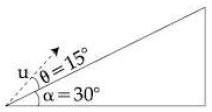
- A.14 cm
- B.18 cm
- C.20 cm
- D.26 cm
Correct answer: C
Question 3
Physics · 4 marks · −1The time dependence of the position of a particle of mass is given by . Its angular momentum, with respect to the origin, at time is:
- A.
- B.
- C.
- D.
Correct answer: B
Question 4
Physics · 4 marks · −1Two blocks A and B of masses kg and kg are kept on the table as shown in figure. The coefficient of friction between A and B is 0.2 and between B and the surface of the table is also 0.2. The maximum force F that can be applied on B horizontally, so that the block A does not slide over the block B is: [Take ]
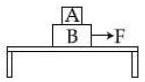
- A.8 N
- B.12 N
- C.16 N
- D.40 N
Correct answer: C
Question 5
Physics · 4 marks · −1A bullet of mass 20 g has an initial speed of , just before it starts penetrating a mud wall of thickness 20 cm. If the wall offers a mean resistance of N, the speed of the bullet after emerging from the other side of the wall is close to:
- A.0.7
- B.0.3
- C.0.4
- D.0.1
Correct answer: A
Question 6
Physics · 4 marks · −1A solid sphere of mass and radius is divided into two unequal parts. The first part has a mass of and is converted into a uniform disc of radius . The second part is converted into a uniform solid sphere. Let be the moment of inertia of the disc about its axis and be the moment of inertia of the new sphere about its axis. The ratio is given by:
- A.140
- B.65
- C.285
- D.185
Correct answer: A
Question 7
Physics · 4 marks · −1A metal coin of mass 5 g and radius 1 cm is fixed to a thin stick AB of negligible mass as shown in the figure. The system is initially at rest. The constant torque, that will make the system rotate about AB at 25 rotations per second in 5 s, is close to:
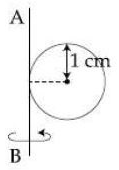
- A. Nm
- B. Nm
- C. Nm
- D. Nm
Correct answer: D
Question 8
Physics · 4 marks · −1A spaceship orbits around a planet at a height of 20 km from its surface. Assuming that only gravitational field of the planet acts on the spaceship, what will be the number of complete revolutions made by the spaceship in 24 hours around the planet? [Given: Mass of planet kg, Radius of planet m, Gravitational constant ]
- A.13
- B.17
- C.9
- D.11
Correct answer: D
Question 9
Physics · 4 marks · −1The elastic limit of brass is 379 MPa. What should be the minimum diameter of a brass rod if it is to support a 400 N load without exceeding its elastic limit?
- A.1.00 mm
- B.0.90 mm
- C.1.16 mm
- D.1.36 mm
Correct answer: C
Question 10
Physics · 4 marks · −1Water from a tap emerges vertically downwards with an initial speed of . The cross-sectional area of the tap is . Assume that the pressure is constant throughout the stream of water and that the flow is streamlined. The cross-sectional area of the stream, 0.15 m below the tap would be: (Take )
- A.
- B.
- C.
- D.
Correct answer: D
Question 11
Physics · 4 marks · −1One mole of an ideal gas passes through a process where pressure and volume obey the relation . Here and are constants. Calculate the change in the temperature of the gas if its volume changes from to .
- A.
- B.
- C.
- D.
Correct answer: D
Question 12
Physics · 4 marks · −1When heat is supplied to a diatomic gas of rigid molecules, at constant volume its temperature increases by . The heat required to produce the same change in temperature, at a constant pressure is:
- A.
- B.
- C.
- D.
Correct answer: B
Question 13
Physics · 4 marks · −1A submarine experiences a pressure of Pa at a depth of in a sea. When it goes further to a depth of , it experiences a pressure of Pa. Then is approximately: (density of water and acceleration due to gravity )
- A.300 m
- B.600 m
- C.500 m
- D.400 m
Correct answer: A
Question 14
Physics · 4 marks · −1A source of sound S is moving with a velocity of 50 m/s towards a stationary observer. The observer measures the frequency of the source as 1000 Hz. What will be the apparent frequency of the source when it is moving away from the observer after crossing him? (Take velocity of sound in air is 350 m/s)
- A.857 Hz
- B.1143 Hz
- C.750 Hz
- D.807 Hz
Correct answer: C
Question 15
Physics · 4 marks · −1A simple pendulum of length is placed between the plates of a parallel plate capacitor having electric field , as shown in figure. Its bob has mass and charge . The time period of the pendulum is given by:
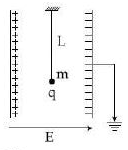
- A.
- B.
- C.
- D.
Correct answer: C
Question 16
Physics · 4 marks · −1The space between two concentric spheres of radii and is filled with a medium of resistivity . The resistance between the two spheres will be:
- A.
- B.
- C.
- D.
Correct answer: B
Question 17
Physics · 4 marks · −1The magnitude of the magnetic field at the center of an equilateral triangular loop of side 1 m which is carrying a current of 10 A is: [Take ]
- A.1 T
- B.3 T
- C.9 T
- D.18 T
Correct answer: D
Question 18
Physics · 4 marks · −1A square loop is carrying a steady current and the magnitude of its magnetic dipole moment is . If this square loop is changed to a circular loop and it carries the same current, the magnitude of the magnetic dipole moment of circular loop will be:
- A.
- B.
- C.
- D.
Correct answer: D
Question 19
Physics · 4 marks · −1A coil of self inductance 10 mH and resistance 0.1 is connected through a switch to a battery of internal resistance 0.9 . After the switch is closed, the time taken for the current to attain 80% of the saturation value is: [take ]
- A.0.016 s
- B.0.002 s
- C.0.103 s
- D.0.324 s
Correct answer: A
Question 20
Physics · 4 marks · −1Light is incident normally on a completely absorbing surface with an energy flux of . If the surface has an area of , the momentum transferred to the surface in 40 min time duration will be:
- A. Ns
- B. Ns
- C. Ns
- D. Ns
Correct answer: C
Question 21
Physics · 4 marks · −1The graph shows how the magnification produced by a thin lens varies with image distance . What is the focal length of the lens used?
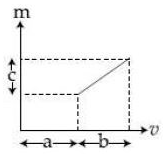
- A.
- B.
- C.
- D.
Correct answer: D
Question 22
Physics · 4 marks · −1In a Young's double slit experiment, the ratio of the slit's width is 4 : 1. The ratio of the intensity of maxima to minima, close to the central fringe on the screen, will be:
- A.4 : 1
- B.9 : 1
- C.
- D.25 : 9
Correct answer: B
Question 23
Physics · 4 marks · −1A 2 mW laser operates at a wavelength of 500 nm. The number of photons that will be emitted per second is: [Given Planck's constant Js, speed of light m/s]
- A.
- B.
- C.
- D.
Correct answer: A
Question 24
Physics · 4 marks · −1In , electron in first Bohr orbit is excited to a level by a radiation of wavelength . When the ion gets deexcited to the ground state in all possible ways (including intermediate emissions), a total of six spectral lines are observed. What is the value of ? (Given: Js; )
- A.9.4 nm
- B.10.8 nm
- C.11.4 nm
- D.12.3 nm
Correct answer: B
Question 25
Physics · 4 marks · −1Two radioactive substances A and B have decay constants and respectively. At , a sample has the same number of the two nuclei. The time taken for the ratio of the number of nuclei to become will be:
- A.
- B.
- C.
- D.
Correct answer: C
Question 26
Physics · 4 marks · −1The figure represents a voltage regulator circuit using a Zener diode. The breakdown voltage of the Zener diode is 6 V and the load resistance is, k. The series resistance of the circuit is k. If the battery voltage varies from 8 V to 16 V, what are the minimum and maximum values of the current through Zener diode?
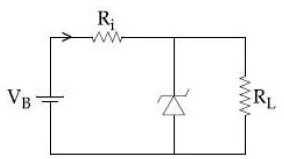
- A.0.5 mA; 6 mA
- B.1.5 mA; 8.5 mA
- C.0.5 mA; 8.5 mA
- D.1 mA; 8.5 mA
Correct answer: C
Question 27
Physics · 4 marks · −1The correct figure that shows, schematically, the wave pattern produced by superposition of two waves of frequencies 9 Hz and 11 Hz, is:
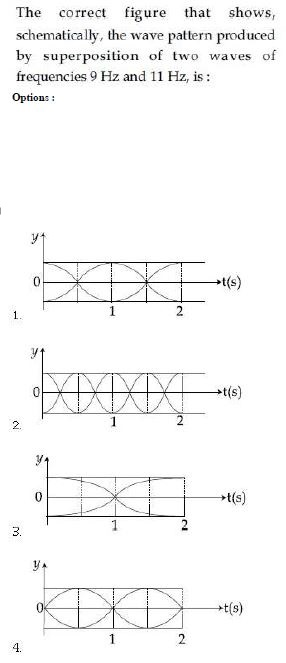
- A.Figure 1: displacement y vs t over 0–2 s showing an envelope with 2 beats per second (4 envelope lobes in 2 s)
- B.Figure 2: displacement y vs t over 0–2 s showing an envelope with 4 lobes per second (8 lobes in 2 s)
- C.Figure 3: displacement y vs t over 0–2 s showing an envelope with one crossing at t = 1 s (2 lobes in 2 s)
- D.Figure 4: displacement y vs t over 0–2 s showing an envelope with lobes of alternating size
Correct answer: B
Question 28
Physics · 4 marks · −1A cubical block of side 0.5 m floats on water with 30% of its volume under water. What is the maximum weight that can be put on the block without fully submerging it under water? [Take, density of water ]
- A.30.1 kg
- B.87.5 kg
- C.46.3 kg
- D.65.4 kg
Correct answer: B
Question 29
Chemistry · 4 marks · −1The major product 'Y' in the following reaction is: Acetophenone () X Y
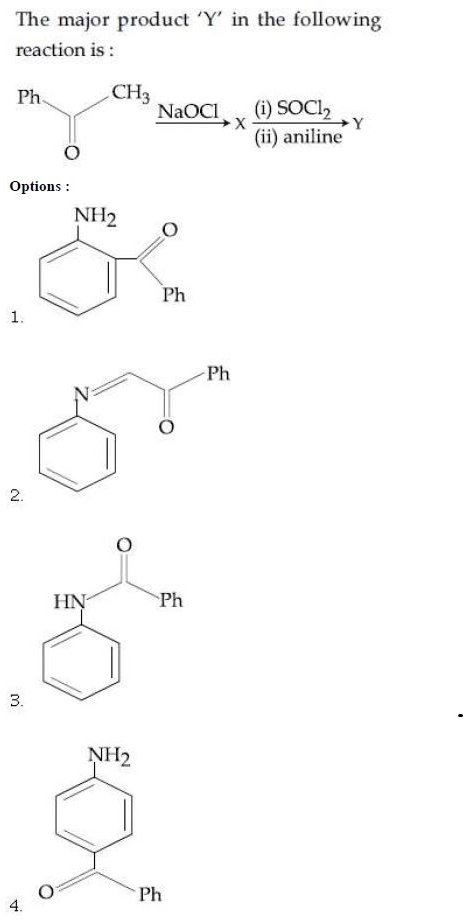
- A.2-Aminobenzophenone (benzene ring bearing and, ortho to it, )
- B. (N-phenyl imine of phenylglyoxal)
- C.Benzanilide,
- D.4-Aminobenzophenone (benzene ring bearing and, para to it, )
Correct answer: C
Question 30
Chemistry · 4 marks · −1Which of these factors does not govern the stability of a conformation in acyclic compounds?
- A.Steric interactions
- B.Angle strain
- C.Torsional strain
- D.Electrostatic forces of interaction
Correct answer: B
Question 31
Chemistry · 4 marks · −1In chromatography, which of the following statements is INCORRECT for ?
- A.Higher value means higher adsorption.
- B.The value of depends on the type of chromatography.
- C.The value of can not be more than one.
- D. value is dependent on the mobile phase.
Correct answer: A
Question 32
Chemistry · 4 marks · −1The number of chiral carbons present in the molecule of glucose in its open chain and cyclic structures respectively are:
- A.4 and 4
- B.4 and 5
- C.5 and 4
- D.5 and 5
Correct answer: B
Question 33
Chemistry · 4 marks · −1The major product 'Y' in the following reaction is: (2-chloro-3-methylbutane) X Y
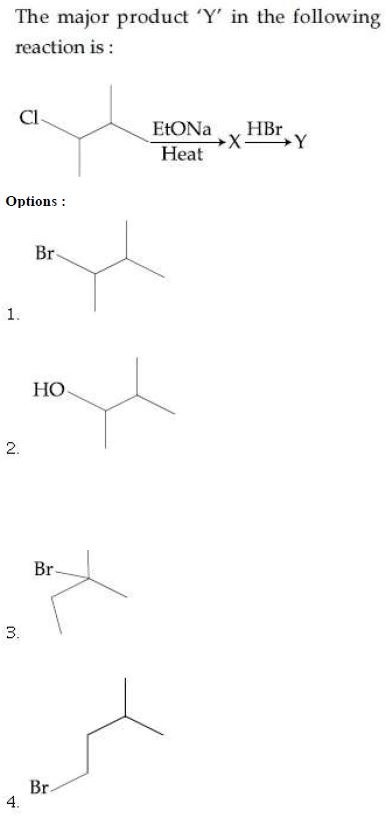
- A. (2-bromo-3-methylbutane)
- B. (3-methylbutan-2-ol)
- C. (2-bromo-2-methylbutane)
- D. (1-bromo-3-methylbutane)
Correct answer: C
Question 34
Chemistry · 4 marks · −1The major product obtained in the given reaction is: 3-Methylphenyl–O–––CH(Cl)– Product
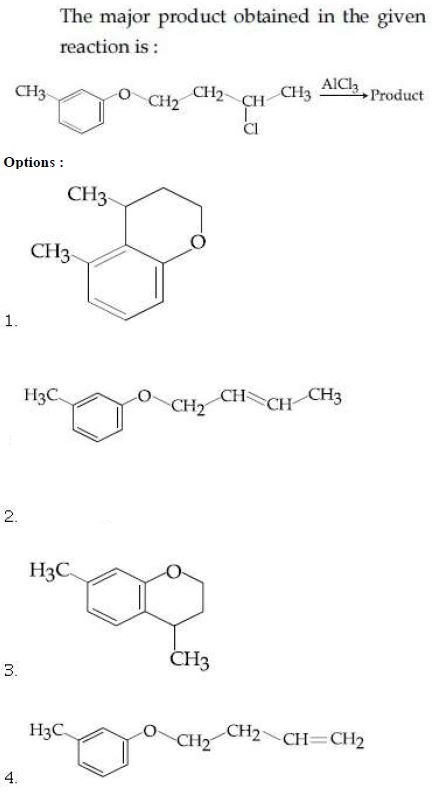
- A.Chromane with two methyl groups: one at C-4 of the pyran ring and one on the aromatic ring adjacent (peri) to it
- B.–CH–O––CH=CH– (m-tolyl but-2-enyl ether)
- C.4-Methylchromane with a on the aromatic ring para to the ring-fusion carbon bearing C-4 (7-methyl-4-methylchromane)
- D.–CH–O–––CH= (m-tolyl but-3-enyl ether)
Correct answer: C
Question 35
Chemistry · 4 marks · −1Arrange the following nucleophiles in the increasing order of nucleophilicity: (a) (b) (c) (d)
- A.(b) < (c) < (d) < (a)
- B.(a) < (d) < (c) < (b)
- C.(b) < (c) < (a) < (d)
- D.(d) < (a) < (c) < (b)
Correct answer: C
Question 36
Chemistry · 4 marks · −1Which of the following is not a correct method of the preparation of benzylamine from cyanobenzene?
- A.(i) HCl/ (ii)
- B.(i) (ii)
- C./Ni
- D.(i) + HCl(gas) (ii)
Correct answer: A
Question 37
Chemistry · 4 marks · −1The correct order of the first ionization enthalpies is:
- A.Ti < Mn < Ni < Zn
- B.Mn < Ti < Zn < Ni
- C.Ti < Mn < Zn < Ni
- D.Zn < Ni < Mn < Ti
Correct answer: A
Question 38
Chemistry · 4 marks · −1The correct statement is:
- A.Aniline is a froth stabilizer.
- B.Sodium cyanide cannot be used in the metallurgy of silver.
- C.Zincite is a carbonate ore.
- D.Zone refining process is used for the refining of titanium.
Correct answer: A
Question 39
Chemistry · 4 marks · −1The correct statements among (a) to (d) are: (a) Saline hydrides produce gas when reacted with . (b) Reaction of with leads to . (c) and are electron-rich and electron-precise hydrides, respectively. (d) HF and are called as molecular hydrides.
- A.(c) and (d) only
- B.(a), (c) and (d) only
- C.(a), (b) and (c) only
- D.(a), (b), (c) and (d)
Correct answer: D
Question 40
Chemistry · 4 marks · −1A hydrated solid X on heating initially gives a monohydrated compound Y. Y upon heating above 373 K leads to an anhydrous white powder Z. X and Z, respectively, are:
- A.Baking soda and soda ash.
- B.Washing soda and dead burnt plaster.
- C.Washing soda and soda ash.
- D.Baking soda and dead burnt plaster.
Correct answer: C
Question 41
Chemistry · 4 marks · −1The number of pentagons in and trigons (triangles) in white phosphorus, respectively, are:
- A.12 and 4
- B.12 and 3
- C.20 and 3
- D.20 and 4
Correct answer: A
Question 42
Chemistry · 4 marks · −1The highest possible oxidation states of uranium and plutonium, respectively, are:
- A.7 and 6
- B.6 and 7
- C.6 and 4
- D.4 and 6
Correct answer: B
Question 43
Chemistry · 4 marks · −1The crystal field stabilization energy (CFSE) of and , respectively, are:
- A. and
- B. and
- C. and
- D. and
Correct answer: B
Question 44
Chemistry · 4 marks · −1The INCORRECT statement is:
- A.the spin-only magnetic moment of is 2.83 BM.
- B.the spin-only magnetic moments of and are nearly similar.
- C.the color of is violet as it absorbs the yellow light.
- D.the gemstone, ruby, has ions occupying the octahedral sites of beryl.
Correct answer: D
Question 45
Chemistry · 4 marks · −1Air pollution that occurs in sunlight is:
- A.acid rain
- B.fog
- C.reducing smog
- D.oxidising smog
Correct answer: D
Question 46
Chemistry · 4 marks · −1The minimum amount of consumed per gram of reactant is for the reaction: (Given atomic mass: Fe = 56, O = 16, Mg = 24, P = 31, C = 12, H = 1)
- A.
- B.
- C.
- D.
Correct answer: A
Question 47
Chemistry · 4 marks · −1Points I, II and III in the following plot respectively correspond to (: most probable velocity)
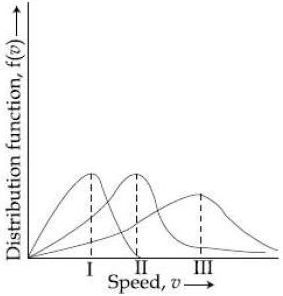
- A. of (300 K); of (300 K); of (400 K)
- B. of (400 K); of (300 K); of (300 K)
- C. of (300 K); of (400 K); of (300 K)
- D. of (300 K); of (300 K); of (400 K)
Correct answer: C
Question 48
Chemistry · 4 marks · −1The ratio of the shortest wavelength of two spectral series of hydrogen spectrum is found to be about 9. The spectral series are:
- A.Balmer and Brackett
- B.Lyman and Paschen
- C.Paschen and Pfund
- D.Brackett and Pfund
Correct answer: B
Question 49
Chemistry · 4 marks · −1The difference between and , when the combustion of one mole of heptane(l) is carried out at a temperature T, is equal to:
- A.4 RT
- B.3 RT
- C.−4 RT
- D.−3 RT
Correct answer: C
Question 50
Chemistry · 4 marks · −11 g of a non-volatile non-electrolyte solute is dissolved in 100 g of two different solvents A and B whose ebullioscopic constants are in the ratio of 1 : 5. The ratio of the elevation in their boiling points, , is:
- A.1 : 0.2
- B.5 : 1
- C.1 : 5
- D.10 : 1
Correct answer: C
Question 51
Chemistry · 4 marks · −1For the reaction, , and . Which of the following statement is INCORRECT?
- A.The equilibrium constant decreases as the temperature increases.
- B.The equilibrium will shift in forward direction as the pressure increases.
- C.The addition of inert gas at constant volume will not affect the equilibrium constant.
- D.The equilibrium constant is large suggestive of reaction going to completion and so no catalyst is required.
Correct answer: D
Question 52
Chemistry · 4 marks · −1The pH of a 0.02 M solution will be [given and ]
- A.4.65
- B.2.65
- C.5.35
- D.4.35
Correct answer: C
Question 53
Chemistry · 4 marks · −1Which one of the following graphs between molar conductivity versus is correct?
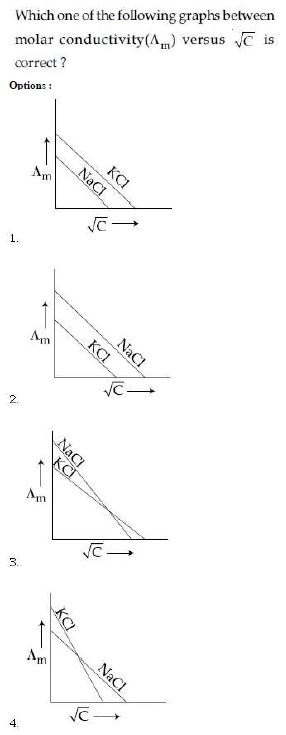
- A.Graph 1: two parallel straight lines falling with , KCl above NaCl
- B.Graph 2: two parallel straight lines falling with , NaCl above KCl
- C.Graph 3: two falling straight lines that cross, NaCl starting above KCl
- D.Graph 4: two falling straight lines with different slopes, KCl steeper and starting higher, NaCl less steep
Correct answer: A
Question 54
Chemistry · 4 marks · −1For the reaction of with , the rate constant is at 327 °C and at 527 °C. The activation energy for the reaction, in kJ mol is: ()
- A.59
- B.72
- C.150
- D.166
Correct answer: D
Question 55
Chemistry · 4 marks · −1The correct option among the following is:
- A.Addition of alum to water makes it unfit for drinking.
- B.Colloidal medicines are more effective because they have small surface area.
- C.Colloidal particles in lyophobic sols can be precipitated by electrophoresis.
- D.Brownian motion in colloidal solution is faster if the viscosity of the solution is very high.
Correct answer: C
Question 56
Mathematics · 4 marks · −1Let , and , . If is a positive real number such that and , then:
- A.
- B.
- C.
- D.
Correct answer: D
Question 57
Mathematics · 4 marks · −1If and are two complex numbers such that and , then:
- A.
- B.
- C.
- D.
Correct answer: A
Question 58
Mathematics · 4 marks · −1The number of real roots of the equation is:
- A.4
- B.1
- C.2
- D.3
Correct answer: B
Question 59
Mathematics · 4 marks · −1The sum of the real roots of the equation , is equal to:
- A.−4
- B.0
- C.1
- D.6
Correct answer: B
Question 60
Mathematics · 4 marks · −1Let be a real number for which the system of linear equations has infinitely many solutions. Then is a root of the quadratic equation:
- A.
- B.
- C.
- D.
Correct answer: D
Question 61
Mathematics · 4 marks · −1Suppose that 20 pillars of the same height have been erected along the boundary of a circular stadium. If the top of each pillar has been connected by beams with the top of all its non-adjacent pillars, then the total number of beams is:
- A.170
- B.190
- C.180
- D.210
Correct answer: A
Question 62
Mathematics · 4 marks · −1The smallest natural number , such that the coefficient of in the expansion of is , is:
- A.23
- B.38
- C.35
- D.58
Correct answer: B
Question 63
Mathematics · 4 marks · −1Let , and be in G.P. with common ratio , where and . If , and are the first three terms of an A.P., then the term of this A.P. is:
- A.
- B.
- C.
- D.
Correct answer: B
Question 64
Mathematics · 4 marks · −1The sum is equal to:
- A.620
- B.660
- C.1240
- D.1860
Correct answer: A
Question 65
Mathematics · 4 marks · −1If , then is equal to:
- A.1
- B.5
- C.−4
- D.−7
Correct answer: D
Question 66
Mathematics · 4 marks · −1Let be an A.P. with . Then the common difference of this A.P., which maximises the product , is:
- A.
- B.
- C.
- D.
Correct answer: B
Question 67
Mathematics · 4 marks · −1A spherical iron ball of radius 10 cm is coated with a layer of ice of uniform thickness that melts at a rate of . When the thickness of the ice is 5 cm, then the rate at which the thickness (in cm/min) of the ice decreases, is:
- A.
- B.
- C.
- D.
Correct answer: C
Question 68
Mathematics · 4 marks · −1If the tangent to the curve , , , at a point on it is parallel to the line , then:
- A.
- B.
- C.
- D.
Correct answer: A
Question 69
Mathematics · 4 marks · −1If , where is a constant of integration, then is equal to:
- A.
- B.−1
- C.
- D.1
Correct answer: A
Question 70
Mathematics · 4 marks · −1The integral is equal to:
- A.
- B.
- C.
- D.
Correct answer: D
Question 71
Mathematics · 4 marks · −1The area (in sq. units) of the region bounded by the curves and , in the first quadrant is:
- A.
- B.
- C.
- D.
Correct answer: B
Question 72
Mathematics · 4 marks · −1Let be the solution of the differential equation, , , such that . Then:
- A.
- B.
- C.
- D.
Correct answer: C
Question 73
Mathematics · 4 marks · −1Lines are drawn parallel to the line , at a distance from the origin. Then which one of the following points lies on any of these lines?
- A.
- B.
- C.
- D.
Correct answer: D
Question 74
Mathematics · 4 marks · −1The locus of the centres of the circles, which touch the circle, externally, also touch the -axis and lie in the first quadrant, is:
- A.,
- B.,
- C.,
- D.,
Correct answer: A
Question 75
Mathematics · 4 marks · −1If the line , touches both the curves and , then is equal to:
- A.
- B.
- C.
- D.2
Correct answer: A
Question 76
Mathematics · 4 marks · −1The tangent and normal to the ellipse at the point P(2, 2) meet the -axis at Q and R, respectively. Then the area (in sq. units) of the triangle PQR is:
- A.
- B.
- C.
- D.
Correct answer: D
Question 77
Mathematics · 4 marks · −1If is the directrix of the hyperbola , then its corresponding focus is:
- A.(−5, 0)
- B.(5, 0)
- C.
- D.
Correct answer: A
Question 78
Mathematics · 4 marks · −1A perpendicular is drawn from a point on the line to the plane such that the foot of the perpendicular Q also lies on the plane . Then the co-ordinates of Q are:
- A.(2, 0, 1)
- B.(1, 0, 2)
- C.(−1, 0, 4)
- D.(4, 0, −1)
Correct answer: A
Question 79
Mathematics · 4 marks · −1If the plane has the distances and units from the planes and , respectively, then the maximum value of is equal to:
- A.5
- B.9
- C.13
- D.15
Correct answer: C
Question 80
Mathematics · 4 marks · −1The distance of the point having position vector from the straight line passing through the point (2, 3, −4) and parallel to the vector, is:
- A.6
- B.7
- C.
- D.
Correct answer: B
Question 81
Mathematics · 4 marks · −1If both the mean and the standard deviation of 50 observations are equal to 16, then the mean of is:
- A.380
- B.400
- C.480
- D.525
Correct answer: B
Question 82
Mathematics · 4 marks · −1Minimum number of times a fair coin must be tossed so that the probability of getting at least one head is more than 99% is:
- A.5
- B.6
- C.7
- D.8
Correct answer: C
Question 83
Mathematics · 4 marks · −1If , where , , , then for all , is equal to:
- A.
- B.
- C.
- D.
Correct answer: C
Question 84
Mathematics · 4 marks · −1The angles A, B and C of a triangle ABC are in A.P. and . If cm, then the area (in sq. cm) of this triangle is:
- A.
- B.
- C.
- D.
Correct answer: B
Question 85
Mathematics · 4 marks · −1The negation of the Boolean expression is equivalent to:
- A.
- B.
- C.
- D.
Correct answer: B