JEE Main 2019 — 10 Jan Shift 1 (Previous Year Paper)
JEE Main · 2019 · with answers and explanations
- questions
- 85
- Total marks
- 340
- Duration
- 180 minutes
- Negative marking
- −1
Subjects: Physics · Chemistry · Mathematics
Question 1
Physics · 4 marks · −1The density of a material in SI units is 128 kg m. In certain units in which the unit of length is 25 cm and the unit of mass is 50 g, the numerical value of density of the material is:
- A.40
- B.410
- C.640
- D.16
Correct answer: A
Question 2
Physics · 4 marks · −1Two guns A and B can fire bullets at speeds 1 km/s and 2 km/s respectively. From a point on a horizontal ground, they are fired in all possible directions. The ratio of maximum areas covered by the bullets fired by the two guns, on the ground is:
- A.1 : 2
- B.1 : 16
- C.1 : 8
- D.1 : 4
Correct answer: B
Question 3
Physics · 4 marks · −1In the cube of side 'a' shown in the figure, the vector from the central point of the face ABOD to the central point of the face BEFO will be:
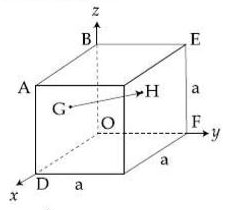
- A.
- B.
- C.
- D.
Correct answer: C
Question 4
Physics · 4 marks · −1A piece of wood of mass 0.03 kg is dropped from the top of a 100 m height building. At the same time, a bullet of mass 0.02 kg is fired vertically upward, with a velocity 100 m s, from the ground. The bullet gets embedded in the wood. Then the maximum height to which the combined system reaches above the top of the building before falling below is: ( m s)
- A.40 m
- B.30 m
- C.20 m
- D.10 m
Correct answer: A
Question 5
Physics · 4 marks · −1A block of mass m is kept on a platform which starts from rest with constant acceleration g/2 upward, as shown in fig. Work done by normal reaction on block in time t is:
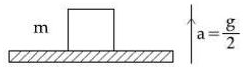
- A.
- B.
- C.
- D.0
Correct answer: A
Question 6
Physics · 4 marks · −1A homogeneous solid cylindrical roller of radius R and mass M is pulled on a cricket pitch by a horizontal force. Assuming rolling without slipping, angular acceleration of the cylinder is:
- A.
- B.
- C.
- D.
Correct answer: A
Question 7
Physics · 4 marks · −1To mop-clean a floor, a cleaning machine presses a circular mop of radius R vertically down with a total force F and rotates it with a constant angular speed about its axis. If the force F is distributed uniformly over the mop and if coefficient of friction between the mop and the floor is , the torque, applied by the machine on the mop is:
- A.
- B.
- C.
- D.
Correct answer: D
Question 8
Physics · 4 marks · −1A satellite is moving with a constant speed in circular orbit around the earth. An object of mass 'm' is ejected from the satellite such that it just escapes from the gravitational pull of the earth. At the time of ejection, the kinetic energy of the object is:
- A.
- B.
- C.
- D.
Correct answer: B
Question 9
Physics · 4 marks · −1Water flows into a large tank with flat bottom at the rate of ms. Water is also leaking out of a hole of area 1 cm at its bottom. If the height of the water in the tank remains steady, then this height is:
- A.5.1 cm
- B.4 cm
- C.2.9 cm
- D.1.7 cm
Correct answer: A
Question 10
Physics · 4 marks · −1Three Carnot engines operate in series between a heat source at a temperature and a heat sink at temperature (see figure). There are two other reservoirs at temperature and , as shown, with . The three engines are equally efficient if:
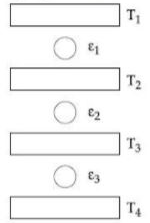
- A.
- B.
- C.
- D.
Correct answer: C
Question 11
Physics · 4 marks · −1A heat source at K is connected to another heat reservoir at K by a copper slab which is 1 m thick. Given that the thermal conductivity of copper is 0.1 WKm, the energy flux through it in the steady state is:
- A.90 Wm
- B.120 Wm
- C.65 Wm
- D.200 Wm
Correct answer: A
Question 12
Physics · 4 marks · −1A string of length 1 m and mass 5 g is fixed at both ends. The tension in the string is 8.0 N. The string is set into vibration using an external vibrator of frequency 100 Hz. The separation between successive nodes on the string is close to:
- A.10.0 cm
- B.16.6 cm
- C.20.0 cm
- D.33.3 cm
Correct answer: C
Question 13
Physics · 4 marks · −1A train moves towards a stationary observer with speed 34 m/s. The train sounds a whistle and its frequency registered by the observer is . If the speed of the train is reduced to 17 m/s, the frequency registered is . If speed of sound is 340 m/s, then the ratio is:
- A.18/17
- B.21/20
- C.20/19
- D.19/18
Correct answer: D
Question 14
Physics · 4 marks · −1A parallel plate capacitor is of area 6 cm and a separation 3 mm. The gap is filled with three dielectric materials of equal thickness (see figure) with dielectric constants , and . The dielectric constant of a material which when fully inserted in above capacitor, gives same capacitance would be:
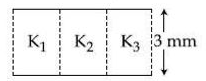
- A.36
- B.12
- C.4
- D.14
Correct answer: B
Question 15
Physics · 4 marks · −1Two electric dipoles, A, B with respective dipole moments and are placed on the x-axis with a separation R, as shown in the figure. The distance from A at which both of them produce the same potential is:
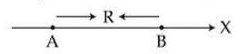
- A.
- B.
- C.
- D.
Correct answer: B
Question 16
Physics · 4 marks · −1A charge Q is distributed over three concentric spherical shells of radii a, b, c (a < b < c) such that their surface charge densities are equal to one another. The total potential at a point at distance r from their common centre, where r < a, would be:
- A.
- B.
- C.
- D.
Correct answer: B
Question 17
Physics · 4 marks · −1A uniform metallic wire has a resistance of 18 Ω and is bent into an equilateral triangle. Then, the resistance between any two vertices of the triangle is:
- A.2 Ω
- B.12 Ω
- C.4 Ω
- D.8 Ω
Correct answer: C
Question 18
Physics · 4 marks · −1In the given circuit the cells have zero internal resistance. The currents (in Amperes) passing through resistance and respectively, are:
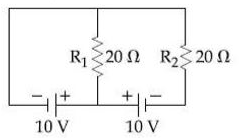
- A.0.5, 0
- B.1, 2
- C.2, 2
- D.0, 1
Correct answer: A
Question 19
Physics · 4 marks · −1A solid metal cube of edge length 2 cm is moving in a positive -direction at a constant speed of 6 m/s. There is a uniform magnetic field of 0.1 T in the positive -direction. The potential difference between the two faces of the cube perpendicular to the -axis, is:
- A.1 mV
- B.6 mV
- C.12 mV
- D.2 mV
Correct answer: C
Question 20
Physics · 4 marks · −1If the magnetic field of a plane electromagnetic wave is given by (The speed of light = m/s) then the maximum electric field associated with it is:
- A. N/C
- B. N/C
- C. N/C
- D. N/C
Correct answer: C
Question 21
Physics · 4 marks · −1A plano convex lens of refractive index and focal length is kept in contact with another plano concave lens of refractive index and focal length . If the radius of curvature of their spherical faces is R each and , then and are related as:
- A.
- B.
- C.
- D.
Correct answer: C
Question 22
Physics · 4 marks · −1In a Young's double slit experiment with slit separation 0.1 mm, one observes a bright fringe at angle rad by using light of wavelength . When the light of wavelength is used a bright fringe is seen at the same angle in the same set up. Given that and are in visible range (380 nm to 740 nm), their values are:
- A.380 nm, 525 nm
- B.625 nm, 500 nm
- C.380 nm, 500 nm
- D.400 nm, 500 nm
Correct answer: B
Question 23
Physics · 4 marks · −1In an electron microscope, the resolution that can be achieved is of the order of the wavelength of electrons used. To resolve a width of m, the minimum electron energy required is close to:
- A.1 keV
- B.25 keV
- C.500 keV
- D.100 keV
Correct answer: B
Question 24
Physics · 4 marks · −1Using a nuclear counter the count rate of emitted particles from a radioactive source is measured. At t = 0 it was 1600 counts per second and t = 8 seconds it was 100 counts per second. The count rate observed, as counts per second, at t = 6 seconds is close to:
- A.150
- B.200
- C.360
- D.400
Correct answer: B
Question 25
Physics · 4 marks · −1To get output '1' at R, for the given logic gate circuit the input values must be:
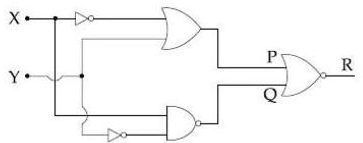
- A.X = 0, Y = 0
- B.X = 0, Y = 1
- C.X = 1, Y = 0
- D.X = 1, Y = 1
Correct answer: C
Question 26
Physics · 4 marks · −1A TV transmission tower has a height of 140 m and the height of the receiving antenna is 40 m. What is the maximum distance upto which signals can be broadcasted from this tower in LOS (Line of Sight) mode? (Given: radius of earth = m).
- A.40 km
- B.80 km
- C.65 km
- D.48 km
Correct answer: C
Question 27
Physics · 4 marks · −1A potentiometer wire AB having length L and resistance 12r is joined to a cell D of emf and internal resistance r. A cell C having emf and internal resistance 3r is connected. The length AJ at which the galvanometer as shown in fig. shows no deflection is:
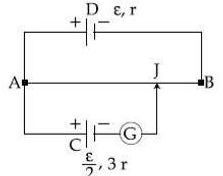
- A.
- B.
- C.
- D.
Correct answer: A
Question 28
Physics · 4 marks · −1A 2 W carbon resistor is color coded with green, black, red and brown respectively. The maximum current which can be passed through this resistor is:
- A.0.4 mA
- B.20 mA
- C.63 mA
- D.100 mA
Correct answer: B
Question 29
Chemistry · 4 marks · −1The correct structure of product 'P' in the following reaction is: Asn−Ser + (excess) P
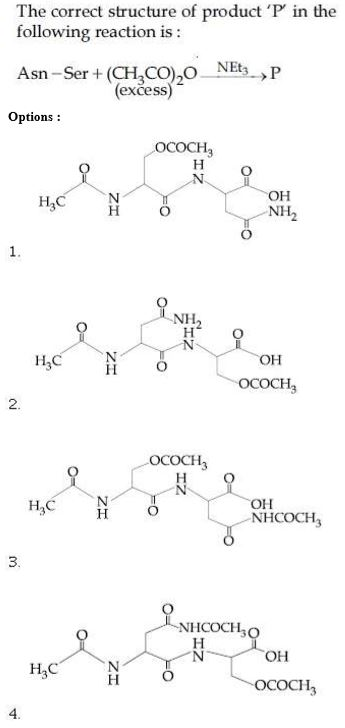
- A. (Ser at the N-terminus, O-acetylated; Asn at the C-terminus)
- B. (N-acetyl Asn, side-chain amide free; Ser O-acetylated)
- C. type (side-chain amide also acetylated)
- D. (Asn side-chain amide N-acetylated and Ser O-acetylated)
Correct answer: B
Question 30
Chemistry · 4 marks · −1The major product formed in the reaction given below will be: (octahydro-1H-inden-2-yl)methanamine, i.e. a bicyclic (6-5 fused, saturated) ring bearing on the five-membered ring ?
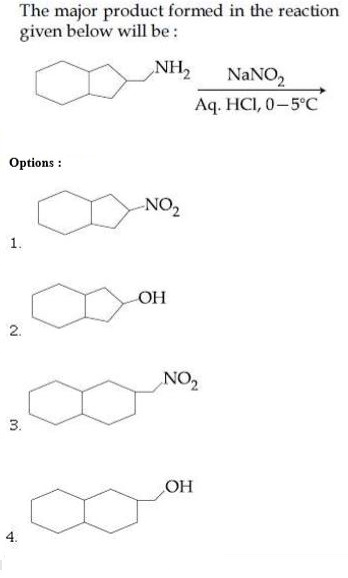
- A.The 6-5 fused bicyclic ring with on the five-membered ring
- B.The 6-5 fused bicyclic ring with on the five-membered ring
- C.A 6-6 fused bicyclic (decalin) ring with on a ring carbon
- D.A 6-6 fused bicyclic (decalin) ring with on a ring carbon (ring-expanded alcohol)
Correct answer: D
Question 31
Chemistry · 4 marks · −1The decreasing order of ease of alkaline hydrolysis for the following esters is: I ; II ; III ; IV
- A.III > II > IV > I
- B.II > III > I > IV
- C.III > II > I > IV
- D.IV > II > III > I
Correct answer: C
Question 32
Chemistry · 4 marks · −1Which dicarboxylic acid in presence of a dehydrating agent is least reactive to give an anhydride?
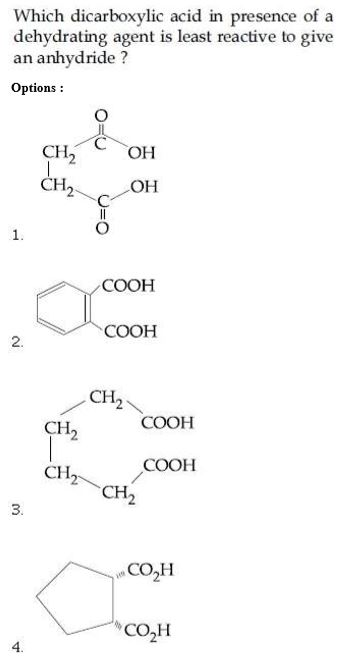
- A.Succinic acid,
- B.Phthalic acid (benzene-1,2-dicarboxylic acid)
- C.Adipic acid,
- D.trans-Cyclopentane-1,2-dicarboxylic acid
Correct answer: C
Question 33
Chemistry · 4 marks · −1The major product 'X' formed in the following reaction is: methyl 2-(6-oxocyclohex-2-en-1-yl)acetate (a cyclohexenone ring carrying on the carbon next to C=O) X
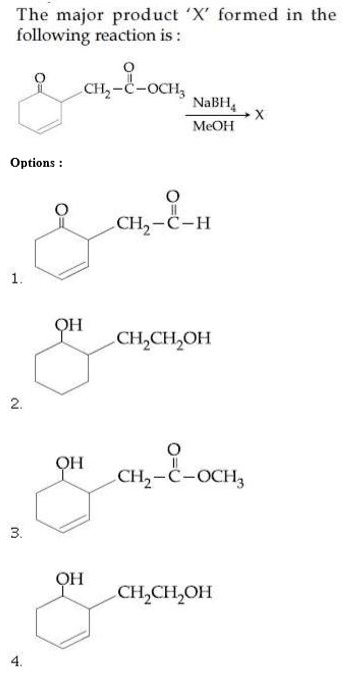
- A.Ketone retained, ester reduced to aldehyde: ring C=O with side chain (ring C=C retained)
- B.Saturated cyclohexanol with side chain (C=C, C=O and ester all reduced)
- C.Cyclohexenol with side chain (only the ketone reduced)
- D.Cyclohexenol with side chain (ketone and ester reduced, C=C retained)
Correct answer: C
Question 34
Chemistry · 4 marks · −1The increasing order of the pKa values of the following compounds is: A phenol; B p-nitrophenol; C m-nitrophenol; D p-methoxyphenol
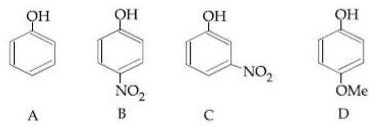
- A.D < A < C < B
- B.B < C < A < D
- C.C < B < A < D
- D.B < C < D < A
Correct answer: B
Question 35
Chemistry · 4 marks · −1The major product of the following reaction is: 1-methoxy-3-(4-chloro-3-methylbutyl)benzene () ?
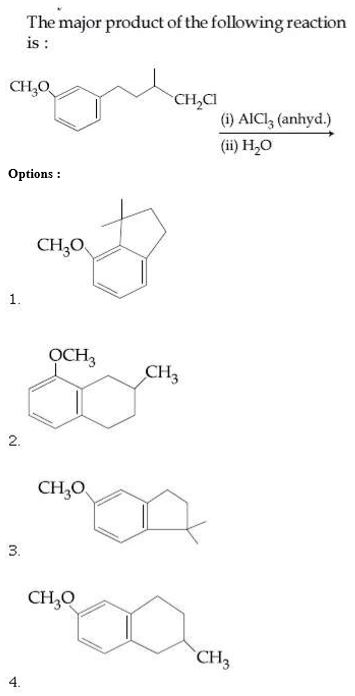
- A.1,1-dimethylindane with the OCH on the ring carbon adjacent to the ring fusion bearing the gem-dimethyl carbon (7-methoxy)
- B.2-methyltetralin with OCH on the aromatic carbon adjacent to the ring fusion (5-methoxy)
- C.1,1-dimethylindane with OCH para to the ring fusion carbon bearing the gem-dimethyl carbon (6-methoxy-1,1-dimethylindane)
- D.2-methyltetralin with OCH on the aromatic ring remote from the ring fusion (6/7-methoxy)
Correct answer: C
Question 36
Chemistry · 4 marks · −1Which hydrogen in compound (E) is easily replaceable during bromination reaction in presence of light? (E):
- A.α - hydrogen
- B.β - hydrogen
- C.γ - hydrogen
- D.δ - hydrogen
Correct answer: C
Question 37
Chemistry · 4 marks · −1The major product of the following reaction is: ?
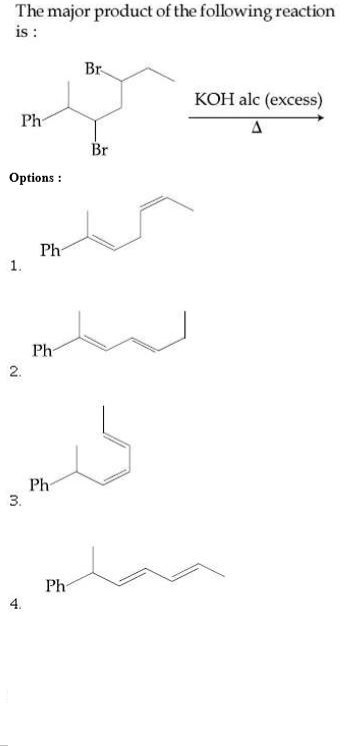
- A. (non-conjugated diene)
- B. (diene conjugated with the phenyl ring)
- C. drawn with a cis (Z) inner double bond (diene not conjugated with Ph)
- D. drawn all-trans (diene not conjugated with Ph)
Correct answer: B
Question 38
Chemistry · 4 marks · −1If dichloromethane (DCM) and water () are used for differential extraction, which one of the following statements is correct?
- A.DCM and HO would stay as upper and lower layer respectively in the separating funnel (S.F.)
- B.DCM and HO would stay as lower and upper layer respectively in the S.F.
- C.DCM and HO will make turbid/colloidal mixture
- D.DCM and HO will be miscible clearly
Correct answer: B
Question 39
Chemistry · 4 marks · −1The electronegativity of aluminium is similar to:
- A.Lithium
- B.Carbon
- C.Beryllium
- D.Boron
Correct answer: C
Question 40
Chemistry · 4 marks · −1Hall-Heroult's process is given by:
- A.
- B.
- C.
- D.
Correct answer: B
Question 41
Chemistry · 4 marks · −1The chemical nature of hydrogen peroxide is:
- A.Oxidising agent in acidic medium, but not in basic medium.
- B.Reducing agent in basic medium, but not in acidic medium.
- C.Oxidising and reducing agent in acidic medium, but not in basic medium.
- D.Oxidising and reducing agent in both acidic and basic medium.
Correct answer: D
Question 42
Chemistry · 4 marks · −1The total number of isotopes of hydrogen and number of radioactive isotopes among them, respectively, are:
- A.2 and 1
- B.3 and 1
- C.2 and 0
- D.3 and 2
Correct answer: B
Question 43
Chemistry · 4 marks · −1The metal used for making X-ray tube window is:
- A.Mg
- B.Ca
- C.Na
- D.Be
Correct answer: D
Question 44
Chemistry · 4 marks · −1The type of hybridisation and number of lone pair(s) of electrons of Xe in , respectively, are:
- A.spd and 1
- B.spd and 2
- C.spd and 1
- D.spd and 2
Correct answer: C
Question 45
Chemistry · 4 marks · −1The effect of lanthanoid contraction in the lanthanoid series of elements by and large means:
- A.decrease in both atomic and ionic radii
- B.increase in atomic radii and decrease in ionic radii
- C.decrease in atomic radii and increase in ionic radii
- D.increase in both atomic and ionic radii
Correct answer: A
Question 46
Chemistry · 4 marks · −1Wilkinson catalyst is: (Et = CH)
- A.
- B.
- C.
- D.
Correct answer: A
Question 47
Chemistry · 4 marks · −1The total number of isomers for a square planar complex is:
- A.4
- B.8
- C.12
- D.16
Correct answer: C
Question 48
Chemistry · 4 marks · −1Water filled in two glasses A and B have BOD values of 10 and 20, respectively. The correct statement regarding them, is:
- A.B is more polluted than A.
- B.A is more polluted than B.
- C.A is suitable for drinking, whereas B is not.
- D.Both A and B are suitable for drinking.
Correct answer: A
Question 49
Chemistry · 4 marks · −1A mixture of 100 m mol of and 2 g of sodium sulphate was dissolved in water and the volume was made up to 100 mL. The mass of calcium sulphate formed and the concentration of OH in resulting solution, respectively, are: (Molar mass of , and are 74, 143 and 136 g mol, respectively; of is )
- A.13.6 g, 0.28 mol L
- B.1.9 g, 0.14 mol L
- C.13.6 g, 0.14 mol L
- D.1.9 g, 0.28 mol L
Correct answer: D
Question 50
Chemistry · 4 marks · −1Which primitive unit cell has unequal edge lengths () and all axial angles different from 90°?
- A.Tetragonal
- B.Hexagonal
- C.Monoclinic
- D.Triclinic
Correct answer: D
Question 51
Chemistry · 4 marks · −1Which of the graphs shown below does not represent the relationship between incident light and the electron ejected from metal surface?
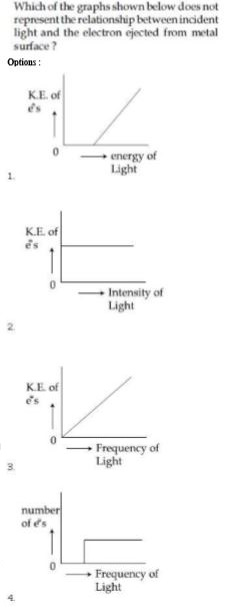
- A.Graph of K.E. of es vs energy of light: zero up to a threshold, then a straight line rising
- B.Graph of K.E. of es vs intensity of light: a horizontal line (K.E. independent of intensity)
- C.Graph of K.E. of es vs frequency of light: a straight line rising from the origin
- D.Graph of number of es vs frequency of light: zero below a threshold frequency, then a constant (step)
Correct answer: C
Question 52
Chemistry · 4 marks · −1Two pi and half sigma bonds are present in:
- A.
- B.
- C.
- D.
Correct answer: D
Question 53
Chemistry · 4 marks · −1Liquids A and B form an ideal solution in the entire composition range. At 350 K, the vapor pressures of pure A and pure B are Pa and Pa, respectively. The composition of the vapor in equilibrium with a solution containing 40 mole percent of A at this temperature is:
- A.
- B.
- C.
- D.
Correct answer: D
Question 54
Chemistry · 4 marks · −1The values of for the following reactions at 300 K are, respectively: (At 300 K, RT = 24.62 dmatm mol) ; ;
- A.1, 24.62 dmatm mol, 606.0 dmatm mol
- B.24.62 dmatm mol, 606.0 dmatm mol, dmatm mol
- C.1, 24.62 dmatm mol, dmatm mol
- D.1, dmatm mol, 606 dmatm mol
Correct answer: C
Question 55
Chemistry · 4 marks · −1Consider the following reduction processes: ; V. ; V. ; V. ; V. The reducing power of the metals increases in the order:
- A.Ca < Zn < Mg < Ni
- B.Ca < Mg < Zn < Ni
- C.Ni < Zn < Mg < Ca
- D.Zn < Mg < Ni < Ca
Correct answer: C
Question 56
Chemistry · 4 marks · −1Consider the given plots for a reaction obeying Arrhenius equation (0°C < T < 300°C): (k and are rate constant and activation energy, respectively). Choose the correct option:
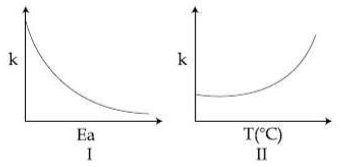
- A.Both I and II are correct
- B.Both I and II are wrong
- C.I is right but II is wrong
- D.I is wrong but II is right
Correct answer: A
Question 57
Chemistry · 4 marks · −1Which of the following is not an example of heterogeneous catalytic reaction?
- A.Haber's process
- B.Combustion of coal
- C.Hydrogenation of vegetable oils
- D.Ostwald's process
Correct answer: B
Question 58
Mathematics · 4 marks · −1In a class of 140 students numbered 1 to 140, all even numbered students opted Mathematics course, those whose number is divisible by 3 opted Physics course and those whose number is divisible by 5 opted Chemistry course. Then the number of students who did not opt for any of the three courses is:
- A.1
- B.102
- C.38
- D.42
Correct answer: C
Question 59
Mathematics · 4 marks · −1Consider the quadratic equation , . Let S be the set of all integral values of c for which one root of the equation lies in the interval (0, 2) and its other root lies in the interval (2, 3). Then the number of elements in S is:
- A.18
- B.12
- C.11
- D.10
Correct answer: C
Question 60
Mathematics · 4 marks · −1Let , and , . If the minimum value of det(A) is 8, then a value of d is:
- A.−5
- B.
- C.−7
- D.
Correct answer: A
Question 61
Mathematics · 4 marks · −1If the system of equations , , has infinitely many solutions, then equals:
- A.5
- B.18
- C.8
- D.21
Correct answer: C
Question 62
Mathematics · 4 marks · −1If , then k equals:
- A.50
- B.100
- C.200
- D.400
Correct answer: B
Question 63
Mathematics · 4 marks · −1If the third term in the binomial expansion of equals 2560, then a possible value of is:
- A.
- B.
- C.
- D.
Correct answer: B
Question 64
Mathematics · 4 marks · −1If 5, 5r, 5r are the lengths of the sides of a triangle, then r cannot be equal to:
- A.
- B.
- C.
- D.
Correct answer: D
Question 65
Mathematics · 4 marks · −1The sum of all two digit positive numbers which when divided by 7 yield 2 or 5 as remainder is:
- A.1465
- B.1256
- C.1356
- D.1365
Correct answer: C
Question 66
Mathematics · 4 marks · −1For each , let be the greatest integer less than or equal to t. Then,
- A.equals 0
- B.equals 1
- C.equals −1
- D.does not exist
Correct answer: A
Question 67
Mathematics · 4 marks · −1Let . Let S be the set of points in the interval (−4, 4) at which is not differentiable. Then S:
- A.is an empty set
- B.equals
- C.equals
- D.equals
Correct answer: C
Question 68
Mathematics · 4 marks · −1Let be a function such that , . Then equals:
- A.−4
- B.30
- C.8
- D.−2
Correct answer: D
Question 69
Mathematics · 4 marks · −1The shortest distance between the point and the curve , , is:
- A.
- B.
- C.
- D.
Correct answer: A
Question 70
Mathematics · 4 marks · −1Let be a natural number and . Then is equal to: (where C is a constant of integration)
- A.
- B.
- C.
- D.
Correct answer: A
Question 71
Mathematics · 4 marks · −1Let . If I is minimum then the ordered pair (a, b) is:
- A.
- B.
- C.
- D.
Correct answer: C
Question 72
Mathematics · 4 marks · −1If the area enclosed between the curves and , , is 1 square unit. Then k is:
- A.
- B.
- C.
- D.
Correct answer: B
Question 73
Mathematics · 4 marks · −1If the line intersects the -axis at the point A and the -axis at the point B, then the incentre of the triangle OAB, where O is the origin, is:
- A.(4, 3)
- B.(2, 2)
- C.(3, 4)
- D.(4, 4)
Correct answer: B
Question 74
Mathematics · 4 marks · −1A point P moves on the line . If Q(1, 4) and R(3, −2) are fixed points, then the locus of the centroid of PQR is a line:
- A.parallel to -axis
- B.parallel to -axis
- C.with slope
- D.with slope
Correct answer: D
Question 75
Mathematics · 4 marks · −1If a circle C passing through the point (4, 0) touches the circle externally at the point (1, −1), then the radius of C is:
- A.
- B.4
- C.
- D.5
Correct answer: D
Question 76
Mathematics · 4 marks · −1If the parabolas and have a common normal, then which one of the following is a valid choice for the ordered triad (a, b, c)?
- A.
- B.(1, 1, 3)
- C.(1, 1, 0)
- D.
Correct answer: B
Question 77
Mathematics · 4 marks · −1The equation of a tangent to the hyperbola parallel to the line is:
- A.
- B.
- C.
- D.
Correct answer: A
Question 78
Mathematics · 4 marks · −1The plane passing through the point (4, −1, 2) and parallel to the lines and also passes through the point:
- A.(1, 1, 1)
- B.(1, 1, −1)
- C.(−1, −1, −1)
- D.(−1, −1, 1)
Correct answer: A
Question 79
Mathematics · 4 marks · −1Let A be a point on the line and B(3, 2, 6) be a point in the space. Then the value of for which the vector is parallel to the plane is:
- A.
- B.
- C.
- D.
Correct answer: B
Question 80
Mathematics · 4 marks · −1Let , and be three vectors such that and is perpendicular to . Then a possible value of is:
- A.
- B.(1, 5, 1)
- C.(1, 3, 1)
- D.
Correct answer: A
Question 81
Mathematics · 4 marks · −1The mean of five observations is 5 and their variance is 9.20. If three of the given five observations are 1, 3 and 8, then a ratio of other two observations is:
- A.10 : 3
- B.4 : 9
- C.5 : 8
- D.6 : 7
Correct answer: B
Question 82
Mathematics · 4 marks · −1An unbiased coin is tossed. If the outcome is a head then a pair of unbiased dice is rolled and the sum of the numbers obtained on them is noted. If the toss of the coin results in tail then a card from a well-shuffled pack of nine cards numbered 1, 2, 3, ..., 9 is randomly picked and the number on the card is noted. The probablity that the noted number is either 7 or 8 is:
- A.
- B.
- C.
- D.
Correct answer: B
Question 83
Mathematics · 4 marks · −1The sum of all values of satisfying is:
- A.
- B.
- C.
- D.
Correct answer: B
Question 84
Mathematics · 4 marks · −1Consider a triangular plot ABC with sides AB = 7 m, BC = 5 m and CA = 6 m. A vertical lamp-post at the mid point D of AC subtends an angle 30° at B. The height (in m) of the lamp-post is:
- A.
- B.
- C.
- D.
Correct answer: D
Question 85
Mathematics · 4 marks · −1Consider the statement: \"P(n): is prime.\" Then which one of the following is true?
- A.Both P(3) and P(5) are false.
- B.P(3) is false but P(5) is true.
- C.P(5) is false but P(3) is true.
- D.Both P(3) and P(5) are true.
Correct answer: D