JEE Main 2019 — 11 Jan Shift 1 (Previous Year Paper)
JEE Main · 2019 · with answers and explanations
- questions
- 82
- Total marks
- 328
- Duration
- 180 minutes
- Negative marking
- −1
Subjects: Physics · Chemistry · Mathematics
Question 1
Physics · 4 marks · −1The force of interaction between two atoms is given by ; where is the distance, is the Boltzmann constant and is temperature and and are two constants. The dimension of is:
- A.
- B.
- C.
- D.
Correct answer: D
Question 2
Physics · 4 marks · −1A particle is moving along a circular path with a constant speed of . What is the magnitude of the change in velocity of the particle, when it moves through an angle of around the centre of the circle?
- A.zero
- B. m/s
- C. m/s
- D. m/s
Correct answer: D
Question 3
Physics · 4 marks · −1A body is projected at with a velocity at an angle of with the horizontal. The radius of curvature of its trajectory at s is . Neglecting air resistance and taking acceleration due to gravity , the value of is:
- A.2.5 m
- B.5.1 m
- C.2.8 m
- D.10.3 m
Correct answer: C
Question 4
Physics · 4 marks · −1A liquid of density is coming out of a hose pipe of radius with horizontal speed and hits a mesh. 50% of the liquid passes through the mesh unaffected. 25% looses all of its momentum and 25% comes back with the same speed. The resultant pressure on the mesh will be:
- A.
- B.
- C.
- D.
Correct answer: C
Question 5
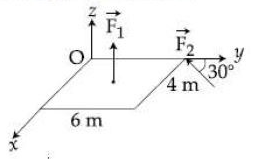
Physics · 4 marks · −1A slab is subjected to two forces and of same magnitude as shown in the figure. Force is in XY-plane while force acts along z-axis at the point . The moment of these forces about point O will be:
- A.
- B.
- C.
- D.
Correct answer: B
Question 6
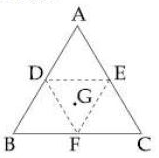
Physics · 4 marks · −1An equilateral triangle ABC is cut from a thin solid sheet of wood. (See figure) D, E and F are the mid-points of its sides as shown and G is the centre of the triangle. The moment of inertia of the triangle about an axis passing through G and perpendicular to the plane of the triangle is . If the smaller triangle DEF is removed from ABC, the moment of inertia of the remaining figure about the same axis is . Then:
- A.
- B.
- C.
- D.
Correct answer: D
Question 7
Physics · 4 marks · −1A satellite is revolving in a circular orbit at a height from the earth surface, such that where is the radius of the earth. Assuming that the effect of earth's atmosphere can be neglected the minimum increase in the speed required so that the satellite could escape from the gravitational field of earth is:
- A.
- B.
- C.
- D.
Correct answer: C
Question 8
Physics · 4 marks · −1Ice at C is added to 50 g of water at C. When the temperature of the mixture reaches C, it is found that 20 g of ice is still unmelted. The amount of ice added to the water was close to (Specific heat of water J/g/C, Specific heat of Ice J/g/C, Heat of fusion of water at C J/g)
- A.60 g
- B.40 g
- C.50 g
- D.100 g
Correct answer: B
Question 9
Physics · 4 marks · −1A rigid diatomic ideal gas undergoes an adiabatic process at room temperature. The relation between temperature and volume for this process is constant, then is:
- A.
- B.
- C.
- D.
Correct answer: B
Question 10
Physics · 4 marks · −1A gas mixture consists of 3 moles of oxygen and 5 moles of argon at temperature . Considering only translational and rotational modes, the total internal energy of the system is:
- A.4 RT
- B.12 RT
- C.15 RT
- D.20 RT
Correct answer: C
Question 11
Physics · 4 marks · −1Equation of travelling wave on a stretched string of linear density 5 g/m is where distance and time are measured in SI units. The tension in the string is:
- A.5 N
- B.7.5 N
- C.10 N
- D.12.5 N
Correct answer: D
Question 12
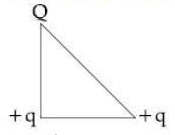
Physics · 4 marks · −1Three charges , and are placed at the vertices of a right-angle isosceles triangle as shown below. The net electrostatic energy of the configuration is zero, if the value of is:
- A.
- B.
- C.
- D.
Correct answer: B
Question 13
Physics · 4 marks · −1The given graph shows variation (with distance from centre) of:
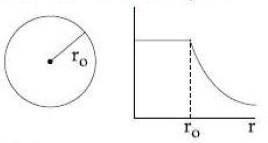
- A.Potential of a uniformly charged spherical shell
- B.Potential of a uniformly charged sphere
- C.Electric field of a uniformly charged spherical shell
- D.Electric field of a uniformly charged sphere
Correct answer: A
Question 14
Physics · 4 marks · −1Two equal resistances when connected in series to a battery, consume electric power of 60 W. If these resistances are now connected in parallel combination to the same battery, the electric power consumed will be:
- A.60 W
- B.240 W
- C.120 W
- D.30 W
Correct answer: B
Question 15
Physics · 4 marks · −1In a Wheatstone bridge (see fig.), Resistances P and Q are approximately equal. When , the bridge is balanced. On interchanging P and Q, the value of R, for balance, is . The value of X is close to:
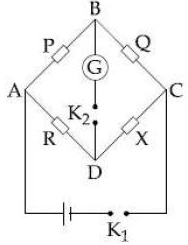
- A.401.5 ohm
- B.404.5 ohm
- C.402.5 ohm
- D.403.5 ohm
Correct answer: C
Question 16
Physics · 4 marks · −1In an experiment, electrons are accelerated, from rest, by applying a voltage of 500 V. Calculate the radius of the path if a magnetic field 100 mT is then applied. [Charge of the electron C, Mass of the electron kg]
- A.7.5 m
- B. m
- C. m
- D. m
Correct answer: C
Question 17
Physics · 4 marks · −1There are two long co-axial solenoids of same length . The inner and outer coils have radii and and number of turns per unit length and , respectively. The ratio of mutual inductance to the self-inductance of the inner-coil is:
- A.
- B.
- C.
- D.
Correct answer: A
Question 18
Physics · 4 marks · −1In the circuit shown, the switch is closed at time and the switch is kept open. At some later time (), the switch is opened and is closed. The behaviour of the current as a function of time is given by:
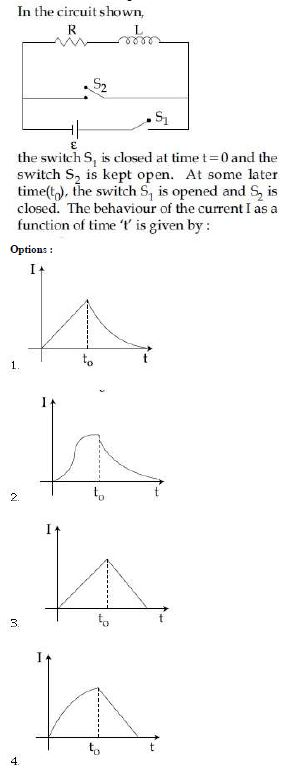
- A.Graph: I rises linearly from 0 to a peak at , then decays exponentially (concave up) toward zero.
- B.Graph: I rises exponentially (concave down, saturating) from 0 up to , then decays exponentially toward zero.
- C.Graph: I rises linearly to a peak at and then falls linearly to zero (triangle).
- D.Graph: I rises along a concave-down curve to and then falls along a concave-down curve to zero.
Correct answer: B
Question 19
Physics · 4 marks · −1An electromagnetic wave of intensity enters in a medium of refractive index without any loss. The ratio of the magnitudes of electric fields, and the ratio of the magnitudes of magnetic fields of the wave before and after entering into the medium are respectively, given by:
- A.
- B.
- C.
- D.
Correct answer: B
Question 20
Physics · 4 marks · −1An object is at a distance of 20 m from a convex lens of focal length 0.3 m. The lens forms an image of the object. If the object moves away from the lens at a speed of 5 m/s, the speed and direction of the image will be:
- A. m/s away from the lens
- B. m/s towards the lens
- C. m/s towards the lens
- D. m/s away from the lens
Correct answer: B
Question 21
Physics · 4 marks · −1In a Young's double slit experiment, the path difference, at a certain point on the screen, between two interfering waves is th of wavelength. The ratio of the intensity at this point to that at the centre of a bright fringe is close to:
- A.0.74
- B.0.80
- C.0.85
- D.0.94
Correct answer: C
Question 22
Physics · 4 marks · −1If the de Broglie wavelength of an electron is equal to times the wavelength of a photon of frequency Hz, then the speed of electron is equal to: (Speed of light m/s, Planck's constant J s, Mass of electron kg)
- A. m/s
- B. m/s
- C. m/s
- D. m/s
Correct answer: B
Question 23
Physics · 4 marks · −1A hydrogen atom, initially in the ground state is excited by absorbing a photon of wavelength 980 Å. The radius of the atom in the excited state, in terms of Bohr radius , will be: ( eV-Å)
- A.
- B.
- C.
- D.
Correct answer: C
Question 24
Physics · 4 marks · −1In the given circuit the current through Zener Diode is close to:
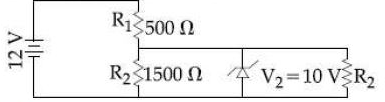
- A.6.7 mA
- B.4.0 mA
- C.0.0 mA
- D.6.0 mA
Correct answer: C
Question 25
Physics · 4 marks · −1The variation of refractive index of a crown glass thin prism with wavelength of the incident light is shown. Which of the following graphs is the correct one, if is the angle of minimum deviation?
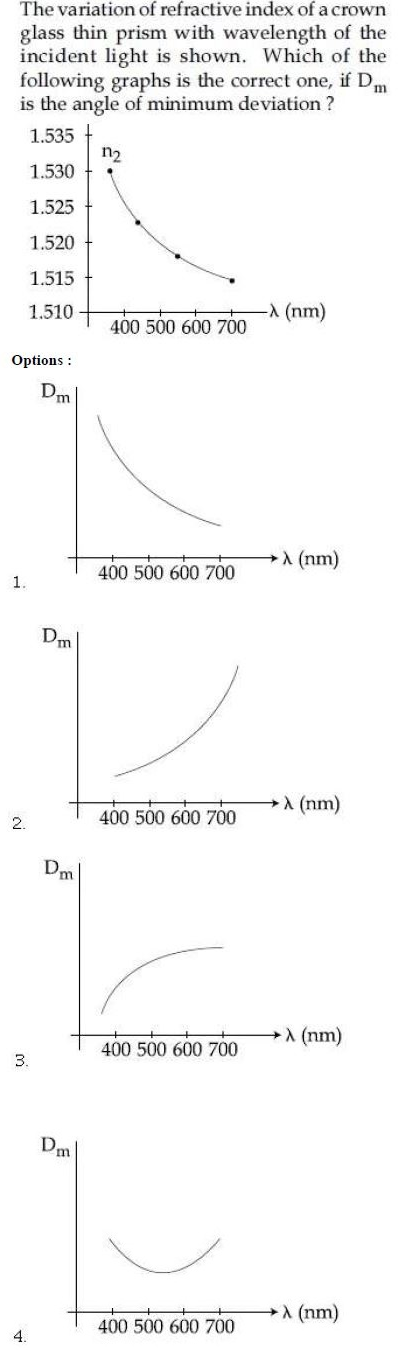
- A.Graph: decreases monotonically with from 400 nm to 700 nm (concave up).
- B.Graph: increases with , rising more steeply at longer wavelengths.
- C.Graph: increases with and levels off (concave down).
- D.Graph: first decreases then increases, with a minimum near 550 nm.
Correct answer: A
Question 26
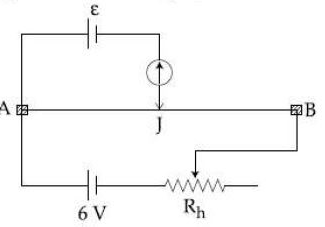
Physics · 4 marks · −1The resistance of the meter bridge AB in given figure is . With a cell of emf V and rheostat resistance the null point is obtained at some point J. When the cell is replaced by another one of emf the same null point J is found for . The emf is:
- A.0.3 V
- B.0.5 V
- C.0.4 V
- D.0.6 V
Correct answer: A
Question 27
Chemistry · 4 marks · −1Among the following compounds, which one is found in RNA?
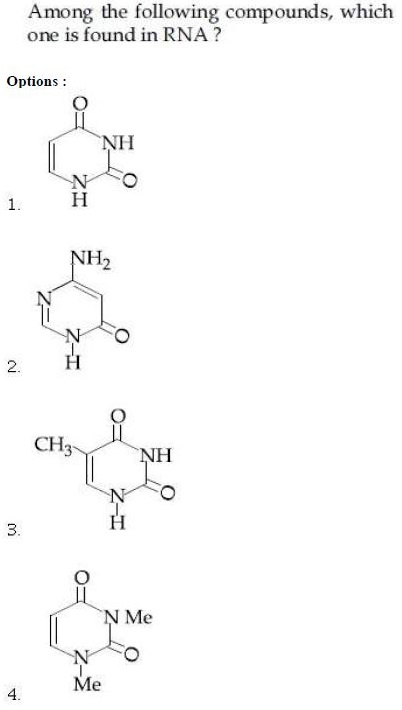
- A.Uracil (pyrimidine-2,4-dione ring with two N-H groups; structure drawn)
- B.Cytosine (4-amino-pyrimidin-2-one; structure drawn)
- C.Thymine (5-methyluracil; structure drawn)
- D.1,3-Dimethyluracil (uracil with both N-H replaced by N-Me; structure drawn)
Correct answer: A
Question 28
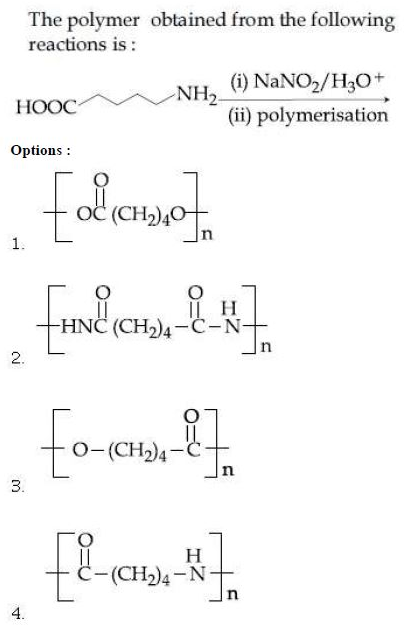
Chemistry · 4 marks · −1The polymer obtained from the following reactions is:
- A.
- B.
- C.
- D.
Correct answer: C
Question 29
Chemistry · 4 marks · −1The major product of the following reaction is: 4-methylacetophenone ()
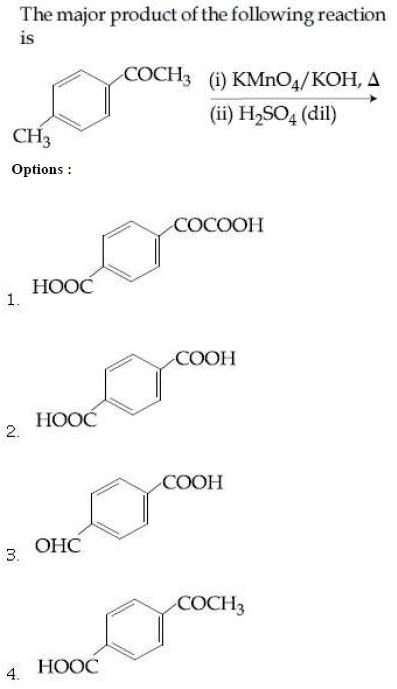
- A.
- B. (terephthalic acid)
- C.
- D.
Correct answer: B
Question 30
Chemistry · 4 marks · −1The major product of the following reaction is: 4-hydroxybenzenesulfonic acid
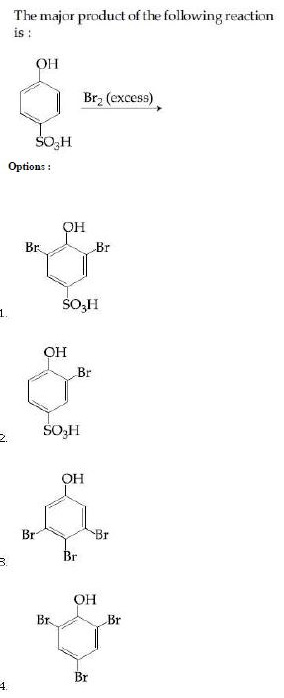
- A.2,6-Dibromo-4-hydroxybenzenesulfonic acid (Br ortho to OH on both sides, SOH retained)
- B.3-Bromo-4-hydroxybenzenesulfonic acid (one Br ortho to OH, SOH retained)
- C.3,4,5-Tribromophenol
- D.2,4,6-Tribromophenol
Correct answer: D
Question 31
Chemistry · 4 marks · −1The major product of the following reaction is: 5-chlorocyclohex-3-en-1-one
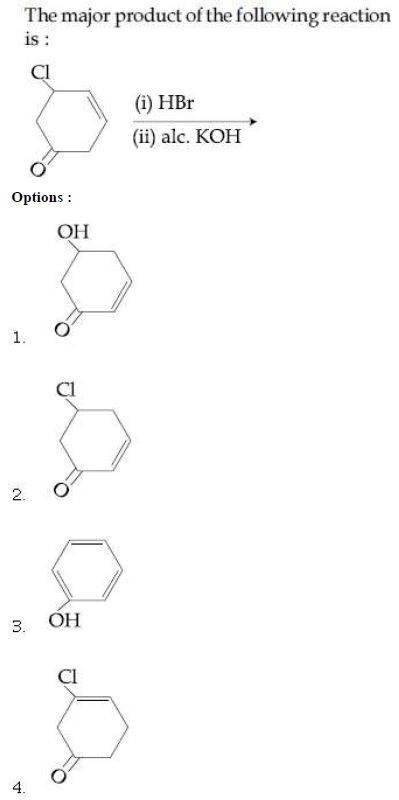
- A.5-Hydroxycyclohex-2-en-1-one
- B.5-Chlorocyclohex-2-en-1-one
- C.Phenol
- D.3-Chlorocyclohex-3-en-1-one (Cl on a ring C=C carbon)
Correct answer: C
Question 32
Chemistry · 4 marks · −1Which compound(s) out of the following is/are not aromatic? (A) cyclopropenyl cation (B) cyclopentadienyl cation (C) cycloheptatrienyl anion (D) cycloheptatriene
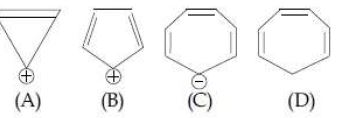
- A.(B)
- B.(A) and (C)
- C.(B), (C) and (D)
- D.(C) and (D)
Correct answer: C
Question 33
Chemistry · 4 marks · −1The major product of the following reaction is: ethyl 2-(cyanomethyl)benzoate
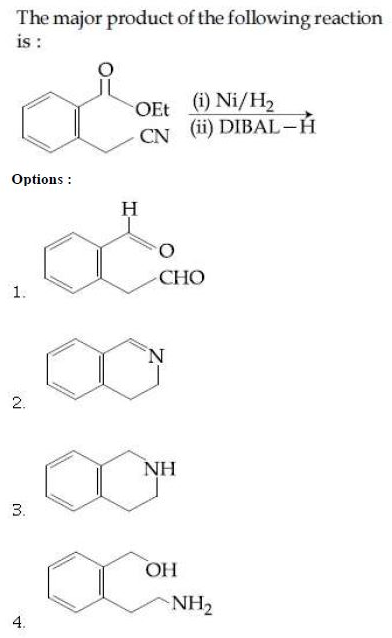
- A.2-(2-Oxoethyl)benzaldehyde ()
- B.3,4-Dihydroisoquinoline (cyclic imine fused to benzene)
- C.1,2,3,4-Tetrahydroisoquinoline
- D.2-(2-Aminoethyl)benzyl alcohol ()
Correct answer: B
Question 34
Chemistry · 4 marks · −1The correct match between items I and II is:<br>Item-I (Mixture): (A) HO : Sugar (B) HO : Aniline (C) HO : Toluene<br>Item-II (Separation method): (P) Sublimation (Q) Recrystallization (R) Steam distillation (S) Differential extraction
- A.(A)(R); (B)(P); (C)(S)
- B.(A)(S); (B)(R); (C)(P)
- C.(A)(Q); (B)(R); (C)(S)
- D.(A)(Q); (B)(R); (C)(P)
Correct answer: C
Question 35
Chemistry · 4 marks · −1The correct match between item (I) and item (II) is:<br>Item-I: (A) Norethindrone (B) Ofloxacin (C) Equanil<br>Item-II: (P) Anti-biotic (Q) Anti-fertility (R) Hypertension (S) Analgesics
- A.(A)(R); (B)(P); (C)(S)
- B.(A)(R); (B)(P); (C)(R)
- C.(A)(Q); (B)(R); (C)(S)
- D.(A)(Q); (B)(P); (C)(R)
Correct answer: D
Question 36
Chemistry · 4 marks · −1An organic compound is estimated through Dumas method and was found to evolve 6 moles of CO, 4 moles of HO and 1 mole of nitrogen gas. The formula of the compound is:
- A.CHN
- B.CHN
- C.CHN
- D.CHN
Correct answer: C
Question 37
Chemistry · 4 marks · −1The correct order of the atomic radii of C, Cs, Al, and S is:
- A.S < C < Cs < Al
- B.C < S < Al < Cs
- C.C < S < Cs < Al
- D.S < C < Al < Cs
Correct answer: B
Question 38
Chemistry · 4 marks · −1Match the ores (column A) with the metals (column B):<br>Column A (Ores): (I) Siderite (II) Kaolinite (III) Malachite (IV) Calamine<br>Column B (Metals): (a) Zinc (b) Copper (c) Iron (d) Aluminium
- A.(I)-(a); (II)-(b); (III)-(c); (IV)-(d)
- B.(I)-(c); (II)-(d); (III)-(b); (IV)-(a)
- C.(I)-(b); (II)-(c); (III)-(d); (IV)-(a)
- D.(I)-(c); (II)-(d); (III)-(a); (IV)-(b)
Correct answer: B
Question 39
Chemistry · 4 marks · −1NaH is an example of:
- A.metallic hydride
- B.molecular hydride
- C.saline hydride
- D.electron-rich hydride
Correct answer: C
Question 40
Chemistry · 4 marks · −1The correct statements among (a) to (d) regarding H as a fuel are:<br>(a) It produces less pollutants than petrol.<br>(b) A cylinder of compressed dihydrogen weighs ~30 times more than a petrol tank producing the same amount of energy.<br>(c) Dihydrogen is stored in tanks of metal alloys like NaNi.<br>(d) On combustion, values of energy released per gram of liquid dihydrogen and LPG are 50 and 142 kJ, respectively.
- A.(a) and (c) only
- B.(b), (c) and (d) only
- C.(b) and (d) only
- D.(a), (b) and (c) only
Correct answer: D
Question 41
Chemistry · 4 marks · −1The amphoteric hydroxide is:
- A.Be(OH)
- B.Mg(OH)
- C.Ca(OH)
- D.Sr(OH)
Correct answer: A
Question 42
Chemistry · 4 marks · −1The chloride that CANNOT get hydrolysed is:
- A.CCl
- B.SiCl
- C.SnCl
- D.PbCl
Correct answer: A
Question 43
Chemistry · 4 marks · −1The element that usually does NOT show variable oxidation states is:
- A.Sc
- B.Cu
- C.Ti
- D.V
Correct answer: A
Question 44
Chemistry · 4 marks · −1Match the metals (column I) with the coordination compound(s)/enzyme(s) (column II):<br>Column I (Metals): (A) Co (B) Zn (C) Rh (D) Mg<br>Column II: (i) Wilkinson catalyst (ii) Chlorophyll (iii) Vitamin B (iv) Carbonic anhydrase
- A.(A)-(ii); (B)-(i); (C)-(iv); (D)-(iii)
- B.(A)-(iv); (B)-(iii); (C)-(i); (D)-(ii)
- C.(A)-(i); (B)-(ii); (C)-(iii); (D)-(iv)
- D.(A)-(iii); (B)-(iv); (C)-(i); (D)-(ii)
Correct answer: D
Question 45
Chemistry · 4 marks · −1The concentration of dissolved oxygen (DO) in cold water can go upto:
- A.8 ppm
- B.10 ppm
- C.14 ppm
- D.16 ppm
Correct answer: B
Question 46
Chemistry · 4 marks · −1Peroxyacetyl nitrate (PAN), an eye irritant is produced by:
- A.acid rain
- B.organic waste
- C.photochemical smog
- D.classical smog
Correct answer: C
Question 47
Chemistry · 4 marks · −1A 10 mg effervescent tablet containing sodium bicarbonate and oxalic acid releases 0.25 ml of CO at K and bar. If molar volume of CO is 25.0 L under such condition, what is the percentage of sodium bicarbonate in each tablet? [Molar mass of NaHCO g mol]
- A.8.4
- B.0.84
- C.16.8
- D.33.6
Correct answer: A
Question 48
Chemistry · 4 marks · −1Heat treatment of muscular pain involves radiation of wavelength of about 900 nm. Which spectral line of H-atom is suitable for this purpose? [ cm, J s, m s]
- A.Lyman,
- B.Balmer,
- C.Paschen,
- D.Paschen,
Correct answer: D
Question 49
Chemistry · 4 marks · −1For the chemical reaction , the standard reaction Gibbs energy depends on temperature (in K) as . The major component of the reaction mixture at is:
- A.X if K
- B.Y if K
- C.X if K
- D.Y if K
Correct answer: C
Question 50
Chemistry · 4 marks · −1Two blocks of the same metal having same mass and at temperature and , respectively, are brought in contact with each other and allowed to attain thermal equilibrium at constant pressure. The change in entropy, , for this process is:
- A.
- B.
- C.
- D.
Correct answer: B
Question 51
Chemistry · 4 marks · −1The freezing point of a diluted milk sample is found to be C, while it should have been C for pure milk. How much water has been added to pure milk to make the diluted sample?
- A.1 cup of water to 2 cups of pure milk
- B.2 cups of water to 3 cups of pure milk
- C.3 cups of water to 2 cups of pure milk
- D.1 cup of water to 3 cups of pure milk
Correct answer: C
Question 52
Chemistry · 4 marks · −1Consider the reaction . The equilibrium constant of the above reaction is . If pure ammonia is left to dissociate, the partial pressure of ammonia at equilibrium is given by (Assume that at equilibrium)
- A.
- B.
- C.
- D.
Correct answer: D
Question 53
Chemistry · 4 marks · −1For the cell Zn(s)|Zn(aq)||M(aq)|M(s), different half cells and their standard electrode potentials are given below:<br>Au(aq)/Au(s): 1.40 V; Ag(aq)/Ag(s): 0.80 V; Fe(aq)/Fe(aq): 0.77 V; Fe(aq)/Fe(s): V.<br>If V, which cathode will give a maximum value of per electron transferred?
- A.Au/Au
- B.Ag/Ag
- C.Fe/Fe
- D.Fe/Fe
Correct answer: B
Question 54
Chemistry · 4 marks · −1If a reaction follows the Arrhenius equation, the plot vs gives straight line with a gradient unit. The energy required to activate the reactant is:
- A. unit
- B. unit
- C. unit
- D. unit
Correct answer: B
Question 55
Chemistry · 4 marks · −1An example of solid sol is:
- A.Gem stones
- B.Paint
- C.Butter
- D.Hair cream
Correct answer: A
Question 56
Mathematics · 4 marks · −1Let be defined by , . Then the range of is:
- A.
- B.
- C.
- D.
Correct answer: D
Question 57
Mathematics · 4 marks · −1If one real root of the quadratic equation is cube of the other root, then a value of is:
- A.
- B.100
- C.144
- D.
Correct answer: A
Question 58
Mathematics · 4 marks · −1Let , where and are real numbers, then equals:
- A.91
- B.85
- C.
- D.
Correct answer: A
Question 59
Mathematics · 4 marks · −1Let . If , then is:
- A.
- B.
- C.
- D.
Correct answer: A
Question 60
Mathematics · 4 marks · −1If the system of linear equations<br><br><br><br>where are non-zero real numbers, has more than one solution, then:
- A.
- B.
- C.
- D.
Correct answer: C
Question 61
Mathematics · 4 marks · −1The sum of the real values of for which the middle term in the binomial expansion of equals 5670 is:
- A.0
- B.4
- C.6
- D.8
Correct answer: A
Question 62
Mathematics · 4 marks · −1Let be a G.P. If , then equals:
- A.
- B.
- C.
- D.
Correct answer: D
Question 63
Mathematics · 4 marks · −1The sum of an infinite geometric series with positive terms is 3 and the sum of the cubes of its terms is . Then the common ratio of this series is:
- A.
- B.
- C.
- D.
Correct answer: D
Question 64
Mathematics · 4 marks · −1The value of for which is maximum, is:
- A.11
- B.15
- C.10
- D.20
Correct answer: D
Question 65
Mathematics · 4 marks · −1Let denote the greatest integer less than or equal to . Then: :
- A.equals
- B.equals 0
- C.equals
- D.does not exist
Correct answer: D
Question 66
Mathematics · 4 marks · −1If , then at is equal to:
- A.
- B.
- C.
- D.
Correct answer: A
Question 67
Mathematics · 4 marks · −1Let and . Then, in the interval , is:
- A.not continuous
- B.not differentiable at one point
- C.not differentiable at two points
- D.differentiable at all points
Correct answer: B
Question 68
Mathematics · 4 marks · −1The maximum value of the function on the set is:
- A.122
- B.
- C.222
- D.
Correct answer: A
Question 69
Mathematics · 4 marks · −1If , for a suitable chosen integer and a function , where is a constant of integration, then equals:
- A.
- B.
- C.
- D.
Correct answer: C
Question 70
Mathematics · 4 marks · −1The value of the integral (where denotes the greatest integer less than or equal to ) is:
- A.
- B.0
- C.4
- D.
Correct answer: B
Question 71
Mathematics · 4 marks · −1The area (in sq. units) of the region bounded by the curve and the straight line is:
- A.
- B.
- C.
- D.
Correct answer: B
Question 72
Mathematics · 4 marks · −1If is the solution of the differential equation , , where , then:
- A.
- B.
- C. is decreasing in
- D. is decreasing in
Correct answer: D
Question 73
Mathematics · 4 marks · −1Two circles with equal radii are intersecting at the points and . The tangent at the point to one of the circles passes through the centre of the other circle. Then the distance between the centres of these circles is:
- A.
- B.1
- C.2
- D.
Correct answer: C
Question 74
Mathematics · 4 marks · −1The straight line meets the coordinate axes at A and B. A circle is drawn through A, B and the origin. Then the sum of perpendicular distances from A and B on the tangent to the circle at the origin is:
- A.
- B.
- C.
- D.
Correct answer: D
Question 75
Mathematics · 4 marks · −1A square is inscribed in the circle with its sides parallel to the coordinate axes. Then the distance of the vertex of this square which is nearest to the origin is:
- A.6
- B.
- C.13
- D.
Correct answer: B
Question 76
Mathematics · 4 marks · −1The direction ratios of normal to the plane through the points and and making an angle with the plane are:
- A.
- B.
- C.
- D.
Correct answer: A
Question 77
Mathematics · 4 marks · −1Let , and be coplanar vectors. Then the non-zero vector is:
- A.
- B.
- C.
- D.
Correct answer: C
Question 78
Mathematics · 4 marks · −1The outcome of each of 30 items was observed; 10 items gave an outcome each, 10 items gave outcome each and the remaining 10 items gave outcome each. If the variance of this outcome data is then equals:
- A.
- B.2
- C.
- D.
Correct answer: A
Question 79
Mathematics · 4 marks · −1Two integers are selected at random from the set . Given that the sum of selected numbers is even, the conditional probability that both the numbers are even is:
- A.
- B.
- C.
- D.
Correct answer: A
Question 80
Mathematics · 4 marks · −1Let for Then for all , the value of is equal to:
- A.
- B.
- C.
- D.
Correct answer: A
Question 81
Mathematics · 4 marks · −1In a triangle, the sum of lengths of two sides is and the product of the lengths of the same two sides is . If , where is the length of the third side of the triangle, then the circumradius of the triangle is:
- A.
- B.
- C.
- D.
Correct answer: B
Question 82
Mathematics · 4 marks · −1If is false and is true, then which one of the following statements is a tautology?
- A.
- B.
- C.
- D.
Correct answer: C