JEE Main 2019 — 11 Jan Shift 2 (Previous Year Paper)
JEE Main · 2019 · with answers and explanations
- questions
- 88
- Total marks
- 352
- Duration
- 180 minutes
- Negative marking
- −1
Subjects: Physics · Chemistry · Mathematics
Question 1
Physics · 4 marks · −1If speed (V), acceleration (A) and force (F) are considered as fundamental units, the dimension of Young's modulus will be:
- A.
- B.
- C.
- D.
Correct answer: A
Question 2
Physics · 4 marks · −1A particle moves from the point m, at , with an initial velocity . It is acted upon by a constant force which produces a constant acceleration . What is the distance of the particle from the origin at time 2 s?
- A. m
- B.15 m
- C. m
- D.5 m
Correct answer: A
Question 3
Physics · 4 marks · −1The magnitude of torque on a particle of mass 1 kg is 2.5 Nm about the origin. If the force acting on it is 1 N, and the distance of the particle from the origin is 5 m, the angle between the force and the position vector is (in radians):
- A.
- B.
- C.
- D.
Correct answer: B
Question 4
Physics · 4 marks · −1A particle of mass is moving in a straight line with momentum . Starting at time , a force acts in the same direction on the moving particle during time interval so that its momentum changes from to . Here is a constant. The value of is:
- A.
- B.
- C.
- D.
Correct answer: B
Question 5
Physics · 4 marks · −1A particle of mass and charge is in an electric and magnetic field given by ; . The charged particle is shifted from the origin to the point along a straight path. The magnitude of the total work done is:
- A.
- B.
- C.
- D.
Correct answer: A
Question 6
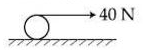
Physics · 4 marks · −1A string is wound around a hollow cylinder of mass 5 kg and radius 0.5 m. If the string is now pulled with a horizontal force of 40 N, and the cylinder is rolling without slipping on a horizontal surface (see figure), then the angular acceleration of the cylinder will be (Neglect the mass and thickness of the string):
- A.10 rad/s
- B.12 rad/s
- C.16 rad/s
- D.20 rad/s
Correct answer: C
Question 7
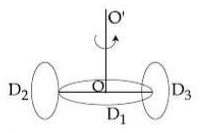
Physics · 4 marks · −1A circular disc of mass and radius has two identical discs and of the same mass and radius attached rigidly at its opposite ends (see figure). The moment of inertia of the system about the axis , passing through the centre of , as shown in the figure, will be:
- A.
- B.
- C.
- D.
Correct answer: C
Question 8
Physics · 4 marks · −1The mass and the diameter of a planet are three times the respective values for the Earth. The period of oscillation of a simple pendulum on the Earth is 2 s. The period of oscillation of the same pendulum on the planet would be:
- A. s
- B. s
- C. s
- D. s
Correct answer: D
Question 9
Physics · 4 marks · −1When 100 g of a liquid A at C is added to 50 g of a liquid B at temperature C, the temperature of the mixture becomes C. The temperature of the mixture, if 100 g of liquid A at C is added to 50 g of liquid B at C, will be:
- A.C
- B.C
- C.C
- D.C
Correct answer: C
Question 10
Physics · 4 marks · −1In a process, temperature and volume of one mole of an ideal monoatomic gas are varied according to the relation , where is a constant. In this process the temperature of the gas is increased by . The amount of heat absorbed by gas is ( is gas constant):
- A.
- B.
- C.
- D.
Correct answer: A
Question 11
Physics · 4 marks · −1A metal ball of mass 0.1 kg is heated upto C and dropped into a vessel of heat capacity 800 J K and containing 0.5 kg water. The initial temperature of water and vessel is C. What is the approximate percentage increment in the temperature of the water? [Specific Heat Capacities of water and metal are, respectively, 4200 J kgK and 400 J kgK]
- A.30%
- B.25%
- C.15%
- D.20%
Correct answer: D
Question 12
Physics · 4 marks · −1A pendulum is executing simple harmonic motion and its maximum kinetic energy is . If the length of the pendulum is doubled and it performs simple harmonic motion with the same amplitude as in the first case, its maximum kinetic energy is . Then:
- A.
- B.
- C.
- D.
Correct answer: C
Question 13
Physics · 4 marks · −1A simple pendulum of length 1 m is oscillating with an angular frequency 10 rad/s. The support of the pendulum starts oscillating up and down with a small angular frequency of 1 rad/s and an amplitude of m. The relative change in the angular frequency of the pendulum is best given by:
- A. rad/s
- B. rad/s
- C. rad/s
- D.1 rad/s
Correct answer: B
Question 14
Physics · 4 marks · −1Seven capacitors, each of capacitance F, are to be connected in a configuration to obtain an effective capacitance of F. Which of the combinations, shown in figures below, will achieve the desired value?
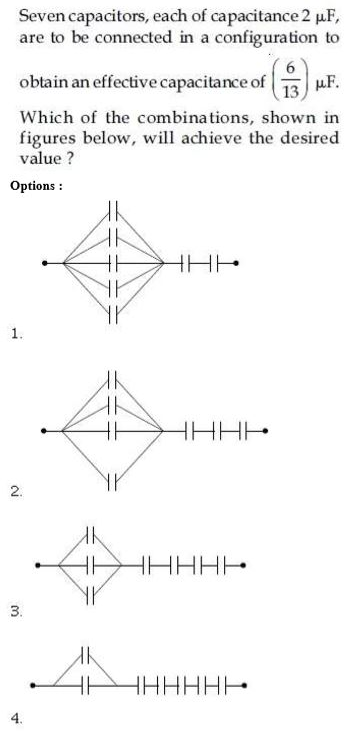
- A.Figure: 5 capacitors in parallel, followed in series by 2 capacitors.
- B.Figure: 4 capacitors in parallel, followed in series by 3 capacitors.
- C.Figure: 3 capacitors in parallel, followed in series by 4 capacitors.
- D.Figure: 2 capacitors in parallel, followed in series by 5 capacitors.
Correct answer: C
Question 15
Physics · 4 marks · −1An electric field of 1000 V/m is applied to an electric dipole at angle of . The value of electric dipole moment is C m. What is the potential energy of the electric dipole?
- A. J
- B. J
- C. J
- D. J
Correct answer: A
Question 16
Physics · 4 marks · −1Two rods A and B of identical dimensions are at temperature C. If A is heated upto C and B upto C, then the new lengths are the same. If the ratio of the coefficients of linear expansion of A and B is 4 : 3, then the value of is:
- A.C
- B.C
- C.C
- D.C
Correct answer: B
Question 17
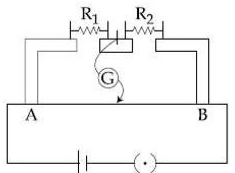
Physics · 4 marks · −1In the experimental set up of metre bridge shown in the figure, the null point is obtained at a distance of 40 cm from A. If a resistor is connected in series with , the null point shifts by 10 cm. The resistance that should be connected in parallel with such that the null point shifts back to its initial position is:
- A.
- B.
- C.
- D.
Correct answer: A
Question 18
Physics · 4 marks · −1In the circuit shown, the potential difference between A and B is:
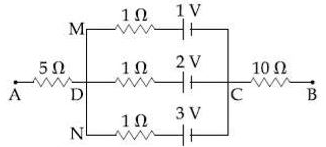
- A.2 V
- B.3 V
- C.6 V
- D.1 V
Correct answer: A
Question 19
Physics · 4 marks · −1A paramagnetic substance in the form of a cube with sides 1 cm has a magnetic dipole moment of J/T when a magnetic intensity of A/m is applied. Its magnetic susceptibility is:
- A.
- B.
- C.
- D.
Correct answer: D
Question 20
Physics · 4 marks · −1The region between and contains a magnetic field . A particle of mass and charge enters the region with a velocity . If , the acceleration of the charged particle at the point of its emergence at the other side is:
- A.
- B.
- C.
- D.
Correct answer: A
Question 21
Physics · 4 marks · −1A copper wire is wound on a wooden frame, whose shape is that of an equilateral triangle. If the linear dimension of each side of the frame is increased by a factor of 3, keeping the number of turns of the coil per unit length of the frame the same, then the self inductance of the coil:
- A.increases by a factor of 3
- B.decreases by a factor of 9
- C.increases by a factor of 27
- D.decreases by a factor of
Correct answer: C
Question 22
Physics · 4 marks · −1A 27 mW laser beam has a cross-sectional area of 10 mm. The magnitude of the maximum electric field in this electromagnetic wave is given by: [Given permittivity of space SI units, Speed of light m/s]
- A.1.4 kV/m
- B.1 kV/m
- C.2 kV/m
- D.0.7 kV/m
Correct answer: A
Question 23
Physics · 4 marks · −1A monochromatic light is incident at a certain angle on an equilateral triangular prism and suffers minimum deviation. If the refractive index of the material of the prism is , then the angle of incidence is:
- A.
- B.
- C.
- D.
Correct answer: C
Question 24
Physics · 4 marks · −1In a photoelectric experiment, the wavelength of the light incident on a metal is changed from 300 nm to 400 nm. The decrease in the stopping potential is close to: ( nm-V)
- A.1.0 V
- B.2.0 V
- C.0.5 V
- D.1.5 V
Correct answer: A
Question 25
Physics · 4 marks · −1In a hydrogen like atom, when an electron jumps from the M-shell to the L-shell, the wavelength of emitted radiation is . If an electron jumps from N-shell to the L-shell, the wavelength of emitted radiation will be:
- A.
- B.
- C.
- D.
Correct answer: C
Question 26
Physics · 4 marks · −1The circuit shown below contains two ideal diodes, each with a forward resistance of . If the battery voltage is 6 V, the current through the resistance (in Amperes) is:
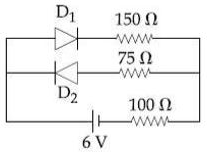
- A.0.020
- B.0.027
- C.0.030
- D.0.036
Correct answer: A
Question 27
Physics · 4 marks · −1An amplitude modulated signal is plotted below: [graph of with maximum amplitude 10 V, minimum amplitude 8 V, envelope period 100 s and carrier period 8 s]. Which one of the following best describes the above signal?
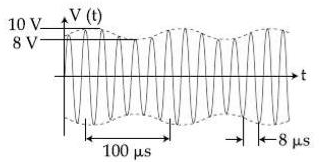
- A. V
- B. V
- C. V
- D. V
Correct answer: D
Question 28
Physics · 4 marks · −1A galvanometer having a resistance of and 30 divisions on both sides has figure of merit 0.005 ampere/division. The resistance that should be connected in series such that it can be used as a voltmeter upto 15 volt, is:
- A.
- B.
- C.
- D.
Correct answer: A
Question 29
Physics · 4 marks · −1A thermometer graduated according to a linear scale reads a value when in contact with boiling water, and when in contact with ice. What is the temperature of an object in C, if this thermometer in the contact with the object reads ?
- A.60
- B.25
- C.35
- D.40
Correct answer: B
Question 30
Chemistry · 4 marks · −1Which of the following compounds reacts with ethylmagnesium bromide and also decolourizes bromine water solution:
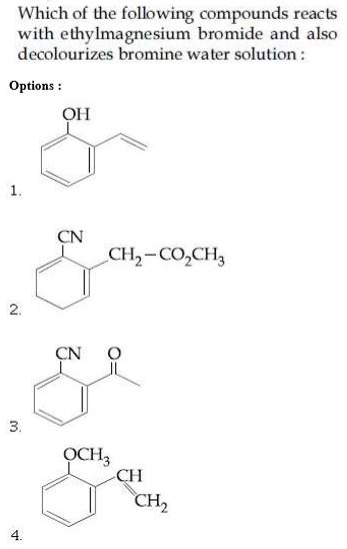
- A.2-Vinylphenol (benzene ring with OH and an adjacent CH=CH)
- B.Cyclohexene ring bearing CN and CHCOCH on adjacent carbons
- C.2-Acetylbenzonitrile (benzene ring with CN and an adjacent COCH)
- D.2-Methoxystyrene (benzene ring with OCH and an adjacent CH=CH)
Correct answer: A
Question 31
Chemistry · 4 marks · −1The correct match between Item I and Item II is:<br>Item I: (A) Ester test (B) Carbylamine test (C) Phthalein dye test<br>Item II: (P) Tyr (Q) Asp (R) Ser (S) Lys
- A.(A)(Q); (B)(S); (C)(R)
- B.(A)(Q); (B)(S); (C)(P)
- C.(A)(R); (B)(Q); (C)(P)
- D.(A)(R); (B)(S); (C)(Q)
Correct answer: B
Question 32
Chemistry · 4 marks · −1The homopolymer formed from 4-hydroxybutanoic acid is:
- A.
- B.
- C.
- D.
Correct answer: D
Question 33
Chemistry · 4 marks · −1In the following compound (adenine, with sites labelled: (a) the exocyclic NH, (b) and (c) the two pyrimidine-ring N atoms, (d) the imidazole-ring N=, (e) the imidazole N-H), the favourable site/s for protonation is/are:
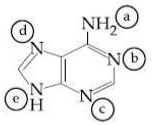
- A.(a)
- B.(a) and (e)
- C.(b), (c) and (d)
- D.(a) and (d)
Correct answer: C
Question 34
Chemistry · 4 marks · −1A compound 'X' on treatment with Br/NaOH, provided CHN, which gives positive carbylamine test. Compound 'X' is:
- A.CHCHCOCHNH
- B.CHCHCHCONH
- C.CHCON(CH)
- D.CHCOCHNHCH
Correct answer: B
Question 35
Chemistry · 4 marks · −1The major product obtained in the following reaction is: [cyclohexane ring bearing COOH, CH=CH, COCH and NO groups]
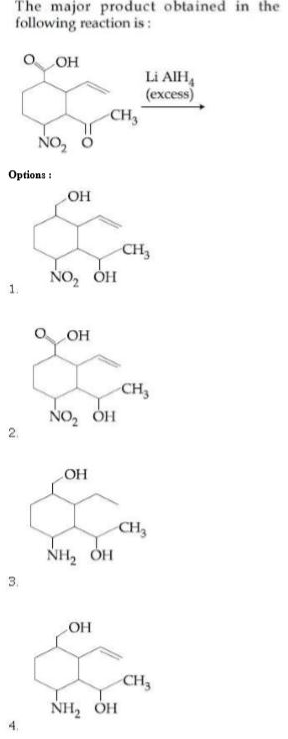
- A.COOH reduced to CHOH and COCH reduced to CH(OH)CH; NO and CH=CH unchanged
- B.COOH unchanged, COCH reduced to CH(OH)CH; NO and CH=CH unchanged
- C.CHOH, CH(OH)CH, NH, and the vinyl group reduced to ethyl
- D.CHOH, CH(OH)CH and NH (NO reduced); CH=CH unchanged
Correct answer: D
Question 36
Chemistry · 4 marks · −1The major product of the following reaction is: 3-(but-3-en-1-yl)phenol
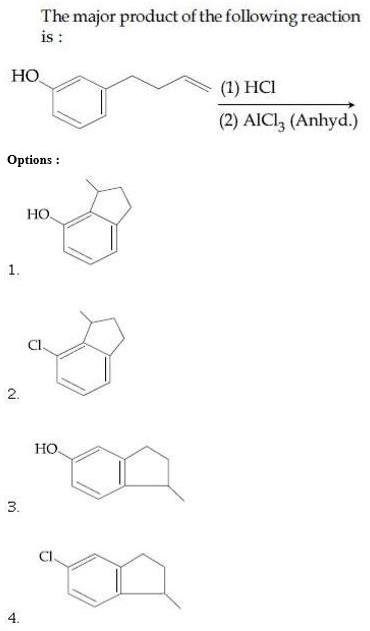
- A.Indane with a methyl group at C-1 and OH on the benzene ring adjacent (ortho) to the ring fusion near C-1
- B.Same indane skeleton as option 1 but with Cl in place of OH
- C.Indane with a methyl group at C-1 and OH on the benzene ring para to the C-1 ring-fusion carbon (1-methylindan-5-ol type)
- D.Same indane skeleton as option 3 but with Cl in place of OH
Correct answer: C
Question 37
Chemistry · 4 marks · −1The major product obtained in the following conversion is: 2-(but-2-enoyl)phenyl acetate
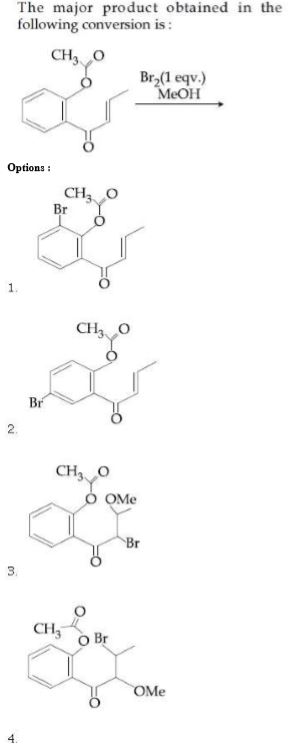
- A.Ring-brominated: Br ortho to the acetoxy group, side chain unchanged
- B.Ring-brominated: Br para to the acetoxy group, side chain unchanged
- C.Ar-CO-CH(Br)-CH(OMe)-CH (Br on the carbon next to C=O, OMe on the next carbon)
- D.Ar-CO-CH(OMe)-CH(Br)-CH (OMe on the carbon next to C=O, Br on the next carbon)
Correct answer: C
Question 38
Chemistry · 4 marks · −1Which of the following compounds will produce a precipitate with AgNO?
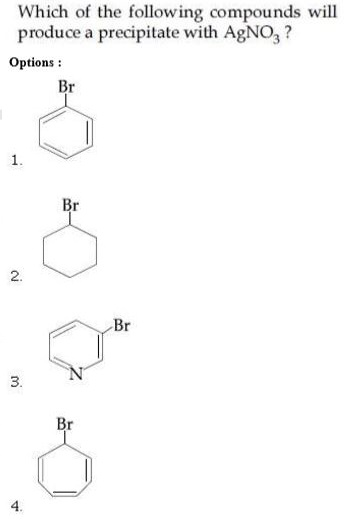
- A.Bromobenzene
- B.Bromocyclohexane
- C.3-Bromopyridine
- D.7-Bromocyclohepta-1,3,5-triene (tropylium bromide)
Correct answer: D
Question 39
Chemistry · 4 marks · −1The correct match between Item I and Item II is:<br>Item I: (A) Allosteric effect (B) Competitive inhibitor (C) Receptor (D) Poison<br>Item II: (P) Molecule binding to the active site of enzyme (Q) Molecule crucial for communication in the body (R) Molecule binding to a site other than the active site of enzyme (S) Molecule binding to the enzyme covalently
- A.(A)(P); (B)(R); (C)(Q); (D)(S)
- B.(A)(P); (B)(R); (C)(S); (D)(Q)
- C.(A)(R); (B)(P); (C)(Q); (D)(S)
- D.(A)(R); (B)(P); (C)(S); (D)(Q)
Correct answer: C
Question 40
Chemistry · 4 marks · −1The correct option with respect to the Pauling electronegativity values of the elements is:
- A.Te > Se
- B.P > S
- C.Si < Al
- D.Ga < Ge
Correct answer: D
Question 41
Chemistry · 4 marks · −1The reaction that does NOT define calcination is:
- A.
- B.
- C.
- D.
Correct answer: D
Question 42
Chemistry · 4 marks · −1The hydride that is NOT electron deficient is:
- A.SiH
- B.AlH
- C.BH
- D.GaH
Correct answer: A
Question 43
Chemistry · 4 marks · −1Match the following items in column I with the corresponding items in column II.<br>Column I: (i) NaCO$_3\cdot_2_3_2$ (iii) NaOH (iv) CaAlO<br>Column II: (A) Portland cement ingredient (B) Castner-Kellner process (C) Solvay process (D) Temporary hardness
- A.(i)(B); (ii)(C); (iii)(A); (iv)(D)
- B.(i)(C); (ii)(B); (iii)(D); (iv)(A)
- C.(i)(C); (ii)(D); (iii)(B); (iv)(A)
- D.(i)(D); (ii)(A); (iii)(B); (iv)(C)
Correct answer: C
Question 44
Chemistry · 4 marks · −1<br><br><br>In the above sequence of reactions, and , respectively, are:
- A.KI and KMnO
- B.MnO and KIO
- C.KIO and MnO
- D.KI and KMnO
Correct answer: B
Question 45
Chemistry · 4 marks · −1The number of bridging CO ligand(s) and Co-Co bond(s) in Co(CO), respectively are:
- A.0 and 2
- B.2 and 0
- C.2 and 1
- D.4 and 0
Correct answer: C
Question 46
Chemistry · 4 marks · −1The coordination number of Th in K[Th(CO)(OH)] is: (CO = Oxalato)
- A.6
- B.8
- C.10
- D.14
Correct answer: C
Question 47
Chemistry · 4 marks · −1Taj Mahal is being slowly disfigured and discoloured. This is primarily due to:
- A.soil pollution
- B.global warming
- C.acid rain
- D.water pollution
Correct answer: C
Question 48
Chemistry · 4 marks · −1The higher concentration of which gas in air can cause stiffness of flower buds?
- A.SO
- B.CO
- C.NO
- D.CO
Correct answer: A
Question 49
Chemistry · 4 marks · −125 ml of the given HCl solution requires 30 mL of 0.1 M sodium carbonate solution. What is the volume of this HCl solution required to titrate 30 mL of 0.2 M aqueous NaOH solution?
- A.25 mL
- B.50 mL
- C.75 mL
- D.12.5 mL
Correct answer: A
Question 50
Chemistry · 4 marks · −1The radius of the largest sphere which fits properly at the centre of the edge of a body centred cubic unit cell is: (Edge length is represented by )
- A.0.134 a
- B.0.067 a
- C.0.027 a
- D.0.047 a
Correct answer: B
Question 51
Chemistry · 4 marks · −1The de Broglie wavelength () associated with a photoelectron varies with the frequency () of the incident radiation as, [ is threshold frequency]:
- A.
- B.
- C.
- D.
Correct answer: A
Question 52
Chemistry · 4 marks · −1The standard reaction Gibbs energy for a chemical reaction at an absolute temperature is given by , where A and B are non-zero constants. Which of the following is TRUE about this reaction?
- A.Endothermic if
- B.Exothermic if
- C.Endothermic if and
- D.Exothermic if and
Correct answer: A
Question 53
Chemistry · 4 marks · −1The reaction, , for which kJ mol and J K mol, is not feasible at 298 K. Temperature above which reaction will be feasible is:
- A.2040.5 K
- B.2480.3 K
- C.2380.5 K
- D.1890.0 K
Correct answer: B
Question 54
Chemistry · 4 marks · −1KHgI is 40% ionised in aqueous solution. The value of its van't Hoff factor () is:
- A.1.6
- B.1.8
- C.2.0
- D.2.2
Correct answer: B
Question 55
Chemistry · 4 marks · −1For the equilibrium, , the value of at 298 K is approximately:
- A. kJ mol
- B. kJ mol
- C.80 kJ mol
- D.100 kJ mol
Correct answer: C
Question 56
Chemistry · 4 marks · −1Given the equilibrium constant of the reaction: is , calculate the of this reaction at 298 K. [ at 298 K V]
- A.0.04736 V
- B.0.4736 V
- C.0.04736 mV
- D.0.4736 mV
Correct answer: B
Question 57
Chemistry · 4 marks · −1The reaction is a zeroth order reaction. If the initial concentration of X is 0.2 M, the half-life is 6 h. When the initial concentration of X is 0.5 M, the time required to reach its final concentration of 0.2 M will be:
- A.7.2 h
- B.18.0 h
- C.9.0 h
- D.12.0 h
Correct answer: B
Question 58
Chemistry · 4 marks · −1Among the colloids cheese (C), milk (M) and smoke (S), the correct combination of the dispersed phase and dispersion medium, respectively is:
- A.C: solid in liquid; M: liquid in liquid; S: gas in solid
- B.C: solid in liquid; M: solid in liquid; S: solid in gas
- C.C: liquid in solid; M: liquid in solid; S: solid in gas
- D.C: liquid in solid; M: liquid in liquid; S: solid in gas
Correct answer: D
Question 59
Mathematics · 4 marks · −1Let a function be defined by . Then is:
- A.injective only
- B.not injective but it is surjective
- C.neither injective nor surjective
- D.both injective as well as surjective
Correct answer: B
Question 60
Mathematics · 4 marks · −1Let be a complex number such that (where ). Then is equal to:
- A.
- B.
- C.
- D.
Correct answer: A
Question 61
Mathematics · 4 marks · −1Let and be the roots of the quadratic equation , and . Then is equal to:
- A.
- B.
- C.
- D.
Correct answer: D
Question 62
Mathematics · 4 marks · −1Let A and B be two invertible matrices of order . If and , then is equal to:
- A.1
- B.
- C.16
- D.
Correct answer: D
Question 63
Mathematics · 4 marks · −1If , and , then is equal to:
- A.
- B.
- C.
- D.
Correct answer: D
Question 64
Mathematics · 4 marks · −1The number of functions from onto such that is a multiple of 3, whenever is a multiple of 4, is:
- A.
- B.
- C.
- D.
Correct answer: D
Question 65
Mathematics · 4 marks · −1Let , for all ; then is equal to:
- A.12.75
- B.12.50
- C.12.25
- D.12.00
Correct answer: C
Question 66
Mathematics · 4 marks · −1If 19th term of a non-zero A.P. is zero, then its (49th term) : (29th term) is:
- A.4 : 1
- B.1 : 3
- C.2 : 1
- D.3 : 1
Correct answer: D
Question 67
Mathematics · 4 marks · −1Let and where is a real number and . If , then is equal to:
- A.202
- B.200
- C.
- D.
Correct answer: C
Question 68
Mathematics · 4 marks · −1is equal to:
- A.2
- B.0
- C.1
- D.4
Correct answer: C
Question 69
Mathematics · 4 marks · −1Let K be the set of all real values of where the function is not differentiable. Then the set K is equal to:
- A.
- B.
- C.
- D. (an empty set)
Correct answer: D
Question 70
Mathematics · 4 marks · −1Let , , where , and are non-zero real constants. Then:
- A. is an increasing function of
- B. is neither increasing nor decreasing function of
- C. is a decreasing function of
- D. is not a continuous function of
Correct answer: A
Question 71
Mathematics · 4 marks · −1Let be positive real numbers and positive integers. The maximum value of the expression is:
- A.
- B.1
- C.
- D.
Correct answer: A
Question 72
Mathematics · 4 marks · −1If , where C is a constant of integration, then is equal to:
- A.
- B.
- C.
- D.
Correct answer: D
Question 73
Mathematics · 4 marks · −1The integral equals:
- A.
- B.
- C.
- D.
Correct answer: A
Question 74
Mathematics · 4 marks · −1The area (in sq. units) in the first quadrant bounded by the parabola, , the tangent to it at the point and the coordinate axes is:
- A.
- B.
- C.
- D.
Correct answer: A
Question 75
Mathematics · 4 marks · −1The solution of the differential equation, , when , is:
- A.
- B.
- C.
- D.
Correct answer: A
Question 76
Mathematics · 4 marks · −1If in a parallelogram ABDC, the coordinates of A, B and C are respectively , and , then the equation of the diagonal AD is:
- A.
- B.
- C.
- D.
Correct answer: B
Question 77
Mathematics · 4 marks · −1Let the length of the latus rectum of an ellipse with its major axis along -axis and centre at the origin, be 8. If the distance between the foci of this ellipse is equal to the length of its minor axis, then which one of the following points lies on it?
- A.
- B.
- C.
- D.
Correct answer: D
Question 78
Mathematics · 4 marks · −1A circle cuts a chord of length on the -axis and passes through a point on the -axis, distant from the origin. Then the locus of the centre of this circle, is:
- A.a straight line
- B.an ellipse
- C.a parabola
- D.a hyperbola
Correct answer: C
Question 79
Mathematics · 4 marks · −1If the area of the triangle whose one vertex is at the vertex of the parabola, and the other two vertices are the points of intersection of the parabola and -axis, is 250 sq. units, then a value of is:
- A.
- B.
- C.5
- D.
Correct answer: C
Question 80
Mathematics · 4 marks · −1If a hyperbola has length of its conjugate axis equal to 5 and the distance between its foci is 13, then the eccentricity of the hyperbola is:
- A.
- B.2
- C.
- D.
Correct answer: D
Question 81
Mathematics · 4 marks · −1Two lines and intersect at the point R. The reflection of R in the -plane has coordinates:
- A.
- B.
- C.
- D.
Correct answer: A
Question 82
Mathematics · 4 marks · −1If the point lies on the plane which passes through the points and and is perpendicular to the plane , then is equal to:
- A.17
- B.12
- C.5
- D.7
Correct answer: D
Question 83
Mathematics · 4 marks · −1Let , and respectively be the position vectors of the points A, B and C with respect to the origin O. If the distance of C from the bisector of the acute angle between OA and OB is , then the sum of all possible values of is:
- A.1
- B.2
- C.3
- D.4
Correct answer: A
Question 84
Mathematics · 4 marks · −1A bag contains 30 white balls and 10 red balls. 16 balls are drawn one by one randomly from the bag with replacement. If X be the number of white balls drawn, then is equal to:
- A.
- B.
- C.
- D.4
Correct answer: C
Question 85
Mathematics · 4 marks · −1Let . A subset B of S is said to be \"nice\", if the sum of the elements of B is 203. Then the probability that a randomly chosen subset of S is \"nice\" is:
- A.
- B.
- C.
- D.
Correct answer: A
Question 86
Mathematics · 4 marks · −1Given for a with usual notation. If , then the ordered triad has a value:
- A.
- B.
- C.
- D.
Correct answer: C
Question 87
Mathematics · 4 marks · −1All satisfying the inequality , lie in the interval:
- A.
- B.
- C.
- D.
Correct answer: B
Question 88
Mathematics · 4 marks · −1Contrapositive of the statement \"If two numbers are not equal, then their squares are not equal.\" is:
- A.If the squares of two numbers are equal, then the numbers are not equal.
- B.If the squares of two numbers are not equal, then the numbers are not equal.
- C.If the squares of two numbers are not equal, then the numbers are equal.
- D.If the squares of two numbers are equal, then the numbers are equal.
Correct answer: D