JEE Main 2019 — 12 Apr Shift 1 (Previous Year Paper)
JEE Main · 2019 · with answers and explanations
- questions
- 89
- Total marks
- 356
- Duration
- 180 minutes
- Negative marking
- −1
Subjects: Physics · Chemistry · Mathematics
Question 1
Physics · 4 marks · −1Which of the following combinations has the dimension of electrical resistance ( is the permittivity of vacuum and is the permeability of vacuum)?
- A.
- B.
- C.
- D.
Correct answer: C
Question 2
Physics · 4 marks · −1The trajectory of a projectile near the surface of the earth is given as . If it were launched at an angle with speed then ():
- A. and
- B. and
- C. and
- D. and
Correct answer: B
Question 3
Physics · 4 marks · −1A man (mass = 50 kg) and his son (mass = 20 kg) are standing on a frictionless surface facing each other. The man pushes his son so that he starts moving at a speed of with respect to the man. The speed of the man with respect to the surface is:
- A.0.20
- B.0.28
- C.0.47
- D.0.14
Correct answer: A
Question 4
Physics · 4 marks · −1A person of mass M is, sitting on a swing of length L and swinging with an angular amplitude . If the person stands up when the swing passes through its lowest point, the work done by him, assuming that his centre of mass moves by a distance , is close to:
- A.
- B.
- C.
- D.
Correct answer: D
Question 5
Physics · 4 marks · −1A circular disc of radius has a hole of radius at its centre (see figure). If the mass per unit area of the disc varies as , then the radius of gyration of the disc about its axis passing through the centre is:
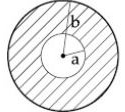
- A.
- B.
- C.
- D.
Correct answer: D
Question 6
Physics · 4 marks · −1A uniform rod of length is being rotated in a horizontal plane with a constant angular speed about an axis passing through one of its ends. If the tension generated in the rod due to rotation is at a distance from the axis, then which of the following graphs depicts it most closely?
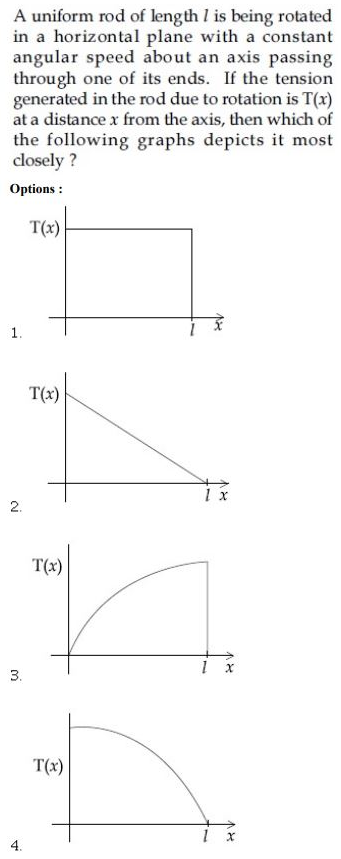
- A.Graph 1: constant from to
- B.Graph 2: decreasing linearly from a maximum at to zero at
- C.Graph 3: increasing from zero at , concave down, to a maximum at
- D.Graph 4: maximum at , decreasing as a downward parabola (concave down) to zero at
Correct answer: D
Question 7
Physics · 4 marks · −1A shell is fired from a fixed artillery gun with an initial speed such that it hits the target on the ground at a distance R from it. If and are the values of the time taken by it to hit the target in two possible ways, the product is:
- A.
- B.
- C.
- D.
Correct answer: C
Question 8
Physics · 4 marks · −1At 40°C, a brass wire of 1 mm radius is hung from the ceiling. A small mass, M is hung from the free end of the wire. When the wire is cooled down from 40°C to 20°C it regains its original length of 0.2 m. The value of M is close to: (Coefficient of linear expansion and Young's modulus of brass are /°C and , respectively; )
- A.9 kg
- B.1.5 kg
- C.0.9 kg
- D.0.5 kg
Correct answer: A
Explanation: N, so kg; the nearest option is 9 kg.
Question 9
Physics · 4 marks · −1When gram of ice at −10°C (specific heat ) is added to gram of water at 50°C, finally no ice is left and the water is at 0°C. The value of latent heat of ice, in cal is:
- A.
- B.
- C.
- D.
Correct answer: D
Question 10
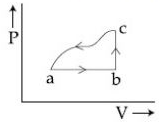
Physics · 4 marks · −1A sample of an ideal gas is taken through the cyclic process abca as shown in the figure. The change in the internal energy of the gas along the path ca is −180 J. The gas absorbs 250 J of heat along the path ab and 60 J along the path bc. The work done by the gas along the path abc is:
- A.100 J
- B.120 J
- C.130 J
- D.140 J
Correct answer: C
Question 11
Physics · 4 marks · −1Two moles of helium gas is mixed with three moles of hydrogen molecules (taken to be rigid). What is the molar specific heat of mixture at constant volume? ( J/mol K)
- A.15.7 J/mol K
- B.17.4 J/mol K
- C.19.7 J/mol K
- D.21.6 J/mol K
Correct answer: B
Question 12
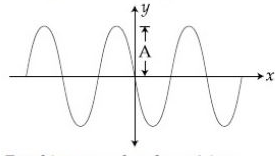
Physics · 4 marks · −1A progressive wave travelling along the positive -direction is represented by . Its snapshot at is given in the figure. For this wave, the phase is:
- A.0
- B.
- C.
- D.
Correct answer: D
Question 13
Physics · 4 marks · −1A submarine (A) travelling at 18 km/hr is being chased along the line of its velocity by another submarine (B) travelling at 27 km/hr. B sends a sonar signal of 500 Hz to detect A and receives a reflected sound of frequency . The value of is close to: (Speed of sound in water )
- A.502 Hz
- B.499 Hz
- C.504 Hz
- D.507 Hz
Correct answer: A
Question 14
Physics · 4 marks · −1A point dipole is kept at the origin. The potential and electric field due to this dipole on the -axis at a distance are, respectively: (Take V = 0 at infinity)
- A.,
- B.,
- C.,
- D.,
Correct answer: C
Question 15
Physics · 4 marks · −1Shown in the figure is a shell made of a conductor. It has inner radius and outer radius , and carries charge Q. At its centre is a dipole as shown. In this case:
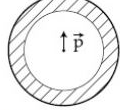
- A.surface charge density on the inner surface of the shell is zero everywhere
- B.surface charge density on the outer surface depends on
- C.surface charge density on the inner surface is uniform and equal to
- D.electric field outside the shell is the same as that of a point charge at the centre of the shell
Correct answer: D
Question 16
Physics · 4 marks · −1Two identical parallel plate capacitors, of capacitance C each, have plates of area A, separated by a distance d. The space between the plates of the two capacitors, is filled with three dielectrics, of equal thickness and dielectric constants , and . The first capacitor is filled as shown in fig. I, and the second one is filled as shown in fig II. If these two modified capacitors are charged by the same potential V, the ratio of the energy stored in the two, would be ( refers to capacitor (I) and to capacitor (II)):
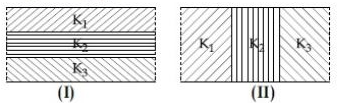
- A.
- B.
- C.
- D.
Correct answer: A
Question 17
Physics · 4 marks · −1To verify Ohm's law, a student connects the voltmeter across the battery as, shown in the figure. The measured voltage is plotted as a function of the current, and the following graph is obtained. If is almost zero, identify the correct statement:
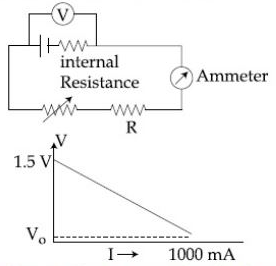
- A.The value of the resistance R is 1.5
- B.The emf of the battery is 1.5 V and its internal resistance is 1.5
- C.The potential difference across the battery is 1.5 V when it sends a current of 1000 mA
- D.The emf of the battery is 1.5 V and the value of R is 1.5
Correct answer: B
Question 18
Physics · 4 marks · −1The resistive network shown below is connected to a D.C. source of 16 V. The power consumed by the network is 4 Watt. The value of R is:
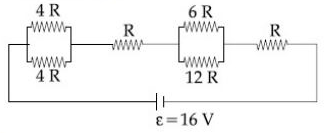
- A.6
- B.8
- C.1
- D.16
Correct answer: B
Question 19
Physics · 4 marks · −1A thin ring of 10 cm radius carries a uniformly distributed charge. The ring rotates at a constant angular speed of about its axis, perpendicular to its plane. If the magnetic field at its centre is T, then the charge carried by the ring is close to ().
- A. C
- B. C
- C. C
- D. C
Correct answer: D
Question 20
Physics · 4 marks · −1A galvanometer of resistance 100 has 50 divisions on its scale and has sensitivity of 20 A/division. It is to be converted to a voltmeter with three ranges, of 0-2V, 0-10 V and 0-20 V. The appropriate circuit to do so is:
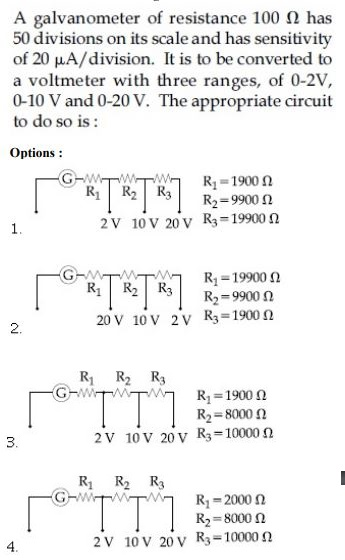
- A.Galvanometer G in series with , , , tapped after each resistor for 2 V, 10 V, 20 V, with , ,
- B.Same arrangement with taps labelled 20 V, 10 V, 2 V and , ,
- C.Same arrangement with taps 2 V, 10 V, 20 V and , ,
- D.Same arrangement with taps 2 V, 10 V, 20 V and , ,
Correct answer: C
Question 21
Physics · 4 marks · −1A magnetic compass needle oscillates 30 times per minute at a place where the dip is 45°, and 40 times per minute where the dip is 30°. If and are respectively the total magnetic field due to the earth at the two places, then the ratio is best given by:
- A.0.7
- B.1.8
- C.2.2
- D.3.6
Correct answer: A
Question 22
Physics · 4 marks · −1An electromagnetic wave is represented by the electric field . Taking unit vectors in , and directions to be , , , the direction of propagation , is:
- A.
- B.
- C.
- D.
Correct answer: B
Question 23
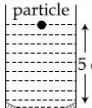
Physics · 4 marks · −1A concave mirror has radius of curvature of 40 cm. It is at the bottom of a glass that has water filled up to 5 cm (see figure). If a small particle is floating on the surface of water, its image as seen, from directly above the glass, is at a distance from the surface of water. The value of is close to: (Refractive index of water = 1.33)
- A.11.7 cm
- B.8.8 cm
- C.6.7 cm
- D.13.4 cm
Correct answer: B
Question 24
Physics · 4 marks · −1In a double slit experiment, when a thin film of thickness having refractive index is introduced in front of one of the slits, the maximum at the centre of the fringe pattern shifts by one fringe width. The value of is ( is the wavelength of the light used):
- A.
- B.
- C.
- D.
Correct answer: C
Question 25
Physics · 4 marks · −1The value of numerical aperature of the objective lens of a microscope is 1.25. If light of wavelength 5000 Å is used, the minimum separation between two points, to be seen as distinct, will be:
- A.0.48 m
- B.0.12 m
- C.0.38 m
- D.0.24 m
Correct answer: D
Question 26
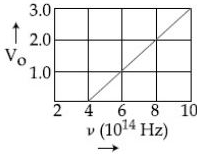
Physics · 4 marks · −1The stopping potential (in volt) as a function of frequency () for a sodium emitter, is shown in the figure. The work function of sodium, from the data plotted in the figure, will be: (Given: Planck's constant Js, electron charge C)
- A.1.66 eV
- B.1.82 eV
- C.1.95 eV
- D.2.12 eV
Correct answer: A
Question 27
Physics · 4 marks · −1An excited ion emits two photons in succession, with wavelengths 108.5 nm and 30.4 nm, in making a transition to ground state. The quantum number , corresponding to its initial excited state is (for photon of wavelength , energy ):
- A.n = 7
- B.n = 6
- C.n = 5
- D.n = 4
Correct answer: C
Question 28
Physics · 4 marks · −1The truth table for the circuit given in the fig. is:
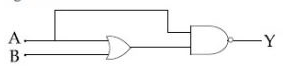
- A.A B Y: 0 0 1; 0 1 1; 1 0 0; 1 1 0
- B.A B Y: 0 0 0; 0 1 0; 1 0 1; 1 1 1
- C.A B Y: 0 0 1; 0 1 0; 1 0 0; 1 1 0
- D.A B Y: 0 0 1; 0 1 1; 1 0 1; 1 1 1
Correct answer: A
Question 29
Physics · 4 marks · −1The transfer characteristic curve of a transistor, having input and output resistance 100 and 100 k respectively, is shown in the figure. The Voltage and Power gain, are respectively:
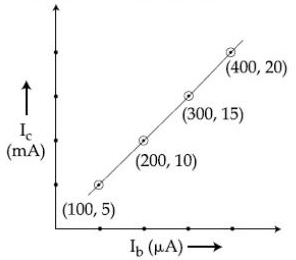
- A.,
- B.,
- C.,
- D.,
Correct answer: B
Question 30
Chemistry · 4 marks · −1Which of the following statements is not true about RNA?
- A.It is present in the nucleus of the cell
- B.It has always double stranded -helix structure
- C.It controls the synthesis of protein
- D.It usually does not replicate
Correct answer: B
Question 31
Chemistry · 4 marks · −1The increasing order of the of the following compound is: (A) 1-(4-fluorophenyl)-3-phenylthiourea (B) 1-(4-methoxyphenyl)-3-phenylthiourea (C) 1-(4-nitrophenyl)-3-phenylthiourea (D) 1-(4-methylphenyl)-3-phenylthiourea
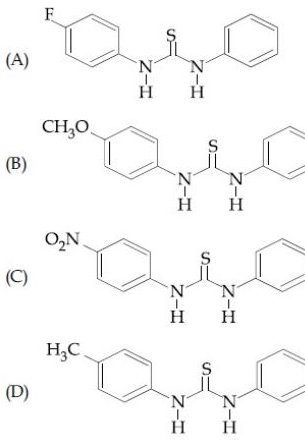
- A.(A) < (C) < (D) < (B)
- B.(B) < (D) < (C) < (A)
- C.(B) < (D) < (A) < (C)
- D.(C) < (A) < (D) < (B)
Correct answer: C
Question 32
Chemistry · 4 marks · −1The major product of the following reaction is: 3-(3-hydroxyphenyl)propan-1-ol (benzene ring bearing and, meta to it, )
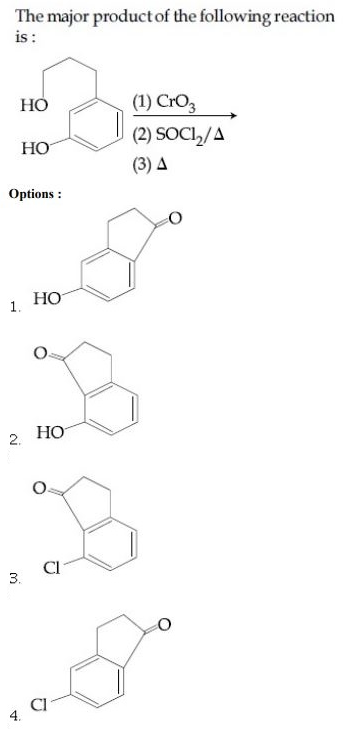
- A.Indan-1-one with the ring OH para to the carbonyl-bearing ring carbon (5-hydroxy-1-indanone)
- B.Indan-1-one with the ring OH ortho to the carbonyl-bearing ring carbon (7-hydroxy-1-indanone)
- C.Indan-1-one with a ring Cl ortho to the carbonyl-bearing ring carbon (7-chloro-1-indanone)
- D.Indan-1-one with a ring Cl para to the carbonyl-bearing ring carbon (5-chloro-1-indanone)
Correct answer: A
Question 33
Chemistry · 4 marks · −1Glucose and Galactose are having identical configuration in all the positions except position.
- A.C − 2
- B.C − 3
- C.C − 4
- D.C − 5
Correct answer: C
Question 34
Chemistry · 4 marks · −1The major product of the following addition reaction is
- A.
- B.
- C.–(epoxide) (methyloxirane, propylene oxide)
- D. (acetone)
Correct answer: B
Question 35
Chemistry · 4 marks · −1The major products of the following reaction are: 4-Chlorophenol
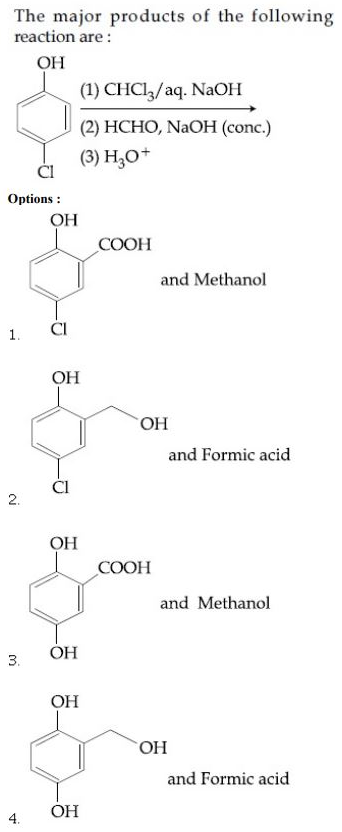
- A.5-Chloro-2-hydroxybenzoic acid (OH, and ortho COOH, Cl para to OH) and methanol
- B.4-Chloro-2-(hydroxymethyl)phenol (OH, ortho , Cl para to OH) and formic acid
- C.2,5-Dihydroxybenzoic acid (OH, ortho COOH, OH para) and methanol
- D.2-(Hydroxymethyl)benzene-1,4-diol (OH, ortho , OH para) and formic acid
Correct answer: B
Question 36
Chemistry · 4 marks · −1Which of the following is a thermosetting polymer?
- A.PVC
- B.Bakelite
- C.Nylon 6
- D.Buna-N
Correct answer: B
Question 37
Chemistry · 4 marks · −1But-2-ene on reaction with alkaline at elevated temperature followed by acidification will give:
- A.
- B.2 molecules of
- C.one molecule of and one molecule of
- D.2 molecules of
Correct answer: D
Question 38
Chemistry · 4 marks · −1The major product(s) obtained in the following reaction is/are: 4-Bromocyclohexene
- A. and
- B.
- C.
- D.
Correct answer: A
Question 39
Chemistry · 4 marks · −1An organic compound 'A' is oxidized with followed by boiling with . The resultant solution is then treated with ammonium molybdate to yield a yellow precipitate. Based on above observation, the element present in the given compound is:
- A.Sulphur
- B.Nitrogen
- C.Fluorine
- D.Phosphorus
Correct answer: D
Question 40
Chemistry · 4 marks · −1The group number, number of valence electrons, and valency of an element with atomic number 15, respectively, are:
- A.15, 6 and 2
- B.16, 6 and 3
- C.15, 5 and 3
- D.16, 5 and 2
Correct answer: C
Question 41
Chemistry · 4 marks · −1The idea of froth floatation method came from a person X and this method is related to the process Y of ores. X and Y, respectively, are:
- A.washer man and reduction
- B.washer woman and concentration
- C.fisher woman and concentration
- D.fisher man and reduction
Correct answer: B
Question 42
Chemistry · 4 marks · −1The metal that gives hydrogen gas upon treatment with both acid as well as base is:
- A.magnesium
- B.iron
- C.zinc
- D.mercury
Correct answer: C
Question 43
Chemistry · 4 marks · −1The correct sequence of thermal stability of the following carbonates is:
- A.
- B.
- C.
- D.
Correct answer: A
Question 44
Chemistry · 4 marks · −1The correct statement among the following is:
- A.Ni(CO) is diamagnetic and [NiCl] and [Ni(CN)] are paramagnetic.
- B.Ni(CO) and [NiCl] are diamagnetic and [Ni(CN)] is paramagnetic.
- C.[Ni(CN)] and [NiCl] are diamagnetic and Ni(CO) is paramagnetic.
- D.Ni(CO) and [Ni(CN)] are diamagnetic and [NiCl] is paramagnetic.
Correct answer: D
Question 45
Chemistry · 4 marks · −1The basic structural unit of feldspar, zeolites, mica, and asbestos is:
- A.
- B. (R = Me)
- C.
- D.
Correct answer: D
Question 46
Chemistry · 4 marks · −1An example of a disproportionation reaction is:
- A.
- B.
- C.
- D.
Correct answer: C
Question 47
Chemistry · 4 marks · −1The complex ion that will lose its crystal field stabilization energy upon oxidation of its metal to +3 state is: (Phen = 1,10-phenanthroline, and ignore pairing energy)
- A.
- B.
- C.
- D.
Correct answer: C
Question 48
Chemistry · 4 marks · −1Complete removal of both the axial ligands (along the -axis) from an octahedral complex leads to which of the following splitting patterns? (relative orbital energies not on scale).
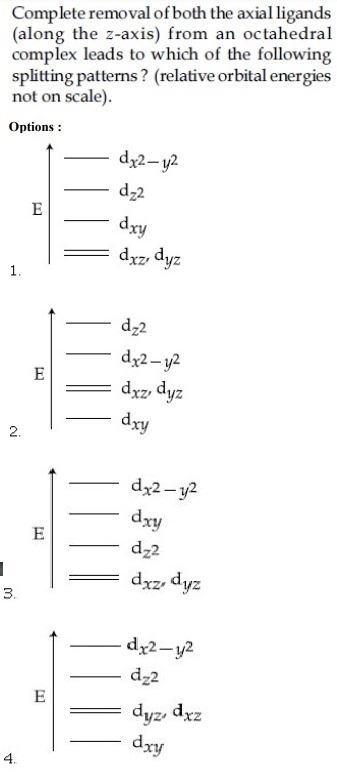
- A.Energy increasing: < < <
- B.Energy increasing: < < <
- C.Energy increasing: < < <
- D.Energy increasing: < < <
Correct answer: C
Question 49
Chemistry · 4 marks · −1The correct set of species responsible for the photochemical smog is:
- A., , and hydrocarbons
- B., and hydrocarbons
- C.NO, , and hydrocarbons
- D., , and hydrocarbons
Correct answer: C
Question 50
Chemistry · 4 marks · −15 moles of weigh kg and 10 moles of weigh kg. The molar mass of A () and molar mass of B () in kg mol are:
- A. and
- B. and
- C. and
- D. and
Correct answer: A
Question 51
Chemistry · 4 marks · −1An element has a face-centred cubic (fcc) structure with a cell edge of . The distance between the centres of two nearest tetrahedral voids in the lattice is:
- A.
- B.
- C.
- D.
Correct answer: C
Question 52
Chemistry · 4 marks · −1The electrons are more likely to be found:
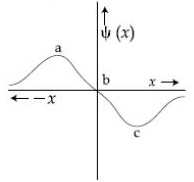
- A.only in the region a
- B.in the region a and b
- C.only in the region c
- D.in the region a and c
Correct answer: D
Question 53
Chemistry · 4 marks · −1Enthalpy of sublimation of iodine is 24 cal at 200 °C. If specific heat of and (vap) are 0.055 and 0.031 cal respectively, then enthalpy of sublimation of iodine at 250 °C in cal is:
- A.22.8
- B.11.4
- C.5.7
- D.2.85
Correct answer: A
Question 54
Chemistry · 4 marks · −1An ideal gas is allowed to expand from 1 L to 10 L against a constant external pressure of 1 bar. The work done in kJ is:
- A.−0.9
- B.−2.0
- C.+10.0
- D.−9.0
Correct answer: A
Question 55
Chemistry · 4 marks · −1The mole fraction of a solvent in aqueous solution of a solute is 0.8. The molality (in mol ) of the aqueous solution is:
- A.13.88
- B.
- C.
- D.
Correct answer: A
Question 56
Chemistry · 4 marks · −1What is the molar solubility of in 0.2 M NaOH solution? Given that, solubility product of :
- A.
- B.
- C.
- D.
Correct answer: A
Question 57
Chemistry · 4 marks · −1Given: ; V ; V ; V ; V Oxidizing power of the species will increase in the order:
- A.
- B.
- C.
- D.
Correct answer: C
Question 58
Chemistry · 4 marks · −1In the following reaction; 'A' and 'B' respectively can be:
- A. and
- B.n-Butane and Iso-butane
- C. and
- D. and
Correct answer: C
Question 59
Chemistry · 4 marks · −1Peptization is a:
- A.process of converting a colloidal solution into precipitate
- B.process of converting precipitate into colloidal solution
- C.process of converting soluble particles to form colloidal solution
- D.process of bringing colloidal molecule into solution
Correct answer: B
Question 60
Mathematics · 4 marks · −1For , let , and . If , then is equal to:
- A.
- B.
- C.
- D.
Correct answer: D
Question 61
Mathematics · 4 marks · −1If and are the roots of the equation , then is equal to:
- A.
- B.
- C.
- D.
Correct answer: B
Question 62
Mathematics · 4 marks · −1The equation , , represents:
- A.a circle of radius 1.
- B.a circle of radius .
- C.the line through the origin with slope −1.
- D.the line through the origin with slope 1.
Correct answer: D
Question 63
Mathematics · 4 marks · −1If is the inverse of a matrix A, then the sum of all values of for which , is:
- A.2
- B.1
- C.0
- D.−1
Correct answer: B
Question 64
Mathematics · 4 marks · −1If A is a symmetric matrix and B is a skew-symmetric matrix such that , then AB is equal to:
- A.
- B.
- C.
- D.
Correct answer: C
Question 65
Mathematics · 4 marks · −1The number of ways of choosing 10 objects out of 31 objects of which 10 are identical and the remaining 21 are distinct, is:
- A.
- B.
- C.
- D.
Correct answer: B
Question 66
Mathematics · 4 marks · −1The coefficient of in the product is:
- A.84
- B.126
- C.−126
- D.−84
Correct answer: A
Question 67
Mathematics · 4 marks · −1Let denote the sum of the first terms of an A.P.. If and , then is equal to:
- A.−260
- B.−320
- C.−380
- D.−410
Correct answer: B
Question 68
Mathematics · 4 marks · −1For , let denote the greatest integer , then the sum of the series is:
- A.−135
- B.−153
- C.−131
- D.−133
Correct answer: D
Question 69
Mathematics · 4 marks · −1Let be a continuously differentiable function such that and . If , then is equal to:
- A.12
- B.18
- C.24
- D.36
Correct answer: B
Question 70
Mathematics · 4 marks · −1If , the ordered pair at is equal to:
- A.
- B.
- C.
- D.
Correct answer: A
Question 71
Mathematics · 4 marks · −1A 2 m ladder leans against a vertical wall. If the top of the ladder begins to slide down the wall at the rate 25 cm/sec., then the rate (in cm/sec.) at which the bottom of the ladder slides away from the wall on the horizontal ground when the top of the ladder is 1 m above the ground is:
- A.
- B.
- C.25
- D.
Correct answer: B
Question 72
Mathematics · 4 marks · −1If is the minimum value of for which the function is increasing in the interval and M is the maximum value of in when , then the ordered pair is equal to:
- A.
- B.
- C.
- D.
Correct answer: C
Question 73
Mathematics · 4 marks · −1The integral is equal to: (Here C is a constant of integration)
- A.
- B.
- C.
- D.
Correct answer: A
Question 74
Mathematics · 4 marks · −1If , then is equal to:
- A.1
- B.−1
- C.
- D.
Correct answer: B
Question 75
Mathematics · 4 marks · −1If the area (in sq. units) of the region is , then is equal to:
- A.
- B.6
- C.
- D.
Correct answer: B
Question 76
Mathematics · 4 marks · −1Consider the differential equation, . If value of is 1 when , then the value of for which , is:
- A.
- B.
- C.
- D.
Correct answer: C
Question 77
Mathematics · 4 marks · −1The equation represents a straight line lying in:
- A.first, second and fourth quadrants
- B.second and third quadrants only
- C.third and fourth quadrants only
- D.first, third and fourth quadrants
Correct answer: C
Question 78
Mathematics · 4 marks · −1If the angle of intersection at a point where the two circles with radii 5 cm and 12 cm intersect is 90°, then the length (in cm) of their common chord is:
- A.
- B.
- C.
- D.
Correct answer: A
Question 79
Mathematics · 4 marks · −1If the normal to the ellipse at a point P on it is parallel to the line, and the tangent to the ellipse at P passes through Q(4, 4) then PQ is equal to:
- A.
- B.
- C.
- D.
Correct answer: A
Question 80
Mathematics · 4 marks · −1Let P be the point of intersection of the common tangents to the parabola and the hyperbola . If S and S' denote the foci of the hyperbola where S lies on the positive -axis then P divides SS' in a ratio:
- A.14 : 13
- B.13 : 11
- C.5 : 4
- D.2 : 1
Correct answer: C
Question 81
Mathematics · 4 marks · −1If the line intersects the plane at a point P and the plane at a point Q, then PQ is equal to:
- A.
- B.
- C.14
- D.
Correct answer: B
Question 82
Mathematics · 4 marks · −1If the volume of parallelopiped formed by the vectors , and is minimum, then is equal to:
- A.
- B.
- C.
- D.
Correct answer: C
Question 83
Mathematics · 4 marks · −1Let and be two vectors. If a vector perpendicular to both the vectors and has the magnitude 12 then one such vector is:
- A.
- B.
- C.
- D.
Correct answer: C
Question 84
Mathematics · 4 marks · −1Let a random variable X have a binomial distribution with mean 8 and variance 4. If , then is equal to:
- A.1
- B.17
- C.121
- D.137
Correct answer: D
Question 85
Mathematics · 4 marks · −1If three of the six vertices of a regular hexagon are chosen at random, then the probability that the triangle formed with these chosen vertices is equilateral is:
- A.
- B.
- C.
- D.
Correct answer: A
Question 86
Mathematics · 4 marks · −1If the data is such that the mean of first four of these is 11, the mean of the remaining six is 16 and the sum of squares of all of these is 2,000; then the standard deviation of this data is:
- A.4
- B.2
- C.
- D.
Correct answer: B
Question 87
Mathematics · 4 marks · −1The number of solutions of the equation , is:
- A.7
- B.3
- C.4
- D.5
Correct answer: D
Question 88
Mathematics · 4 marks · −1The value of is equal to:
- A.
- B.
- C.
- D.
Correct answer: D
Question 89
Mathematics · 4 marks · −1If the truth value of the statement is false (F), then the truth values of the statements , , are respectively:
- A.T, T, F
- B.T, F, T
- C.T, F, F
- D.F, T, T
Correct answer: A