JEE Main 2019 — 9 Jan Shift 1 (Previous Year Paper)
JEE Main · 2019 · with answers and explanations
- questions
- 87
- Total marks
- 348
- Duration
- 180 minutes
- Negative marking
- −1
Subjects: Physics · Chemistry · Mathematics
Question 1
Physics · 4 marks · −1A copper wire is stretched to make it 0.5% longer. The percentage change in its electrical resistance if its volume remains unchanged is:
- A.0.5 %
- B.1.0 %
- C.2.5 %
- D.2.0 %
Correct answer: B
Question 2
Physics · 4 marks · −1A particle is moving with a velocity , where K is a constant. The general equation for its path is:
- A.
- B.
- C.
- D.
Correct answer: A
Question 3
Physics · 4 marks · −1A block of mass 10 kg is kept on a rough inclined plane as shown in the figure. A force of 3 N is applied on the block. The coefficient of static friction between the plane and the block is 0.6. What should be the minimum value of force P, such that the block does not move downward? (take )
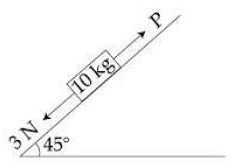
- A.25 N
- B.32 N
- C.23 N
- D.18 N
Correct answer: B
Question 4
Physics · 4 marks · −1Three blocks A, B and C are lying on a smooth horizontal surface, as shown in the figure. A and B have equal masses, m while C has mass M. Block A is given an initial speed towards B due to which it collides with B perfectly inelastically. The combined mass collides with C, also perfectly inelastically. th of the initial kinetic energy is lost in the whole process. What is value of ?
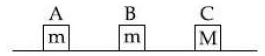
- A.3
- B.4
- C.2
- D.5
Correct answer: B
Question 5
Physics · 4 marks · −1An L-shaped object, made of thin rods of uniform mass density, is suspended with a string as shown in figure. If AB = BC, and the angle made by AB with downward vertical is , then:
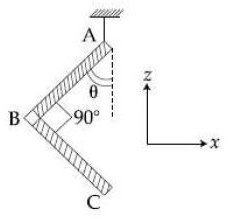
- A.
- B.
- C.
- D.
Correct answer: B
Question 6
Physics · 4 marks · −1A block of mass m, lying on a smooth horizontal surface, is attached to a spring (of negligible mass) of spring constant k. The other end of the spring is fixed, as shown in the figure. The block is initially at rest in its equilibrium position. If now the block is pulled with a constant force F, the maximum speed of the block is:
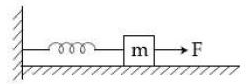
- A.
- B.
- C.
- D.
Correct answer: C
Question 7
Physics · 4 marks · −1If the angular momentum of a planet of mass m, moving around the Sun in a circular orbit is L, about the center of the Sun, its areal velocity is:
- A.
- B.
- C.
- D.
Correct answer: C
Question 8
Physics · 4 marks · −1A rod, of length L at room temperature and uniform area of cross section A, is made of a metal having coefficient of linear expansion . It is observed that an external compressive force F, is applied on each of its ends, prevents any change in the length of the rod, when its temperature rises by K. Young's modulus, Y, for this metal is:
- A.
- B.
- C.
- D.
Correct answer: B
Question 9
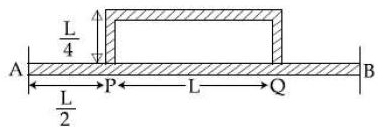
Physics · 4 marks · −1Temperature difference of 120°C is maintained between two ends of a uniform rod AB of length 2L. Another bent rod PQ, of same cross-section as AB and length , is connected across AB (See figure). In steady state, temperature difference between P and Q will be close to:
- A.60 °C
- B.75 °C
- C.35 °C
- D.45 °C
Correct answer: D
Question 10
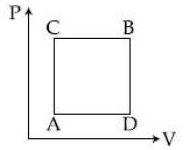
Physics · 4 marks · −1A gas can be taken from A to B via two different processes ACB and ADB. When path ACB is used 60 J of heat flows into the system and 30 J of work is done by the system. If path ADB is used work done by the system is 10 J. The heat flow into the system in path ADB is:
- A.100 J
- B.20 J
- C.80 J
- D.40 J
Correct answer: D
Question 11
Physics · 4 marks · −1A mixture of 2 moles of helium gas (atomic mass = 4 u), and 1 mole of argon gas (atomic mass = 40 u) is kept at 300 K in a container. The ratio of their rms speeds , is close to:
- A.0.32
- B.0.45
- C.2.24
- D.3.16
Correct answer: D
Question 12
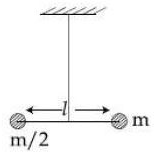
Physics · 4 marks · −1Two masses m and are connected at the two ends of a massless rigid rod of length . The rod is suspended by a thin wire of torsional constant at the centre of mass of the rod-mass system (see figure). Because of torsional constant , the restoring torque is for angular displacement . If the rod is rotated by and released, the tension in it when it passes through its mean position will be:
- A.
- B.
- C.
- D.
Correct answer: B
Question 13
Physics · 4 marks · −1A heavy ball of mass M is suspended from the ceiling of a car by a light string of mass m (m << M). When the car is at rest, the speed of transverse waves in the string is 60 m s. When the car has acceleration a, the wave-speed increases to 60.5 m s. The value of a, in terms of gravitational acceleration g, is closest to:
- A.
- B.
- C.
- D.
Correct answer: B
Question 14
Physics · 4 marks · −1Three charges +Q, q, +Q are placed respectively, at distance, 0, d/2 and d from the origin, on the x-axis. If the net force experienced by +Q, placed at x = 0, is zero, then value of q is:
- A.+Q/4
- B.−Q/4
- C.+Q/2
- D.−Q/2
Correct answer: B
Question 15
Physics · 4 marks · −1For a uniformly charged ring of radius R, the electric field on its axis has the largest magnitude at a distance h from its centre. Then value of h is:
- A.R
- B.
- C.
- D.
Correct answer: C
Question 16
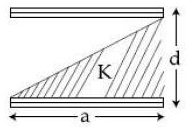
Physics · 4 marks · −1A parallel plate capacitor is made of two square plates of side 'a', separated by a distance d (d << a). The lower triangular portion is filled with a dielectric of dielectric constant K, as shown in the figure. Capacitance of this capacitor is:
- A.
- B.
- C.
- D.
Correct answer: D
Question 17
Physics · 4 marks · −1Drift speed of electrons, when 1.5 A of current flows in a copper wire of cross section 5 mm, is . If the electron density in copper is the value of in mm/s is close to (Take charge of electron to be C)
- A.3
- B.2
- C.0.2
- D.0.02
Correct answer: D
Question 18
Physics · 4 marks · −1When the switch S, in the circuit shown, is closed, then the value of current will be:
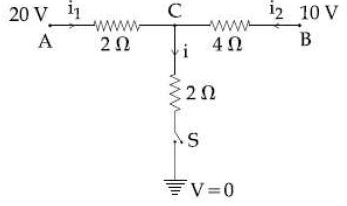
- A.2 A
- B.3 A
- C.4 A
- D.5 A
Correct answer: D
Question 19
Physics · 4 marks · −1A current loop, having two circular arcs joined by two radial lines is shown in the figure. It carries a current of 10 A. The magnetic field at point O will be close to:
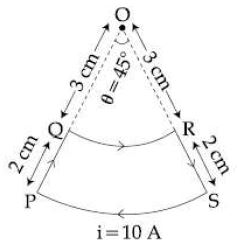
- A. T
- B. T
- C. T
- D. T
Correct answer: C
Question 20
Physics · 4 marks · −1An infinitely long current carrying wire and a small current carrying loop are in the plane of the paper as shown. The radius of the loop is a and distance of its centre from the wire is d (d >> a). If the loop applies a force F on the wire then:
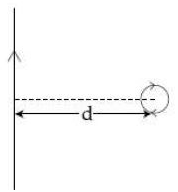
- A.
- B.
- C.
- D.
Correct answer: C
Question 21
Physics · 4 marks · −1A bar magnet is demagnetized by inserting it inside a solenoid of length 0.2 m, 100 turns, and carrying a current of 5.2 A. The coercivity of the bar magnet is:
- A.1200 A/m
- B.520 A/m
- C.285 A/m
- D.2600 A/m
Correct answer: D
Question 22
Physics · 4 marks · −1A plane electromagnetic wave of frequency 50 MHz travels in free space along the positive x-direction. At a particular point in space and time, V/m. The corresponding magnetic field , at that point will be:
- A. T
- B. T
- C. T
- D. T
Correct answer: B
Question 23
Physics · 4 marks · −1A convex lens is put 10 cm from a light source and it makes a sharp image on a screen, kept 10 cm from the lens. Now a glass block (refractive index 1.5) of 1.5 cm thickness is placed in contact with the light source. To get the sharp image again, the screen is shifted by a distance d. Then d is:
- A.0
- B.0.55 cm towards the lens
- C.0.55 cm away from the lens
- D.1.1 cm away from the lens
Correct answer: C
Question 24
Physics · 4 marks · −1Two coherent sources produce waves of different intensities which interfere. After interference, the ratio of the maximum intensity to the minimum intensity is 16. The intensity of the waves are in the ratio:
- A.4 : 1
- B.16 : 9
- C.25 : 9
- D.5 : 3
Correct answer: C
Question 25
Physics · 4 marks · −1Consider a tank made of glass (refractive index 1.5) with a thick bottom. It is filled with a liquid of refractive index . A student finds that, irrespective of what the incident angle (see figure) is for a beam of light entering the liquid, the light reflected from the liquid glass interface is never completely polarized. For this to happen, the minimum value of is:
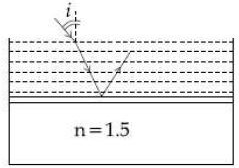
- A.
- B.
- C.
- D.
Correct answer: B
Question 26
Physics · 4 marks · −1Surface of certain metal is first illuminated with light of wavelength nm and then, by light of wavelength nm. It is found that the maximum speed of the photo electrons in the two cases differ by a factor of 2. The work function of the metal (in eV) is close to: (Energy of photon eV)
- A.1.8
- B.5.6
- C.1.4
- D.2.5
Correct answer: A
Question 27
Physics · 4 marks · −1A sample of radioactive material A, that has an activity of 10 mCi (1 Ci = decays/s), has twice the number of nuclei as another sample of a different radioactive material B which has an activity of 20 mCi. The correct choices for half-lives of A and B would then be respectively:
- A.20 days and 10 days
- B.20 days and 5 days
- C.5 days and 10 days
- D.10 days and 40 days
Correct answer: B
Question 28
Physics · 4 marks · −1Mobility of electrons in a semiconductor is defined as the ratio of their drift velocity to the applied electric field. If, for an n-type semiconductor, the density of electrons is m and their mobility is 1.6 m/(V.s) then the resistivity of the semiconductor (since it is an n-type semiconductor contribution of holes is ignored) is close to:
- A.0.2 Ωm
- B.2 Ωm
- C.4 Ωm
- D.0.4 Ωm
Correct answer: D
Question 29
Physics · 4 marks · −1A resistance is shown in the figure. Its value and tolerance are given respectively by:
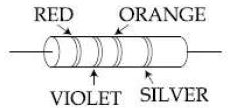
- A.270 Ω, 5 %
- B.27 kΩ, 10 %
- C.27 kΩ, 20 %
- D.270 Ω, 10 %
Correct answer: B
Question 30
Chemistry · 4 marks · −1Major product of the following reaction is: 2-chloroprop-2-enoyl chloride () + ?
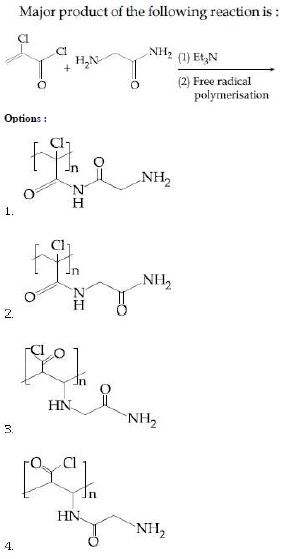
- A.Polymer whose side chain is (no carbonyl in the amine part)
- B.Polymer whose side chain is
- C.Polymer with a group on the chain and a side chain attached through nitrogen
- D.Polymer with a group on the chain and a side chain attached through nitrogen
Correct answer: B
Question 31
Chemistry · 4 marks · −1The increasing order of pKa of the following amino acids in aqueous solution is: Gly Asp Lys Arg
- A.Gly < Asp < Arg < Lys
- B.Asp < Gly < Lys < Arg
- C.Arg < Lys < Gly < Asp
- D.Asp < Gly < Arg < Lys
Correct answer: B
Question 32
Chemistry · 4 marks · −1Arrange the following amines in the decreasing order of basicity: I = pyridine, II = pyrrole, III = piperidine (see figure).
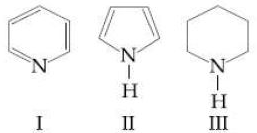
- A.III > II > I
- B.III > I > II
- C.I > III > II
- D.I > II > III
Correct answer: B
Question 33
Chemistry · 4 marks · −1The major product of following reaction is: ?
- A.
- B.
- C.
- D.
Correct answer: D
Question 34
Chemistry · 4 marks · −1The correct decreasing order for acid strength is:
- A.
- B.
- C.
- D.
Correct answer: A
Question 35
Chemistry · 4 marks · −1The compounds A and B in the following reaction are, respectively: Benzene A B
- A.A = Benzyl alcohol, B = Benzyl isocyanide
- B.A = Benzyl chloride, B = Benzyl isocyanide
- C.A = Benzyl chloride, B = Benzyl cyanide
- D.A = Benzyl alcohol, B = Benzyl cyanide
Correct answer: B
Question 36
Chemistry · 4 marks · −1The major product of the following reaction is: 1-bromo-3-(3-bromopropyl)benzene (an aryl Br and a chain meta to each other) ?
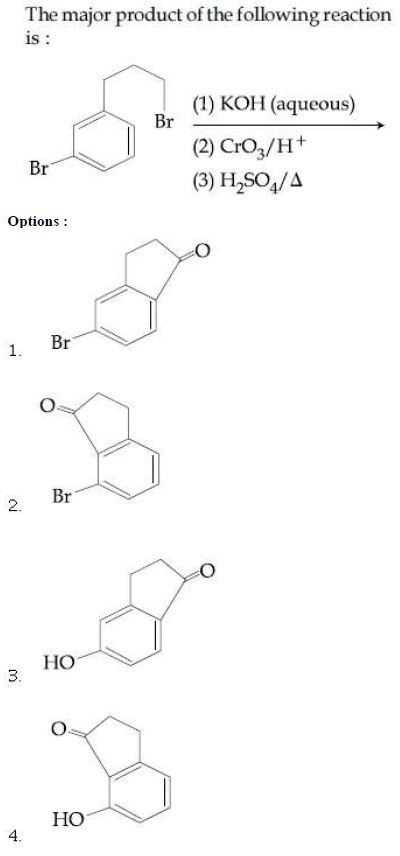
- A.Bromo-1-indanone with the Br on the benzene ring para to the ring-fusion carbon bearing the (6-bromo-1-indanone as drawn: Br remote from the C=O)
- B.Bromo-1-indanone with the Br on the benzene ring ortho to the side, adjacent to the C=O region as drawn (Br next to ring fusion)
- C.Hydroxy-1-indanone: same skeleton as option 1 with OH in place of Br
- D.Hydroxy-1-indanone: same skeleton as option 2 with OH in place of Br
Correct answer: A
Explanation: Aqueous KOH hydrolyses only the alkyl C-Br to an alcohol (aryl C-Br survives); CrO3/H+ oxidises it to the propanoic acid; hot H2SO4 effects intramolecular Friedel-Crafts acylation to a bromo-indanone (NTA key: option 1).
Question 37
Chemistry · 4 marks · −1Which amongst the following is the strongest acid?
- A.
- B.
- C.
- D.
Correct answer: D
Question 38
Chemistry · 4 marks · −1The correct match between Item-I (drug) and Item-II (test) is: Item-I: (A) Chloroxylenol, (B) Norethindrone, (C) Sulphapyridine, (D) Penicillin. Item-II: (P) Carbylamine test, (Q) Sodium hydrogen carbonate test, (R) Ferric chloride test, (S) Bayer's test.
- A.A→R; B→P; C→S; D→Q
- B.A→Q; B→P; C→S; D→R
- C.A→Q; B→S; C→P; D→R
- D.A→R; B→S; C→P; D→Q
Correct answer: D
Question 39
Chemistry · 4 marks · −1The major product of the following reaction is: 1,2-dihydronaphthalene ?
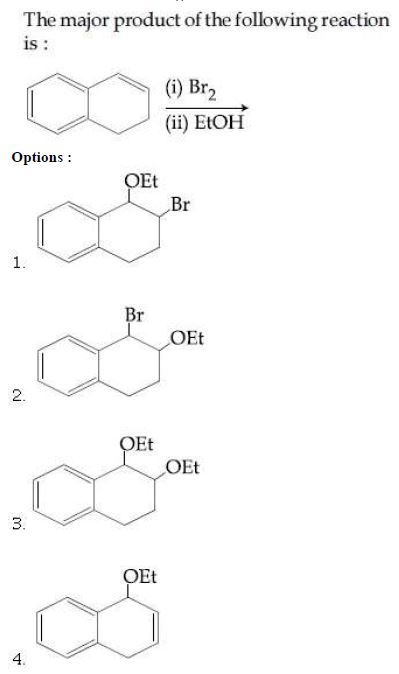
- A.1-ethoxy-2-bromo-1,2,3,4-tetrahydronaphthalene (OEt on the benzylic carbon, Br on the adjacent carbon)
- B.1-bromo-2-ethoxy-1,2,3,4-tetrahydronaphthalene (Br on the benzylic carbon, OEt on the adjacent carbon)
- C.1,2-diethoxy-1,2,3,4-tetrahydronaphthalene
- D.1-ethoxy-1,4-dihydronaphthalene (OEt on the benzylic carbon, double bond retained in the ring)
Correct answer: A
Question 40
Chemistry · 4 marks · −1In general, the properties that decrease and increase down a group in the periodic table, respectively, are:
- A.electronegativity and atomic radius.
- B.electronegativity and electron gain enthalpy.
- C.atomic radius and electronegativity.
- D.electron gain enthalpy and electronegativity.
Correct answer: A
Question 41
Chemistry · 4 marks · −1The ore that contains both iron and copper is:
- A.malachite
- B.azurite
- C.dolomite
- D.copper pyrites
Correct answer: D
Question 42
Chemistry · 4 marks · −1The isotopes of hydrogen are:
- A.Protium and deuterium only
- B.Tritium and protium only
- C.Protium, deuterium and tritium
- D.Deuterium and tritium only
Correct answer: C
Question 43
Chemistry · 4 marks · −1The alkaline earth metal nitrate that does not crystallise with water molecules, is:
- A.
- B.
- C.
- D.
Correct answer: D
Question 44
Chemistry · 4 marks · −1The one that is extensively used as a piezoelectric material is:
- A.quartz
- B.tridymite
- C.mica
- D.amorphous silica
Correct answer: A
Question 45
Chemistry · 4 marks · −1Aluminium is usually found in +3 oxidation state. In contrast, thallium exists in +1 and +3 oxidation states. This is due to:
- A.lanthanoid contraction
- B.diagonal relationship
- C.lattice effect
- D.inert pair effect
Correct answer: D
Question 46
Chemistry · 4 marks · −1Correct statements among a to d regarding silicones are: (a) They are polymers with hydrophobic character. (b) They are biocompatible. (c) In general, they have high thermal stability and low dielectric strength. (d) Usually, they are resistant to oxidation and used as greases.
- A.(a), (b) and (c) only
- B.(a), (b), (c) and (d)
- C.(a) and (b) only
- D.(a), (b) and (d) only
Correct answer: D
Question 47
Chemistry · 4 marks · −1The highest value of the calculated spin-only magnetic moment (in BM) among all the transition metal complexes is:
- A.5.92
- B.4.90
- C.6.93
- D.3.87
Correct answer: A
Question 48
Chemistry · 4 marks · −1Two complexes (A) and (B) are violet and yellow coloured, respectively. The incorrect statement regarding them is:
- A.both are paramagnetic with three unpaired electrons.
- B. value for (A) is less than that of (B).
- C.both absorb energies corresponding to their complementary colors.
- D. values of (A) and (B) are calculated from the energies of violet and yellow light, respectively.
Correct answer: D
Question 49
Chemistry · 4 marks · −1A water sample has ppm level concentration of the following metals: Fe = 0.2; Mn = 5.0; Cu = 3.0; Zn = 5.0. The metal that makes the water sample unsuitable for drinking is:
- A.Fe
- B.Mn
- C.Cu
- D.Zn
Correct answer: B
Question 50
Chemistry · 4 marks · −1A solution of sodium sulfate contains 92 g of Na ions per kilogram of water. The molality of Na ions in that solution in mol kg is:
- A.4
- B.8
- C.12
- D.16
Correct answer: A
Question 51
Chemistry · 4 marks · −1According to molecular orbital theory, which of the following is true with respect to Li and Li?
- A.Both are unstable
- B.Li is stable and Li is unstable
- C.Li is unstable and Li is stable
- D.Both are stable
Correct answer: D
Question 52
Chemistry · 4 marks · −1Consider the reversible isothermal expansion of an ideal gas in a closed system at two different temperatures and . The correct graphical depiction of the dependence of work done (w) on the final volume (V) is:
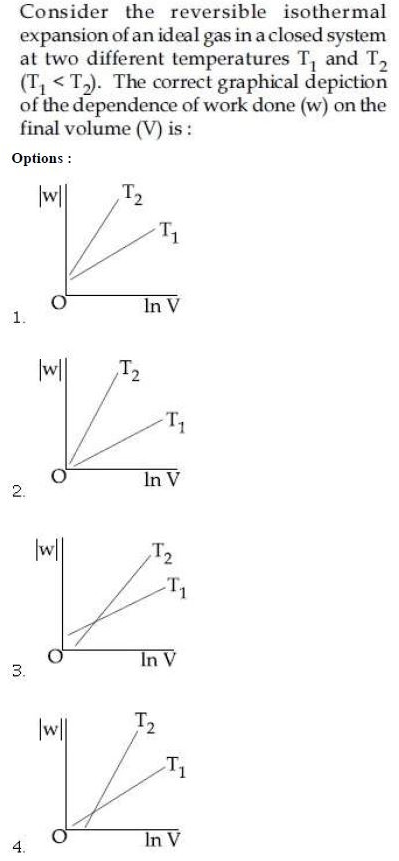
- A.Plot of |w| vs ln V: two straight lines starting from the same point on the |w| axis above the origin, the T line steeper than the T line
- B.Plot of |w| vs ln V: two straight lines starting from the origin O, the T line steeper than the T line
- C.Plot of |w| vs ln V: two straight lines crossing each other above the ln V axis (both with positive |w|-intercepts), the T line steeper
- D.Plot of |w| vs ln V: two straight lines meeting on the ln V axis (at |w| = 0, to the right of the origin), the T line steeper than the T line
Correct answer: D
Question 53
Chemistry · 4 marks · −1Which one of the following statements regarding Henry's law is not correct?
- A.The partial pressure of the gas in vapour phase is proportional to the mole fraction of the gas in the solution.
- B.Different gases have different (Henry's law constant) values at the same temperature.
- C.Higher the value of at a given pressure, higher is the solubility of the gas in the liquids.
- D.The value of increases with increase of temperature and is function of the nature of the gas
Correct answer: C
Question 54
Chemistry · 4 marks · −120 mL of 0.1 M solution is added to 30 mL of 0.2 M solution. The pH of the resultant mixture is: [p of = 4.7].
- A.5.0
- B.5.2
- C.9.0
- D.9.4
Correct answer: C
Question 55
Chemistry · 4 marks · −1The anodic half-cell of lead-acid battery is recharged using electricity of 0.05 Faraday. The amount of electrolyzed in g during the process is: (Molar mass of = 303 g mol)
- A.15.2
- B.7.6
- C.22.8
- D.11.4
Correct answer: B
Question 56
Chemistry · 4 marks · −1The following results were obtained during kinetic studies of the reaction; \n\n| Experiment | [A] (in mol L) | [B] (in mol L) | Initial Rate of reaction (in mol L min) |\n|---|---|---|---|\n| I | 0.10 | 0.20 | |\n| II | 0.10 | 0.25 | |\n| III | 0.20 | 0.30 | |\n\nThe time (in minutes) required to consume half of A is:
- A.1
- B.5
- C.100
- D.10
Correct answer: B
Explanation: Rate is independent of [B] and first order in A, so rate with min. Since rate , A is consumed with rate constant : min.
Question 57
Chemistry · 4 marks · −1Adsorption of a gas follows Freundlich adsorption isotherm. In the given plot, is the mass of the gas adsorbed on mass m of the adsorbent at pressure p. is proportional to:
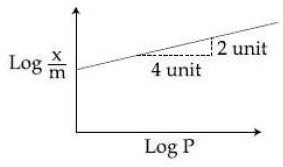
- A.
- B.
- C.
- D.
Correct answer: A
Question 58
Mathematics · 4 marks · −1For , let , and be three given functions. If a function, satisfies then is equal to:
- A.
- B.
- C.
- D.
Correct answer: C
Question 59
Mathematics · 4 marks · −1Let . Then the sum of the elements in A is:
- A.
- B.
- C.
- D.
Correct answer: B
Question 60
Mathematics · 4 marks · −1Let and be two roots of the equation , then is equal to:
- A.256
- B.−256
- C.512
- D.−512
Correct answer: B
Question 61
Mathematics · 4 marks · −1If , then the matrix when , is equal to:
- A.
- B.
- C.
- D.
Correct answer: A
Question 62
Mathematics · 4 marks · −1The system of linear equations , ,
- A.is inconsistent when
- B.has infinitely many solutions for
- C.is inconsistent when
- D.has a unique solution for
Correct answer: A
Question 63
Mathematics · 4 marks · −1Consider a class of 5 girls and 7 boys. The number of different teams consisting of 2 girls and 3 boys that can be formed from this class, if there are two specific boys A and B, who refuse to be the members of the same team, is:
- A.200
- B.300
- C.350
- D.500
Correct answer: B
Question 64
Mathematics · 4 marks · −1If the fractional part of the number is , then k is equal to:
- A.4
- B.8
- C.14
- D.6
Correct answer: B
Question 65
Mathematics · 4 marks · −1Let be an A.P., and . If and , then is equal to:
- A.42
- B.47
- C.57
- D.52
Correct answer: D
Question 66
Mathematics · 4 marks · −1If a, b and c be three distinct real numbers in G.P. and , then cannot be:
- A.−2
- B.−3
- C.2
- D.4
Correct answer: C
Question 67
Mathematics · 4 marks · −1- A.does not exist
- B.exists and equals
- C.exists and equals
- D.exists and equals
Correct answer: C
Question 68
Mathematics · 4 marks · −1Let be a function defined as . Then, is:
- A.continuous if and
- B.continuous if and
- C.continuous if and
- D.not continuous for any values of a and b
Correct answer: D
Question 69
Mathematics · 4 marks · −1If denotes the acute angle between the curves, and at a point of their intersection, then is equal to:
- A.
- B.
- C.
- D.
Correct answer: B
Question 70
Mathematics · 4 marks · −1The maximum volume (in cu.m) of the right circular cone having slant height 3 m is:
- A.
- B.
- C.
- D.
Correct answer: C
Question 71
Mathematics · 4 marks · −1For , (the set of natural numbers), the integral is equal to: (where c is a constant of integration)
- A.
- B.
- C.
- D.
Correct answer: B
Question 72
Mathematics · 4 marks · −1The value of is:
- A.0
- B.
- C.
- D.
Correct answer: C
Question 73
Mathematics · 4 marks · −1The area (in sq. units) bounded by the parabola , the tangent at the point (2, 3) to it and the -axis is:
- A.
- B.
- C.
- D.
Correct answer: A
Question 74
Mathematics · 4 marks · −1If is the solution of the differential equation, satisfying , then is equal to:
- A.
- B.
- C.
- D.
Correct answer: D
Question 75
Mathematics · 4 marks · −1Consider the set of all lines such that . Which one of the following statements is true?
- A.The lines are all parallel.
- B.The lines are concurrent at the point .
- C.The lines are not concurrent.
- D.Each line passes through the origin.
Correct answer: B
Question 76
Mathematics · 4 marks · −1Equation of a common tangent to the circle, and the parabola, , is:
- A.
- B.
- C.
- D.
Correct answer: D
Question 77
Mathematics · 4 marks · −1Three circles of radii a, b, c (a < b < c) touch each other externally. If they have -axis as a common tangent, then:
- A.a, b, c are in A.P.
- B. are in A.P.
- C.
- D.
Correct answer: C
Question 78
Mathematics · 4 marks · −1Axis of a parabola lies along -axis. If its vertex and focus are at distances 2 and 4 respectively from the origin, on the positive -axis then which of the following points does not lie on it?
- A.
- B.
- C.
- D.
Correct answer: D
Question 79
Mathematics · 4 marks · −1Let . If the eccentricity of the hyperbola is greater than 2, then the length of its latus rectum lies in the interval:
- A.
- B.
- C.
- D.
Correct answer: D
Question 80
Mathematics · 4 marks · −1The plane through the intersection of the planes and and parallel to -axis also passes through the point:
- A.
- B.
- C.
- D.
Correct answer: C
Question 81
Mathematics · 4 marks · −1The equation of the line passing through , parallel to the plane and intersecting the line is:
- A.
- B.
- C.
- D.
Correct answer: C
Question 82
Mathematics · 4 marks · −1Let , and be a vector such that and , then is equal to:
- A.
- B.
- C.9
- D.8
Correct answer: A
Question 83
Mathematics · 4 marks · −15 students of a class have an average height 150 cm and variance 18 cm. A new student, whose height is 156 cm, joined them. The variance (in cm) of the height of these six students is:
- A.20
- B.16
- C.18
- D.22
Correct answer: A
Question 84
Mathematics · 4 marks · −1Two cards are drawn successively with replacement from a well-shuffled deck of 52 cards. Let X denote the random variable of number of aces obtained in the two drawn cards. Then equals:
- A.24/169
- B.25/169
- C.49/169
- D.52/169
Correct answer: B
Question 85
Mathematics · 4 marks · −1For any , the expression equals:
- A.
- B.
- C.
- D.
Correct answer: D
Question 86
Mathematics · 4 marks · −1If , then is equal to:
- A.
- B.
- C.
- D.
Correct answer: A
Question 87
Mathematics · 4 marks · −1If the Boolean expression is equivalent to , where , then the ordered pair is:
- A.
- B.
- C.
- D.
Correct answer: B