JEE Main 2020 — 2 Sep Shift 1 (Previous Year Paper)
JEE Main · 2020 · with answers and explanations
- questions
- 73
- Total marks
- 292
- Duration
- 180 minutes
- Negative marking
- −1
Subjects: Physics · Chemistry · Mathematics
Question 1
Physics · 4 marks · −1If speed V, area A and force F are chosen as fundamental units, then the dimension of Young's modulus will be:
- A.
- B.
- C.
- D.
Correct answer: C
Explanation: Y = stress = F/A.
Question 2
Physics · 4 marks · −1Train A and train B are running on parallel tracks in the opposite directions with speeds of 36 km/hour and 72 km/hour, respectively. A person is walking in train A in the direction opposite to its motion with a speed of 1.8 km/hour. Speed (in ms) of this person as observed from train B will be close to: (take the distance between the tracks as negligible)
- A.30.5 ms
- B.28.5 ms
- C.31.5 ms
- D.29.5 ms
Correct answer: D
Explanation: m/s.
Question 3
Physics · 4 marks · −1A particle of mass m with an initial velocity collides perfectly elastically with a mass 3m at rest. It moves with a velocity after collision, then, v is given by:
- A.
- B.
- C.
- D.
Correct answer: C
Explanation: Momentum: ; energy: .
Question 4
Physics · 4 marks · −1A bead of mass m stays at point P(a, b) on a wire bent in the shape of a parabola and rotating with angular speed (see figure). The value of is (neglect friction):
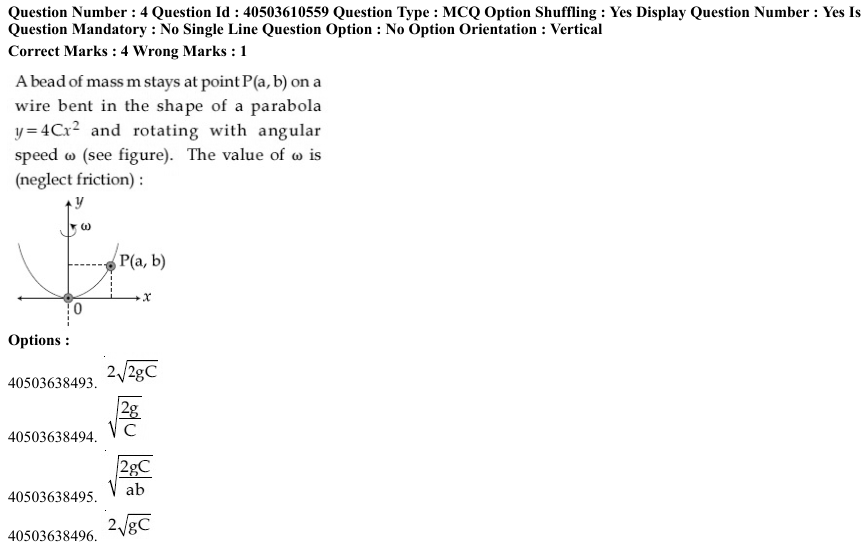
- A.
- B.
- C.
- D.
Correct answer: A
Explanation: .
Question 5
Physics · 4 marks · −1A uniform cylinder of mass M and radius R is to be pulled over a step of height a (a < R) by applying a force F at its centre 'O' perpendicular to the plane through the axes of the cylinder on the edge of the step (see figure). The minimum value of F required is:
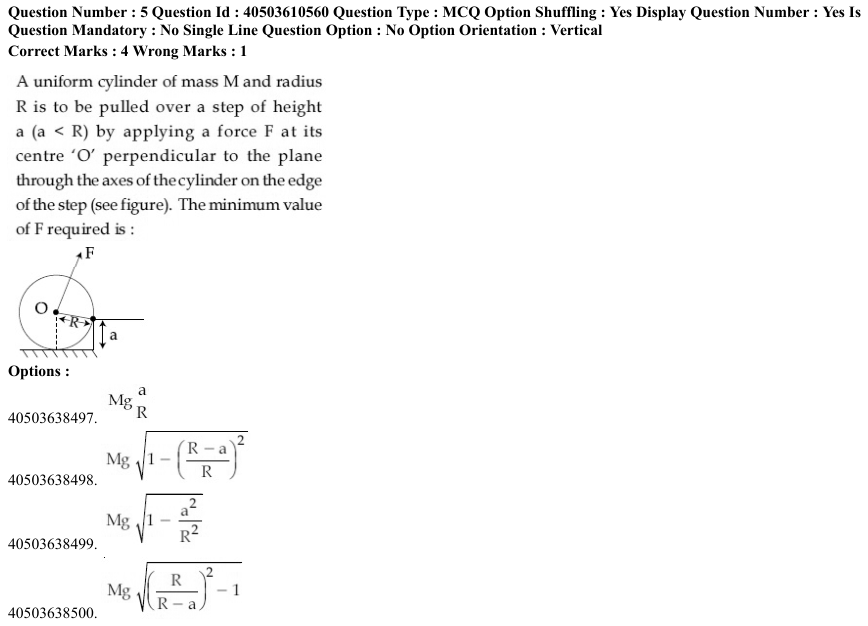
- A.
- B.
- C.
- D.
Correct answer: B
Explanation: Torque about the edge: .
Question 6
Physics · 4 marks · −1The mass density of a spherical galaxy varies as over a large distance 'r' from its centre. In that region, a small star is in a circular orbit of radius R. Then the period of revolution, T depends on R as:
- A.
- B.
- C.
- D.
Correct answer: B
Explanation: , so and .
Question 7
Physics · 4 marks · −1Shown in the figure is rigid and uniform one meter long rod AB held in horizontal position by two strings tied to its ends and attached to the ceiling. The rod is of mass 'm' and has another weight of mass 2 m hung at a distance of 75 cm from A. The tension in the string at A is:
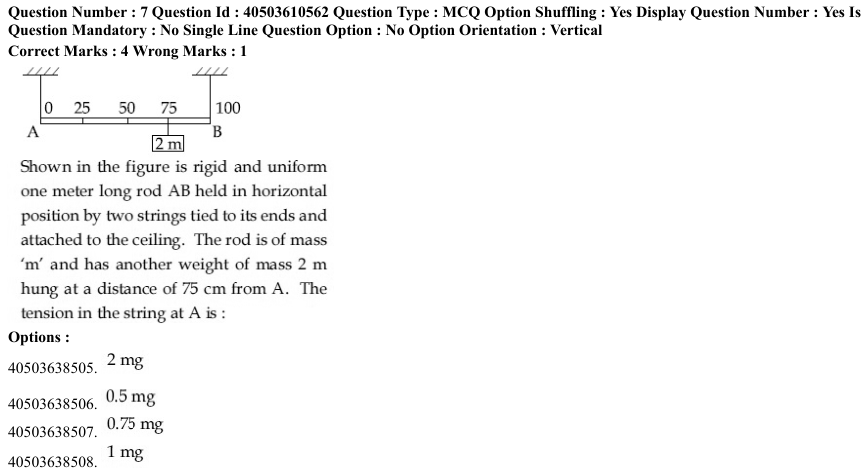
- A.2 mg
- B.0.5 mg
- C.0.75 mg
- D.1 mg
Correct answer: D
Explanation: Moments about B: .
Question 8
Physics · 4 marks · −1A cylindrical vessel containing a liquid is rotated about its axis so that the liquid rises at its sides as shown in the figure. The radius of vessel is 5 cm and the angular speed of rotation is rad s. The difference in the height, h (in cm) of liquid at the centre of vessel and at the side will be:
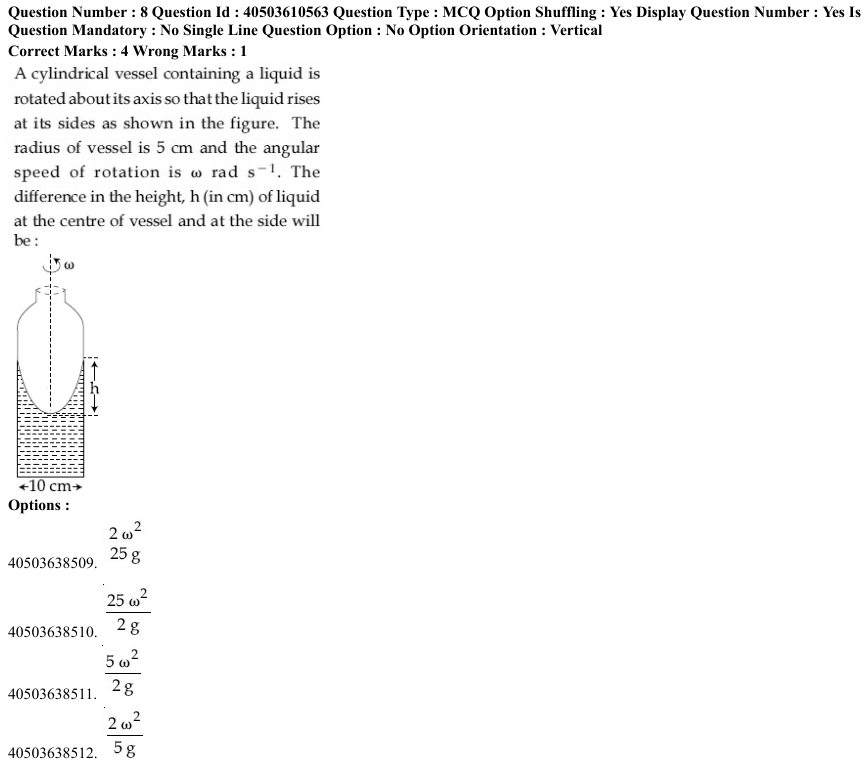
- A.
- B.
- C.
- D.
Correct answer: B
Explanation: (cm, g in cm s).
Question 9
Physics · 4 marks · −1A gas mixture consists of 3 moles of oxygen and 5 moles of argon at temperature T. Assuming the gases to be ideal and the oxygen bond to be rigid, the total internal energy (in units of RT) of the mixture is:
- A.11
- B.13
- C.15
- D.20
Correct answer: C
Explanation: .
Question 10
Physics · 4 marks · −1Two identical strings X and Z made of same material have tension and in them. If their fundamental frequencies are 450 Hz and 300 Hz, respectively, then the ratio is:
- A.1.5
- B.2.25
- C.1.25
- D.0.44
Correct answer: B
Explanation: .
Question 11
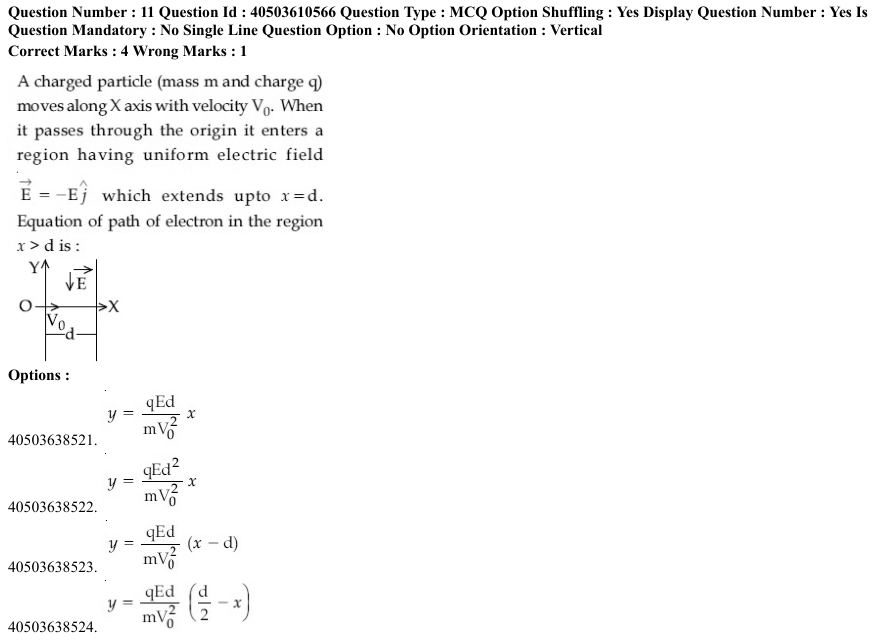
Physics · 4 marks · −1A charged particle (mass m and charge q) moves along X axis with velocity . When it passes through the origin it enters a region having uniform electric field which extends upto . Equation of path of electron in the region is:
- A.
- B.
- C.
- D.
Correct answer: D
Explanation: Exit at with slope ; straight line thereafter.
Question 12
Physics · 4 marks · −1Consider four conducting materials copper, tungsten, mercury and aluminium with resistivity , , and respectively. Then:
- A.
- B.
- C.
- D.
Correct answer: D
Question 13
Physics · 4 marks · −1A beam of protons with speed ms enters a uniform magnetic field of 0.3 T at an angle of 60° to the magnetic field. The pitch of the resulting helical path of protons is close to: (Mass of the proton kg, charge of the proton C)
- A.2 cm
- B.5 cm
- C.4 cm
- D.12 cm
Correct answer: C
Explanation: cm.
Question 14
Physics · 4 marks · −1Magnetic materials used for making permanent magnets (P) and magnets in a transformer (T) have different properties of the following, which property best matches for the type of magnet required?
- A.P: Large retentivity, large coercivity
- B.P: Small retentivity, large coercivity
- C.T: Large retentivity, large coercivity
- D.T: Large retentivity, small coercivity
Correct answer: A
Question 15
Physics · 4 marks · −1A plane electromagnetic wave, has frequency of Hz and its energy density is J/m in vacuum. The amplitude of the magnetic field of the wave is close to ( Nm/C and speed of light ms):
- A.160 nT
- B.180 nT
- C.190 nT
- D.150 nT
Correct answer: A
Explanation: nT.
Question 16
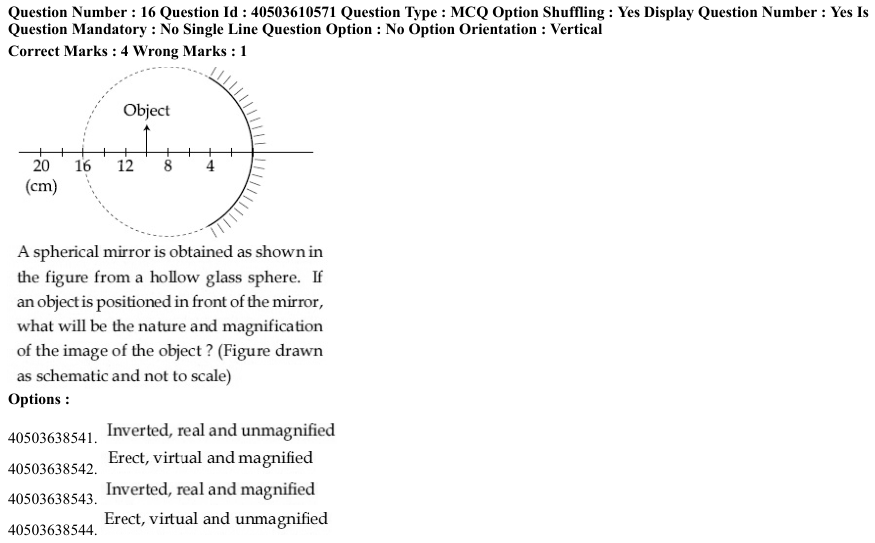
Physics · 4 marks · −1A spherical mirror is obtained as shown in the figure from a hollow glass sphere. If an object is positioned in front of the mirror, what will be the nature and magnification of the image of the object? (Figure drawn as schematic and not to scale)
- A.Inverted, real and unmagnified
- B.Erect, virtual and magnified
- C.Inverted, real and magnified
- D.Erect, virtual and unmagnified
Correct answer: C
Question 17
Physics · 4 marks · −1Interference fringes are observed on a screen by illuminating two thin slits 1 mm apart with a light source ( nm). The distance between the screen and the slits is 100 cm. If a bright fringe is observed on a screen at a distance of 1.27 mm from the central bright fringe, then the path difference between the waves, which are reaching this point from the slits is close to:
- A.1.27 m
- B.2.87 nm
- C.2 nm
- D.2.05 m
Correct answer: A
Explanation: m.
Question 18
Physics · 4 marks · −1In a reactor, 2 kg of fuel is fully used up in 30 days. The energy released per fission is 200 MeV. Given that the Avogadro number, per kilo mole and 1 eV J. The power output of the reactor is close to:
- A.60 MW
- B.125 MW
- C.54 MW
- D.35 MW
Correct answer: A
Explanation: J over s: 63 MW.
Question 19
Physics · 4 marks · −1The least count of the main scale of a vernier callipers is 1 mm. Its vernier scale is divided into 10 divisions and coincide with 9 divisions of the main scale. When jaws are touching each other, the 7 division of vernier scale coincides with a division of main scale and the zero of vernier scale is lying right side of the zero of main scale. When this vernier is used to measure length of a cylinder the zero of the vernier scale between 3.1 cm and 3.2 cm and 4 VSD coincides with a main scale division. The length of the cylinder is: (VSD is vernier scale division)
- A.3.2 cm
- B.3.07 cm
- C.3.21 cm
- D.2.99 cm
Correct answer: B
Explanation: cm.
Question 20
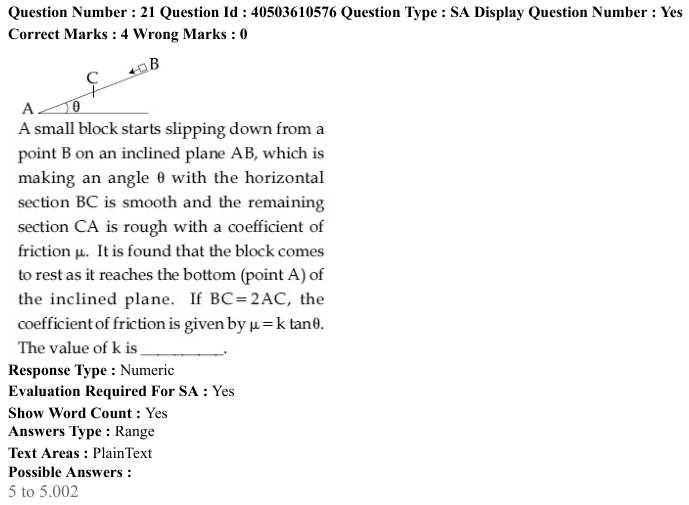
Physics · 4 marksA small block starts slipping down from a point B on an inclined plane AB, which is making an angle with the horizontal section BC is smooth and the remaining section CA is rough with a coefficient of friction . It is found that the block comes to rest as it reaches the bottom (point A) of the inclined plane. If BC = 2AC, the coefficient of friction is given by . The value of k is ________.
Correct answer: 3
Explanation: .
Question 21
Physics · 4 marksAn engine takes in 5 moles of air at 20°C and 1 atm, and compresses it adiabaticaly to 1/10 of the original volume. Assuming air to be a diatomic ideal gas made up of rigid molecules, the change in its internal energy during this process comes out to be X kJ. The value of X to the nearest integer is ________.
Correct answer: 46
Explanation: K; kJ.
Question 22
Physics · 4 marksA 5 F capacitor is charged fully by a 220 V supply. It is then disconnected from the supply and is connected in series to another uncharged 2.5 F capacitor. If the energy change during the charge redistribution is J then value of X to the nearest integer is ________.
Correct answer: 36
Explanation: J: X = 4.
Question 23
Physics · 4 marksA circular coil of radius 10 cm is placed in a uniform magnetic field of T with its plane perpendicular to the field initially. It is rotated at constant angular speed about an axis along the diameter of coil and perpendicular to magnetic field so that it undergoes half of rotation in 0.2s. The maximum value of EMF induced (in V) in the coil will be close to the integer ________.
Correct answer: 15
Explanation: ; V.
Question 24
Physics · 4 marksWhen radiation of wavelength is used to illuminate a metallic surface, the stopping potential is V. When the same surface is illuminated with radiation of wavelength , the stopping potential is . If the threshold wavelength for the metallic surface is then value of n will be ________.
Correct answer: 9
Explanation: : n = 9.
Question 25
Chemistry · 4 marks · −1For the following Assertion and Reason, the correct option is Assertion (A): When Cu (II) and sulphide ions are mixed, they react together extremely quickly to give a solid. Reason (R): The equilibrium constant of is high because the solubility product is low.
- A.Both (A) and (R) are true and (R) is the explanation for (A).
- B.Both (A) and (R) are true but (R) is not the explanation for (A).
- C.(A) is false and (R) is true.
- D.Both (A) and (R) are false.
Correct answer: B
Question 26
Chemistry · 4 marks · −1Which of the following is used for the preparation of colloids?
- A.Mond Process
- B.Ostwald Process
- C.Van Arkel Method
- D.Bredig's Arc Method
Correct answer: D
Question 27
Chemistry · 4 marks · −1If AB molecule is a polar molecule, a possible geometry of AB is:
- A.Tetrahedral
- B.Square planar
- C.Rectangular planar
- D.Square pyramidal
Correct answer: D
Question 28
Chemistry · 4 marks · −1The figure that is not a direct manifestation of the quantum nature of atoms is:
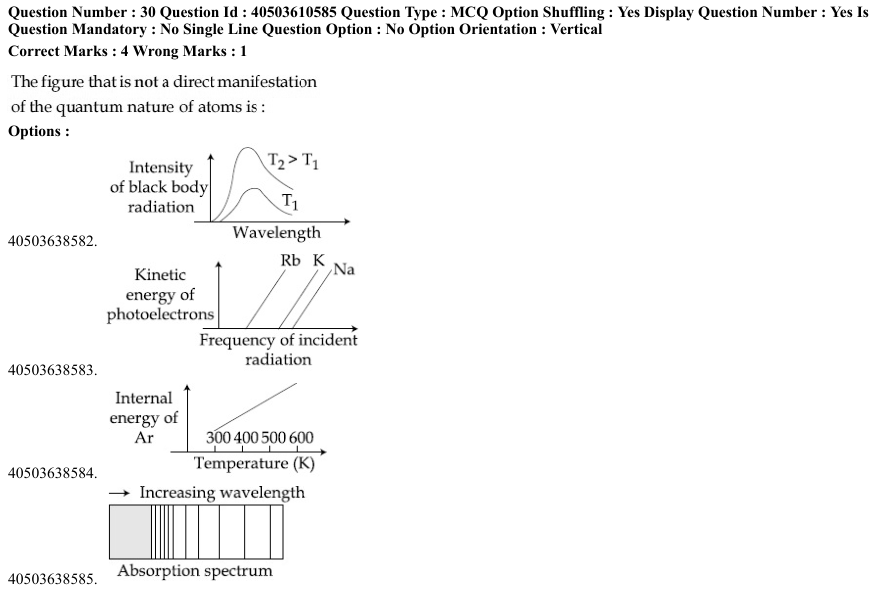
- A.Black-body radiation: intensity vs wavelength curves for T2 > T1
- B.Photoelectric effect: kinetic energy of photoelectrons vs frequency for Rb, K, Na (parallel lines)
- C.Internal energy of Ar increasing linearly with temperature (300-600 K)
- D.Absorption spectrum (discrete lines with increasing wavelength)
Correct answer: C
Question 29
Chemistry · 4 marks · −1Which one of the following graphs is not correct for ideal gas? I: d decreasing (hyperbola) with T; II: d increasing linearly with T; III: d increasing linearly with 1/T; IV: d increasing linearly with P. (d = Density, P = Pressure, T = Temperature)
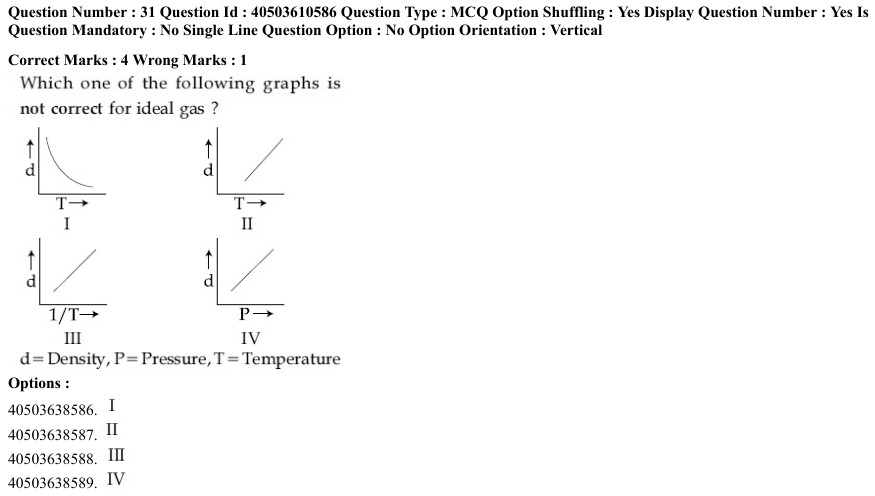
- A.I
- B.II
- C.III
- D.IV
Correct answer: B
Question 30
Chemistry · 4 marks · −1In general, the property (magnitudes only) that shows an opposite trend in comparison to other properties across a period is:
- A.Electronegativity
- B.Atomic radius
- C.Ionization enthalpy
- D.Electron gain enthalpy
Correct answer: B
Question 31
Chemistry · 4 marks · −1While titrating dilute HCl solution with aqueous NaOH, which of the following will not be required?
- A.Burette and porcelain tile
- B.Pipette and distilled water
- C.Bunsen burner and measuring cylinder
- D.Clamp and phenolphthalein
Correct answer: C
Question 32
Chemistry · 4 marks · −1The metal mainly used in devising photoelectric cells is:
- A.Li
- B.Na
- C.Rb
- D.Cs
Correct answer: D
Question 33
Chemistry · 4 marks · −1On heating compound (A) gives a gas (B) which is a constituent of air. This gas when treated with H in the presence of a catalyst gives another gas (C) which is basic in nature. (A) should not be:
- A.NHNO
- B.(NH)CrO
- C.NaN
- D.Pb(NO)
Correct answer: D
Question 34
Chemistry · 4 marks · −1For octahedral Mn(II) and tetrahedral Ni(II) complexes, consider the following statements: (I) both the complexes can be high spin. (II) Ni(II) complex can very rarely be low spin. (III) with strong field ligands, Mn(II) complexes can be low spin. (IV) aqueous solution of Mn(II) ions is yellow in color. The correct statements are:
- A.(I), (III) and (IV) only
- B.(I), (II) and (III) only
- C.(II), (III) and (IV) only
- D.(I) and (II) only
Correct answer: B
Question 35
Chemistry · 4 marks · −1Consider that a d metal ion (M) forms a complex with aqua ligands, and the spin only magnetic moment of the complex is 4.90 BM. The geometry and the crystal field stabilization energy of the complex is:
- A.octahedral and
- B.tetrahedral and
- C.octahedral and
- D.tetrahedral and
Correct answer: B
Question 36
Chemistry · 4 marks · −1The statement that is not true about ozone is:
- A.in the stratosphere, it forms a protective shield against UV radiation.
- B.in the atmosphere, it is depleted by CFCs.
- C.it is a toxic gas and its reaction with NO gives NO.
- D.in the stratosphere, CFCs release chlorine free radicals (Cl·) which reacts with O to give chlorine dioxide radicals.
Correct answer: D
Question 37
Chemistry · 4 marks · −1The IUPAC name for the following compound is:
- A.2,5-dimethyl-6-oxo-hex-3-enoic acid
- B.6-formyl-2-methyl-hex-3-enoic acid
- C.2,5-dimethyl-5-carboxy-hex-3-enal
- D.2,5-dimethyl-6-carboxy-hex-3-enal
Correct answer: A
Question 38
Chemistry · 4 marks · −1In Carius method of estimation of halogen, 0.172 g of an organic compound showed presence of 0.08 g of bromine. Which of these is the correct structure of the compound?
- A.4-bromoaniline
- B.2,4-dibromoaniline
- C.HC–Br
- D.HC–CH–Br
Correct answer: A
Explanation: 46.5% Br: (M = 172).
Question 39
Chemistry · 4 marks · −1The major product in the following reaction is: 1-methyl-1-vinylcyclopentane
- A.1,2-dimethylcyclohexene
- B.3,3-dimethylcyclohexene
- C.1-(1-methylcyclopentyl)ethanol
- D.1-isopropylcyclopentene
Correct answer: A
Explanation: Protonation gives a secondary cation next to the ring; ring expansion to a cyclohexyl cation, methyl/hydride adjustments and loss of H+ give 1,2-dimethylcyclohexene.
Question 40
Chemistry · 4 marks · −1The increasing order of the following compounds towards HCN addition is: (i) 3-methoxybenzaldehyde (ii) 2-nitrobenzaldehyde (iii) 2-methoxybenzaldehyde (iv) 3-nitrobenzaldehyde
- A.(iii) < (iv) < (i) < (ii)
- B.(iii) < (i) < (iv) < (ii)
- C.(i) < (iii) < (iv) < (ii)
- D.(iii) < (iv) < (ii) < (i)
Correct answer: B
Question 41
Chemistry · 4 marks · −1The major aromatic product C in the following reaction sequence will be: 2-methyl-2H-chromene (benzopyran) A B C
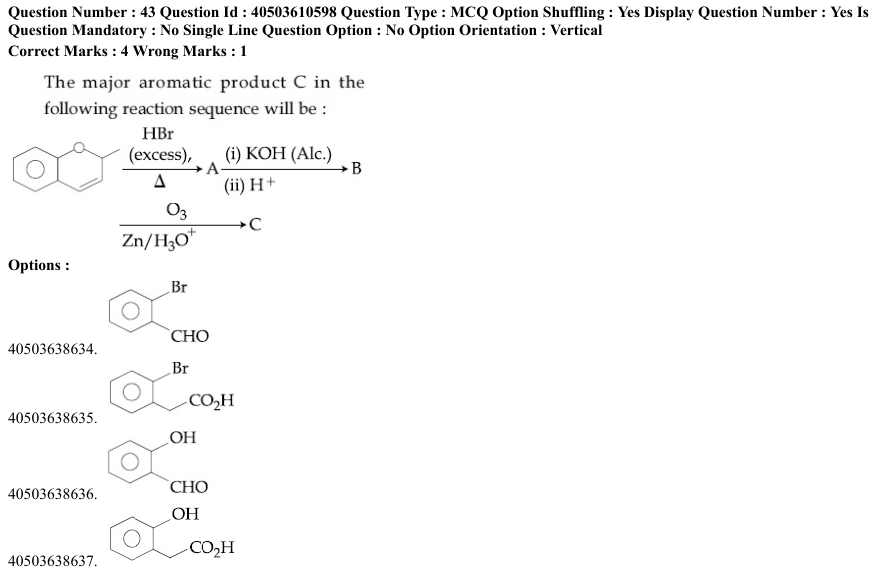
- A.2-bromobenzaldehyde
- B.2-bromophenylacetic acid
- C.2-hydroxybenzaldehyde (salicylaldehyde)
- D.2-hydroxyphenylacetic acid
Correct answer: C
Question 42
Chemistry · 4 marks · −1Which of the following compounds will show retention in configuration on nucleophilic substitution by OH ion?
- A.
- B.
- C.
- D.
Correct answer: C
Question 43
Chemistry · 4 marks · −1Consider the following reactions: (i) Glucose + ROH Acetal acetyl derivative (ii) Glucose A acetyl derivative (iii) Glucose acetyl derivative. 'x', 'y' and 'z' in these reactions are respectively.
- A.4, 5 & 5
- B.4, 6 & 5
- C.5, 4 & 5
- D.5, 6 & 5
Correct answer: B
Question 44
Chemistry · 4 marksThe internal energy change (in J) when 90 g of water undergoes complete evaporation at 100°C is ________. (Given: for water at 373 K = 41 kJ/mol, R = 8.314 JK mol)
Correct answer: 189000
Explanation: J.
Question 45
Chemistry · 4 marksThe Gibbs energy change (in J) for the given reaction at [Cu] = [Sn] = 1 M and 298 K is: ; ( V, V, Take F = 96500 C mol)
Correct answer: 96500
Explanation: V; J.
Question 46
Chemistry · 4 marksThe mass of gas adsorbed, x, per unit mass of adsorbate, m, was measured at various pressures, p. A graph between and gives a straight line with slope equal to 2 and the intercept equal to 0.4771. The value of at a pressure of 4 atm is: (Given log 3 = 0.4771)
Correct answer: 48
Explanation: .
Question 47
Chemistry · 4 marksThe oxidation states of iron atoms in compounds (A), (B) and (C), respectively, are x, y and z. The sum of x, y and z is ________. (A) Na[Fe(CN)(NOS)] (B) Na[FeO] (C) [Fe(CO)]
Correct answer: 6
Explanation: +2, +4, 0: sum 6.
Question 48
Chemistry · 4 marksThe number of chiral carbons present in the molecule given below is ________. [A quinine-like structure: a quinoline ring bearing a –CH(OH)CH group, linked through a CH(O–CH–CH) carbon to a quinuclidine (azabicyclo) ring that carries an ethyl group]
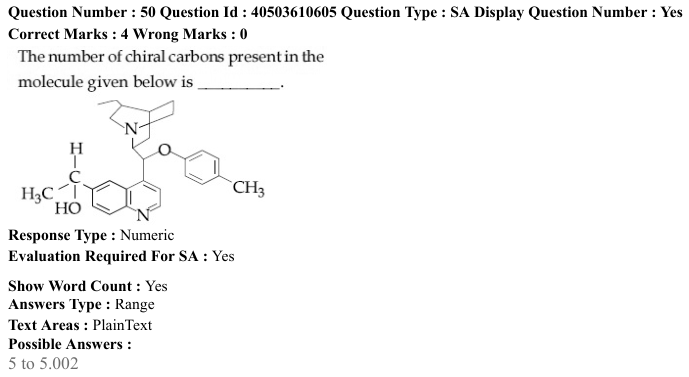
Correct answer: 5
Question 49
Mathematics · 4 marks · −1If is a relation on the set of integers , then the domain of is:
- A.
- B.
- C.
- D.
Correct answer: C
Question 50
Mathematics · 4 marks · −1Let and be the roots of the equation, . If , n = 1, 2, 3, ..., then:
- A.
- B.
- C.
- D.
Correct answer: B
Question 51
Mathematics · 4 marks · −1The value of is:
- A.
- B.
- C.
- D.
Correct answer: D
Explanation: Ratio ; cube .
Question 52
Mathematics · 4 marks · −1Let A be a real matrix with entries from {0, 1} and . Consider the following two statements: (P) If , then (Q) If , then tr(A) = 2, where denotes identity matrix and tr(A) denotes the sum of the diagonal entries of A. Then:
- A.(P) is true and (Q) is false
- B.(P) is false and (Q) is true
- C.Both (P) and (Q) are false
- D.Both (P) and (Q) are true
Correct answer: B
Question 53
Mathematics · 4 marks · −1Let S be the set of all for which the system of linear equations , , has no solution. Then the set S
- A.is an empty set.
- B.is a singleton.
- C.contains exactly two elements.
- D.contains more than two elements.
Correct answer: C
Question 54
Mathematics · 4 marks · −1Let , be such that . If the maximum value of the term independent of x in the binomial expansion of is 10k, then k is equal to:
- A.84
- B.176
- C.336
- D.352
Correct answer: C
Explanation: Term , maximum 16 at : 3360.
Question 55
Mathematics · 4 marks · −1The sum of the first three terms of a G.P. is S and their product is 27. Then all such S lie in:
- A.
- B.
- C.
- D.
Correct answer: B
Question 56
Mathematics · 4 marks · −1If , and , then the sum to infinity of the following series is:
- A.
- B.
- C.
- D.
Correct answer: C
Question 57
Mathematics · 4 marks · −1If a function f(x) defined by be continuous for some and , then the value of a is:
- A.
- B.
- C.
- D.
Correct answer: A
Question 58
Mathematics · 4 marks · −1If the tangent to the curve at a point (a, b) is parallel to the line joining and , then:
- A.
- B.
- C.
- D.
Correct answer: A
Question 59
Mathematics · 4 marks · −1If p(x) be a polynomial of degree three that has a local maximum value 8 at x = 1 and a local minimum value 4 at x = 2; then p(0) is equal to:
- A.−12
- B.−24
- C.6
- D.12
Correct answer: A
Question 60
Mathematics · 4 marks · −1Area (in sq. units) of the region outside and inside the ellipse is:
- A.
- B.
- C.
- D.
Correct answer: C
Question 61
Mathematics · 4 marks · −1Let be the solution of the differential equation, , , . If and at is b, then the ordered pair (a, b) is equal to:
- A.
- B.(1, 1)
- C.(1, −1)
- D.(2, 1)
Correct answer: B
Question 62
Mathematics · 4 marks · −1Let P(h, k) be a point on the curve , nearest to the line, . Then the equation of the normal to the curve at P is:
- A.
- B.
- C.
- D.
Correct answer: C
Question 63
Mathematics · 4 marks · −1A line parallel to the straight line is tangent to the hyperbola at the point . Then is equal to:
- A.10
- B.8
- C.6
- D.5
Correct answer: C
Question 64
Mathematics · 4 marks · −1The plane passing through the points (1, 2, 1), (2, 1, 2) and parallel to the line, , also passes through the point:
- A.(2, 0, −1)
- B.(−2, 0, 1)
- C.(0, 6, −2)
- D.(0, −6, 2)
Correct answer: B
Question 65
Mathematics · 4 marks · −1Let and and . If mean and variance of elements of Y are 17 and 216 respectively then a + b is equal to:
- A.−27
- B.7
- C.−7
- D.9
Correct answer: C
Question 66
Mathematics · 4 marks · −1Box I contains 30 cards numbered 1 to 30 and Box II contains 20 cards numbered 31 to 50. A box is selected at random and a card is drawn from it. The number on the card is found to be a non-prime number. The probability that the card was drawn from Box I is:
- A.
- B.
- C.
- D.
Correct answer: A
Question 67
Mathematics · 4 marks · −1The domain of the function is . Then a is equal to:
- A.
- B.
- C.
- D.
Correct answer: B
Question 68
Mathematics · 4 marks · −1The contrapositive of the statement "If I reach the station in time, then I will catch the train" is:
- A.If I do not reach the station in time, then I will catch the train.
- B.If I do not reach the station in time, then I will not catch the train.
- C.If I will catch the train, then I reach the station in time.
- D.If I will not catch the train, then I do not reach the station in time.
Correct answer: D
Question 69
Mathematics · 4 marksIf the letters of the word 'MOTHER' be permuted and all the words so formed (with or without meaning) be listed as in a dictionary, then the position of the word 'MOTHER' is ________.
Correct answer: 309
Explanation: .
Question 70
Mathematics · 4 marksIf , then the value of n is equal to ________.
Correct answer: 40
Explanation: .
Question 71
Mathematics · 4 marksThe integral is equal to ________.
Correct answer: 1.5
Explanation: .
Question 72
Mathematics · 4 marksThe number of integral values of k for which the line, intersects the circle, at two distinct points is ________.
Correct answer: 9
Explanation: : k = 7, ..., 15 (9 values).
Question 73
Mathematics · 4 marksLet , and be three unit vectors such that . Then is equal to ________.
Correct answer: 2
Explanation: Both squared distances equal 4, so : .