JEE Main 2020 — 7 Jan Shift 1 (Previous Year Paper)
JEE Main · 2020 · with answers and explanations
- questions
- 75
- Total marks
- 300
- Duration
- 180 minutes
- Negative marking
- −1
Subjects: Physics · Chemistry · Mathematics
Question 1
Physics · 4 marks · −1A LCR circuit behaves like a damped harmonic oscillator. Comparing it with a physical spring-mass damped oscillator having damping constant 'b', the correct equivalence would be:
- A.
- B.
- C.
- D.
Correct answer: B
Explanation: vs : , , .
Question 2
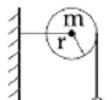
Physics · 4 marks · −1As shown in the figure, a bob of mass m is tied by a massless string whose other end portion is wound on a fly wheel (disc) of radius r and mass m. When released from rest the bob starts falling vertically. When it has covered a distance of h, the angular speed of the wheel will be:
- A.
- B.
- C.
- D.
Correct answer: A
Explanation: , .
Question 3
Physics · 4 marks · −1A 60 HP electric motor lifts an elevator having a maximum total load capacity of 2000 kg. If the frictional force on the elevator is 4000 N, the speed of the elevator at full load is close to: (1 HP = 746 W, )
- A.
- B.
- C.
- D.
Correct answer: B
Explanation: m/s.
Question 4
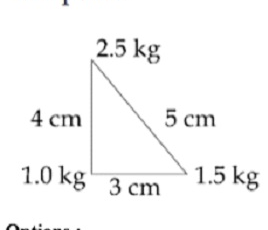
Physics · 4 marks · −1Three point particles of masses 1.0 kg, 1.5 kg and 2.5 kg are placed at three corners of a right angle triangle of sides 4.0 cm, 3.0 cm and 5.0 cm as shown in the figure. The center of mass of the system is at a point:
- A.0.9 cm right and 2.0 cm above 1 kg mass
- B.2.0 cm right and 0.9 cm above 1 kg mass
- C.0.6 cm right and 2.0 cm above 1 kg mass
- D.1.5 cm right and 1.2 cm above 1 kg mass
Correct answer: A
Explanation: Origin at 1 kg: cm, cm.
Question 5
Physics · 4 marks · −1The radius of gyration of a uniform rod of length , about an axis passing through a point away from the centre of the rod, and perpendicular to it, is:
- A.
- B.
- C.
- D.
Correct answer: C
Explanation: .
Question 6
Physics · 4 marks · −1A satellite of mass m is launched vertically upwards with an initial speed u from the surface of the earth. After it reaches height R (R = radius of the earth), it ejects a rocket of mass so that subsequently the satellite moves in a circular orbit. The kinetic energy of the rocket is (G is the gravitational constant; M is the mass of the earth):
- A.
- B.
- C.
- D.
Correct answer: A
Explanation: At height R: (vertical). Remaining moves horizontally with ; rocket gets vertical speed and horizontal speed . .
Question 7
Physics · 4 marks · −1Two moles of an ideal gas with are mixed with 3 moles of another ideal gas with . The value of for the mixture is:
- A.1.50
- B.1.47
- C.1.42
- D.1.45
Correct answer: C
Explanation: , , .
Question 8
Physics · 4 marks · −1A litre of dry air at STP expands adiabatically to a volume of 3 litres. If , the work done by air is: () [Take air to be an ideal gas]
- A.48 J
- B.60.7 J
- C.90.5 J
- D.100.8 J
Correct answer: C
Explanation: J.
Question 9
Physics · 4 marks · −1Speed of a transverse wave on a straight wire (mass 6.0 g, length 60 cm and area of cross-section 1.0 mm) is 90 m s. If the Young's modulus of wire is N m, the extension of wire over its natural length is:
- A.0.03 mm
- B.0.02 mm
- C.0.01 mm
- D.0.04 mm
Correct answer: A
Explanation: N; mm.
Question 10
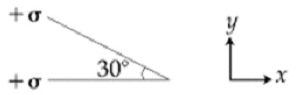
Physics · 4 marks · −1Two infinite planes each with uniform surface charge density are kept in such a way that the angle between them is 30°. The electric field in the region shown between them is given by:
- A.
- B.
- C.
- D.
Correct answer: A
Question 11
Physics · 4 marks · −1A parallel plate capacitor has plates of area A separated by distance 'd' between them. It is filled with a dielectric which has a dielectric constant that varies as where 'x' is the distance measured from one of the plates. If , the total capacitance of the system is best given by the expression:

- A.
- B.
- C.
- D.
Correct answer: D
Explanation: .
Question 12
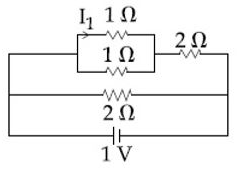
Physics · 4 marks · −1The current (in A) flowing through 1 Ω resistor in the following circuit is:
- A.0.4
- B.0.5
- C.0.2
- D.0.25
Correct answer: C
Explanation: Branch (1 Ω ∥ 1 Ω) + 2 Ω = 2.5 Ω across 1 V carries 0.4 A, split equally: A.
Question 13
Physics · 4 marks · −1Consider a circular coil of wire carrying constant current I, forming a magnetic dipole. The magnetic flux through an infinite plane that contains the circular coil and excluding the circular coil area is given by . The magnetic flux through the area of the circular coil area is given by . Which of the following option is correct?
- A.
- B.
- C.
- D.
Correct answer: D
Explanation: Field lines are closed, so the total flux through the infinite plane is zero.
Question 14
Physics · 4 marks · −1A long solenoid of radius R carries a time (t)-dependent current . A ring of radius 2R is placed coaxially near its middle. During the time interval , the induced current () and the induced EMF () in the ring change as:
- A.Direction of remains unchanged and is maximum at
- B.At direction of reverses and is zero
- C.Direction of remains unchanged and is zero at
- D.At direction of reverses and is maximum
Correct answer: B
Explanation: : zero and changes sign at .
Question 15
Physics · 4 marks · −1If the magnetic field in a plane electromagnetic wave is given by T, then what will be expression for electric field?
- A.
- B.
- C.
- D.
Correct answer: B
Explanation: V/m; wave travels along , so .
Question 16
Physics · 4 marks · −1If we need a magnification of 375 from a compound microscope of tube length 150 mm and an objective of focal length 5 mm, the focal length of the eye-piece, should be close to:
- A.12 mm
- B.22 mm
- C.33 mm
- D.2 mm
Correct answer: B
Explanation: mm.
Question 17
Physics · 4 marks · −1A polarizer - analyser set is adjusted such that the intensity of light coming out of the analyser is just 10% of the original intensity. Assuming that the polarizer - analyser set does not absorb any light, the angle by which the analyser need to be rotated further to reduce the output intensity to be zero, is:
- A.90°
- B.18.4°
- C.71.6°
- D.45°
Correct answer: B
Explanation: ; further rotation .
Question 18
Physics · 4 marks · −1The time period of revolution of electron in its ground state orbit in a hydrogen atom is s. The frequency of revolution of the electron in its first excited state (in s) is:
- A.
- B.
- C.
- D.
Correct answer: C
Explanation: : s.
Question 19
Physics · 4 marks · −1Which of the following gives a reversible operation?
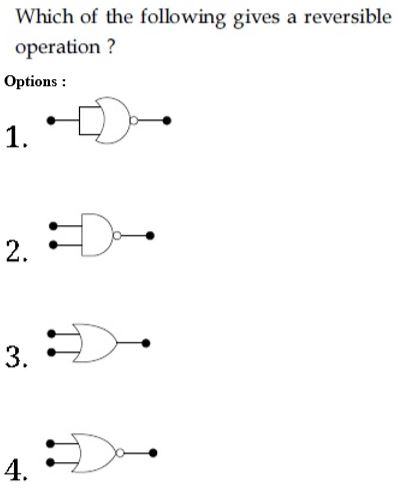
- A.Option 1 (drawn): a single-input gate with an output bubble — a NOT gate
- B.Option 2 (drawn): a two-input AND-shaped gate with an output bubble — a NAND gate
- C.Option 3 (drawn): a two-input OR gate
- D.Option 4 (drawn): a two-input OR-shaped gate with an output bubble — a NOR gate
Correct answer: A
Explanation: Only the NOT gate maps inputs to outputs one-to-one, so its input can be recovered from its output.
Question 20
Physics · 4 marks · −1Visible light of wavelength cm falls normally on a single slit and produces a diffraction pattern. It is found that the second diffraction minimum is at 60° from the central maximum. If the first minimum is produced at , then is close to:
- A.45°
- B.30°
- C.25°
- D.20°
Correct answer: C
Explanation: , .
Question 21
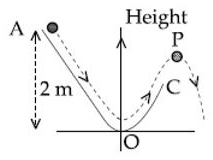
Physics · 4 marksA particle (m = 1 kg) slides down a frictionless track (AOC) starting from rest at a point A (height 2 m). After reaching C, the particle continues to move freely in air as a projectile. When it reaching its highest point P (height 1 m), the kinetic energy of the particle (in J) is: (Figure drawn is schematic and not to scale; take ) ________.
Correct answer: 10
Explanation: J.
Question 22
Physics · 4 marksA non-isotropic solid metal cube has coefficients of linear expansion as: /°C along the x-axis and /°C along the y and the z-axis. If the coefficient of volume expansion of the solid is /°C then the value of C is ________.
Correct answer: 60
Explanation: /°C.
Question 23
Physics · 4 marksA Carnot engine operates between two reservoirs of temperatures 900 K and 300 K. The engine performs 1200 J of work per cycle. The heat energy (in J) delivered by the engine to the low temperature reservoir, in a cycle, is ________.
Correct answer: 600
Explanation: , J, J.
Question 24
Physics · 4 marksA loop ABCDEFA of straight edges has six corner points A(0, 0, 0), B(5, 0, 0), C(5, 5, 0), D(0, 5, 0), E(0, 5, 5) and F(0, 0, 5). The magnetic field in this region is T. The quantity of flux through the loop ABCDEFA (in Wb) is ________.
Correct answer: 175
Explanation: Loop = ABCDA () + ADEFA (). Wb.
Question 25
Physics · 4 marksA beam of electromagnetic radiation of intensity W/cm is comprised of wavelength, nm. It falls normally on a metal (work function eV) of surface area of 1 cm. If one in photons ejects an electron, total number of electrons ejected in 1 s is . (hc = 1240 eV nm, 1 eV = J), then x is ________.
Correct answer: 11
Explanation: eV J; photons/s ; electrons , x = 11.
Question 26
Chemistry · 4 marks · −1At 35°C, the vapour pressure of CS is 512 mm Hg and that of acetone is 344 mm Hg. A solution of CS in acetone has a total vapour pressure of 600 mm Hg. The false statement amongst the following is:
- A.heat must be absorbed in order to produce the solution at 35°C
- B.a mixture of 100 mL CS and 100 mL acetone has a volume < 200 mL
- C.CS and acetone are less attracted to each other than to themselves
- D.Raoult's law is not obeyed by this system
Correct answer: B
Explanation: Total VP exceeds both pure values: positive deviation, so ΔV_mix > 0; statement 2 is false.
Question 27
Chemistry · 4 marks · −1Given that the standard potentials (E°) of Cu/Cu and Cu/Cu are 0.34 V and 0.522 V respectively, the E° of Cu/Cu is:
- A.0.182 V
- B.−0.182 V
- C.+0.158 V
- D.−0.158 V
Correct answer: C
Explanation: V.
Question 28
Chemistry · 4 marks · −1The dipole moments of CCl, CHCl and CH are in the order:
- A.CH < CCl < CHCl
- B.CCl < CH < CHCl
- C.CH = CCl < CHCl
- D.CHCl < CH = CCl
Correct answer: C
Question 29
Chemistry · 4 marks · −1The number of orbitals associated with quantum numbers , is:
- A.50
- B.15
- C.25
- D.11
Correct answer: C
Explanation: n = 5 has orbitals; each holds one electron with .
Question 30
Chemistry · 4 marks · −1The relative strength of interionic/intermolecular forces in decreasing order is:
- A.ion-dipole > ion-ion > dipole-dipole
- B.ion-ion > ion-dipole > dipole-dipole
- C.ion-dipole > dipole-dipole > ion-ion
- D.dipole-dipole > ion-dipole > ion-ion
Correct answer: B
Question 31
Chemistry · 4 marks · −1Amongst the following statements, that which was not proposed by Dalton was:
- A.matter consists of indivisible atoms.
- B.all the atoms of a given element have identical properties including identical mass. Atoms of different elements differ in mass.
- C.when gases combine or reproduced in a chemical reaction they do so in a simple ratio by volume provided all gases are at the same T & P.
- D.chemical reactions involve reorganization of atoms. These are neither created nor destroyed in a chemical reaction.
Correct answer: C
Explanation: The law of combining volumes is Gay-Lussac's, not Dalton's.
Question 32
Chemistry · 4 marks · −1The electron gain enthalpy (in kJ/mol) of fluorine, chlorine, bromine and iodine, respectively, are:
- A.−333, −349, −325 and −296
- B.−349, −333, −325 and −296
- C.−333, −325, −349 and −296
- D.−296, −325, −333 and −349
Correct answer: A
Question 33
Chemistry · 4 marks · −1The purest form of commercial iron is:
- A.wrought iron
- B.pig iron
- C.cast iron
- D.scrap iron and pig iron
Correct answer: A
Question 34
Chemistry · 4 marks · −1In comparison to the zeolite process for the removal of permanent hardness, the synthetic resins method is:
- A.less efficient as it exchanges only anions
- B.more efficient as it can exchange both cations as well as anions
- C.more efficient as it can exchange only cations
- D.less efficient as the resins cannot be regenerated
Correct answer: B
Question 35
Chemistry · 4 marks · −1Oxidation number of potassium in KO, KO and KO, respectively, is:
- A.+1, +2 and +4
- B.+1, +4 and +2
- C.+2, +1 and
- D.+1, +1 and +1
Correct answer: D
Question 36
Chemistry · 4 marks · −1The atomic radius of Ag is closest to:
- A.Ni
- B.Cu
- C.Hg
- D.Au
Correct answer: D
Question 37
Chemistry · 4 marks · −1The theory that can completely/properly explain the nature of bonding in [Ni(CO)] is:
- A.Werner's theory
- B.Valence bond theory
- C.Crystal field theory
- D.Molecular orbital theory
Correct answer: D
Question 38
Chemistry · 4 marks · −1The IUPAC name of the complex [Pt(NH)Cl(NHCH)]Cl is:
- A.Bisammine(methanamine)chlorido platinum(II)chloride
- B.Diammine(methanamine)chlorido platinum(II)chloride
- C.Diamminechlorido(methanamine) platinum(II)chloride
- D.Diamminechlorido(aminomethane) platinum(II)chloride
Correct answer: C
Question 39
Chemistry · 4 marks · −1Consider the following reaction: N,N-dimethylaniline + (p-sulphonatobenzenediazonium chloride) 'X'. The product 'X' is used:
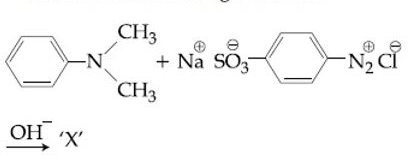
- A.as food grade colourant
- B.in protein estimation as an alternative to ninhydrin
- C.in acid base titration as an indicator
- D.in laboratory test for phenols
Correct answer: C
Explanation: Coupling gives methyl orange, an acid–base indicator.
Question 40
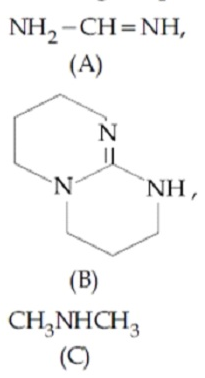
Chemistry · 4 marks · −1The increasing order of pK for the following compounds will be: (A) NH–CH=NH, (B) the bicyclic amidine shown in the figure, (C) CHNHCH
- A.(A) < (B) < (C)
- B.(B) < (C) < (A)
- C.(C) < (A) < (B)
- D.(B) < (A) < (C)
Correct answer: D
Explanation: Amidines are stronger bases than secondary amines (resonance-stabilised conjugate acid); the cyclic, alkyl-substituted amidine (B) is the strongest base: pKb B < A < C.
Question 41
Chemistry · 4 marks · −1A solution of m-chloroaniline, m-chlorophenol and m-chlorobenzoic acid in ethyl acetate was extracted initially with a saturated solution of NaHCO to give fraction A. The left over organic phase was extracted with dilute NaOH solution to give fraction B. The final organic layer was labelled as fraction C. Fractions A, B and C, contain respectively:
- A.m-chloroaniline, m-chlorobenzoic acid and m-chlorophenol
- B.m-chlorobenzoic acid, m-chloroaniline and m-chlorophenol
- C.m-chlorobenzoic acid, m-chlorophenol and m-chloroaniline
- D.m-chlorophenol, m-chlorobenzoic acid and m-chloroaniline
Correct answer: C
Question 42
Chemistry · 4 marks · −1Match the following: (i) Riboflavin, (ii) Thiamine, (iii) Pyridoxine, (iv) Ascorbic acid with (a) Beriberi, (b) Scurvy, (c) Cheilosis, (d) Convulsions
- A.(i)-(c), (ii)-(a), (iii)-(d), (iv)-(b)
- B.(i)-(d), (ii)-(b), (iii)-(a), (iv)-(c)
- C.(i)-(c), (ii)-(d), (iii)-(a), (iv)-(b)
- D.(i)-(a), (ii)-(d), (iii)-(c), (iv)-(b)
Correct answer: A
Question 43
Chemistry · 4 marks · −1What is the product of following reaction? Hex-3-ynal ?
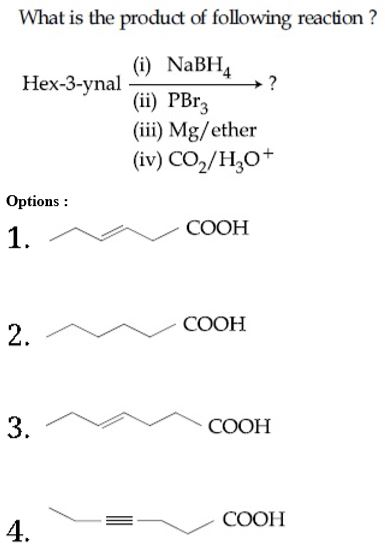
- A.Hept-4-enoic acid drawn as a zig-zag chain with a C=C double bond, ending in COOH
- B.Heptanoic acid (saturated zig-zag chain ending in COOH)
- C.Oct-4-enoic-type chain: longer zig-zag chain with a C=C double bond ending in COOH
- D.Hept-4-ynoic acid: CH3CH2–C≡C–CH2CH2–COOH (zig-zag with a triple bond, ending in COOH)
Correct answer: D
Explanation: CHO → CH2OH → CH2Br → CH2MgBr → CH2COOH; the triple bond survives: CH3CH2C≡CCH2CH2COOH.
Question 44
Chemistry · 4 marks · −11-methyl ethylene oxide when treated with an excess of HBr produces:
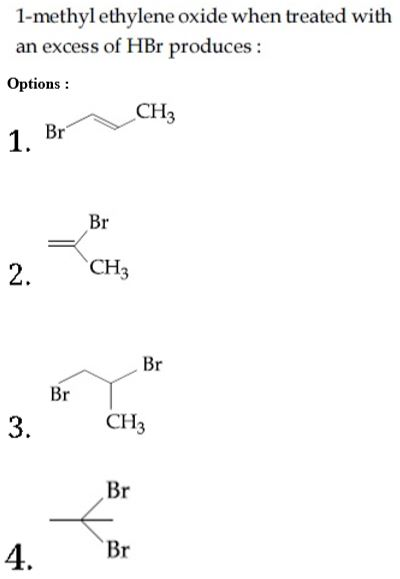
- A.Br–CH=CH–CH3 (1-bromopropene, drawn as skeletal structure)
- B.CH2=C(Br)–CH3 (2-bromopropene)
- C.BrCH2–CH(Br)–CH3 (1,2-dibromopropane)
- D.(CH3)2CBr2 (2,2-dibromopropane)
Correct answer: C
Explanation: Excess HBr opens the epoxide and then substitutes the OH: 1,2-dibromopropane.
Question 45
Chemistry · 4 marks · −1Consider the following reactions: (a) (CH)CCH(OH)CH (b) (CH)CHCH(Br)CH (c) (CH)CHCH(Br)CH (d) (CH)C(OH)–CH–CHO . Which of these reaction(s) will not produce Saytzeff product?
- A.(d) only
- B.(b) and (d)
- C.(a), (c) and (d)
- D.(c) only
Correct answer: D
Explanation: Bulky tert-butoxide gives the Hofmann (less substituted) alkene; the others give the more substituted/conjugated product.
Question 46
Chemistry · 4 marksDuring the nuclear explosion, one of the products is Sr with half life of 6.93 years. If 1 μg of Sr was absorbed in the bones of a newly born baby in place of Ca, how much time, in years, is required to reduce it by 90% if it is not lost metabolically ________.
Correct answer: 23.03
Explanation: years.
Question 47
Chemistry · 4 marksTwo solutions, A and B, each of 100 L was made by dissolving 4 g of NaOH and 9.8 g of HSO in water, respectively. The pH of the resultant solution obtained from mixing 40 L of solution A and 10 L of solution B is ________.
Correct answer: 10.6
Explanation: OH: 0.04 mol; H: 2×0.01 = 0.02 mol; excess OH = 0.02 mol in 50 L = M; pOH = 3.4, pH = 10.6.
Question 48
Chemistry · 4 marksFor the reaction; A(l) → 2B(g), ΔU = 2.1 kcal, ΔS = 20 cal K at 300 K. Hence ΔG in kcal is ________.
Correct answer: -2.7
Explanation: kcal; kcal.
Question 49
Chemistry · 4 marksChlorine reacts with hot and concentrated NaOH and produces compounds (X) and (Y). Compound (X) gives white precipitate with silver nitrate solution. The average bond order between Cl and O atoms in (Y) is ________.
Correct answer: 1.67
Explanation: X = NaCl, Y = NaClO; ClO has 2 Cl=O + 1 Cl–O resonating over 3 bonds: bond order = 5/3 ≈ 1.67.
Question 50
Chemistry · 4 marksThe number of chiral carbons in chloramphenicol is ________.
Correct answer: 2
Explanation: Chloramphenicol, O2N–C6H4–CH(OH)–CH(NHCOCHCl2)–CH2OH, has two stereocentres (the CH(OH) and CH(NH) carbons).
Question 51
Mathematics · 4 marks · −1If and , then is equal to:
- A.
- B.
- C.
- D.
Correct answer: A
Explanation: At : ⇒ ⇒ .
Question 52
Mathematics · 4 marks · −1If , where , then the point lies on a:
- A.straight line whose slope is .
- B.straight line whose slope is .
- C.circle whose centre is at .
- D.circle whose diameter is .
Correct answer: D
Explanation: Simplifies to : radius , diameter .
Question 53
Mathematics · 4 marks · −1Let be a root of the equation and the matrix , then the matrix is equal to:
- A.
- B.
- C.
- D.
Correct answer: C
Explanation: , so .
Question 54
Mathematics · 4 marks · −1If the system of linear equations , , , where are non-zero and distinct; has a non-zero solution, then:
- A.
- B. are in A.P.
- C.a, b, c are in G.P.
- D.a, b, c are in A.P.
Correct answer: B
Explanation: Determinant gives , i.e. .
Question 55
Mathematics · 4 marks · −1Total number of 6-digit numbers in which only and all the five digits 1, 3, 5, 7 and 9 appear, is:
- A.
- B.
- C.
- D.
Correct answer: C
Explanation: Choose the repeated digit (5 ways), arrange: .
Question 56
Mathematics · 4 marks · −1Five numbers are in A.P., whose sum is 25 and product is 2520. If one of these five numbers is , then the greatest number amongst them is:
- A.7
- B.16
- C.
- D.27
Correct answer: B
Explanation: Middle term 5; ⇒ ; terms .
Question 57
Mathematics · 4 marks · −1The greatest positive integer k, for which is a factor of the sum , is:
- A.32
- B.60
- C.63
- D.65
Correct answer: C
Explanation: Sum , so k = 63.
Question 58
Mathematics · 4 marks · −1Let , and , then k is:
- A.
- B.
- C.
- D.
Correct answer: A
Explanation: ⇒ .
Question 59
Mathematics · 4 marks · −1Let the function, be continuous on and differentiable on . If and , for all , then for all such functions , lies in the interval:
- A.
- B.
- C.
- D.
Correct answer: D
Explanation: MVT: , ; no lower bound.
Question 60
Mathematics · 4 marks · −1If , for all x, where a and b are fixed positive real numbers, then is equal to:
- A.
- B.
- C.
- D.
Correct answer: C
Question 61
Mathematics · 4 marks · −1The area of the region, enclosed by the circle which is not common to the region bounded by the parabola and the straight line , is:
- A.
- B.
- C.
- D.
Correct answer: B
Explanation: Region between and has area and lies inside the circle: .
Question 62
Mathematics · 4 marks · −1If is the solution of the differential equation, such that , then is equal to:
- A.
- B.
- C.
- D.
Correct answer: A
Explanation: Let : ⇒ (using ) ⇒ .
Question 63
Mathematics · 4 marks · −1If is a tangent to both the parabolas, and , then b is equal to:
- A.−128
- B.128
- C.−64
- D.−32
Correct answer: A
Explanation: Tangent to : ⇒ . For : has D = 0 ⇒ ⇒ .
Question 64
Mathematics · 4 marks · −1If the distance between the foci of an ellipse is 6 and the distance between its directrices is 12, then the length of its latus rectum is:
- A.
- B.
- C.
- D.
Correct answer: C
Explanation: , ⇒ , ; LR .
Question 65
Mathematics · 4 marks · −1Let P be a plane passing through the points (2, 1, 0), (4, 1, 1) and (5, 0, 1) and R be any point (2, 1, 6). Then the image of R in the plane P is:
- A.(6, 5, −2)
- B.(4, 3, 2)
- C.(6, 5, 2)
- D.(3, 4, −2)
Correct answer: A
Explanation: Plane: ; image of (2,1,6) is (6,5,−2).
Question 66
Mathematics · 4 marks · −1A vector lies in the plane of the vectors, and . If bisects the angle between and , then:
- A.
- B.
- C.
- D.
Correct answer: B
Explanation: or ; with j-coefficient 2 the latter gives (the internal bisector gives , not offered).
Question 67
Mathematics · 4 marks · −1Let and be two real roots of the equation , where and are real numbers. If , then a value of is:
- A.5
- B.10
- C.
- D.
Correct answer: B
Explanation: ⇒ ⇒ .
Question 68
Mathematics · 4 marks · −1An unbiased coin is tossed 5 times. Suppose that a variable X is assigned the value k when k consecutive heads are obtained for k = 3, 4, 5, otherwise X takes the value −1. Then the expected value of X, is:
- A.
- B.
- C.
- D.
Correct answer: D
Explanation: P(X=3) = 5/32, P(X=4) = 2/32, P(X=5) = 1/32, P(X=−1) = 24/32: E = (15+8+5−24)/32 = 1/8.
Question 69
Mathematics · 4 marks · −1If , , then at is:
- A.
- B.
- C.−4
- D.4
Correct answer: D
Explanation: on the interval; .
Question 70
Mathematics · 4 marks · −1The logical statement is equivalent to:
- A.p
- B.q
- C.~p
- D.~q
Correct answer: C
Question 71
Mathematics · 4 marksIf the variance of the first n natural numbers is 10 and the variance of the first m even natural numbers is 16, then m + n is equal to ________.
Correct answer: 18
Explanation: ; ; m + n = 18.
Question 72
Mathematics · 4 marksIf the sum of the coefficients of all even powers of x in the product is 61, then n is equal to ________.
Correct answer: 30
Explanation: Sum .
Question 73
Mathematics · 4 marksis equal to ________.
Correct answer: 36
Explanation: With : numerator , denominator ; ratio .
Question 74
Mathematics · 4 marksLet S be the set of points where the function, , , is not differentiable. Then is equal to ________.
Correct answer: 3
Explanation: S = {1, 3, 5}; f(1) = f(5) = 0, f(3) = 2; f(0) = 1, f(2) = 1; sum = 1 + 1 + 1 = 3.
Question 75
Mathematics · 4 marksLet A(1, 0), B(6, 2) and be the vertices of a triangle ABC. If P is a point inside the triangle ABC such that the triangles APC, APB and BPC have equal areas, then the length of the line segment PQ, where Q is the point , is ________.
Correct answer: 5
Explanation: P is the centroid ; PQ = .