JEE Main 2020 — 7 Jan Shift 2 (Previous Year Paper)
JEE Main · 2020 · with answers and explanations
- questions
- 72
- Total marks
- 288
- Duration
- 180 minutes
- Negative marking
- −1
Subjects: Physics · Chemistry · Mathematics
Question 1
Physics · 4 marks · −1The dimension of , where B is magnetic field and is the magnetic permeability of vacuum, is:
- A.
- B.
- C.
- D.
Correct answer: D
Explanation: It is energy per unit volume: .
Question 2
Physics · 4 marks · −1A mass of 10 kg is suspended by a rope of length 4 m, from the ceiling. A force F is applied horizontally at the mid-point of the rope such that the top half of the rope makes an angle of 45° with the vertical. Then F equals: (Take and the rope to be massless)
- A.90 N
- B.70 N
- C.100 N
- D.75 N
Correct answer: C
Explanation: At the midpoint: , ⇒ N.
Question 3
Physics · 4 marks · −1An elevator in a building can carry a maximum of 10 persons, with the average mass of each person being 68 kg. The mass of the elevator itself is 920 kg and it moves with a constant speed of 3 m/s. The frictional force opposing the motion is 6000 N. If the elevator is moving up with its full capacity, the power delivered by the motor to the elevator () must be at least:
- A.56300 W
- B.66000 W
- C.48000 W
- D.62360 W
Correct answer: B
Explanation: N; W.
Question 4
Physics · 4 marks · −1Mass per unit area of a circular disc of radius a depends on the distance r from its centre as . The moment of inertia of the disc about the axis, perpendicular to the plane and passing through its centre is:
- A.
- B.
- C.
- D.
Correct answer: A
Explanation: .
Question 5
Physics · 4 marks · −1A box weighs 196 N on a spring balance at the north pole. Its weight recorded on the same balance if it is shifted to the equator is close to (Take at the north pole and the radius of the earth = 6400 km):
- A.194.32 N
- B.195.66 N
- C.195.32 N
- D.194.66 N
Correct answer: C
Explanation: kg; ; N.
Question 6
Physics · 4 marks · −1An ideal fluid flows (laminar flow) through a pipe of non-uniform diameter. The maximum and minimum diameters of the pipes are 6.4 cm and 4.8 cm, respectively. The ratio of the minimum and the maximum velocities of fluid in this pipe is:
- A.
- B.
- C.
- D.
Correct answer: D
Explanation: : .
Question 7
Physics · 4 marks · −1Two ideal Carnot engines operate in cascade (all heat given up by one engine is used by the other engine to produce work) between temperatures, and . The temperature of the hot reservoir of the first engine is and the temperature of the cold reservoir of the second engine is . T is temperature of the sink of first engine which is also the source for the second engine. How is T related to and , if both the engines perform equal amount of work?
- A.
- B.
- C.
- D.
Correct answer: A
Explanation: Equal work ⇒ .
Question 8
Physics · 4 marks · −1A stationary observer receives sound from two identical tuning forks, one of which approaches and the other one recedes with the same speed (much less than the speed of sound). The observer hears 2 beats/sec. The oscillation frequency of each tuning fork is Hz and the velocity of sound in air is 350 m/s. The speed of each tuning fork is close to:
- A.1 m/s
- B. m/s
- C. m/s
- D. m/s
Correct answer: C
Explanation: Beat ⇒ m/s.
Question 9
Physics · 4 marks · −1A particle of mass m and charge q has an initial velocity . If an electric field and magnetic field act on the particle, its speed will double after a time:
- A.
- B.
- C.
- D.
Correct answer: D
Explanation: Speed in the y–z plane stays ; . when ⇒ .
Question 10
Physics · 4 marks · −1In a building there are 15 bulbs of 45 W, 15 bulbs of 100 W, 15 small fans of 10 W and 2 heaters of 1 kW. The voltage of electric main is 220 V. The minimum fuse capacity (rated value) of the building will be:
- A.10 A
- B.20 A
- C.15 A
- D.25 A
Correct answer: B
Explanation: Total power 4325 W; A ⇒ 20 A.
Question 11
Physics · 4 marks · −1A planar loop of wire rotates in a uniform magnetic field. Initially, at t = 0, the plane of the loop is perpendicular to the magnetic field. If it rotates with a period of 10 s about an axis in its plane then the magnitude of induced emf will be maximum and minimum, respectively at:
- A.2.5 s and 5.0 s
- B.5.0 s and 7.5 s
- C.5.0 s and 10.0 s
- D.2.5 s and 7.5 s
Correct answer: A
Explanation: , : maximum at T/4 = 2.5 s, zero at T/2 = 5 s.
Question 12
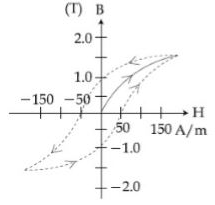
Physics · 4 marks · −1The figure gives experimentally measured B vs. H variation in a ferromagnetic material. The retentivity, co-ercivity and saturation, respectively, of the material are:
- A.1.0 T, 50 A/m and 1.5 T
- B.1.5 T, 50 A/m and 1.0 T
- C.150 A/m, 1.0 T and 1.5 T
- D.1.5 T, 50 A/m and 1.0 T
Correct answer: A
Explanation: Read from the loop: B at H = 0 is 1.0 T, H at B = 0 is 50 A/m, saturation 1.5 T.
Question 13
Physics · 4 marks · −1The electric field of a plane electromagnetic wave is given by . At t = 0, a positively charged particle is at the point . If its instantaneous velocity at (t = 0) is , the force acting on it due to the wave is:
- A.parallel to
- B.antiparallel to
- C.zero
- D.parallel to
Correct answer: B
Explanation: At that point ; the wave moves along , and is also along : net force antiparallel to .
Question 14
Physics · 4 marks · −1A thin lens made of glass (refractive index = 1.5) of focal length f = 16 cm is immersed in a liquid of refractive index 1.42. If its focal length in liquid is , then the ratio is closest to the integer:
- A.1
- B.5
- C.9
- D.17
Correct answer: C
Explanation: .
Question 15
Physics · 4 marks · −1In a Young's double slit experiment, the separation between the slits is 0.15 mm. In the experiment, a source of light of wavelength 589 nm is used and the interference pattern is observed on a screen kept 1.5 m away. The separation between the successive bright fringes on the screen is:
- A.6.9 mm
- B.5.9 mm
- C.4.9 mm
- D.3.9 mm
Correct answer: B
Explanation: mm.
Question 16
Physics · 4 marks · −1An electron (of mass m) and a photon have the same energy E in the range of a few eV. The ratio of the de-Broglie wavelength associated with the electron and the wavelength of the photon is (c = speed of light in vacuum)
- A.
- B.
- C.
- D.
Correct answer: D
Explanation: , ; ratio .
Question 17
Physics · 4 marks · −1The activity of a radioactive sample falls from 700 s to 500 s in 30 minutes. Its half life is close to:
- A.52 min
- B.62 min
- C.66 min
- D.72 min
Correct answer: B
Explanation: ; min.
Question 18
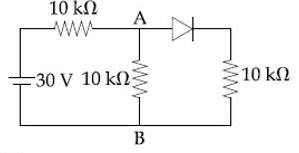
Physics · 4 marks · −1In the figure, potential difference between A and B is:
- A.zero
- B.5 V
- C.10 V
- D.15 V
Correct answer: C
Explanation: Diode forward biased: the two 10 kΩ resistors from A are in parallel (5 kΩ) in series with 10 kΩ: V.
Question 19
Physics · 4 marksThe sum of two forces and is such that . The angle θ (in degrees) that the resultant of and will make with is, ________.
Correct answer: 90
Explanation: : 90°.
Question 20
Physics · 4 marksM grams of steam at 100°C is mixed with 200 g of ice at its melting point in a thermally insulated container. If it produces liquid water at 40°C [heat of vaporization of water is 540 cal/g and heat of fusion of ice is 80 cal/g], the value of M is ________.
Correct answer: 40
Explanation: ⇒ g.
Question 21
Physics · 4 marksA 60 pF capacitor is fully charged by a 20 V supply. It is then disconnected from the supply and is connected to another uncharged 60 pF capacitor in parallel. The electrostatic energy that is lost in this process by the time the charge is redistributed between them is (in nJ) ________.
Correct answer: 6
Explanation: nJ; equal capacitors ⇒ half is lost: 6 nJ.
Question 22
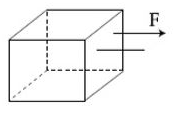
Physics · 4 marksConsider a uniform cubical box of side a on a rough floor that is to be moved by applying minimum possible force F at a point b above its centre of mass (see figure). If the coefficient of friction is , the maximum possible value of for box not to topple before moving is ________.
Correct answer: 50
Explanation: Not toppling: ⇒ ; but the point of application cannot be above the top face, . Max .
Question 23
Physics · 4 marksThe balancing length for a cell is 560 cm in a potentiometer experiment. When an external resistance of 10 Ω is connected in parallel to the cell, the balancing length changes by 60 cm. If the internal resistance of the cell is Ω, where N is an integer then value of N is ________.
Correct answer: 12
Explanation: Ω ⇒ N = 12.
Question 24
Chemistry · 4 marks · −1For the reaction 2H(g) + 2NO(g) → N(g) + 2HO(g) the observed rate expression is, rate = [NO][H]. The rate expression for the reverse reaction is:
- A.[N][HO]
- B.[N][HO]
- C.[N][HO]/[NO]
- D.[N][HO]/[H]
Correct answer: D
Explanation: At equilibrium ⇒ reverse rate .
Question 25
Chemistry · 4 marks · −1Two open beakers one containing a solvent and the other containing a mixture of that solvent with a non volatile solute are together sealed in a container. Over time:
- A.the volume of the solution increases and the volume of the solvent decreases
- B.the volume of the solution decreases and the volume of the solvent increases
- C.the volume of the solution does not change and the volume of the solvent decreases
- D.the volume of the solution and the solvent does not change
Correct answer: A
Question 26
Chemistry · 4 marks · −1The equation that is incorrect is:
- A.
- B.
- C.
- D.
Correct answer: C
Explanation: Option 3: LHS = λ(Br⁻) − λ(I⁻), RHS = λ(K⁺) − λ(Na⁺): not equal.
Question 27
Chemistry · 4 marks · −1The ammonia (NH) released on quantitative reaction of 0.6 g urea (NHCONH) with sodium hydroxide (NaOH) can be neutralized by:
- A.100 ml of 0.1 N HCl
- B.200 ml of 0.2 N HCl
- C.100 ml of 0.2 N HCl
- D.200 ml of 0.4 N HCl
Correct answer: C
Explanation: 0.01 mol urea → 0.02 mol NH3 = 100 mL of 0.2 N HCl.
Question 28
Chemistry · 4 marks · −1Identify the correct labels of A, B and C in the following graph from the options given below: Root mean square speed (); most probable speed (); Average speed ()
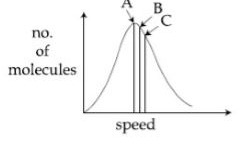
- A.A - ; B - ; C -
- B.A - ; B - ; C -
- C.A - ; B - ; C -
- D.A - ; B - ; C -
Correct answer: B
Question 29
Chemistry · 4 marks · −1The bond order and the magnetic characteristics of CN are:
- A., diamagnetic
- B.3, paramagnetic
- C., paramagnetic
- D.3, diamagnetic
Correct answer: D
Question 30
Chemistry · 4 marks · −1Within each pair of elements F & Cl, S & Se, and Li & Na, respectively, the elements that release more energy upon an electron gain are:
- A.Cl, Se and Na
- B.F, S and Li
- C.F, Se and Na
- D.Cl, S and Li
Correct answer: D
Question 31
Chemistry · 4 marks · −1The refining method used when the metal and the impurities have low and high melting temperatures, respectively, is:
- A.distillation
- B.liquation
- C.vapour phase refining
- D.zone refining
Correct answer: B
Question 32
Chemistry · 4 marks · −1Among statements (a)-(d), the correct ones are: (a) Decomposition of hydrogen peroxide gives dioxygen. (b) Like hydrogen peroxide, compounds, such as KClO, Pb(NO) and NaNO when heated liberate dioxygen. (c) 2-Ethylanthraquinone is useful for the industrial preparation of hydrogen peroxide. (d) Hydrogen peroxide is used for the manufacture of sodium perborate.
- A.(a) and (c) only
- B.(a), (b) and (c) only
- C.(a), (c) and (d) only
- D.(a), (b), (c) and (d)
Correct answer: D
Question 33
Chemistry · 4 marks · −1In the following reactions, products (A) and (B), respectively, are: NaOH (hot and conc.) + Cl → (A) + side products; Ca(OH) (dry) + Cl → (B) + side products
- A.NaOCl and Ca(OCl)
- B.NaClO and Ca(OCl)
- C.NaClO and Ca(ClO)
- D.NaOCl and Ca(ClO)
Correct answer: B
Question 34
Chemistry · 4 marks · −1The redox reaction among the following is:
- A.formation of ozone from atmospheric oxygen in the presence of sunlight
- B.reaction of HSO with NaOH
- C.combination of dinitrogen with dioxygen at 2000 K
- D.reaction of [Co(HO)]Cl with AgNO
Correct answer: C
Question 35
Chemistry · 4 marks · −1The number of possible optical isomers for the complexes MAB with sp and dsp hybridized metal atom, respectively, is: Note: A and B are unidentate neutral and unidentate monoanionic ligands, respectively.
- A.2 and 2
- B.0 and 2
- C.0 and 1
- D.0 and 0
Correct answer: D
Explanation: Tetrahedral MA2B2 and square-planar MA2B2 both have a mirror plane: no optical isomers.
Question 36
Chemistry · 4 marks · −1Among the statements (a)-(d), the incorrect ones are: (a) Octahedral Co(III) complexes with strong field ligands have very high magnetic moments (b) When , the d-electron configuration of Co(III) in an octahedral complex is (c) Wavelength of light absorbed by [Co(en)] is lower than that of [CoF] (d) If the for an octahedral complex of Co(III) is 18,000 cm, the for its tetrahedral complex with the same ligand will be 16,000 cm
- A.(a) and (b) only
- B.(c) and (d) only
- C.(a) and (d) only
- D.(b) and (c) only
Correct answer: C
Explanation: (a) strong field ⇒ low spin, diamagnetic; (d) cm.
Question 37
Chemistry · 4 marks · −1A chromatography column, packed with silica gel as stationary phase, was used to separate a mixture of compounds consisting of (A) benzanilide (B) aniline and (C) acetophenone. When the column is eluted with a mixture of solvents, hexane : ethyl acetate (20:80), the sequence of obtained compounds is:
- A.(A), (B) and (C)
- B.(B), (C) and (A)
- C.(C), (A) and (B)
- D.(B), (A) and (C)
Correct answer: C
Question 38
Chemistry · 4 marks · −1In the following reaction sequence, p-toluidine (4-methylaniline) A B, the major product B is:
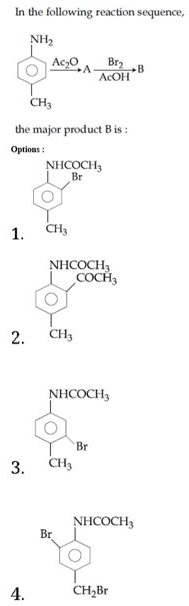
- A.2-bromo-4-methylacetanilide (Br ortho to NHCOCH3, CH3 para)
- B.2-acetyl-4-methylacetanilide (COCH3 ortho to NHCOCH3, CH3 para)
- C.3-bromo-4-methylacetanilide (Br ortho to CH3)
- D.2-bromo-4-(bromomethyl)acetanilide (Br ortho to NHCOCH3, CH2Br para)
Correct answer: A
Explanation: –NHCOCH3 is the stronger o/p director; para is blocked by CH3, so Br enters ortho to the acetamido group.
Question 39
Chemistry · 4 marks · −1The correct order of stability for the following alkoxides is: (A) CH–CH(NO)–O (B) CH=C(NO)–O (C) ON–CH=CH–O
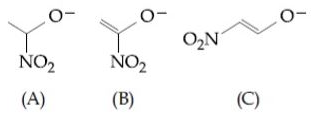
- A.(C) > (A) > (B)
- B.(C) > (B) > (A)
- C.(B) > (A) > (C)
- D.(B) > (C) > (A)
Correct answer: B
Explanation: In (C) the negative charge is delocalised onto the nitro group through the C=C (extended conjugation); (B) is stabilised only inductively/cross-conjugated; (A) has no resonance.
Question 40
Chemistry · 4 marks · −1In the following reaction sequence, structures of A and B, respectively will be: chromane bearing a CHBr group on the benzene ring (see figure) A (Intramolecular Product) B
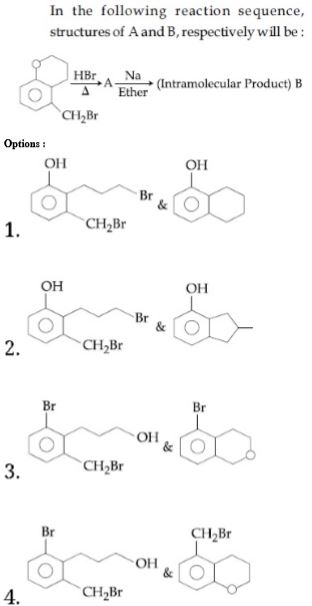
- A.A: 2-(3-bromopropyl)-phenol bearing the ring CH2Br; B: a phenol fused to a six-membered carbocycle (5,6,7,8-tetrahydronaphthol type)
- B.A: same bromopropyl phenol with ring CH2Br; B: a phenol fused to a five-membered ring carrying a methyl (indane type)
- C.A: aryl bromide with a 3-hydroxypropyl chain and ring CH2Br; B: bromo-substituted fused bicyclic compound (ring drawn with a substituent)
- D.A: aryl bromide with a 3-hydroxypropyl chain and ring CH2Br; B: a CH2Br-substituted benzopyran (chromane)
Correct answer: A
Explanation: HBr cleaves the alkyl–O bond of the aryl alkyl ether, giving a phenol and a primary alkyl bromide; Wurtz coupling of the two C–Br groups (alkyl Br and benzylic CH2Br) closes a new carbocycle.
Question 41
Chemistry · 4 marks · −1Which of the following statements is correct?
- A.Gluconic acid can form cyclic (acetal/hemiacetal) structure
- B.Gluconic acid is a partial oxidation product of glucose
- C.Gluconic acid is a dicarboxylic acid
- D.Gluconic acid is obtained by oxidation of glucose with HNO
Correct answer: B
Question 42
Chemistry · 4 marks · −1Consider the following reactions: (a) benzene + chlorobenzene biphenyl (b) benzene + Cl (excess) hexachlorobenzene (c) benzene + CH=CH–Cl styrene (CH–CH=CH) (d) benzene + CH=CH–CHCl allylbenzene (CH–CH–CH=CH). Which of these reactions are possible?
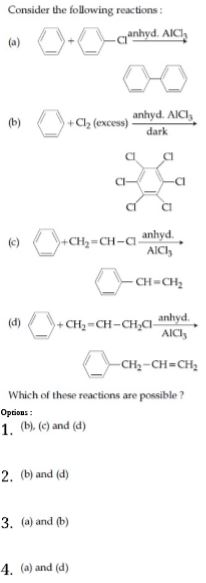
- A.(b), (c) and (d)
- B.(b) and (d)
- C.(a) and (b)
- D.(a) and (d)
Correct answer: B
Explanation: Aryl and vinyl halides do not form carbocations under Friedel–Crafts conditions.
Question 43
Chemistry · 4 marks · −1For the following reactions: CHCHCHBr + Z CHCHCHZ + Br and CHCHCHBr + Z CHCH=CH + HZ + Br, where, Z = CHCHO (A) or (CH)C–O (B), and , are, respectively, the rate constants for substitution and elimination, and , the correct option is ________.
- A. and
- B. and
- C. and
- D. and
Correct answer: B
Explanation: Bulky tert-butoxide favours elimination (larger k_e, smaller k_s/k_e).
Question 44
Chemistry · 4 marks3 g of acetic acid is added to 250 mL of 0.1 M HCl and the solution made up to 500 mL. To 20 mL of this solution mL of 5 M NaOH is added. The pH of the solution is ________. [Given: pKa of acetic acid = 4.75, molar mass of acetic acid = 60 g/mol, log 3 = 0.4771] Neglect any changes in volume.
Correct answer: 5.23
Explanation: In 20 mL: CHCOOH 2 mmol, HCl 1 mmol; NaOH 2.5 mmol neutralises HCl and converts 1.5 mmol acid to acetate: pH = 4.75 + log(1.5/0.5) = 5.23.
Question 45
Chemistry · 4 marksThe flocculation value of HCl for arsenic sulphide sol. is 30 m mol L. If HSO is used for the flocculation of arsenic sulphide, the amount, in grams, of HSO in 250 ml required for the above purpose is ________. (molecular mass of HSO = 98 g/mol)
Correct answer: 0.37
Explanation: The coagulating ion is H: 30 mmol L of H needs 15 mmol L HSO; in 250 mL: 3.75 mmol × 98 = 0.3675 g.
Question 46
Chemistry · 4 marksConsider the following reactions: NaCl + KCrO + HSO (Conc.) → (A) + side products; (A) + NaOH → (B) + Side products; (B) + HSO (dilute) + HO → (C) + Side products. The sum of the total number of atoms in one molecule each of (A), (B) and (C) is ________.
Correct answer: 18
Explanation: A = CrOCl (5), B = NaCrO (7), C = CrO (6): 18.
Question 47
Chemistry · 4 marksThe number of sp hybridised carbons present in "Aspartame" is ________.
Correct answer: 9
Explanation: 6 aromatic carbons + 3 carbonyl carbons (acid, amide, ester) = 9.
Question 48
Mathematics · 4 marks · −1Let α and β be the roots of the equation . If , , then which one of the following statements is not true?
- A.
- B.
- C.
- D.
Correct answer: D
Explanation: : 1, 3, 4, 7, 11; .
Question 49
Mathematics · 4 marks · −1If , , is a real number, then an argument of is:
- A.
- B.
- C.
- D.
Correct answer: C
Explanation: Real ⇒ , ; taking , : point has argument .
Question 50
Mathematics · 4 marks · −1Let and be two 3 × 3 real matrices such that , where i, j = 1, 2, 3. If the determinant of B is 81, then the determinant of A is:
- A.1/3
- B.1/9
- C.1/81
- D.3
Correct answer: B
Explanation: with : ⇒ .
Question 51
Mathematics · 4 marks · −1The number of ordered pairs (r, k) for which , where k is an integer, is:
- A.6
- B.4
- C.3
- D.2
Correct answer: B
Explanation: ⇒ : (r = 5), (r = 35): 4 pairs.
Question 52
Mathematics · 4 marks · −1The coefficient of in the expression is:
- A.120
- B.210
- C.330
- D.420
Correct answer: C
Explanation: .
Question 53
Mathematics · 4 marks · −1Let be a G. P. such that , and . If , then λ is equal to:
- A.−513
- B.
- C.−171
- D.171
Correct answer: C
Explanation: , ⇒ , ; ⇒ .
Question 54
Mathematics · 4 marks · −1If the sum of the first 40 terms of the series, is (102)m, then m is equal to:
- A.25
- B.20
- C.10
- D.5
Correct answer: B
Explanation: Pair sums 7, 17, 27, ... (20 terms): .
Question 55
Mathematics · 4 marks · −1Let be a function of x satisfying where k is a constant and . Then at , is equal to:
- A.
- B.
- C.
- D.
Correct answer: C
Explanation: $\sin^{-1}x + \sin^{-1}y = $ const ⇒ .
Question 56
Mathematics · 4 marks · −1The value of c in the Lagrange's mean value theorem for the function , when is:
- A.
- B.
- C.
- D.
Correct answer: A
Explanation: ⇒ ⇒ .
Question 57
Mathematics · 4 marks · −1Let f(x) be a polynomial of degree 5 such that x = ±1 are its critical points. If , then which one of the following is not true?
- A.f is an odd function.
- B.x = 1 is a point of maxima and x = −1 is a point of minimum of f.
- C.f(1) − 4f(−1) = 4.
- D.x = 1 is a point of minima and x = −1 is a point of maxima of f.
Correct answer: D
Explanation: ; ⇒ maximum at x = 1.
Question 58
Mathematics · 4 marks · −1The value of α for which , is:
- A.
- B.
- C.
- D.
Correct answer: B
Explanation: ⇒ , .
Question 59
Mathematics · 4 marks · −1The area (in sq. units) of the region is:
- A.
- B.
- C.
- D.
Correct answer: D
Explanation: .
Question 60
Mathematics · 4 marks · −1Let be the solution curve of the differential equation, , satisfying . This curve intersects the x-axis at a point whose abscissa is:
- A.2
- B.2 + e
- C.2 − e
- D.−e
Correct answer: C
Explanation: ⇒ , C = −e; at y = 0: x = 2 − e.
Question 61
Mathematics · 4 marks · −1Let the tangents drawn from the origin to the circle, touch it at the points A and B. The is equal to:
- A.
- B.
- C.
- D.
Correct answer: D
Explanation: Tangent length L = 4, r = 2: , .
Question 62
Mathematics · 4 marks · −1The locus of the mid-points of the perpendiculars drawn from points on the line, x = 2y to the line x = y is:
- A.3x − 2y = 0
- B.2x − 3y = 0
- C.7x − 5y = 0
- D.5x − 7y = 0
Correct answer: D
Explanation: From (2t, t) the foot on y = x is (3t/2, 3t/2); midpoint (7t/4, 5t/4) ⇒ 5x = 7y.
Question 63
Mathematics · 4 marks · −1If is a tangent to the ellipse for some , then the distance between the foci of the ellipse is:
- A.
- B.
- C.
- D.4
Correct answer: B
Explanation: : ⇒ ; foci distance .
Question 64
Mathematics · 4 marks · −1Let , and be three unit vectors such that . If and , then the ordered pair, is equal to:
- A.
- B.
- C.
- D.
Correct answer: A
Explanation: ; with each cross product equals .
Question 65
Mathematics · 4 marks · −1In a workshop, there are five machines and the probability of any one of them to be out of service on a day is . If the probability that at most two machines will be out of service on the same day is , then k is equal to:
- A.
- B.
- C.4
- D.
Correct answer: D
Explanation: .
Question 66
Mathematics · 4 marks · −1If and be respectively the smallest and the largest values of θ in which satisfy the equation, , then is equal to:
- A.
- B.
- C.
- D.
Correct answer: C
Explanation: ⇒ : θ = π/6, 5π/6; integral .
Question 67
Mathematics · 4 marks · −1Let A, B, C and D be four non-empty sets. The contrapositive statement of \"If and , then \" is:
- A.If , then and
- B.If , then or
- C.If , then and
- D.If , then or
Correct answer: B
Question 68
Mathematics · 4 marksLet . If is a multiple of and is a multiple of , then the number of elements in the smallest subset of X containing both A and B is ________.
Correct answer: 29
Explanation: .
Question 69
Mathematics · 4 marksIf the system of linear equations, , , has more than two solutions, then is equal to ________.
Correct answer: 13
Explanation: Third equation = 4(first) − (second): λ = 1, μ = 14 ⇒ μ − λ² = 13.
Question 70
Mathematics · 4 marksIf the function f defined on by is continuous, then k is equal to ________.
Correct answer: 5
Explanation: .
Question 71
Mathematics · 4 marksIf the foot of the perpendicular drawn from the point (1, 0, 3) on a line passing through (α, 7, 1) is , then α is equal to ________.
Correct answer: 4
Explanation: must be ⟂ to : ⇒ α = 4.
Question 72
Mathematics · 4 marksIf the mean and variance of eight numbers 3, 7, 9, 12, 13, 20, x and y be 10 and 25 respectively, then x·y is equal to ________.
Correct answer: 54
Explanation: x + y = 16; ⇒ ⇒ xy = 54.