JEE Main 2021 — 26 Aug Shift 1 (Previous Year Paper)
JEE Main · 2021 · with answers and explanations
- questions
- 90
- Total marks
- 300
- Duration
- 180 minutes
- Negative marking
- −1
Subjects: Physics · Chemistry · Mathematics
Question 1
Physics · 4 marks · −1In a Screw Gauge, fifth division of the circular scale coincides with the reference line when the ratchet is closed. There are 50 divisions on the circular scale, and the main scale moves by 0.5 mm on a complete rotation. For a particular observation the reading on the main scale is 5 mm and the 20 division of the circular scale coincides with reference line. Calculate the true reading.
- A.5.20 mm
- B.5.25 mm
- C.5.15 mm
- D.5.00 mm
Correct answer: C
Explanation: LC = 0.01 mm; zero error +0.05 mm; reading mm.
Question 2
Physics · 4 marks · −1The rms speeds of the molecules of Hydrogen, Oxygen and Carbondioxide at the same temperature are , and respectively then:
- A.
- B.
- C.
- D.
Correct answer: C
Explanation: : 2 < 32 < 44.
Question 3
Physics · 4 marks · −1Identify the logic operation carried out by the given circuit:
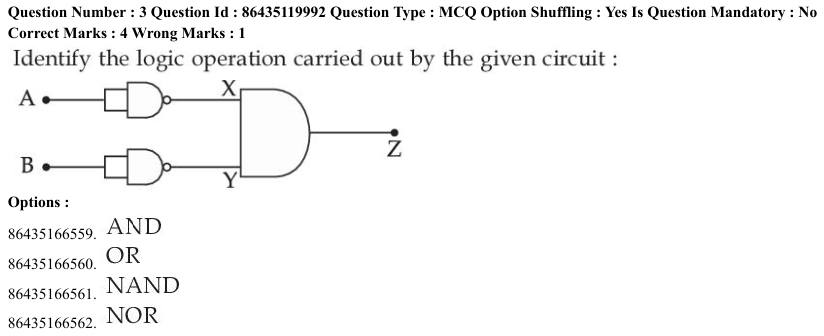
- A.AND
- B.OR
- C.NAND
- D.NOR
Correct answer: D
Explanation: : NOR.
Question 4
Physics · 4 marks · −1An electric appliance supplies 6000 J/min heat to the system. If the system delivers a power of 90 W. How long it would take to increase the internal energy by J?
- A. s
- B. s
- C. s
- D. s
Correct answer: B
Explanation: Net rate W; s.
Question 5
Physics · 4 marks · −1A particular hydrogen like ion emits radiation of frequency Hz when it makes transition from to . The frequency in Hz of radiation emitted in transition from to will be:
- A.
- B.
- C.
- D.
Correct answer: D
Explanation: : Hz.
Question 6
Physics · 4 marks · −1Two narrow bores of diameter 5.0 mm and 8.0 mm are joined together to form a U-shaped tube open at both ends. If this U-tube contains water, what is the difference in the level of two limbs of the tube. [Take surface tension of water Nm, angle of contact = 0, ms and density of water kg m]
- A.5.34 mm
- B.3.62 mm
- C.4.97 mm
- D.2.19 mm
Correct answer: D
Explanation: mm.
Question 7
Physics · 4 marks · −1In a photoelectric experiment ultraviolet light of wavelength 280 nm is used with lithium cathode having work function eV. If the wavelength of incident light is switched to 400 nm, find out the change in the stopping potential. ( Js, ms)
- A.1.3 V
- B.1.9 V
- C.0.6 V
- D.1.1 V
Correct answer: A
Explanation: V.
Question 8
Physics · 4 marks · −1Car B overtakes another car A at a relative speed of 40 ms. How fast will the image of car B appear to move in the mirror of focal length 10 cm fitted in car A, when the car B is 1.9 m away from the car A?
- A.0.1 ms
- B.0.2 ms
- C.40 ms
- D.4 ms
Correct answer: A
Explanation: Convex rear-view mirror: m/s.
Question 9
Physics · 4 marks · −1An inductor coil stores 64 J of magnetic field energy and dissipates energy at the rate of 640 W when a current of 8 A is passed through it. If this coil is joined across an ideal battery, find the time constant of the circuit in seconds:
- A.0.2
- B.0.4
- C.0.8
- D.0.125
Correct answer: A
Explanation: H, , s.
Question 10
Physics · 4 marks · −1A series LCR circuit driven by 300 V at a frequency of 50 Hz contains a resistance k, an inductor of inductive reactance and an unknown capacitor. The value of capacitance to maximize the average power should be: (take )
- A.400 F
- B.40 F
- C.25 F
- D.4 F
Correct answer: D
Explanation: Resonance: F.
Question 11
Physics · 4 marks · −1The fractional change in the magnetic field intensity at a distance 'r' from centre on the axis of current carrying coil of radius 'a' to the magnetic field intensity at the centre of the same coil is: (Take r < a).
- A.
- B.
- C.
- D.
Correct answer: D
Explanation: .
Question 12
Physics · 4 marks · −1In the given figure, the emf of the cell is 2.2 V and if internal resistance is 0.6 . Calculate the power dissipated in the whole circuit:
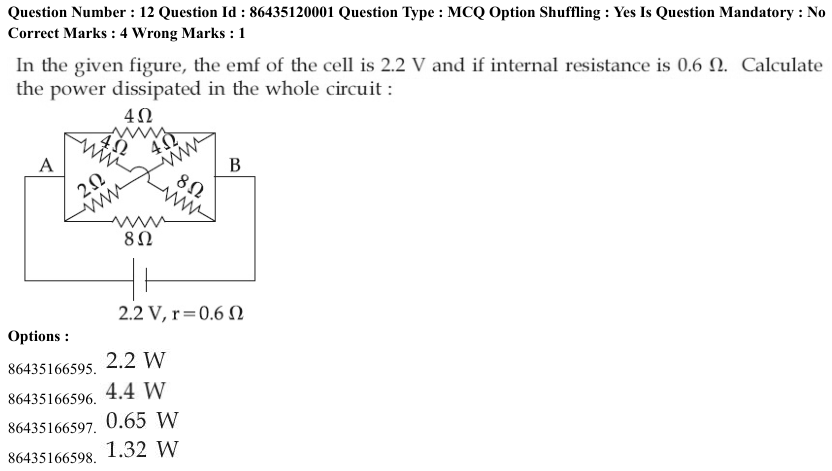
- A.2.2 W
- B.4.4 W
- C.0.65 W
- D.1.32 W
Correct answer: A
Explanation: The resistor network between A and B reduces to ; with the total is , so A and the power in the whole circuit is W.
Question 13
Physics · 4 marks · −1A solid metal sphere of radius R having charge q is enclosed inside the concentric spherical shell of inner radius a and outer radius b as shown in figure. The approximate variation electric field as a function of distance r from centre O is given by:
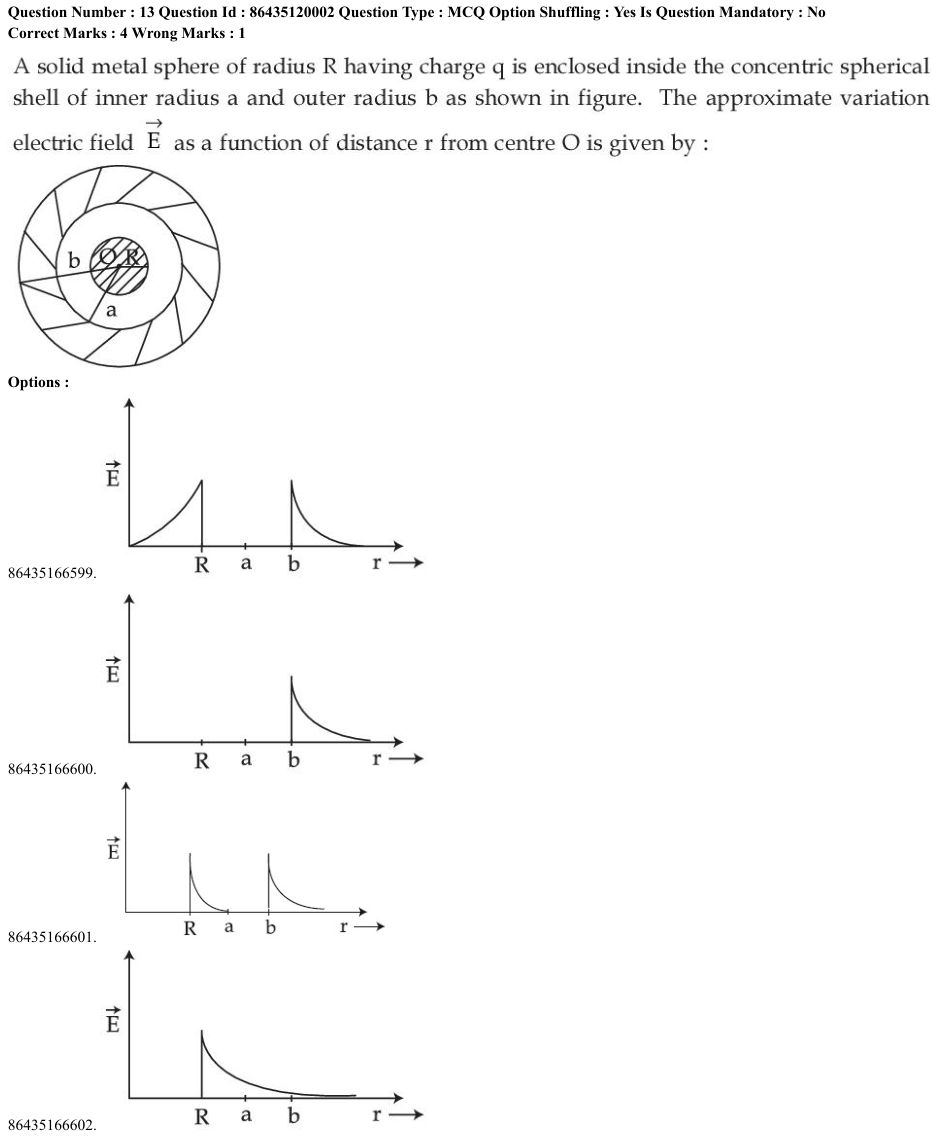
- A.E rises from r = 0 up to R, is zero between R and a... (graph 1: rising curve up to R, gap, then decaying curve beyond b)
- B.E is zero up to b, then decays as 1/r^2 beyond b
- C.E is zero for r < R, decays as 1/r^2 from R to a, is zero from a to b, and decays as 1/r^2 beyond b
- D.E is zero for r < R and then decays continuously as 1/r^2 from R onwards
Correct answer: C
Explanation: Inside the solid conductor E = 0; between R and a, ; inside the shell material E = 0; outside b, .
Question 14
Physics · 4 marks · −1The material filled between the plates of a parallel plate capacitor has resistivity 200 m. The value of capacitance of the capacitor is 2 pF. If a potential difference of 40 V is applied across the plates of the capacitor, then the value of leakage current flowing out of the capacitor is: (given the value of relative permitivity of material is 50)
- A.9.0 mA
- B.0.9 mA
- C.0.9 A
- D.9.0 A
Correct answer: B
Explanation: ; mA.
Question 15
Physics · 4 marks · −1Inside a uniform spherical shell: (a) the gravitational field is zero. (b) the gravitational potential is zero. (c) the gravitational field is same everywhere. (d) the gravitation potential is same everywhere. (e) all of the above. Choose the most appropriate answer from the options given below:
- A.(b), (c) and (d) only
- B.(a), (b) and (c) only
- C.(a), (c) and (d) only
- D.(e) only
Correct answer: C
Question 16
Physics · 4 marks · −1The initial mass of a rocket is 1000 kg. Calculate at what rate the fuel should be burnt so that the rocket is given an acceleration of 20 ms. The gases come out at a relative speed of 500 ms with respect to the rocket: [Use g = 10 m/s]
- A.60 kg s
- B. kg s
- C.500 kg s
- D.10 kg s
Correct answer: A
Explanation: kg/s.
Question 17
Physics · 4 marks · −1What equal length of an iron wire and a copper-nickel alloy wire, each of 2 mm diameter connected parallel to give an equivalent resistance of 3 ? (Given resistivities of iron and copper-nickel alloy wire are 12 cm and 51 cm respectively)
- A.110 m
- B.97 m
- C.90 m
- D.82 m
Correct answer: B
Explanation: with : m.
Question 18
Physics · 4 marks · −1The magnitude of vectors , and in the given figure are equal. The direction of with -axis will be:
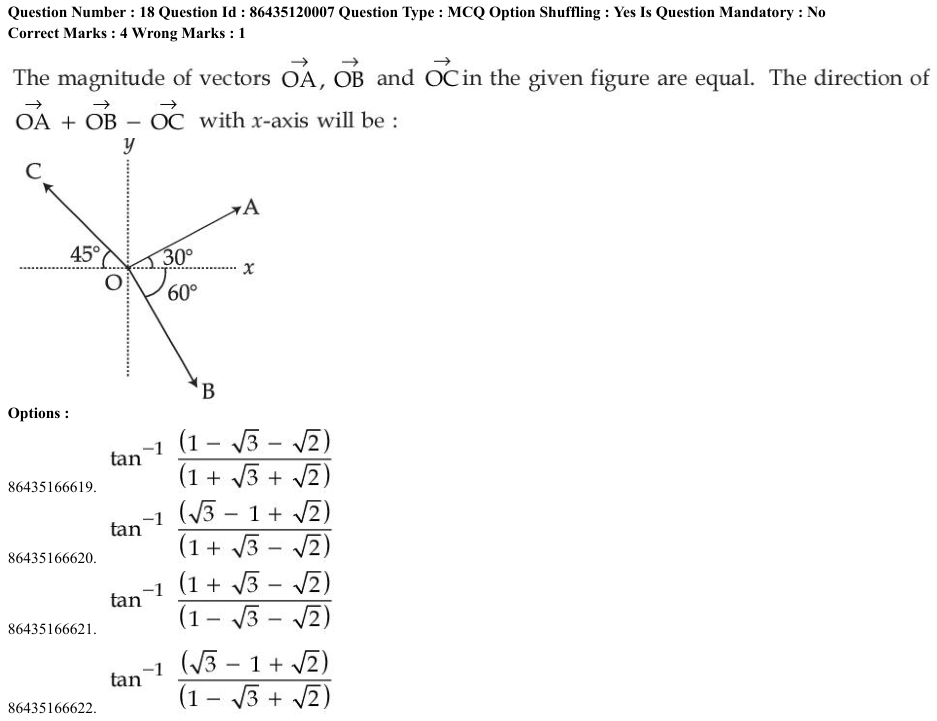
- A.
- B.
- C.
- D.
Correct answer: A
Explanation: Components (unit magnitude): , ; ratio .
Question 19
Physics · 4 marks · −1Statement I: By doping silicon semiconductor with pentavalent material, the electrons density increases. Statement II: The n-type semiconductor has net negative charge. In the light of the above statements, choose the most appropriate answer from the options given below:
- A.Both Statement I and Statement II are true.
- B.Both Statement I and Statement II are false.
- C.Statement I is true but Statement II is false.
- D.Statement I is false but Statement II is true.
Correct answer: C
Explanation: n-type material is electrically neutral.
Question 20
Physics · 4 marks · −1If E, L, M and G denote the quantities as energy, angular momentum, mass and constant of gravitation respectively, then the dimensions of P in the formula are:
- A.
- B.
- C.
- D.
Correct answer: D
Explanation: .
Question 21
Physics · 4 marksA uniform chain of length 3 meter and mass 3 kg overhangs a smooth table with 2 meter laying on the table. If k is the kinetic energy of the chain in joule as it completely slips off the table, then the value of k is ________. (Take g = 10 m/s)
Correct answer: 40
Explanation: : hanging 1 kg at m to 3 kg at m: J.
Question 22
Physics · 4 marksConsider a badminton racket with length scales as shown in the figure. If the mass of the linear and circular portions of the badminton racket are same (M) and the mass of the threads are negligible, the moment of inertia of the racket about an axis perpendicular to the handle and in the plane of the ring at, distance from the end A of the handle will be ________ .
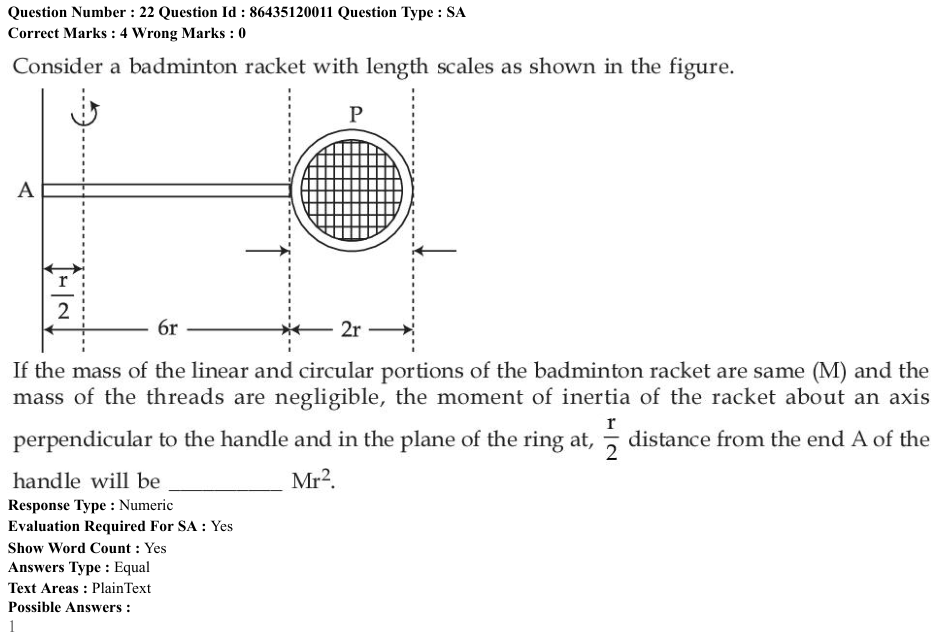
Correct answer: 52
Explanation: Rod: ; ring: ; total 52.
Question 23
Physics · 4 marksA soap bubble of radius 3 cm is formed inside the another soap bubble of radius 6 cm. The radius of an equivalent soap bubble which has the same excess pressure as inside the smaller bubble with respect to the atmospheric pressure is ________ cm.
Correct answer: 2
Explanation: cm.
Question 24
Physics · 4 marksTwo travelling waves produces a standing wave represented by equation. . The node closest to the origin in the region will be at = ________ cm.
Correct answer: 1
Explanation: cm.
Question 25
Physics · 4 marksTwo short magnetic dipoles and each having magnetic moment of 1 Am are placed at point O and P respectively. The distance between OP is 1 meter. The torque experienced by the magnetic dipole due to the presence of is ________ Nm.
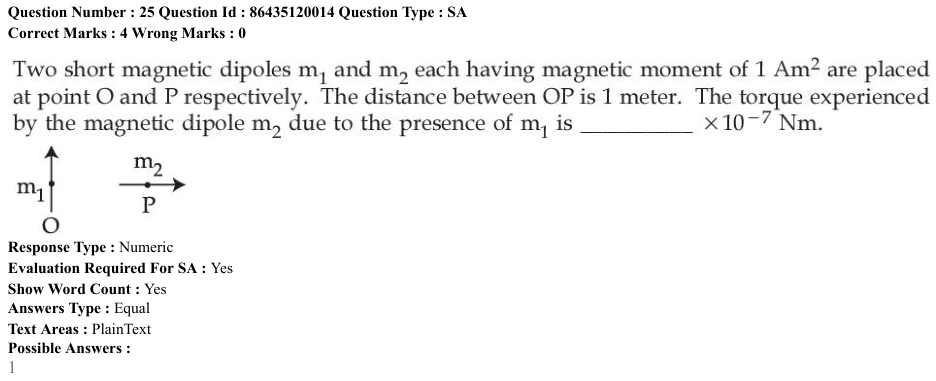
Correct answer: 1
Explanation: P is on the equatorial line of : T (antiparallel to ), perpendicular to : N m.
Question 26
Physics · 4 marksThe electric field in a plane electromagnetic wave is given by . If this wave falls normally on a perfectly reflecting surface having an area of 100 cm. If the radiation pressure exerted by the E.M. wave on the surface during a 10 minute exposure is . Find the value of .
Correct answer: 354
Explanation: ; N m.
Question 27
Physics · 4 marksWhite light is passed through a double slit and interference is observed on a screen 1.5 m away. The separation between the slits is 0.3 mm. The first violet and red fringes are formed 2.0 mm and 3.5 mm away from the central white fringes. The difference in wavelengths of red and voilet light is ________ nm.
Correct answer: 300
Explanation: nm.
Question 28
Physics · 4 marksAn amplitude modulated wave is represented by volts. The modulating frequency in kHz will be ________.
Correct answer: 2
Explanation: Hz kHz.
Question 29
Physics · 4 marksTwo spherical balls having equal masses with radius of 5 cm each are thrown upwards along the same vertical direction at an interval of 3 s with the same initial velocity of 35 m/s, then these balls collide at a height of ________ m. (take g = 10 m/s)
Correct answer: 50
Explanation: They meet when s: height 50 m.
Question 30
Physics · 4 marksA source and a detector move away from each other in absence of wind with a speed of 20 m/s with respect to the ground. If the detector detects a frequency of 1800 Hz of the sound coming from the source, then the original frequency of source considering speed of sound in air 340 m/s will be ________ Hz.
Correct answer: 2025
Explanation: Hz.
Question 31
Chemistry · 4 marks · −1Given below are two statements: Statement I: Frenkel defects are vacancy as well as interstitial defects. Statement II: Frenkel defect leads to colour in ionic solids due to presence of F-centres. Choose the most appropriate answer for the statements from the options given below:
- A.Both Statement I and Statement II are true
- B.Both Statement I and Statement II are false
- C.Statement I is true but Statement II is false
- D.Statement I is false but Statement II is true
Correct answer: C
Question 32
Chemistry · 4 marks · −1Given below are two statements: Statement I: According to Bohr's model of an atom, qualitatively the magnitude of velocity of electron increases with decrease in positive charges on the nucleus as there is no strong hold on the electron by the nucleus. Statement II: According to Bohr's model of an atom, qualitatively the magnitude of velocity of electron increases with decrease in principal quantum number. In the light of the above statements, choose the most appropriate answer from the options given below:
- A.Both Statement I and Statement II are true
- B.Both Statement I and Statement II are false
- C.Statement I is true but Statement II is false
- D.Statement I is false but Statement II is true
Correct answer: D
Explanation: .
Question 33
Chemistry · 4 marks · −1Given below are two statements: Statement I: The limiting molar conductivity of KCl (strong electrolyte) is higher compared to that of CHCOOH (weak electrolyte). Statement II: Molar conductivity decreases with decrease in concentration of electrolyte. In the light of the above statements, choose the most appropriate answer from the options given below:
- A.Both Statement I and Statement II are true
- B.Both Statement I and Statement II are false
- C.Statement I is true but Statement II is false
- D.Statement I is false but Statement II is true
Correct answer: B
Explanation: (CHCOOH) S cm mol exceeds (KCl) , so I is false; molar conductivity increases on dilution, so II is false.
Question 34
Chemistry · 4 marks · −1Which one of the following is correct for the adsorption of a gas at a given temperature on a solid surface?
- A.
- B.
- C.
- D.
Correct answer: D
Question 35
Chemistry · 4 marks · −1Given below are two statements. Statement I: The choice of reducing agents for metals extraction can be made by using Ellingham diagram, a plot of vs temperature. Statement II: The value of increases from left to right in Ellingham diagram. In the light of the above statements, choose the most appropriate answer from the options given below:
- A.Both Statement I and Statement II are true
- B.Both Statement I and Statement II are false
- C.Statement I is true but Statement II is false
- D.Statement I is false but Statement II is true
Correct answer: C
Question 36
Chemistry · 4 marks · −1Which one of the following methods is most suitable for preparing deionized water?
- A.Clark's method
- B.Synthetic resin method
- C.Calgon's method
- D.Permutit method
Correct answer: B
Question 37
Chemistry · 4 marks · −1What are the products formed in sequence when excess of CO is passed in slaked lime?
- A.CaCO, Ca(HCO)
- B.Ca(HCO), CaCO
- C.CaO, CaCO
- D.CaO, Ca(HCO)
Correct answer: A
Question 38
Chemistry · 4 marks · −1The incorrect statement is:
- A.Cl is more reactive than ClF.
- B.F is more reactive than ClF.
- C.On hydrolysis ClF forms HOCl and HF.
- D.F is a stronger oxidizing agent than Cl in aqueous solution.
Correct answer: A
Explanation: Interhalogens (except F2) are more reactive than the parent halogens: Cl2 is less reactive than ClF.
Question 39
Chemistry · 4 marks · −1Which one of the following when dissolved in water gives coloured solution in nitrogen atmosphere?
- A.ZnCl
- B.CuCl
- C.CuCl
- D.AgCl
Correct answer: B
Explanation: Cu (d) is coloured.
Question 40
Chemistry · 4 marks · −1The conversion of hydroxyapatite occurs due to presence of F ions in water. The correct formula of hydroxyapatite is:
- A.[3Ca(PO)·CaF]
- B.[Ca(PO)·CaF]
- C.[3Ca(PO)·Ca(OH)]
- D.[3Ca(OH)·CaF]
Correct answer: C
Question 41
Chemistry · 4 marks · −1Which one of the following complexes is violet in colour?
- A.[Fe(SCN)]
- B.[Fe(CN)NOS]
- C.Fe[Fe(CN)]·HO
- D.[Fe(CN)]
Correct answer: B
Explanation: Sodium nitroprusside test for sulphide gives the violet [Fe(CN)5NOS]4- complex.
Question 42
Chemistry · 4 marks · −1Excess of isobutane on reaction with Br in presence of light at 125°C gives which one of the following, as the major product?
- A.
- B.
- C.
- D.
Correct answer: B
Explanation: Bromination is highly selective for the tertiary C–H.
Question 43
Chemistry · 4 marks · −1The major product formed in the following reaction is: isoprene (2-methylbuta-1,3-diene) + HBr (excess) Major Product
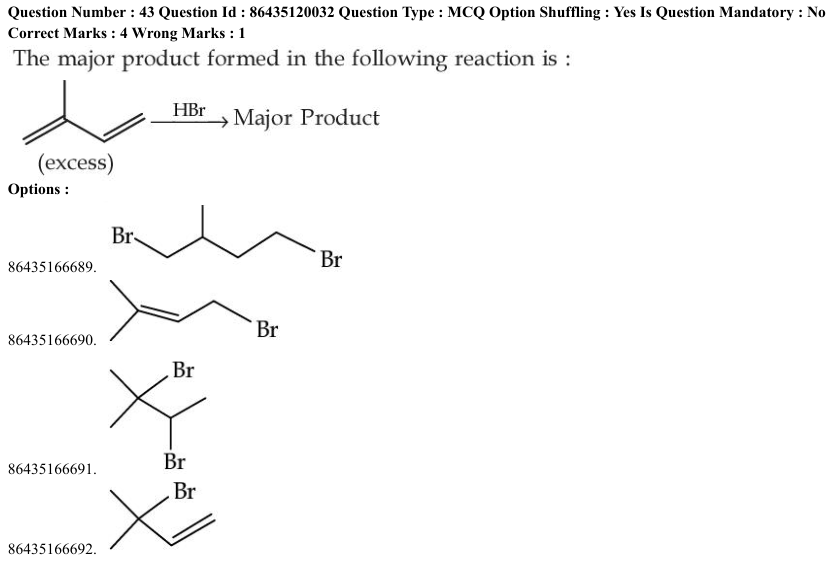
- A.1,4-dibromo-2-methylbutane (Br-CH2-CH(CH3)-CH2-CH2-Br)
- B.1-bromo-3-methylbut-2-ene ((CH3)2C=CH-CH2Br)
- C.2,3-dibromo-2-methylbutane ((CH3)2CBr-CHBr-CH3)
- D.3-bromo-3-methylbut-1-ene ((CH3)2CBr-CH=CH2)
Correct answer: B
Explanation: Protonation of isoprene gives the allylic tertiary cation; 1,4-addition (thermodynamic product) gives 1-bromo-3-methylbut-2-ene (official key).
Question 44
Chemistry · 4 marks · −1Among the following compounds I–IV, which one forms a yellow precipitate on reacting sequentially with (i) NaOH (ii) dil. HNO (iii) AgNO? I: 4-chlorotoluene; II: 3-chlorotoluene; III: 2-bromotoluene; IV: 2-chlorobenzyl iodide (Cl on ring, CHI side chain)
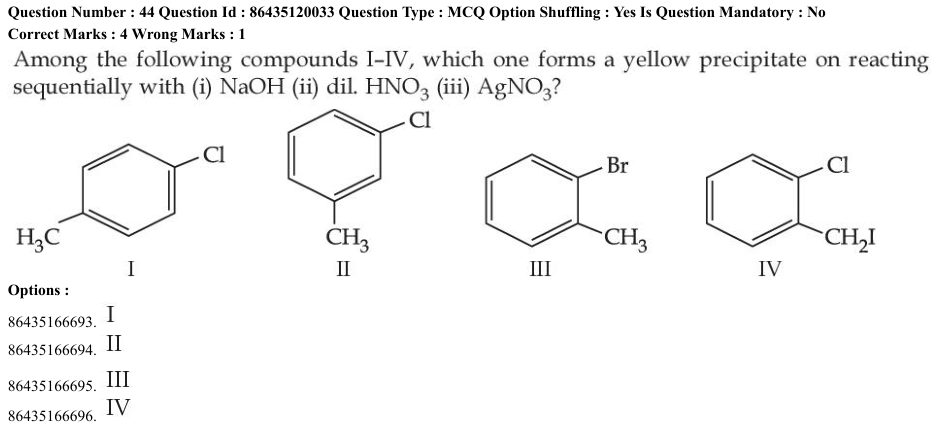
- A.I
- B.II
- C.III
- D.IV
Correct answer: D
Explanation: Only the benzylic iodide hydrolyses to give I- (yellow AgI).
Question 45
Chemistry · 4 marks · −1The major products formed in the following reaction sequence A and B are: acetophenone A + B
- A.A = CHCOOK, B = CHBr
- B.A = 3,5-dibromoacetophenone, B = 3,5-dihydroxyacetophenone
- C.A = 2-bromo-1-(3-bromophenyl)ethanone, B = 1-(3-bromophenyl)-2-hydroxyethanone
- D.A = CHCOCBr, B = CHCHO
Correct answer: A
Explanation: Haloform reaction: potassium benzoate and bromoform.
Question 46
Chemistry · 4 marks · −1The correct options for the products A and B of the following reactions are: phenol A; phenol B
- A.A = 4-bromophenol, B = 4-bromophenol
- B.A = 2,3,4-tribromophenol (as drawn), B = 2,6-dibromophenol
- C.A = 2,4,6-tribromophenol, B = 4-bromophenol
- D.A = 2,4,6-tribromophenol, B = 2,4-dibromophenol
Correct answer: C
Question 47
Chemistry · 4 marks · −1The major product formed in the following reaction is: tryptophan Major Product
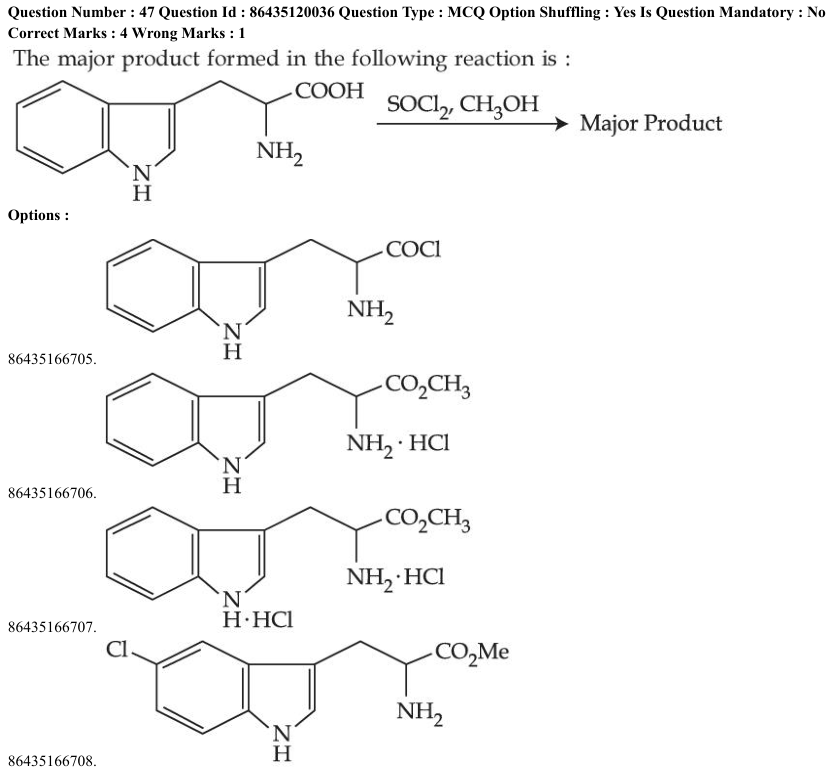
- A.tryptophanyl chloride (–COCl, free NH2)
- B.tryptophan methyl ester hydrochloride (–CO2CH3, –NH2·HCl)
- C.methyl ester with both the alpha-amino group and indole N-H as hydrochlorides
- D.5-chlorotryptophan methyl ester (Cl on the benzene ring)
Correct answer: B
Explanation: SOCl2/MeOH generates HCl in situ: esterification with the amine isolated as its hydrochloride; the indole N is not basic.
Question 48
Chemistry · 4 marks · −1The correct sequential addition of reagents in the preparation of 3-nitrobenzoic acid from benzene is:
- A.HNO/HSO, Br/AlBr, Mg/ether, CO, HO
- B.Br/AlBr, NaCN, HO, HNO/HSO
- C.Br/AlBr, HNO/HSO, NaCN, HO
- D.Br/AlBr, HNO/HSO, Mg/ether, CO, HO
Correct answer: A
Explanation: Nitration first makes the ring meta-directing, so bromination goes meta; the Br is then converted to COOH via the Grignard and CO2 (official key; the textbook caveat that a nitro group is incompatible with Grignard formation is ignored by the question).
Question 49
Chemistry · 4 marks · −1The polymer formed on heating Novolac with formaldehyde is:
- A.Melamine
- B.Bakelite
- C.Polyester
- D.Nylon 6,6
Correct answer: B
Question 50
Chemistry · 4 marks · −1Given below are two statements: Statement I: In the titration between strong acid and weak base methyl orange is suitable as an indicator. Statement II: For titration of acetic acid with NaOH phenolphthalein is not a suitable indicator. In the light of the above statements, choose the most appropriate answer from the options given below:
- A.Both Statement I and Statement II are true
- B.Both Statement I and Statement II are false
- C.Statement I is true but Statement II is false
- D.Statement I is false but Statement II is true
Correct answer: C
Question 51
Chemistry · 4 marksAn aqueous KCl solution of density 1.20 g mL has a molality of 3.30 mol kg. The molarity of the solution in mol L is ________. (Nearest integer) [Molar mass of KCl = 74.5]
Correct answer: 3
Explanation: 1245.9 g solution per 3.30 mol: L, .
Question 52
Chemistry · 4 marksAB is an interhalogen T-shaped molecule. The number of lone pairs of electrons on A is ________. (Integer answer)
Correct answer: 2
Explanation: T-shaped (sp3d): 2 lone pairs.
Question 53
Chemistry · 4 marksThe Born-Haber cycle for KCl is evaluated with the following data: for KCl = kJ mol; for K = 89.2 kJ mol; for K = 419.0 kJ mol; for Cl = kJ mol; for Cl = 243.0 kJ mol. The magnitude of lattice enthalpy of KCl in kJ mol is ________. (Nearest integer)
Correct answer: 718
Explanation: .
Question 54
Chemistry · 4 marksOf the following four aqueous solutions, total number of those solutions whose freezing point is lower than that of 0.10 M CHOH is ________. (Integer answer) (i) 0.10 M Ba(PO) (ii) 0.10 M NaSO (iii) 0.10 M KCl (iv) 0.10 M LiPO
Correct answer: 4
Explanation: All four electrolytes have i > 1: 4.
Question 55
Chemistry · 4 marksThe OH concentration in a mixture of 5.0 mL of 0.0504 M NHCl and 2 mL of 0.0210 M NH solution is M. The value of is ________. (Nearest integer) [Given and ]
Correct answer: 3
Explanation: .
Question 56
Chemistry · 4 marksThe following data was obtained for chemical reaction given below at 975 K. . (A) [NO] , [H] , Rate ; (B) , , ; (C) , , (concentrations in mol L, rate in mol Ls). The order of the reaction with respect to NO is ________. [Integer answer]
Correct answer: 1
Explanation: Tripling [NO] triples the rate: order 1.
Question 57
Chemistry · 4 marksThese are physical properties of an element (A) Sublimation enthalpy (B) Ionisation enthalpy (C) Hydration enthalpy (D) Electron gain enthalpy. The total number of above properties that affect the reduction potential is ________. (Integer answer)
Correct answer: 3
Question 58
Chemistry · 4 marksThe number of 4f electrons in the ground state electronic configuration of Gd is ________. [Atomic number of Gd = 64]
Correct answer: 7
Explanation: Gd: [Xe]4f$^7^1^2^{2+}^7^1$: 7.
Question 59
Chemistry · 4 marksThe ratio of number of water molecules in Mohr's salt and potash alum is ________ . (Integer answer)
Correct answer: 5
Explanation: Mohr's salt FeSO(NH)SO$_4\cdot_2_4_2\cdot_2$O: .
Question 60
Chemistry · 4 marksThe total number of negative charge in the tetrapeptide, Gly-Glu-Asp-Tyr, at pH 12.5 will be ________. (Integer answer)
Correct answer: 4
Explanation: C-terminal COO-, Glu and Asp side-chain COO-, and Tyr phenoxide: 4.
Question 61
Mathematics · 4 marks · −1Out of all the patients in a hospital 89% are found to be suffering from heart ailment and 98% are suffering from lungs infection. If K% of them are suffering from both ailments, then K can not belong to the set:
- A.
- B.
- C.
- D.
Correct answer: C
Explanation: ; the set has no admissible value.
Question 62
Mathematics · 4 marks · −1The equation represents a circle with:
- A.centre at and radius
- B.centre at and radius 2
- C.centre at and radius
- D.centre at and radius
Correct answer: C
Explanation: (arc): centre , radius .
Question 63
Mathematics · 4 marks · −1If , , , and , then the inverse of the matrix is equal to:
- A.
- B.
- C.
- D.
Correct answer: A
Explanation: is orthogonal, so , whose inverse has .
Question 64
Mathematics · 4 marks · −1Let . If the system of linear equations , , has a non-trivial solution, then the value of is:
- A.
- B.
- C.
- D.
Correct answer: B
Explanation: .
Question 65
Mathematics · 4 marks · −1The sum of the series when is:
- A.
- B.
- C.
- D.
Correct answer: A
Explanation: Telescoping with : sum at .
Question 66
Mathematics · 4 marks · −1If is the co-efficient of in the expansion of , then the value of is equal to:
- A.
- B.
- C.
- D.
Correct answer: D
Explanation: .
Question 67
Mathematics · 4 marks · −1If the sum of an infinite GP is 15 and the sum of the squares of its each term is 150, then the sum of is:
- A.
- B.
- C.
- D.
Correct answer: B
Explanation: and give , so , ; .
Question 68
Mathematics · 4 marks · −1Let , . Then:
- A.
- B.
- C.
- D.
Correct answer: C
Explanation: , so and : ; .
Question 69
Mathematics · 4 marks · −1The value of is:
- A.
- B.
- C.
- D.
Correct answer: C
Explanation: Integrand ; integral .
Question 70
Mathematics · 4 marks · −1The value of is:
- A.
- B.
- C.
- D.
Correct answer: B
Explanation: .
Question 71
Mathematics · 4 marks · −1The sum of solutions of the equation , is:
- A.
- B.
- C.
- D.
Correct answer: B
Question 72
Mathematics · 4 marks · −1Let ABC be a triangle with and , . If the equation of the median through B is and the equation of angle bisector of C is , then is equal to:
- A.
- B.
- C.
- D.2
Correct answer: C
Question 73
Mathematics · 4 marks · −1If a line along a chord of the circle , passes through the point and is tangent to the parabola , then the length of this chord is:
- A.7
- B.
- C.5
- D.
Correct answer: B
Explanation: Tangent through : . Circle centre , ; distance of centre from is ; chord .
Question 74
Mathematics · 4 marks · −1On the ellipse let P be a point in the second quadrant such that the tangent at P to the ellipse is perpendicular to the line . Let S and S' be the foci of the ellipse and e be its eccentricity. If A is the area of the triangle SPS' then, the value of is:
- A.24
- B.14
- C.12
- D.6
Correct answer: D
Explanation: Slope 2 tangent at ; , foci ; ; .
Question 75
Mathematics · 4 marks · −1A plane P contains the line , and is perpendicular to the plane . Then which of the following points lies on P?
- A.
- B.
- C.
- D.
Correct answer: B
Question 76
Mathematics · 4 marks · −1Let be a solution curve of the differential equation , . If , then the value of is:
- A.
- B.
- C.
- D.
Correct answer: D
Question 77
Mathematics · 4 marks · −1Let and . If is a vector such that and , then is equal to:
- A.
- B.2
- C.
- D.6
Correct answer: A
Explanation: .
Question 78
Mathematics · 4 marks · −1If the truth value of the Boolean expression is false, then the truth values of the statements p, q, r respectively can be:
- A.T F T
- B.F F T
- C.F T F
- D.T F F
Correct answer: D
Explanation: Need antecedent true and false: , (else fails), .
Question 79
Mathematics · 4 marks · −1Let A and B be independent events such that , . The largest value of p, for which P (exactly one of A, B occurs) , is:
- A.
- B.
- C.
- D.
Correct answer: C
Explanation: or ; largest .
Question 80
Mathematics · 4 marks · −1The mean and standard deviation of 20 observations were calculated as 10 and 2.5 respectively. It was found that by mistake one data value was taken as 25 instead of 35. If and are the mean and standard deviation respectively for correct data, then is:
- A.(11, 25)
- B.(11, 26)
- C.(10.5, 26)
- D.(10.5, 25)
Correct answer: C
Explanation: ; ; .
Question 81
Mathematics · 4 marksThe number of three-digit even numbers, formed by the digits 0, 1, 3, 4, 6, 7 if the repetition of digits is not allowed, is ________.
Correct answer: 52
Explanation: Last 0: ; last 4 or 6: ; total 52.
Question 82
Mathematics · 4 marksLet , . Define a function . If is continuous at , then is equal to ________.
Correct answer: 14
Explanation: ; .
Question 83
Mathematics · 4 marksThe sum of all integral values of () for which the equation in has no real roots, is ________.
Correct answer: 66
Question 84
Mathematics · 4 marksA wire of length 36 m is cut into two pieces, one of the pieces is bent to form a square and the other is bent to form a circle. If the sum of the areas of the two figures is minimum, and the circumference of the circle is k (meter), then is equal to ________.
Correct answer: 36
Explanation: Minimum when square side circle diameter: , so .
Question 85
Mathematics · 4 marksThe area of the region is ________.
Correct answer: 27
Explanation: .
Question 86
Mathematics · 4 marksIf is an implicit function of such that , then at is equal to ________.
Correct answer: 40
Question 87
Mathematics · 4 marksIf , , then is equal to ________.
Correct answer: 136
Explanation: : ; .
Question 88
Mathematics · 4 marksLet the line L be the projection of the line in the plane . If d is the distance of the point from L, then is equal to ________.
Correct answer: 26
Question 89
Mathematics · 4 marksLet , . Then the value of is ________.
Correct answer: 13
Explanation: : ; the cubes over one period of 6 sum to ; add ; total .
Question 90
Mathematics · 4 marksThe locus of a point, which moves such that the sum of squares of its distances from the points , , , is 18 units, is a circle of diameter d. Then is equal to ________.
Correct answer: 16
Explanation: , .