JEE Main 2022 — 25 Jul Shift 1 (Previous Year Paper)
JEE Main · 2022 · with answers and explanations
- questions
- 87
- Total marks
- 296
- Duration
- 180 minutes
- Negative marking
- −1
Subjects: Mathematics · Physics · Chemistry
Question 1
Mathematics · 4 marks · −1The total number of functions, such that , is equal to:
- A.60
- B.90
- C.108
- D.126
Correct answer: B
Explanation: Pairs with sum : 15; free: .
Question 2
Mathematics · 4 marks · −1If are the roots of the equation , then is equal to:
- A.
- B.
- C.1
- D.4
Correct answer: B
Explanation: Roots are the non-real fifth roots of unity; , so the sum equals .
Question 3
Mathematics · 4 marks · −1The number of for which the system of linear equations , , has no solution, is:
- A.6
- B.7
- C.8
- D.9
Correct answer: B
Question 4
Mathematics · 4 marks · −1If , then is equal to:
- A.4
- B.
- C.
- D.8
Correct answer: C
Explanation: and , so ; .
Question 5
Mathematics · 4 marks · −1If the absolute maximum value of the function in the interval is , then:
- A.
- B.
- C.
- D.
Correct answer: B
Explanation: On the exponent has derivative , so is decreasing from , and also decreases there; the maximum is at .
Question 6
Mathematics · 4 marks · −1The curve touches the -axis at the point and cuts the -axis at the point Q, where is equal to 3. Then the local maximum value of is:
- A.
- B.
- C.
- D.
Correct answer: A
Explanation: ; , give . (max): .
Question 7
Mathematics · 4 marks · −1The area of the region given by is:
- A.
- B.
- C.
- D.
Correct answer: B
Explanation: Lines meet at . .
Question 8
Mathematics · 4 marks · −1For any real number , let denote the largest integer less than equal to . Let be a real valued function defined on the interval by . Then the value of is:
- A.4
- B.2
- C.1
- D.0
Correct answer: A
Explanation: has period 2 and is even; on , and on , . , so and the value is 4.
Question 9
Mathematics · 4 marks · −1The slope of the tangent to a curve at any point on it is . If C passes through the points and , then is equal to:
- A.
- B.
- C.
- D.
Correct answer: B
Question 10
Mathematics · 4 marks · −1The general solution of the differential equation is:
- A.
- B.
- C.
- D.
Correct answer: A
Question 11
Mathematics · 4 marks · −1A line, with the slope greater than one, passes through the point and intersects the line at the point B. If the length of the line segment AB is , then B also lies on the line:
- A.
- B.
- C.
- D.
Correct answer: C
Question 12
Mathematics · 4 marks · −1Let the locus of the centre , , of the circle which touches the circle externally and also touches the -axis be L. Then the area bounded by L and the line is:
- A.
- B.
- C.
- D.
Correct answer: C
Explanation: . Area with : .
Question 13
Mathematics · 4 marks · −1Let P be the plane containing the straight line and perpendicular to the plane containing the straight lines and . If d is the distance of P from the point , then is equal to:
- A.
- B.96
- C.
- D.54
Correct answer: C
Question 14
Mathematics · 4 marks · −1Let ABC be a triangle such that , , , , and . Consider the statements: (S1): (S2): . Then
- A.both (S1) and (S2) are true
- B.only (S1) is true
- C.only (S2) is true
- D.both (S1) and (S2) are false
Correct answer: C
Question 15
Mathematics · 4 marks · −1If the sum and the product of mean and variance of a binomial distribution are 24 and 128 respectively, then the probability of one or two successes is:
- A.
- B.
- C.
- D.
Correct answer: C
Explanation: Mean 16, variance 8: . .
Question 16
Mathematics · 4 marks · −1If the numbers appeared on the two throws of a fair six faced die are and , then the probability that , for all , is:
- A.
- B.
- C.
- D.
Correct answer: A
Explanation: Need : : 6; : 5; : 4; : 2; total 17.
Question 17
Mathematics · 4 marks · −1The number of solutions of , such that is:
- A.4
- B.6
- C.8
- D.12
Correct answer: C
Explanation: Solutions in each period of where : 4 periods give 8.
Question 18
Mathematics · 4 marks · −1A tower PQ stands on a horizontal ground with base Q on the ground. The point R divides the tower in two parts such that QR = 15 m. If from a point A on the ground the angle of elevation of R is 60° and the part PR of the tower subtends an angle of 15° at A, then the height of the tower is:
- A. m
- B. m
- C. m
- D. m
Correct answer: A
Explanation: ; .
Question 19
Mathematics · 4 marks · −1Which of the following statements is a tautology?
- A.
- B.
- C.
- D.
Correct answer: D
Explanation: If is true then is true.
Question 20
Mathematics · 4 marks · −1Let and . If , then the number of elements in the set is equal to ________.
Correct answer: 17
Question 21
Mathematics · 4 marks · −1The letters of the word 'MANKIND' are written in all possible orders and arranged in serial order as in an English dictionary. Then the serial number of the word 'MANKIND' is ________.
Correct answer: 1492
Explanation: Alphabetical letters A, D, I, K, M, N, N. Words starting A/D/I/K: ; MA then D/I/K: ; MAN then D/I: ; MANK then D: 2; MANKI then D: 1; then MANKIND: rank .
Question 22
Mathematics · 4 marks · −1If the maximum value of the term independent of in the expansion of , , is K, then 8K is equal to ________.
Correct answer: 6006
Question 23
Mathematics · 4 marks · −1Let a, b be two non-zero real numbers. If p and r are the roots of the equation and q and s are the roots of the equation , such that are in A.P., then is equal to ________.
Correct answer: 38
Question 24
Mathematics · 4 marks · −1Let , and for every natural number . Then is equal to ________.
Correct answer: 27560
Explanation: , : .
Question 25
Mathematics · 4 marks · −1Let where denotes the greatest integer less than or equal to . Then the number of points in where is not differentiable is ________.
Correct answer: 3
Question 26
Mathematics · 4 marks · −1If , then the integral value of k is equal to ________.
Correct answer: 5
Explanation: LHS , RHS : .
Question 27
Mathematics · 4 marks · −1Let the equation of two diameters of a circle be and . Then the slope of the tangent to the hyperbola passing through the centre of the circle is equal to ________.
Correct answer: 2
Explanation: The centre lies on both diameters; the consistent solution gives centre . Tangent to : .
Question 28
Mathematics · 4 marks · −1The sum of diameters of the circles that touch (i) the parabola at the point and (ii) the -axis, is equal to ________.
Correct answer: 10
Question 29
Physics · 4 marks · −1If momentum [P], area [A] and time [T] are taken as fundamental quantities, then the dimensional formula for coefficient of viscosity is:
- A.
- B.
- C.
- D.
Correct answer: A
Explanation: has dimensions of pressure time .
Question 30
Physics · 4 marks · −1Which of the following physical quantities have the same dimensions?
- A.Electric displacement () and surface charge density
- B.Displacement current and electric field
- C.Current density and surface charge density
- D.Electric potential and energy
Correct answer: A
Question 31
Physics · 4 marks · −1A person moved from A to B on a circular path as shown in figure. If the distance travelled by him is 60 m, then the magnitude of displacement would be: (Given )
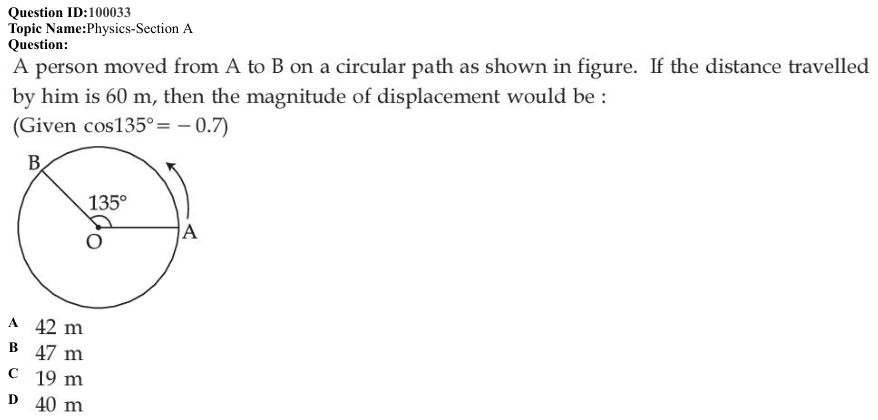
- A.42 m
- B.47 m
- C.19 m
- D.40 m
Correct answer: B
Explanation: m; m.
Question 32
Physics · 4 marks · −1A body of mass 0.5 kg travels on straight line path with velocity m/s. The net workdone by the force during its displacement from to m is:
- A.64 J
- B.60 J
- C.120 J
- D.128 J
Correct answer: B
Explanation: : 4 to 16 m/s; J.
Question 33
Physics · 4 marks · −1A solid cylinder and a solid sphere, having same mass M and radius R, roll down the same inclined plane from top without slipping. They start from rest. The ratio of velocity of the solid cylinder to that of the solid sphere, with which they reach the ground, will be:
- A.
- B.
- C.
- D.
Correct answer: D
Explanation: : .
Question 34
Physics · 4 marks · −1Three identical particles A, B and C of mass 100 kg each are placed in a straight line with AB = BC = 13 m. The gravitational force on a fourth particle P of the same mass is F, when placed at a distance 13 m from the particle B on the perpendicular bisector of the line AC. The value of F will be approximately:
- A.21 G
- B.100 G
- C.59 G
- D.42 G
Correct answer: B
Explanation: .
Question 35
Physics · 4 marks · −1A certain amount of gas of volume V at 27°C temperature and pressure Nm expands isothermally until its volume gets doubled. Later it expands adiabatically until its volume gets redoubled. The final pressure of the gas will be (Use ):
- A. Pa
- B. Pa
- C. Pa
- D. Pa
Correct answer: B
Explanation: Pa.
Question 36
Physics · 4 marks · −1Following statements are given: (A) The average kinetic energy of a gas molecule decreases when the temperature is reduced. (B) The average kinetic energy of a gas molecule increases with increase in pressure at constant temperature. (C) The average kinetic energy of a gas molecule decreases with increase in volume. (D) Pressure of a gas increases with increase in temperature at constant pressure. (E) The volume of gas decreases with increase in temperature. Choose the correct answer from the options given below:
- A.(A) and (D) only
- B.(A), (B) and (D) only
- C.(B) and (D) only
- D.(A), (B) and (E) only
Correct answer: A
Question 37
Physics · 4 marks · −1In figure (A), mass '2 m' is fixed on mass 'm' which is attached to two springs of spring constant k. In figure (B), mass 'm' is attached to two springs of spring constant 'k' and '2k'. If mass 'm' in (A) and in (B) are displaced by distance 'x' horizontally and then released, then time period and corresponding to (A) and (B) respectively follow the relation.
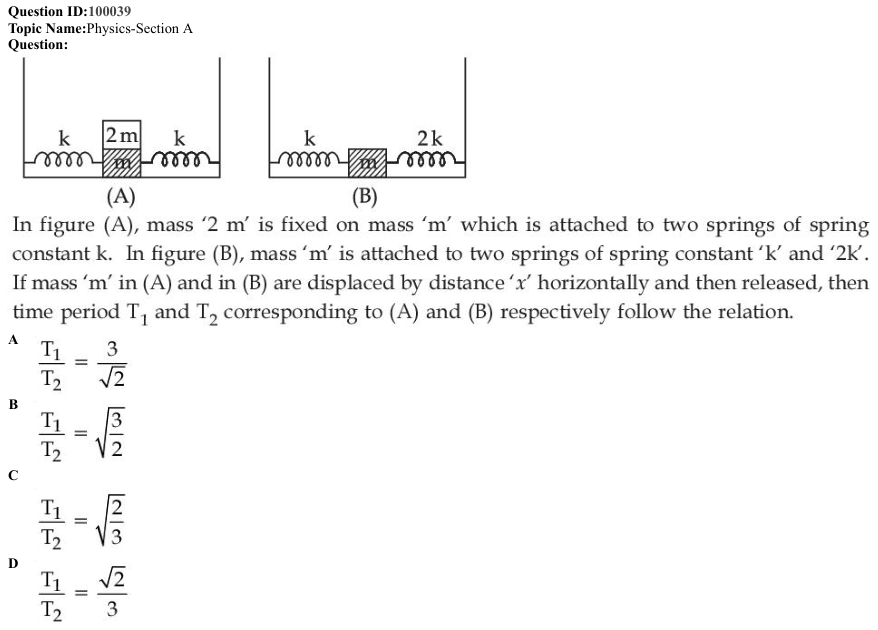
- A.
- B.
- C.
- D.
Correct answer: A
Explanation: , ; ratio .
Question 38
Physics · 4 marks · −1A condenser of 2 F capacitance is charged steadily from 0 to 5 C. Which of the following graph represents correctly the variation of potential difference (V) across it\'s plates with respect to the charge (Q) on the condenser?
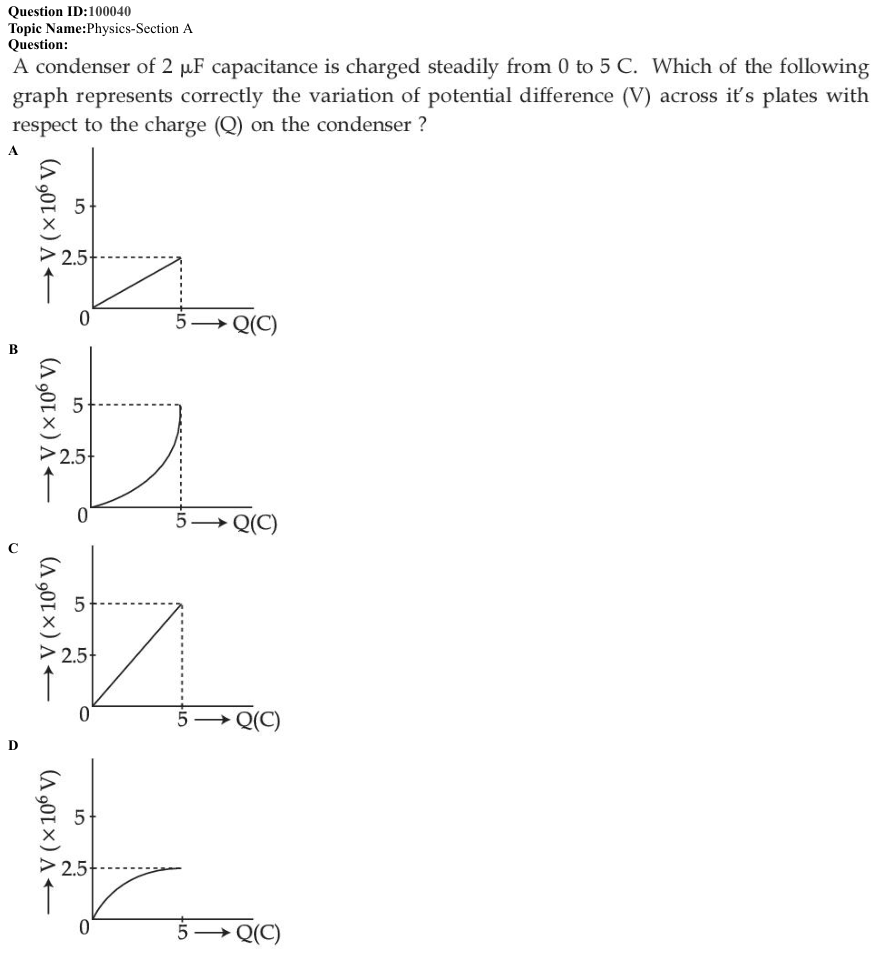
- A.Straight line from origin reaching V = 2.5 x 10^6 V at Q = 5 C
- B.Curve bending upward (convex) from origin reaching V = 5 x 10^6 V at Q = 5 C
- C.Straight line from origin reaching V = 5 x 10^6 V at Q = 5 C
- D.Curve rising and saturating near V = 2.5 x 10^6 V by Q = 5 C
Correct answer: A
Explanation: is linear, reaching V.
Question 39
Physics · 4 marks · −1Two charged particles, having same kinetic energy, are allowed to pass through a uniform magnetic field perpendicular to the direction of motion. If the ratio of radii of their circular paths is 6 : 5 and their respective masses ratio is 9 : 4. Then, the ratio of their charges will be:
- A.8 : 5
- B.5 : 4
- C.5 : 3
- D.8 : 7
Correct answer: B
Explanation: : .
Question 40
Physics · 4 marks · −1To increase the resonant frequency in series LCR circuit,
- A.source frequency should be increased.
- B.another resistance should be added in series with the first resistance.
- C.another capacitor should be added in series with the first capacitor.
- D.the source frequency should be decreased.
Correct answer: C
Explanation: Series capacitors reduce C, raising .
Question 41
Physics · 4 marks · −1A small square loop of wire of side is placed inside a large square loop of wire L (). Both loops are coplanar and their centres coincide at point O as shown in figure. The mutual inductance of the system is:
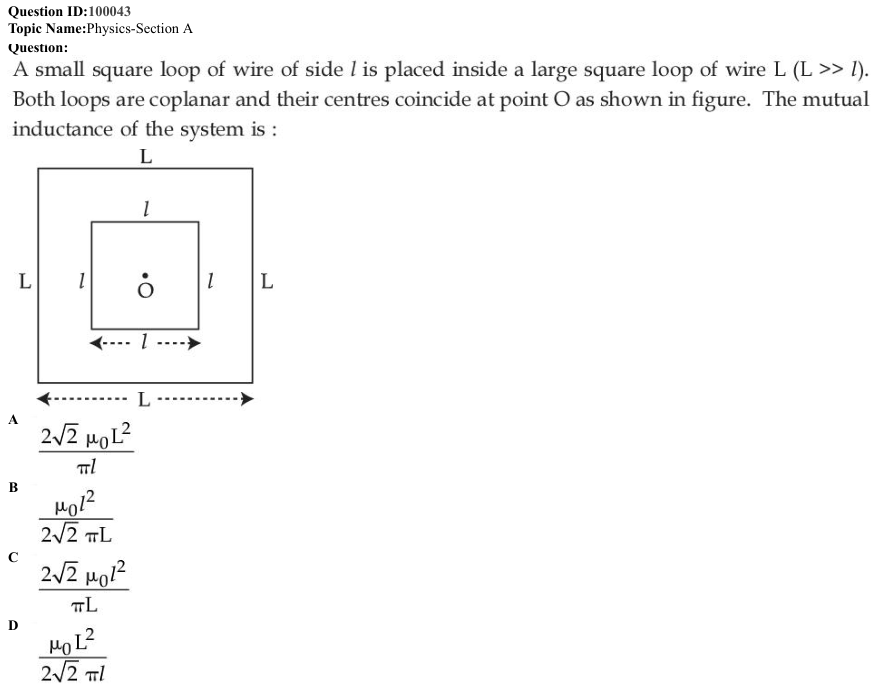
- A.
- B.
- C.
- D.
Correct answer: C
Explanation: Field at centre of large square ; .
Question 42
Physics · 4 marks · −1The rms value of conduction current in a parallel plate capacitor is 6.9 A. The capacity of this capacitor, if it is connected to 230 V ac supply with an angular frequency of 600 rad/s, will be:
- A.5 pF
- B.50 pF
- C.100 pF
- D.200 pF
Correct answer: B
Explanation: pF.
Question 43
Physics · 4 marks · −1Which of the following statement is correct?
- A.In primary rainbow, observer sees red colour on the top and violet on the bottom
- B.In primary rainbow, observer sees violet colour on the top and red on the bottom
- C.In primary rainbow, light wave suffers total internal reflection twice before coming out of water drops.
- D.Primary rainbow is less bright than secondary rainbow.
Correct answer: A
Question 44
Physics · 4 marks · −1Time taken by light to travel in two different materials A and B of refractive indices and of same thickness is and respectively. If s and the ratio of to is 1 : 2. Then, the thickness of material, in meter is: (Given and are velocities of light in A and B materials respectively.)
- A. m
- B. m
- C. m
- D. m
Correct answer: A
Explanation: ; .
Question 45
Physics · 4 marks · −1A metal exposed to light of wavelength 800 nm and and emits photoelectrons with a certain kinetic energy. The maximum kinetic energy of photo-electron doubles when light of wavelength 500 nm is used. The workfunction of the metal is: (Take hc = 1230 eV-nm).
- A.1.537 eV
- B.2.46 eV
- C.0.615 eV
- D.1.23 eV
Correct answer: C
Explanation: eV.
Question 46
Physics · 4 marks · −1The momentum of an electron revolving in orbit is given by: (Symbols have their usual meanings)
- A.
- B.
- C.
- D.
Correct answer: A
Explanation: .
Question 47
Physics · 4 marks · −1The magnetic moment of an electron (e) revolving in an orbit around nucleus with an orbital angular momentum is given by:
- A.
- B.
- C.
- D.
Correct answer: B
Question 48
Physics · 4 marks · −1In the circuit, the logical value of A = 1 or B = 1 when potential at A or B is 5 V and the logical value of A = 0 or B = 0 when potential at A or B is 0 V. The truth table of the given circuit will be:
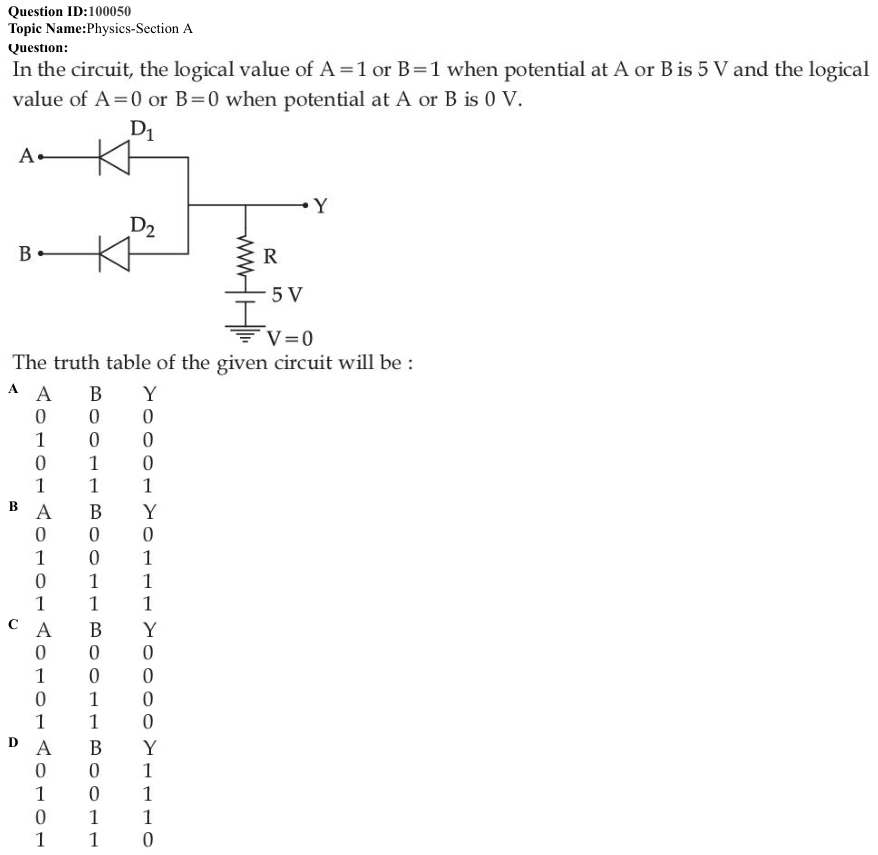
- A.A B Y: 0 0 0; 1 0 0; 0 1 0; 1 1 1
- B.A B Y: 0 0 0; 1 0 1; 0 1 1; 1 1 1
- C.A B Y: 0 0 0; 1 0 0; 0 1 0; 1 1 0
- D.A B Y: 0 0 1; 1 0 1; 0 1 1; 1 1 0
Correct answer: A
Explanation: Y is high only when both diodes are reverse biased (A = B = 1): AND gate.
Question 49
Physics · 4 marks · −1A car is moving with speed of 150 km/h and after applying the break it will move 27 m before it stops. If the same car is moving with a speed of one third the reported speed then it will stop after travelling ________ m distance.
Correct answer: 3
Explanation: : m.
Question 50
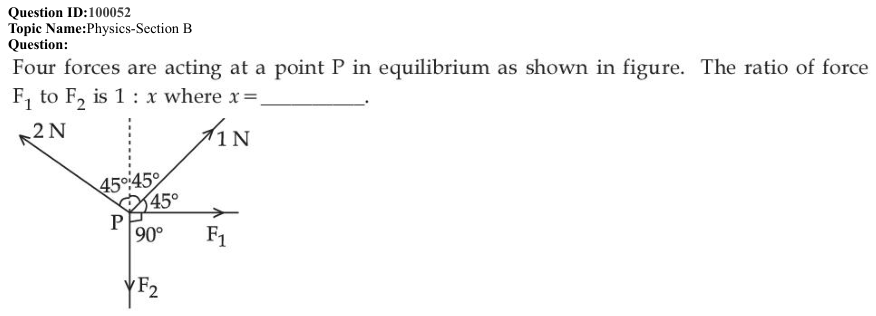
Physics · 4 marks · −1Four forces are acting at a point P in equilibrium as shown in figure. The ratio of force to is where = ________.
Correct answer: 3
Explanation: Horizontal: ; vertical: ; ratio .
Question 51
Physics · 4 marks · −1A wire of length L and radius r is clamped rigidly at one end. When the other end of the wire is pulled by a force F, its length increases by 5 cm. Another wire of the same material of length 4L and radius 4r is pulled by a force 4F under same conditions. The increase in length of this wire is ________ cm.
Correct answer: 5
Explanation: : , so 5 cm.
Question 52
Physics · 4 marks · −1A unit scale is to be prepared whose length does not change with temperature and remains 20 cm, using a bimetallic strip made of brass and iron each of different length. The length of both components would change in such a way that difference between their lengths remains constant. If length of brass is 40 cm and length of iron will be ________ cm. ( K and K).
Correct answer: 60
Explanation: cm.
Question 53
Physics · 4 marks · −1An observer is riding on a bicycle and moving towards a hill at 18 kmh. He hears a sound from a source at some distance behind him directly as well as after its reflection from the hill. If the original frequency of the sound as emitted by source is 640 Hz and velocity of the sound in air is 320 m/s, the beat frequency between the two sounds heard by observer will be ________ Hz.
Correct answer: 20
Explanation: Direct: ; reflected: ; beats 20 Hz.
Question 54
Physics · 4 marks · −1The volume charge density of a sphere of radius 6 m is 2 C cm. The number of lines of force per unit surface area coming out from the surface of the sphere is ________ NC. [Given: Permittivity of vacuum C N-m]
Correct answer: 45
Explanation: .
Question 55
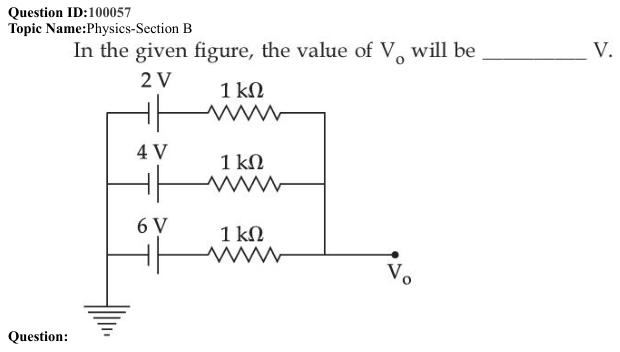
Physics · 4 marks · −1In the given figure, the value of will be ________ V.
Correct answer: 4
Explanation: Millman: V.
Question 56
Physics · 4 marks · −1Eight copper wire of length and diameter d are joined in parallel to form a single composite conductor of resistance R. If a single copper wire of length have the same resistance (R) then its diameter will be ________ d.
Correct answer: 4
Explanation: \frac{\rho l}{8A}=\frac{\rho2l}{A\'}\Rightarrow A\'=16A, diameter .
Question 57
Physics · 4 marks · −1The energy band gap of semiconducting material to produce violet (wavelength = 4000 Å) LED is ________ eV. (Round off to the nearest integer).
Correct answer: 3
Explanation: eV.
Question 58
Physics · 4 marks · −1The required height of a TV tower which can cover the population of 6.03 lakh is h. If the average population density is 100 per square km and the radius of earth is 6400 km, then the value of h will be ________ m.
Correct answer: 150
Explanation: Area km km m.
Question 59
Chemistry · 4 marks · −1SOCl on reaction with excess of water results into acidic mixture . 16 moles of NaOH is required for the complete neutralisation of the resultant acidic mixture. The number of moles of SOCl used is:
- A.16
- B.8
- C.4
- D.2
Correct answer: C
Explanation: Each mole gives 4 mol H: 4 mol.
Question 60
Chemistry · 4 marks · −1Which of the following sets of quantum numbers is not allowed?
- A.
- B.
- C.
- D.
Correct answer: C
Question 61
Chemistry · 4 marks · −1The depression in freezing point observed for a formic acid solution of concentration 0.5 mL L is 0.0405°C. Density of formic acid is 1.05 g mL. The Van't Hoff factor of the formic acid solution is nearly: (Given for water = 1.86 k kg mol)
- A.0.8
- B.1.1
- C.1.9
- D.2.4
Correct answer: C
Explanation: 0.525 g/L m; .
Question 62
Chemistry · 4 marks · −120 mL of 0.1 M NHOH is mixed with 40 mL of 0.05 M HCl. The pH of the mixture is nearest to: (Given: (NHOH) = , log 2 = 0.30, log 3 = 0.48, log 5 = 0.69, log 7 = 0.84, log 11 = 1.04)
- A.3.2
- B.4.2
- C.5.2
- D.6.2
Correct answer: C
Explanation: Exact neutralisation: M; pH .
Question 63
Chemistry · 4 marks · −1Match List - I with List - II. List - I: (A) (B) (C) (D) . List - II: (I) Cu (II) Cu/ZnO–CrO (III) FeO + KO + AlO (IV) Ni. Choose the correct answer from the options given below:
- A.(A) - (II), (B) - (IV), (C) - (I), (D) - (III)
- B.(A) - (II), (B) - (I), (C) - (IV), (D) - (III)
- C.(A) - (III), (B) - (IV), (C) - (I), (D) - (II)
- D.(A) - (III), (B) - (I), (C) - (IV), (D) - (II)
Correct answer: C
Question 64
Chemistry · 4 marks · −1The IUPAC nomenclature of an element with electronic configuration [Rn] 5f$^{14}^1^2$ is:
- A.Unnilbium
- B.Unnilunium
- C.Unnilquadium
- D.Unniltrium
Correct answer: D
Explanation: Z = 103: Unniltrium.
Question 65
Chemistry · 4 marks · −1The compound(s) that is(are) removed as slag during the extraction of copper is: (A) CaO (B) FeO (C) AlO (D) ZnO (E) NiO. Choose the correct answer from the options given below:
- A.(C), (D) only
- B.(A), (B), (E) only
- C.(A), (B) only
- D.(B) only
Correct answer: D
Question 66
Chemistry · 4 marks · −1The reaction of HO with potassium permanganate in acidic medium leads to the formation of mainly:
- A.Mn
- B.Mn
- C.Mn
- D.Mn
Correct answer: A
Question 67
Chemistry · 4 marks · −1Choose the correct order of density of the alkali metals:
- A.Li < K < Na < Rb < Cs
- B.Li < Na < K < Rb < Cs
- C.Cs < Rb < K < Na < Li
- D.Li < Na < K < Cs < Rb
Correct answer: A
Question 68
Chemistry · 4 marks · −1The geometry around boron in the product 'B' formed from the following reaction is ;
- A.trigonal planar
- B.tetrahedral
- C.pyramidal
- D.square planar
Correct answer: B
Explanation: A = BH; B = MeN·BH with tetrahedral boron.
Question 69
Chemistry · 4 marks · −1The interhalogen compound formed from the reaction of bromine with excess of fluorine is a:
- A.hypohalite
- B.halate
- C.perhalate
- D.halite
Correct answer: B
Question 70
Chemistry · 4 marks · −1The photochemical smog does not generally contain:
- A.NO
- B.NO
- C.SO
- D.HCHO
Correct answer: C
Question 71
Chemistry · 4 marks · −1A compound 'A' on reaction with 'X' and 'Y' produces the same major product but different by product 'a' and 'b'. Oxidation of 'a' gives a substance produced by ants. Compound 'A' = ; with X: a + ; with Y: b + . 'X' and 'Y' respectively are
- A.KMnO/H and dil. KMnO, 273 K
- B.KMnO(dilute), 273 K and KMnO/H
- C.KMnO/H and O, HO/Zn
- D.O, HO/Zn and KMnO/H
Correct answer: D
Explanation: By-product a oxidises to formic acid, so a = HCHO: X is ozonolysis (O, HO/Zn). With acidic KMnO the =CH end goes to CO (b). So X = O/Zn and Y = KMnO/H.
Question 72
Chemistry · 4 marks · −1Most stable product of the following reaction is: (3-methylpentan-2-ol drawn with wedge bonds at C-2 (OH) and C-3 (ethyl))
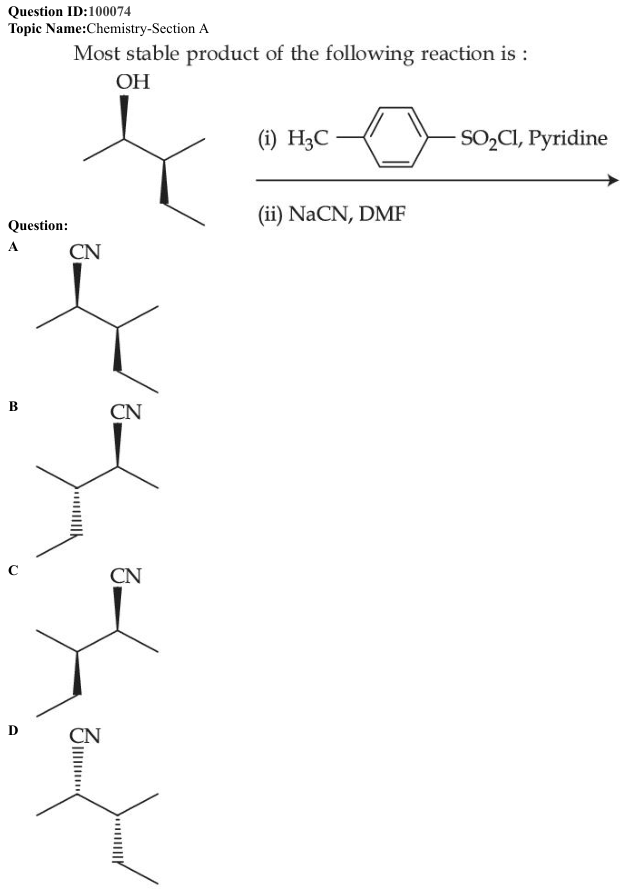
- A.2-cyano-3-methylpentane with CN on a wedge at C-2 and ethyl on a wedge at C-3 (configuration retained at C-2)
- B.CN wedge at C-2 and the ethyl on a hashed bond at C-3
- C.CN wedge at C-2, ethyl wedge at C-3 drawn in the alternative skeleton orientation
- D.CN on a hashed bond at C-2 and ethyl on a hashed bond at C-3
Correct answer: B
Explanation: Tosylation retains configuration at C-2; S$_N^-$ then inverts C-2 while C-3 is untouched (answer per official key; the option drawings differ only in wedge/hash placement).
Question 73
Chemistry · 4 marks · −1Which one of the following reactions does not represent correct combination of substrate and product under the given conditions?
- A.p-toluoyl chloride p-tolualdehyde
- B.p-tolunitrile p-tolualdehyde
- C.ethyl p-toluate (COCH) p-tolualdehyde
- D.4-methylbenzyl alcohol p-tolualdehyde
Correct answer: D
Explanation: Acidified dichromate oxidises the primary alcohol on to the carboxylic acid.
Question 74
Chemistry · 4 marks · −1An organic compound 'A' on reaction with NH followed by heating gives compound B. Which on further strong heating gives compound C (CHNO). Compound C on sequential reaction with ethanolic KOH, alkyl chloride and hydrolysis with alkali gives a primary amine. The compound A is:
- A.benzene-1,2-dicarbaldehyde (phthalaldehyde)
- B.2-formylbenzoic acid
- C.benzene-1,2-dicarboxylic acid (phthalic acid)
- D.2-hydroxybenzaldehyde (salicylaldehyde)
Correct answer: C
Explanation: Phthalic acid → ammonium phthalate → phthalamide → phthalimide (C8H5NO2), used in Gabriel synthesis.
Question 75
Chemistry · 4 marks · −1Melamine polymer is formed by the condensation of:
- A.2,4,6-triamino-1,3,5-triazine + HCHO
- B.2,4,6-triaminopyrimidine + HCHO
- C.benzene-1,3,5-triamine + HCHO
- D.pyridine-2,4-diamine + HCHO
Correct answer: A
Question 76
Chemistry · 4 marks · −1During the denaturation of proteins, which of these structures will remain intact?
- A.Primary
- B.Secondary
- C.Tertiary
- D.Quaternary
Correct answer: A
Question 77
Chemistry · 4 marks · −1Drugs used to bind to receptors, inhibiting its natural function and blocking a message are called:
- A.Agonists
- B.Antagonists
- C.Allosterists
- D.Anti histaminists
Correct answer: B
Question 78
Chemistry · 4 marks · −1Given below are two statements: Statement I: On heating with KHSO, glycerol is dehydrated and acrolein is formed. Statement II: Acrolein has fruity odour and can be used to test glycerol's presence. Choose the correct option.
- A.Both Statement I and Statement II are correct.
- B.Both Statement I and Statement II are incorrect.
- C.Statement I is correct but Statement II is incorrect.
- D.Statement I is incorrect but Statement II is correct.
Correct answer: C
Explanation: Acrolein has a pungent (not fruity) odour.
Question 79
Chemistry · 4 marks · −1Among the following species N, N, N, N, O, O, O, O the number of species showing diamagnesim is ________.
Correct answer: 2
Explanation: N (14 e) and O (18 e) are diamagnetic; N is isoelectronic with O (paramagnetic). Answer 2.
Question 80
Chemistry · 4 marks · −1The enthalpy of combustion of propane, graphite and dihydrogen at 298 K are kJ mol, kJ mol and kJ mol respectively. The magnitude of enthalpy of formation of propane (CH) is ________ kJ mol. (Nearest integer)
Correct answer: 104
Explanation: : 104.
Question 81
Chemistry · 4 marks · −1The pressure of a moist gas at 27°C is 4 atm. The volume of the container is doubled at the same temperature. The new pressure of the moist gas is ________ atm. (Nearest integer) (Given: The vapour pressure of water at 27°C is 0.4 atm.)
Correct answer: 22
Explanation: Dry gas atm; plus 0.4: 2.2 atm .
Question 82
Chemistry · 4 marks · −1The cell potential for Zn|Zn(aq)||Sn|Sn is 0.801 V at 298 K. The reaction quotient for the above reaction is . The number of electrons involved in the given electrochemical cell reaction is ________. (Given: V, V and V)
Correct answer: 4
Explanation: .
Question 83
Chemistry · 4 marks · −1The half life for the decomposition of gaseous compound A is 240 s when the gaseous pressure was 500 Torr initially. When the pressure was 250 Torr, the half life was found to be 4.0 min. The order of the reaction is ________. (Nearest integer)
Correct answer: 1
Explanation: Half-life independent of initial pressure: first order (1).
Question 84
Chemistry · 4 marks · −1Consider the following metal complexes: , , , . The spin-only magnetic moment value of the complex that absorbes light with shortest wavelength is ________ B.M. (Nearest integer)
Correct answer: 0
Explanation: [Co(CN)] (largest ) is low-spin d: 0 B.M.
Question 85
Chemistry · 4 marks · −1Among Co, Ti, V and Cr ions, one if used as a reagent cannot liberate H from dilute mineral acid solution, its spin-only magnetic moment in gaseous state is ________ B.M. (Nearest integer)
Correct answer: 5
Explanation: Co (oxidising) cannot; gaseous d: 4 unpaired, B.M.
Question 86
Chemistry · 4 marks · −1While estimating the nitrogen present in an organic compound by Kjeldahl's method, the ammonia evolved from 0.25 g of the compound neutralized 2.5 mL of 2 M HSO. The percentage of nitrogen present in organic compound is ________.
Correct answer: 56
Explanation: NH = 10 mmol, N = 0.14 g: 56%.
Question 87
Chemistry · 4 marks · −1In the given reaction: a cyclopentane ring bearing, on C-1, a CH and a –C(=O)OEt group and, on the adjacent C-2, a –CH–C(=O)–CH group, treated with OEt gives A. (Where Et is –CH). The number of chiral carbon/s in product A is ________.
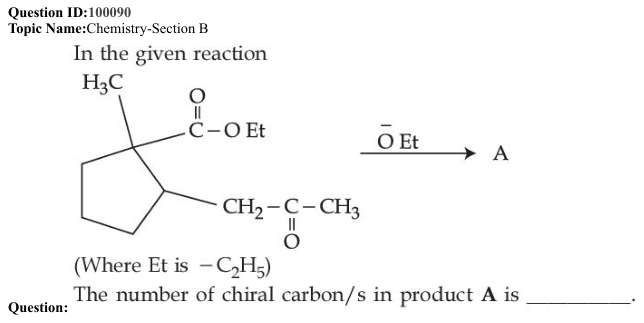
Correct answer: 2