JEE Main 2023 — 15 Apr Shift 1 (Previous Year Paper)
JEE Main · 2023 · with answers and explanations
- questions
- 90
- Total marks
- 300
- Duration
- 180 minutes
- Negative marking
- −1
Subjects: Mathematics · Physics · Chemistry
Question 1
Mathematics · 4 marks · −1If the domain of the function is , then is equal to
- A.45
- B.54
- C.63
- D.72
Correct answer: A
Explanation: or ; ; . Intersection , so .
Question 2
Mathematics · 4 marks · −1The number of real roots of the equation , is
- A.6
- B.3
- C.5
- D.4
Correct answer: B
Explanation: : gives one root . : gives . : gives . Total 3.
Question 3
Mathematics · 4 marks · −1If the set is equal to the interval , then is equal to
- A.27
- B.30
- C.36
- D.42
Correct answer: B
Explanation: With : numerator , denominator . Real part . .
Question 4
Mathematics · 4 marks · −1Let the determinant of a square matrix A of order be , where and satisfy and . If , then is equal to
- A.84
- B.96
- C.101
- D.109
Correct answer: B
Explanation: , . ; , so .
Question 5
Mathematics · 4 marks · −1Let the system of linear equations , , , has a unique solution . Then the distance of the point from the plane is
- A.7
- B.9
- C.11
- D.13
Correct answer: A
Explanation: Solving the first three equations gives ; the fourth then forces . Distance .
Question 6
Mathematics · 4 marks · −1The total number of three-digit numbers, divisible by 3, which can be formed using the digits 1, 3, 5, 8, if repetition of digits is allowed, is
- A.18
- B.20
- C.21
- D.22
Correct answer: D
Explanation: Residues mod 3: 1,0,2,2 (digits 1,3,5,8). Count ordered triples with digit-sum : (0,0,0):1; (1,1,1):1; (2,2,2): ; one each of 0,1,2: . Total 22.
Question 7
Mathematics · 4 marks · −1Let . If and , then is equal to
- A.6
- B.8
- C.12
- D.15
Correct answer: C
Explanation: . . .
Question 8
Mathematics · 4 marks · −1Let and be two arithmetic means and be three geometric means of two distinct positive numbers. Then is equal to
- A.
- B.
- C.
- D.
Correct answer: C
Explanation: Numbers , , : , and .
Question 9
Mathematics · 4 marks · −1Let denote the greatest integer function and . Let be the number of points in , where is not continuous and be the number of points in , where is not differentiable. Then is equal to
- A.2
- B.3
- C.6
- D.11
Correct answer: B
Explanation: on and (from ), so the only discontinuity is at () and is differentiable on (): .
Question 10
Mathematics · 4 marks · −1If , then is equal to
- A.
- B.0
- C.19
- D.21
Correct answer: D
Explanation: Adding the integral to itself with removes the exponential factor: , , so ; and .
Question 11
Mathematics · 4 marks · −1Let be the solution of the differential equation with . Then is equal to
- A.3
- B.
- C.
- D.
Correct answer: D
Explanation: Put : , i.e. , so . gives ; at : .
Question 12
Mathematics · 4 marks · −1If is the orthocenter of the triangle ABC with vertices , and , then is equal to
- A.25
- B.30
- C.35
- D.40
Correct answer: A
Explanation: Altitude from A (slope ): ; altitude from B (slope 12): . Solving: , so .
Question 13
Mathematics · 4 marks · −1The number of common tangents, to the circles and , is
- A.1
- B.2
- C.3
- D.4
Correct answer: C
Explanation: Centres , radii ; distance , so the circles touch externally: 3 common tangents.
Question 14
Mathematics · 4 marks · −1Let the foot of perpendicular of the point on the plane passing through the points , , be . Then the distance of from the origin is
- A.
- B.
- C.
- D.
Correct answer: D
Question 15
Mathematics · 4 marks · −1Let S be the set of all values of , for which the shortest distance between the lines and is 13. Then is equal to
- A.302
- B.304
- C.306
- D.308
Correct answer: C
Question 16
Mathematics · 4 marks · −1Let be the set of all for which the vectors , and , where , are coplanar, then is equal to
- A.2130
- B.2210
- C.2290
- D.2370
Correct answer: C
Question 17
Mathematics · 4 marks · −1Let ABCD be a quadrilateral. If E and F are the mid points of the diagonals AC and BD respectively and , then is equal to
- A.
- B.
- C.2
- D.4
Correct answer: A
Explanation: LHS , so .
Question 18
Mathematics · 4 marks · −1A bag contains 6 white and 4 black balls. A die is rolled once and the number of balls equal to the number obtained on the die are drawn from the bag at random. The probability that all the balls drawn are white is
- A.
- B.
- C.
- D.
Correct answer: A
Explanation: .
Question 19
Mathematics · 4 marks · −1The mean and standard deviation of 10 observations are 20 and 8 respectively. Later on, it was observed that one observation was recorded as 50 instead of 40. Then the correct variance is
- A.11
- B.12
- C.13
- D.14
Correct answer: C
Explanation: ; corrected , ; variance .
Question 20
Mathematics · 4 marks · −1Negation of is
- A.
- B.
- C.
- D.
Correct answer: D
Explanation: , so is a contradiction; its negation is a tautology, which is .
Question 21
Mathematics · 4 marks · −1Let and R be a relation on the set defined by . Then the number of elements in R is ________.
Correct answer: 6
Explanation: Common values of and : 9 (1×1), 13 (1×1), 14 (: (1,4),(4,2); : (1,2)) → 2, 17 (1×1), 18 (1×1). Total 6.
Question 22
Mathematics · 4 marks · −1A person forgets his 4-digit ATM pin code. But he remembers that in the code all the digits are different, the greatest digit is 7 and the sum of the first two digits is equal to the sum of the last two digits. Then the maximum number of trials necessary to obtain the correct code is ________.
Correct answer: 72
Question 23
Mathematics · 4 marks · −1The number of elements in the set and is a multiple of 7 is ________.
Correct answer: 15
Explanation: iff ; : 15 values.
Question 24
Mathematics · 4 marks · −1If the sum of the series is , where and are co-prime, then is equal to ________.
Correct answer: 7
Explanation: The -th bracket is ; summing over : , so .
Question 25
Mathematics · 4 marks · −1Consider the triangles with vertices , and , . If the maximum and the minimum perimeters of such triangles are obtained at and respectively, then is equal to ________.
Correct answer: 48
Explanation: is convex in ; the maximum on is at (). The minimum is where C lies on the reflection line: reflect B in to ; the line from to meets at (). .
Question 26
Mathematics · 4 marks · −1Let . If and , , then is equal to ________.
Correct answer: 28
Question 27
Mathematics · 4 marks · −1If the area bounded by the curve , lines , and outside the circle is A, then is equal to ________.
Correct answer: 42
Question 28
Mathematics · 4 marks · −1Let an ellipse with centre and latus rectum of length have its major axis along x-axis. If its minor axis subtends an angle at the foci, then the square of the sum of the lengths of its minor and major axes is equal to ________.
Correct answer: 9
Explanation: , ; . .
Question 29
Mathematics · 4 marks · −1Let the plane P contain the line and be parallel to the line . Then the distance of the point from the plane P measured parallel to the line is equal to ________.
Correct answer: 26
Question 30
Mathematics · 4 marks · −1If the line intersects the line , where are the angles of a triangle , then is equal to ________.
Correct answer: 5
Explanation: At : , , so , giving .
Question 31
Physics · 4 marks · −1In a linear Simple Harmonic Motion (SHM) (A) Restoring force is directly proportional to the displacement. (B) The acceleration and displacement are opposite in direction. (C) The velocity is maximum at mean position. (D) The acceleration is minimum at extreme points. Choose the correct answer from the options given below:
- A.(A), (B) and (C) Only
- B.(C) and (D) only
- C.(A), (C) and (D) only
- D.(A), (B) and (D) only
Correct answer: A
Explanation: Acceleration is maximum (not minimum) at the extreme points, so only (A), (B), (C) are true.
Question 32
Physics · 4 marks · −1A flask contains Hydrogen and Argon in the ratio 2:1 by mass. The temperature of the mixture is C. The ratio of average kinetic energy per molecule of the two gases () is: (Given: Atomic Weight of Ar = 39.9)
- A.
- B.1
- C.39.9
- D.2
Correct answer: B
Explanation: Average translational KE per molecule depends only on temperature, so the ratio is 1.
Question 33
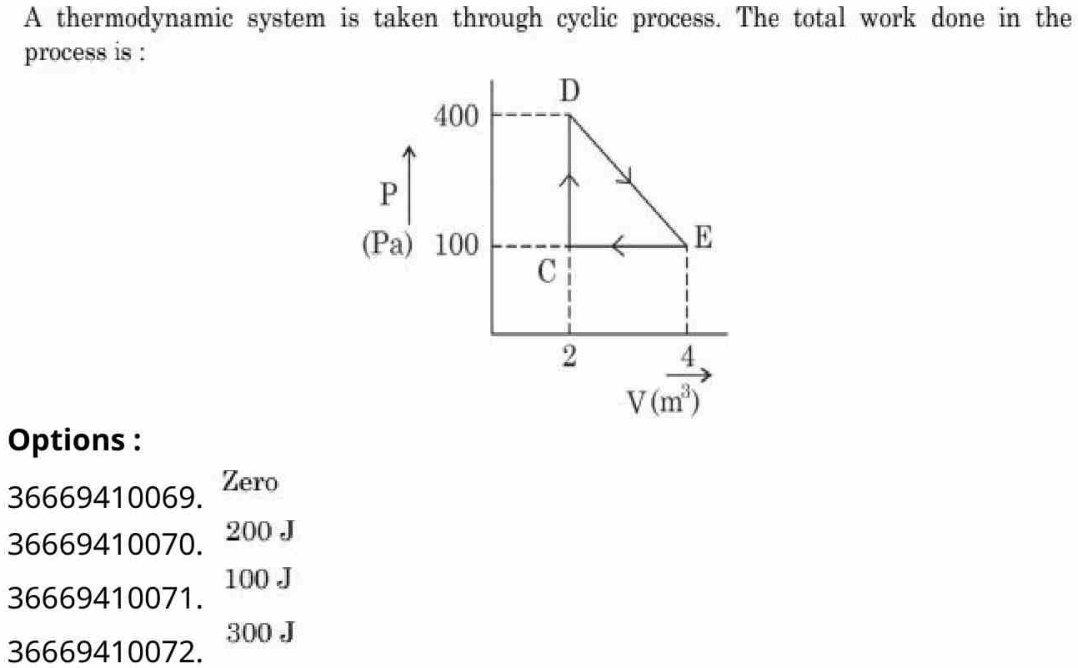
Physics · 4 marks · −1A thermodynamic system is taken through cyclic process. The total work done in the process is:
- A.Zero
- B.200 J
- C.100 J
- D.300 J
Correct answer: D
Explanation: Work = area of triangle J.
Question 34
Physics · 4 marks · −1A wire of length 'L' and radius 'r' is clamped rigidly at one end. When the other end of the wire is pulled by a force , its length increases by ''. Another wire of same material of length '2L' and radius '2r' is pulled by a force '2f'. Then the increase in its length will be:
- A.
- B.
- C.
- D.
Correct answer: A
Explanation: : .
Question 35
Physics · 4 marks · −1A body is released from a height equal to the radius (R) of the earth. The velocity of the body when it strikes the surface of the earth will be: (Given g = acceleration due to gravity on the earth.)
- A.
- B.
- C.
- D.
Correct answer: D
Explanation: .
Question 36
Physics · 4 marks · −1Two identical particles each of mass 'm' go round a circle of radius under the action of their mutual gravitational attraction. The angular speed of each particle will be:
- A.
- B.
- C.
- D.
Correct answer: B
Explanation: Separation : .
Question 37
Physics · 4 marks · −1A vector in plane makes an angle of with y-axis. The magnitude of y-component of vector is . The magnitude of -component of the vector will be:
- A.2
- B.
- C.
- D.6
Correct answer: A
Explanation: .
Question 38
Physics · 4 marks · −1The position of a particle related to time is given by m. The magnitude of velocity of the particle at s will be:
- A.14 ms
- B.16 ms
- C.10 ms
- D.06 ms
Correct answer: B
Explanation: m/s.
Question 39
Physics · 4 marks · −1The speed of a wave produced in water is given by . Where , and are wavelength of wave, acceleration due to gravity and density of water respectively. The values of , and respectively, are:
- A.1, 1, 0
- B.
- C.
- D.1, −1, 0
Correct answer: C
Explanation: .
Question 40
Physics · 4 marks · −1The position vector of a particle related to time is given by m. The direction of net force experienced by the particle is:
- A.Positive -axis
- B.Positive -axis
- C.Positive -axis
- D.In - plane
Correct answer: B
Explanation: , so the net force is along +y.
Question 41
Physics · 4 marks · −1The electric field due to a short electric dipole at a large distance () from center of dipole on the equatorial plane varies with distance as:
- A.
- B.
- C.
- D.
Correct answer: C
Explanation: .
Question 42
Physics · 4 marks · −1The height of transmitting antenna is 180 m and the height of the receiving antenna is 245 m. The maximum distance between them for satisfactory communication in line of sight will be: (given R = 6400 km)
- A.48 km
- B.56 km
- C.96 km
- D.104 km
Correct answer: D
Explanation: km.
Question 43
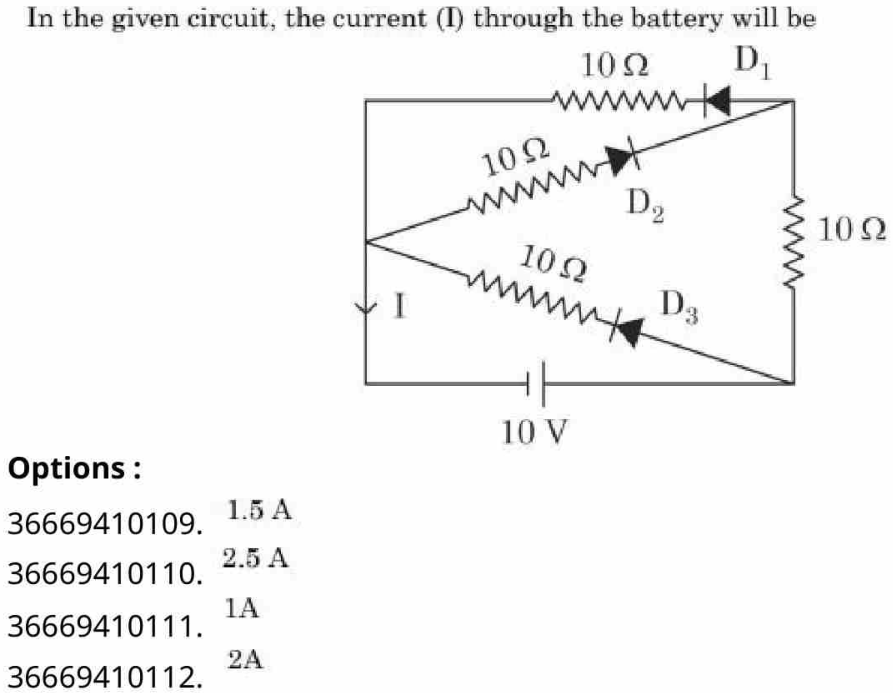
Physics · 4 marks · −1In the given circuit, the current (I) through the battery will be
- A.1.5 A
- B.2.5 A
- C.1A
- D.2A
Correct answer: A
Explanation: With B at +10 V relative to L: D3 branch conducts, A; path BT (10 )D1L (10 ) carries A; D2 is reverse biased. Total 1.5 A.
Question 44
Physics · 4 marks · −1The half-life of a radioactive nucleus is 5 years. The fraction of the original sample that would decay in 15 years is:
- A.
- B.
- C.
- D.
Correct answer: D
Explanation: Three half-lives leave , so decays.
Question 45
Physics · 4 marks · −1The de Broglie wavelength of an electron having kinetic energy E is . If the kinetic energy of electron becomes , then its de-Broglie wavelength will be:
- A.
- B.
- C.
- D.
Correct answer: B
Explanation: , so .
Question 46
Physics · 4 marks · −1A single slit of width is illuminated by a monochromatic light of wavelength 600 nm. The value of '' for which first minimum appears at on the screen will be:
- A.0.6 m
- B.1.2 m
- C.1.8 m
- D.3 m
Correct answer: B
Explanation: m.
Question 47
Physics · 4 marks · −1Match List I with List II of Electromagnetic waves with corresponding wavelength range: List I: (A) Microwave (B) Ultraviolet (C) X-Ray (D) Infra-red. List II: (I) 400 nm to 1 nm (II) 1 nm to nm (III) 1 mm to 700 nm (IV) 0.1 m to 1 mm. Choose the correct answer from the options given below:
- A.(A)-(I), (B)-(IV), (C)-(II), (D)-(III)
- B.(A)-(IV), (B)-(II), (C)-(I), (D)-(III)
- C.(A)-(IV), (B)-(I), (C)-(II), (D)-(III)
- D.(A)-(IV), (B)-(I), (C)-(III), (D)-(II)
Correct answer: C
Question 48
Physics · 4 marks · −1A 12 V battery connected to a coil of resistance 6 through a switch, drives a constant current in the circuit. The switch is opened in 1 ms. The emf induced across the coil is 20 V. The inductance of the coil is:
- A.5 mH
- B.8 mH
- C.10 mH
- D.12 mH
Correct answer: C
Explanation: A falls to 0 in 1 ms: mH.
Question 49
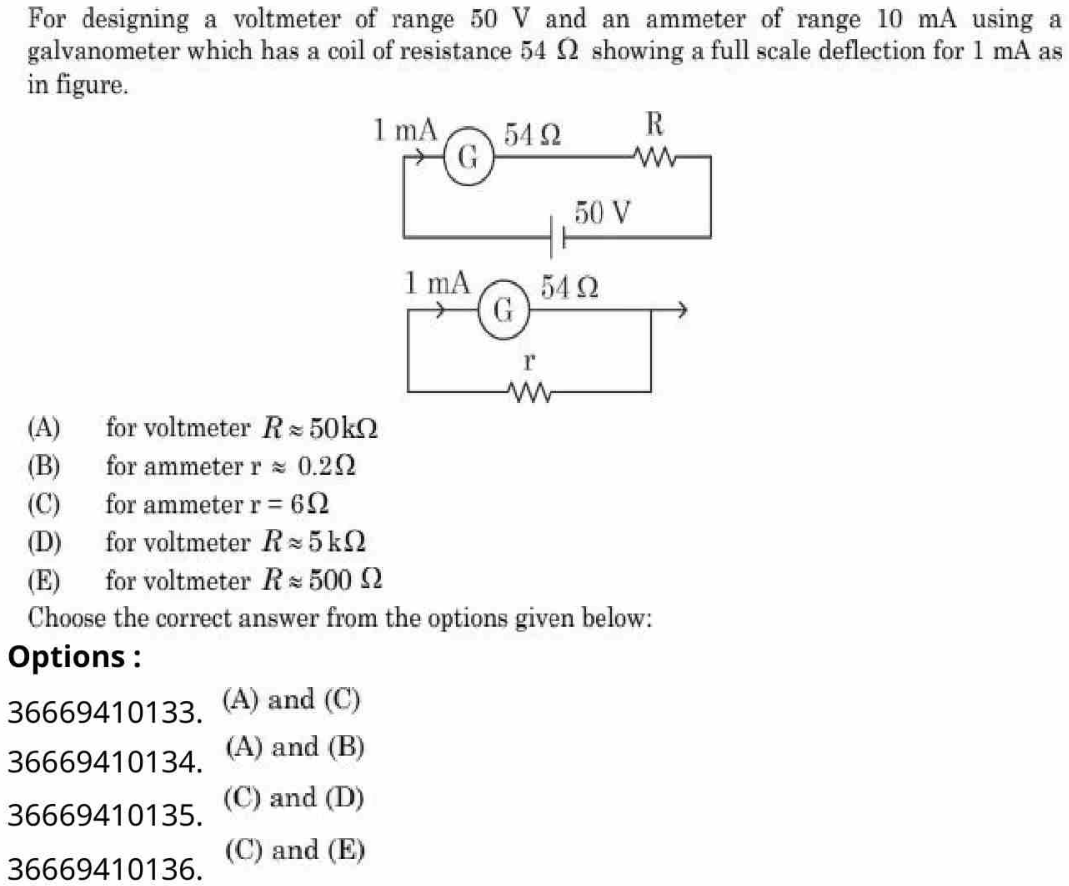
Physics · 4 marks · −1For designing a voltmeter of range 50 V and an ammeter of range 10 mA using a galvanometer which has a coil of resistance 54 showing a full scale deflection for 1 mA as in figure. (A) for voltmeter k (B) for ammeter (C) for ammeter (D) for voltmeter k (E) for voltmeter . Choose the correct answer from the options given below:
- A.(A) and (C)
- B.(A) and (B)
- C.(C) and (D)
- D.(C) and (E)
Correct answer: A
Explanation: k; .
Question 50
Physics · 4 marks · −1Given below are two statements: Statement I: The equivalent resistance of resistors in a series combination is smaller than least resistance used in the combination. Statement II: The resistivity of the material is independent of temperature. In the light of the above statements, choose the correct answer from the options given below:
- A.Both Statement I and Statement II are true
- B.Both Statement I and Statement II are false
- C.Statement I is true but Statement II is false
- D.Statement I is false but Statement II is true
Correct answer: B
Question 51
Physics · 4 marks · −1The fundamental frequency of vibration of a string stretched between two rigid support is 50 Hz. The mass of the string is 18 g and its linear mass density is 20 g/m. The speed of the transverse waves so produced in the string is ________ ms
Correct answer: 90
Explanation: m, m, m/s.
Question 52
Physics · 4 marks · −1There is an air bubble of radius 1.0 mm in a liquid of surface tension 0.075 Nm and density 1000 kg m at a depth of 10 cm below the free surface. The amount by which the pressure inside the bubble is greater than the atmospheric pressure is ________ Pa ( ms)
Correct answer: 1150
Explanation: Pa.
Question 53
Physics · 4 marks · −1A solid sphere and a solid cylinder of same mass and radius are rolling on a horizontal surface without slipping. The ratio of their radius of gyrations respectively () is . The value of is ________
Correct answer: 5
Explanation: , ; ratio .
Question 54
Physics · 4 marks · −1A block of mass 10 kg is moving along x-axis under the action of force N. The work done by the force in moving the block from m to 4 m will be ________ J.
Correct answer: 30
Explanation: J.
Question 55
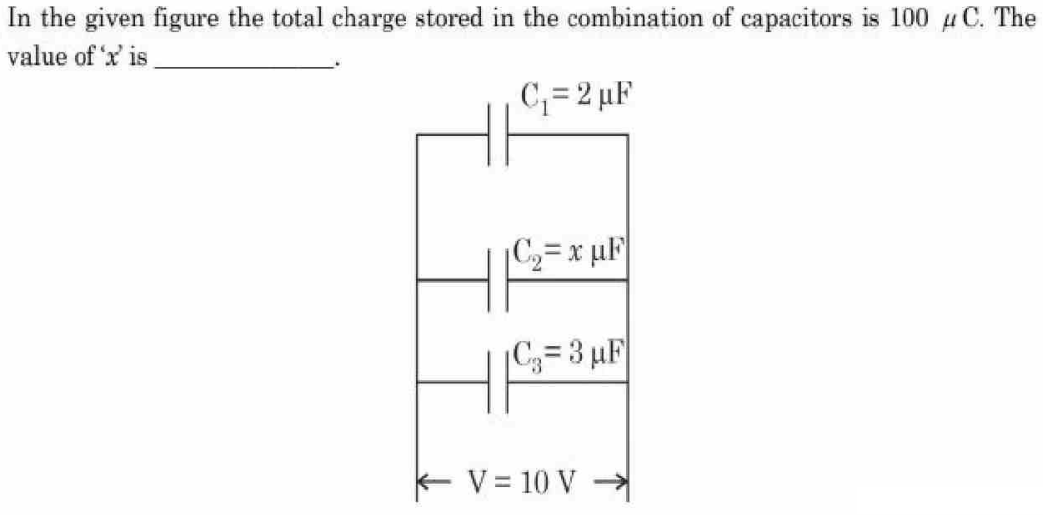
Physics · 4 marks · −1In the given figure the total charge stored in the combination of capacitors is 100 C. The value of 'x' is ________.
Correct answer: 5
Explanation: .
Question 56
Physics · 4 marks · −1As per given figure A, B and C are the first, second and third excited energy levels of hydrogen atom respectively. If the ratio of the two wavelengths (i.e. ) is , then the value of will be ________.
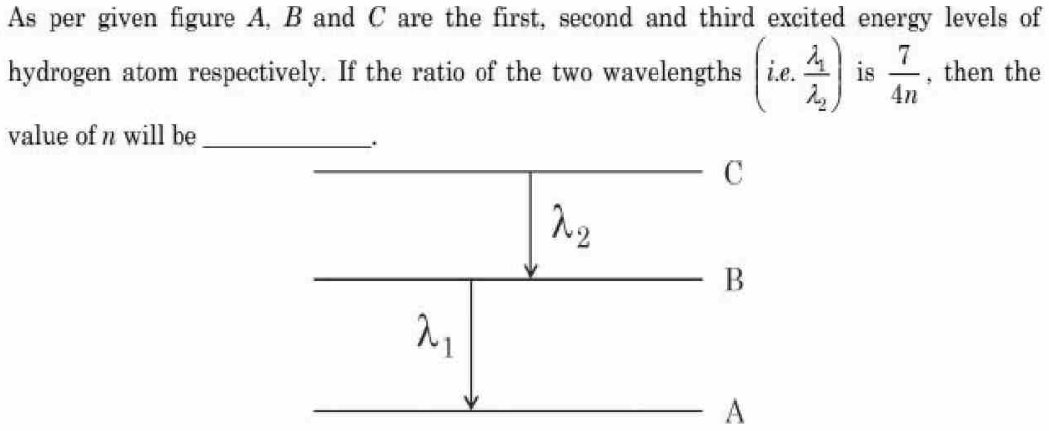
Correct answer: 5
Explanation: A, B, C are . .
Question 57
Physics · 4 marks · −1The refractive index of a transparent liquid filled in an equilateral hollow prism is . The angle of minimum deviation for the liquid will be ________ .
Correct answer: 30
Explanation: .
Question 58
Physics · 4 marks · −1A 20 cm long metallic rod is rotated with 210 rpm about an axis normal to the rod passing through its one end. The other end of the rod is in contact with a circular metallic ring. A constant and uniform magnetic field 0.2T parallel to the axis exists everywhere. The emf developed between the centre and the ring is ________ mV. Take
Correct answer: 88
Explanation: rad/s; V mV.
Question 59
Physics · 4 marks · −1An electron in a hydrogen atom revolves around its nucleus with a speed of ms in an orbit of radius 0.52 Å. The magnetic field produced at the nucleus of the hydrogen atom is ________ T.
Correct answer: 40
Explanation: T.
Question 60
Physics · 4 marks · −1A network of four resistances is connected to 9 V battery, as shown in figure. The magnitude of voltage difference between the points A and B is ________ V.
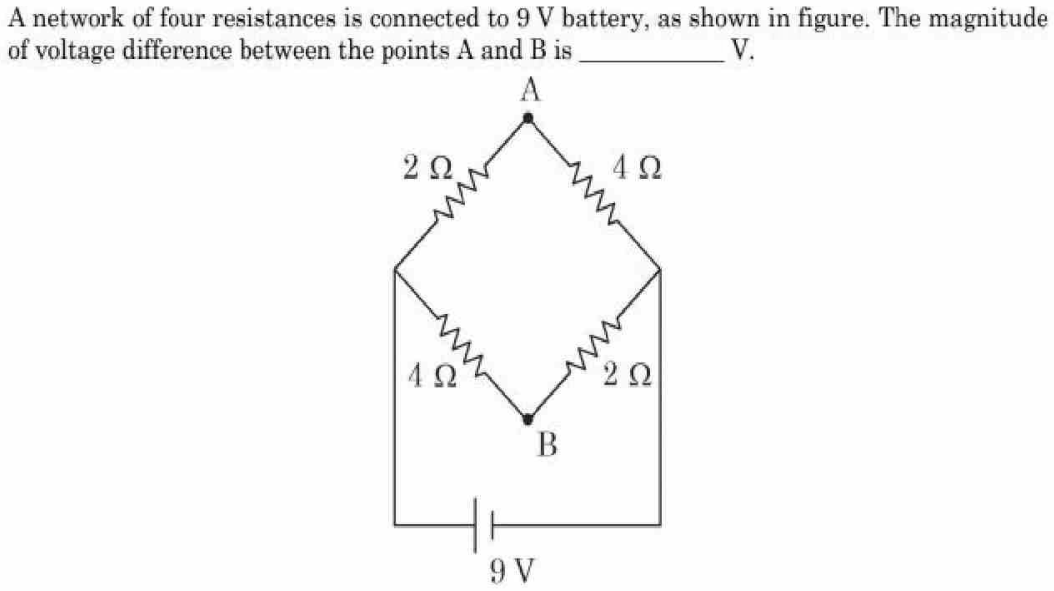
Correct answer: 3
Explanation: Each branch is 6 carrying 1.5 A. Drop from left vertex to A V, to B V, so V.
Question 61
Chemistry · 4 marks · −1Which of the following expressions is correct in case of a CsCl unit cell (edge length 'a')?
- A.
- B.
- C.
- D.
Correct answer: C
Explanation: Ions touch along the body diagonal: .
Question 62
Chemistry · 4 marks · −1Given below are two statements: Statement I: According to Bohr's model of hydrogen atom, the angular momentum of an electron in a given stationary state is quantised. Statement II: The concept of electron in Bohr's orbit, violates the Heisenberg uncertainty principle. In the light of the above statements, choose the most appropriate answer from the options given below:
- A.Both Statement I and Statement II are correct
- B.Both Statement I and Statement II are incorrect
- C.Statement I is correct but Statement II is incorrect
- D.Statement I is incorrect but Statement II is correct
Correct answer: A
Question 63
Chemistry · 4 marks · −1Consider the following statements: (A) NF molecule has a trigonal planar structure. (B) Bond length of N is shorter than O. (C) Isoelectronic molecules or ions have identical bond order. (D) Dipole moment of HS is higher than that of water molecule. Choose the correct answer from the options given below:
- A.(A) and (B) are correct
- B.(B) and (C) are correct
- C.(C) and (D) are correct
- D.(A) and (D) are correct
Correct answer: B
Question 64
Chemistry · 4 marks · −1Which of the following statement(s) is/are correct? (A) The pH of M HCl solution is 8. (B) The conjugate base of HPO is HPO. (C) K increases with increase in temperature. (D) When a solution of a weak monoprotic acid is titrated against a strong base at half neutralisation point, pH pK. Choose the correct answer from the options given below:
- A.(A), (B), (C)
- B.(B), (C), (D)
- C.(B), (C)
- D.(A), (D)
Correct answer: C
Question 65
Chemistry · 4 marks · −1Which one of the following is not an example of calcination?
- A.
- B.
- C.
- D.
Correct answer: D
Explanation: Heating a sulphide ore in air is roasting, not calcination.
Question 66
Chemistry · 4 marks · −1During water-gas shift reaction
- A.carbon is oxidized to carbon monoxide.
- B.carbon monoxide is oxidized to carbon dioxide.
- C.carbon dioxide is reduced to carbon monoxide.
- D.water is evaporated in presence of catalyst.
Correct answer: B
Explanation: (catalyst): CO is oxidised to CO.
Question 67
Chemistry · 4 marks · −1Given below are two statements: One is labelled as Assertion A and the other is labelled as Reason R: Assertion (A): BeCl and MgCl produce characteristic flame. Reason (R): The excitation energy is high in BeCl and MgCl. In the light of the above statements, choose the correct answer from the options given below:
- A.Both (A) and (R) are true and (R) is the correct explanation of (A)
- B.Both (A) and (R) are true but (R) is NOT the correct explanation of (A)
- C.(A) is true but (R) is false
- D.(A) is false but (R) is true
Correct answer: D
Question 68
Chemistry · 4 marks · −1For a good quality cement, the ratio of silica to alumina is found to be
- A.1.5
- B.3
- C.4.5
- D.2
Correct answer: B
Question 69
Chemistry · 4 marks · −1The number of P–O–P bonds in HPO, (HPO) and PO are respectively
- A.0, 3, 4
- B.0, 3, 6
- C.1, 2, 4
- D.1, 3, 6
Correct answer: D
Question 70
Chemistry · 4 marks · −1The complex with highest magnitude of crystal field splitting energy () is
- A.
- B.
- C.
- D.
Correct answer: B
Question 71
Chemistry · 4 marks · −1The possibility of photochemical smog formation will be minimum at
- A.New-Delhi in August (Summer)
- B.Srinagar, Jammu and Kashmir in January
- C.Mumbai in May
- D.Kolkata in October
Correct answer: B
Explanation: Photochemical smog needs strong sunlight and warmth; cold winter Srinagar is least likely.
Question 72
Chemistry · 4 marks · −1Indane-1,2,3-trione (a benzene ring fused to a five-membered ring carrying three C=O groups) is treated with HO to give 'A' (major product). 'A' formed in the above reaction is
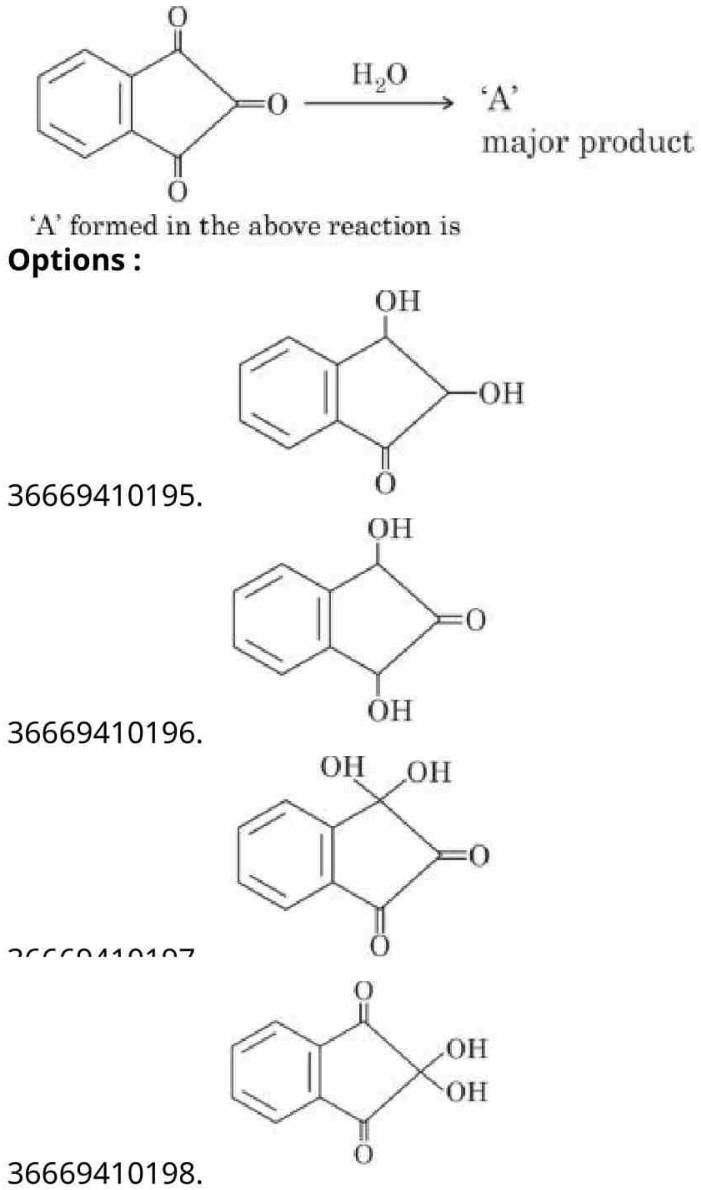
- A.2,3-dihydroxyindan-1-one (C-1 C=O; OH on C-2 and C-3)
- B.1,3-dihydroxyindan-2-one (OH on C-1 and C-3; C=O at C-2)
- C.3,3-dihydroxyindane-1,2-dione (gem-diol on C-3; C=O at C-1 and C-2)
- D.2,2-dihydroxyindane-1,3-dione (ninhydrin; gem-diol at C-2)
Correct answer: D
Explanation: The central C=O of the trione, flanked by two carbonyls, is hydrated to a stable gem-diol: ninhydrin.
Question 73
Chemistry · 4 marks · −1Decreasing order of reactivity towards electrophilic substitution for the following compounds is: (a) toluene (CHCH), (b) benzene, (c) benzotrifluoride (CHCF), (d) anisole (CHOCH), (e) N,N-dimethylaniline (CHNMe)
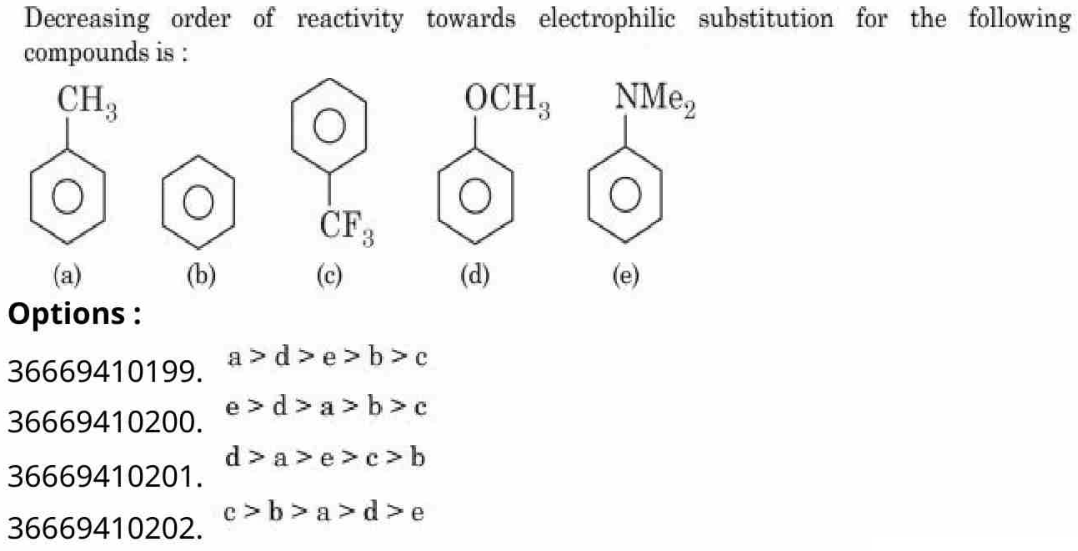
- A.a > d > e > b > c
- B.e > d > a > b > c
- C.d > a > e > c > b
- D.c > b > a > d > e
Correct answer: B
Question 74
Chemistry · 4 marks · −1The major product formed in the Friedel-Craft acylation of chlorobenzene is
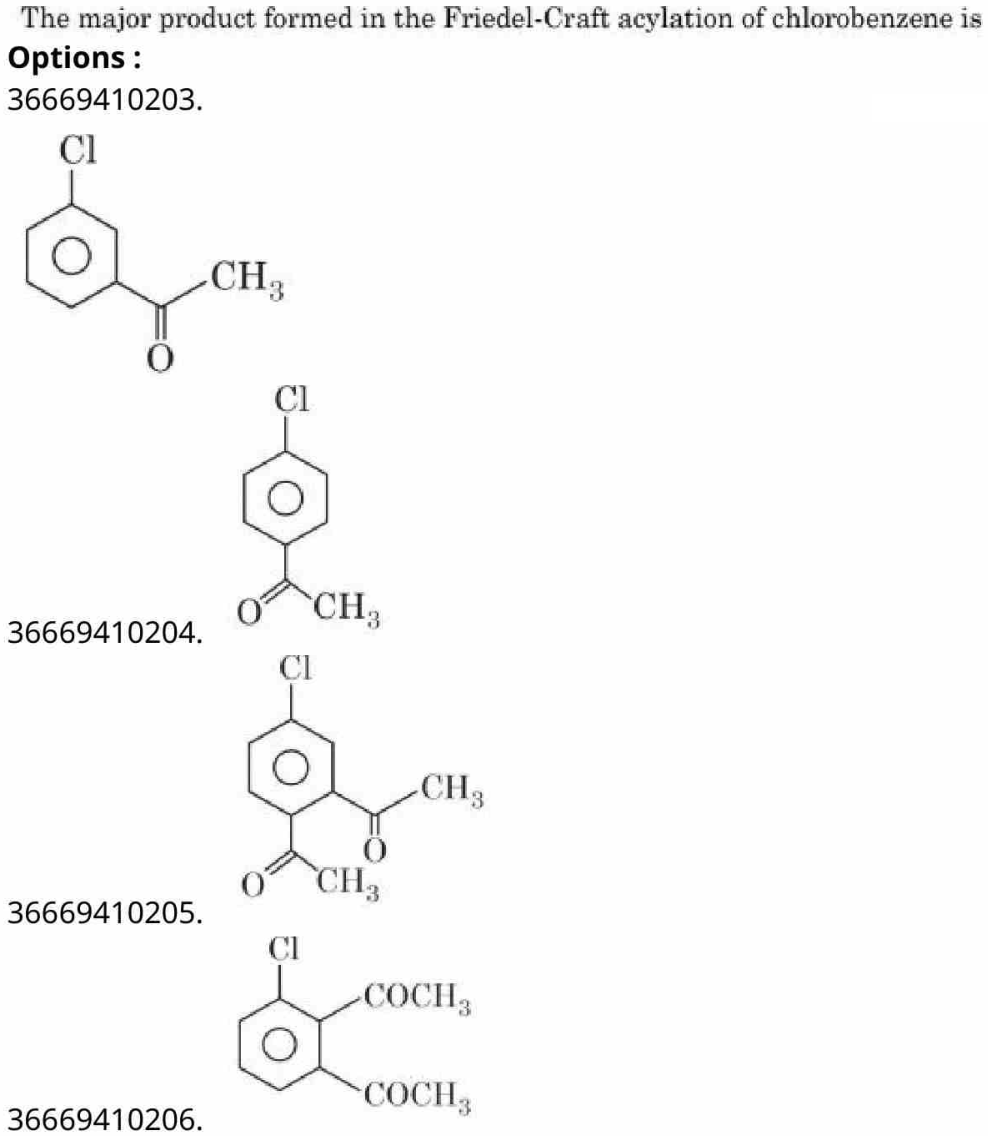
- A.3-chloroacetophenone (m-chloroacetophenone)
- B.4-chloroacetophenone (p-chloroacetophenone)
- C.4-chloro-1,2-diacetylbenzene (acetyl groups meta and para to Cl)
- D.3-chloro-1,2-diacetylbenzene (acetyl groups ortho and meta to Cl)
Correct answer: B
Explanation: Cl is an ortho/para director; the para acyl product dominates, and the acyl group deactivates the ring against a second acylation.
Question 75
Chemistry · 4 marks · −14-Nitrotoluene is converted (in several steps) to 2-bromo-4-chlorobenzoic acid (COOH at C-1, Br at C-2, Cl at C-4). In the above conversion the correct sequence of reagents to be added is
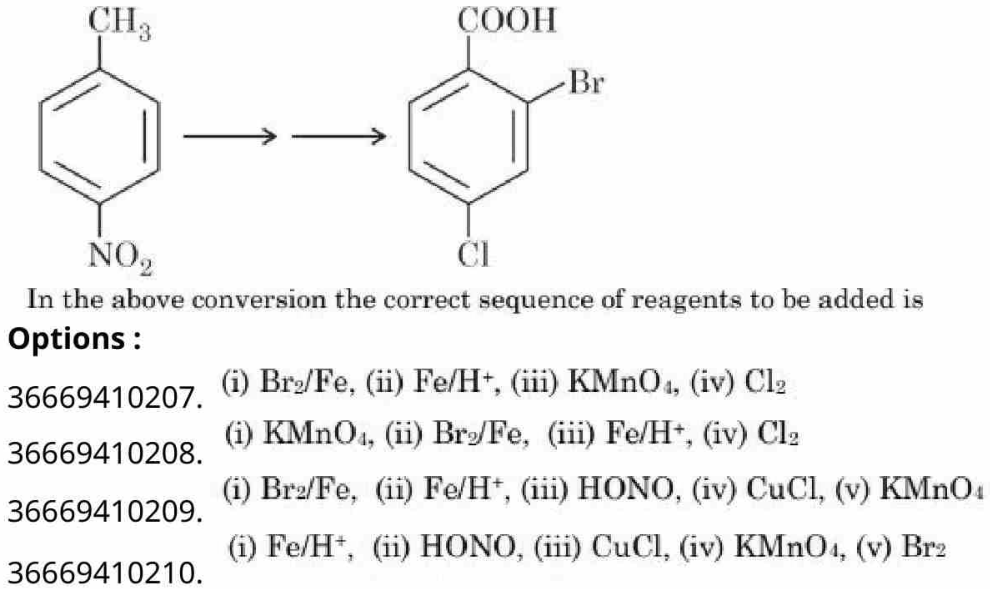
- A.(i) Br/Fe, (ii) Fe/H, (iii) KMnO, (iv) Cl
- B.(i) KMnO, (ii) Br/Fe, (iii) Fe/H, (iv) Cl
- C.(i) Br/Fe, (ii) Fe/H, (iii) HONO, (iv) CuCl, (v) KMnO
- D.(i) Fe/H, (ii) HONO, (iii) CuCl, (iv) KMnO, (v) Br
Correct answer: C
Explanation: Brominate ortho to CH3 (both CH3 and NO2 direct there), reduce NO2 to NH2, diazotise, replace by Cl (Sandmeyer), then oxidise CH3 to COOH.
Question 76
Chemistry · 4 marks · −1The product formed in the following multistep reaction is: treated with i) BH ii) HO, NaOH iii) PCC iv) CHMgBr
- A. (2-methylpropan-2-ol)
- B.
- C.
- D.
Correct answer: B
Explanation: Hydroboration–oxidation gives propan-1-ol; PCC gives propanal; CH3MgBr then gives butan-2-ol.
Question 77
Chemistry · 4 marks · −1Consider the following sequence of reactions: aniline 'A' 'B'. The product 'B' is
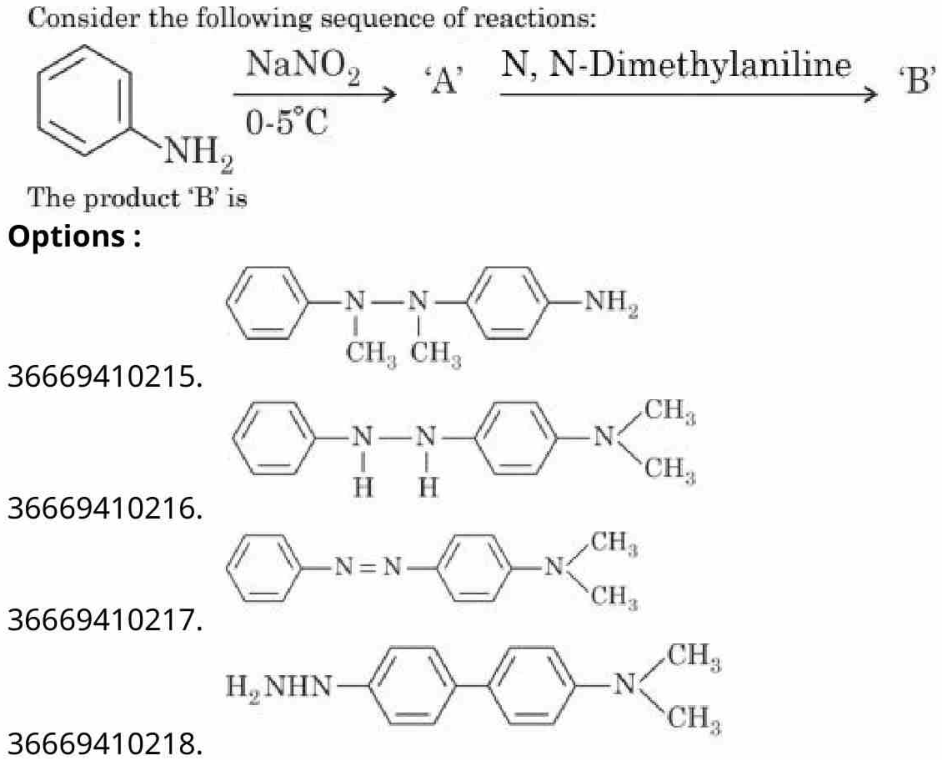
- A. (p-)
- B. (p-)
- C. (p-dimethylaminoazobenzene)
- D. (4,4\'-substituted biphenyl)
Correct answer: C
Explanation: Diazonium coupling at the para position of N,N-dimethylaniline gives the azo dye p-(dimethylamino)azobenzene.
Question 78
Chemistry · 4 marks · −1Match List I with List II: List I (Monomer): (A) Tetrafluoroethene (B) Acrylonitrile (C) Caprolactam (D) Isoprene. List II (Polymer): (I) Orlon (II) Natural rubber (III) Teflon (IV) Nylon-6. Choose the correct answer from the options given below:
- A.(A)-(III), (B)-(I), (C)-(IV), (D)-(II)
- B.(A)-(III), (B)-(IV), (C)-(II), (D)-(I)
- C.(A)-(II), (B)-(III), (C)-(IV), (D)-(I)
- D.(A)-(IV), (B)-(I), (C)-(II), (D)-(III)
Correct answer: A
Question 79
Chemistry · 4 marks · −1Which is not true for arginine?
- A.It is a crystalline solid.
- B.It has high solubility in benzene.
- C.It has a fairly high melting point.
- D.It is associated with more than one pK values.
Correct answer: B
Explanation: Amino acids exist as zwitterions: ionic, high-melting, insoluble in non-polar benzene.
Question 80
Chemistry · 4 marks · −1Which of the following statement is correct for paper chromatography?
- A.Paper sheet forms the stationary phase.
- B.Water present in the pores of the paper forms the stationary phase.
- C.Paper and water present in its pores together form the stationary phase.
- D.Water present in the mobile phase gets absorbed by the paper which then forms the stationary phase.
Correct answer: B
Question 81
Chemistry · 4 marks · −1The volume (in mL) of 0.1 M AgNO required for complete precipitation of chloride ions present in 20 mL of 0.01 M solution of as silver chloride is ________
Correct answer: 4
Explanation: Two ionisable Cl: mmol, needing mL.
Question 82
Chemistry · 4 marks · −130.4 kJ of heat is required to melt one mole of sodium chloride and the entropy change at the melting point is 28.4 J K mol at 1 atm. The melting point of sodium chloride is ________ K (Nearest Integer)
Correct answer: 1070
Explanation: K.
Question 83
Chemistry · 4 marks · −1The vapour pressure of 30% (w/v) aqueous solution of glucose is ________ mm Hg at 25C. [Given: The density of 30% (w/v), aqueous solution of glucose is 1.2 g cm and vapour pressure of pure water is 24 mm Hg.] (Molar mass of glucose is 180 g mol.)
Correct answer: 23
Explanation: 100 mL = 120 g solution: 30 g glucose (1/6 mol), 90 g water (5 mol). mm Hg.
Question 84
Chemistry · 4 marks · −1The number of correct statements from the following is ________ (A) Conductivity always decreases with decrease in concentration for both strong and weak electrolytes. (B) The number of ions per unit volume that carry current in a solution increases on dilution. (C) Molar conductivity increases with decrease in concentration. (D) The variation in molar conductivity is different for strong and weak electrolytes. (E) For weak electrolytes, the change in molar conductivity with dilution is due to decrease in degree of dissociation.
Correct answer: 3
Explanation: (A), (C), (D) are correct; (B) is wrong (ions per unit volume fall) and (E) is wrong (degree of dissociation increases).
Question 85
Chemistry · 4 marks · −1For a reversible reaction A B, the kJ mol. The activation energy of the uncatalysed forward reaction is 300 kJ mol. When the reaction is catalysed keeping the reactant concentration same, the rate of the catalysed forward reaction at 27C is found to be same as that of the uncatalysed reaction at 327C. The activation energy of the catalysed backward reaction is ________ kJ mol.
Correct answer: 130
Explanation: kJ; backward kJ mol.
Question 86
Chemistry · 4 marks · −120 mL of 0.5 M NaCl is required to coagulate 200 mL of AsS solution in 2 hours. The coagulating value of NaCl is ________.
Correct answer: 50
Explanation: 10 mmol NaCl per 0.2 L sol = 50 mmol L.
Question 87
Chemistry · 4 marks · −1The total number of isoelectronic species from the given set is ________. O, F, Al, Mg, Na, O, Mg, Al, F
Correct answer: 5
Explanation: O, F, Mg, Na, Al all have 10 electrons: 5.
Question 88
Chemistry · 4 marks · −1The total change in the oxidation state of manganese involved in the reaction of KMnO and potassium iodide in the acidic medium is ________.
Correct answer: 5
Explanation: Mn goes from +7 to +2: change of 5.
Question 89
Chemistry · 4 marks · −1The homoleptic and octahedral complex of Co and HO has ________ unpaired electron(s) in the t set of orbitals.
Correct answer: 1
Explanation: High-spin d: , one unpaired electron in .
Question 90
Chemistry · 4 marks · −1In Chromyl chloride, the oxidation state of chromium is (+) ________.
Correct answer: 6
Explanation: CrOCl: Cr is +6.