JEE Main 2023 — 24 Jan Shift 1 (Previous Year Paper)
JEE Main · 2023 · with answers and explanations
- questions
- 90
- Total marks
- 300
- Duration
- 180 minutes
- Negative marking
- −1
Subjects: Physics · Chemistry · Mathematics
Question 1
Physics · 4 marks · −1Match List I with List II. List I: A. Planck's constant (h); B. Stopping potential (Vs); C. Work function (); D. Momentum (p). List II: I. ; II. ; III. ; IV. . Choose the correct answer from the options given below:
- A.A-I, B-III, C-IV, D-II
- B.A-II, B-IV, C-III, D-I
- C.A-III, B-I, C-II, D-IV
- D.A-III, B-IV, C-I, D-II
Correct answer: D
Question 2
Physics · 4 marks · −1A travelling wave is described by the equation m. The velocity of the wave is: [all the quantities are in SI unit]
- A.8 ms
- B.4 ms
- C.0.5 ms
- D.2 ms
Correct answer: C
Explanation: m/s.
Question 3
Physics · 4 marks · −1The maximum vertical height to which a man can throw a ball is 136 m. The maximum horizontal distance upto which he can throw the same ball is:
- A.136 m
- B.68 m
- C.272 m
- D.192 m
Correct answer: C
Explanation: m.
Question 4
Physics · 4 marks · −1Given below are two statements: Statement I: An elevator can go up or down with uniform speed when its weight is balanced with the tension of its cable. Statement II: Force exerted by the floor of an elevator on the foot of a person standing on it is more than his/her weight when the elevator goes down with increasing speed. In the light of the above statements, choose the correct answer from the options given below:
- A.Both Statement I and Statement II are true
- B.Both Statement I and Statement II are false
- C.Statement I is true but Statement II is false
- D.Statement I is false but Statement II is true
Correct answer: C
Question 5
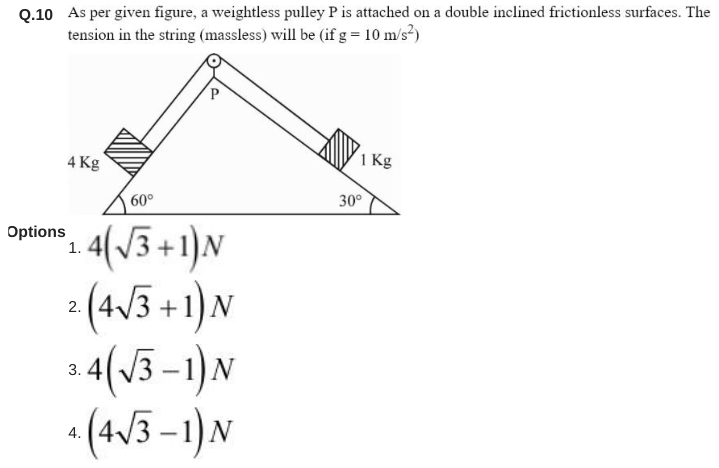
Physics · 4 marks · −1As per given figure, a weightless pulley P is attached on a double inclined frictionless surfaces. The tension in the string (massless) will be (if g = 10 m/s)
- A. N
- B. N
- C. N
- D. N
Correct answer: C
Explanation: ; N.
Question 6
Physics · 4 marks · −1The weight of a body at the surface of earth is 18 N. The weight of the body at an altitude of 3200 km above the earth's surface is (given, radius of earth = 6400 km):
- A.4.9 N
- B.19.6 N
- C.8 N
- D.9.8 N
Correct answer: C
Explanation: N.
Question 7
Physics · 4 marks · −1A 100 m long wire having cross-sectional area m and Young's modulus is Nm is subjected to a load of 250 N, then the elongation in the wire will be:
- A. m
- B. m
- C. m
- D. m
Correct answer: D
Explanation: m.
Question 8
Physics · 4 marks · −11 g of a liquid is converted to vapour at Pa pressure. If 10% of the heat supplied is used for increasing the volume by 1600 cm during this phase change, then the increase in internal energy in the process will be:
- A.4800 J
- B.432000 J
- C. J
- D.4320 J
Correct answer: D
Explanation: J J; J.
Question 9
Physics · 4 marks · −1Given below are two statements: Statement I: The temperature of a gas is C. When the gas is heated to C, the root mean square speed of the molecules is doubled. Statement II: The product of pressure and volume of an ideal gas will be equal to translational kinetic energy of the molecules. In the light of the above statements, choose the correct answer from the options given below:
- A.Both Statement I and Statement II are true
- B.Both Statement I and Statement II are false
- C.Statement I is true but Statement II is false
- D.Statement I is false but Statement II is true
Correct answer: C
Explanation: 200 K to 800 K quadruples T, doubling (I true). (II false).
Question 10
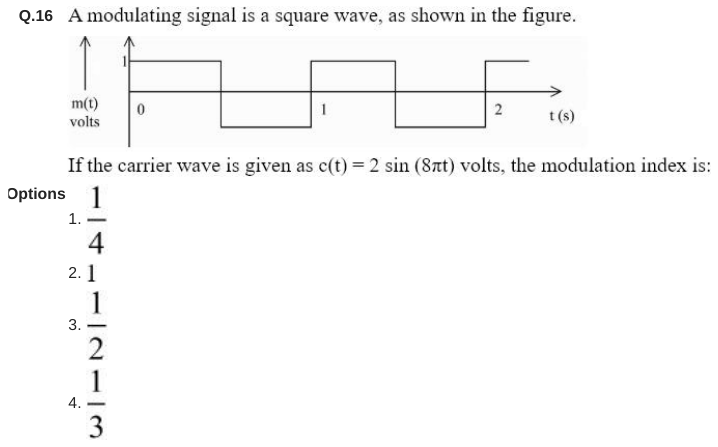
Physics · 4 marks · −1A modulating signal is a square wave, as shown in the figure. If the carrier wave is given as volts, the modulation index is:
- A.
- B.1
- C.
- D.
Correct answer: C
Explanation: .
Question 11
Physics · 4 marks · −1Given below are two statements: one is labelled as Assertion A and the other is labelled as Reason R. Assertion A: Photodiodes are preferably operated in reverse bias condition for light intensity measurement. Reason R: The current in the forward bias is more than the current in the reverse bias for a junction diode. In the light of the above statements, choose the correct answer from the options given below:
- A.Both A and R are true and R is the correct explanation of A
- B.Both A and R are true but R is NOT the correct explanation of A
- C.A is true but R is false
- D.A is false but R is true
Correct answer: B
Question 12
Physics · 4 marks · −1Consider the following radioactive decay process . The mass number and the atomic number of are given by:
- A.210 and 82
- B.210 and 80
- C.210 and 84
- D.211 and 80
Correct answer: B
Explanation: Mass: . Charge: .
Question 13
Physics · 4 marks · −1From the photoelectric effect experiment, following observations are made. Identify which of these are correct. A. The stopping potential depends only on the work function of the metal. B. The saturation current increases as the intensity of incident light increases. C. The maximum kinetic energy of a photo electron depends on the intensity of the incident light. D. Photoelectric effect can be explained using wave theory of light. Choose the correct answer from the options given below:
- A.B only
- B.A, B, D only
- C.B, C only
- D.A, C, D only
Correct answer: A
Explanation: Stopping potential depends on frequency too; KE_max is independent of intensity; wave theory fails. Only B is correct.
Question 14
Physics · 4 marks · −1Given below are two statements: Statement I: If the Brewster's angle for the light propagating from air to glass is , then Brewster's angle for the light propagating from glass to air is . Statement II: The Brewster's angle for the light propagating from glass to air is where is the refractive index of glass. In the light of the above statements, choose the correct answer from the options given below:
- A.Both Statement I and Statement II are true
- B.Both Statement I and Statement II are false
- C.Statement I is true but Statement II is false
- D.Statement I is false but Statement II is true
Correct answer: C
Explanation: Glass to air: , so (I true); II gives the air-to-glass angle (false).
Question 15
Physics · 4 marks · −1If and represent electric field and propagation vectors of the EM waves in vacuum, then magnetic field vector is given by: ( - angular frequency):
- A.
- B.
- C.
- D.
Correct answer: D
Explanation: From Faraday\'s law for a plane wave, .
Question 16
Physics · 4 marks · −1A conducting circular loop of radius cm is placed perpendicular to a uniform magnetic field of 0.5 T. The magnetic field is decreased to zero in 0.5 s at a steady rate. The induced emf in the circular loop at 0.25 s is:
- A.emf = 100 mV
- B.emf = 1 mV
- C.emf = 10 mV
- D.emf = 5 mV
Correct answer: C
Explanation: cm m, T/s: emf mV (constant).
Question 17
Physics · 4 marks · −1Two long straight wires P and Q carrying equal current 10A each were kept parallel to each other at 5 cm distance. Magnitude of magnetic force experienced by 10 cm length of wire P is . If distance between wires is halved and currents on them are doubled, force on 10 cm length of wire P will be:
- A.
- B.
- C.
- D.
Correct answer: A
Explanation: : .
Question 18
Physics · 4 marks · −1A circular loop of radius is carrying current I A. The ratio of magnetic field at the center of circular loop and at a distance r from the center of the loop on its axis is:
- A.
- B.
- C.
- D.
Correct answer: B
Explanation: , so the ratio is .
Question 19
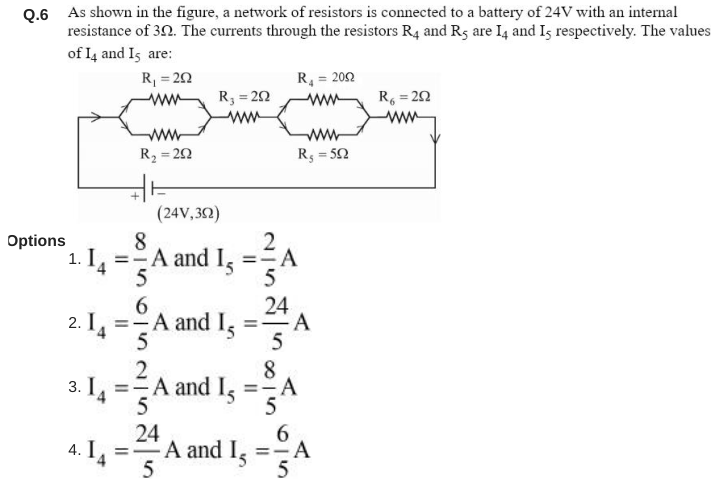
Physics · 4 marks · −1As shown in the figure, a network of resistors is connected to a battery of 24V with an internal resistance of 3. The currents through the resistors and are and respectively. The values of and are:
- A. A and A
- B. A and A
- C. A and A
- D. A and A
Correct answer: A
Explanation: External , total 12 , A. Voltage across is 8 V: A, A.
Question 20
Physics · 4 marks · −1If two charges and are separated with distance 'd' and placed in a medium of dielectric constant K. What will be the equivalent distance between charges in air for the same electrostatic force?
- A.
- B.
- C.
- D.
Correct answer: A
Explanation: .
Question 21
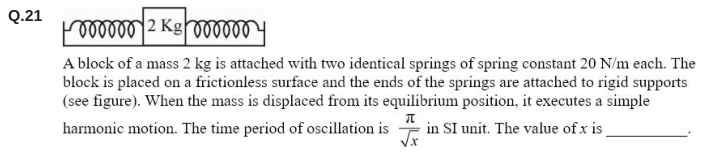
Physics · 4 marks · −1A block of a mass 2 kg is attached with two identical springs of spring constant 20 N/m each. The block is placed on a frictionless surface and the ends of the springs are attached to rigid supports (see figure). When the mass is displaced from its equilibrium position, it executes a simple harmonic motion. The time period of oscillation is in SI unit. The value of is ________.
Correct answer: 5
Explanation: N/m, , so .
Question 22
Physics · 4 marks · −1Vectors and are perpendicular to each other when , the ratio of to is . The value of is ________.
Correct answer: 1
Explanation: and give ; .
Question 23
Physics · 4 marks · −1A spherical body of mass 2 kg starting from rest acquires a kinetic energy of 10000 J at the end of 5 second. The force acted on the body is ________ N.
Correct answer: 40
Explanation: m/s after 5 s, m/s, N.
Question 24
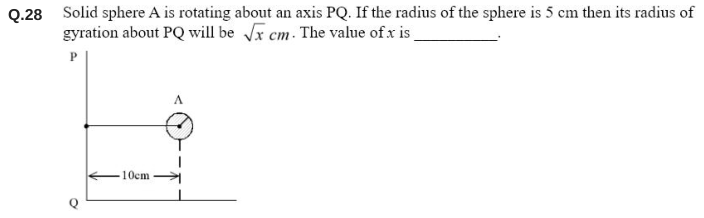
Physics · 4 marks · −1Solid sphere A is rotating about an axis PQ. If the radius of the sphere is 5 cm then its radius of gyration about PQ will be cm. The value of is ________.
Correct answer: 110
Explanation: .
Question 25
Physics · 4 marks · −1A hole is drilled in a metal sheet. At C, the diameter of hole is 5 cm. When the sheet is heated to C, the change in the diameter of hole is cm. The value of d will be ________ if coefficient of linear expansion of the metal is C.
Correct answer: 12
Explanation: cm.
Question 26
Physics · 4 marks · −1Assume that protons and neutrons have equal masses. Mass of a nucleon is kg and radius of nucleus is m. The approximate ratio of the nuclear density and water density is . The value of is ________.
Correct answer: 11
Explanation: kg m; ratio .
Question 27
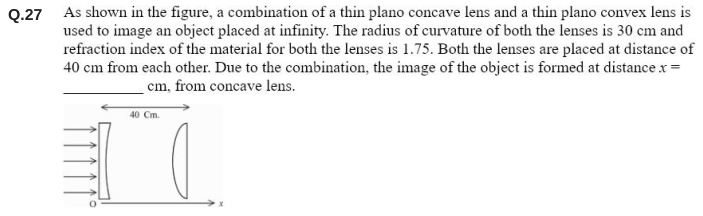
Physics · 4 marks · −1As shown in the figure, a combination of a thin plano concave lens and a thin plano convex lens is used to image an object placed at infinity. The radius of curvature of both the lenses is 30 cm and refraction index of the material for both the lenses is 1.75. Both the lenses are placed at distance of 40 cm from each other. Due to the combination, the image of the object is formed at distance = ________ cm, from concave lens.
Correct answer: 120
Explanation: cm. Concave lens forms a virtual image 40 cm to its left, i.e. 80 cm from the convex lens; cm, i.e. cm from the concave lens.
Question 28
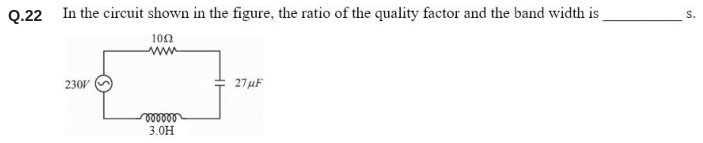
Physics · 4 marks · −1In the circuit shown in the figure, the ratio of the quality factor and the band width is ________ s.
Correct answer: 10
Explanation: , bandwidth ; s.
Question 29
Physics · 4 marks · −1A hollow cylindrical conductor has length of 3.14 m, while its inner and outer diameters are 4 mm and 8 mm respectively. The resistance of the conductor is . If the resistivity of the material is m. The value of is ________.
Correct answer: 2
Explanation: m; .
Question 30
Physics · 4 marks · −1A stream of a positively charged particles having and velocity m/s is deflected by an electric field kV/m. The electric field exists in a region of 10 cm along direction. Due to the electric field, the deflection of the charge particles in the direction is ________ mm.
Correct answer: 2
Explanation: m.
Question 31
Chemistry · 4 marks · −1Order of Covalent bond; A. KF > KI; LiF > KF. B. KF < KI; LiF > KF. C. SnCl > SnCl; CuCl > NaCl. D. LiF > KF; CuCl < NaCl. E. KF < KI; CuCl > NaCl. Choose the correct answer from the options given below:
- A.A, B only
- B.B, C only
- C.C, E only
- D.B, C, E only
Correct answer: D
Question 32
Chemistry · 4 marks · −1In the depression of freezing point experiment A. Vapour pressure of the solution is less than that of pure solvent B. Vapour pressure of the solution is more than that of pure solvent C. Only solute molecules solidify at the freezing point D. Only solvent molecules solidify at the freezing point. Choose the most appropriate answer from the options given below:
- A.A only
- B.A and C only
- C.B and C only
- D.A and D only
Correct answer: D
Question 33
Chemistry · 4 marks · −1Statement I: For colloidal particles, the values of colligative properties are of small order as compared to values shown by true solutions at same concentration. Statement II: For colloidal particles, the potential difference between the fixed layer and the diffused layer of same charges is called the electrokinetic potential or zeta potential. In the light of the above statements, choose the correct answer from the options given below
- A.Both Statement I and Statement II are true
- B.Both Statement I and Statement II are false
- C.Statement I is true but Statement II is false
- D.Statement I is false but Statement II is true
Correct answer: C
Question 34
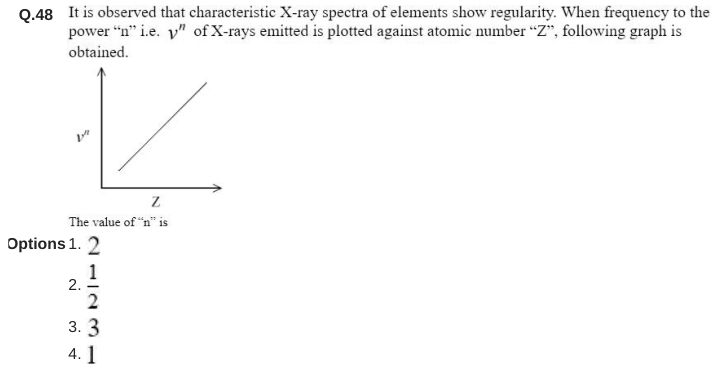
Chemistry · 4 marks · −1It is observed that characteristic X-ray spectra of elements show regularity. When frequency to the power "n" i.e. of X-rays emitted is plotted against atomic number "Z", following graph is obtained. The value of "n" is
- A.1
- B.2
- C.3
- D.
Correct answer: D
Explanation: Moseley: , so .
Question 35
Chemistry · 4 marks · −1Match List I with List II. List I: A. Reverberatory furnace; B. Electrolytic cell; C. Blast furnace; D. Zone Refining furnace. List II: I. Pig Iron; II. Aluminum; III. Silicon; IV. Copper. Choose the correct answer from the options given below:
- A.A-IV, B-II, C-I, D-III
- B.A-I, B-IV, C-II, D-III
- C.A-I, B-III, C-II, D-IV
- D.A-III, B-IV, C-I, D-II
Correct answer: A
Question 36
Chemistry · 4 marks · −1Decreasing order of the hydrogen bonding in following forms of water is correctly represented by A. Liquid water B. Ice C. Impure water. Choose the correct answer from the options given below:
- A.A > B > C
- B.B > A > C
- C.C > B > A
- D.A = B > C
Correct answer: B
Question 37
Chemistry · 4 marks · −1Reaction of BeO with ammonia and hydrogen fluoride gives A which on thermal decomposition gives BeF and NHF. What is 'A'?
- A.(NH)BeF
- B.(NH)BeF
- C.HNBeF
- D.(NH)BeF
Correct answer: B
Question 38
Chemistry · 4 marks · −1Match List I with List II. List I: A. Chlorophyll; B. Soda ash; C. Dentistry, Ornamental work; D. Used in white washing. List II: I. NaCO; II. CaSO; III. Mg; IV. Ca(OH). Choose the correct answer from the options given below:
- A.A-II, B-I, C-III, D-IV
- B.A-II, B-III, C-IV, D-I
- C.A-III, B-IV, C-I, D-II
- D.A-III, B-I, C-II, D-IV
Correct answer: D
Question 39
Chemistry · 4 marks · −1Which of the Phosphorus oxoacid can create silver mirror from AgNO solution?
- A.HPO
- B.(HPO)
- C.HPO
- D.HPO
Correct answer: A
Explanation: Only pyrophosphorous acid HPO has P–H bonds (reducing).
Question 40
Chemistry · 4 marks · −1The magnetic moment of a transition metal compound has been calculated to be 3.87 B.M. The metal ion is
- A.Ti
- B.V
- C.Cr
- D.Mn
Correct answer: B
Explanation: 3.87 BM : 3 unpaired electrons, V (d).
Question 41
Chemistry · 4 marks · −1Which of the following is true about freons?
- A.These are chlorofluorocarbon compounds
- B.These are radicals of chlorine and chlorine monoxide
- C.These are chemicals causing skin cancer
- D.All radicals are called freons
Correct answer: A
Question 42
Chemistry · 4 marks · −1The primary and secondary valencies of cobalt respectively in are:
- A.2 and 6
- B.3 and 5
- C.2 and 8
- D.3 and 6
Correct answer: D
Question 43
Chemistry · 4 marks · −1Increasing order of stability of the resonance structures is: A. ; B. ; C. (oxygen drawn with a single bond and a positive charge); D. . Choose the correct answer from the options given below:
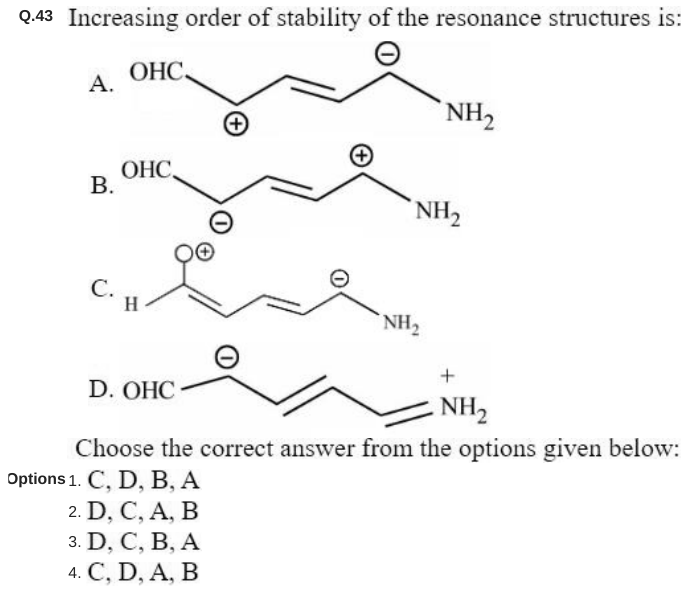
- A.D, C, B, A
- B.C, D, B, A
- C.C, D, A, B
- D.D, C, A, B
Correct answer: C
Question 44
Chemistry · 4 marks · −1In the following given reaction, 'A' is: (cyclobutyl)C(CH)=CH + HBr 'A' (major product)
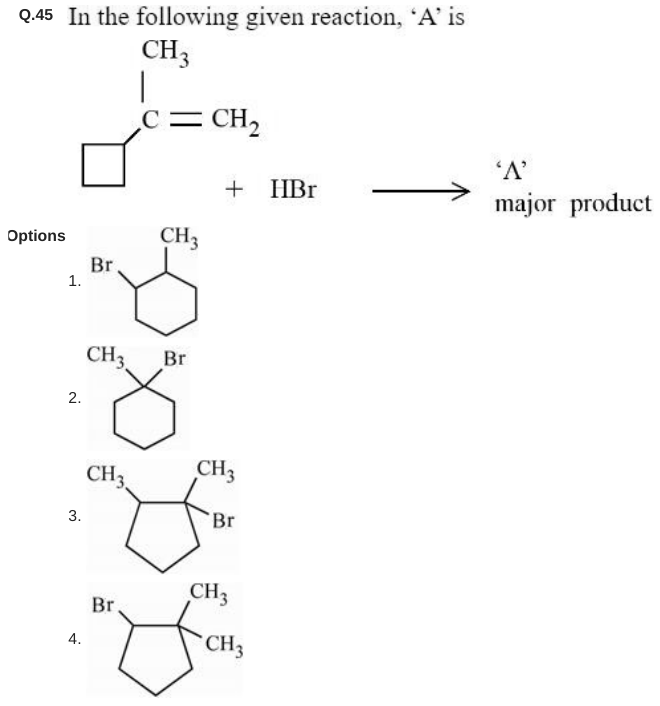
- A.2-bromo-1-methylcyclohexane with CH3 and Br on adjacent ring carbons (six-membered ring)
- B.1-bromo-1-methylcyclohexane
- C.2-bromo-1,1-dimethylcyclopentane
- D.1-bromo-1,2-dimethylcyclopentane
Correct answer: D
Explanation: Markovnikov protonation gives a tertiary cation next to the strained ring; ring expansion to a cyclopentyl cation followed by a methyl shift gives the tertiary cation, trapped as 1-bromo-1,2-dimethylcyclopentane.
Question 45
Chemistry · 4 marks · −1Assertion A: Hydrolysis of an alkyl chloride is a slow reaction but in the presence of NaI, the rate of the hydrolysis increases. Reason R: I is a good nucleophile as well as a good leaving group. In the light of the above statements, choose the correct answer from the options given below
- A.Both A and R are true and R is the correct explanation of A
- B.Both A and R are true but R is NOT the correct explanation of A
- C.A is true but R is false
- D.A is false but R is true
Correct answer: A
Question 46
Chemistry · 4 marks · −1'A' and 'B' formed in the following set of reactions are: 3-(hydroxymethyl)phenol A; 3-methoxyphenol B
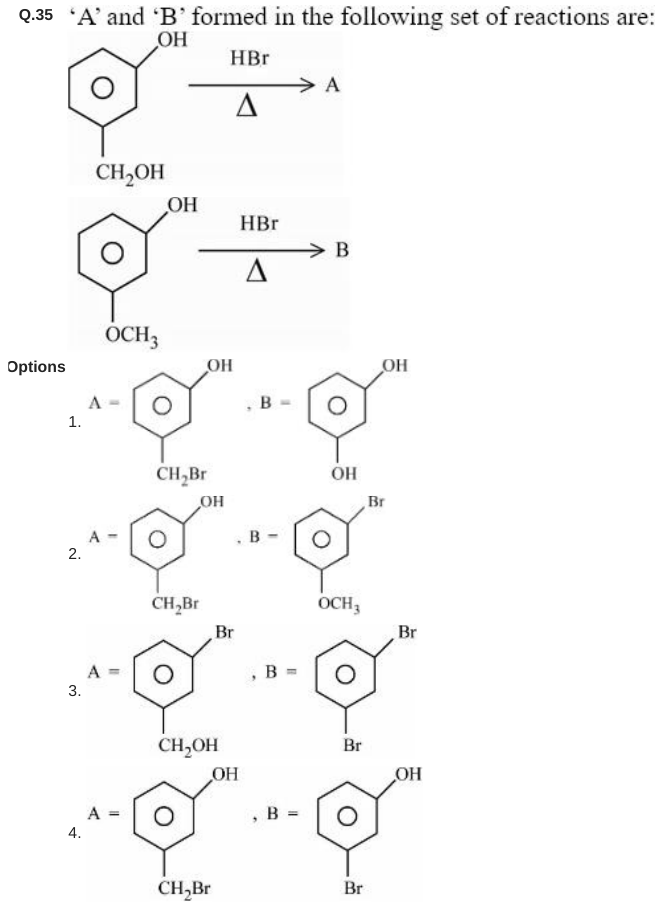
- A.A = 3-(bromomethyl)phenol, B = benzene-1,3-diol (resorcinol)
- B.A = 3-(bromomethyl)phenol, B = 3-bromophenol
- C.A = 3-bromobenzyl alcohol (Br replaces OH on ring), B = 1,3-dibromobenzene
- D.A = 3-(bromomethyl)phenol, B = 2-bromo-5-methoxyphenol-type (Br on ring, OCH3 retained)
Correct answer: A
Explanation: HBr substitutes the benzylic OH (A = 3-(bromomethyl)phenol) and cleaves the aryl methyl ether to the phenol (B = resorcinol); phenolic C-OH is not replaced.
Question 47
Chemistry · 4 marks · −1Compound (X) undergoes following sequence of reactions to give the Lactone (Y): Compound (X) Lactone (Y) [a five-membered lactone (γ-butyrolactone ring) with OH on the carbon alpha to C=O and two CH groups on the next (β) carbon, i.e. pantolactone]. Compound (X) is
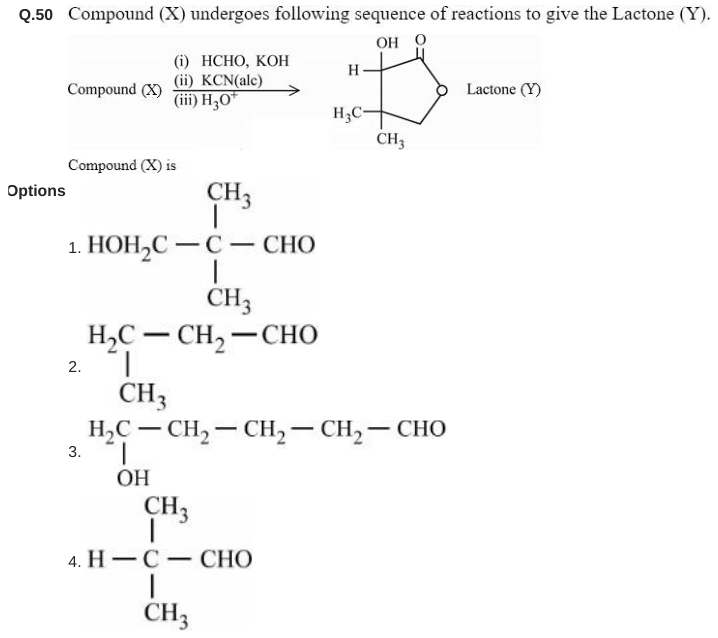
- A.
- B. (drawn as HC(OH)–CH–CH–CH–CHO)
- C.
- D. (drawn as HC(CH)–CH–CHO)
Correct answer: C
Explanation: Isobutyraldehyde undergoes crossed aldol with HCHO to HOCH2C(CH3)2CHO; cyanohydrin formation and acid hydrolysis give the hydroxy acid that lactonises to pantolactone.
Question 48
Chemistry · 4 marks · −1'R' formed in the following sequence of reactions is: 4-chloroacetophenone 'P' 'Q' 'R' (major product)
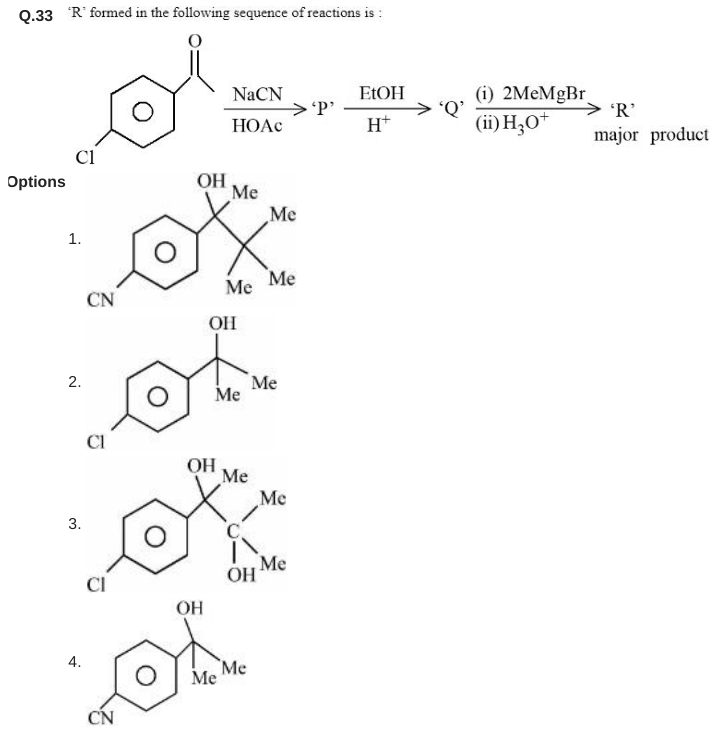
- A.2-(4-chlorophenyl)-3-methylbutane-2,3-diol: p-Cl-C6H4-C(OH)(Me)-C(OH)Me2
- B.2-(4-cyanophenyl)propan-2-ol: p-NC-C6H4-C(OH)Me2
- C.2-(4-chlorophenyl)propan-2-ol: p-Cl-C6H4-C(OH)Me2
- D.2-(4-cyanophenyl)-3,3-dimethylbutan-2-ol: p-NC-C6H4-C(OH)(CH3)-C(CH3)3
Correct answer: A
Explanation: Cyanohydrin, then the nitrile is converted to the ethyl ester; two MeMgBr convert the ester into a tertiary alcohol, giving the vicinal diol ArC(OH)(Me)C(OH)Me2.
Question 49
Chemistry · 4 marks · −1An ammoniacal metal salt solution gives a brilliant red precipitate on addition of dimethylglyoxime. The metal ion is:
- A.Fe
- B.Co
- C.Ni
- D.Cu
Correct answer: C
Question 50
Chemistry · 4 marks · −1Given below are two statements: Statement I: Noradrenaline is a neurotransmitter. Statement II: Low level of noradrenaline is not the cause of depression in human. In the light of the above statements, choose the correct answer from the options given below
- A.Both Statement I and Statement II are correct
- B.Both Statement I and Statement II are incorrect
- C.Statement I is correct but Statement II is incorrect
- D.Statement I is incorrect but Statement II is correct
Correct answer: C
Question 51
Chemistry · 4 marks · −15 g of NaOH was dissolved in deionized water to prepare a 450 mL stock solution. What volume (in mL) of this solution would be required to prepare 500 mL of 0.1 M solution? ________ Given: Molar Mass of Na, O and H is 23, 16 and 1 g mol respectively
Correct answer: 180
Explanation: Stock M; need 0.05 mol: mL.
Question 52
Chemistry · 4 marks · −1When FeO is heated in presence of oxygen, it converts to FeO. The number of correct statement/s from the following is ________ A. The equivalent weight of FeO is B. The number of moles of Fe and Fe in 1 mole of FeO is 0.79 and 0.14 respectively C. FeO is metal deficient with lattice comprising of cubic closed packed arrangement of O ions D. The % composition of Fe and Fe in FeO is 85% and 15% respectively
Correct answer: 4
Question 53
Chemistry · 4 marks · −1If wavelength of the first line of the Paschen series of hydrogen atom is 720 nm, then the wavelength of the second line of this series is ________ nm. (Nearest integer)
Correct answer: 492
Explanation: nm.
Question 54
Chemistry · 4 marks · −1For independent processes at 300 K: Process A: kJ mol, J K; B: , ; C: , ; D: , . The number of non-spontaneous processes from the following is ________
Correct answer: 2
Explanation: (kJ): A , B , C , D : two non-spontaneous.
Question 55
Chemistry · 4 marks · −1The dissociation constant of acetic acid is . When 25 mL of 0.2 M CHCOONa solution is mixed with 25 mL of 0.02 M CHCOOH solution, the pH of the resultant solution is found to be equal to 5. The value of is ________
Correct answer: 10
Explanation: , .
Question 56
Chemistry · 4 marks · −1At 298 K, a 1 litre solution containing 10 mmol of CrO and 100 mmol of Cr shows a pH of 3.0. Given: CrO Cr; = 1.330V and = 0.059 V. The potential for the half cell reaction is V. The value of is ________
Correct answer: 917
Explanation: V, so .
Question 57
Chemistry · 4 marks · −1The number of correct statement/s from the following is ________ A. Larger the activation energy, smaller is the value of the rate constant. B. The higher is the activation energy, higher is the value of the temperature coefficient. C. At lower temperatures, increase in temperature causes more change in the value of k than at higher temperature D. A plot of ln k vs is a straight line with slope equal to
Correct answer: 3
Question 58
Chemistry · 4 marks · −1The d-electronic configuration of in tetrahedral crystal field is . Sum of "m" and "number of unpaired electrons" is ________
Correct answer: 7
Explanation: Co d: , 3 unpaired; .
Question 59
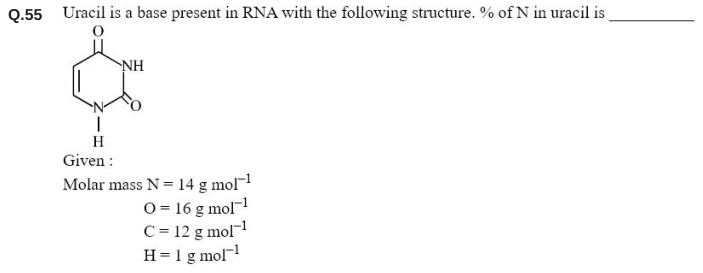
Chemistry · 4 marks · −1Uracil is a base present in RNA with the following structure. % of N in uracil is ________ Given: Molar mass N = 14 g mol, O = 16 g mol, C = 12 g mol, H = 1 g mol
Correct answer: 25
Explanation: CHNO, M = 112: %N .
Question 60
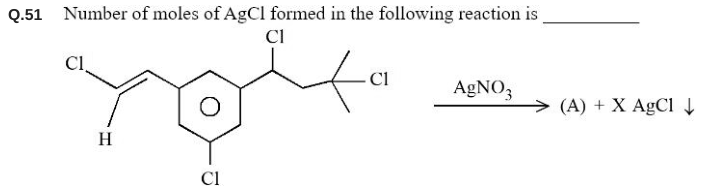
Chemistry · 4 marks · −1Number of moles of AgCl formed in the following reaction is ________. [Substrate: a benzene ring bearing (i) a vinylic chloride side chain –CH=CH–Cl, (ii) an aryl Cl, and (iii) a side chain –CH(Cl)–CH–C(CH)–Cl (one benzylic secondary Cl and one tertiary Cl)] (A) + X AgCl
Correct answer: 2
Explanation: Only the benzylic and tertiary chlorides ionise; vinylic and aryl chlorides do not: 2 mol AgCl.
Question 61
Mathematics · 4 marks · −1The equation , where denotes the greatest integer function, has:
- A.exactly two solutions in
- B.a unique solution in
- C.a unique solution in
- D.no solution
Correct answer: B
Explanation: : , or (impossible). Unique solution .
Question 62
Mathematics · 4 marks · −1The relation is:
- A.reflexive but not symmetric
- B.symmetric but not transitive
- C.transitive but not reflexive
- D.neither symmetric nor transitive
Correct answer: D
Explanation: but (since ); ... transitivity also fails, e.g. but .
Question 63
Mathematics · 4 marks · −1Let and , . Then and are roots of the equation.
- A.
- B.
- C.
- D.
Correct answer: D
Explanation: : . Roots : .
Question 64
Mathematics · 4 marks · −1Let N denote the number that turns up when a fair die is rolled. If the probability that the system of equations , , has unique solution is , then the sum of value of k and all possible values of N is
- A.21
- B.18
- C.19
- D.20
Correct answer: D
Explanation: for : , sum .
Question 65
Mathematics · 4 marks · −1If A and B are two non-zero matrices such that , then
- A.
- B. or
- C.
- D.
Correct answer: C
Explanation: implies , i.e. .
Question 66
Mathematics · 4 marks · −1Let be a root of the equation where a, b, c are distinct real numbers such that the matrix is singular. Then, the value of is
- A.3
- B.6
- C.9
- D.12
Correct answer: A
Explanation: With , , so the expression .
Question 67
Mathematics · 4 marks · −1is equal to:
- A.
- B.
- C.
- D.
Correct answer: B
Explanation: .
Question 68
Mathematics · 4 marks · −1Let be the solution of the differential equation , , . Then is equal to
- A.
- B.e
- C.3
- D.1
Correct answer: D
Explanation: Linear with IF : ; ; .
Question 69
Mathematics · 4 marks · −1The value of is
- A.
- B.
- C.
- D.
Correct answer: C
Explanation: (Vandermonde).
Question 70
Mathematics · 4 marks · −1Let a tangent to the curve meet the curve at the points A and B. Then the mid points of such line segments AB lie on a parabola with the
- A.directrix
- B.directrix
- C.length of latus rectum
- D.length of latus rectum 2
Correct answer: B
Question 71
Mathematics · 4 marks · −1The distance of the point from the plane passing through the points , and is:
- A.4
- B.5
- C.
- D.
Correct answer: D
Explanation: Plane ; distance .
Question 72
Mathematics · 4 marks · −1For three positive integers p, q, r, and such that 3, , , are in A.P. with common difference . Then is equal to
- A.2
- B.12
- C.−6
- D.6
Correct answer: A
Question 73
Mathematics · 4 marks · −1Let . Then at
- A. is continuous but not differentiable
- B. is continuous but not differentiable
- C. and both are continuous
- D. is continuous but is not continuous
Correct answer: D
Explanation: but has no limit at 0.
Question 74
Mathematics · 4 marks · −1is equal to
- A.
- B.
- C.
- D.n
Correct answer: D
Explanation: Factor : the bracket tends to 1, limit .
Question 75
Mathematics · 4 marks · −1The area enclosed by the curves and is:
- A.
- B.
- C.9
- D.
Correct answer: C
Explanation: Intersections at ; area .
Question 76
Mathematics · 4 marks · −1The distance of the point from the plane measured parallel to the line is
- A.
- B.
- C.26
- D.31
Correct answer: C
Explanation: Point on plane: ; distance .
Question 77
Mathematics · 4 marks · −1Let , , and . Then is equal to
- A.
- B.1
- C.
- D.2
Correct answer: B
Explanation: Dotting with : , so ; with this gives and .
Question 78
Mathematics · 4 marks · −1Let PQR be a triangle. The points A, B and C are on the sides QR, RP and PQ respectively such that . Then is equal to
- A.2
- B.
- C.3
- D.4
Correct answer: C
Question 79
Mathematics · 4 marks · −1Let be the sample space and be an event. Given below are two statements: (S1): If , then (S2): If , then . Then
- A.both (S1) and (S2) are true
- B.both (S1) and (S2) are false
- C.only (S1) is true
- D.only (S2) is true
Correct answer: B
Question 80
Mathematics · 4 marks · −1The compound statement is equivalent to
- A.
- B.
- C.
- D.
Correct answer: D
Question 81
Mathematics · 4 marks · −1Let a tangent to the curve intersect the coordinate axes at the points A and B. Then, the minimum length of the line segment AB is ________
Correct answer: 7
Explanation: For , min intercept .
Question 82
Mathematics · 4 marks · −1The number of 9 digit numbers, that can be formed using all the digits of the number 123412341 so that the even digits occupy only even places, is ________
Correct answer: 60
Explanation: Even digits 2,2,4,4 in 4 even places: ; odd digits 1,1,1,3,3 in 5 odd places: ; total 60.
Question 83
Mathematics · 4 marks · −1The 4 term of GP is 500 and its common ratio is , . Let denote the sum of the first n terms of this GP. If and , then the number of possible values of m is ________
Correct answer: 12
Explanation: ; : 12 values.
Question 84
Mathematics · 4 marks · −1Suppose . Then the value of is ________
Correct answer: 1012
Explanation: .
Question 85
Mathematics · 4 marks · −1A boy needs to select five courses from 12 available courses, out of which 5 courses are language courses. If he can choose at most two language courses, then the number of ways he can choose five courses is ________
Correct answer: 546
Explanation: .
Question 86
Mathematics · 4 marks · −1Let and let the equation E be . Then the largest element in the set is an integer solution of E is ________
Correct answer: 5
Explanation: ; integer needs : or . Max .
Question 87
Mathematics · 4 marks · −1The value of is ________
Correct answer: 22
Explanation: ; times 12 .
Question 88
Mathematics · 4 marks · −1The value of is ________
Correct answer: 2
Explanation: The integral is (King property), so the value is 2.
Question 89
Mathematics · 4 marks · −1Let C be the largest circle centred at and inscribed in the ellipse . If lies on C, then is equal to ________
Correct answer: 118
Explanation: Min of is 12.8 at ; .
Question 90
Mathematics · 4 marks · −1The shortest distance between the lines and is equal to ________
Correct answer: 14
Explanation: , ; ; distance 14.