JEE Main 2024 — 1 Feb Shift 2 (Previous Year Paper)
JEE Main · 2024 · with answers and explanations
- questions
- 88
- Total marks
- 292
- Duration
- 180 minutes
- Negative marking
- −1
Subjects: Mathematics · Physics · Chemistry
Question 1
Mathematics · 4 marks · −1Let α and β be the roots of the equation , where . If p, q and r be the consecutive terms of a non constant G.P. and , then the value of is:
- A.
- B.
- C.9
- D.8
Correct answer: A
Explanation: with gives , ; .
Question 2
Mathematics · 4 marks · −1If the mirror image of the point P(3, 4, 9) in the line is , then is:
- A.138
- B.132
- C.102
- D.108
Correct answer: D
Explanation: Foot at ; image sum .
Question 3
Mathematics · 4 marks · −1Let Ajay will not appear in JEE exam with probability , while both Ajay and Vijay will appear in the exam with probability . Then the probability, that Ajay will appear in the exam and Vijay will not appear is:
- A.
- B.
- C.
- D.
Correct answer: A
Explanation: .
Question 4
Mathematics · 4 marks · −1The number of solutions of the equation ; is:
- A.0
- B.1
- C.3
- D.2
Correct answer: A
Explanation: With : has its only real root above 1.
Question 5
Mathematics · 4 marks · −1Let P and Q be the points on the line which are at a distance of 6 units from the point R (1, 2, 3). If the centroid of the tringle PQR is , then is:
- A.24
- B.36
- C.26
- D.18
Correct answer: C
Explanation: The foot of the perpendicular from R is the midpoint M of PQ: ; centroid .
Question 6
Mathematics · 4 marks · −1Consider 10 observations such that and , where α, β are positive integers. Let the mean and the variance of the observations be and respectively. Then is equal to:
- A.
- B.2
- C.
- D.1
Correct answer: B
Explanation: ; , .
Question 7
Mathematics · 4 marks · −1Consider the relations and defined as for all and for all . Then:
- A.Neither nor is an equivalence relation
- B.Only is an equivalence relation
- C.Only is an equivalence relation
- D. and both are equivalence relations
Correct answer: B
Question 8
Mathematics · 4 marks · −1Let m and n be the coefficients of seventh and thirteenth terms respectively in the expansion of . Then is:
- A.
- B.
- C.
- D.
Correct answer: A
Explanation: , ; , cube root .
Question 9
Mathematics · 4 marks · −1Let the system of equations , , have infinite number of solutions. Then is equal to:
- A.28
- B.17
- C.22
- D.15
Correct answer: B
Explanation: ; consistency gives .
Question 10
Mathematics · 4 marks · −1The value of is equal to:
- A.−1
- B.2
- C.0
- D.1
Correct answer: C
Explanation: The cubic is odd about .
Question 11
Mathematics · 4 marks · −1Let the locus of the midpoints of the chords of the circle drawn from the origin intersect the line at P and Q. Then, the length of PQ is:
- A.1
- B.
- C.
- D.
Correct answer: B
Explanation: Locus (centre , radius ); distance of centre from the line ; chord .
Question 12
Mathematics · 4 marks · −1Let . If for some , , then , where [t] denotes the greatest integer less than or equal to t, is equal to:
- A.225
- B.121
- C.169
- D.144
Correct answer: D
Explanation: (); limit .
Question 13
Mathematics · 4 marks · −1Let , . If m and n denote the number of points where f is not continuous and not differentiable respectively, then m + n is equal to:
- A.5
- B.2
- C.0
- D.3
Correct answer: D
Explanation: Continuous everywhere; non-differentiable at .
Question 14
Mathematics · 4 marks · −1If the domain of the function is , then is equal to:
- A.150
- B.175
- C.125
- D.140
Correct answer: A
Explanation: Domain : .
Question 15
Mathematics · 4 marks · −1If , where a and b are rational numbers, then 9a + 8b is equal to:
- A.2
- B.1
- C.
- D.3
Correct answer: A
Explanation: ; , so , , .
Question 16
Mathematics · 4 marks · −1Let denote the sum of the first n terms of an arithmetic progression. If and the ratio of the tenth and the fifth terms is 15 : 7, then is equal to:
- A.790
- B.690
- C.800
- D.890
Correct answer: A
Explanation: , ; .
Question 17
Mathematics · 4 marks · −1Let P be a point on the ellipse . Let the line passing through P and parallel to y-axis meet the circle at point Q such that P and Q are on the same side of the x-axis. Then, the eccentricity of the locus of the point R on PQ such that PR : RQ = 4 : 3 as P moves on the ellipse, is:
- A.
- B.
- C.
- D.
Correct answer: C
Explanation: : ellipse with , .
Question 18
Mathematics · 4 marks · −1Consider a ΔABC where A(1, 3, 2), B(–2, 8, 0) and C(3, 6, 7). If the angle bisector of ∠BAC meets the line BC at D, then the length of the project of the vector on the vector is:
- A.
- B.
- C.
- D.
Correct answer: D
Explanation: , = midpoint ; .
Question 19
Mathematics · 4 marks · −1The lines are distinct. For n = 1, 2, 3, ...., 10 all the lines are parallel to each other and all the lines pass through a given P. The maximum number of points of intersection of pairs of lines form the set is equal to ______.
Correct answer: 101
Explanation: .
Question 20
Mathematics · 4 marks · −1Let , and be three vectors such that . If the angle between vector and the vector is θ, then the greatest integer less than or equal to is ______.
Correct answer: 38
Explanation: ; ; .
Question 21
Mathematics · 4 marks · −1If , , then is equal to ______.
Correct answer: 5
Explanation: : ; .
Question 22
Mathematics · 4 marks · −1Let and . If , then is equal to ______.
Correct answer: 219
Explanation: ; sum .
Question 23
Mathematics · 4 marks · −1Three points O(0, 0), P(a, a²), Q(–b, b²), a > 0, b > 0, are on the parabola . Let be the area of the region bounded by the line PQ and the parabola, and be the area of the triangle OPQ. If the minimum value of is , gcd(m, n) = 1, then m + n is equal to ______.
Correct answer: 7
Explanation: , ; ratio .
Question 24
Mathematics · 4 marks · −1Let where M is a real matrix of order 2 × 1 such that the relation holds. If λ is a real number such that the relation holds for some non-zero real matrix X of order 2 × 1, then the sum of squares of all possible values of λ is equal to ______.
Correct answer: 2
Explanation: is a reflection: eigenvalues .
Question 25
Mathematics · 4 marks · −1The sum of squares of all possible values of k, for which area of the region bounded by the parabolas and is maximum, is equal to ______.
Correct answer: 8
Question 26
Mathematics · 4 marks · −1If three successive terms of G.P. with common ration r (r > 1) are the lengths of the sides of a triangle and [r] denotes the greatest integer less than or equal to r, then 3[r] + [–r] is equal to ______.
Correct answer: 1
Explanation: : .
Question 27
Mathematics · 4 marks · −1If , then is equal to ______.
Correct answer: 105
Explanation: , ; .
Question 28
Mathematics · 4 marks · −1Let ABC be an isosceles triangle in which A is at (–1, 0), , AB = AC and B is on the positive x-axis. If and the line BC intersects the line at then is ______.
Correct answer: 36
Question 29
Physics · 4 marks · −1Conductivity of a photodiode starts changing only if the wavelength of incident light is less than 660 nm. The band gap of photodiode is found to be eV. The value of X is: (Given, h = J s, e = C)
- A.11
- B.13
- C.21
- D.15
Correct answer: D
Explanation: eV .
Question 30
Physics · 4 marks · −1A diatomic gas (γ = 1.4) does 200 J of work when it is expanded isobarically. The heat given to the gas in the process is:
- A.700 J
- B.600 J
- C.800 J
- D.850 J
Correct answer: A
Explanation: .
Question 31
Physics · 4 marks · −1In an ammeter, 5% of the main current passes through the galvanometer. If resistance of the galvanometer is G, the resistance of ammeter will be:
- A.
- B.
- C.
- D.
Correct answer: A
Explanation: Shunt ; .
Question 32
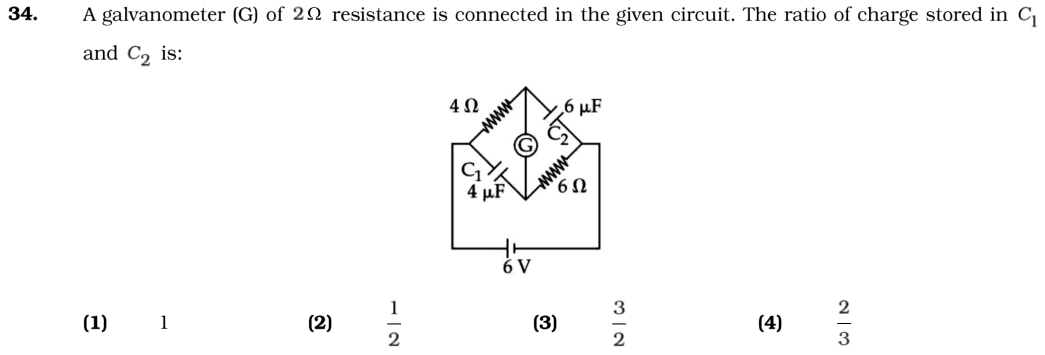
Physics · 4 marks · −1A galvanometer (G) of 2Ω resistance is connected in the given circuit. The ratio of charge stored in and is:
- A.1
- B.
- C.
- D.
Correct answer: B
Explanation: Steady current flows 4 Ω → G → 6 Ω: A. = drop across 4 Ω + G = 3 V, = drop across G + 6 Ω = 4 V; .
Question 33
Physics · 4 marks · −1From the statements given below: (A) The angular momentum of an electron in orbit is an integral multiple of ħ. (B) Nuclear forces do not obey inverse square law. (C) Nuclear forces are spin dependent. (D) Nuclear forces are central and charge independent. (E) Stability of nucleus is inversely proportional to the value of packing fraction. Choose the correct answer from the options given below:
- A.(A), (C), (D), (E) only
- B.(A), (B), (C), (E) only
- C.(A), (B), (C), (D) only
- D.(B), (C), (D), (E) only
Correct answer: B
Explanation: Nuclear forces are non-central.
Question 34
Physics · 4 marks · −1A body of mass 4 kg experiences two forces and . The acceleration acting on the body is:
- A.
- B.
- C.
- D.
Correct answer: B
Question 35
Physics · 4 marks · −1A disc of radius R and mass M is rolling horizontally without slipping with speed v. It then moves up an inclined smooth surface as shown in figure. The maximum height that the disc can go up the incline is:

- A.
- B.
- C.
- D.
Correct answer: C
Explanation: On a smooth incline the spin is unchanged; only translational KE converts: .
Question 36
Physics · 4 marks · −1In a metre-bridge when a resistance in the left gap is 2Ω and unknown resistance in the right gap, the balance length is found to be 40 cm. On shunting the unknown resistance with 2Ω, the balance length changes by:
- A.22.5 cm
- B.62.5 cm
- C.65 cm
- D.20 cm
Correct answer: A
Explanation: ; ; new balance 62.5 cm, change 22.5 cm.
Question 37
Physics · 4 marks · −1A cricket player catches a ball of mass 120 g moving with 25 m/s speed. If the catching process is completed in 0.1 s then the magnitude of force exerted by the ball on the hand of player will be: (in SI unit):
- A.12
- B.30
- C.25
- D.24
Correct answer: B
Question 38
Physics · 4 marks · −1If frequency of electromagnetic wave is 60 MHz and it travels in air along z direction then the corresponding electric and magnetic field vectors will be mutually perpendicular to each other and the wavelength of the wave (in m) is:
- A.10
- B.2.5
- C.5
- D.2
Correct answer: C
Question 39
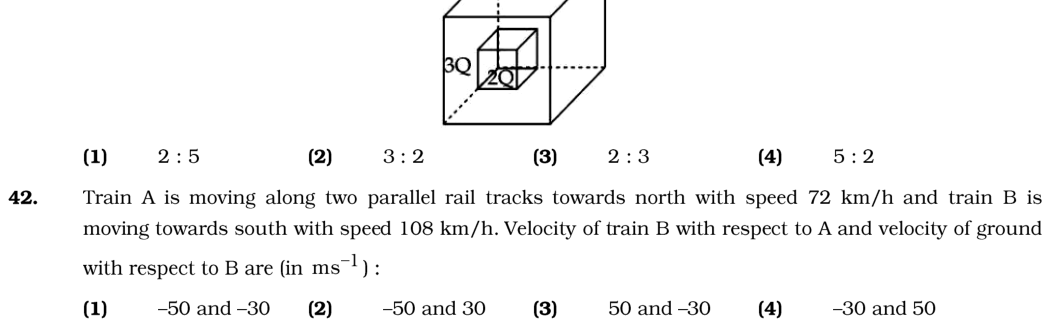
Physics · 4 marks · −1and are two hollow concentric cubes enclosing charges 2Q and 3Q respectively as shown in figure. The ratio of electric flux passing through and is:
- A.2 : 5
- B.3 : 2
- C.2 : 3
- D.5 : 2
Correct answer: A
Explanation: encloses 2Q, encloses 5Q.
Question 40
Physics · 4 marks · −1Train A is moving along two parallel rail tracks towards north with speed 72 km/h and train B is moving towards south with speed 108 km/h. Velocity of train B with respect to A and velocity of ground with respect to B are (in m s):
- A.−50 and −30
- B.−50 and 30
- C.50 and −30
- D.−30 and 50
Correct answer: B
Question 41
Physics · 4 marks · −1A microwave of wavelength 2.0 cm falls normally on a slit of width 4.0 cm. The angular spread of the central maxima of the diffraction pattern obtained on a screen 1.5 m away from the slit, will be:
- A.45°
- B.60°
- C.30°
- D.15°
Correct answer: B
Explanation: ; spread .
Question 42
Physics · 4 marks · −1A light planet is revolving around a massive star in a circular orbit of radius R with a period of revolution T. If the force of attraction between planet and star is proportional to then chose the correct option:
- A.
- B.
- C.
- D.
Correct answer: B
Explanation: .
Question 43
Physics · 4 marks · −1If the root mean square velocity of hydrogen molecule at a given temperature and pressure is 2 km/s, the root mean square velocity of oxygen at the same condition in km/s is:
- A.0.5
- B.1.0
- C.1.5
- D.2.0
Correct answer: A
Question 44
Physics · 4 marks · −1A big drop is formed by coalescing 1000 small droplets of water. The surface energy will become:
- A.100 times
- B.th
- C.10 times
- D.th
Correct answer: D
Question 45
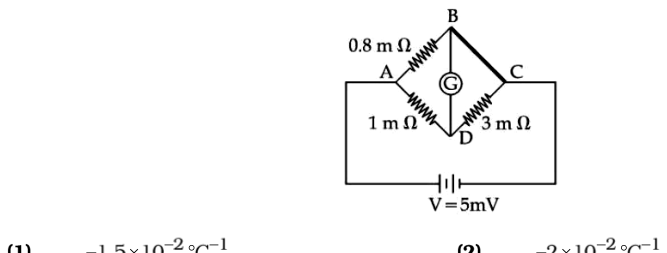
Physics · 4 marks · −1To measure the temperature coefficient of resistivity α of a semiconductor, an electrical arrangement shown in the figure is prepared. The arm BC is made up of the semiconductor. The experiment is being conducted at 25° and resistance of the semiconductor arm is 3 mΩ. Arm BC is cooled at a constant rate of 2°C/s. If the galvanometer G shows no deflection after 10 s. then α is:
- A. °C
- B. °C
- C. °C
- D. °C
Correct answer: C
Explanation: Balance needs mΩ after 10 s (20 °C of cooling): /°C; the keyed option carries the negative sign expected for a semiconductor.
Question 46
Physics · 4 marks · −1Match List-I with List-II. List-I (Number): (A) 1001; (B) 010.1; (C) 100.100; (D) 0.0010010 List-II (Significant figure): (I) 3; (II) 4; (III) 5; (IV) 6 Choose the correct answer from the options given below:
- A.(A)-(IV), (B)-(III), (C)-(I), (D)-(II)
- B.(A)-(III), (B)-(IV), (C)-(II), (D)-(I)
- C.(A)-(II), (B)-(I), (C)-(IV), (D)-(III)
- D.(A)-(I), (B)-(II), (C)-(III), (D)-(IV)
Correct answer: C
Question 47
Physics · 4 marks · −1Monochromatic light of frequency Hz is produced by a laser. The power emitted is W. How many photons per second on an average, are emitted by the source?
- A.
- B.
- C.
- D.
Correct answer: D
Question 48
Physics · 4 marks · −1A transformer has an efficiency of 80% and works at 10 V and 4 kW. If the secondary voltage is 240 V, then the current in the secondary coil is:
- A.1.59 A
- B.13.33 A
- C.1.33 A
- D.15.1 A
Correct answer: B
Explanation: A.
Question 49
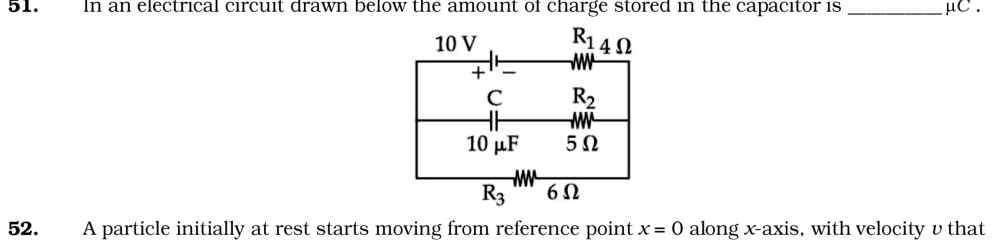
Physics · 4 marks · −1In an electrical circuit drawn below the amount of charge stored in the capacitor is ______ μC.
Correct answer: 60
Explanation: Current A through and ; the capacitor branch sees 6 V: μC.
Question 50
Physics · 4 marks · −1A particle initially at rest starts moving from reference point x = 0 along x-axis, with velocity v that varies as m/s. The acceleration of the particle is ______ m s.
Correct answer: 8
Explanation: .
Question 51
Physics · 4 marks · −1A mass m is suspended from a spring of negligible mass and the system oscillates with a frequency . The frequency of oscillations if a mass 9 m is suspended from the same spring is . The value of is ______.
Correct answer: 3
Question 52
Physics · 4 marks · −1One end of a metal wire is fixed to a ceiling and a load of 2 kg hands from the other end. A similar wire is attached to the bottom of the load and anther load of 1 kg hangs from this lower wire. Then the ratio of longitudinal strain of upper wire to that of the lower wire will be ______. [Area of cross section of wire = 0.005 cm²; Y = N m and g = 10 m s]
Correct answer: 3
Explanation: Tensions 30 N and 10 N.
Question 53
Physics · 4 marks · −1A coil of 200 turns and area 0.20 m² is rotated at half a revolution per second and is placed in uniform magnetic field of 0.01 T perpendicular to axis of rotation of the coil. The maximum voltage generated in the coil is volt. The value of β is ______.
Correct answer: 5
Explanation: .
Question 54
Physics · 4 marks · −1A moving coil galvanometer has 100 turns and each has an area of 2.0 cm². The magnetic field produced by the magnet is 0.01 T and the deflection in the coil is 0.05 radian when a current of 10 mA is passed through it. The torsional constant of the suspension wire is N-m/rad. The value of x is ______.
Correct answer: 4
Explanation: .
Question 55
Physics · 4 marks · −1A uniform rod AB of mass 2 kg and length 30 cm at rest on a smooth horizontal surface. An impulse of force 0.2 Ns is applied to end B. The time taken by the rod to turn through at right angles will be s, where x = ______.
Correct answer: 4
Explanation: rad/s; .
Question 56
Physics · 4 marks · −1A particular hydrogen - like ion emits the radiation of frequency Hz when it makes transition from n = 2 to n = 1. The frequency of radiation emitted in transition from n = 3 to n = 1 is Hz, when x = ______.
Correct answer: 32
Explanation: .
Question 57
Physics · 4 marks · −1In Yong's double slit experiment, monochromatic light of wavelength 5000 Å is used. The slits are 1.0 mm apart and screen is placed at 1.0 m away from slits. The distance from the centre of the screen where intensity becomes half of the maximum intensity for the first time is ______ m.
Correct answer: 125
Explanation: Phase : m.
Question 58
Physics · 4 marks · −1Suppose a uniformly charged wall provides a uniform electric field of N/C normally. A charged particle of mass 2 g being suspended through a silk thread of length 20 cm and remain stayed at a distance of 10 cm from the wall. Then the charge on the particle will be μC where x = ______. [use g = 10 m/s²]
Correct answer: 3
Explanation: ; μC.
Question 59
Chemistry · 4 marks · −1Given below are two statements: Statement (I): Both metals and non-metals exist in p and d-block elements. Statement (II): Non-metals have higher ionization enthalpy and higher electronegativity than the metals. In the light of the above statements, choose the most appropriate answer from the options given below:
- A.Statements I is true but Statement II is false
- B.Statement I is false but Statement II is true
- C.Both Statement I and Statement II are true
- D.Both Statement I and Statement II are false
Correct answer: B
Explanation: d-block contains only metals.
Question 60
Chemistry · 4 marks · −1Given below are two statements : one is labelled as Assertion (A) and the other is labelled as Reason (R). Assertion (A): In aqueous solutions is reducing while is oxidizing in nature. Reason (R): Extra stability to half filled electronic configuration is observed than incompletely filled electronic configuration. In the light of the above statements, choose the most appropriate answer from the options given below:
- A.(A) is true but (R) is false
- B.(A) is false but (R) is true
- C.Both (A) and (R) are true and (R) is the correct explanation of (A)
- D.Both (A) and (R) are true but (R) is not the correct explanation of (A)
Correct answer: C
Question 61
Chemistry · 4 marks · −1Given below are two statements: Statement (I): and are acidic while SnO and PbO are amphoteric in nature. Statement (II): Allotropic forms of carbon are due to property of catenation and pπ-dπ bond formation. In the light of the above statements, choose the most appropriate answer from the options given below:
- A.Statements I is true but Statement II is false
- B.Both Statement I and Statement II are false
- C.Statement I is false but Statement II is true
- D.Both Statement I and Statement II are true
Correct answer: A
Explanation: Carbon allotropy involves pπ–pπ bonding.
Question 62
Chemistry · 4 marks · −1The number of radial node/s for 3p orbital is:
- A.4
- B.3
- C.2
- D.1
Correct answer: D
Explanation: .
Question 63
Chemistry · 4 marks · −1Solubility of calcium phosphate (molecular mass, M) in water is per 100 mL at 25 °C. Its solubility product at 25 °C will be approximately.
- A.
- B.
- C.
- D.
Correct answer: B
Explanation: mol/L; .
Question 64
Chemistry · 4 marks · −1Match List-I with List-II. List-I (Compound): (A) Carbon tetrachloride; (B) Methylene chloride; (C) DDT; (D) Freons List-II (Use): (I) Paint remover; (II) Refrigerators and air conditioners; (III) Fire extinguisher; (IV) Non Biodegradable insecticide Choose the correct answer from the options given below:
- A.(A)-(IV), (B)-(III), (C)-(II), (D)-(I)
- B.(A)-(I), (B)-(II), (C)-(III), (D)-(IV)
- C.(A)-(II), (B)-(III), (C)-(I), (D)-(IV)
- D.(A)-(III), (B)-(I), (C)-(IV), (D)-(II)
Correct answer: D
Question 65
Chemistry · 4 marks · −1The functional group that shows negative resonance effect is:
- A.–OR
- B.–OH
- C.–COOH
- D.–NH
Correct answer: C
Question 66
Chemistry · 4 marks · −1and are respectively known as:
- A.Inner orbital complex, Spin paired Complex
- B.Spin paired Complex, Spin free Complex
- C.Outer orbital Complex Inner orbital Complex
- D.Spin free Complex, Spin paired Complex
Correct answer: B
Question 67
Chemistry · 4 marks · −1Which of the following compounds show colour due to d-d transition?
- A.
- B.
- C.
- D.
Correct answer: C
Question 68
Chemistry · 4 marks · −1Lassaigne's test is used for detection of :
- A.Phosphorous and halogens only
- B.Nitrogen, Sulphur and Phosphorous only
- C.Nitrogen, Sulphur and halogens
- D.Nitrogen and Sulphur only
Correct answer: C
Question 69
Chemistry · 4 marks · −1Select the compound from the following that will show intramolecular hydrogen bonding.
- A.
- B.o-Nitrophenol
- C.
- D.
Correct answer: B
Question 70
Chemistry · 4 marks · −1In the given reaction identify A and B cis- (cis-pent-2-ene) "B"
- A.A : 2 – Pentyne, B : Cis – 2 – butene
- B.A : n – Pentane, B : Cis – 2 – butene
- C.A : 2 – Pentyne, B : trans – 2 – butene
- D.A : n – Pentane, B : trans – 2 – butene
Correct answer: C
Question 71
Chemistry · 4 marks · −1The set of meta directing functional groups from the following sets is:
- A.–NO, –CHO, –SOH, –COR
- B.–CN, –NH, –NHR, –OCH
- C.–CN, –CHO, –NHCOCH, –COOR
- D.–NO, –NH, –COOH, –COOR
Correct answer: A
Question 72
Chemistry · 4 marks · −1Which among the following has highest boiling point?
- A.
- B.
- C.
- D.
Correct answer: D
Question 73
Chemistry · 4 marks · −1Given below are two statements: Statement (I): A π bonding MO has lower electron density above and below the inter-nuclear axis. Statement (II): The π* antibonding MO has a node between the nuclei. In the light of the above statements, choose the most appropriate answer from the options given below:
- A.Both Statement I and Statement II are true
- B.Statements I is true but Statement II is false
- C.Statement I is false but Statement II is true
- D.Both Statement I and Statement II are false
Correct answer: C
Question 74
Chemistry · 4 marks · −1The transition metal having highest 3rd ionisation enthalpy is:
- A.V
- B.Fe
- C.Mn
- D.Cr
Correct answer: C
Explanation: Mn is d.
Question 75
Chemistry · 4 marks · −1. Acid D formed in above reaction is:
- A.Succinic acid
- B.Oxalic acid
- C.Gluconic acid
- D.Malonic acid
Correct answer: A
Question 76
Chemistry · 4 marks · −1Given below are two statements: Statement (I): Dimethyl glyoxime forms a six-membered covalent chelate when treated with solution in presence of . Statement (II): Prussian blue precipitate contains ion both in (+2) and (+3) oxidation states. In the light of the above statements, choose the most appropriate answer from the options given below:
- A.Statements I is true but Statement II is false
- B.Both Statement I and Statement II are false
- C.Both Statement I and Statement II are true
- D.Statement I is false but Statement II is true
Correct answer: D
Explanation: Ni(dmg) rings are five-membered.
Question 77
Chemistry · 4 marks · −1The strongest reducing agent among the following is:
- A.
- B.
- C.
- D.
Correct answer: C
Question 78
Chemistry · 4 marks · −1Match List-I with List-II. List-I (Reactants): (A) Phenol, Zn/Δ; (B) Phenol, , NaOH, HCl; (C) Phenol, , NaOH, HCl; (D) Phenol, Conc. List-II (Product): (I) Salicylaldehyde; (II) Salicylic acid; (III) Benzene; (IV) Picric acid Choose the correct answer from the options given below:
- A.(A)-(IV), (B)-(II), (C)-(I), (D)-(III)
- B.(A)-(III), (B)-(IV), (C)-(I), (D)-(II)
- C.(A)-(IV), (B)-(I), (C)-(II), (D)-(III)
- D.(A)-(III), (B)-(I), (C)-(II), (D)-(IV)
Correct answer: D
Question 79
Chemistry · 4 marks · −1Total number of isomeric compounds (including stereoisomers) formed by monochlorination of 2-methylbutane is ______.
Correct answer: 6
Question 80
Chemistry · 4 marks · −1Mass of ethylene glycol (antifreeze) to be added to 18.6 kg of water to protect the freezing point at –24°C is ______ kg (Molar mass in g mol for ethylene glycol 62, of water = 1.86 K kg mol)
Correct answer: 15
Explanation: ; moles ; mass kg ≈ 15.
Question 81
Chemistry · 4 marks · −1For a certain reaction at 300 K, K = 10, then ΔG° for the same reaction is ______ kJ mol. (Given R = 8.314 J K mol)
Correct answer: 57
Explanation: kJ/mol.
Question 82
Chemistry · 4 marks · −1The number of tripeptides formed by three different amino acids using each amino acid once is ______.
Correct answer: 6
Question 83
Chemistry · 4 marks · −110 mL of gaseous hydrocarbon on combustion gives 40 mL of (g) and 50 mL of water vapour. Total number of carbon and hydrogen atoms in the hydrocarbon is ______.
Correct answer: 14
Explanation: .
Question 84
Chemistry · 4 marks · −1The amount of electricity in Columb required for the oxidation of 1 mol of to is ______ C.
Correct answer: 2
Explanation: 2 F ≈ C.
Question 85
Chemistry · 4 marks · −1Number of compounds which give reaction with Hinsberg's reagent is ______.
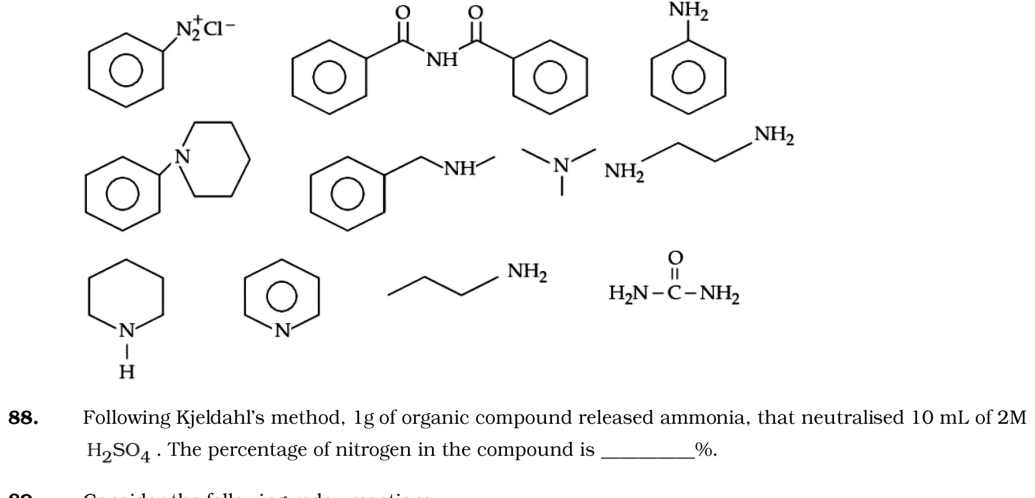
Correct answer: 5
Explanation: Primary and secondary amines: aniline, N-methylbenzylamine, ethylenediamine, piperidine, propylamine.
Question 86
Chemistry · 4 marks · −1Following Kjeldahl's method, 1g of organic compound released ammonia, that neutralised 10 mL of 2M . The percentage of nitrogen in the compound is ______ %.
Correct answer: 56
Explanation: 40 mmol NH → 0.56 g N.
Question 87
Chemistry · 4 marks · −1Consider the following redox reaction: . The standard reduction potentials are given as below: V; V. If the equilibrium constant of the above reaction is given as , then the value of x = ______. (nearest Integer)
Correct answer: 338
Explanation: , V; .
Question 88
Chemistry · 4 marks · −1The following data were obtained during the first order thermal decomposition of a gas A at constant volume: | S. No. | Time/s | Total pressure/(atm) | | 1. | 0 | 0.1 | | 2. | 115 | 0.28 | The rate constant of the reaction is ______ s (nearest integer)
Correct answer: 2
Explanation: ; .