JEE Main 2024 — 27 Jan Shift 2 (Previous Year Paper)
JEE Main · 2024 · with answers and explanations
- questions
- 89
- Total marks
- 296
- Duration
- 180 minutes
- Negative marking
- −1
Subjects: Mathematics · Physics · Chemistry
Question 1
Mathematics · 4 marks · −1An urn contains 6 white and 9 black balls. Two successive draws of 4 balls are made without replacement. The probability, that the first draw gives all white balls and the second draw gives all black balls, is:
- A.
- B.
- C.
- D.
Correct answer: A
Explanation: .
Question 2
Mathematics · 4 marks · −1If is the solution curve of the differential equation , , and the slope of the curve is never zero, then the value of equals:
- A.
- B.
- C.
- D.
Correct answer: A
Explanation: Separating: ; gives . At : and, since , .
Question 3
Mathematics · 4 marks · −1The values of , for which , lie in the interval.
- A.
- B.
- C.
- D.
Correct answer: A
Explanation: The determinant equals ; roots , both in .
Question 4
Mathematics · 4 marks · −1The position vectors of the vertices , and of a triangle are , and respectively. Let denotes the length of the angle bisector of where is on the line segment , then equals:
- A.50
- B.49
- C.42
- D.45
Correct answer: D
Explanation: , so is the midpoint ; , .
Question 5
Mathematics · 4 marks · −1Let and for all . If is decreasing in and increasing in , then is:
- A.18
- B.24
- C.0
- D.20
Correct answer: A
Explanation: , zero when , ; .
Question 6
Mathematics · 4 marks · −1Let and . Then:
- A. and
- B. and
- C. and
- D. and
Correct answer: C
Explanation: is the number of ways to split objects into labelled groups of ; both are integers.
Question 7
Mathematics · 4 marks · −1Consider the function defined by and the function defined by . Then,
- A. is continuous but not differentiable at
- B. is not continuous for all
- C. is continuous and differentiable for all
- D. is neither continuous nor differentiable at
Correct answer: A
Explanation: decreases on , so on ; but .
Question 8
Mathematics · 4 marks · −1Let the position vectors of vertices , and of a triangle be , and respectively. Let and be the lengths of perpendiculars drawn from the ortho centre of the triangle on the sides , and respectively, then equals:
- A.
- B.
- C.
- D.
Correct answer: D
Explanation: Equilateral triangle of side ; each distance is the inradius , so the sum is .
Question 9
Mathematics · 4 marks · −1Let the image of the point in the line be the point . Then which one of the following points lies on the line passing through and making angles and with -axis and -axis respectively and an acute angle with -axis ?
- A.
- B.
- C.
- D.
Correct answer: C
Explanation: Foot , image ; direction ; gives .
Question 10
Mathematics · 4 marks · −1Let and be two finite sets with and elements respectively. The total number of subsets of the set is 56 more than the total number of subsets of . Then the distance of the point from the point is:
- A.8
- B.4
- C.10
- D.6
Correct answer: C
Explanation: ; distance .
Question 11
Mathematics · 4 marks · −1Let and be defined as and . Then, the domain of the function is:
- A.
- B.
- C.
- D.
Correct answer: B
Explanation: has no solution, so only is excluded.
Question 12
Mathematics · 4 marks · −1Let be the interior region between the lines and containing the origin. The set of all values of , for which the points lie in , is:
- A.
- B.
- C.
- D.
Correct answer: D
Explanation: and give .
Question 13
Mathematics · 4 marks · −1The integral is equal to:
- A.
- B.
- C.
- D.
Correct answer: B
Explanation: With , and the integrand becomes .
Question 14
Mathematics · 4 marks · −1If has exactly 7 solutions in the interval , for the least value of , then is equal to:
- A.
- B.
- C.
- D.
Correct answer: A
Explanation: ; the 7th solution lies in , so and .
Question 15
Mathematics · 4 marks · −1If are the roots of the equation, and , then:
- A.
- B.
- C.
- D.
Correct answer: D
Explanation: gives .
Question 16
Mathematics · 4 marks · −1Let be the eccentricity of the hyperbola and be the eccentricity of the ellipse , , which passes through the foci of the hyperbola. If , then the length of the chord of the ellipse parallel to the -axis and passing through is:
- A.
- B.
- C.
- D.
Correct answer: B
Explanation: , , , ; at , .
Question 17
Mathematics · 4 marks · −1For , the value of the integral is:
- A.
- B.
- C.
- D.
Correct answer: D
Question 18
Mathematics · 4 marks · −1If , then is equal to:
- A.2
- B.1
- C.7
- D.5
Correct answer: D
Explanation: , (the term must vanish); .
Question 19
Mathematics · 4 marks · −1The term from the end of the progression is:
- A.−100
- B.−110
- C.−118
- D.−115
Correct answer: D
Explanation: .
Question 20
Mathematics · 4 marks · −1Considering only the principal values of inverse trigonometric functions, the number of positive real values of satisfying is:
- A.2
- B.more than 2
- C.1
- D.0
Correct answer: C
Explanation: ; one positive root.
Question 21
Mathematics · 4 marks · −1If the area of the region is , then is equal to ______.
Correct answer: 304
Question 22
Mathematics · 4 marks · −1If the solution curve, of the differential equation passing through the point is , then is equal to:
Correct answer: 11
Question 23
Mathematics · 4 marks · −1The coefficient of in the expansion of is equal to ______.
Correct answer: 0
Explanation: ; 2012 and 2011 are not multiples of 3, so the coefficient is 0.
Question 24
Mathematics · 4 marks · −1The lines and intersect at the point . If the distance of from the line is , then is equal to ______.
Correct answer: 108
Question 25
Mathematics · 4 marks · −1Let the complex numbers and lie on the circles and respectively, where . Then, the value of is ______.
Correct answer: 20
Question 26
Mathematics · 4 marks · −1Let , where is a continuous odd function. If , then is equal to ______.
Correct answer: 2
Explanation: is odd so it integrates to 0; ; .
Question 27
Mathematics · 4 marks · −1Let be a real matrix and be the identity matrix of order 2. If the roots of the equation be and 3, then the sum of the diagonal elements of the matrix is ______.
Correct answer: 10
Explanation: Eigenvalues of are 1 and 9; trace 10.
Question 28
Mathematics · 4 marks · −1If the sum of squares of all real values of , for which the lines , and do not form a triangle is , then the greatest integer less than or equal to is ______.
Correct answer: 32
Question 29
Mathematics · 4 marks · −1Consider a circle , where . If the circle touches the line at the point , whose distance from the origin is , then is equal to ______.
Correct answer: 100
Explanation: Distance of centre from is , so .
Question 30
Mathematics · 4 marks · −1The mean and standard deviation of 15 observations were found to be 12 and 3 respectively. On rechecking it was found that an observation was read as 10 in place of 12. If and denote the mean and variance of the correct observations respectively, then is equal to ______.
Correct answer: 2521
Explanation: Corrected , ; .
Question 31
Physics · 4 marks · −1An object is placed in a medium of refractive index 3. An electromagnetic wave of intensity W/m² falls normally on the object and it is absorbed completely. The radiation pressure on the object would be (speed of light in free space m/s):
- A.2 N m
- B.6 N m
- C.36 N m
- D.18 N m
Correct answer: B
Explanation: N m.
Question 32
Physics · 4 marks · −1Given below are two statements: one is labelled as Assertion (A) and the other is labelled as Reason (R). Assertion (A): Work done by electric field on moving a positive charge on an equipotential surface is always zero. Reason (R): Electric lines of forces are always perpendicular to equipotential surfaces. In the light of the above statements, choose the most appropriate answer from the options given below:
- A.(A) is not correct but (R) is correct
- B.(A) is correct but (R) is not correct
- C.Both (A) and (R) are correct and (R) is the correct explanation of (A)
- D.Both (A) and (R) are correct but (R) is not the correct explanation of (A)
Correct answer: C
Question 33
Physics · 4 marks · −1Primary side of a transformer is connected to 230 V, 50 Hz supply. Turns ratio of primary to secondary winding is 10 : 1. Load resistance connected to secondary side is 46 Ω. The power consumed in it is:
- A.10.0 W
- B.11.5 W
- C.12.0 W
- D.12.5 W
Correct answer: B
Explanation: V; W.
Question 34
Physics · 4 marks · −1During an adiabatic process, the pressure of a gas is found to be proportional to the cube of its absolute temperature. The ratio of for the gas is:
- A.
- B.
- C.
- D.
Correct answer: B
Explanation: Adiabatic: ; .
Question 35
Physics · 4 marks · −1The threshold frequency of a metal with work function 6.63 eV is:
- A. Hz
- B. Hz
- C. Hz
- D. Hz
Correct answer: A
Explanation: Hz.
Question 36
Physics · 4 marks · −1Given below are two statements: Statement (I): The limiting force of static friction depends on the area of contact and independent of materials. Statement (II): The limiting forces of kinetic friction is independent of the area of contact and depends on materials. In the light of the above statements, choose the most appropriate answer from the options given below:
- A.Both Statement I and Statement II are correct
- B.Statement I is correct and Statement II is incorrect
- C.Both Statement I and Statement II are incorrect
- D.Statement I is incorrect and Statement II is correct
Correct answer: D
Question 37
Physics · 4 marks · −1The atomic mass of is 12.000000 u and that of is 13.003354 u. The required energy to remove a neutron from , if mass of neutron is 1.008665 u, will be:
- A.4.95 MeV
- B.62.5 MeV
- C.49.5 MeV
- D.6.25 MeV
Correct answer: A
Explanation: u MeV.
Question 38
Physics · 4 marks · −1Given below are two statements: one is labelled as Assertion (A) and the other is labelled as Reason (R). Assertion (A): The property of body, by virtue of which it tends to regain its original shape when the external force is removed, is Elasticity. Reason (R): The restoring force depends upon the bonded inter atomic and inter molecular force of solid. In the light of the above statements, choose the most appropriate answer from the options given below:
- A.Both (A) and (R) are true and (R) is the correct explanation of (A)
- B.Both (A) and (R) are true but (R) is not the correct explanation of (A)
- C.(A) is true but (R) is false
- D.(A) is false but (R) is true
Correct answer: A
Question 39
Physics · 4 marks · −1Given below are two statements: one is labelled as Assertion (A) and the other is labelled as Reason (R). Assertion (A): The angular speed of the moon in its orbit about the earth is more than the angular speed of the earth in its orbit about the sun. Reason (R): The moon takes less time to move around the earth than the time taken by the earth to move around the sun. In the light of the above statements, choose the correct answer from the options given below:
- A.(A) is not correct but (R) is correct
- B.Both (A) and (R) are correct but (R) is not the correct explanation of (A)
- C.(A) is correct but (R) is not correct
- D.Both (A) and (R) are correct and (R) is the correct explanation of (A)
Correct answer: D
Explanation: and the moon's period is shorter.
Question 40
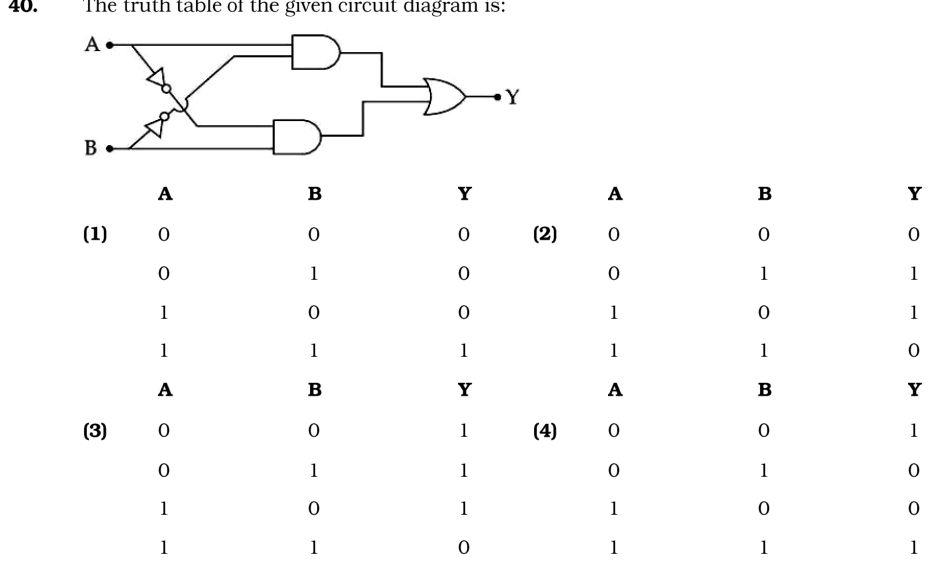
Physics · 4 marks · −1The truth table of the given circuit diagram is:
- A.A B Y: 0 0 0; 0 1 0; 1 0 0; 1 1 1
- B.A B Y: 0 0 0; 0 1 1; 1 0 1; 1 1 0
- C.A B Y: 0 0 1; 0 1 1; 1 0 1; 1 1 0
- D.A B Y: 0 0 1; 0 1 0; 1 0 0; 1 1 1
Correct answer: B
Explanation: is XOR.
Question 41
Physics · 4 marks · −1A heavy iron bar of weight 12 kg is having its one end on the ground and the other on the shoulder of a man. The rod makes an angle 60° with the horizontal, the weight experienced by the man is:
- A.3 kg
- B. kg
- C.6 kg
- D.12 kg
Correct answer: A
Explanation: Taking the shoulder force perpendicular to the rod: kg-wt.
Question 42
Physics · 4 marks · −1When a polaroid sheet is rotated between two crossed polaroids then the transmitted light intensity will be maximum for a rotation of:
- A.45°
- B.30°
- C.60°
- D.90°
Correct answer: A
Explanation: , maximum at 45°.
Question 43
Physics · 4 marks · −1A current of 200 μA deflects the coil of a moving coil galvanometer through 60°. The current to cause deflection through radian is:
- A.60 μA
- B.120 μA
- C.30 μA
- D.180 μA
Correct answer: A
Explanation: : μA.
Question 44
Physics · 4 marks · −1Three voltmeters, all having different internal resistances are joined as shown in figure. When some potential difference is applied across A and B, their readings are , and . Choose the correct option.

- A.
- B.
- C.
- D.
Correct answer: B
Question 45
Physics · 4 marks · −1The equation of state of a real gas is given by , where P, V and T are pressure, volume and temperature respectively and R is the universal gas constant. The dimensions of is similar to that of:
- A.
- B.
- C.
- D.
Correct answer: D
Explanation: , , so .
Question 46
Physics · 4 marks · −1Given below are two statements: one is labelled as Assertion (A) and the other is labelled as Reason (R). Assertion (A): In Vernier Calliper if positive zero error exists, then while taking measurements, the reading taken will be more than the actual reading. Reason (R): The zero error in Vernier Calliper might have happened due to manufacturing defect or due to rough handling. In the light of the above statements, choose the correct answer from the options give below:
- A.Both (A) and (R) are correct and (R) is the correct explanation of (A)
- B.(A) is true but (R) is false
- C.(A) is false but (R) is true
- D.Both (A) and (R) are correct but (R) is not the correct explanation of (A)
Correct answer: D
Question 47
Physics · 4 marks · −1A ball suspended by a thread swings in a vertical plane so that its magnitude of acceleration in the extreme position and lowest position are equal. The angle of thread deflection in the extreme position will be:
- A.
- B.
- C.
- D.
Correct answer: B
Explanation: .
Question 48
Physics · 4 marks · −1The total kinetic energy of 1 mole of oxygen at 27°C is: [Use universal gas constant (R) = 8.31 J/mole K]
- A.5670.5 J
- B.5942.0 J
- C.6845.5 J
- D.6232.5 J
Correct answer: D
Explanation: J.
Question 49
Physics · 4 marks · −1Wheatstone bridge principle is used to measure the specific resistance of given wire, having length , radius . If is the resistance of wire, then specific resistance is; . If the length of the wire gets doubled then the value of specific resistance will be:
- A.
- B.
- C.
- D.
Correct answer: B
Explanation: Resistivity is a material property.
Question 50
Physics · 4 marks · −1A parallel beam of monochromatic light of wavelength 5000 Å is incident normally on a single narrow slit of width 0.001 mm. The light is focused by convex lens on screen, placed on its focal plane. The first minima will be formed for the angle of diffraction of ______ (degree).
Correct answer: 30
Explanation: , .
Question 51
Physics · 4 marks · −1Two charges of and are placed at the points m and m located in an electric field V/cm. The magnitude of the torque acting on the dipole is N m, where ______.
Correct answer: 2
Explanation: , V/m; .
Question 52
Physics · 4 marks · −1A closed organ pipe 150 cm long gives 7 beats per second with an open organ pipe of length 350 cm, both vibrating in fundamental mode. The velocity of sound is ______ m/s.
Correct answer: 294
Explanation: m/s.
Question 53
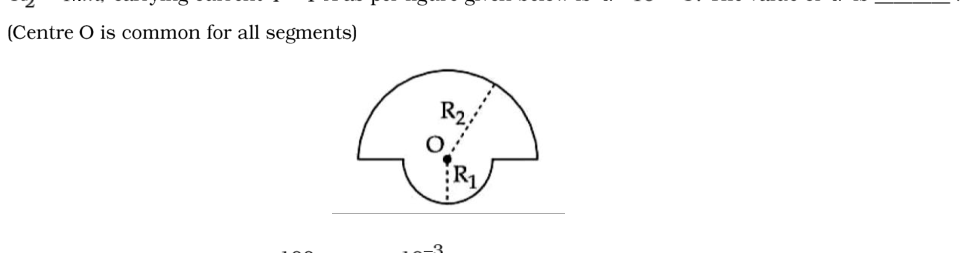
Physics · 4 marks · −1The magnetic field at the centre of a wire loop formed by two semicircular wires of radii m and m, carrying current A as per figure given below is T. The value of is ______. (Centre O is common for all segments)
Correct answer: 3
Explanation: T.
Question 54
Physics · 4 marks · −1A series LCR circuit with mH, F and , is connected across an ac source of 220 V, 50 Hz supply. The power factor of the circuit would be ______.
Correct answer: 1
Explanation: : resonance, power factor 1.
Question 55
Physics · 4 marks · −1A body falling under gravity covers two points A and B separated by 80 m in 2 s. The distance of upper point A from the starting point is ______ m (use m s).
Correct answer: 45
Explanation: ; m.
Question 56
Physics · 4 marks · −1The reading of pressure metre attached with a closed pipe is N/m². On opening the valve, water starts flowing and the reading of pressure metre falls to N/m². The velocity of water is found to be m/s. The value of is ______.
Correct answer: 50
Explanation: .
Question 57
Physics · 4 marks · −1The electric potential at the surface of an atomic nucleus of radius cm is ______ V.
Correct answer: 8
Explanation: V.
Question 58
Physics · 4 marks · −1If Rydberg's constant is , the longest wavelength of radiation in Paschen series will be , where ______.
Correct answer: 144
Explanation: .
Question 59
Physics · 4 marks · −1A ring and a solid sphere roll down the same inclined plane without slipping. They start from rest. The radii of both bodies are identical and the ratio of their kinetic energies is , where is ______.
Correct answer: 7
Explanation: Both lose the same potential energy on reaching the bottom (same mass implied), so the ratio is 1.
Question 60
Chemistry · 4 marks · −1The final product A, formed in the following reaction sequence is:
- A.
- B.
- C.
- D.
Correct answer: B
Explanation: Anti-Markovnikov alcohol → PhCHCHBr → Grignard + HCHO adds one carbon: PhCHCHCHOH.
Question 61
Chemistry · 4 marks · −1Which of the following cannot function as an oxidizing agent?
- A.
- B.
- C.
- D.
Correct answer: C
Explanation: N is in its lowest oxidation state (−3).
Question 62
Chemistry · 4 marks · −1Which among the following halide/s will not show reaction: (A) (B) (C) benzyl chloride () (D) Choose the most appropriate answer from the options given below:
- A.(A), (B) and (D) only
- B.(B) and (C) only
- C.(A) and (B) only
- D.(B) only
Correct answer: D
Explanation: Only the vinylic halide cannot form a stable carbocation.
Question 63
Chemistry · 4 marks · −1Identify B formed in the reaction.
- A.
- B.1,1'-bipiperidine (two piperidine rings joined N–N)
- C.
- D.Piperidine
Correct answer: C
Question 64
Chemistry · 4 marks · −1The molecular formula of second homologue in the homologous series of mono carboxylic acid is:
- A.
- B.
- C.
- D.
Correct answer: D
Question 65
Chemistry · 4 marks · −1Match List-I with List-II. List-I (Reaction): (A) phenol → salicylic acid (o-hydroxybenzoic acid); (B) phenol → salicylaldehyde (o-hydroxybenzaldehyde); (C) phenol → p-benzoquinone; (D) phenol → anisole (methoxybenzene) List-II (Reagent(s)): (I) , (II) (i) NaOH (ii) (III) (i) NaOH, (ii) NaOH (iii) HCl (IV) (i) NaOH (ii) (iii) HCl
- A.(A)-(IV), (B)-(I), (C)-(III), (D)-(II)
- B.(A)-(IV), (B)-(III), (C)-(I), (D)-(II)
- C.(A)-(II), (B)-(I), (C)-(III), (D)-(IV)
- D.(A)-(II), (B)-(III), (C)-(I), (D)-(IV)
Correct answer: B
Explanation: Kolbe (A), Reimer–Tiemann (B), oxidation (C), Williamson (D).
Question 66
Chemistry · 4 marks · −1The quantity which changes with temperature is:
- A.Molarity
- B.Molality
- C.Mole fraction
- D.Mass percentage
Correct answer: A
Question 67
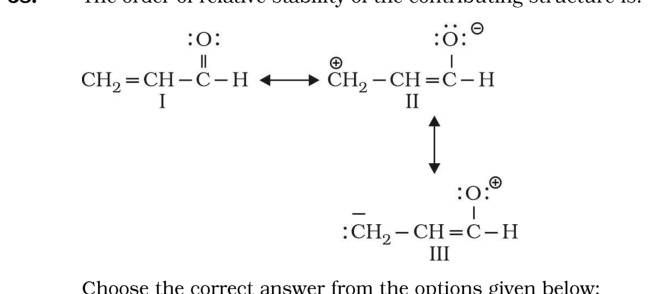
Chemistry · 4 marks · −1The order of relative stability of the contributing structure is: I: (acrolein, neutral); II: ; III: (as drawn in the figure, with H on the carbonyl carbon) Choose the correct answer from the options given below:
- A.III > II > I
- B.I = II = III
- C.II > I > III
- D.I > II > III
Correct answer: D
Question 68
Chemistry · 4 marks · −1Identify the incorrect pair from the following:
- A.Photography – AgBr
- B.Haber process – Iron
- C.Polythene preparation – ,
- D.Wacker process –
Correct answer: D
Explanation: The Wacker process uses PdCl.
Question 69
Chemistry · 4 marks · −1The incorrect statement regarding conformations of ethane is:
- A.Ethane has infinite number of conformations
- B.The conformations of ethane are inter-convertible to one-another
- C.The dihedral angle in staggered conformation is 60°.
- D.Eclipsed conformation is the most stable conformation.
Correct answer: D
Question 70
Chemistry · 4 marks · −1The technique used for purification of steam volatile water immiscible substances is:
- A.distillation
- B.steam distillation
- C.fractional distillation
- D.fractional distillation under reduced pressure
Correct answer: B
Question 71
Chemistry · 4 marks · −1Which structure of protein remains intact after coagulation of egg white on boiling?
- A.Primary
- B.Secondary
- C.Quaternary
- D.Tertiary
Correct answer: A
Question 72
Chemistry · 4 marks · −1Bond line formula of is:
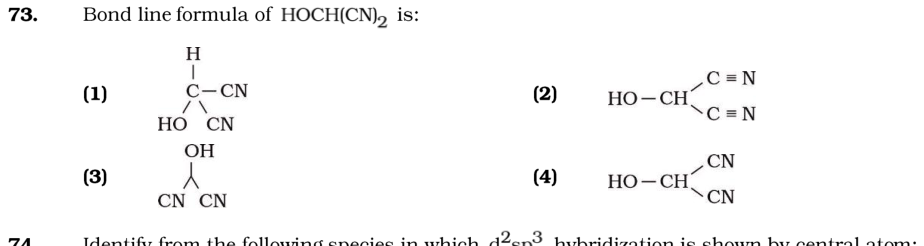
- A.Structure with explicit H: central C bearing H, OH and two CN (drawn with bonds)
- B. (condensed, triple bonds shown)
- C.Bond-line: a vertex carbon carrying OH above and two CN groups on the lower branches
- D. (condensed)
Correct answer: C
Question 73
Chemistry · 4 marks · −1Identify from the following species in which hybridization is shown by central atom:
- A.
- B.
- C.
- D.
Correct answer: A
Explanation: Low-spin Co(III) with NH uses inner 3d orbitals.
Question 74
Chemistry · 4 marks · −1Phenolic group can be identified by a positive:
- A.Tollen's test
- B.Lucas test
- C.Phthalein dye test
- D.Carbylamine test
Correct answer: C
Question 75
Chemistry · 4 marks · −1Given below are two statements: Statement (I): In the lanthanoids, the formation of is favoured by its noble gas configuration. Statement (II): is a strong oxidant reverting to the common +3 state. In the light of the above statements, choose the most appropriate answer from the options given below:
- A.Both Statement I and Statement II are true
- B.Statement I is true but Statement II is false
- C.Statement I is false but Statement II is true
- D.Both Statement I and Statement II are false
Correct answer: A
Question 76
Chemistry · 4 marks · −1Which of the following statements is not correct about rusting of iron?
- A.When pH lies above 9 or 10, rusting of iron does not take place.
- B.Rusting of iron is envisaged as setting up of electrochemical cell on the surface of iron object.
- C.Coating of iron surface by tin prevents rusting, even if the tin coating is peeling off.
- D.Dissolved acidic oxides , in water act as catalyst in the process of rusting.
Correct answer: C
Question 77
Chemistry · 4 marks · −1Given below are two statements: Statement (I): Oxygen being the first member of group 16 exhibits only −2 oxidation state. Statement (II): Down the group 16 stability of +4 oxidation state decreases and +6 oxidation state increases. In the light of the above statements, choose the most appropriate answer from the options given below:
- A.Both Statement I and Statement II are correct
- B.Both Statement I and Statement II are incorrect
- C.Statement I is correct but Statement II is incorrect
- D.Statement I is incorrect but Statement II is correct
Correct answer: B
Explanation: Oxygen also shows +2, −1 etc.; down the group +4 becomes more stable (inert pair effect).
Question 78
Chemistry · 4 marks · −1Major product formed in the following reaction is a mixture of: Cyclohexyl tert-butyl ether Major Product
- A.Iodocyclohexane and
- B.Iodocyclohexane and
- C.Cyclohexanol and
- D.Cyclohexanol and
Correct answer: D
Explanation: Cleavage proceeds via the stable tert-butyl cation (S$_N$1): tert-butyl iodide + cyclohexanol.
Question 79
Chemistry · 4 marks · −1Choose the correct having all the elements with electronic configuration from the following:
- A.Co, Ni, Fe, Cr
- B.Cu, Zn, Cd, Ag
- C.Ni, Cr, Fe, Cu
- D.Pd, Ni, Fe, Cr
Correct answer: B
Question 80
Chemistry · 4 marks · −1Time required for completion of 99.9% of a First order reaction is ______ times of half life of the reaction.
Correct answer: 10
Explanation: .
Question 81
Chemistry · 4 marks · −1The spin only magnetic moment value of square planar complex is ______ B.M. (Nearest integer) (Given atomic number for Pt = 78)
Correct answer: 0
Explanation: Pt(II), d square planar: no unpaired electrons.
Question 82
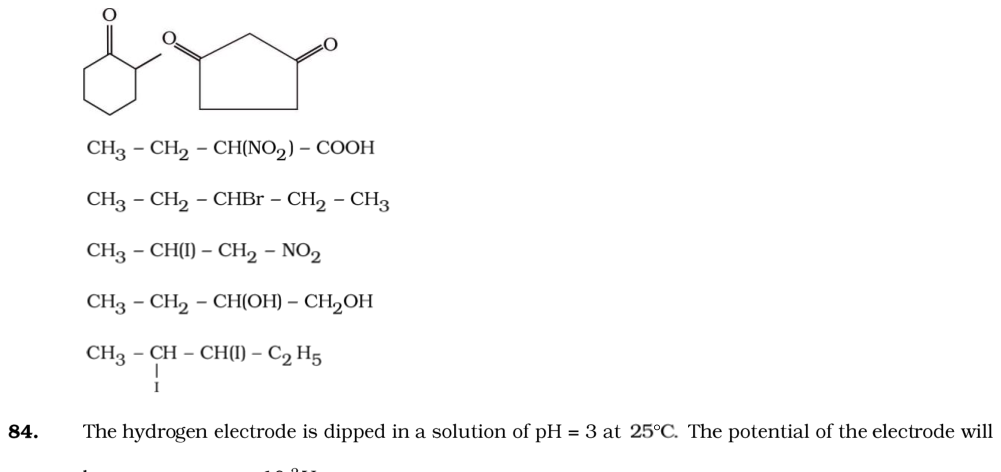
Chemistry · 4 marks · −1Total number of compounds with Chiral carbon atoms from following is ______. (i) 2-methylcyclohexanone-type structure (cyclohexanone with a CH on the carbon next to C=O, as drawn); (ii) cyclopentane-1,3-dione (as drawn); (iii) ; (iv) ; (v) ; (vi) ; (vii)
Correct answer: 5
Question 83
Chemistry · 4 marks · −1The hydrogen electrode is dipped in a solution of pH = 3 at 25°C. The potential of the electrode will be − ______ V.
Correct answer: 18
Explanation: V ≈ V.
Question 84
Chemistry · 4 marks · −1The number of non-polar molecules from the following is ______. HF, H₂O, SO₂, H₂, CO₂, CH₄, NH₃, HCl, CHCl₃, BF₃
Correct answer: 4
Explanation: H, CO, CH, BF.
Question 85
Chemistry · 4 marks · −1For a certain thermochemical reaction M → N at T = 400 K, kJ mol, J K, log equilibrium constant (log K) is − ______ .
Correct answer: 37
Explanation: J; .
Question 86
Chemistry · 4 marks · −1Volume of 3 M NaOH (formula weight 40 g mol⁻¹) which can be prepared from 84 g of NaOH is ______ dm³.
Correct answer: 7
Explanation: 2.1 mol / 3 M = 0.7 dm.
Question 87
Chemistry · 4 marks · −1Total number of ions from the following with noble gas configuration is ______. (z = 38), (z = 55), (z = 57), (z = 82), (z = 70) and (z = 26)
Correct answer: 2
Explanation: Only Sr and Cs.
Question 88
Chemistry · 4 marks · −19.3 g of aniline is subjected to reaction with excess of acetic anhydride to prepare acetanilide. The mass of acetanilide produced if the reaction is 100% completed is ______ g. (Given molar mass in g mol⁻¹ N : 14, O : 16, C : 12, H : 1)
Correct answer: 135
Explanation: 0.1 mol aniline → 0.1 mol acetanilide (135 g/mol) = 13.5 g.
Question 89
Chemistry · 4 marks · −11 mole of PbS is oxidized by "X" moles of O₃ to get "Y" moles of O₂. X + Y = ______.
Correct answer: 8
Explanation: .