JEE Main 2024 — 30 Jan Shift 2 (Previous Year Paper)
JEE Main · 2024 · with answers and explanations
- questions
- 89
- Total marks
- 296
- Duration
- 180 minutes
- Negative marking
- −1
Subjects: Mathematics · Physics · Chemistry
Question 1
Mathematics · 4 marks · −1If is the locus of a point, which moves such that it is always equidistant from the lines and , then the value of equals.
- A.14
- B.6
- C.8
- D.29
Correct answer: A
Explanation: ; .
Question 2
Mathematics · 4 marks · −1Let , . If and are the maximum and minimum values of , respectively in , then the value of is:
- A.392
- B.600
- C.108
- D.608
Correct answer: D
Explanation: Candidates , , , , .
Question 3
Mathematics · 4 marks · −1Let be a thrice differentiable function in (−5, 5). Let the tangents to the curve at and make angles and , respectively with positive -axis. If where are integers, then the value of equals.
- A.36
- B.−16
- C.−14
- D.26
Correct answer: D
Explanation: .
Question 4
Mathematics · 4 marks · −1Let , . Let a vector be such that the angle between and is and . If , then the value of is equal to:
- A.85
- B.75
- C.90
- D.95
Correct answer: C
Explanation: so ; .
Question 5
Mathematics · 4 marks · −1Let , , , , and , be three lines such that is perpendicular to and is perpendicular to both and . Then, the point which lies on is:
- A.(1, −7, 4)
- B.(−1, 7, 4)
- C.(−1, −7, 4)
- D.(1, 7, −4)
Correct answer: B
Explanation: ; direction of is , through the origin.
Question 6
Mathematics · 4 marks · −1Bag A contains 3 white, 7 red balls and Bag B contains 3 white, 2 red balls. One bag is selected at random and a ball is drawn from it. The probability of drawing the ball from the bag A, if the ball drawn is white, is:
- A.
- B.
- C.
- D.
Correct answer: C
Explanation: .
Question 7
Mathematics · 4 marks · −1Let be a function satisfying for all , . If , then:
- A.
- B.
- C.
- D.
Correct answer: C
Explanation: with .
Question 8
Mathematics · 4 marks · −1Let be a non-zero matrix, where , . For a square matrix , Let trace denote the sum of all the diagonal entries of . Then, among the statements: (I) Trace (II) If trace, then has exactly one non-zero entry.
- A.Only (II) is true
- B.Only (I) is true
- C.Neither (I) nor (II) is true
- D.Both (I) and (II) are true
Correct answer: C
Explanation: , so trace; and adj(adj ) has non-zero trace, while all three diagonal entries are non-zero.
Question 9
Mathematics · 4 marks · −1If is a complex number, then the number of common roots of the equations and , is equal to:
- A.1
- B.0
- C.2
- D.3
Correct answer: C
Explanation: The cubic has roots ; and satisfy the first equation, does not.
Question 10
Mathematics · 4 marks · −1Let and be two distinct positive real numbers. Let term of a GP, whose first term is and third term is , is equal to term of another GP, whose first term is a and fifth term is . Then is equal to:
- A.20
- B.24
- C.25
- D.21
Correct answer: D
Explanation: .
Question 11
Mathematics · 4 marks · −1Let and be two vectors such that and . Then is equal to:
- A.5
- B.3
- C.4
- D.1
Correct answer: A
Explanation: .
Question 12
Mathematics · 4 marks · −1Let be defined as . If , and , then the value of equals.
- A.10
- B.8
- C.12
- D.16
Correct answer: B
Explanation: , , give .
Question 13
Mathematics · 4 marks · −1Let be a function defined by , and . Then, is equal to:
- A.42
- B.39
- C.36
- D.33
Correct answer: B
Explanation: ; with the integral is .
Question 14
Mathematics · 4 marks · −1Let be a point on the hyperbola , in the first quadrant such that the area of triangle formed by and the two foci of is . Then, the square of the distance of from the origin is:
- A.20
- B.22
- C.18
- D.26
Correct answer: B
Explanation: Area , ; .
Question 15
Mathematics · 4 marks · −1Let and be real constants such that the function defined by be differentiable on . Then, the value of equals.
- A.17
- B.
- C.
- D.21
Correct answer: A
Explanation: , ; .
Question 16
Mathematics · 4 marks · −1If the domain of the function is , then the value of is equal to:
- A.9
- B.11
- C.10
- D.12
Correct answer: D
Explanation: Log condition: ; condition: ; domain .
Question 17
Mathematics · 4 marks · −1Let and be the points on the line . Let the point divide the line segment internally in the ratio 7 : 3. Let be a directrix of the ellipse and the corresponding focus be . If from , the perpendicular on the -axis passes through , then the length of the latus rectum of is equal to:
- A.
- B.
- C.
- D.
Correct answer: D
Explanation: , so and : , ; latus rectum .
Question 18
Mathematics · 4 marks · −1For , let and a real number be such that . Then, the value of is equal to:
- A.5
- B.
- C.−5
- D.
Correct answer: C
Explanation: .
Question 19
Mathematics · 4 marks · −1Consider the system of linear equations , , , where . Then, which of the following statement is NOT correct?
- A.System is consistent if and
- B.System has unique solution if and
- C.System is inconsistent if and
- D.System has infinite number of solutions if and
Correct answer: B
Explanation: also vanishes at , so "" does not guarantee a unique solution.
Question 20
Mathematics · 4 marks · −1Let be the sum to -terms of an arithmetic progression 3, 7, 11, ....... If , then equals ______.
Correct answer: 9
Explanation: ; ; .
Question 21
Mathematics · 4 marks · −1In an examination of Mathematics paper, there are 20 questions of equal marks and the question paper is divided into three sections: A, B and C. A students is required to attempt total 15 questions taking at least 4 questions from each section. If section A has 8 questions, section B has 6 questions and section C 6 questions, then the total number of ways a student can select 15 questions is ______.
Correct answer: 11376
Question 22
Mathematics · 4 marks · −1Consider two circles and , where . Let the angle between the two radii (one to each circle) drawn from one of the intersection points of and be . If the length of common chord of and is , then the value of equals ______.
Correct answer: 1575
Question 23
Mathematics · 4 marks · −1The variance of the data | | 0 | 1 | 5 | 6 | 10 | 12 | 17 | | | 3 | 2 | 3 | 2 | 6 | 3 | 3 | is ______.
Correct answer: 29
Question 24
Mathematics · 4 marks · −1Let a line passing through the point (−1, 2, 3) intersects the lines at and at . Then, the value of equals ______.
Correct answer: 196
Question 25
Mathematics · 4 marks · −1The number of symmetric relations defined on the set {1, 2, 3, 4} which are not reflexive is ______.
Correct answer: 960
Explanation: Symmetric relations ; symmetric and reflexive ; .
Question 26
Mathematics · 4 marks · −1Let be a curve lying in the first quadrant such that the area enclosed by the line and the co-ordinate axes, where is any point on the curve, is always , . If , then equals ______.
Correct answer: 20
Question 27
Mathematics · 4 marks · −1The area of the region enclosed by the parabola , the line and the positive coordinate axes is ______.
Correct answer: 5
Question 28
Mathematics · 4 marks · −1The number of real solutions of the equation is ______.
Correct answer: 1
Explanation: The bracket is always positive, so only .
Question 29
Mathematics · 4 marks · −1Let and . If , then equals ______.
Correct answer: 10
Question 30
Physics · 4 marks · −1A block of mass is placed on a surface having vertical cross section given by . If coefficient of friction is 0.5, the maximum height above the ground at which block can be placed without slipping is:
- A. m
- B. m
- C. m
- D. m
Correct answer: D
Explanation: , m.
Question 31
Physics · 4 marks · −1If a nuclear fission reaction of an isotope of mass , three similar daughter nuclei of same mass are formed. The speed of a daughter nuclei in terms of mass defect will be:
- A.
- B.
- C.
- D.
Correct answer: A
Explanation: .
Question 32
Physics · 4 marks · −1A beam of unpolarized light of intensity passed through a polaroid A and then through another polaroid B which is oriented so that its principal plane makes an angle of 45° relative to that of A. The intensity of emergent light is:
- A.
- B.
- C.
- D.
Correct answer: D
Question 33
Physics · 4 marks · −1If the total energy transferred to a surface in time is J, then the magnitude of the total momentum delivered to this surface for complete absorption will be:
- A. kg m/s
- B. kg m/s
- C. kg m/s
- D. kg m/s
Correct answer: A
Explanation: .
Question 34
Physics · 4 marks · −1A particle of charge '−q' and mass 'm' moves in a circle of radius 'r' around an infinitely long line charge of linear charge density '+λ'. Then time period will be given as: (Consider k as Coulomb's constant)
- A.
- B.
- C.
- D.
Correct answer: B
Explanation: gives a radius-independent speed.
Question 35
Physics · 4 marks · −1If mass is written as then the value of P will be: (Constants have their usual meaning with k a dimensionless constant).
- A.
- B.
- C.
- D.2
Correct answer: A
Explanation: Planck mass .
Question 36
Physics · 4 marks · −1If 50 Vernier divisions are equal to 49 main scale division of a traveling microscope and one smallest reading of main scale is 0.5 mm, the Vernier constant of traveling microscope is:
- A.0.1 mm
- B.0.1 cm
- C.0.01 cm
- D.0.01 mm
Correct answer: D
Explanation: mm.
Question 37
Physics · 4 marks · −1In the given circuit, the voltage across load resistance is:
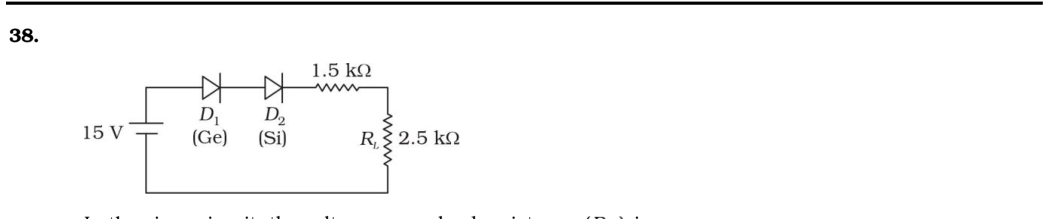
- A.14.00 V
- B.8.75 V
- C.9.00 V
- D.8.50 V
Correct answer: B
Explanation: mA; V.
Question 38
Physics · 4 marks · −1If three moles of monoatomic gas is mixed with two moles of a diatomic gas , the value of adiabatic exponent γ for the mixture is:
- A.1.35
- B.1.40
- C.1.52
- D.1.75
Correct answer: C
Explanation: ; .
Question 39
Physics · 4 marks · −1For the photoelectric effect, the maximum kinetic energy of the photoelectrons is plotted against the frequency (ν) of the incident photons as shown in figure. The slope of the graph gives
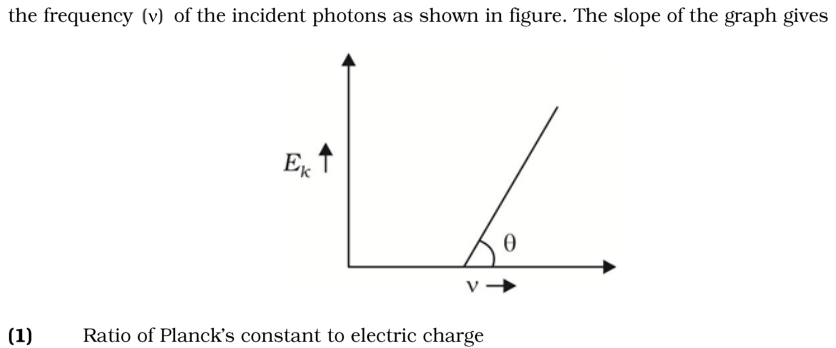
- A.Ratio of Planck's constant to electric charge
- B.Planck's constant
- C.Work function of the metal
- D.Charge of electron
Correct answer: B
Question 40
Physics · 4 marks · −1Choose the correct statement for processes A & B shown in figure.
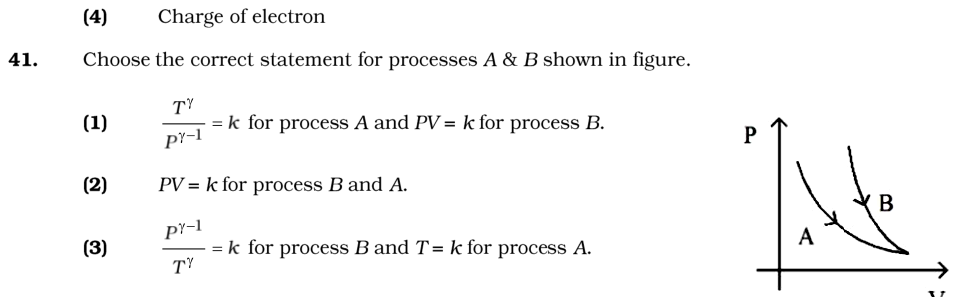
- A. for process A and for process B.
- B. for process B and A.
- C. for process B and for process A.
- D. for process B and for process A.
Correct answer: D
Question 41
Physics · 4 marks · −1Projectiles A and B are thrown at angles of 45° and 60° with vertical respectively from top of a 400 m high tower. If their range and times of flight are same, the ratio of their speeds of projection is: [Take m s]
- A.1 : 2
- B.
- C.
- D.
Correct answer: C
Explanation: Equal times of flight need equal vertical components: .
Question 42
Physics · 4 marks · −1A block of ice at −10°C is slowly heated and converted to steam at 100°C. Which of the following curves represent the phenomenon qualitatively:
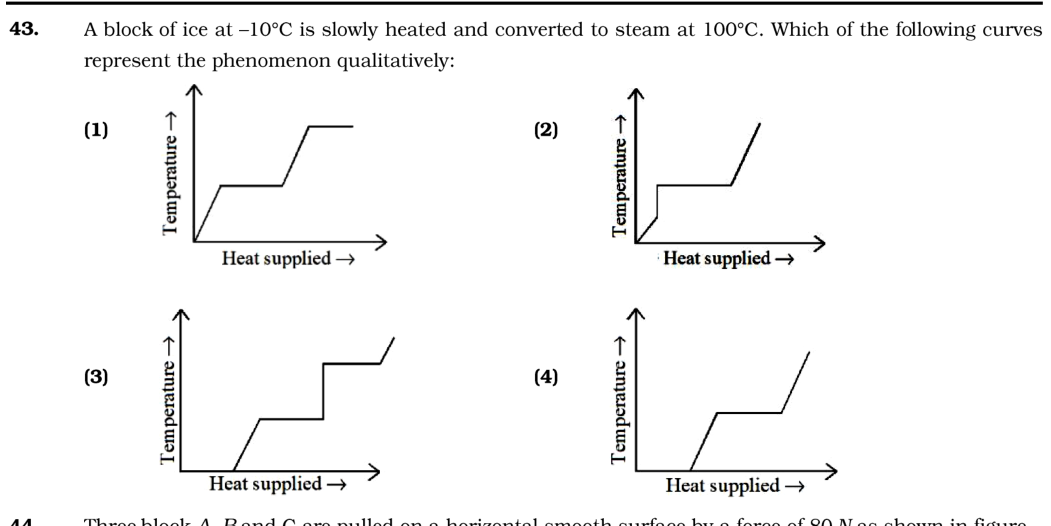
- A.Temperature rises, stays constant, rises, then stays constant (two plateaus, second longer)
- B.Temperature rises, a plateau, then rises steeply (one plateau)
- C.Plateau at the start, rise, plateau, rise
- D.Rise, plateau, rise (single plateau)
Correct answer: A
Explanation: Two phase changes (melting at 0°C, boiling at 100°C) give two plateaus, the second much longer.
Question 43
Physics · 4 marks · −1Three block A, B and C are pulled on a horizontal smooth surface by a force of 80 N as shown in figure. The tension and in the string are respectively:

- A.60 N, 80 N
- B.40 N, 64 N
- C.80 N, 100 N
- D.88 N, 96 N
Correct answer: B
Explanation: m/s²; N, N.
Question 44
Physics · 4 marks · −1An electron revolving in Bohr orbit has magnetic moment . If , the value of is:
- A.3
- B.0
- C.1
- D.2
Correct answer: C
Explanation: .
Question 45
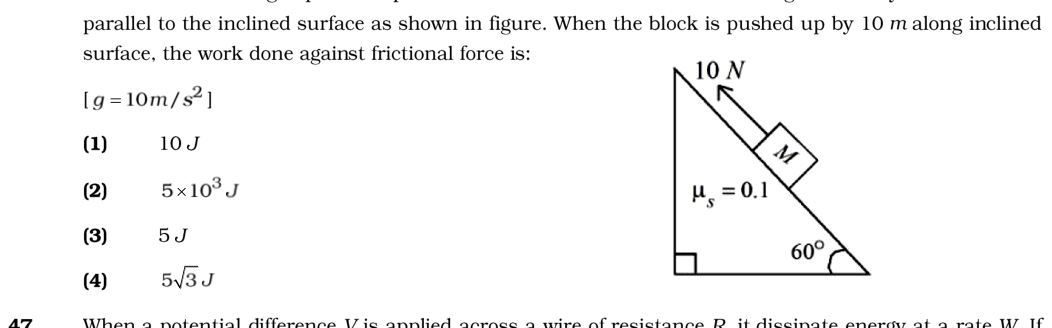
Physics · 4 marks · −1A block of mass 1 kg is pushed up a surface inclined to horizontal at an angle of 60° by a force of 10 N parallel to the inclined surface as shown in figure. When the block is pushed up by 10 m along inclined surface, the work done against frictional force is: [ m/s²]
- A.10 J
- B. J
- C.5 J
- D. J
Correct answer: C
Explanation: J.
Question 46
Physics · 4 marks · −1When a potential difference V is applied across a wire of resistance R, it dissipate energy at a rate W. If the wire is cut into two halve and these halve are connected mutually parallel across the same supply, the energy dissipation rate will become:
- A.4W
- B.
- C.
- D.2W
Correct answer: A
Question 47
Physics · 4 marks · −1Escape velocity of a body from earth is 11.2 km/s. If the radius of a planet be one-third the radius of earth and mass be one-sixth that of earth, the escape velocity from the planet is:
- A.4.2 km/s
- B.8.4 km/s
- C.11.2 km/s
- D.7.9 km/s
Correct answer: D
Explanation: .
Question 48
Physics · 4 marks · −1An alternating voltage volt is applied to a purely resistive load of 50 Ω. The time taken for the current to rise from half of the peak value to the peak value is:
- A.5 ms
- B.3.3 ms
- C.7.2 ms
- D.2.2 ms
Correct answer: B
Explanation: Phase from to : ms.
Question 49
Physics · 4 marks · −1Match List I with List II. List-I: A. Gauss's law of magnetostatics; B. Faraday's law of electro magnetic induction; C. Ampere's Law; D. Gauss's law of electrostatics List-II: I. ; II. ; III. ; IV. Choose the correct answer from the options given below:
- A.A-II, B-III, C-IV, D-I
- B.A-I, B-III, C-IV, D-II
- C.A-III, B-IV, C-I, D-II
- D.A-IV, B-II, C-III, D-I
Correct answer: A
Question 50
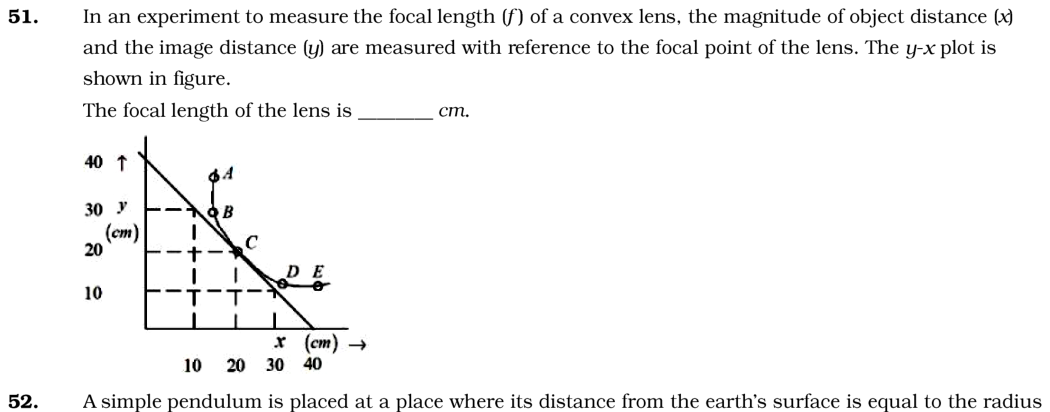
Physics · 4 marks · −1In an experiment to measure the focal length (f) of a convex lens, the magnitude of object distance (x) and the image distance (y) are measured with reference to the focal point of the lens. The y-x plot is shown in figure. The focal length of the lens is ______ cm.
Correct answer: 20
Explanation: Newton's formula ; the symmetric point (20, 20) gives cm.
Question 51
Physics · 4 marks · −1A simple pendulum is placed at a place where its distance from the earth's surface is equal to the radius of the earth. If the length of the string is 4 m, then the time period of small oscillation will be ______ s. [take m s]
Correct answer: 8
Explanation: ; s.
Question 52
Physics · 4 marks · −1A big drop is formed by coalescing 1000 small identical drops of water. If be the total surface energy of 1000 small drops of water and be the surface energy of single big drop of water, then is where ______.
Correct answer: 10
Explanation: ; .
Question 53
Physics · 4 marks · −1Two resistance of 100 Ω and 200 Ω are connected in series with a battery of 4 V and negligible internal resistance. A voltmeter is used to measure voltage across 100 Ω resistance, which give reading as 1 V. The resistance of voltmeter must be ______ Ω.
Correct answer: 200
Explanation: 200 Ω carries 3 V → 15 mA; 100 Ω carries 10 mA, so the voltmeter draws 5 mA at 1 V: 200 Ω.
Question 54
Physics · 4 marks · −1A vector has magnitude same as that of and is parallel to . The and components of this vector in first quadrant are and 3 respectively were ______.
Correct answer: 4
Explanation: .
Question 55
Physics · 4 marks · −1A power transmission line feeds input power at 2.3 kV to a step down transformer with its primary winding having 3000 turns. The output power is delivered at 230 V by the transformer. The current in the primary of the transformer is 5A and it efficiency is 90%. The winding of transformer is made of copper. The output current of transformer is ______ A.
Correct answer: 45
Explanation: A.
Question 56
Physics · 4 marks · −1A point source is emitting sound waves of intensity W m at the origin. The difference in intensity (magnitude only) at two points located at a distance of 2 m and 4 m from the origin respectively will be ______ W m.
Correct answer: 3
Explanation: Taking the given intensity at 1 m: .
Question 57
Physics · 4 marks · −1Two identical charged spheres are suspended by strings of equal lengths. The strings make an angle of 37° with each other. When suspended in a liquid of density 0.7 g/cm³, the angle remains same. If density of material of the sphere is 1.4 g/cm³, the dielectric constant of the liquid is ______ .
Correct answer: 2
Explanation: .
Question 58
Physics · 4 marks · −1The current of 5A flows in a square loop of side 1 m is placed in air. The magnetic field at the centre of the loop is T. The value of X is ______.
Correct answer: 40
Explanation: .
Question 59
Physics · 4 marks · −1Two discs of moment of inertia kg m² and kg m², about their central axes & normal to their planes, rotating with angular speeds 10 rad/s & 4 rad/s respectively are brought into contact face to face with their axes of rotation coincident. The loss in kinetic energy of the system in the process is ______ J.
Correct answer: 24
Explanation: J.
Question 60
Chemistry · 4 marks · −1Salicylaldehyde is synthesized from phenol, when reacted with.
- A., NaOH
- B.Formyl chloride (HCOCl), NaOH
- C., NaOH
- D., NaOH
Correct answer: A
Question 61
Chemistry · 4 marks · −1Given below are two statements: Statement – I: High concentration of strong nucleophilic reagent with secondary alkyl halide which do not have bulky substituents will follow mechanism. Statement – II: A secondary alkyl halide when treated with a large excess of ethanol follows mechanism. In the light of the above statements, choose the most appropriate from the options given below:
- A.Statement I is false but Statement II is true.
- B.Both Statement I and Statement II are false.
- C.Both Statement I and Statement II are true.
- D.Statement I is true but Statement II is false.
Correct answer: C
Question 62
Chemistry · 4 marks · −1Reduction potential of ion are given below: V; V; V. The correct order of their oxidizing power is:
- A.
- B.
- C.
- D.
Correct answer: B
Question 63
Chemistry · 4 marks · −1Given below are two statements: One is labelled as Assertion A and the other is labelled as Reason R: Assertion A: is more acidic than . Reason R: Bond dissociation enthalpy of is lower than . In the light of the above statements, choose the most appropriate from the options given below:
- A.A is true but R is false
- B.Both A and R are true but R is NOT the correct explanation of A.
- C.A is false but R is true.
- D.Both A and R are true and R is the correct explanation of A.
Correct answer: D
Question 64
Chemistry · 4 marks · −1The solution from the following with highest depression in freezing point/lowest freezing point is:
- A.180 g of acetic acid dissolved in water
- B.180 g of glucose dissolved in water
- C.180 g of acetic acid dissolved in benzene
- D.180 g of benzoic acid dissolved in benzene
Correct answer: A
Explanation: 3 mol of acetic acid (no dimerisation in water, slight ionisation) gives the largest number of solute particles.
Question 65
Chemistry · 4 marks · −1If a substance 'A' dissolves in solution of a mixture of 'B' and 'C' with their respective number of moles as , and , Mole fraction of C in the solution is:
- A.
- B.
- C.
- D.
Correct answer: D
Question 66
Chemistry · 4 marks · −1Given below are two statements: Statement-I: Along the period, the chemical reactivity of the element gradually increases from group 1 to group 18. Statement-II: The nature of oxides formed by group 1 elements is basic while that of group 17 elements is acidic. In the light of the above statements, choose the most appropriate from the options given below:
- A.Both Statement I and Statement II are false
- B.Statement I is false but Statement II is true
- C.Both Statement I and Statement II are true
- D.Statement I is true but Statement II is false
Correct answer: B
Question 67
Chemistry · 4 marks · −1Which among the following purification methods is based on the principle of "Solubility" in two different solvents?
- A.Distillation
- B.Differential Extraction
- C.Column Chromatography
- D.Sublimation
Correct answer: B
Question 68
Chemistry · 4 marks · −1Given below are two statement: Statement-I: Since Fluorine is more electronegative than nitrogen, the net dipole moment of is greater than . Statement-II: In , the orbital dipole due to lone pair and the dipole moment of NH bonds are in opposite direction, but in the orbital dipole due to lone pair and dipole moment of N – F bonds are in same direction. In the light of the above statements, choose the most appropriate from the options given below:
- A.Statement I is false but Statement II is true.
- B.Statement I is true but Statement II is false.
- C.Both Statement I and Statement II are false.
- D.Both Statement I and Statement II are true.
Correct answer: C
Explanation: NH (1.47 D) > NF (0.23 D); the directions in Statement II are reversed.
Question 69
Chemistry · 4 marks · −1The coordination geometry around the manganese in decacarbonyldimanganese (0) is:
- A.Square planar
- B.Octahedral
- C.Square pyramidal
- D.Trigonal bipyramidal
Correct answer: B
Question 70
Chemistry · 4 marks · −1Alkaline oxidative fusion of gives "A" which on electrolytic oxidation in alkaline solution produces B. A and B respectively are
- A. and
- B. and
- C. and
- D. and
Correct answer: C
Question 71
Chemistry · 4 marks · −1The correct stability order of carbocations is:
- A.
- B.
- C.
- D.
Correct answer: A
Question 72
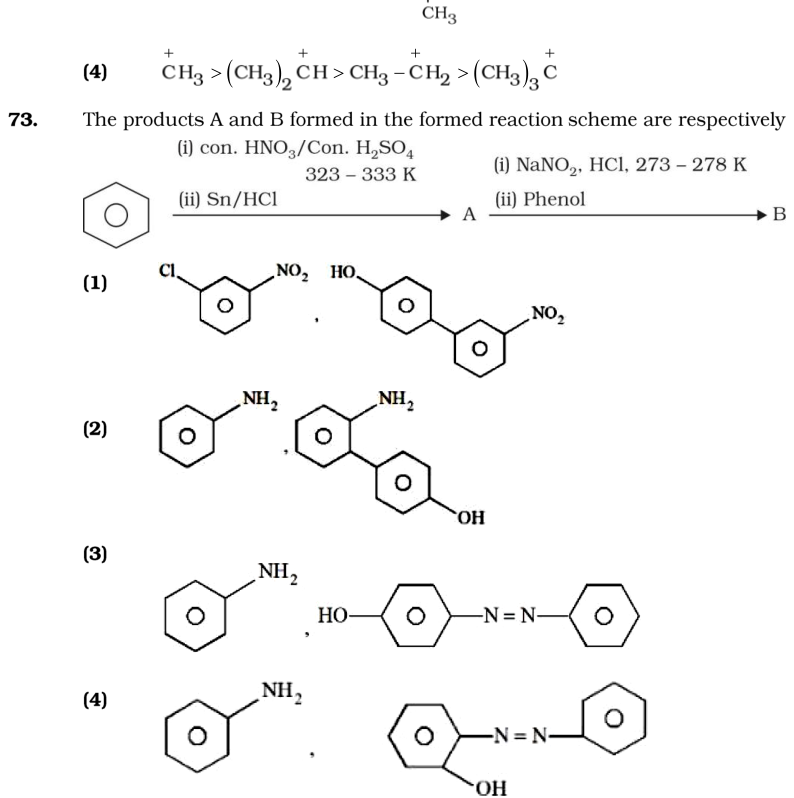
Chemistry · 4 marks · −1The products A and B formed in the following reaction scheme are respectively Benzene A B
- A.1-Chloro-3-nitrobenzene, 3'-nitrobiphenyl-4-ol
- B.Aniline, 2-amino-4'-hydroxybiphenyl
- C.Aniline, 4-hydroxyazobenzene (, para)
- D.Aniline, 2-hydroxyazobenzene (ortho)
Correct answer: C
Explanation: Nitration, reduction to aniline, diazotisation and para coupling with phenol.
Question 73
Chemistry · 4 marks · −1A and B formed in the following reactions are:
- A.A = , B =
- B.A = , B =
- C.A = , B =
- D.A = , B =
Correct answer: D
Question 74
Chemistry · 4 marks · −1Choose the correct statements about the hydrides of group 15 elements. A. The stability of the hydrides decreases in the order B. The reducing ability of the hydride increases in the order C. Among the hydrides, is strong reducing agent while is mild reducing agent. D. The basicity of the hydrides increases in the order .
- A.B and C only
- B.A and D only
- C.C and D only
- D.A and B only
Correct answer: D
Question 75
Chemistry · 4 marks · −1The molecule / ion with square pyramidal shape is:
- A.
- B.
- C.
- D.
Correct answer: C
Question 76
Chemistry · 4 marks · −1IUPAC name of following compound is:
- A.2-Aminobutanenitrile
- B.2-Aminopentanenitrile
- C.3-Aminopropanenitrile
- D.3-Aminobutanenitrile
Correct answer: D
Question 77
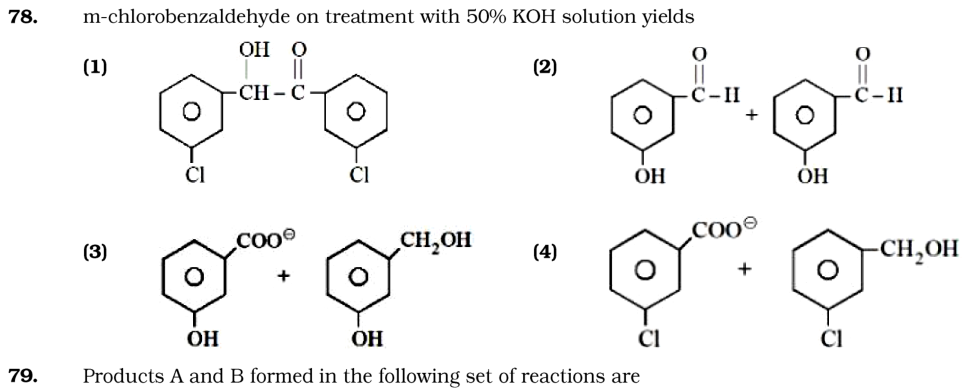
Chemistry · 4 marks · −1m-chlorobenzaldehyde on treatment with 50% KOH solution yields
- A.2-hydroxy-1,2-bis(3-chlorophenyl)ethanone (benzoin-type product)
- B.3-hydroxybenzaldehyde (two molecules)
- C.3-hydroxybenzoate + 3-hydroxybenzyl alcohol
- D.3-chlorobenzoate + 3-chlorobenzyl alcohol
Correct answer: D
Explanation: Cannizzaro disproportionation of a non-enolisable aldehyde.
Question 78
Chemistry · 4 marks · −1Products A and B formed in the following set of reactions are 1-Methylcyclohexene: A; B
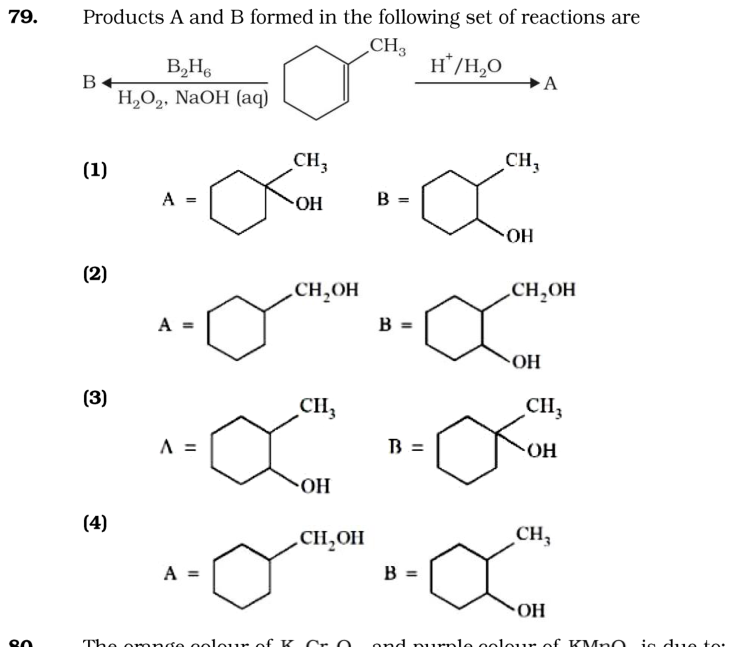
- A.A = 1-methylcyclohexan-1-ol; B = 2-methylcyclohexan-1-ol
- B.A = cyclohexylmethanol; B = 2-(hydroxymethyl)cyclohexan-1-ol
- C.A = 2-methylcyclohexan-1-ol; B = 1-methylcyclohexan-1-ol
- D.A = cyclohexylmethanol; B = 2-methylcyclohexan-1-ol
Correct answer: A
Explanation: Acid-catalysed hydration is Markovnikov; hydroboration–oxidation is anti-Markovnikov.
Question 79
Chemistry · 4 marks · −1The orange colour of and purple colour of is due to:
- A.d → d transitions in and charge transfer transitions in .
- B.d → d transitions in and charge transfer transitions in .
- C.Charge transfer transition in both.
- D.d → d transitions in both.
Correct answer: C
Explanation: Both are d: colour from ligand-to-metal charge transfer.
Question 80
Chemistry · 4 marks · −1Number of metal ions characterized by flame test among the following is ______. , , , , , ,
Correct answer: 4
Explanation: Sr, Ba, Ca, Cu.
Question 81
Chemistry · 4 marks · −1The total number of correct statements, regarding the nucleic acids is ______. A. RNA is regarded as the reserve of genetic information. B. DNA molecule self-duplicates during cell division. C. DNA synthesizes proteins in the cell D. The message for the syntheses of particular proteins is present in DNA E. Identical DNA strands are transferred to daughter cells.
Correct answer: 3
Explanation: B, D, E are correct.
Question 82
Chemistry · 4 marks · −12 – chlorobutane + → (isomers) Total number of optically active isomers shown by , obtained in the above reaction is ______.
Correct answer: 3
Question 83
Chemistry · 4 marks · −1required for a reaction is produced by decomposition of in as by equation . The initial concentration of is 3 mol L and it is 2.75 mol L after 30 minutes. The rate of formation of is mol L min, value of is ______. (nearest integer).
Correct answer: 17
Explanation: ; NO forms twice as fast: .
Question 84
Chemistry · 4 marks · −1Number of geometrical isomers possible for the given structure is/are ______.
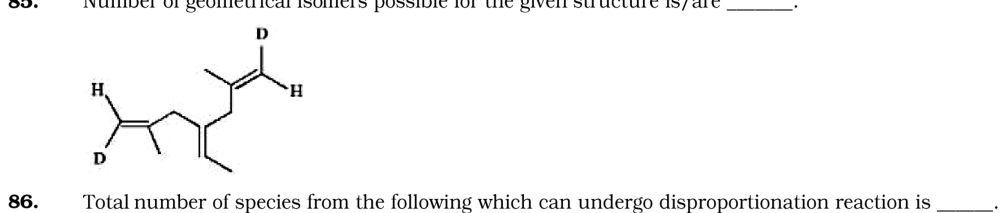
Correct answer: 4
Question 85
Chemistry · 4 marks · −1Total number of species from the following which can undergo disproportionation reaction is ______. , , , , Ag, , , ,
Correct answer: 6
Explanation: HO, ClO, P, Cl, Cu, NO.
Question 86
Chemistry · 4 marks · −1Number of complexes which show optical isomerism among the following is ______. cis-, , cis-, cis-, trans-, trans-
Correct answer: 4
Explanation: All four cis/tris-chelate complexes; the trans ones have a mirror plane.
Question 87
Chemistry · 4 marks · −1The pH of an aqueous solution containing 1M benzoic acid () and 1M sodium benzoate is 4.5. The volume of benzoic acid solution in 300 mL of this buffer solution is ______ mL. (given : log2 = 0.3)
Correct answer: 100
Explanation: : acid 100 mL, salt 200 mL.
Question 88
Chemistry · 4 marks · −1Number of spectral lines obtained in spectra, when an electron makes transition from fifth excited state to first excited state will be:
Correct answer: 10
Explanation: : .
Question 89
Chemistry · 4 marks · −1Two reactions are given below: , kJ/mol , kJ/mol Then enthalpy change for following reaction is ______ kJ/mol.
Correct answer: 492
Explanation: .