JEE Main 2024 — 4 Apr Shift 1 (Previous Year Paper)
JEE Main · 2024 · with answers and explanations
- questions
- 85
- Total marks
- 284
- Duration
- 180 minutes
- Negative marking
- −1
Subjects: Physics · Chemistry · Mathematics
Question 1
Physics · 4 marks · −1In an experiment to measure focal length of convex lens, the least counts of the measuring scales for the position of object and for the position of image are and , respectively. The error in the measurement of the focal length of the convex lens will be:
- A.
- B.
- C.
- D.
Correct answer: C
Explanation: Differentiating : .
Question 2
Physics · 4 marks · −1The equation of stationary wave is: . Which of the following is NOT correct:
- A.The dimensions of is [T]
- B.The dimensions of is
- C.The dimensions of is [L]
- D.The dimensions of is [L]
Correct answer: A
Explanation: is dimensionless, so and .
Question 3
Physics · 4 marks · −1A body travels 102.5 m in second and 115.0 m in second. The acceleration is:
- A.6.25 m/s²
- B.12.5 m/s²
- C.9 m/s²
- D.5 m/s²
Correct answer: A
Explanation: .
Question 4
Physics · 4 marks · −1The co-ordinates of a particle moving in plane are given by: , . The motion of the particle is:
- A.uniformly accelerated having motion along a parabolic path.
- B.uniform motion along a straight line.
- C.uniformly accelerated having motion along a straight line.
- D.non-uniformly accelerated.
Correct answer: A
Explanation: is constant and not parallel to .
Question 5
Physics · 4 marks · −1If a rubber ball falls from a height and rebounds upto the height of . The percentage loss of total energy of the initial system as well as velocity ball before it strikes the ground, respectively, are:
- A.50%,
- B.50%,
- C.40%,
- D.50%,
Correct answer: A
Question 6
Physics · 4 marks · −1A metal wire of uniform mass density having length and mass is bent to form a semicircular arc and a particle of mass is placed at the centre of the arc. The gravitational force on the particle by the wire is:
- A.
- B.
- C.0
- D.
Correct answer: D
Explanation: ; .
Question 7
Physics · 4 marks · −1Given below are two statements: Statement I : When speed of liquid is zero everywhere, pressure difference at any two points depends on equation . Statement II : In ventury tube shown . In the light of the above statements, choose the most appropriate answer from the options given below.
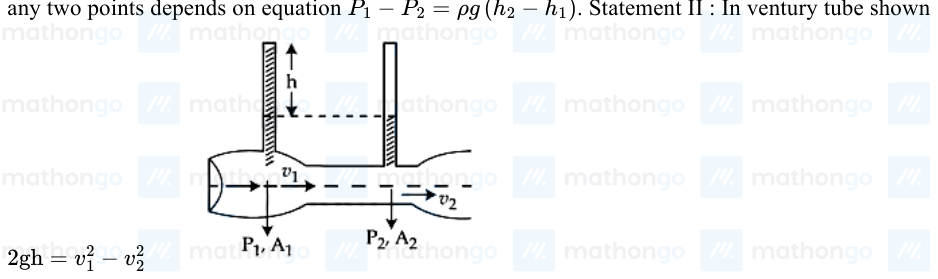
- A.Both Statement I and Statement II are correct.
- B.Statement I is correct but Statement II is incorrect.
- C.Statement I is incorrect but Statement II is correct.
- D.Both Statement I and Statement II are incorrect.
Correct answer: B
Explanation: Flow is faster at the throat: .
Question 8
Physics · 4 marks · −1The resistances of the platinum wire of a platinum resistance thermometer at the ice point and steam point are 8Ω and 10Ω respectively. After inserting in a hot bath of temperature 400°C, the resistance of platinum wire is:
- A.10Ω
- B.8Ω
- C.16Ω
- D.2Ω
Correct answer: C
Explanation: .
Question 9
Physics · 4 marks · −1On celcius scale the temperature of body increases by 40°C. The increase in temperature on Fahrenheit scale is:
- A.68°F
- B.75°F
- C.72°F
- D.70°F
Correct answer: C
Question 10
Physics · 4 marks · −1P-T diagram of an ideal gas having three different densities (in three different cases) is shown in the figure. Which of the following is correct:
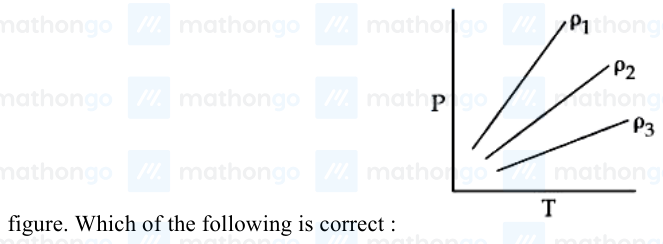
- A.
- B.
- C.
- D.
Correct answer: A
Explanation: : slope ∝ ρ.
Question 11
Physics · 4 marks · −1An infinitely long positively charged straight thread has a linear charge density λ C/m. An electron revolves along a circular path having axis along the length of the wire. The graph that correctly represents the variation of the kinetic energy of electron as a function of radius of circular path from the wire is:
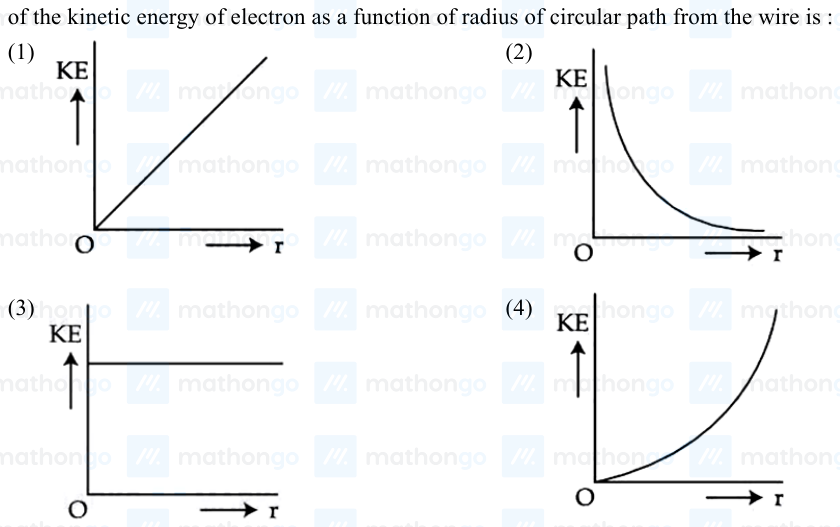
- A.KE increases linearly with r
- B.KE decreases (hyperbola-like) with r
- C.KE constant (horizontal line)
- D.KE increases non-linearly with r
Correct answer: C
Explanation: , so KE is independent of r.
Question 12
Physics · 4 marks · −1To measure the internal resistance of a battery, potentiometer is used. For R = 10Ω, the balance point is observed at = 500 cm and for R = 1Ω the balance point is observed at = 400 cm. The internal resistance of the battery is approximately:
- A.0.2Ω
- B.0.3Ω
- C.0.4Ω
- D.0.1Ω
Correct answer: B
Explanation: .
Question 13
Physics · 4 marks · −1An electron is projected with uniform velocity along the axis inside a current carrying long solenoid. Then:
- A.the electron will continue to move with uniform velocity along the axis of the solenoid.
- B.the electron will be accelerated along the axis.
- C.the electron path will be circular about the axis.
- D.the electron will experience a force at 45° to the axis and execute a helical path.
Correct answer: A
Question 14
Physics · 4 marks · −1In an ac circuit, the instantaneous current is zero, when the instantaneous voltage is maximum. In this case, the source may be connected to: A. pure inductor. B. pure capacitor. C. pure resistor. D. combination of an inductor and capacitor. Choose the correct answer from the options given below:
- A.A, B and C only
- B.A and B only
- C.B, C and D only
- D.A, B and D only
Correct answer: D
Question 15
Physics · 4 marks · −1The electric field in an electromagnetic wave is given by N C. The magnetic field induction of this wave is (in SI unit):
- A.
- B.
- C.
- D.
Correct answer: D
Question 16
Physics · 4 marks · −1An effective power of a combination of 5 identical convex lenses which are kept in contact along the principal axis is 25D. Focal length of each of the convex lens is:
- A.20 cm
- B.50 cm
- C.500 cm
- D.25 cm
Correct answer: A
Question 17
Physics · 4 marks · −1Which figure shows the correct variation of applied potential difference (V) with photoelectric current (I) at two different intensities of light of same wavelengths:
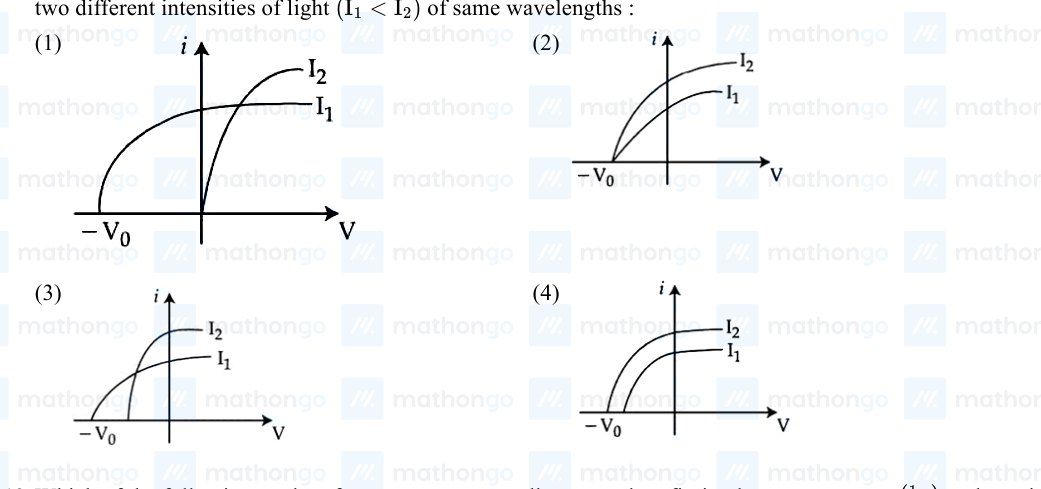
- A.Curves for and with different cut-off voltages
- B.Both curves start at the same stopping potential ; saturates higher than
- C.Curves with different stopping potentials, higher
- D.Both from with and crossing
Correct answer: B
Explanation: Stopping potential depends only on frequency; saturation current ∝ intensity.
Question 18
Physics · 4 marks · −1Which of the following nuclear fragments corresponding to nuclear fission between neutron and uranium isotope is correct:
- A.
- B.
- C.
- D.
Correct answer: B
Explanation: Mass number 236 and charge 92 must balance.
Question 19
Physics · 4 marks · −1The value of net resistance of the network as shown in the given figure is:
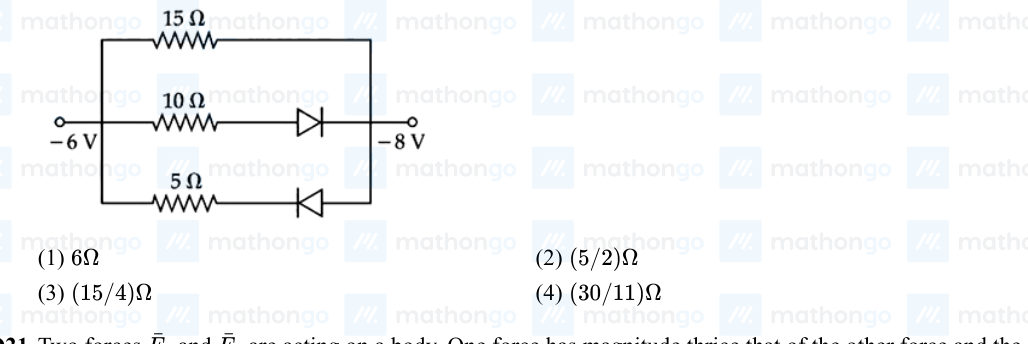
- A.6Ω
- B.(5/2)Ω
- C.(15/4)Ω
- D.(30/11)Ω
Correct answer: A
Explanation: The 5 Ω branch is blocked; .
Question 20
Physics · 4 marks · −1Two forces and are acting on a body. One force has magnitude thrice that of the other force and the resultant of the two forces is equal to the force of larger magnitude. The angle between and is . The value of is ______.
Correct answer: 6
Explanation: .
Question 21
Physics · 4 marks · −1A solid sphere and a hollow cylinder roll up without slipping on same inclined plane with same initial speed . The sphere and the cylinder reaches upto maximum heights and , respectively, above the initial level. The ratio is . The value of is ______.
Correct answer: 7
Explanation: , .
Question 22
Physics · 4 marks · −1An elastic spring under tension of 3 N has a length . Its length is under tension 2 N. For its length , the value of tension will be ______ N.
Correct answer: 5
Explanation: : N.
Question 23
Physics · 4 marks · −1A soap bubble is blown to a diameter of 7 cm. 36960 erg of work is done in blowing it further. If surface tension of soap solution is 40 dyne/cm then the new radius is ______ cm. Take
Correct answer: 7
Explanation: .
Question 24
Physics · 4 marks · −1An infinite plane sheet of charge having uniform surface charge density C/m² is placed on plane. Another infinitely long line charge having uniform linear charge density C/m is placed at m plane and parallel to y-axis. If the magnitude values then at point (0, 0, 2), the ratio of magnitudes of electric field values due to sheet charge to that of line charge is . The value of is ______.
Correct answer: 16
Explanation: .
Question 25
Physics · 4 marks · −1Twelve wires each having resistance 2Ω are joined to form a cube. A battery of 6 V emf is joined across point a and c. The voltage difference between e and f is ______ V.
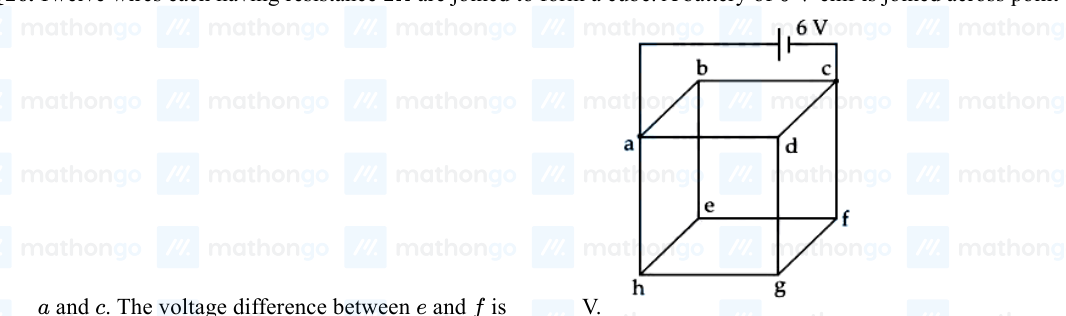
Correct answer: 1
Question 26
Physics · 4 marks · −1The magnetic field existing in a region is given by T. A square loop of edge 50 cm carrying 0.5 A current is placed in plane with its edges parallel to the axes, as shown in figure. The magnitude of the net magnetic force experienced by the loop is ______ mN.
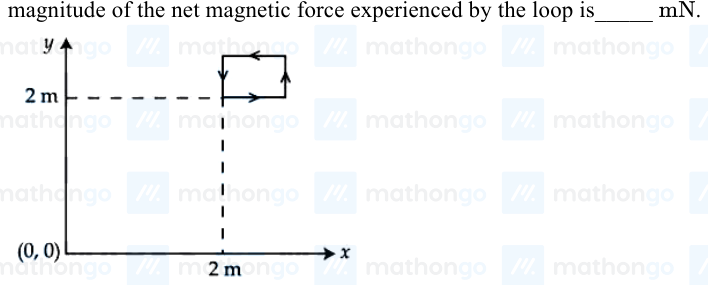
Correct answer: 50
Explanation: Forces on the two edges parallel to y differ: N.
Question 27
Physics · 4 marks · −1A alternating current at any instant is given by A. The rms value of the current is ______ A.
Correct answer: 8
Explanation: .
Question 28
Physics · 4 marks · −1Two wavelengths and are used in Young's double slit experiment. nm and nm. The minimum order of fringe produced by which overlaps with the fringe produced by is . The value of is ______.
Correct answer: 9
Explanation: : .
Question 29
Physics · 4 marks · −1A hydrogen atom changes its state from to . Due to recoil, the percentage change in the wave length of emitted light is approximately . The value of is ______. [Given Rhc = 13.6 eV, hc = 1242 eV nm, h = J s mass of the hydrogen atom = kg]
Correct answer: 7
Explanation: , i.e. .
Question 30
Chemistry · 4 marks · −1Number of elements from the following that CANNOT form compounds with valencies which match with their respective group valencies is ______. B, C, N, S, O, F, P, Al, Si
- A.7
- B.3
- C.5
- D.6
Correct answer: B
Explanation: N (max covalency 4), O and F cannot show their group valency.
Question 31
Chemistry · 4 marks · −1The correct order of first ionization enthalpy values of the following elements is: (A) O (B) N (C) Be (D) F (E) B. Choose the correct answer from the options given below:
- A.E < C < A < B < D
- B.C < E < A < B < D
- C.B < D < C < E < A
- D.A < B < D < C < E
Correct answer: A
Explanation: B (801) < Be (899) < O (1314) < N (1402) < F (1681) kJ/mol.
Question 32
Chemistry · 4 marks · −1Which one of the following molecules has maximum dipole moment?
- A.
- B.
- C.
- D.
Correct answer: D
Question 33
Chemistry · 4 marks · −1Number of molecules/ions from the following in which the central atom is involved in hybridization is: , , ,
- A.4
- B.3
- C.2
- D.1
Correct answer: C
Explanation: ClO and ClO (ClO).
Question 34
Chemistry · 4 marks · −1Match List I with List II: List-I (Mechanism steps): (A) resonance in aniline (lone pair on N delocalised into the ring); (B) cyclohexene + H → secondary carbocation (π electrons move towards H); (C) cyclohexene + CN → carbanion (π electrons move away from the attacking nucleophile); (D) resonance in nitrobenzene (ring π electrons delocalised onto the NO group) List-II (Effect): (I) −E effect; (II) −R effect; (III) +E effect; (IV) +R effect Choose the correct answer from the options given below:
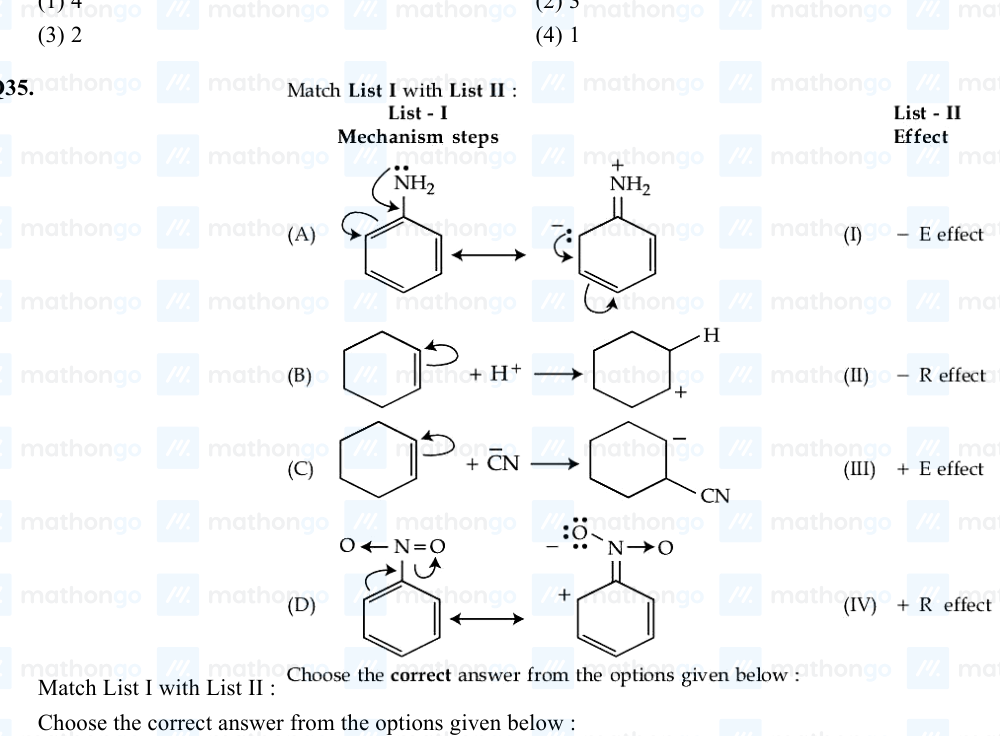
- A.(A)-(IV), (B)-(III), (C)-(I), (D)-(II)
- B.(A)-(I), (B)-(II), (C)-(IV), (D)-(III)
- C.(A)-(III), (B)-(I), (C)-(II), (D)-(IV)
- D.(A)-(II), (B)-(IV), (C)-(III), (D)-(I)
Correct answer: A
Question 35
Chemistry · 4 marks · −1Which of the following nitrogen containing compound does not give Lassaigne's test?
- A.Urea
- B.Phenyl hydrazine
- C.Glycene
- D.Hydrazine
Correct answer: D
Explanation: Hydrazine has no carbon, so no NaCN forms on fusion.
Question 36
Chemistry · 4 marks · −1Which among the following is incorrect statement?
- A.Electromeric effect dominates over inductive effect
- B.The electromeric effect is, temporary effect
- C.Hydrogen ion (H) shows negative electromeric effect
- D.The organic compound shows electromeric effect in the presence of the reagent only.
Correct answer: C
Explanation: Attack by an electrophile such as H produces a +E effect.
Question 37
Chemistry · 4 marks · −1(A) 1-bromo-4-(2-bromoethyl)benzene (-) (B) (C). Identify (B) and (C) and how are (A) and (C) related?
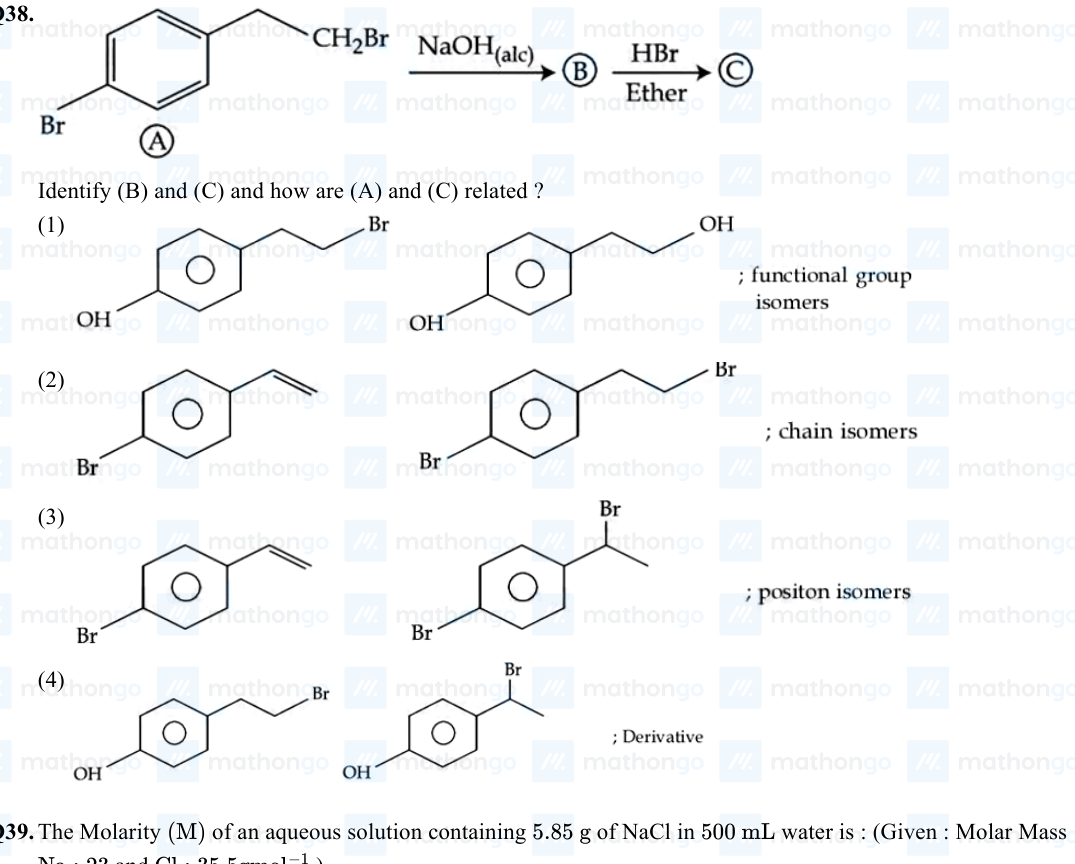
- A.B = 4-(2-bromoethyl)phenol, C = 4-(2-hydroxyethyl)phenol; functional group isomers
- B.B = 4-bromostyrene, C = 1-bromo-4-(2-bromoethyl)benzene; chain isomers
- C.B = 4-bromostyrene, C = 1-bromo-4-(1-bromoethyl)benzene; position isomers
- D.B = 4-(2-bromoethyl)phenol, C = 4-(1-bromoethyl)phenol; derivative
Correct answer: C
Explanation: Dehydrohalogenation gives 4-bromostyrene; Markovnikov addition of HBr gives the benzylic bromide, a position isomer of A.
Question 38
Chemistry · 4 marks · −1The Molarity (M) of an aqueous solution containing 5.85 g of NaCl in 500 mL water is: (Given : Molar Mass Na : 23 and Cl : 35.5 g mol)
- A.2
- B.20
- C.4
- D.0.2
Correct answer: D
Question 39
Chemistry · 4 marks · −1What pressure (bar) of would be required to make emf of hydrogen electrode zero in pure water at 25°C?
- A.
- B.0.5
- C.1
- D.
Correct answer: D
Explanation: bar.
Question 40
Chemistry · 4 marks · −1One of the commonly used electrode is calomel electrode. Under which of the following categories, calomel electrode comes?
- A.Oxidation - Reduction electrodes
- B.Metal ion - Metal electrodes
- C.Gas - Ion electrodes
- D.Metal - Insoluble Salt - Anion electrodes
Correct answer: D
Question 41
Chemistry · 4 marks · −1What will be the decreasing order of basic strength of the following conjugate bases? OH, R, CHCO, C
- A.R > OH > CHCO > C
- B.C > R > OH > CHCO
- C.OH > R > CHCO > C
- D.C > OH > R > CHCO
Correct answer: A
Question 42
Chemistry · 4 marks · −1The element which shows only one oxidation state other than its elemental form is:
- A.Cobalt
- B.Titanium
- C.Nickel
- D.Scandium
Correct answer: D
Question 43
Chemistry · 4 marks · −1Number of complexes from the following with even number of unpaired "d" electrons is , , , , [Given atomic numbers : V = 23, Cr = 24, Fe = 26, Ni = 28 Cu = 29]
- A.2
- B.1
- C.4
- D.5
Correct answer: A
Explanation: V (2) and Cr (4) are even; Fe (5), Ni (3), Cu (1) are odd.
Question 44
Chemistry · 4 marks · −1The correct sequence of ligands in the order of decreasing field strength is:
- A.NCS > EDTA > CN > CO
- B.CO > HO > F > S
- C.S > OH > EDTA > CO
- D.OH > F > NH > CN
Correct answer: B
Question 45
Chemistry · 4 marks · −1Identify the correct set of reagents or reaction conditions 'X' and 'Y' in the following set of transformation: Product
- A.X = dil.aq. NaOH, 20°C, Y = Br/CHCl
- B.X = conc.alc. NaOH, 80°C, Y = Br/CHCl
- C.X = dil.aq. NaOH, 20°C, Y = HBr/acetic acid
- D.X = conc.alc. NaOH, 80°C, Y = HBr/acetic acid
Correct answer: D
Question 46
Chemistry · 4 marks · −1Given below are two statements: Statements I : Acidity of α-hydrogens of aldehydes and ketones is responsible for Aldol reaction. Statement II : Reaction between benzaldehyde and ethanal will NOT give Cross - Aldol product. In the light of the above statements, choose the most appropriate answer from the options given below:
- A.Statement I is correct but Statement II is incorrect
- B.Both Statement I and Statement II are correct
- C.Both Statement I and Statement II are incorrect
- D.Statement I is incorrect but Statement II is correct
Correct answer: A
Question 47
Chemistry · 4 marks · −1In the precipitation of the iron group (III) in qualitative analysis, ammonium chloride is added before adding ammonium hydroxide to:
- A.increase concentration of Cl ions
- B.increase concentration of NH ions
- C.prevent interference by phosphate ions
- D.decrease concentration of OH ions
Correct answer: D
Question 48
Chemistry · 4 marks · −1Which of the following is the correct structure of L-Glucose?
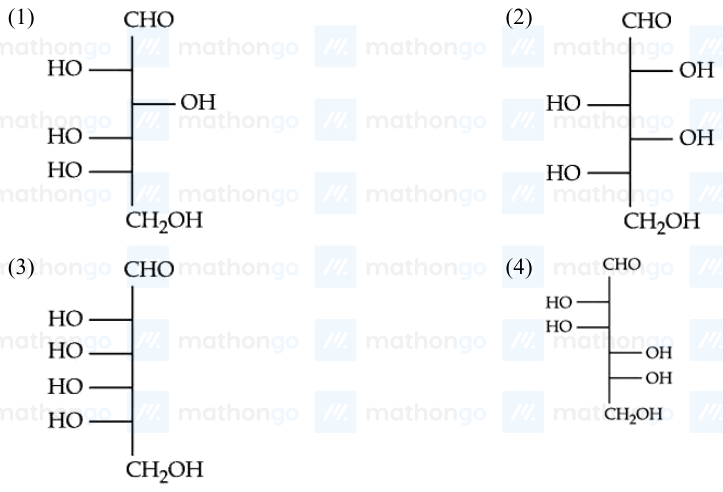
- A.Fischer projection (C2→C5): HO left, OH right, HO left, HO left
- B.OH right, HO left, OH right, OH right... as drawn (D-glucose-like pattern)
- C.HO left on all four stereocentres
- D.HO, HO left; OH, OH right
Correct answer: A
Explanation: L-glucose is the mirror image of D-glucose (D: right, left, right, right at C2–C5).
Question 49
Chemistry · 4 marks · −1The de-Broglie's wavelength of an electron in the orbit is ______ . ( = Bohr's radius)
Correct answer: 8
Explanation: .
Question 50
Chemistry · 4 marks · −1Number of molecules/species from the following having one unpaired electron is ______. , , NO, CN,
Correct answer: 2
Explanation: O and NO.
Question 51
Chemistry · 4 marks · −1The enthalpy of formation of ethane () from ethylene by addition of hydrogen where the bond-energies of C–H, C–C, C=C, H–H are 414 kJ, 347 kJ, 615 kJ and 435 kJ respectively is ______ kJ.
Correct answer: 125
Explanation: kJ.
Question 52
Chemistry · 4 marks · −1Only 2 mL of solution of unknown molarity is required to reach the end point of a titration of 20 mL of oxalic acid (2M) in acidic medium. The molarity of solution should be ______ M.
Correct answer: 8
Explanation: .
Question 53
Chemistry · 4 marks · −1The number of different chain isomers for is ______.
Correct answer: 9
Question 54
Chemistry · 4 marks · −12.5 g of a non-volatile, non-electrolyte is dissolved in 100 g of water at 25°C. The solution showed a boiling point elevation by 2°C. Assuming the solute concentration is negligible with respect to the solvent concentration, the vapor pressure of the resulting aqueous solution is ______ mm of Hg (nearest integer) [Given : Molal boiling point elevation constant of water K kg mol, 1 atm pressure = 760 mm of Hg, molar mass of water = 18 g mol]
Correct answer: 707
Explanation: ; ; mm Hg.
Question 55
Chemistry · 4 marks · −1Consider the following transformation involving first order elementary reaction in each step at constant temperature as shown below. . Some details of the above reactions are listed below. | Step | Rate constant (s) | Activation energy (kJ mol) | | 1 | | 300 | | 2 | | 200 | | 3 | | | If the overall rate constant of the above transformation (k) is given as and the overall activation energy is 400 kJ mol, then the value of is ______ kJ mol (nearest integer)
Correct answer: 100
Explanation: .
Question 56
Chemistry · 4 marks · −1Consider the following reaction . Product 'A' in neutral or acidic medium disproportionate to give products 'B' and 'C' along with water. The sum of spin-only magnetic moment values of B and C is ______ BM. (nearest integer) (Given atomic number of Mn is 25)
Correct answer: 4
Explanation: A = KMnO → MnO (d, 0 BM) + MnO (d, 3.87 BM).
Question 57
Chemistry · 4 marks · −1The number of the correct reaction(s) among the following is ______. (A) Benzene + benzoyl chloride diphenylmethane (B) Benzoyl chloride benzoic acid (C) Benzene benzaldehyde (D) Benzamide aniline
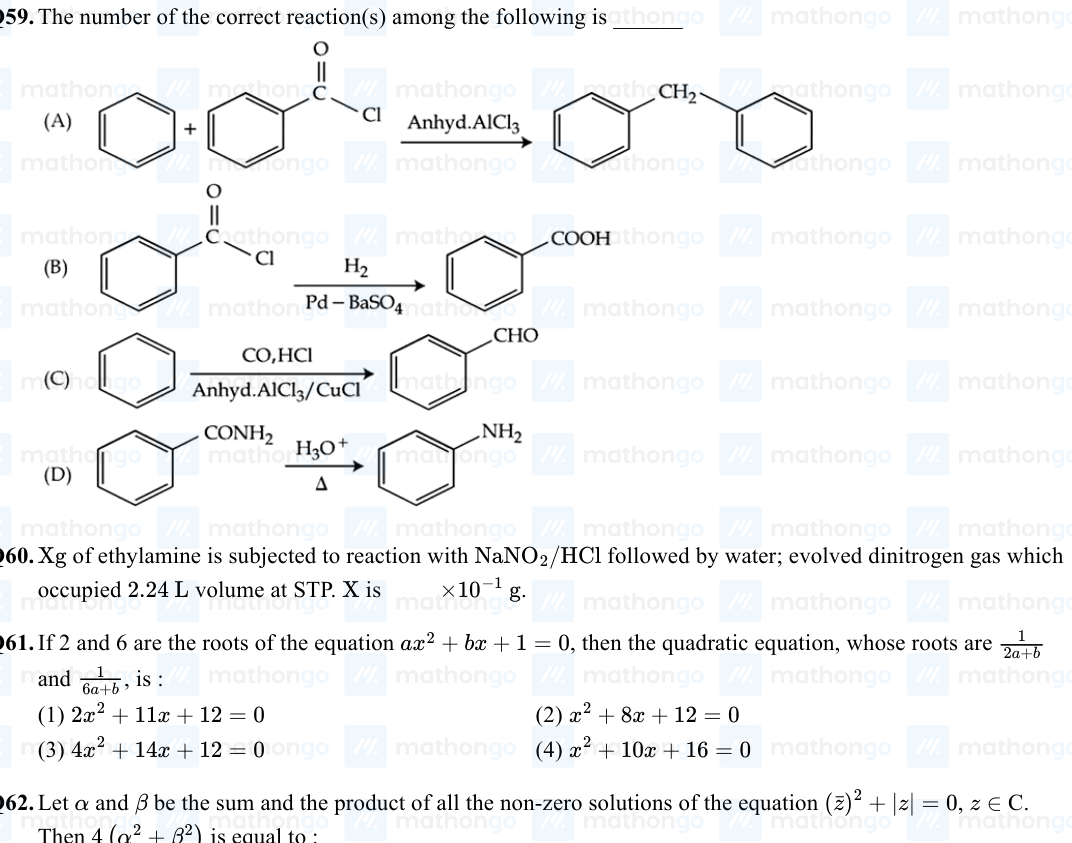
Correct answer: 1
Explanation: Only the Gattermann–Koch reaction (C) is correct.
Question 58
Chemistry · 4 marks · −1X g of ethylamine is subjected to reaction with NaNO/HCl followed by water; evolved dinitrogen gas which occupied 2.24 L volume at STP. X is ______ g.
Correct answer: 45
Explanation: 0.1 mol N ⇒ 0.1 mol CHNH = 4.5 g.
Question 59
Mathematics · 4 marks · −1If 2 and 6 are the roots of the equation , then the quadratic equation, whose roots are and , is:
- A.
- B.
- C.
- D.
Correct answer: B
Explanation: , ; roots −2 and −6.
Question 60
Mathematics · 4 marks · −1Let α and β be the sum and the product of all the non-zero solutions of the equation , . Then is equal to:
- A.6
- B.8
- C.2
- D.4
Correct answer: D
Explanation: Non-zero solutions are : , .
Question 61
Mathematics · 4 marks · −1There are 5 points on the side AB, excluding A and B, of a triangle ABC. Similarly there are 6 points on the side BC and 7 points on the side CA of the triangle. The number of triangles, that can be formed using the points as vertices, is:
- A.776
- B.796
- C.751
- D.771
Correct answer: C
Explanation: .
Question 62
Mathematics · 4 marks · −1Let the first three terms 2, p and q, with , of a G.P. be respectively the , and terms of an A.P. If the term of the G.P. is the term of the A.P., then n is equal to:
- A.163
- B.151
- C.177
- D.169
Correct answer: A
Explanation: , ratio 5; .
Question 63
Mathematics · 4 marks · −1The sum of all rational terms in the expansion of is equal to:
- A.3133
- B.931
- C.6131
- D.633
Correct answer: A
Explanation: Only the first and last terms are rational: .
Question 64
Mathematics · 4 marks · −1The vertices of a triangle are A(−1, 3), B(−2, 2) and C(3, −1). A new triangle is formed by shifting the sides of the triangle by one unit inwards. Then the equation of the side of the new triangle nearest to origin is:
- A.
- B.
- C.
- D.
Correct answer: C
Explanation: Side AC: is nearest the origin; shifting it one unit towards the interior gives .
Question 65
Mathematics · 4 marks · −1A square is inscribed in the circle . One side of this square is parallel to . If are the vertices of the square, then is equal to:
- A.148
- B.152
- C.160
- D.156
Correct answer: B
Explanation: Centre (5, 3), radius 2; vertices .
Question 66
Mathematics · 4 marks · −1Let . Let the mean and the variance of 6 observations −3, 4, 7, −6, α, β be 2 and 23, respectively. The mean deviation about the mean of these 6 observations is:
- A.
- B.
- C.
- D.
Correct answer: A
Explanation: , : {6, 4}; deviations 5, 2, 5, 8, 4, 2.
Question 67
Mathematics · 4 marks · −1Let and . If , then is equal to:
- A.36
- B.16
- C.1
- D.49
Correct answer: B
Explanation: , so the product of determinants is ; ; .
Question 68
Mathematics · 4 marks · −1If the system of equations , , has a non-trivial solution, then is equal to:
- A.
- B.
- C.
- D.
Correct answer: B
Explanation: .
Question 69
Mathematics · 4 marks · −1If the domain of the function is , then is equal to:
- A.100
- B.95
- C.97
- D.98
Correct answer: C
Explanation: The condition gives ; the log condition keeps there: domain , .
Question 70
Mathematics · 4 marks · −1Let the sum of the maximum and the minimum values of the function be , where gcd(m, n) = 1. Then m + n is equal to:
- A.195
- B.201
- C.217
- D.182
Correct answer: B
Explanation: Range endpoints satisfy : ; sum .
Question 71
Mathematics · 4 marks · −1Let be a function given by , where . If f is continuous at x = 0, then is equal to:
- A.3
- B.12
- C.48
- D.6
Correct answer: B
Explanation: , .
Question 72
Mathematics · 4 marks · −1Let for all . Consider a function g(x) such that for all . Then the value of is:
- A.2
- B.8
- C.4
- D.16
Correct answer: D
Explanation: , , so .
Question 73
Mathematics · 4 marks · −1Let and . Then is equal to:
- A.1
- B.6
- C.4
- D.2
Correct answer: D
Explanation: on and 0 on .
Question 74
Mathematics · 4 marks · −1If the solution of the differential equation satisfies , then is equal to:
- A.
- B.
- C.0
- D.
Correct answer: D
Explanation: The denominator is and the integrand splits as : .
Question 75
Mathematics · 4 marks · −1Let the point, on the line passing through the points P(1, −2, 3) and Q(5, −4, 7), farther from the origin and at distance of 9 units from the point P, be . Then is equal to:
- A.165
- B.160
- C.155
- D.150
Correct answer: C
Explanation: Candidates : (7, −5, 9) is farther.
Question 76
Mathematics · 4 marks · −1Three urns A, B and C contain 7 red, 5 black; 5 red, 7 black and 6 red, 6 black balls, respectively. One of the urn is selected at random and a ball is drawn from it. If the ball drawn is black, then the probability that it is drawn from urn A is:
- A.
- B.
- C.
- D.
Correct answer: A
Explanation: .
Question 77
Mathematics · 4 marks · −1Let , . Then is equal to ______.
Correct answer: 8
Explanation: sums to , so ; ; .
Question 78
Mathematics · 4 marks · −1Let the length of the focal chord PQ of the parabola be 15 units. If the distance of PQ from the origin is p, then is equal to ______.
Correct answer: 72
Explanation: ; .
Question 79
Mathematics · 4 marks · −1If , where gcd(m, n) = 1, then 8m + 12n is equal to ______.
Correct answer: 100
Question 80
Mathematics · 4 marks · −1In a survey of 220 students of a higher secondary school, it was found that at least 125 and at most 130 students studied Mathematics; at least 85 and at most 95 studied Physics; at least 75 and at most 90 studied Chemistry; 30 studied both Physics and Chemistry; 50 studied both Chemistry and Mathematics; 40 studied both Mathematics and Physics and 10 studied none of these subjects. Let m and n respectively be the least and the most number of students who studied all the three subjects. Then m + n is equal to ______.
Correct answer: 45
Question 81
Mathematics · 4 marks · −1Let A be a matrix of non-negative real elements such that . Then the maximum value of det(A) is ______.
Correct answer: 27
Explanation: Each row sums to 3; the maximum determinant is attained by : 27.
Question 82
Mathematics · 4 marks · −1If , where , then a + b is equal to ______.
Correct answer: 8
Question 83
Mathematics · 4 marks · −1Let the solution y = y(x) of the differential equation satisfy . Then is equal to ______.
Correct answer: 7
Explanation: with ; .
Question 84
Mathematics · 4 marks · −1Let ABC be a triangle of area and the vectors , and , d > 0. Then the square of the length of the largest side of the triangle ABC is ______.
Correct answer: 54
Question 85
Mathematics · 4 marks · −1If the shortest distance between the lines and is , and , where [x] denotes the greatest integer function, then is equal to ______.
Correct answer: 48