JEE Main 2024 — 6 Apr Shift 1 (Previous Year Paper)
JEE Main · 2024 · with answers and explanations
- questions
- 82
- Total marks
- 268
- Duration
- 180 minutes
- Negative marking
- −1
Subjects: Physics · Chemistry · Mathematics
Question 1
Physics · 4 marks · −1To find the spring constant (k) of a spring experimentally, a student commits 2% positive error in the measurement of time and 1% negative error in measurement of mass. The percentage error in determining value of k is :
- A.5%
- B.1%
- C.3%
- D.4%
Correct answer: A
Explanation: : .
Question 2
Physics · 4 marks · −1Match List I with List II. List I: A. Torque; B. Magnetic field; C. Magnetic moment; D. Permeability of free space. List II: I. ; II. ; III. ; IV. . Choose the correct answer from the options given below:
- A.A-III, B-I, C-II, D-IV
- B.A-IV, B-II, C-III, D-I
- C.A-IV, B-III, C-II, D-I
- D.A-I, B-III, C-II, D-IV
Correct answer: C
Question 3
Physics · 4 marks · −1A train starting from rest first accelerates uniformly up to a speed of 80 km/h for time t, then it moves with a constant speed for time 3t. The average speed of the train for this duration of journey will be (in km/h) :
- A.40
- B.80
- C.30
- D.70
Correct answer: D
Explanation: .
Question 4
Physics · 4 marks · −1A light string passing over a smooth light pulley connects two blocks of masses and (where ). If the acceleration of the system is , then the ratio of the masses is:
- A.
- B.
- C.
- D.
Correct answer: B
Question 5
Physics · 4 marks · −1A bullet of mass 50 g is fired with a speed 100 m/s on a plywood and emerges with 40 m/s. The percentage loss of kinetic energy is :
- A.84%
- B.16%
- C.32%
- D.44%
Correct answer: A
Question 6
Physics · 4 marks · −1Four particles A, B, C, D of mass , m, 2m, 4m, have same momentum, respectively. The particle with maximum kinetic energy is :
- A.B
- B.A
- C.D
- D.C
Correct answer: B
Explanation: .
Question 7
Physics · 4 marks · −1To project a body of mass m from earth's surface to infinity, the required kinetic energy is (assume, the radius of earth is , g = acceleration due to gravity on the surface of earth):
- A.
- B.
- C.
- D.
Correct answer: C
Question 8
Physics · 4 marks · −1A small ball of mass m and density ρ is dropped in a viscous liquid of density . After sometime, the ball falls with constant velocity. The viscous force on the ball is :
- A.
- B.
- C.
- D.
Correct answer: D
Question 9
Physics · 4 marks · −1A sample contains mixture of helium and oxygen gas. The ratio of root mean square speed of helium and oxygen in the sample, is:
- A.
- B.
- C.
- D.
Correct answer: B
Question 10
Physics · 4 marks · −1The specific heat at constant pressure of a real gas obeying equation is:
- A.
- B.
- C.
- D.R
Correct answer: C
Explanation: At constant P: , so .
Question 11
Physics · 4 marks · −1An element is placed at the origin and carries a large current I = 10 A. The magnetic field on the y-axis at a distance of 0.5 m from the elements Δx of 1 cm length is:
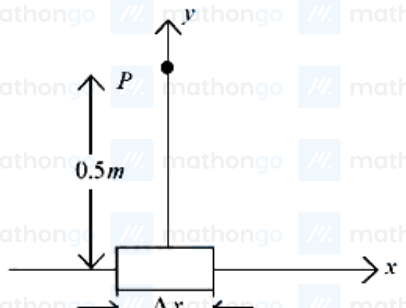
- A. T
- B. T
- C. T
- D. T
Correct answer: A
Explanation: .
Question 12
Physics · 4 marks · −1Given below are two statements: Statement I: In an LCR series circuit, current is maximum at resonance. Statement II: Current in a purely resistive circuit can never be less than that in a series LCR circuit when connected to same voltage source. In the light of the above statements, choose the correct from the options given below:
- A.Statement I is false but Statement II is true
- B.Statement I is true but Statement II is false
- C.Both Statement I and Statement II are true
- D.Both Statement I and Statement II are false
Correct answer: C
Question 13
Physics · 4 marks · −1Electromagnetic waves travel in a medium with speed of m s. The relative permeability of the medium is 2.0. The relative permittivity will be:
- A.2
- B.4
- C.5
- D.1
Correct answer: A
Question 14
Physics · 4 marks · −1In photoelectric experiment energy of 2.48 eV irradiates a photo sensitive material. The stopping potential was measured to be 0.5 V. Work function of the photo sensitive material is :
- A.1.68 eV
- B.2.48 eV
- C.1.98 eV
- D.0.5 eV
Correct answer: C
Question 15
Physics · 4 marks · −1Which of the following phenomena does not explain by wave nature of light. A. reflection B. diffraction C. photoelectric effect D. interference E. polarization Choose the most appropriate answer from the options given below:
- A.E only
- B.B, D only
- C.C only
- D.A, C only
Correct answer: C
Question 16
Physics · 4 marks · −1The ratio of the shortest wavelength of Balmer series to the shortest wavelength of Lyman series for hydrogen atom is :
- A.4 : 1
- B.1 : 4
- C.2 : 1
- D.1 : 2
Correct answer: A
Question 17
Physics · 4 marks · −1The correct truth table for the following logic circuit is :
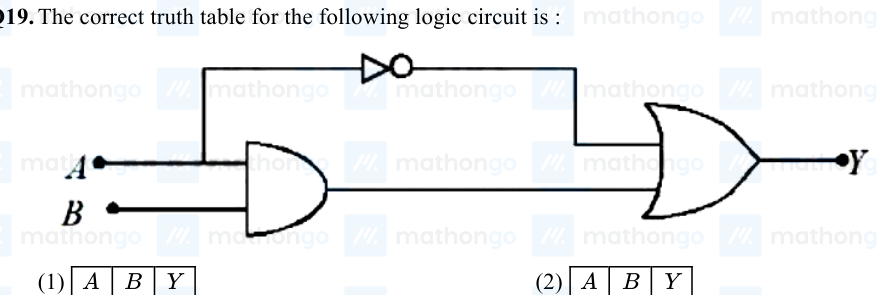
- A.A B Y: 0 0 1; 0 1 1; 1 0 0; 1 1 1
- B.A B Y: 0 0 0; 0 1 1; 1 0 0; 1 1 1
- C.A B Y: 0 0 1; 0 1 1; 1 0 0; 1 1 0
- D.A B Y: 0 0 0; 0 1 0; 1 0 0; 1 1 1
Correct answer: A
Explanation: .
Question 18
Physics · 4 marks · −1While measuring diameter of wire using screw gauge the following readings were noted. Main scale reading is 1 mm and circular scale reading is equal to 42 divisions. Pitch of screw gauge is 1 mm and it has 100 divisions on circular scale. The diameter of the wire is mm. The value of x is :
- A.21
- B.142
- C.71
- D.42
Correct answer: C
Explanation: .
Question 19
Physics · 4 marks · −1For three vectors , and , if , then value of x is ______
Correct answer: 4
Explanation: ; .
Question 20
Physics · 4 marks · −1If the radius of earth is reduced to three-fourth of its present value without change in its mass then value of duration of the day of earth will be ______ hours 30 minutes.
Correct answer: 13
Explanation: : h.
Question 21
Physics · 4 marks · −1A big drop is formed by coalescing 1000 small droplets of water. The ratio of surface energy of 1000 droplets to that of energy of big drop is . The value of x is ______
Correct answer: 1
Question 22
Physics · 4 marks · −1A particle is doing simple harmonic motion of amplitude 0.06 m and time period 3.14 s. The maximum velocity of the particle is ______ cm/s.
Correct answer: 12
Question 23
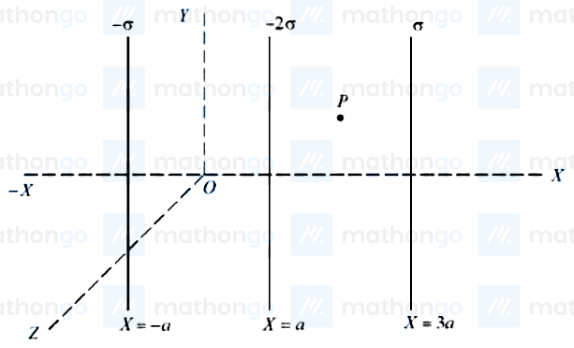
Physics · 4 marks · −1Three infinitely long charged thin sheets are placed as shown in figure. The magnitude of electric field at the point P is . The value of x is ______ (all quantities are measured in SI units).
Correct answer: 2
Explanation: Fields at P (between and ): from and (to the left of P) point towards them, from (to the right) points away from it; magnitudes add to .
Question 24
Physics · 4 marks · −1A wire of resistance R and radius r is stretched till its radius became r/2. If new resistance of the stretched wire is xR, then value of x is ______
Correct answer: 16
Question 25
Physics · 4 marks · −1A circular coil having 200 turns, m² area and carrying 100 μA current is placed in a uniform magnetic field of 1T. Initially the magnetic dipole moment was directed along . Amount of work, required to rotate the coil through 90° from its initial orientation such that becomes perpendicular to , is ______ μJ.
Correct answer: 5
Question 26
Physics · 4 marks · −1When a dc voltage of 100 V is applied to an inductor, a dc current of 5 A flows through it. When an ac voltage of 200 V peak value is connected to inductor, its inductive reactance is found to be Ω. The power dissipated in the circuit is ______ W.
Correct answer: 250
Explanation: , , W.
Question 27
Physics · 4 marks · −1The refractive index of prism is and the ratio of the angle of minimum deviation to the angle of prism is one. The value of angle of prism is ______.
Correct answer: 60
Explanation: .
Question 28
Physics · 4 marks · −1Radius of a certain orbit of hydrogen atom is 8.48 Å. If energy of electron in this orbit is E/x, then x = ______ (Given Å, E = energy of electron in ground state).
Correct answer: 16
Question 29
Chemistry · 4 marks · −1The density of 'x' M solution ('x' molar) of NaOH is 1.12 g mL, while in molality, the concentration of the solution is 3 m (3 molal). Then x is (Given : Molar mass of NaOH is 40 g/mol)
- A.3.5
- B.3.8
- C.2.8
- D.3.0
Correct answer: D
Explanation: 1000 g water + 120 g NaOH = 1120 g = 1 L solution.
Question 30
Chemistry · 4 marks · −1The electron affinity value are negative for A. Be → Be B. N → N C. O → O D. Na → Na E. Al → Al Choose the most appropriate answer from the options given below :
- A.D and E only
- B.A, B and C only
- C.A and D only
- D.A, B, D and E only
Correct answer: B
Question 31
Chemistry · 4 marks · −1Which of the following material is not a semiconductor.
- A.Silicon
- B.Copper oxide
- C.Germanium
- D.Graphite
Correct answer: D
Question 32
Chemistry · 4 marks · −1Match List I with List II. List-I (Hybridization): A. ; B. ; C. ; D. . List-II (Orientation in Space): I. Trigonal bipyramidal; II. Octahedral; III. Tetrahedral; IV. Square planar.
- A.A-IV, B-III, C-I, D-II
- B.A-III, B-IV, C-I, D-II
- C.A-III, B-I, C-IV, D-II
- D.A-II, B-I, C-IV, D-III
Correct answer: B
Question 33
Chemistry · 4 marks · −1Match List I with List II. List-I (Compound/Species): A. ; B. ; C. ; D. . List-II (Shape/Geometry): I. Tetrahedral; II. Pyramidal; III. See saw; IV. Bent T-Shape.
- A.A-II, B-III, C-I, D-IV
- B.A-II, B-IV, C-III, D-I
- C.A-III, B-IV, C-II, D-I
- D.A-III, B-II, C-IV, D-I
Correct answer: C
Question 34
Chemistry · 4 marks · −1Match List I with List II. List-I (Molecule/Species): A. ; B. NO; C. ; D. . List-II (Property/Shape): I. Paramagnetic; II. Diamagnetic; III. Tetrahedral; IV. Linear.
- A.A-II, B-III, C-I, D-IV
- B.A-III, B-I, C-II, D-IV
- C.A-IV, B-I, C-III, D-II
- D.A-III, B-IV, C-II, D-I
Correct answer: B
Question 35
Chemistry · 4 marks · −1At −20°C and 1 atm pressure, a cylinder is filled with equal number of , and HI molecules for the reaction , the for the process is . x = ______ [Given : R = 0.082 L atm K mol]
- A.0.01
- B.10
- C.2
- D.1
Correct answer: B
Question 36
Chemistry · 4 marks · −1Functional group present in sulphonic acids is :
- A.
- B.
- C.
- D.
Correct answer: B
Question 37
Chemistry · 4 marks · −1Which of the following statements are correct? A. Glycerol is purified by vacuum distillation because it decomposes at its normal boiling point. B. Aniline can be purified by steam distillation as aniline is miscible in water. C. Ethanol can be separated from ethanol water mixture by azeotropic distillation because it forms azeotrope. D. An organic compound is pure, if mixed M.P. is remained same. Choose the most appropriate answer from the options given below :
- A.A, B, C only
- B.A, C, D only
- C.A, B, D only
- D.B, C, D only
Correct answer: B
Question 38
Chemistry · 4 marks · −1Which of the following is metamer of the given compound (X)? (X) = N-phenylcyclohexanecarboxamide ()
- A.N-cyclohexylbenzamide ()
- B.N-phenylbenzamide
- C.N-cyclohexylcyclohexanecarboxamide
- D.4-(cyclohexylamino)benzaldehyde
Correct answer: A
Question 39
Chemistry · 4 marks · −1Given below are two statements: Statement I : Gallium is used in the manufacturing of thermometers. Statement II : A thermometer containing gallium is useful for measuring the freezing point (256 K) of brine solution. In the light of the above statements, choose the correct answer from the options given below :
- A.Both Statement I and Statement II are true
- B.Statement I is false but Statement II is true
- C.Both Statement I and Statement II are false
- D.Statement I is true but Statement II is false
Correct answer: D
Explanation: Gallium melts at 303 K, so it cannot measure 256 K.
Question 40
Chemistry · 4 marks · −1A conductivity cell with two electrodes (dark side) are half filled with infinitely dilute aqueous solution of a weak electrolyte. If volume is doubled by adding more water at constant temperature, the molar conductivity of the cell will -
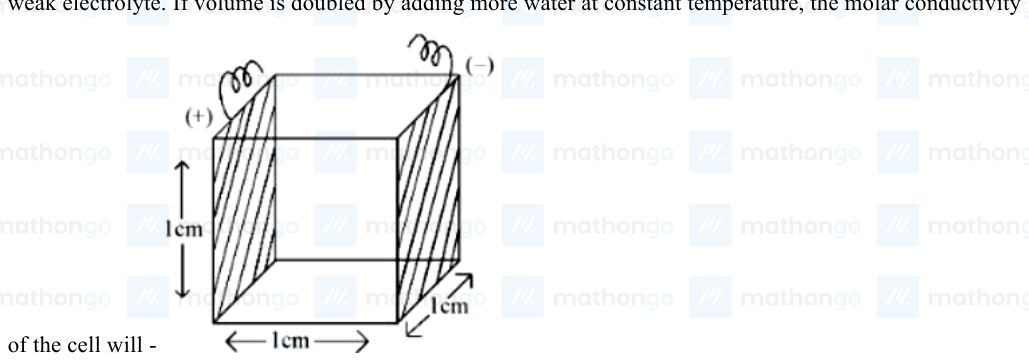
- A.decrease sharply
- B.increase sharply
- C.remain same or can not be measured accurately
- D.depend upon type of electrolyte
Correct answer: C
Question 41
Chemistry · 4 marks · −1The number of element from the following that do not belong to lanthanoids is Eu, Cm, Er, Tb, Yb and Lu
- A.3
- B.4
- C.1
- D.5
Correct answer: C
Question 42
Chemistry · 4 marks · −1Match List I with List II. List-I (Compound): A. Iodoform; B. Carbon tetrachloride; C. CFC; D. DDT. List-II (Uses): I. Fire extinguisher; II. Insecticide; III. Antiseptic; IV. Refrigerants.
- A.A-I, B-II, C-III, D-IV
- B.A-III, B-I, C-IV, D-II
- C.A-II, B-IV, C-I, D-III
- D.A-III, B-II, C-IV, D-I
Correct answer: B
Question 43
Chemistry · 4 marks · −1The following complexes (A), (B), (C), (D). The correct order of A, B, C and D in terms of wavenumber of light absorbed is :
- A.C < D < A < B
- B.B < C < A < D
- C.A < C < B < D
- D.D < A < C < B
Correct answer: D
Question 44
Chemistry · 4 marks · −1Given below are two statements : Statement I : Picric acid is 2,4,6 - trinitrotoluene. Statement II : Phenol - 2,4 - disulphonic acid is treated with Conc. to get picric acid. In the light of the above statements, choose the most appropriate answer from the options given below :
- A.Statement I is incorrect but Statement II is correct
- B.Both Statement I and Statement II are incorrect
- C.Statement I is correct but Statement II is incorrect
- D.Both Statement I and Statement II are correct
Correct answer: A
Question 45
Chemistry · 4 marks · −1In Reimer - Tiemann reaction, phenol is converted into salicylaldehyde through an intermediate. The structure of intermediate is ______
- A.Sodium 2-(dichloromethyl)phenoxide
- B.Sodium 2-formylphenoxide
- C.Sodium 2-methylphenoxide
- D.2-(Dichloromethyl)phenol
Correct answer: A
Question 46
Chemistry · 4 marks · −1Which among the following aldehydes is most reactive towards nucleophilic addition reactions?
- A.
- B.
- C.
- D.
Correct answer: D
Question 47
Chemistry · 4 marks · −1Match List I with List II. List-I (Precipitating reagent and conditions): A. ; B. ; C. gas; D. dilute HCl. List-II (Cation): I. ; II. ; III. ; IV. .
- A.A-III, B-IV, C-I, D-II
- B.A-III, B-IV, C-II, D-I
- C.A-IV, B-III, C-II, D-I
- D.A-IV, B-III, C-I, D-II
Correct answer: A
Question 48
Chemistry · 4 marks · −1DNA molecule contains 4 bases whose structure are shown below. One of the structures is not correct, identify the incorrect base structure.
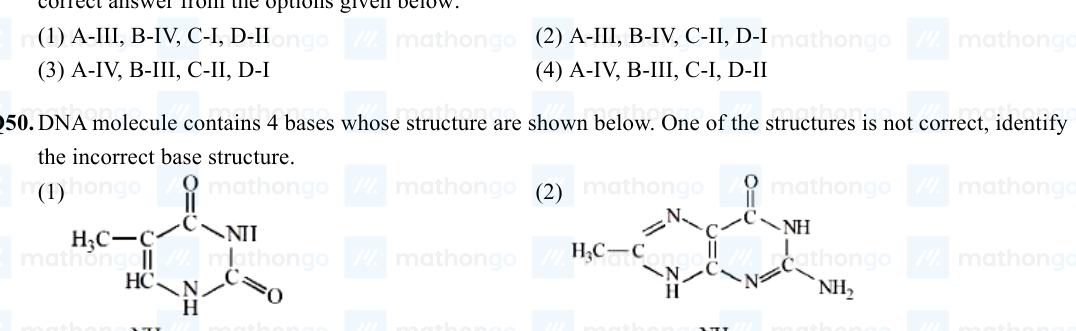
- A.Thymine-type pyrimidine (5-methyluracil) as drawn
- B.Guanine-type purine (drawn with a methyl group on the imidazole carbon)
- C.Cytosine as drawn
- D.Adenine as drawn
Correct answer: B
Question 49
Chemistry · 4 marks · −1Frequency of the de-Broglie wave of electron in Bohr's first orbit of hydrogen atom is ______ Hz (nearest integer). [Given : (Rydberg constant) = J, h (Plank's constant) = J s.]
Correct answer: 661
Explanation: Hz .
Question 50
Chemistry · 4 marks · −1Number of molecules from the following which can exhibit hydrogen bonding is ______ (nearest integer). , , , , o-nitrophenol, HF,
Correct answer: 5
Question 51
Chemistry · 4 marks · −1An ideal gas, , is expanded adiabatically against a constant pressure of 1 atm untill it doubles in volume. If the initial temperature and pressure is 298 K and 5 atm, respectively then the final temperature is ______ K (nearest integer). [ is the molar heat capacity at constant volume]
Correct answer: 274
Explanation: : K.
Question 52
Chemistry · 4 marks · −1The major product of the following reaction is P. P. Number of oxygen atoms present in product 'P' is ______ (nearest integer)
Correct answer: 2
Explanation: trans-But-2-ene → butane-2,3-diol.
Question 53
Chemistry · 4 marks · −1Consider the dissociation of the weak acid HX as given below , [ : dissociation constant]. The osmotic pressure of 0.03M aqueous solution of HX at 300 K is ______ bar (nearest integer). [Given : R = 0.083 L bar mol K]
Correct answer: 76
Explanation: ; bar.
Question 54
Chemistry · 4 marks · −1Time required for 99.9% completion of a first order reaction is ______ times the time required for completion of 90% reaction. (nearest integer)
Correct answer: 3
Question 55
Chemistry · 4 marks · −1Among CrO, and , the sum of spin-only magnetic moment values of basic and amphoteric oxides is ______ BM (nearest integer). (Given atomic number of Cr is 24)
Correct answer: 877
Explanation: CrO (d, 4.90) + CrO (d, 3.87) = 8.77.
Question 56
Chemistry · 4 marks · −1The difference in the 'spin-only' magnetic moment values of and the manganese product formed during titration of against oxalic acid in acidic medium is ______ BM. (nearest integer)
Correct answer: 6
Question 57
Chemistry · 4 marks · −1The major products from the following reaction sequence are product A and product B. Cyclohexene A; Cyclohexene B. The total sum of π electrons in product A and product B are ______ (nearest integer)
Correct answer: 8
Question 58
Chemistry · 4 marks · −19.3 g of pure aniline upon diazotisation followed by coupling with phenol gives an orange dye. The mass of orange dye produced (assume 100% yield/conversion) is ______ g. (nearest integer)
Correct answer: 20
Explanation: 0.1 mol × 198 g/mol.
Question 59
Mathematics · 4 marks · −1The number of triangles whose vertices are at the vertices of a regular octagon but none of whose sides is a side of the octagon is
- A.48
- B.56
- C.24
- D.16
Correct answer: D
Explanation: .
Question 60
Mathematics · 4 marks · −1Let is neither a multiple of 3 nor a multiple of 4. Then the number of elements in A is
- A.290
- B.280
- C.300
- D.310
Correct answer: C
Explanation: .
Question 61
Mathematics · 4 marks · −1Let a variable line of slope m > 0 passing through the point (4, −9) intersect the coordinate axes at the points A and B. The minimum value of the sum of the distances of A and B from the origin is
- A.30
- B.25
- C.15
- D.10
Correct answer: B
Explanation: .
Question 62
Mathematics · 4 marks · −1A circle is inscribed in an equilateral triangle of side of length 12. If the area and perimeter of any square inscribed in this circle are m and n, respectively, then is equal to
- A.408
- B.414
- C.396
- D.312
Correct answer: A
Explanation: , square side : .
Question 63
Mathematics · 4 marks · −1The mean and standard deviation of 20 observations are found to be 10 and 2, respectively. On rechecking, it was found that an observation by mistake was taken 8 instead of 12. The correct standard deviation is
- A.1.8
- B.1.94
- C.
- D.
Correct answer: C
Explanation: , ; .
Question 64
Mathematics · 4 marks · −1Let the relations and on the set X = {1, 2, 3, ..., 20} be given by and . If M and N be the minimum number of elements required to be added in and , respectively, in order to make the relations symmetric, then M + N equals
- A.12
- B.16
- C.8
- D.10
Correct answer: D
Explanation: has 6 pairs (none symmetric), has 4.
Question 65
Mathematics · 4 marks · −1The function , , is
- A.one-one but not onto.
- B.both one-one and onto.
- C.onto but not one-one.
- D.neither one-one nor onto.
Correct answer: D
Explanation: ; bounded range.
Question 66
Mathematics · 4 marks · −1If then
- A.
- B.
- C.
- D.
Correct answer: A
Explanation: ; at : .
Question 67
Mathematics · 4 marks · −1The interval in which the function , x > 0, is strictly increasing is
- A.
- B.
- C.
- D.
Correct answer: C
Question 68
Mathematics · 4 marks · −1is equal to
- A.1/6
- B.1/3
- C.1/12
- D.1/9
Correct answer: A
Explanation: With : .
Question 69
Mathematics · 4 marks · −1Let y = y(x) be the solution of the differential equation , y(1) = 0. Then y(0) is
- A.
- B.
- C.
- D.
Correct answer: B
Explanation: , .
Question 70
Mathematics · 4 marks · −1Let y = y(x) be the solution of the differential equation , x > 0 and . Then, y(e) is equal to
- A.
- B.
- C.
- D.
Correct answer: A
Explanation: IF : , so with ; .
Question 71
Mathematics · 4 marks · −1The shortest distance between the lines and is
- A.
- B.
- C.
- D.
Correct answer: B
Explanation: ; .
Question 72
Mathematics · 4 marks · −1A company has two plants A and B to manufacture motorcycles. 60% motorcycles are manufactured at plant A and the remaining are manufactured at plant B. 80% of the motorcycles manufactured at plant A are rated of the standard quality, while 90% of the motorcycles manufactured at plant B are rated of the standard quality. A motorcycle picked up randomly from the total production is found to be of the standard quality. If p is the probability that it was manufactured at plant B, then 126p is
- A.54
- B.66
- C.64
- D.56
Correct answer: A
Question 73
Mathematics · 4 marks · −1Let be the solution of the equation and . Then the value of m is
Correct answer: 221
Explanation: with : .
Question 74
Mathematics · 4 marks · −1Let the first term of a series be and its term , r = 2, 3, ..., n. If the sum of the first n terms of this series is , then n is equal to ______
Correct answer: 6
Question 75
Mathematics · 4 marks · −1If the second, third and fourth terms in the expansion of are 135, 30 and , respectively, then is equal to ______
Correct answer: 806
Explanation: Ratios give , , : .
Question 76
Mathematics · 4 marks · −1Let a conic C pass through the point (4, −2) and P(x, y), x ≥ 3, be any point on C. Let the slope of the line touching the conic C only at a single point P be half the slope of the line joining the points P and (3, −5). If the focal distance of the point (7, 1) on C is d, then 12d equals ______
Correct answer: 75
Question 77
Mathematics · 4 marks · −1Let , be the lines passing through the point P(0, 1) and touching the parabola . Let Q and R be the points on the lines and such that the △PQR is an isosceles triangle with base QR. If the slopes of the lines QR are and , then is equal to ______
Correct answer: 68
Question 78
Mathematics · 4 marks · −1Let αβγ = 45; α, β, γ ∈ R. If x(α, 1, 2) + y(1, β, 2) + z(2, 3, γ) = (0, 0, 0) for some x, y, z ∈ R, xyz ≠ 0, then 6α + 4β + γ is equal to ______
Correct answer: 55
Question 79
Mathematics · 4 marks · −1For n ∈ N, if , then n is equal to ______
Correct answer: 47
Explanation: ; remaining .
Question 80
Mathematics · 4 marks · −1Let , k ∈ N. Then the value of is equal to ______
Correct answer: 65
Explanation: Integration by parts: , so ; sum .
Question 81
Mathematics · 4 marks · −1Let , and a vector be such that . If , then is equal to ______
Correct answer: 46
Question 82
Mathematics · 4 marks · −1Let P be the point (10, −2, −1) and Q be the foot of the perpendicular drawn from the point R(1, 7, 6) on the line passing through the points (2, −5, 11) and (−6, 7, −5). Then the length of the line segment PQ is equal to ______
Correct answer: 13
Explanation: Line: ; foot at : ; .