JEE Main 2025 — 2 Apr Shift 2 (Previous Year Paper)
JEE Main · 2025 · with answers and explanations
- questions
- 75
- Total marks
- 300
- Duration
- 180 minutes
- Negative marking
- −1
Subjects: Mathematics · Physics · Chemistry
Question 1
Mathematics · 4 marks · −1Given three indentical bags each containing 10 balls, whose colours are as follows : Bag I: Red 3, Blue 2, Green 5; Bag II: Red 4, Blue 3, Green 3; Bag III: Red 5, Blue 1, Green 4. A person chooses a bag at random and takes out a ball. If the ball is Red, the probability that it is from bag I is p and if the ball is Green, the probability that it is from bag III is q, then the value of is :
- A.7
- B.6
- C.9
- D.8
Correct answer: A
Explanation: , ; .
Question 2
Mathematics · 4 marks · −1Let (a, b) be the point of intersection of the curve and the straight line in the second quadrant. Then the integral is equal to :
- A.24
- B.18
- C.21
- D.27
Correct answer: A
Explanation: , point ; .
Question 3
Mathematics · 4 marks · −1If the image of the point P(1, 0, 3) in the line joining the points A(4, 7, 1) and B(3, 5, 3) is Q(), then is equal to :
- A.
- B.18
- C.
- D.13
Correct answer: A
Question 4
Mathematics · 4 marks · −1If , then the number of solutions of , is equal to :
- A.8
- B.7
- C.6
- D.10
Correct answer: C
Question 5
Mathematics · 4 marks · −1Let the point P of the focal chord PQ of the parabola be . If the focus of the parabola divides the chord PQ in the ratio m : n, , then is equal to :
- A.10
- B.37
- C.17
- D.26
Correct answer: C
Explanation: , with ; has : . , : ratio 1 : 4, .
Question 6
Mathematics · 4 marks · −1If the system of equations , , has infinitely many solutions, then is equal to :
- A.18
- B.22
- C.30
- D.26
Correct answer: D
Question 7
Mathematics · 4 marks · −1If the domain of the function is (a, b), then is equal to :
- A.25
- B.30
- C.26
- D.29
Correct answer: C
Explanation: Need and : domain ; .
Question 8
Mathematics · 4 marks · −1is equal to :
- A.
- B.
- C.
- D.
Correct answer: C
Question 9
Mathematics · 4 marks · −1The line is parallel to the vector and passes through the point (7, 6, 2) and the line is parallel to the vector and passes through the point (5, 3, 4). The shortest distance between the lines and is :
- A.
- B.
- C.
- D.
Correct answer: D
Explanation: , ; ; SD .
Question 10
Mathematics · 4 marks · −1The number of terms of an A.P. is even; the sum of all the odd terms is 24, the sum of all the even terms is 30 and the last term exceeds the first by . Then the number of terms which are integers in the A.P. is :
- A.4
- B.8
- C.10
- D.6
Correct answer: A
Explanation: (n pairs), give , : 8 terms; , terms → 4 integers.
Question 11
Mathematics · 4 marks · −1Let , and a vector be such that and . If , then is equal to :
- A.18
- B.15
- C.12
- D.9
Correct answer: B
Question 12
Mathematics · 4 marks · −1Let be a differentiable function. If for all , then the value of is :
- A.18
- B.26
- C.32
- D.22
Correct answer: C
Question 13
Mathematics · 4 marks · −1If the length of the minor axis of an ellipse is equal to one fourth of the distance between the foci, then the eccentricity of the ellipse is :
- A.
- B.
- C.
- D.
Correct answer: D
Explanation: ; .
Question 14
Mathematics · 4 marks · −1If the mean and the variance of 6, 4, a, 8, b, 12, 10, 13 are 9 and 9.25 respectively, then is equal to :
- A.103
- B.105
- C.106
- D.100
Correct answer: A
Explanation: ; , known squares 529, so , ; .
Question 15
Mathematics · 4 marks · −1If is finite, then (a + b) is equal to :
- A.
- B.-1
- C.0
- D.
Correct answer: D
Explanation: term: ; constant: ; .
Question 16
Mathematics · 4 marks · −1Let and R be a relation on A such that . Let be a sequence of k elements of R such that the second entry of an ordered pair is equal to the first entry of the next ordered pair. Then the largest integer k, for which such a sequence exists, is equal to :
- A.6
- B.7
- C.8
- D.5
Correct answer: D
Explanation: Each step halves roughly: the longest chain inside A is 63→31→15→7→3→1 (next would need 127), giving k = 5 pairs.
Question 17
Mathematics · 4 marks · −1If , then is equal to :
- A.15
- B.24
- C.11
- D.20
Correct answer: D
Explanation: Sum ; .
Question 18
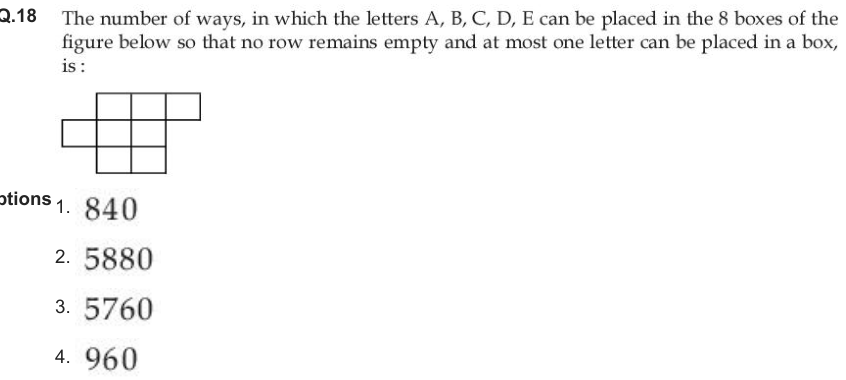
Mathematics · 4 marks · −1The number of ways, in which the letters A, B, C, D, E can be placed in the 8 boxes of the figure below so that no row remains empty and at most one letter can be placed in a box, is :
- A.840
- B.5880
- C.5760
- D.960
Correct answer: C
Explanation: Choose 5 boxes with every row non-empty: (rows of sizes 3,3,2); arrangements .
Question 19
Mathematics · 4 marks · −1Let the area of the triangle formed by a straight line L : with co-ordinate axes be 48 square units. If the perpendicular drawn from the origin to the line L makes an angle of 45° with the positive x-axis, then the value of is :
- A.90
- B.97
- C.93
- D.83
Correct answer: B
Explanation: Normal at 45° ⇒ b = 1; intercepts |c| each, area , ; .
Question 20
Mathematics · 4 marks · −1Let A be a real matrix such that , where I and O are the identity and null matrices, respectively. If , where , , and are real constants, then is equal to :
- A.20
- B.76
- C.12
- D.4
Correct answer: C
Question 21
Mathematics · 4 marks · −1If the set of all , for which the roots of the equation are positive is , then is equal to ______.
Correct answer: 7
Question 22
Mathematics · 4 marks · −1Let A(4, ), B(1, 1) and C(9, ) be the vertices of a triangle ABC. Then the maximum area of the parallelogram AFDE, formed with vertices D, E and F on the sides BC, CA and AB of the triangle ABC respectively, is ______.
Correct answer: 3
Explanation: Area(ABC) ; maximum inscribed parallelogram = half of it = 3.
Question 23
Mathematics · 4 marks · −1Let be the solution of the differential equation such that . Then is equal to ______.
Correct answer: 21
Question 24
Mathematics · 4 marks · −1If the sum of the first 10 terms of the series is , where , then m + n is equal to ______.
Correct answer: 441
Explanation: ; sum ; 441.
Question 25
Mathematics · 4 marks · −1If , then is equal to ______.
Correct answer: 3
Explanation: ; then .
Question 26
Physics · 4 marks · −1Given below are two statements : one is labelled as Assertion (A) and the other is labelled as Reason (R). Assertion (A) : Net dipole moment of a polar linear isotropic dielectric substance is not zero even in the absence of an external electric field. Reason (R) : In absence of an external electric field, the different permanent dipoles of a polar dielectric substance are oriented in random directions. In the light of the above statements, choose the most appropriate answer from the options given below :
- A.(A) is correct but (R) is not correct
- B.Both (A) and (R) are correct and (R) is the correct explanation of (A)
- C.(A) is not correct but (R) is correct
- D.Both (A) and (R) are correct but (R) is not the correct explanation of (A)
Correct answer: C
Question 27
Physics · 4 marks · −1A solenoid having area A and length '' is filled with a material having relative permeability 2. The magnetic energy stored in the solenoid is :
- A.
- B.
- C.
- D.
Correct answer: D
Explanation: .
Question 28
Physics · 4 marks · −1A sinusoidal wave of wavelength 7.5 cm travels a distance of 1.2 cm along the x-direction in 0.3 sec. The crest P is at x = 0 at t = 0 sec and maximum displacement of the wave is 2 cm. Which equation correctly represents this wave ?
- A. cm
- B. cm
- C. cm
- D. cm
Correct answer: D
Explanation: cm, cm/s, s; crest at origin at t = 0 → cosine.
Question 29
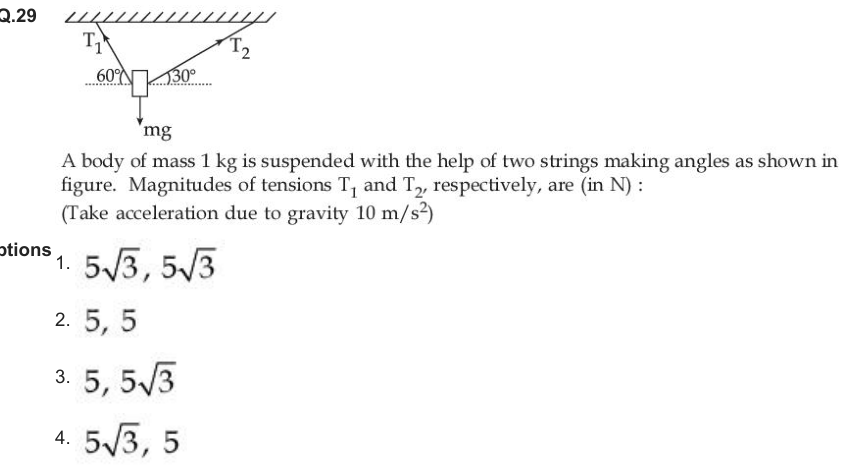
Physics · 4 marks · −1A body of mass 1 kg is suspended with the help of two strings making angles as shown in figure. Magnitudes of tensions and , respectively, are (in N) : (Take acceleration due to gravity 10 )
- A.,
- B.5, 5
- C.5,
- D., 5
Correct answer: D
Explanation: and give , .
Question 30
Physics · 4 marks · −1An electron with mass 'm' with an initial velocity (t=0) () enters a magnetic field . If the initial de-Broglie wavelength at t = 0 is then its value after time 't' would be :
- A.
- B.
- C.
- D.
Correct answer: B
Explanation: Magnetic force does no work; speed and hence wavelength are unchanged.
Question 31
Physics · 4 marks · −1Energy released when two deuterons () fuse to form a helium nucleus () is : (Given : Binding energy per nucleon of = 1.1 MeV and binding energy per nucleon of = 7.0 MeV)
- A.23.6 MeV
- B.26.8 MeV
- C.8.1 MeV
- D.5.9 MeV
Correct answer: A
Explanation: MeV.
Question 32
Physics · 4 marks · −1Consider a circular loop that is uniformly charged and has a radius . Find the position along the positive z-axis of the cartesian coordinate system where the electric field is maximum if the ring was assumed to be placed in xy plane at the origin :
- A.0
- B.
- C.
- D.a
Correct answer: D
Explanation: is maximum at .
Question 33
Physics · 4 marks · −1Match List - I with List - II. List - I: (A) Heat capacity of body (B) Specific heat capacity of body (C) Latent heat (D) Thermal conductivity. List - II: (I) (II) (III) (IV) . Choose the correct answer from the options given below :
- A.(A)-(III), (B)-(IV), (C)-(I), (D)-(II)
- B.(A)-(IV), (B)-(III), (C)-(II), (D)-(I)
- C.(A)-(III), (B)-(I), (C)-(II), (D)-(IV)
- D.(A)-(II), (B)-(III), (C)-(I), (D)-(IV)
Correct answer: D
Question 34
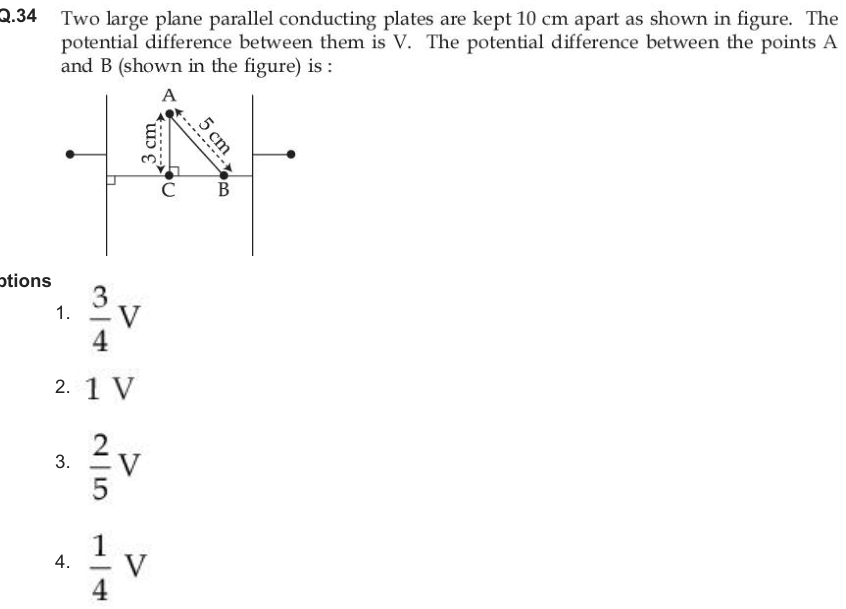
Physics · 4 marks · −1Two large plane parallel conducting plates are kept 10 cm apart as shown in figure. The potential difference between them is V. The potential difference between the points A and B (shown in the figure) is :
- A.V
- B.1 V
- C.V
- D.V
Correct answer: C
Explanation: .
Question 35
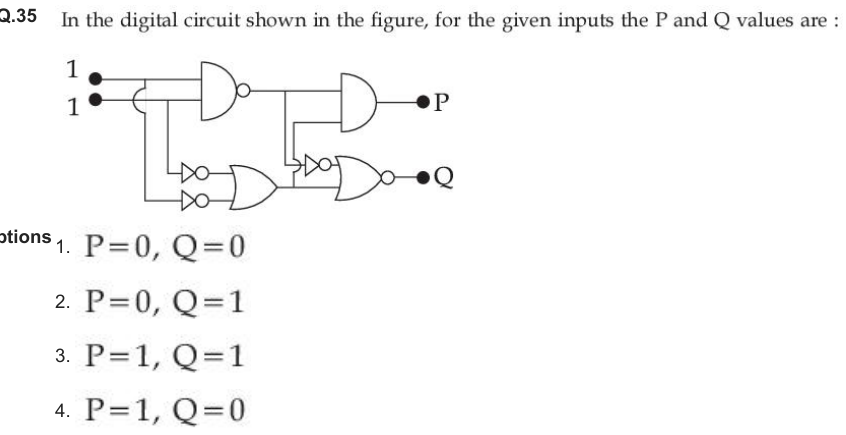
Physics · 4 marks · −1In the digital circuit shown in the figure, for the given inputs the P and Q values are :
- A.P = 0, Q = 0
- B.P = 0, Q = 1
- C.P = 1, Q = 1
- D.P = 1, Q = 0
Correct answer: A
Question 36
Physics · 4 marks · −1Two water drops each of radius 'r' coalesce to form a bigger drop. If 'T' is the surface tension, the surface energy released in this process is :
- A.
- B.
- C.
- D.
Correct answer: A
Explanation: : released .
Question 37
Physics · 4 marks · −1The moment of inertia of a circular ring of mass M and diameter r about a tangential axis lying in the plane of the ring is :
- A.
- B.
- C.
- D.
Correct answer: C
Explanation: with : .
Question 38
Physics · 4 marks · −1Assuming the validity of Bohr's atomic model for hydrogen like ions the radius of ion in its ground state is given by , where X = ______. (Where is the first Bohr's radius.)
- A.9
- B.2
- C.3
- D.1
Correct answer: C
Explanation: with Z = 3.
Question 39
Physics · 4 marks · −1A bi-convex lens has radius of curvature of both the surfaces same as 1/6 cm. If this lens is required to be replaced by another convex lens having different radii of curvatures on both sides (), without any change in lens power then possible combination of and is :
- A. cm and cm
- B. cm and cm
- C. cm and cm
- D. cm and cm
Correct answer: C
Explanation: Need : 5 + 7 = 12.
Question 40
Physics · 4 marks · −1Given a charge q, current I and permeability of vacuum . Which of the following quantity has the dimension of momentum ?
- A.
- B.
- C.
- D.
Correct answer: D
Explanation: has dimensions of (magnetic field × length), so has dimensions of = force × time = momentum.
Question 41
Physics · 4 marks · −1If and are the permeability and permittivity of free space, respectively, then the dimension of is :
- A.
- B.
- C.
- D.
Correct answer: C
Explanation: .
Question 42
Physics · 4 marks · −1Identify the characteristics of an adiabatic process in a monoatomic gas. (A) Internal energy is constant. (B) Work done in the process is equal to the change in internal energy. (C) The product of temperature and volume is a constant. (D) The product of pressure and volume is a constant. (E) The work done to change the temperature from to is proportional to . Choose the correct answer from the options given below :
- A.(B), (D) only
- B.(A), (C), (D) only
- C.(B), (E) only
- D.(A), (C), (E) only
Correct answer: C
Question 43
Physics · 4 marks · −1Two identical objects are placed in front of convex mirror and concave mirror having same radii of curvature of 12 cm, at same distance of 18 cm from the respective mirrors. The ratio of sizes of the images formed by convex mirror and by concave mirror is :
- A.1/3
- B.3
- C.2
- D.1/2
Correct answer: D
Explanation: : convex , concave ; ratio 1/2.
Question 44
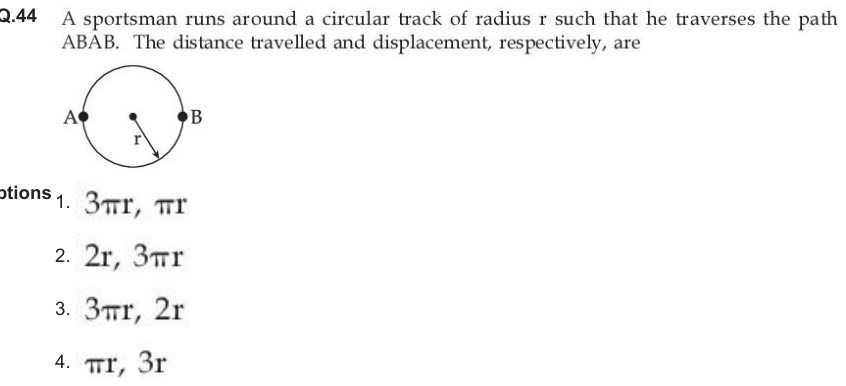
Physics · 4 marks · −1A sportsman runs around a circular track of radius r such that he traverses the path ABAB. The distance travelled and displacement, respectively, are
- A.,
- B.,
- C.,
- D.,
Correct answer: C
Explanation: Three half-circles: ; displacement AB = 2r.
Question 45
Physics · 4 marks · −1In a moving coil galvanometer, two moving coils and have the following particulars : , , , T; , , , T. Assuming that torsional constant of the springs are same for both coils, what will be the ratio of voltage sensitivity of and ?
- A.1 : 4
- B.1 : 2
- C.1 : 1
- D.1 : 3
Correct answer: C
Explanation: : both give → 1 : 1.
Question 46
Physics · 4 marks · −1The internal energy of air in 4 m × 4 m × 3 m sized room at 1 atmospheric pressure will be ______ J. (Consider air as diatomic molecule)
Correct answer: 12
Explanation: J.
Question 47
Physics · 4 marks · −1The length of a light string is 1.4 m when the tension on it is 5 N. If the tension increases to 7 N, the length of the string is 1.56 m. The original length of the string is ______ m.
Correct answer: 1
Explanation: , : , m.
Question 48
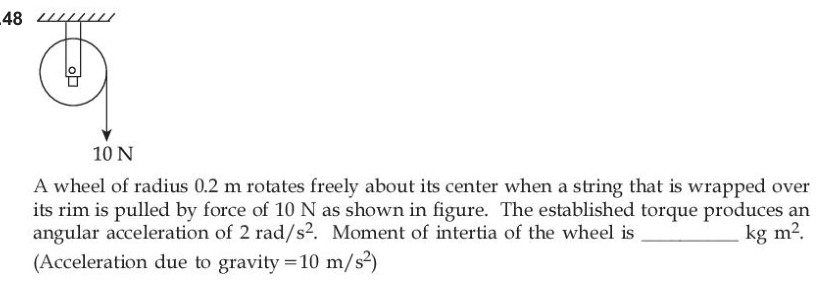
Physics · 4 marks · −1A wheel of radius 0.2 m rotates freely about its center when a string that is wrapped over its rim is pulled by force of 10 N as shown in figure. The established torque produces an angular acceleration of 2 . Moment of intertia of the wheel is ______ kg . (Acceleration due to gravity = 10 )
Correct answer: 1
Explanation: .
Question 49
Physics · 4 marks · −1A ray of light suffers minimum deviation when incident on a prism having angle of the prism equal to 60°. The refractive index of the prism material is . The angle of incidence (in degrees) is ______.
Correct answer: 45
Explanation: , → .
Question 50
Physics · 4 marks · −1A satellite of mass 1000 kg is launched to revolve around the earth in an orbit at a height of 270 km from the earth\'s surface. Kinetic energy of the satellite in this orbit is ______ J. (Mass of earth = kg, Radius of earth = m, Gravitational constant = )
Correct answer: 3
Explanation: J.
Question 51
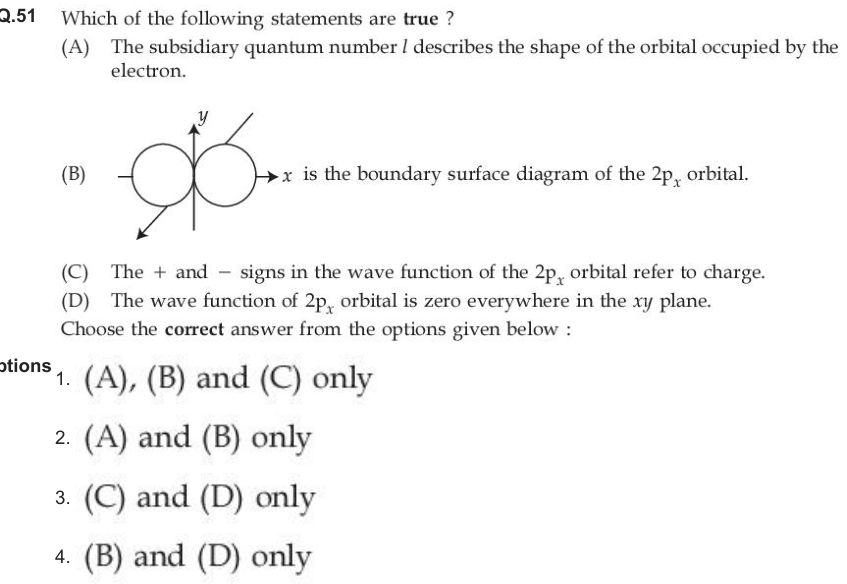
Chemistry · 4 marks · −1Which of the following statements are true ? (A) The subsidiary quantum number describes the shape of the orbital occupied by the electron. (B) [a two-lobed dumbbell drawn along the x-axis] is the boundary surface diagram of the orbital. (C) The + and − signs in the wave function of the orbital refer to charge. (D) The wave function of orbital is zero everywhere in the xy plane. Choose the correct answer from the options given below :
- A.(A), (B) and (C) only
- B.(A) and (B) only
- C.(C) and (D) only
- D.(B) and (D) only
Correct answer: B
Explanation: The nodal plane of is the yz plane, not xy; signs are phases, not charges.
Question 52
Chemistry · 4 marks · −1Match List - I with List - II. List - I (Purification technique): (A) Distillation (simple) (B) Fractional distillation (C) Distillation under reduced pressure (D) Steam distillation. List - II (Mixture of organic compounds): (I) Diesel + Petrol (II) Aniline + Water (III) Chloroform + Aniline (IV) Glycerol + Spent-lye. Choose the correct answer from the options given below :
- A.(A)-(II), (B)-(IV), (C)-(I), (D)-(III)
- B.(A)-(III), (B)-(I), (C)-(IV), (D)-(II)
- C.(A)-(III), (B)-(IV), (C)-(II), (D)-(I)
- D.(A)-(II), (B)-(III), (C)-(IV), (D)-(I)
Correct answer: B
Question 53
Chemistry · 4 marks · −1Match List - I with List - II. List - I (Reaction): (A) (B) (C) (D) . List - II (Name of reaction): (I) Lucas reaction (II) Finkelstein reaction (III) Fittig reaction (IV) Gatterman reaction. Choose the correct answer from the options given below :
- A.(A)-(III), (B)-(II), (C)-(IV), (D)-(I)
- B.(A)-(IV), (B)-(I), (C)-(II), (D)-(III)
- C.(A)-(III), (B)-(IV), (C)-(II), (D)-(I)
- D.(A)-(IV), (B)-(III), (C)-(I), (D)-(II)
Correct answer: C
Question 54
Chemistry · 4 marks · −1The nature of oxide () and hydride () formed by Te, respectively are :
- A.Reducing and basic
- B.Reducing and acidic
- C.Oxidising and basic
- D.Oxidising and acidic
Correct answer: D
Question 55
Chemistry · 4 marks · −1Which among the following molecules is (a) involved in hybridization, (b) has different bond lengths and (c) has lone pair of electrons on the central atom ?
- A.
- B.
- C.
- D.
Correct answer: A
Question 56
Chemistry · 4 marks · −1Formation of , a purple coloured complex formed by addition of sodium nitroprusside in sodium carbonate extract of salt indicates the presence of :
- A.Sulphate ion
- B.Sodium ion
- C.Sulphite ion
- D.Sulphide ion
Correct answer: D
Question 57
Chemistry · 4 marks · −1Arrange the following in order of magnitude of work done by the system/on the system at constant temperature. (a) for expansion in infinite stages. (b) for expansion in single stage. (c) for compression in infinite stages. (d) for compression in single stage. Choose the correct answer from the options given below :
- A.a > c > b > d
- B.a > b > c > d
- C.d > c = a > b
- D.c = a > d > b
Correct answer: C
Question 58
Chemistry · 4 marks · −1Reactant A converts to product D through the given mechanism (with the net evolution of heat) : A B slow; = +ve. B C fast; = −ve. C D fast; = −ve. Which of the following represents the above reaction mechanism ?
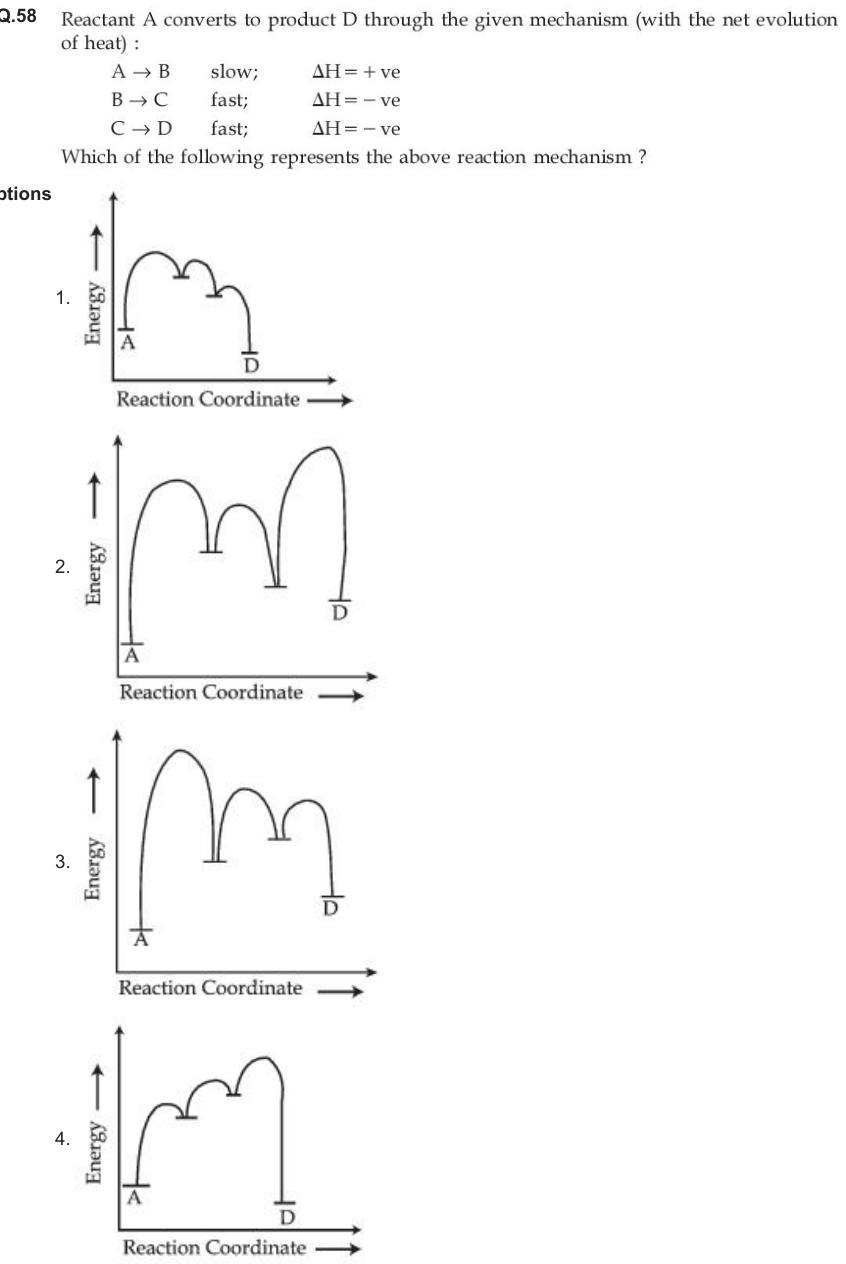
- A.Profile 1: the first hump (A→B) is the highest barrier, B lies above A, then two lower humps lead down through C to D, and D lies well below A
- B.Profile 2: first hump high, second hump lower, third hump the tallest; D lies slightly above A
- C.Profile 3: first hump the tallest, then two lower humps; D lies slightly above A
- D.Profile 4: humps rise successively so the last (C→D) barrier is the highest; D lies far below A
Correct answer: A
Explanation: Slow first step = highest barrier; endothermic first step puts B above A; net exothermic puts D below A.
Question 59
Chemistry · 4 marks · −1'x' g of NaCl is added to water in a beaker with a lid. The temperature of the system is raised from 1°C to 25°C. Which out of the following plots, is best suited for the change in the molarity (M) of the solution with respect to temperature ? [Consider the solubility of NaCl remains unchanged over the temperature range]
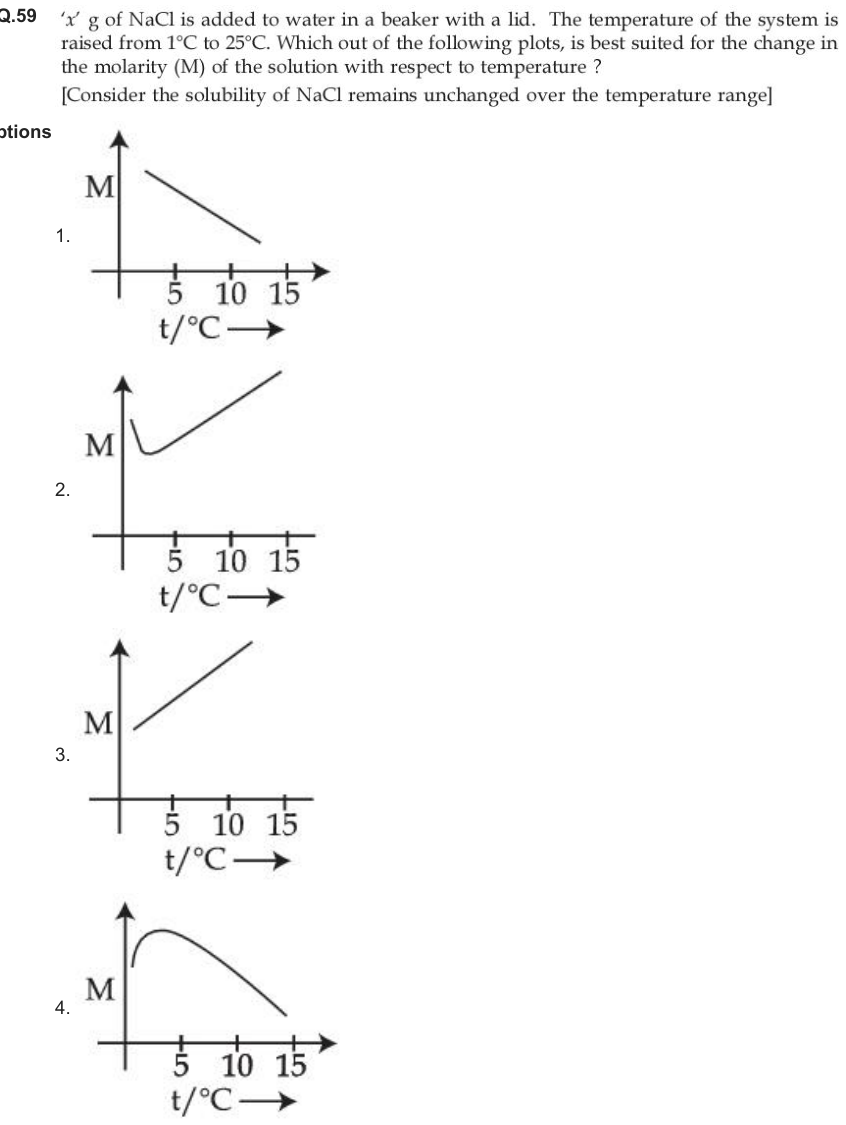
- A.M decreases linearly with t
- B.M dips slightly then increases with t
- C.M increases linearly with t
- D.M first rises to a maximum (around 4 °C) and then decreases with t
Correct answer: D
Explanation: Molarity follows the density of water, which is maximum at 4 °C: M rises slightly up to ~4 °C and then falls.
Question 60
Chemistry · 4 marks · −1When a concentrated solution of sulphanilic acid and 1-naphthylamine is treated with nitrous acid (273 K) and acidified with acetic acid, the mass (g) of 0.1 mole of product formed is : (Given molar mass in g H : 1, C : 12, N : 14, O : 16, S : 32)
- A.330
- B.343
- C.33
- D.66
Correct answer: C
Explanation: Azo dye (, 327 g/mol) → 32.7 ≈ 33 g.
Question 61
Chemistry · 4 marks · −1The type of hybridization and the magnetic property of are,
- A., paramagnetic with two unpaired electrons.
- B., paramagnetic with four unpaired electrons.
- C., paramagnetic with four unpaired electrons.
- D., paramagnetic with two unpaired electrons.
Correct answer: C
Explanation: with weak-field : high spin, outer orbital , 4 unpaired.
Question 62
Chemistry · 4 marks · −1Consider the following chemical equilibrium of the gas phase reaction at a constant temperature : . If p being the total pressure, is the pressure equilibrium constant and is the degree of dissociation, then which of the following is true at equilibrium ?
- A.If value is extremely high compared to p, becomes much less than unity
- B.When p increases decreases
- C.When p increases increases
- D.If p value is extremely high compared to ,
Correct answer: B
Explanation: : α decreases as p increases.
Question 63
Chemistry · 4 marks · −1A tetrapeptide, "x" on complete hydrolysis produced glycine (Gly), alanine (Ala), valine (Val), leucine (Leu) in equimolar proportion each. The number of tetrapeptides (sequences) possible involving each of these amino acids is :
- A.32
- B.24
- C.16
- D.8
Correct answer: B
Explanation: 4! = 24.
Question 64
Chemistry · 4 marks · −1Given below are two statements : Statement (I) : Neopentane forms only one monosubstituted derivative. Statement (II) : Melting point of neopentane is higher than n-pentane. In the light of the above statements, choose the most appropriate answer from the options given below :
- A.Statement I is incorrect but Statement II is correct
- B.Both Statement I and Statement II are correct
- C.Both Statement I and Statement II are incorrect
- D.Statement I is correct but Statement II is incorrect
Correct answer: B
Question 65
Chemistry · 4 marks · −1Which of the following graphs correctly represents the variation of thermodynamic properties of Haber's process ?
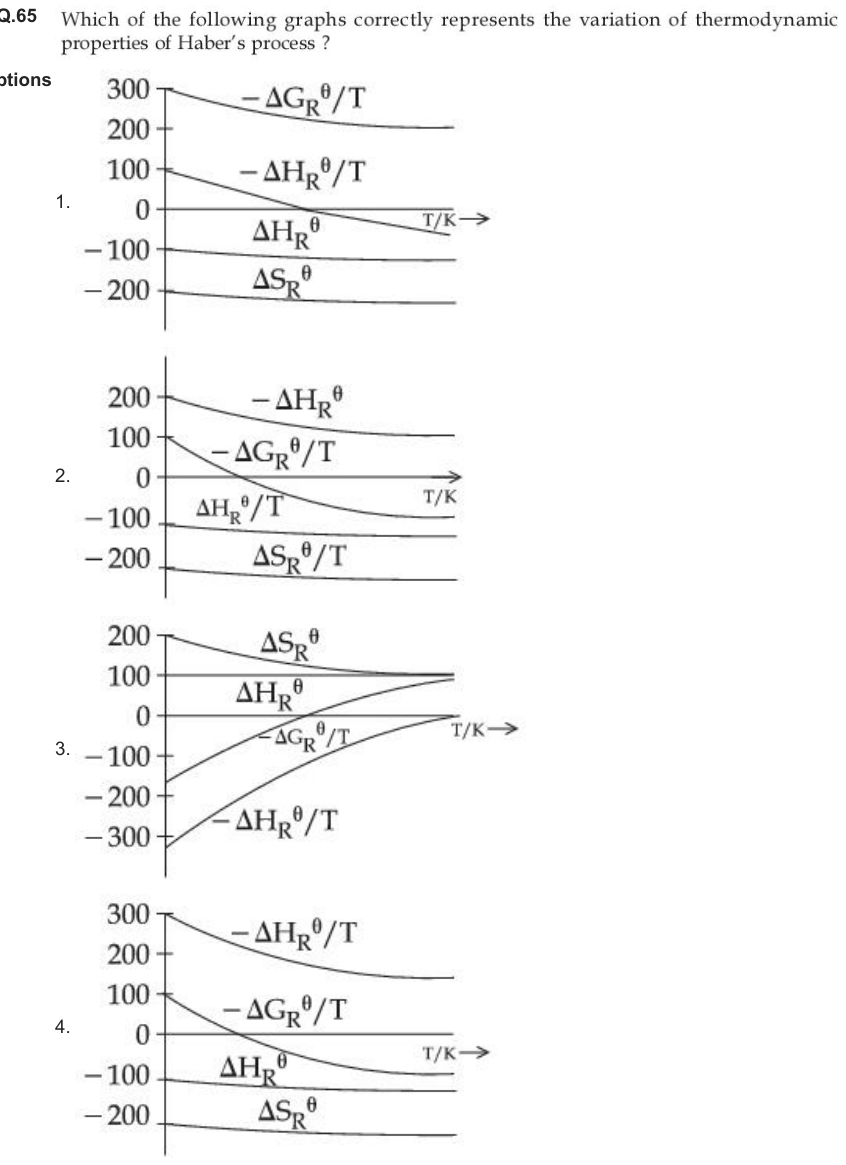
- A.Plot 1: highest (≈ +300 falling), (≈ +100 falling below 0), flat ≈ −100, flat ≈ −200
- B.Plot 2: ≈ +200 falling, ≈ +100 falling below 0, ≈ −100, ≈ −200
- C.Plot 3: ≈ +200 falling to 100, ≈ +100, rising from −100 to 0, rising from −300
- D.Plot 4: highest (≈ +300 falling), (≈ +100 falling below 0), flat ≈ −100, flat ≈ −200
Correct answer: D
Explanation: For : and (flat); is large positive and decreasing; lies about 200 below it and crosses zero.
Question 66
Chemistry · 4 marks · −1Electronic configuration of four elements A, B, C and D are given below : (A) (B) (C) (D) . Which of the following is the correct order of increasing electronegativity (Pauling's scale) ?
- A.A < D < B < C
- B.D < A < B < C
- C.A < C < B < D
- D.A < B < C < D
Correct answer: B
Explanation: C < N < O < F.
Question 67
Chemistry · 4 marks · −1Consider the following reactions. From these reactions which reaction will give carboxylic acid as a major product ? (A) (B) (C) (D) (E) . Choose the correct answer from the options given below :
- A.A, B and E only
- B.B and E only
- C.A and D only
- D.B, C and E only
Correct answer: B
Explanation: Mild hydrolysis of nitrile stops at amide; Stephen reduction and PCC give aldehydes; Grignard + CO2 and Rosenmund followed by Br2-water give acids.
Question 68
Chemistry · 4 marks · −1In 3,3-dimethylhex-1-en-4-yne, there are ______ , ______ and ______ sp hybridised carbon atoms respectively.
- A.3, 3, 2
- B.4, 2, 2
- C.2, 4, 2
- D.2, 2, 4
Correct answer: B
Explanation: : sp = C3, two CH, C6 = 4; sp = 2; sp = 2.
Question 69
Chemistry · 4 marks · −1The d-orbital electronic configuration of the complex among , , and that has the highest CFSE is :
- A.
- B.
- C.
- D.
Correct answer: B
Question 70
Chemistry · 4 marks · −1In Dumas' method for estimation of nitrogen, 0.5 gram of an organic compound gave 60 mL of nitrogen collected at 300 K temperature and 715 mm Hg pressure. The percentage composition of nitrogen in the compound (Aqueous tension at 300 K = 15 mm Hg) is ______ %.
- A.1.257
- B.18.67
- C.20.87
- D.12.57
Correct answer: D
Explanation: mol; mass 0.0628 g → 12.57%.
Question 71
Chemistry · 4 marks · −10.2% (w/v) solution of NaOH is measured to have resistivity 870.0 m m. The molar conductivity of the solution will be ______ mS . (Nearest integer)
Correct answer: 23
Explanation: c = 0.05 M; S/m; S mmol = 2.30 S dmmol = 2300 mS dmmol → 23.
Question 72
Chemistry · 4 marks · −1The spin-only magnetic moment value of ion formed among Ni, Zn, Mn and Cu that has the least enthalpy of atomisation is ______. (in nearest integer) Here n is equal to the number of diamagnetic complexes among , , and
Correct answer: 0
Explanation: Least atomisation enthalpy: Zn; diamagnetic complexes: Zn(II) and Cu(I) → n = 2; is , moment 0.
Question 73
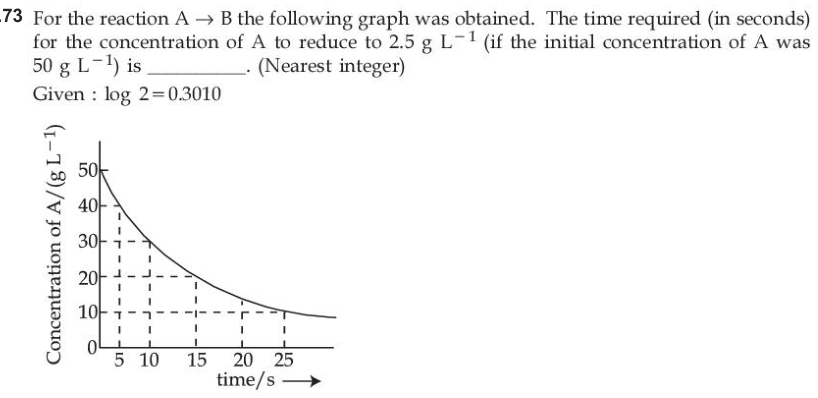
Chemistry · 4 marks · −1For the reaction A B the following graph was obtained. The time required (in seconds) for the concentration of A to reduce to 2.5 g (if the initial concentration of A was 50 g ) is ______. (Nearest integer) Given : log 2 = 0.3010
Correct answer: 43
Explanation: First order, s: s.
Question 74
Chemistry · 4 marks · −1When 1 g each of compounds AB and are dissolved in 15 g of water separately, they increased the boiling point of water by 2.7 K and 1.5 K respectively. The atomic mass of A (in amu) is ______ (Nearest integer) (Given : Molal boiling point elevation constant is 0.5 K kg )
Correct answer: 25
Explanation: , ; B = 9.87, A = 2.47 → 25.
Question 75
Chemistry · 4 marks · −12-Bromopentane P (Major Product) Q. Consider the above sequence of reactions. 151 g of 2-bromopentane is made to react. Yield of major product P is 80% whereas Q is 100%. Mass of product Q obtained is ______ g. (Given molar mass in g H : 1, C : 12, O : 16, Br : 80)
Correct answer: 184
Explanation: 1 mol substrate → 0.8 mol pent-2-ene → 0.8 mol 2,3-dibromopentane (230 g/mol) = 184 g.