JEE Main 2025 — 23 Jan Shift 1 (Previous Year Paper)
JEE Main · 2025 · with answers and explanations
- questions
- 74
- Total marks
- 296
- Duration
- 180 minutes
- Negative marking
- −1
Subjects: Mathematics · Physics · Chemistry
Question 1
Mathematics · 4 marks · −1Let . If , , then is equal to
- A.26
- B.40
- C.39
- D.22
Correct answer: C
Explanation: With , and ; , so b = 4, c = 9 and .
Question 2
Mathematics · 4 marks · −1Let and . Then the domain of is
- A.
- B.
- C.
- D.
Correct answer: A
Explanation: Numerator and denominator , so for all real x.
Question 3
Mathematics · 4 marks · −1One die has two faces marked 1, two faces marked 2, one face marked 3 and one face marked 4. Another die has one face marked 1, two faces marked 2, two faces marked 3 and one face marked 4. The probability of getting the sum of numbers to be 4 or 5, when both the dice are thrown together, is
- A.
- B.
- C.
- D.
Correct answer: C
Explanation: Sum 4: ways; sum 5: ways (out of 36): probability 1/2.
Question 4
Mathematics · 4 marks · −1Let , , be the equation of a circle with center at C. If the area of the triangle, whose vertices are at the points (0, 0), C and (, 0) is 11 square units, then equals:
- A.
- B.50
- C.
- D.100
Correct answer: D
Question 5
Mathematics · 4 marks · −1Let P be the foot of the perpendicular from the point Q(10, , ) on the line . Then the area of the right angled triangle PQR, where R is the point (3, , 1), is
- A.
- B.
- C.
- D.
Correct answer: B
Question 6
Mathematics · 4 marks · −1If the first term of an A.P. is 3 and the sum of its first four terms is equal to one-fifth of the sum of the next four terms, then the sum of the first 20 terms is equal to
- A.-1020
- B.-1200
- C.-1080
- D.-120
Correct answer: C
Explanation: ; .
Question 7
Mathematics · 4 marks · −1The number of words, which can be formed using all the letters of the word "DAUGHTER", so that all the vowels never come together, is
- A.36000
- B.35000
- C.34000
- D.37000
Correct answer: A
Explanation: .
Question 8
Mathematics · 4 marks · −1Let the arc AC of a circle subtend a right angle at the centre O. If the point B on the arc AC, divides the arc AC such that , and , then is equal to
- A.
- B.
- C.
- D.
Correct answer: C
Question 9
Mathematics · 4 marks · −1The value of is
- A.
- B.1
- C.2
- D.
Correct answer: B
Explanation: With over , King property () gives .
Question 10
Mathematics · 4 marks · −1Let the position vectors of the vertices A, B and C of a tetrahedron ABCD be , and respectively. The altitude from the vertex D to the opposite face ABC meets the median line segment through A of the triangle ABC at the point E. If the length of AD is and the volume of the tetrahedron is , then the position vector of E is
- A.
- B.
- C.
- D.
Correct answer: C
Question 11
Mathematics · 4 marks · −1If the system of equations , , has infinitely many solutions, then is equal to
- A.10
- B.12
- C.6
- D.20
Correct answer: B
Question 12
Mathematics · 4 marks · −1If the line intersects the parabola at the points A and B, then at the vertex of the parabola, the line segment AB subtends an angle equal to
- A.
- B.
- C.
- D.
Correct answer: C
Explanation: : A(4,12), B(−2,3); slopes 3 and −3/2; → (obtuse angle ).
Question 13
Mathematics · 4 marks · −1If A, B, and are non-singular matrices of same order, then the inverse of , is equal to
- A.
- B.
- C.
- D.
Correct answer: A
Question 14
Mathematics · 4 marks · −1If , then is equal to
- A.
- B.
- C.
- D.
Correct answer: C
Explanation: with ; , so it equals .
Question 15
Mathematics · 4 marks · −1Let a curve pass through the points (0, 5) and (, k). If the curve satisfies the differential equation , then k is equal to
- A.4
- B.8
- C.32
- D.16
Correct answer: B
Explanation: , and (0, 5) gives c = 0; at : , k = 8.
Question 16
Mathematics · 4 marks · −1Marks obtains by all the students of class 12 are presented in a freqency distribution with classes of equal width. Let the median of this grouped data be 14 with median class interval 12-18 and median class frequency 12. If the number of students whose marks are less than 12 is 18, then the total number of students is
- A.40
- B.44
- C.48
- D.52
Correct answer: B
Explanation: , N = 44.
Question 17
Mathematics · 4 marks · −1Let the area of a with vertices P(5, 4), Q(, 4) and R(a, b) be 35 square units. If its orthocenter and centroid are O and C(c, d) respectively, then c + 2d is equal to
- A.3
- B.2
- C.
- D.
Correct answer: A
Question 18
Mathematics · 4 marks · −1The value of is
- A.1
- B.3/2
- C.2/3
- D.0
Correct answer: A
Explanation: .
Question 19
Mathematics · 4 marks · −1If the function is continuous at x = 0, then is equal to
- A.5
- B.8
- C.20
- D.10
Correct answer: D
Explanation: , : ; sum of squares 10.
Question 20
Mathematics · 4 marks · −1Let R = {(1, 2), (2, 3), (3, 3)} be a relation defined on the set {1, 2, 3, 4}. Then the minimum number of elements, needed to be added in R so that R becomes an equivalence relation, is:
- A.8
- B.10
- C.9
- D.7
Correct answer: D
Explanation: Need classes {1,2,3} and {4}: 9 + 1 = 10 pairs; 3 present → 7 to add.
Question 21
Mathematics · 4 marks · −1The sum of all rational terms in the expansion of is equal to ______.
Correct answer: 612
Question 22
Mathematics · 4 marks · −1If the area of the larger portion bounded between the curves and is , , then b + c is equal to ______.
Correct answer: 77
Question 23
Mathematics · 4 marks · −1Let the circle C touch the line , have the centre on the positive x-axis, and cut off a chord of length along the line . Let H be the hyperbola , whose one of the foci is the centre of C and the length of the transverse axis is the diameter of C. Then is equal to ______.
Correct answer: 19
Question 24
Mathematics · 4 marks · −1If the set of all values of a, for which the equation has three distinct real roots, is the interval (, ), then is equal to ______.
Correct answer: 30
Explanation: has local max 10 and min −10: ; .
Question 25
Mathematics · 4 marks · −1If the equation has equal roots, where a + c = 15 and , then is equal to ______.
Correct answer: 117
Explanation: x = 1 is a root, so equal roots ⇒ product ⇒ ⇒ ; .
Question 26
Physics · 4 marks · −1A light hollow cube of side length 10 cm and mass 10g, is floating in water. It is pushed down and released to execute simple harmonic oscillations. The time period of oscillations is s, where the value of y is (Acceleration due to gravity, g = 10 , density of water = )
- A.1
- B.2
- C.4
- D.6
Correct answer: B
Explanation: , y = 2.
Question 27
Physics · 4 marks · −1Consider a circular disc of radius 20 cm with centre located at the origin. A circular hole of radius 5 cm is cut from this disc in such a way that the edge of the hole touches the edge of the disc. The distance of centre of mass of residual or remaining disc from the origin will be
- A.1.0 cm
- B.2.0 cm
- C.1.5 cm
- D.0.5 cm
Correct answer: A
Explanation: cm.
Question 28
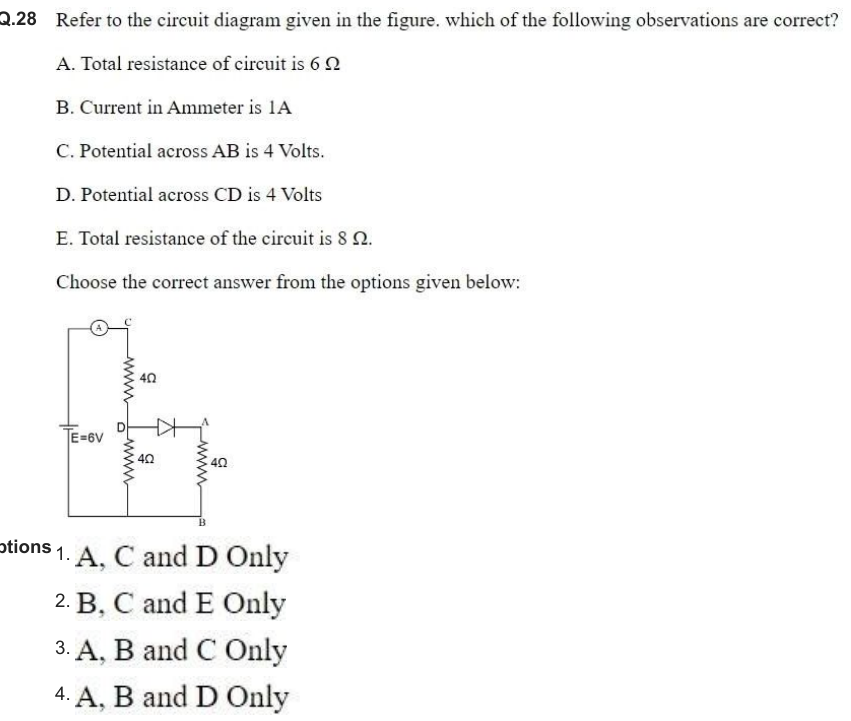
Physics · 4 marks · −1Refer to the circuit diagram given in the figure. which of the following observations are correct? A. Total resistance of circuit is 6 B. Current in Ammeter is 1A C. Potential across AB is 4 Volts. D. Potential across CD is 4 Volts E. Total resistance of the circuit is 8 . Choose the correct answer from the options given below:
- A.A, C and D Only
- B.B, C and E Only
- C.A, B and C Only
- D.A, B and D Only
Correct answer: D
Explanation: Parallel 2 Ω + 4 Ω = 6 Ω, I = 1 A; V, V.
Question 29
Physics · 4 marks · −1Given below are two statements: Statement I: The hot water flows faster than cold water Statement II: Soap water has higher surface tension as compared to fresh water. In the light above statements, choose the correct answer from the options given below
- A.Both Statement I and Statement II are false
- B.Both Statement I and Statement II are true
- C.Statement I is false but Statement II is true
- D.Statement I is true but Statement II is false
Correct answer: D
Question 30
Physics · 4 marks · −1A radioactive nucleus has 3 times the decay constant as compared to the decay constant of another radioactive nucleus . If initial number of both nuclei are the same, what is the ratio of number of nuclei of to the number of nuclei of , after one half-life of ?
- A.8
- B.1/4
- C.4
- D.1/8
Correct answer: B
Explanation: After , and : ratio 1/4.
Question 31
Physics · 4 marks · −1What is the lateral shift of a ray refracted through a parallel-sided glass slab of thickness 'h' in terms of the angle of incidence 'i' and angle of refraction 'r', if the glass slab is placed in air medium?
- A.
- B.
- C.h
- D.
Correct answer: D
Question 32
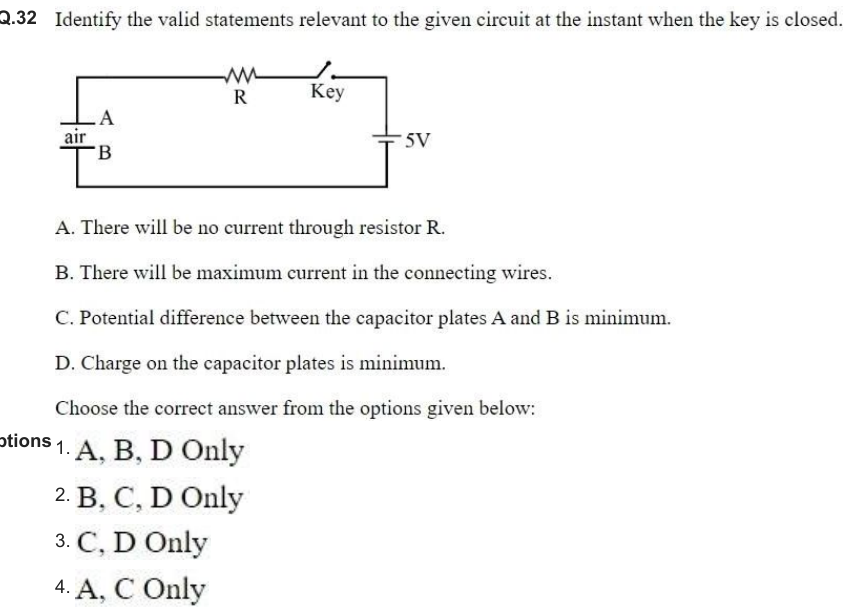
Physics · 4 marks · −1Identify the valid statements relevant to the given circuit at the instant when the key is closed. A. There will be no current through resistor R. B. There will be maximum current in the connecting wires. C. Potential difference between the capacitor plates A and B is minimum. D. Charge on the capacitor plates is minimum. Choose the correct answer from the options given below:
- A.A, B, D Only
- B.B, C, D Only
- C.C, D Only
- D.A, C Only
Correct answer: B
Explanation: At the instant of closing, the uncharged capacitor acts as a short: current is maximum, charge and p.d. are minimum (zero).
Question 33
Physics · 4 marks · −1A solid sphere of mass 'm' and radius 'r' is allowed to roll without slipping from the highest point of an inclined plane of length 'L' and makes an angle 30° with the horizontal. The speed of the particle at the bottom of the plane is . If the angle of inclination is increased to 45° while keeping L constant. Then the new speed of the sphere at the bottom of the plane is . The ratio is
- A.1 : 3
- B.
- C.
- D.1 : 2
Correct answer: B
Explanation: : .
Question 34
Physics · 4 marks · −1Given a thin convex lens (refractive index ), kept in a liquid (refractive index , ) having radii of curvatures and . Its second surface is silver polished. Where should an object be placed on the optic axis so that a real and inverted image is formed at the same place?
- A.
- B.
- C.
- D.
Correct answer: A
Question 35
Physics · 4 marks · −1The position of a particle moving on x-axis is given by , where t is time. The dimension of is
- A.
- B.L
- C.
- D.
Correct answer: D
Explanation: A, B, D have dimension L; C has : .
Question 36
Physics · 4 marks · −1A gun fires a lead bullet of temperature 300 K into a wooden block. The bullet having melting temperature of 600 K penetrates into the block and melts down. If the total heat required for the process is 625 J, then the mass of the bullet is ______ grams. (Latent heat of fusion of lead = and specific heat capacity of lead = 125 )
- A.10
- B.15
- C.5
- D.20
Correct answer: A
Explanation: kg.
Question 37
Physics · 4 marks · −1Match the LIST-I with LIST-II. LIST-I: A. Pressure varies inversely with volume of an ideal gas. B. Heat absorbed goes partly to increase internal energy and partly to do work. C. Heat is neither absorbed nor released by a system. D. No work is done on or by a gas. LIST-II: I. Adiabatic process II. Isochoric process III. Isothermal process IV. Isobaric process. Choose the correct answer from the options given below:
- A.A-I, B-IV, C-II, D-III
- B.A-I, B-III, C-II, D-IV
- C.A-III, B-IV, C-I, D-II
- D.A-III, B-I, C-IV, D-II
Correct answer: C
Question 38
Physics · 4 marks · −1The electric field of an electromagnetic wave in free space is N/C. The associated magnetic field in Tesla is
- A.
- B.
- C.
- D.
Correct answer: D
Question 39
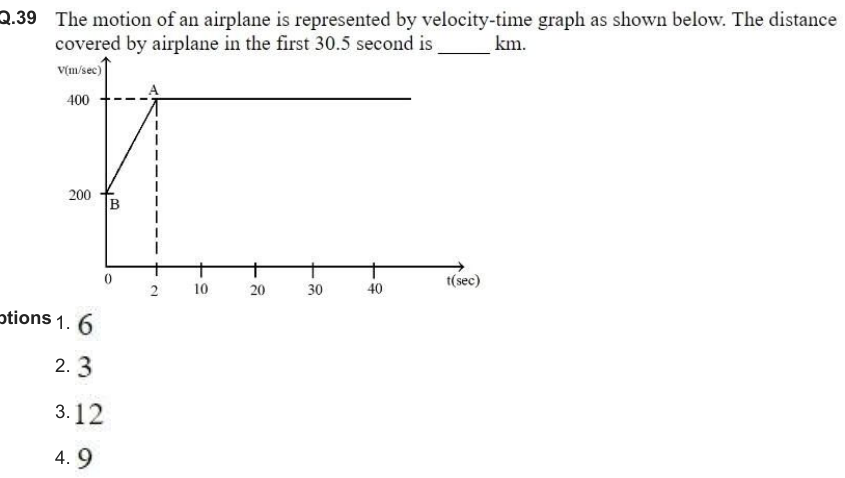
Physics · 4 marks · −1The motion of an airplane is represented by velocity-time graph as shown below. The distance covered by airplane in the first 30.5 second is ______ km.
- A.6
- B.3
- C.12
- D.9
Correct answer: C
Explanation: m.
Question 40
Physics · 4 marks · −1The electric flux is where and are linear and surface charge density, respectively. represents
- A.area
- B.displacement
- C.electric field
- D.charge
Correct answer: B
Explanation: and share dimensions, so = length.
Question 41
Physics · 4 marks · −1Regarding self-inductance: A. The self-inductance of the coil depends on its geometry. B. Self-inductance does not depend on the permeability of the medium. C. Self-induced e.m.f. opposes any change in the current in a circuit. D. Self-inductance is electromagnetic analogue of mass in mechanics. E. Work needs to be done against self-induced e.m.f. in establishing the current. Choose the correct answer from the options given below:
- A.B, C, D, E only
- B.A, C, D, E only
- C.A, B, C, D only
- D.A, B, C, E only
Correct answer: B
Question 42
Physics · 4 marks · −1A sub-atomic particle of mass kg is moving with a velocity m/s. Under the matter wave consideration, the particle will behave closely like ______. (h = J.s)
- A.Gamma rays
- B.X-rays
- C.Visible radiation
- D.Infra-red radiation
Correct answer: B
Explanation: m (X-ray range).
Question 43
Physics · 4 marks · −1A spherical surface of radius of curvature R, separates air from glass (refractive index = 1.5). The centre of curvature is in the glass medium. A point object 'O' placed in air on the optic axis of the surface, so that its real image is formed at 'I' inside glass. The line OI intersects the spherical surface at P and PO = PI. The distance PO equals to
- A.1.5 R
- B.3 R
- C.2 R
- D.5 R
Correct answer: D
Explanation: .
Question 44
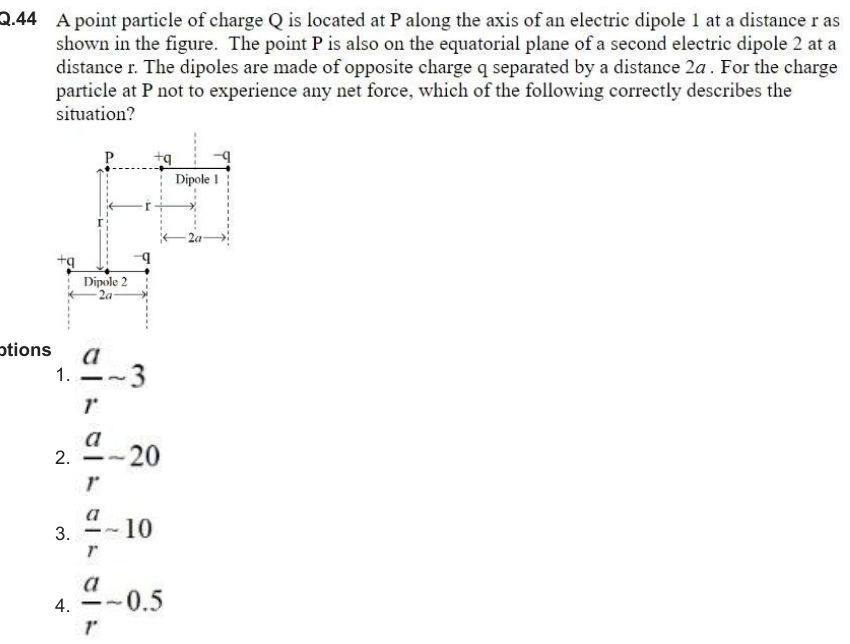
Physics · 4 marks · −1A point particle of charge Q is located at P along the axis of an electric dipole 1 at a distance r as shown in the figure. The point P is also on the equatorial plane of a second electric dipole 2 at a distance r. The dipoles are made of opposite charge q separated by a distance 2a. For the charge particle at P not to experience any net force, which of the following correctly describes the situation?
- A.
- B.
- C.
- D.
Correct answer: A
Question 45
Physics · 4 marks · −1Consider a moving coil galvanometer (MCG): A. The torsional constant in moving coil galvanometer has dimentions B. Increasing the current sensitivity may not necessarily increase the voltage sensitivity. C. If we increase number of turns (N) to its double (2N), then the voltage sensitivity doubles. D. MCG can be converted into an ammeter by introducing a shunt resistance of large value in parallel with galvanometer. E. Current sensitivity of MCG depends inversely on number of turns of coil. Choose the correct answer from the options given below:
- A.A, D Only
- B.B, D, E Only
- C.A, B, E Only
- D.A, B Only
Correct answer: D
Question 46
Physics · 4 marks · −1A force acts on a particle in a plane x + y = 10. The work done by this force during a displacement from (0, 0) to (4m, 2m) is ______ Joule (round off to the nearest integer)
Correct answer: 152
Question 47
Physics · 4 marks · −1Two particles are located at equal distance from origin. The position vectors of those are represented by and , respectively. If both the vectors are at right angle to each other, the value of is ______.
Correct answer: 3
Question 48
Physics · 4 marks · −1An ideal gas initially at 0°C temperature, is compressed suddenly to one fourth of its volume. If the ratio of specific heat at constant pressure to that at constant volume is 3/2, the change in temperature due to the thermodynamic process is ______ K.
Correct answer: 273
Explanation: K; change 273 K.
Question 49
Physics · 4 marks · −1In the given circuit the sliding contact is pulled outwards such that electric current in the circuit changes at the rate of 8 A/s. At an instant when R is 12 , the value of the current in the circuit will be ______ A.
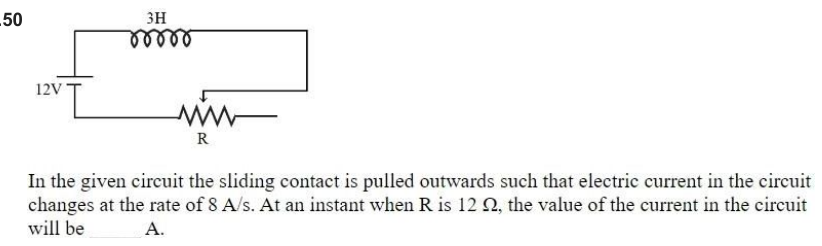
Correct answer: 3
Explanation: Pulling out increases R so current decreases: A.
Question 50
Chemistry · 4 marks · −1Given below are two statements: Statement I: In Lassaigne's test, the covalent organic molecules are transformed into ionic compounds. Statement II: The sodium fusion extract of an organic compound having N and S gives prussian blue colour with and . In the light of the above statements, choose the correct answer from the options given below
- A.Statement I is false but Statement II is true
- B.Both Statement I and Statement II are true
- C.Statement I is true but Statement II is false
- D.Both Statement I and Statement II are false
Correct answer: C
Explanation: With both N and S present, NaSCN forms and gives blood-red colour with Fe3+, not Prussian blue.
Question 51
Chemistry · 4 marks · −1. In the above diagram, the standard electrode potentials are given in volts (over the arrow). The value of is
- A.2.1 V
- B.1.2 V
- C.1.4 V
- D.1.7 V
Correct answer: D
Explanation: V.
Question 52
Chemistry · 4 marks · −1Which among the following react with Hinsberg's reagent? A. Aniline () B. N,N-Dimethylaniline () C. D. E. Diphenylamine (). Choose the correct answer from the options given below:
- A.C and D Only
- B.A, B and E Only
- C.B and D Only
- D.A, C and E Only
Correct answer: D
Explanation: Primary and secondary amines react; tertiary amines do not.
Question 53
Chemistry · 4 marks · −1The incorrect statement among the following is
- A. shows lower proton affinity than .
- B. exists but does not.
- C. can dimerise easily.
- D. can act as an oxidizing agent, but not as a reducing agent.
Correct answer: D
Question 54
Chemistry · 4 marks · −1What amount of bromine will be required to convert 2 g of phenol into 2,4,6-tribromophenol? (Given molar mass in g of C, H, O, Br are 12, 1, 16, 80 respectively)
- A.20.44 g
- B.6.0 g
- C.4.0 g
- D.10.22 g
Correct answer: D
Explanation: 2/94 mol phenol × 3 mol × 160 g = 10.21 g.
Question 55
Chemistry · 4 marks · −1The major product of the following reaction is: ?
- A.
- B.
- C.
- D.
Correct answer: B
Explanation: Two aldol additions of HCHO at the α-carbon, then crossed Cannizzaro reduces CHO to : .
Question 56
Chemistry · 4 marks · −1The complex that shows Facial - Meridional isomerism is:
- A.
- B.
- C.
- D.
Correct answer: C
Question 57
Chemistry · 4 marks · −1Match the LIST-I with LIST-II. LIST-I (Classification of molecules based on octet rule): A. Molecules obeying octet rule B. Molecules with incomplete octet C. Molecules with incomplete octet with odd electron D. Molecules with expanded octet. LIST-II (Example): I. NO, II. , III. , IV. , . Choose the correct answer from the options given below:
- A.A-IV, B-I, C-III, D-II
- B.A-IV, B-II, C-I, D-III
- C.A-III, B-II, C-I, D-IV
- D.A-II, B-IV, C-III, D-I
Correct answer: B
Question 58
Chemistry · 4 marks · −1Heat treatment of muscular pain involves radiation of wavelength of about 900 nm. Which spectral line of H atom is suitable for this? Given : Rydberg constant , h = J s, c = m/s)
- A.Balmer series,
- B.Paschen series,
- C.Paschen series,
- D.Lyman series,
Correct answer: C
Explanation: gives nm for Paschen .
Question 59
Chemistry · 4 marks · −1mol of is left after removing molecules from its 'x' mg sample. The mass of taken initially is Given:
- A.196.2 mg
- B.98.3 mg
- C.48.2 mg
- D.150.4 mg
Correct answer: A
Explanation: molecules mol; total mol × 44 = 196.2 mg.
Question 60
Chemistry · 4 marks · −1The correct set of ions (aqueous solution) with same colour from the following is:
- A., ,
- B., ,
- C., ,
- D., ,
Correct answer: B
Explanation: , and are all violet.
Question 61
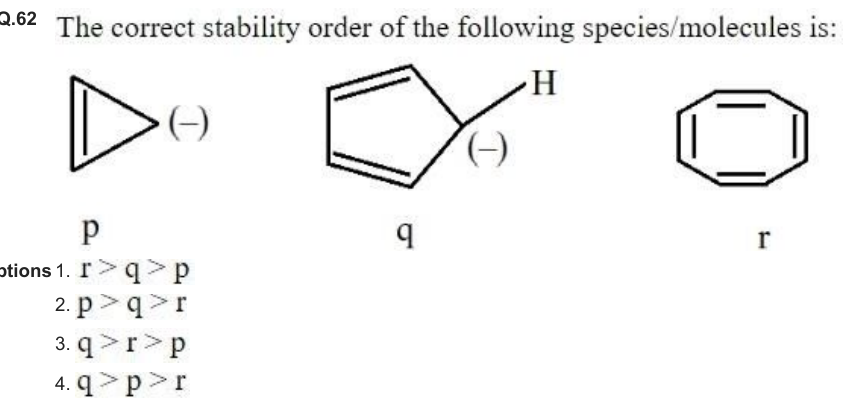
Chemistry · 4 marks · −1The correct stability order of the following species/molecules is: p = cyclopropenyl anion (three-membered ring with one C=C and a − charge); q = cyclopentadienyl anion (five-membered ring with two C=C, a − charge and an H on the charged carbon); r = cyclooctatetraene (eight-membered ring with four C=C).
- A.r > q > p
- B.p > q > r
- C.q > r > p
- D.q > p > r
Correct answer: C
Explanation: Aromatic q > non-aromatic r > antiaromatic p.
Question 62
Chemistry · 4 marks · −1Match the LIST-I with LIST-II. LIST-I (Name reaction): A. Swarts reaction B. Sandmeyer's reaction C. Wurtz Fittig reaction D. Finkelstein reaction. LIST-II (Product obtainable): I. Ethyl benzene II. Ethyl iodide III. Cyanobenzene IV. Ethyl fluoride. Choose the correct answer from the options given below:
- A.A-IV, B-I, C-III, D-II
- B.A-II, B-I, C-III, D-IV
- C.A-II, B-III, C-I, D-IV
- D.A-IV, B-III, C-I, D-II
Correct answer: D
Question 63
Chemistry · 4 marks · −1Given below are two statements: Statement I: Fructose does not contain an aldehydic group but still reduces Tollen's reagent Statement II: In the presence of base, fructose undergoes rearrangement to give glucose. In the light of the above statements, choose the correct answer from the options given below
- A.Both Statement I and Statement II are true
- B.Statement I is true but Statement II is false
- C.Both Statement I and Statement II are false
- D.Statement I is false but Statement II is true
Correct answer: A
Question 64
Chemistry · 4 marks · −1The element that does not belong to the same period of the remaining elements (modern periodic table) is:
- A.Osmium
- B.Palladium
- C.Iridium
- D.Platinum
Correct answer: B
Explanation: Pd is in period 5; Os, Ir, Pt are in period 6.
Question 65
Chemistry · 4 marks · −1Which of the following happens when is added gradually to the solution containing 1M and 1M ions? Given : and at 298 K.
- A. will precipitate before
- B. and will precipitate together
- C. will precipitate before
- D.Both and do not show precipitation with
Correct answer: C
Explanation: needed: A: ; B: → B precipitates first.
Question 66
Chemistry · 4 marks · −1The d– electronic configuration of an octahedral Co(II) complex having magnetic moment of 3.95 BM is:
- A.
- B.
- C.
- D.
Correct answer: D
Explanation: 3 unpaired electrons (3.87 BM): high-spin octahedral = .
Question 67
Chemistry · 4 marks · −1Ice at −5°C is heated to become vapor with temperature of 110°C at atmospheric pressure. The entropy change associated with this process can be obtained from
- A.
- B.
- C.
- D.
Correct answer: A
Question 68
Chemistry · 4 marks · −1Propane molecule on chlorination under photochemical condition gives two di-chloro products, "x" and "y". Amongst "x" and "y", "x" is an optically active molecule. How many tri-chloro products (consider only structural isomers) will be obtained from "x" when it is further treated with chlorine under the photochemical condition?
- A.3
- B.4
- C.2
- D.5
Correct answer: A
Explanation: x = 1,2-dichloropropane; further chlorination gives 1,1,2-, 1,2,2- and 1,2,3-trichloropropane = 3.
Question 69
Chemistry · 4 marks · −1can exist as a complex. 0.1 molal aqueous solution of this complex shows a depression in freezing point of 0.558°C. Assuming 100% ionisation of this complex and coordination number of Cr is 6, the complex will be (Given = 1.86 K kg )
- A.
- B.
- C.
- D.
Correct answer: B
Explanation: .
Question 70
Chemistry · 4 marks · −1If 1 mM solution of ethylamine produces pH = 9, then the ionization constant () of ethylamine is . The value of x is ______ (nearest integer). [The degree of ionization of ethylamine can be neglected with respect to unity.]
Correct answer: 7
Explanation: ; .
Question 71
Chemistry · 4 marks · −1The standard enthalpy and standard entropy of decomposition of to are 55.0 kJ and 175.0 J/K/mol respectively. The standard free energy change for this reaction at 25°C in J is ______ (Nearest integer)
Correct answer: 2850
Explanation: J mol.
Question 72
Chemistry · 4 marks · −1During "S" estimation, 160 mg of an organic compound gives 466 mg of barium sulphate. The percentage of Sulphur in the given compound is ______ %. (Given molar mass in g of Ba : 137, S : 32, O : 16)
Correct answer: 40
Explanation: S = 466 × 32/233 = 64 mg; 40%.
Question 73
Chemistry · 4 marks · −1Consider the following sequence of reactions to produce major product (A): 3-Nitrotoluene (m-nitrotoluene) (A) Major Product. Molar mass of product (A) is ______ g . (Given molar mass in g of C : 12, H: 1, O :16, Br : 80, N : 14, P:31)
Correct answer: 171
Explanation: Bromination, reduction of , diazotisation and deamination leave a bromotoluene = 171.
Question 74
Chemistry · 4 marks · −1For the thermal decomposition of at constant volume, the following table can be formed, for the reaction mentioned below. . Sr. No. 1: Time 0 s, Total pressure 0.6 atm; Sr. No. 2: Time 100 s, Total pressure x. x = ______ atm [nearest integer] Given : Rate constant for the reaction is .
Correct answer: 897
Explanation: atm; total atm → 897.