JEE Main 2025 — 3 Apr Shift 2 (Previous Year Paper)
JEE Main · 2025 · with answers and explanations
- questions
- 74
- Total marks
- 296
- Duration
- 180 minutes
- Negative marking
- −1
Subjects: Mathematics · Physics · Chemistry
Question 1
Mathematics · 4 marks · −1The shortest distance between the curves and is:
- A.
- B.
- C.
- D.
Correct answer: B
Explanation: Circle centre (0,−6), r = 1. Normal to parabola at through (0,−6): , point (2,−4), distance ; answer .
Question 2
Mathematics · 4 marks · −1Line of slope 2 and line of slope intersect at the origin O. In the first quadrant, are 12 points on line and are 9 points on line . Then the total number of triangles, that can be formed having vertices at three of the 22 points O, , , is:
- A.1026
- B.1080
- C.1134
- D.1188
Correct answer: C
Explanation: .
Question 3
Mathematics · 4 marks · −1The number of solutions of the equation , is
- A.5
- B.4
- C.6
- D.3
Correct answer: A
Question 4
Mathematics · 4 marks · −1If the domain of the function is , then is equal to
- A.18
- B.17
- C.16
- D.15
Correct answer: A
Explanation: : ; sum 18.
Question 5
Mathematics · 4 marks · −1If the probability that the random variable X takes the value x is given by , x = 0, 1, 2, 3, ..., where k is a constant, then is equal to
- A.
- B.
- C.
- D.
Correct answer: D
Explanation: so ; , hence .
Question 6
Mathematics · 4 marks · −1The integral is equal to
- A.
- B.
- C.
- D.
Correct answer: D
Explanation: .
Question 7
Mathematics · 4 marks · −1Consider the lines , being a parameter, all passing through a point P. One of these lines (say L) is farthest from the origin. If the distance of L from the point (3, 6) is d, then the value of is
- A.30
- B.10
- C.20
- D.15
Correct answer: C
Explanation: P = (1, 2); L ⟂ OP: ; distance of (3,6): , .
Question 8
Mathematics · 4 marks · −1Let A = {−2, −1, 0, 1, 2, 3}. Let R be a relation on A defined by xRy if and only if y = max{x, 1}. Let be the number of elements in R. Let m and n be the minimum number of elements required to be added in R to make it reflexive and symmetric relations, respectively. Then is equal to
- A.12
- B.14
- C.13
- D.11
Correct answer: A
Explanation: R = {(−2,1),(−1,1),(0,1),(1,1),(2,2),(3,3)}: l = 6; reflexive needs 3 more, symmetric needs 3: 12.
Question 9
Mathematics · 4 marks · −1Each of the angles and that a given line makes with the positive y- and z-axes, respectively, is half of the angle that this line makes with the positive x-axes. Then the sum of all possible values of the angle is
- A.
- B.
- C.
- D.
Correct answer: C
Explanation: ⇒ : or ; sum .
Question 10
Mathematics · 4 marks · −1Let be the solution of the differential equation , . Then is equal to
- A.
- B.
- C.
- D.
Correct answer: C
Explanation: : , C = ; .
Question 11
Mathematics · 4 marks · −1Let be a function defined by . If m is the number of points of local minima and n is the number of points of local maxima of f, then m + n is
- A.3
- B.4
- C.5
- D.2
Correct answer: A
Question 12
Mathematics · 4 marks · −1Let the equation have equal roots. Then the distance of the point from the line is
- A.15
- B.12
- C.
- D.
Correct answer: A
Explanation: ; ; distance of (14, 7): .
Question 13
Mathematics · 4 marks · −1If the four distinct points (4, 6), (, 5), (0, 0) and (k, 3k) lie on a circle of radius r, then is equal to
- A.33
- B.35
- C.32
- D.34
Correct answer: B
Question 14
Mathematics · 4 marks · −1Let C be the circle of minimum area enclosing the ellipse E: with eccentricity and foci (, 0). Let PQR be a variable triangle, whose vertex P is on the circle C and the side QR of length 2a is parallel to the major axis of E and contains the point of intersection of E with the negative y-axis. Then the maximum area of the triangle PQR is :
- A.
- B.
- C.
- D.
Correct answer: A
Explanation: a = 4, , C: radius 4. QR on , length 8; max height ; area .
Question 15
Mathematics · 4 marks · −1If are the vertices of an equilateral triangle, whose centroid is , then is equal to
- A.1
- B.-i
- C.0
- D.i
Correct answer: C
Explanation: ; .
Question 16
Mathematics · 4 marks · −1The area of the region is
- A.
- B.
- C.
- D.512
Correct answer: B
Question 17
Mathematics · 4 marks · −1The distance of the point (7, 10, 11) from the line along the line is
- A.12
- B.14
- C.18
- D.16
Correct answer: B
Explanation: Point on first line needs : t = −2 → (3,4,−1), which satisfies ; distance .
Question 18
Mathematics · 4 marks · −1Let f be a function such that , . Then is equal to
- A.13
- B.12
- C.10
- D.11
Correct answer: D
Explanation: , : sum = 44/4 = 11.
Question 19
Mathematics · 4 marks · −1Let the Mean and Variance of five observations , , , and , a > b, be 5 and 10 respectively. Then the Variance of the observations , n = 1, 2, ..., 5 is
- A.17.4
- B.16.4
- C.17
- D.16
Correct answer: D
Explanation: , ⇒ a = 10, b = 4. New data 2, 5, 13, 11, 9: mean 8, variance .
Question 20
Mathematics · 4 marks · −1The sum upto terms, is equal to
- A.4e
- B.3e
- C.6e
- D.2e
Correct answer: D
Explanation: .
Question 21
Mathematics · 4 marks · −1If , then is equal to ______.
Correct answer: 32
Explanation: ; answer 32.
Question 22
Mathematics · 4 marks · −1If the equation of the hyperbola with foci (4, 2) and (8, 2) is , then is equal to ______.
Correct answer: 141
Explanation: Centre (6,2), c = 2, ⇒ , : → ; 36 + 4 + 101 = 141.
Question 23
Mathematics · 4 marks · −1Let , , and be a vector such that and . Then is equal to ______.
Correct answer: 128
Explanation: ; ⇒ ; .
Question 24
Mathematics · 4 marks · −1Let . If , then k is equal to ______.
Correct answer: 239
Question 25
Physics · 4 marks · −1Given below are two statements: one is labelled as Assertion A and the other is labelled as Reason R. Assertion A : If Oxygen ion () and Hydrogen ion () enter normal to the magnetic field with equal momentum, then the path of ion has a smaller curvature than that of . Reason R : A proton with same linear momentum as an electron will form a path of smaller radius of curvature on entering a uniform magnetic field perpendicularly. In the light of the above statements, choose the correct answer from the options given below
- A.Both A and R are true and R is the correct explanation of A
- B.A is false but R is true
- C.A is true but R is false
- D.Both A and R are true but R is NOT the correct explanation of A
Correct answer: C
Explanation: : with equal momentum the doubly charged has half the radius of ; a proton and an electron with equal momentum have equal radii, so R is false.
Question 26
Physics · 4 marks · −1A particle moves along the x–axis and has its displacement x varying with time t according to the equation: where and c are constants of appropriate dimensions. Then, which of the following statements is correct?
- A.the acceleration of the particle is
- B.the acceleration of the particle is 2c
- C.the acceleration of the particle is
- D.the initial velocity of the particle is 4c
Correct answer: C
Question 27
Physics · 4 marks · −1Width of one of the two slits in a Young's double slit interference experiment is half of the other slit. The ratio of the maximum to the minimum intensity in the interference pattern is :
- A.
- B.3 : 1
- C.9 : 1
- D.
Correct answer: A
Explanation: width: amplitudes ; .
Question 28
Physics · 4 marks · −1Using a battery, a 100 pF capacitor is charged to 60 V and then the battery is removed. After that, a second uncharged capacitor is connected to the first capacitor in parallel. If the final voltage across the second capacitor is 20 V, its capacitance is: (in pF)
- A.600
- B.200
- C.100
- D.400
Correct answer: B
Explanation: pF.
Question 29
Physics · 4 marks · −1A solid steel ball of diameter 3.6 mm acquired terminal velocity m/s while falling under gravity through an oil of density 925 kg . Take density of steel as 7825 kg and g as 9.8 . The viscosity of the oil in SI unit is
- A.1.99
- B.1.68
- C.2.18
- D.2.38
Correct answer: A
Explanation: .
Question 30
Physics · 4 marks · −1A motor operating on 100 V draws a current of 1 A. If the efficiency of the motor is 91.6%, then the loss of power in units of cal/s is
- A.6.2
- B.2
- C.4
- D.8.4
Correct answer: B
Explanation: Loss = 8.4 W = 8.4/4.2 = 2 cal/s.
Question 31
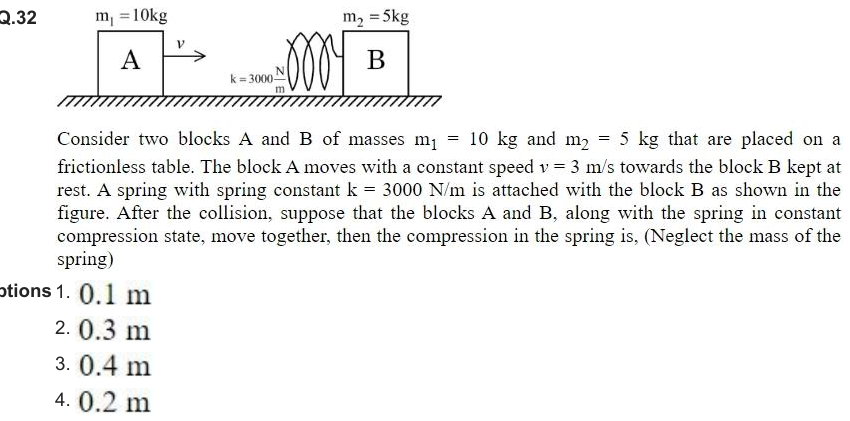
Physics · 4 marks · −1Consider two blocks A and B of masses = 10 kg and = 5 kg that are placed on a frictionless table. The block A moves with a constant speed v = 3 m/s towards the block B kept at rest. A spring with spring constant k = 3000 N/m is attached with the block B as shown in the figure. After the collision, suppose that the blocks A and B, along with the spring in constant compression state, move together, then the compression in the spring is, (Neglect the mass of the spring)
- A.0.1 m
- B.0.3 m
- C.0.4 m
- D.0.2 m
Correct answer: A
Explanation: with : , x = 0.1 m.
Question 32
Physics · 4 marks · −1A monochromatic light of frequency Hz travelling through air, is incident on a medium of refractive index '2'. Wavelength of the refracted light will be :
- A.500 nm
- B.600 nm
- C.300 nm
- D.400 nm
Correct answer: C
Explanation: nm; in medium 300 nm.
Question 33
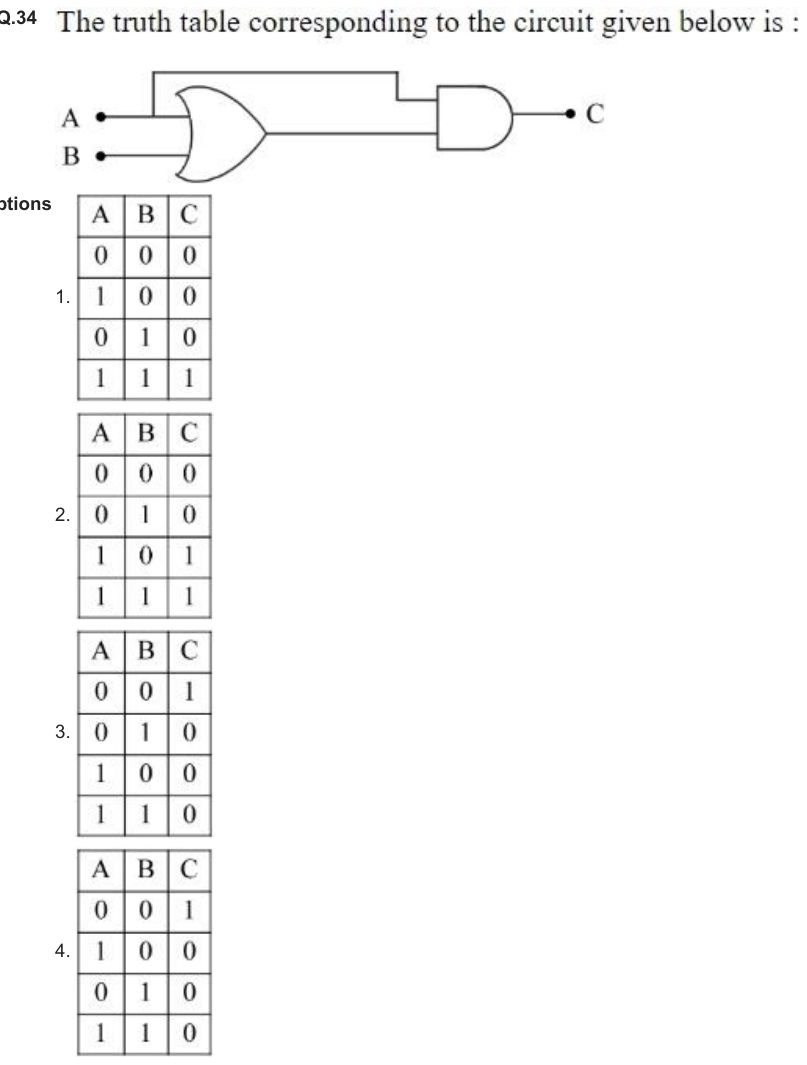
Physics · 4 marks · −1The truth table corresponding to the circuit given below is : [A and B feed an OR gate; the OR output and A feed an AND gate whose output is C]
- A.A B C: 0 0 0; 1 0 0; 0 1 0; 1 1 1
- B.A B C: 0 0 0; 0 1 0; 1 0 1; 1 1 1
- C.A B C: 0 0 1; 0 1 0; 1 0 0; 1 1 0
- D.A B C: 0 0 1; 1 0 0; 0 1 0; 1 1 0
Correct answer: B
Explanation: .
Question 34
Physics · 4 marks · −1Pressure of an ideal gas, contained in a closed vessel, is increased by 0.4% when heated by 1°C. Its initial temperature must be:
- A.2500 K
- B.250°C
- C.250 K
- D.25°C
Correct answer: C
Explanation: : K.
Question 35
Physics · 4 marks · −1Two monochromatic light beams have intensities in the ratio 1:9. An interference pattern is obtained by these beams. The ratio of the intensities of maximum to minimum is
- A.3:1
- B.9:1
- C.8:1
- D.4:1
Correct answer: D
Explanation: .
Question 36
Physics · 4 marks · −1Two cylindrical vessels of equal cross sectional area of contain water upto heights 10m and 6m, respectively. If the vessels are connected at their bottom then the work done by the force of gravity is (Density of water is kg/ and g = 10 )
- A. J
- B. J
- C. J
- D. J
Correct answer: D
Explanation: Final level 8 m; PE change J.
Question 37
Physics · 4 marks · −1A magnetic dipole experiences a torque of N m when placed in uniform magnetic field in such a way that dipole moment makes angle of 60° with magnetic field. The potential energy of the dipole is :
- A. J
- B.−80 J
- C.80 J
- D.−60 J
Correct answer: B
Explanation: ; J.
Question 38
Physics · 4 marks · −1In the resonance experiment, two air columns (closed at one end) of 100 cm and 120 cm long, give 15 beats per second when each one is sounding in the respective fundamental modes. The velocity of sound in the air column is:
- A.360 m/s
- B.370 m/s
- C.340 m/s
- D.335 m/s
Correct answer: A
Explanation: m/s.
Question 39
Physics · 4 marks · −1Given below are two statements: one is labelled as Assertion A and the other is labelled as Reason R. Assertion A : The Bohr model is applicable to hydrogen and hydrogen-like atoms only. Reason R : The formulation of Bohr model does not include repulsive force between electrons. In the light of the above statements, choose the correct answer from the options given below
- A.A is true but R is false
- B.Both A and R are true and R is the correct explanation of A
- C.Both A and R are true but R is NOT the correct explanation of A
- D.A is false but R is true
Correct answer: B
Question 40
Physics · 4 marks · −1A particle is projected with velocity u so that its horizontal range is three times the maximum height attained by it. The horizontal range of the projectile is given as , where value of n is: (Given, \'g\' is the acceleration due to gravity.)
- A.18
- B.6
- C.24
- D.12
Correct answer: C
Explanation: ; .
Question 41
Physics · 4 marks · −1An electric bulb rated as 100W-220V is connected to an ac source of rms voltage 220V. The peak value of current through the bulb is :
- A.0.45 A
- B.0.64 A
- C.0.32 A
- D.2.2 A
Correct answer: B
Explanation: , peak A.
Question 42
Physics · 4 marks · −1Match the LIST-I with LIST-II. LIST-I: A. Boltzmann constant B. Coefficient of viscosity C. Planck's constant D. Thermal conductivity. LIST-II: I. II. III. IV. . Choose the correct answer from the options given below:
- A.A - III, B - II, C - I, D - IV
- B.A - II, B - III, C - IV, D - I
- C.A - III, B - IV, C - II, D - I
- D.A - III, B - IV, C - I, D - II
Correct answer: D
Question 43
Physics · 4 marks · −1An ideal gas exists in a state with pressure , volume . It is isothermally expanded to 4 times of its initial volume (), then isobarically compressed to its original volume. Finally the system is heated isochorically to bring it to its initial state. The amount of heat exchanged in this process is
- A.
- B.
- C.
- D.
Correct answer: C
Explanation: Net Q = net W .
Question 44
Physics · 4 marks · −1A block of mass 1 kg, moving along x with speed = 10 m/s enters a rough region ranging from x = 0.1 m to x = 1.9 m. The retarding force acting on the block in this range is N, with k = 10 N/m. Then the final speed of the block as it crosses rough region is.
- A.4 m/s
- B.6 m/s
- C.10 m/s
- D.8 m/s
Correct answer: D
Explanation: J; , v = 8 m/s.
Question 45
Physics · 4 marks · −1An electron in the hydrogen atom initially in the fourth excited state makes a transition to energy state by emitting a photon of energy 2.86 eV. The integer value of n will be ______.
Correct answer: 2
Explanation: eV; eV ⇒ n = 2.
Question 46
Physics · 4 marks · −1Two cells of emfs 1 V and 2 V and internal resistances 2 and 1 , respectively, are connected in series with an external resistance of 6 . The total current in the circuit is . Now the same two cells in parallel configuration are connected to same external resistance. In this case, the total current drawn is . The value of is . The value of x is ______.
Correct answer: 4
Explanation: ; parallel: , , ; ratio , x = 4.
Question 47
Physics · 4 marks · −1Light from a point source in air falls on a spherical glass surface (refractive index, = 1.5 and radius of curvature = 50 cm). The image is formed at a distance of 200 cm from the glass surface inside the glass. The magnitude of distance of the light source from the glass surface is ______ m.
Correct answer: 4
Explanation: cm = 4 m.
Question 48
Physics · 4 marks · −1The excess pressure inside a soap bubble A in air is half the excess pressure inside another soap bubble B in air. If the volume of the bubble A is n times the volume of the bubble B, then, the value of n is ______.
Correct answer: 8
Explanation: , volume ratio 8.
Question 49
Physics · 4 marks · −1A physical quantity C is related to four other quantities p, q, r and s as follows . The percentage errors in the measurement of p, q, r and s are 1%, 2%, 3% and 2%, respectively. The percentage error in the measurement of C will be ______ %.
Correct answer: 15
Explanation: 1 + 4 + 9 + 1 = 15%.
Question 50
Chemistry · 4 marks · −1The correct orders among the following are A. Atomic radius : B < Al < Ga < In < Tl B. Electronegativity : Al < Ga < In < Tl < B C. Density : Tl < In < Ga < Al < B D. 1st Ionisation Energy : In < Al < Ga < Tl < B. Choose the correct answer from the options given below:
- A.A and C Only
- B.C and D Only
- C.B and D Only
- D.A and B Only
Correct answer: C
Question 51
Chemistry · 4 marks · −1The major product (P) in the following reaction is : P (Major Product)
- A.
- B.
- C.
- D.
Correct answer: A
Explanation: Intramolecular Cannizzaro of phenylglyoxal gives the mandelate salt.
Question 52
Chemistry · 4 marks · −1Identify the diamagnetic octahedral complex ions from below ; A. B. C. D. . Choose the correct answer from the options given below:
- A.A and D Only
- B.B and D Only
- C.B and C Only
- D.A and C Only
Correct answer: C
Question 53
Chemistry · 4 marks · −1In Dumas' method for estimation of nitrogen 0.4 g of an organic compound gave 60 mL of nitrogen collected at 300 K temperature and 715 mm Hg pressure. The percentage composition of nitrogen in the compound is (Given : Aqueous tension at 300 K = 15 mm Hg)
- A.15.71 %
- B.7.85 %
- C.20.95 %
- D.17.46 %
Correct answer: A
Explanation: mass 0.0628 g → 15.71%.
Question 54
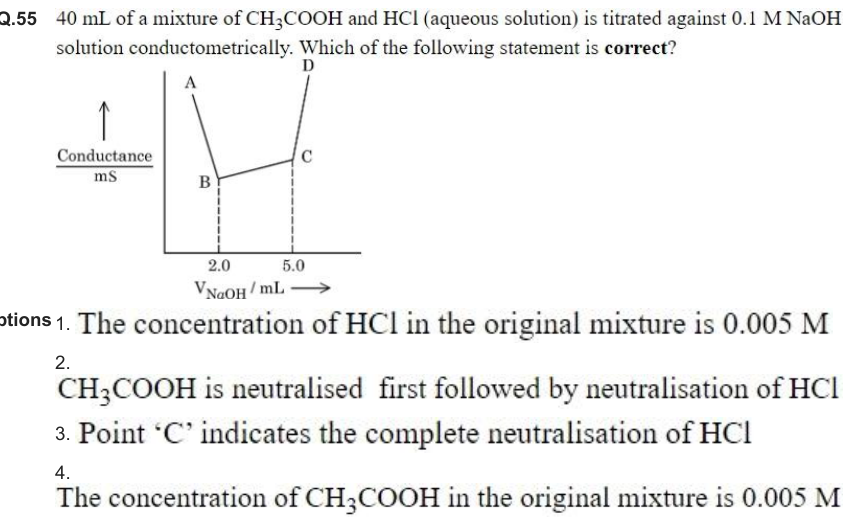
Chemistry · 4 marks · −140 mL of a mixture of and HCl (aqueous solution) is titrated against 0.1 M NaOH solution conductometrically. Which of the following statement is correct?
- A.The concentration of HCl in the original mixture is 0.005 M
- B. is neutralised first followed by neutralisation of HCl
- C.Point 'C' indicates the complete neutralisation of HCl
- D.The concentration of in the original mixture is 0.005 M
Correct answer: A
Explanation: HCl neutralised at B (2 mL): M; acetic acid needs 3 mL more: 0.0075 M.
Question 55
Chemistry · 4 marks · −1The standard cell potential () of a fuel cell based on the oxidation of methanol in air that has been used to power television relay station is measured as 1.21 V. The standard half cell reduction potential for () is 1.229 V. Choose the correct statement:
- A.Reactants are fed at one go to each electrode.
- B.Oxygen is formed at the anode.
- C.Reduction of methanol takes place at the cathode.
- D.The standard half cell reduction potential for the reduction of () is 19 mV
Correct answer: D
Explanation: V.
Question 56
Chemistry · 4 marks · −1Given below are two statements: Statement I : is a stronger oxidizing agent than Statement II : Cr(VI) is more stable than Mo(VI). In the light of the above statements, choose the correct answer from the options given below
- A.Both Statement I and Statement II are true
- B.Statement I is false but Statement II is true
- C.Statement I is true but Statement II is false
- D.Both Statement I and Statement II are false
Correct answer: C
Question 57
Chemistry · 4 marks · −1Consider the following statements related to temperature dependence of rate constants. Identify the correct statements. A. The Arrhenius equation holds true only for an elementary homogenous reaction. B. The unit of A is same as that of k in Arrhenius equation. C. At a given temperature, a low activation energy means a fast reaction. D. A and Ea as used in Arrhenius equation depend on temperature. E. When Ea >> RT, A and Ea become interdependent. Choose the correct answer from the options given below:
- A.A and B Only
- B.B, D and E Only
- C.A, C and D Only
- D.B and C Only
Correct answer: D
Question 58
Chemistry · 4 marks · −1Mass of magnesium required to produce 220 mL of hydrogen gas at STP on reaction with excess of dil. HCl is Given: Molar mass of Mg is 24 g .
- A.236 mg
- B.235.7 g
- C.2.444 g
- D.0.24 mg
Correct answer: A
Explanation: g ≈ 236 mg.
Question 59
Chemistry · 4 marks · −1Match the LIST-I with LIST-II. LIST-I (Family): A. Pnictogen (group 15) B. Chalcogen C. Halogen D. Noble gas. LIST-II (Symbol of Element): I. Ts II. Og III. Lv IV. Mc. Choose the correct answer from the options given below:
- A.A-II, B-III, C-IV, D-I
- B.A-III, B-I, C-IV, D-II
- C.A-IV, B-I, C-II, D-III
- D.A-IV, B-III, C-I, D-II
Correct answer: D
Question 60
Chemistry · 4 marks · −1For electrons in '2s' and '2p' orbitals, the orbital angular momentum values, respectively are :
- A. and
- B.0 and
- C.0 and
- D. and 0
Correct answer: C
Explanation: : 0 and .
Question 61
Chemistry · 4 marks · −1Compounds that should not be used as primary standards in titrimetric analysis are : A. B. Oxalic acid C. NaOH D. E. Sodium tetraborate. Choose the most appropriate answer from the options given below:
- A.D and E Only
- B.C, D and E Only
- C.B and D Only
- D.A, C and D Only
Correct answer: D
Explanation: is hygroscopic (K salt is used), NaOH absorbs moisture/CO, is oxidised by air.
Question 62
Chemistry · 4 marks · −110 mL of 2 M NaOH solution is added to 20 mL of 1 M HCl solution kept in a beaker. Now, 10 mL of this mixture is poured into a volumetric flask of 100 mL containing 2 moles of HCl and made the volume upto the mark with distilled water. The solution in this flask is :
- A.Neutral solution
- B.20 M HCl solution
- C.0.2 M NaCl solution
- D.10 M HCl solution
Correct answer: B
Explanation: The first mixture is neutral; the flask holds 2 mol HCl in 0.1 L = 20 M.
Question 63
Chemistry · 4 marks · −1Fat soluble vitamins are: A. Vitamin B. Vitamin C C. Vitamin E D. Vitamin E. Vitamin K. Choose the correct answer from the options given below:
- A.C & E Only
- B.B & C Only
- C.A & B Only
- D.C & D Only
Correct answer: A
Question 64
Chemistry · 4 marks · −1What is the correct IUPAC name of the compound: benzoic acid with OH at C-2, Br at C-3 and at C-5 (drawn with top-right, top-left, OH right, Br bottom)?
- A.3-Bromo-4-hydroxy-1-nitrobenzoic acid
- B.3-Bromo-2-hydroxy-5-nitrobenzoic acid
- C.2-Hydroxy-3-bromo-5-nitrobenzoic acid
- D.5-Nitro-3-bromo-2-hydroxybenzoic acid
Correct answer: B
Question 65
Chemistry · 4 marks · −1The sequence from the following that would result in giving predominantly 3, 4, 5-Tribromoaniline is :
- A.Nitrobenzene: (i) , acetic acid; (ii) Sn, HCl
- B.Aniline: , water
- C.Benzene: (i) , ; (ii)
- D.4-Nitroaniline: (i) (excess), acetic acid; (ii) , HCl, CuBr; (iii) Sn, HCl
Correct answer: D
Explanation: 4-Nitroaniline brominates at both positions ortho to ; Sandmeyer replaces by Br (giving 3,4,5-tribromonitrobenzene); reduction gives 3,4,5-tribromoaniline.
Question 66
Chemistry · 4 marks · −1Given below are two statements: Statement I : When a system containing ice in equilibrium with water (liquid) is heated, heat is absorbed by the system and there is no change in the temperature of the system until whole ice gets melted. Statement II : At melting point of ice, there is absorption of heat in order to overcome intermolecular forces of attraction within the molecules of water in ice and kinetic energy of molecules is not increased at melting point. In the light of the above statements, choose the correct answer from the options given below
- A.Both Statement I and Statement II are false
- B.Statement I is true but Statement II is false
- C.Statement I is false but Statement II is true
- D.Both Statement I and Statement II are true
Correct answer: D
Question 67
Chemistry · 4 marks · −1Given below are two statements: Statement I : Hyperconjugation is not a permanent effect. Statement II : In general, greater the number of alkyl groups attached to a positively charged C-atom, greater is the hyperconjugation interaction and stabilization of the cation. In the light of the above statements, choose the correct answer from the options given below
- A.Statement I is true but Statement II is false
- B.Both Statement I and Statement II are false
- C.Statement I is false but Statement II is true
- D.Both Statement I and Statement II are true
Correct answer: C
Question 68
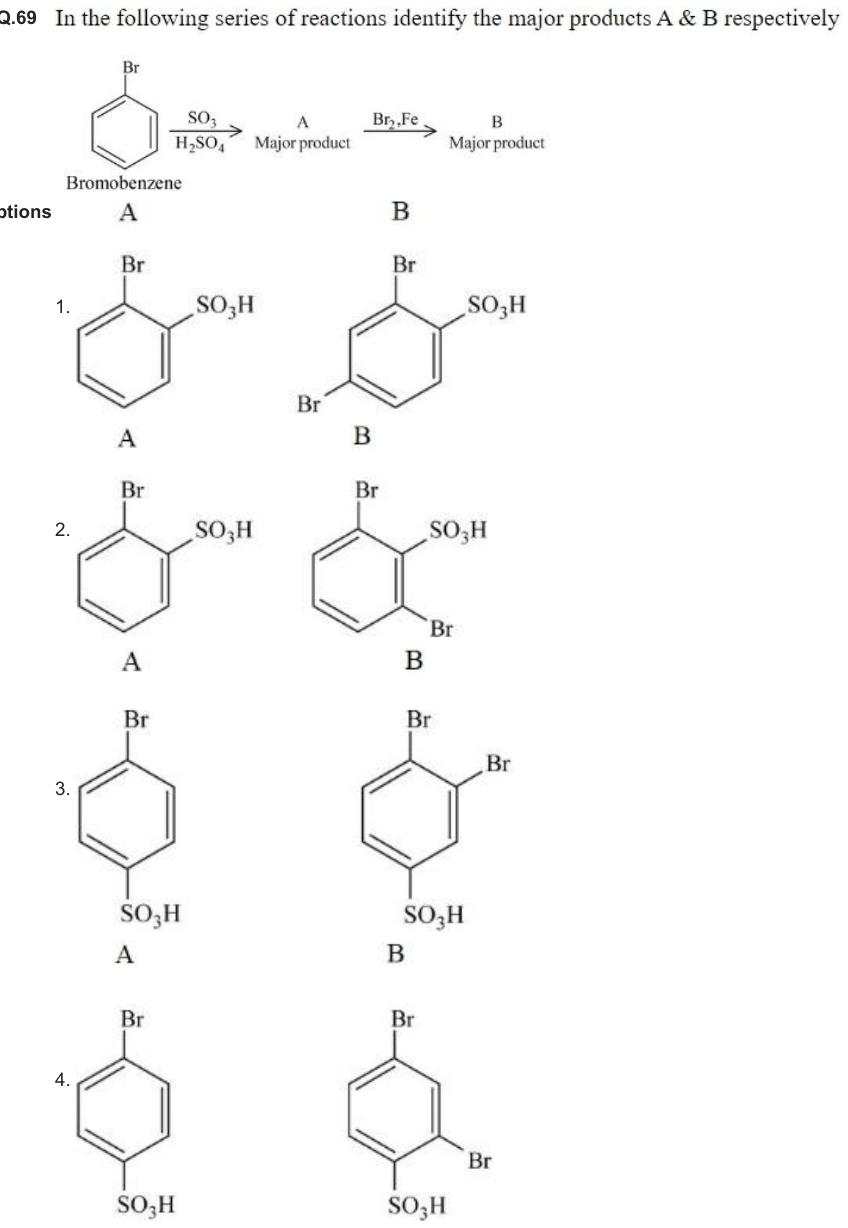
Chemistry · 4 marks · −1In the following series of reactions identify the major products A & B respectively: Bromobenzene A (Major product) B (Major product)
- A.A = 2-bromobenzenesulfonic acid; B = 2,5-dibromobenzenesulfonic acid
- B.A = 2-bromobenzenesulfonic acid; B = 2,6-dibromobenzenesulfonic acid
- C.A = 4-bromobenzenesulfonic acid; B = 3,4-dibromobenzenesulfonic acid (Br ortho to the first Br)
- D.A = 4-bromobenzenesulfonic acid; B = 2,4-dibromobenzenesulfonic acid (Br ortho to SO3H)
Correct answer: C
Explanation: Br is o/p-directing: sulfonation para. In B, Br directs ortho to itself and directs meta to itself — both point to C-3 (relative to at C-1): 3,4-dibromobenzenesulfonic acid.
Question 69
Chemistry · 4 marks · −1Given below are two statements: Statement I : Wet cotton clothes made of cellulose based carbohydrate takes comparatively longer time to get dried than wet nylon polymer based clothes. Statement II : Intermolecular hydrogen bonding with water molecule is more in nylon-based clothes than in the case of cotton clothes. In the light of above statements, choose the correct answer from the options given below
- A.Both Statement I and Statement II are false
- B.Statement I is false but Statement II is true
- C.Statement I is true but Statement II is false
- D.Both Statement I and Statement II are true
Correct answer: C
Question 70
Chemistry · 4 marks · −1A sample of n−octane (1.14 g) was completely burnt in excess of oxygen in a bomb calorimeter, whose heat capacity is 5 kJ . As a result of combustion reaction, the temperature of the calorimeter is increased by 5 K. The magnitude of the heat of combustion of octane at constant volume is ______ kJ (nearest integer).
Correct answer: 2500
Explanation: 25 kJ for 0.01 mol → 2500 kJ/mol.
Question 71
Chemistry · 4 marks · −1X g of nitrobenzene on nitration gave 4.2 g of m−dinitrobenzene. X = ______ g. (nearest integer) [Given : molar mass (in g ) C : 12, H : 1, O : 16, N : 14]
Correct answer: 3
Explanation: 4.2/168 = 0.025 mol × 123 = 3.075 ≈ 3 g.
Question 72
Chemistry · 4 marks · −1A perfect gas (0.1 mol) having = 1.50R (independent of temperature) undergoes the above transformation from point 1 to point 4. If each step is reversible, the total work done (w) while going from point 1 to point 4 is (−) ______ J (nearest integer) [Given: R = 0.082 L atm ]
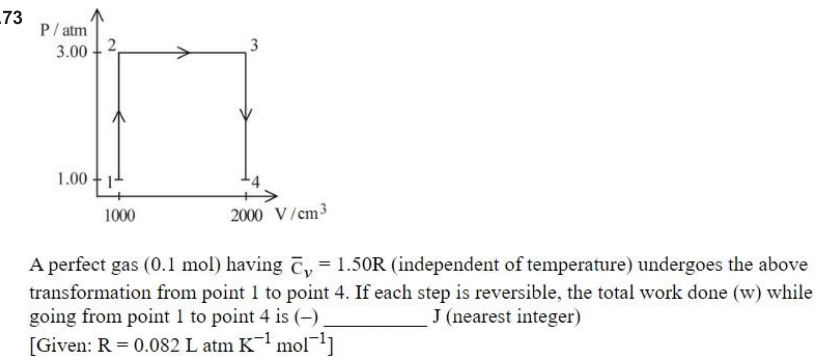
Correct answer: 304
Explanation: Only 2→3 does work: L atm J.
Question 73
Chemistry · 4 marks · −1The total number of structural isomers possible for the substituted benzene derivatives with the molecular formula is ______.
Correct answer: 8
Explanation: Propyl, isopropyl, 3 ethyltoluenes, 3 trimethylbenzenes = 8.
Question 74
Chemistry · 4 marks · −1Among, Sc, Mn, Co and Cu, identify the element with highest enthalpy of atomisation. The spin only magnetic moment value of that element in its +2 oxidation state is ______ BM (in nearest integer).
Correct answer: 4
Explanation: Co (425 kJ/mol) is highest among these; : ≈ 4.